Disclosure: airfryerkitchensupply.com is reader-supported. When you buy through links on our site, we may earn an affiliate commission at no extra cost to you.
Where to buy
Every tiny mixer on this page is a compact hand mixer sold through Amazon, so start with the where-to-buy links below, compare the beater style and speed range that fit the batches you actually make, and check price on Amazon before ordering — compact mixers change configuration (with or without a storage case, with or without a whisk) between listings that otherwise look identical.
KitchenAid 5 Ultra Power Speed Hand Mixer KHM512, Contour Silver (Best Overall): Check the current price on Amazon.
Hamilton Beach 6-Speed Electric Hand Mixer 62682G, White (Best Budget): Check the current price on Amazon.
Cuisinart Power Advantage 5-Speed Hand Mixer HM-50, White (Best for Simple, No-Fuss Mixing): Check the current price on Amazon.
Cuisinart Power Advantage Plus 9-Speed Hand Mixer HM-90S (Best for Bakers Who Mix Often): Check the current price on Amazon.
Hamilton Beach 6-Speed Electric Hand Mixer 62636J with Easy Clean Beaters (Best for Easy Cleanup): Check the current price on Amazon.
Breville BHM800SIL Handy Mixer, Silver (Best Premium Tiny Mixer): Check the current price on Amazon.
Best Tiny Mixers for Small Batches and Small Kitchens
If you are shopping for the best tiny mixers, you have probably already ruled out a stand mixer: the counter space is not there, the batches are one bowl of whipped cream, a single cake batter or a small tray of cookies, and dragging out a full-size machine for that is exactly the friction that makes people stop baking. A tiny mixer — in practice, a compact hand mixer that stores in a drawer — solves the storage problem completely, but it creates a subtler one: small motors stall, small beaters splash, and a mixer that feels fine for frosting can bog down audibly in a thick cookie dough.
This guide treats ‘tiny’ as a real constraint rather than a marketing word. Every pick below stores in a standard kitchen drawer or a small cabinet, weighs little enough to hold one-handed over a bowl for several minutes without forearm fatigue, and is honest about its ceiling: none of these replaces a stand mixer for bread dough or double batches, and the reviews say so plainly where it matters. What they do well is the 90 percent of home mixing that is genuinely small — eggs, cream, batters, frostings, mashed potatoes for two, and the occasional single batch of cookies handled with a little patience.
In this guide
Quick Picks
KitchenAid 5 Ultra Power Speed Hand Mixer KHM512, Contour Silver — Best Overall. The default tiny mixer recommendation: five well-spaced speeds, a lockable swivel cord that stays out of the bowl, and Turbo Beaters that pull batter through instead of pushing it around.
Hamilton Beach 6-Speed Electric Hand Mixer 62682G, White — Best Budget. The value pick: six speeds plus a QuickBurst button for a short blast of extra power, traditional beaters, and a bowl-rest notch that lets it perch on the bowl rim between additions.
Cuisinart Power Advantage 5-Speed Hand Mixer HM-50, White — Best for Simple, No-Fuss Mixing. A straightforward five-speed mixer with extra-long beaters that reach the bottom of deeper bowls, an easy-clean body with no awkward seams, and controls a first-time baker cannot get wrong.
Cuisinart Power Advantage Plus 9-Speed Hand Mixer HM-90S — Best for Bakers Who Mix Often. Nine speeds with SmoothStart — the mixer ramps up gently instead of jumping — plus a snap-on storage case, a whisk and a spatula in the box; the frequent baker’s tiny mixer.
Hamilton Beach 6-Speed Electric Hand Mixer 62636J with Easy Clean Beaters — Best for Easy Cleanup. Easy Clean beaters with a smooth coating that batter slides off, plus dough hooks and a whisk in a snap-on case — the most complete attachment set among the budget tiny mixers.
Breville BHM800SIL Handy Mixer, Silver — Best Premium Tiny Mixer. Nine speeds plus boost, rubber-tipped scraper beaters that work quietly against the bowl and a mixing light — the premium tiny mixer for people who notice details.
How These Picks Were Chosen
Picks were chosen around three tests that matter at this size. First, low-speed control: a tiny mixer whose lowest speed still launches flour out of the bowl is useless for its main job, so models with a genuinely gentle first speed or a soft-start behaviour ranked highest. Second, sustained torque in a thick batter — not the wattage printed on the box, but whether the motor note stays steady instead of climbing and straining halfway through a cookie dough. Third, storage reality: cord behaviour, whether beaters store with the body, and whether the whole thing fits the drawer you measured, not the drawer you wish you had.
Prices and any fixed performance numbers from listings were deliberately left out, because both change — use the check-price links for the current figure and judge the machines on the design differences described here, which do not change.
The 6 Best Tiny Mixers

KitchenAid 5 Ultra Power Speed Hand Mixer KHM512, Contour Silver — Best Overall
The KHM512 earns the top spot because it gets the two things tiny-mixer buyers actually feel — low-speed manners and cord behaviour — right at the same time. The first speed is slow enough to fold flour into a batter without a white cloud over the counter, which sounds trivial until you have used a budget mixer whose ‘low’ is a medium on any sane scale. The lockable swivel cord clicks to the left or right, so the cord drapes away from the bowl whichever hand you mix with; left-handed bakers, who are an afterthought on most hand mixers, will notice this in the first minute.
The Turbo Beater design — no centre post, open shape — moves through soft batters and whipped cream efficiently and rinses clean under a tap without batter cementing into a centre shaft. What it does not do is heavy dough: KitchenAid rates this class of machine for cookie dough in sensible quantities, and a stiff, low-hydration dough will slow it noticeably. Treat it as a batter, cream and frosting specialist that can handle a standard cookie batch, keep the bowl size honest, and it will cover nearly everything a small kitchen asks of it. The eject button is thumb-reachable and the beaters release without a wrestling match, which matters when your hands are buttery.
Strengths
- Genuinely gentle first speed for flour and cocoa
- Lockable swivel cord suits either hand and stays clear of the bowl
- Turbo Beaters rinse clean with no centre post to trap batter
Trade-offs
- No storage case in this configuration
- Not built for bread dough or double batches
- Five speeds is plenty, but whisk work uses the beaters rather than a dedicated whisk
| Detail | What to know |
|---|---|
| Type | Compact corded hand mixer |
| Speeds | 5 (Ultra Power range) |
| Attachment | Turbo Beater II pair |
Best for: Most small kitchens wanting one dependable drawer mixer / Not suited for: Bread bakers or anyone mixing double batches weekly
Check on Amazon — check price on Amazon.

Hamilton Beach 6-Speed Electric Hand Mixer 62682G, White — Best Budget
The 62682G is the mixer to buy when the budget is the first filter and the jobs are ordinary. Its party trick is the bowl rest — a shaped notch on the underside that hooks over the edge of the mixing bowl so the mixer sits upright on the rim instead of lying in a puddle of batter on the counter. It is a small, unglamorous feature that you will use every single session, and it is the main reason this model keeps being recommended years after launch.
The QuickBurst button gives a momentary surge above the selected speed, useful for the last thick fold of a cookie dough or breaking up a lump of cream cheese at the start. Six speeds cover the useful range, though the jump between the lowest speed and the second is more noticeable than on the KitchenAid picks, so start dry ingredients at speed one and accept a slower fold-in. The snap-on storage case on some listings keeps beaters with the body; confirm which configuration the listing shows before ordering, because this model is sold both ways. For mashed potatoes, boxed mixes, whipped cream and weeknight batters, it is honestly all the mixer most households need.
Strengths
- Bowl-rest notch parks the mixer on the rim, drips go back in the bowl
- QuickBurst adds a short power surge on demand
- Traditional beaters are sturdy and widely replaceable
Trade-offs
- Lowest-to-second speed step is abrupt for dry flour
- Motor strains audibly in stiff dough
- Case included only on some listings — check the configuration
| Detail | What to know |
|---|---|
| Type | Compact corded hand mixer |
| Speeds | 6 + QuickBurst |
| Extras | Bowl rest feature |
Best for: Budget-first buyers doing everyday batters and mashing / Not suited for: Anyone who wants the gentlest possible low speed
Check on Amazon — check price on Amazon.
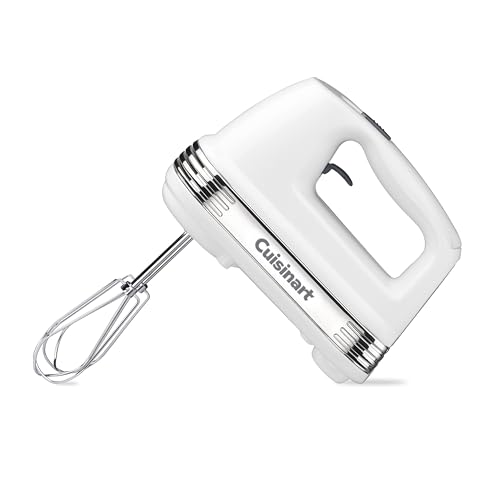
Cuisinart Power Advantage 5-Speed Hand Mixer HM-50, White — Best for Simple, No-Fuss Mixing
The HM-50 is the pick for someone who wants a tiny mixer to be an appliance, not a hobby. Five speeds, one lever, an eject button — the whole interface is learnable in ten seconds, and the smooth body wipes clean without the crevices that collect dried batter on more sculpted designs. The beaters are extra-long, which sounds like a spec-sheet filler until you mix a batter in a deep saucepan or a tall stockpot for soup-season mashed potatoes and realise standard beaters leave an unmixed layer at the bottom.
Power delivery is tuned for the middle of the road: batters, frostings, whipped cream and eggs are all squarely in its comfort zone, and it will work through a normal cookie dough if you add flour in two additions rather than dumping it at once. The swivel cord moves for left or right use. It lacks the very gentle first speed of the KitchenAid KHM512 and the storage polish of the HM-90S below, which is exactly the trade you make at this tier — what you get instead is a mixer that has been in production for years, with replacement beaters easy to find and nothing about it that needs explaining to a houseguest or a teenager baking for the first time.
Strengths
- Extra-long beaters reach deep bowls and pans
- One-lever controls anyone can use immediately
- Smooth, seam-light body wipes clean fast
Trade-offs
- First speed is not the gentlest here for flour
- No whisk attachment in the box
- No storage case included
| Detail | What to know |
|---|---|
| Type | Compact corded hand mixer |
| Speeds | 5 |
| Beaters | Extra-long, easy-clean |
Best for: Beginners and anyone wanting the simplest possible mixer / Not suited for: Precision bakers who fold delicate dry ingredients daily
Check on Amazon — check price on Amazon.

Cuisinart Power Advantage Plus 9-Speed Hand Mixer HM-90S — Best for Bakers Who Mix Often
If you mix several times a week, the HM-90S fixes the two annoyances that accumulate: splatter and storage. SmoothStart brings the beaters up to speed gradually at the start of each use, so the first second in a bowl of flour or icing sugar is a stir, not an eruption — combined with nine closely spaced speeds, it gives this mixer the finest low-end control in the roundup alongside the Breville. The LED speed readout is clear, and the controls stay usable with floury fingers.
The snap-on case is the other half of the appeal: beaters, whisk and the included spatula store attached to the body, so the whole kit goes into the drawer as one object and comes out as one object. The whisk makes this the better choice for egg whites and cream than beater-only models, and the motor has enough reserve for regular cookie and brownie batches. It is the largest and heaviest of the true ‘tiny’ picks here — still drawer-sized, but if your drawer is shallow, measure: this is the pick where the case adds height. For a small kitchen that bakes often, that is space well spent.
Strengths
- SmoothStart anti-splatter ramp-up protects flour and icing sugar
- Nine speeds give fine low-end control
- Snap-on case stores beaters, whisk and spatula with the body
Trade-offs
- Bulkiest pick here once the case is attached
- Heavier in hand on long whipping jobs
- More mixer than a once-a-month baker needs
| Detail | What to know |
|---|---|
| Type | Compact corded hand mixer |
| Speeds | 9 with SmoothStart |
| In the box | Beaters, whisk, spatula, storage case |
Best for: Frequent bakers in small kitchens / Not suited for: The shallowest drawers — measure first
Check on Amazon — check price on Amazon.
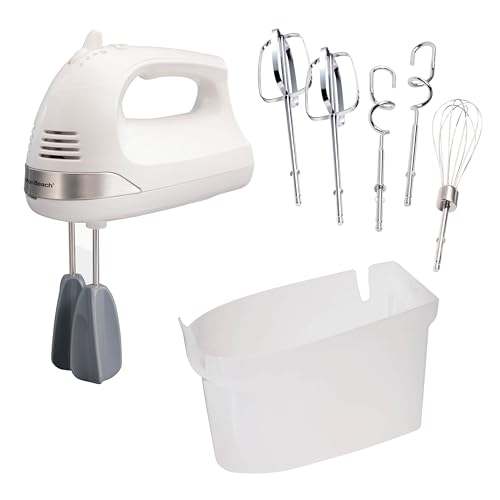
Hamilton Beach 6-Speed Electric Hand Mixer 62636J with Easy Clean Beaters — Best for Easy Cleanup
The 62636J starts from the same sensible six-speed platform as the 62682G and spends its extra money where cleanup-hating cooks feel it: the Easy Clean beaters. Their smooth, coated surface releases sticky batters — think brownie mix, banana bread, cream-cheese frosting — under a quick rinse instead of needing a soak and a bottle brush worked around welded wires. Anyone who has chipped dried batter out of traditional beaters at the sink will understand why this is a headline feature rather than a footnote.
It is also the most versatile budget pick: dough hooks for small, soft doughs and a whisk for eggs and cream join the beaters in a snap-on storage case, so one drawer slot covers mixing jobs that would otherwise need three tools. The QuickBurst-style burst of extra power helps through the thick end of a batch. Keep expectations calibrated — the dough hooks are for pizza dough for one or a soft enriched dough in small quantity, not a kilo of bread flour — and this is the tiny mixer that does the most different jobs per inch of drawer. The motor note under load is workmanlike rather than refined, which at this tier is an acceptable trade.
Strengths
- Easy Clean beaters genuinely rinse faster after sticky batters
- Beaters, dough hooks and whisk all included with case
- Six speeds plus burst cover most small-kitchen jobs
Trade-offs
- Dough hooks suit small soft doughs only
- Motor sounds strained before it actually slows
- Case adds drawer height like the Cuisinart Plus
| Detail | What to know |
|---|---|
| Type | Compact corded hand mixer |
| Speeds | 6 + burst |
| In the box | Easy Clean beaters, dough hooks, whisk, case |
Best for: Cooks who hate washing beaters and want one tool for many jobs / Not suited for: Serious bread dough in any quantity
Check on Amazon — check price on Amazon.

Breville BHM800SIL Handy Mixer, Silver — Best Premium Tiny Mixer
The Breville Handy Mixer is what happens when a company treats a hand mixer as a precision instrument. The scraper beaters carry a flexible rubber edge that sweeps the bowl wall as it mixes, which does two things: it pulls in the ring of unmixed batter that normally needs a spatula stop halfway through, and it makes the mixer noticeably quieter, because metal is no longer clattering against the bowl. In a small apartment kitchen, early in the morning, that quiet is a real feature.
Nine speeds plus a boost button, a count-up timer on the body and a small mixing light aimed into the bowl round out a feature set no other pick here matches. The timer is more useful than it sounds — recipes that say ‘beat for three minutes’ stop being guesswork. The honest costs are size and price tier: it is the premium option in this roundup, it is a touch heavier than the KitchenAid 5-speed, and its storage footprint is at the upper edge of ‘tiny’. Buy it if you bake often, value the quiet and the bowl-scraping, and have the drawer depth; occasional bakers will be just as happy with the KHM512 and money left over for ingredients.
Strengths
- Scraper beaters sweep the bowl and run quietly
- Count-up timer and bowl light are genuinely useful
- Nine speeds plus boost give the widest control range here
Trade-offs
- Premium tier — the most expensive approach to tiny mixing
- Slightly heavier than the lightest picks
- Rubber beater edges are a wear item over years of use
| Detail | What to know |
|---|---|
| Type | Compact corded hand mixer |
| Speeds | 9 + boost |
| Extras | Scraper beaters, timer, mixing light |
Best for: Frequent bakers who value quiet and precision / Not suited for: Strict budgets or the very smallest drawers
Check on Amazon — check price on Amazon.
Comparison Table
| Pick | Badge | Key spec | Best for |
|---|---|---|---|
| KitchenAid 5 Ultra Power Speed Hand Mixer KHM512, Contour Silver | Best Overall | 5 speeds, swivel cord, Turbo Beaters | Most small kitchens wanting one dependable drawer mixer |
| Hamilton Beach 6-Speed Electric Hand Mixer 62682G, White | Best Budget | 6 speeds + QuickBurst, bowl rest | Budget-first buyers doing everyday batters and mashing |
| Cuisinart Power Advantage 5-Speed Hand Mixer HM-50, White | Best for Simple, No-Fuss Mixing | 5 speeds, extra-long beaters | Beginners and anyone wanting the simplest possible mixer |
| Cuisinart Power Advantage Plus 9-Speed Hand Mixer HM-90S | Best for Bakers Who Mix Often | 9 speeds, SmoothStart, storage case | Frequent bakers in small kitchens |
| Hamilton Beach 6-Speed Electric Hand Mixer 62636J with Easy Clean Beaters | Best for Easy Cleanup | 6 speeds, Easy Clean beaters, hooks + whisk | Cooks who hate washing beaters and want one tool for many jobs |
| Breville BHM800SIL Handy Mixer, Silver | Best Premium Tiny Mixer | 9 speeds + boost, scraper beaters, timer | Frequent bakers who value quiet and precision |
How to Choose a Tiny Mixer
Start with the jobs list, written down honestly. Whipped cream, eggs, boxed mixes and frostings ask only for clean speed control. Cookie dough asks for torque. Mashed potatoes ask for beaters that reach the bottom of a pot. A tiny mixer chosen against a written list will satisfy you; one chosen by colour will be back in the drawer of regrets by the third bake. Most households find their real list is shorter and softer than they feared, which is good news — it means the mid-priced picks here are not a compromise at all.
Speed count matters less than speed spacing. Five well-spaced speeds beat nine speeds where the first three are nearly identical and the fourth is a gale. What you are actually buying is a first speed slow enough to combine dry ingredients without redecorating, and enough steps between there and maximum to cream butter and sugar without flinging it. Soft-start or SmoothStart behaviour, where the motor ramps instead of jumping, is worth more than two extra speeds at the top end you will rarely use.
Attachments decide versatility more than the motor does. A whisk transforms egg-white and cream work; dough hooks extend a tiny mixer into small soft doughs; a storage case decides whether those attachments still live with the mixer in year three. If you know you will only ever use beaters, save the money. If your baking is varied, the picks with full attachment sets repay their small premium every time you do not have to improvise.
Size, Weight and the Drawer Test
Measure the drawer before you fall in love. A tiny mixer with its case is a three-dimensional object: length along the body, height where the case bulges, and the cord, which never folds as flat as the product photos pretend. The honest method is to cut a piece of cardboard to the mixer’s footprint from the listing dimensions and put it in the drawer with the cord you already own from another appliance coiled beside it. If it fits with the drawer closing cleanly, it fits in life.
Weight is a mixing-quality feature, not a comfort footnote. You hold a hand mixer against the resistance of the batter for the whole job; a mixer that is tiring at minute four gets tilted, rushed and used less. Lighter picks like the KitchenAid 5-speed suit smaller hands and longer whipping jobs, while the feature-heavy Breville and Cuisinart Plus trade some of that lightness for control and attachments. There is no universal winner — there is your hand, your typical batch length, and the trade you prefer.
Corded is the right default at this size. Cordless hand mixers exist, but in the tiny category the corded models here give more sustained torque for the money and never meet a thick batter with a tired battery. A swivel cord that locks left or right, as on the KitchenAid picks, removes the last cord annoyance — the cable dragging through the bowl — without a battery’s compromises.
What Tiny Mixers Honestly Cannot Do
Bread dough is the bright line. A hand mixer, however good, drives beaters or hooks from a small motor through a plastic or light-metal gearbox, and a stiff dough fights back along exactly that path. Small soft doughs with hooks, in the quantities the Hamilton Beach 62636J is built for, are fine. A full loaf’s worth of lean dough will overheat any pick in this article and shorten its life — that job belongs to a stand mixer, a bread machine, or your hands and a bench scraper.
Double batches are the second line. Doubling a cookie recipe in the same bowl pushes the beaters below the batter line, multiplies the torque demand and usually ends with an uneven mix and a hot motor. The tiny-mixer workflow is two sequential batches, which sounds slower and is not: each batch mixes faster and more evenly, and the total time is close while the results are better. Small machines reward cooks who work in the batch sizes the machine was designed around.
None of this makes a tiny mixer a lesser tool. It makes it a specialised one — the right answer for the small, frequent, everyday mixing that makes up most home baking, in the kitchens where a stand mixer would spend its life as an obstacle. Buy for the work you actually do, respect the two limits above, and a tiny mixer will out-serve a big machine that never leaves its cupboard.
How to Use a Tiny Mixer Without the Splatter
Technique matters more at this size, because a small mixer has less weight to hold it steady and its beaters sit in shallower batter. These steps are the difference between a clean counter and a flour outline of your bowl.
- Start with the bowl, not the mixer. Choose a bowl deeper than feels necessary, with room for the batter to climb. A deep, narrower bowl keeps beaters submerged and splatter contained far better than a wide, shallow one.
- Combine dry ingredients at the lowest speed first. Add flour in two additions, start the mixer at speed one before the beaters touch down fully, and let each addition disappear before adding the next. This single habit prevents most flour clouds.
- Cream butter and sugar patiently. Room-temperature butter, a mid-range speed, and two to three unhurried minutes build the air that makes cakes rise. Rushing this step at top speed warms the butter and defeats the purpose.
- Tilt, don’t plunge. Work the mixer around the bowl at a slight angle, sweeping the walls, rather than stabbing straight down. Scraper beaters do some of this for you; with standard beaters, one spatula stop halfway is normal.
- Whip cream and eggs in a chilled, deep bowl. Cold cream whips faster and holds better. Start medium, finish at the higher speeds, and stop the moment peaks hold — tiny mixers overshoot soft peaks quickly because they accelerate fast.
- Rest the mixer on the bowl rim. If your mixer has a bowl-rest notch, use it during additions instead of laying the mixer in batter on the counter. Otherwise stand it on its heel rest over a folded towel.
- Eject beaters over the bowl, rinse immediately. Tap beaters against the bowl edge, eject them straight into hot soapy water or under the tap. Batter rinsed in the first minute never becomes the dried cement you chip off later.
- Cool the motor between batches. Back-to-back batches are fine with a few minutes’ pause between them. If the body feels hot or smells warm, stop and let it cool fully — heat is how small motors die young.
Follow those steps and the size of the mixer stops being the story: the batter is smooth, the counter is clean, and the whole job — including washing two beaters — takes less time than hauling a stand mixer out would have. That is the entire promise of the category, delivered by technique as much as by hardware.
Battery, Cord and Drawer: Living With a Tiny Mixer
All six picks in this guide are corded, and that is a deliberate feature of the category rather than a missing one. A corded tiny mixer delivers its full torque on the first mix of the day and the last mix of a baking weekend, with no battery state to manage and no performance fade as a charge drains. The cord is also the storage problem, and the picks handle it differently: swivel cords that lock to either side drape away from the bowl in use and coil predictably afterwards, while fixed cords want a loose loop and a drawer corner of their own. Wrap any cord loosely — the tight wrap around the body that looks so tidy in a drawer is the leading cause of the frayed housing-exit failure that ends these mixers’ lives years early.
The drawer itself deserves a final thought. A tiny mixer shares its drawer with whisks, spatulas and the measuring cups, and its beaters — thin welded wire or coated steel — are the most bendable objects in that crowd. A snap-on case, as on the Cuisinart HM-90S and Hamilton Beach 62636J, is armour as much as organisation. Without a case, give the mixer the drawer’s calm corner and lay the beaters alongside rather than underneath. These are small courtesies, but a tiny mixer’s whole promise is that it is ready in five seconds, and a bent beater or a frayed cord is that promise withdrawn.
Matching a Tiny Mixer to Your Baking, Recipe by Recipe
Work through your real repertoire and the right pick names itself. Primarily frostings, whipped cream and boxed mixes: any pick here succeeds, and the budget Hamilton Beach 62682G is the rational buy. Frequent scratch cakes and cookies, with flour folded often: the gentle first speeds of the KitchenAid KHM512 or the SmoothStart Cuisinart HM-90S stop being luxuries and become the difference between a clean counter and a daily flour tax. Egg-white and meringue work: a whisk attachment matters, which points to the HM-90S or the 62636J. Mashed potatoes and savoury work in deep pots: the Cuisinart HM-50’s extra-long beaters reach where others stir the surface.
Two households deserve specific advice. The small-apartment baker with one shallow drawer should measure for the KHM512’s case-free profile and skip the cased models, however appealing — a mixer that does not fit is a countertop appliance by accident. The baker equipping a second kitchen, a holiday house or an RV should read this guide alongside the travel-mixer guidance: the lightest full-power hand mixer, stationed or carried, converts any kitchen into a baking kitchen, and the tiny format is what makes that conversion luggage-sized. In both cases the principle is the same one this whole guide runs on: the best tiny mixer is the one that fits your space, your hand and your recipes — in that order.
Care and Feeding: Making a Small Motor Last
Small motors die of heat and neglect, both preventable. Heat management is technique: work in the batch sizes the mixer was built for, add dry ingredients in stages rather than as one torque spike, and give the motor a few minutes’ rest between back-to-back batches — a pause you will naturally take while you scrape the bowl and line the tin. If the body grows hot or the note changes under load, stop and let it cool fully; a cooled motor forgives, a cooked one does not. Never immerse the body; a wipedown with a damp cloth is the whole of its cleaning, and batter left to dry in the eject mechanism is the only dirt that can actually harm it.
Beaters and attachments repay the same light discipline. Wash or rinse them immediately — the thirty-second rinse that this guide’s how-to section insists on is also the entire maintenance program — dry them before drawer storage so coated finishes and welds stay sound, and inspect occasionally for a bent tine, which announces itself as a new vibration and a stripe of unmixed batter. Replacement beaters for every brand in this guide are readily available, which is itself a buying argument: a mixer whose wear parts can be replaced is a mixer with no built-in expiry date. Treat a tiny mixer this way and the question stops being how long it will last, and becomes what you will bake with it next.
When to Step Up: Tiny Mixer vs Small Stand Mixer
There is a honest border where this guide’s advice hands over to a different category, and knowing it saves money in both directions. Stay with a tiny hand mixer while your baking is cakes, cookies, frostings, creams and mashes in single batches — the drawer machine does all of it well and asks nothing of your counter. Step up when any of three signals appears: bread or pizza dough becomes a weekly habit rather than an annual experiment; you routinely double recipes for a crowd; or your hands and wrists begin to object to holding a mixer against resistance for minutes at a time, because a stand mixer works hands-free while you do everything else. None of these signals is about prestige — they are about torque, batch physics and ergonomics, and they arrive at different years for different bakers.
The step-up target, if it comes, should be chosen with the same discipline as the tiny mixer was: bowl size matched to real batches, a head style matched to your dough habits, and the drawer machine kept, not discarded — because the stand mixer will not whip two egg whites or a cup of cream as gracefully as the hand mixer you already own, and most bakers who own both use both weekly. The tiny mixer is not the stand mixer’s apprentice. It is a permanent member of the kitchen with its own jurisdiction, and the jurisdiction — small, frequent, everyday mixing — is where most home baking actually lives.
Common Buying Mistakes
Buying by wattage alone
Wattage on a hand mixer box is a peak figure measured in a way that tells you little about sustained torque in a thick batter. Two mixers with similar numbers can behave completely differently in cookie dough because gearing and motor design differ. Judge by the job descriptions and speed behaviour in reviews like these, and treat the printed wattage as the least informative number on the page.
Assuming tiny means toy
The opposite mistake from over-buying: dismissing all compact mixers as underpowered novelties and buying a stand mixer that then blocks a third of a small counter forever. The picks here cream, whip and mix real batches daily in real kitchens. Tiny is a storage format, not a quality verdict — the limits are specific (bread dough, double batches), not general.
Ignoring the storage configuration
The same model is often sold with and without its case, whisk or hooks, in listings that look identical at a glance. Buyers discover the missing case when the beaters vanish into a drawer. Before ordering, read the ‘what’s in the box’ line of the exact listing, and treat the configuration — not just the model name — as the product you are buying.
Starting at high speed in dry ingredients
The classic first-use disaster: beaters in flour, thumb to speed six, kitchen redecorated. It is a technique error, not a mixer fault, and it is why soft-start models earn their keep. Whatever you buy, build the habit of starting at the lowest speed in any dry or liquid-heavy bowl and walking the speed up.
Storing the mixer with the cord wrapped tight
Wrapping a cord tightly around the body for drawer storage stresses the cord where it exits the housing — the most common failure point on small appliances. Coil the cord loosely, or use the swivel and a simple loop. A mixer that dies of a broken cord at the strain relief was not worn out; it was stored out.
Final Recommendation
For most small kitchens, the KitchenAid KHM512 is the tiny mixer to buy: gentle first speed, a cord that behaves, beaters that rinse clean, and nothing you will not use. Budget-first buyers should take the Hamilton Beach 62682G and its bowl rest without a second thought, while frequent bakers will get daily value from the Cuisinart HM-90S’s SmoothStart and storage case, or the Breville’s quiet scraper beaters at the premium end. Cleanup-haters: the 62636J’s Easy Clean beaters are your pick.
Whichever you choose, buy the configuration deliberately, measure the drawer, and work in the batch sizes these machines love. A tiny mixer used within its design is not a compromise appliance — it is the mixer you will actually reach for, which is the only kind that earns its space.
Related reading: Best Small Hand Held Mixers Best Small Kitchen Mixers Best Small Food Mixers Best Kitchen Appliance Hand Mixers.
Frequently Asked Questions
Can a tiny mixer handle cookie dough?
Yes, a standard single batch, with the flour added in two additions and the speed kept in the lower half of the range. All six picks here can do it; the Hamilton Beach models add a burst button for the final thick fold. What they cannot do is a doubled batch or a stiff, low-hydration dough — that is stand-mixer territory.
Is a hand mixer or a small stand mixer better for a tiny kitchen?
For storage, the hand mixer wins outright: it lives in a drawer and leaves the counter clear. A small stand mixer wins only if you make dough weekly or mix very frequently, because it works hands-free. Most small kitchens that bake cakes, cookies and frostings are better served by a good tiny hand mixer and the counter space it saves.
How many speeds do I actually need?
Five well-spaced speeds cover everything a tiny mixer should do. More speeds help only when they add finer control at the low end — for folding flour and starting frostings — which is why the nine-speed Cuisinart and Breville picks stand out. Extra top-end speed you will rarely use is not worth paying for by itself.
Can I whip egg whites with a hand mixer?
Absolutely — it is one of the jobs hand mixers do best, especially with a whisk attachment as on the Cuisinart HM-90S and Hamilton Beach 62636J. Use a clean, grease-free deep bowl, start at medium speed and finish high, and stop at the peak stage you need; the fast acceleration of a small mixer makes overshooting easy.
How long should a tiny mixer last?
With sane use — no bread dough, no doubled batches, a cool-down pause between back-to-back batches and a loosely coiled cord — a quality compact hand mixer should give many years of service. Heat and cord strain at the housing exit are the two usual killers, and both are under your control.
Do I need a storage case?
Only if your drawer is shared and busy. A case keeps beaters, whisk and hooks married to the mixer and protects the beaters from bending under heavier items. In a dedicated baking drawer, it is optional. If you buy a model sold both ways, the case version is usually the smarter long-term buy.


