Disclosure: airfryerkitchensupply.com is reader-supported. When you buy through links on our site, we may earn an affiliate commission at no extra cost to you.
Where to buy
Every linked pick below is sold through Amazon and was verified; check price on Amazon on the exact model, because the Weber Smokey Mountain line in particular is sold in three sizes whose listings sit side by side. Travel smokers live and die by packed size and weight, so confirm the dimensions on the listing against your vehicle before ordering — a smoker that does not fit the boot travels exactly once.
Weber Smokey Mountain Cooker 14-inch (Best Overall Travel Smoker): Check the current price on Amazon.
Smokehouse Little Chief Front Load Smoker (Best Ultralight Travel Smoker): Check the current price on Amazon.
Smokehouse Big Chief Electric Smoker, 50 lb Capacity (Best Travel Smoker for Big Batches of Fish and Jerky): Check the current price on Amazon.
recteq RT-B380 Bullseye Pellet Smoker Grill (Best Travel Pellet Option): Check the current price on Amazon.
Weber Smokey Mountain Cooker 18-inch (Best for Bigger Travel Groups): Check the current price on Amazon.
Masterbuilt 30-inch Analog Electric Smoker MB20070210 (Best for Cabin and RV Basecamps): Check the current price on Amazon.
Best Travel Meat Smokers That Actually Travel
The best travel meat smokers solve a packing problem before they solve a cooking problem. The brief is brutal: fit in a car boot beside luggage and a cool box, set up on a campsite, tailgate or rented-cabin deck without a workshop, cook real smoked meat for a group, then pack down — cool, clean-ish and compact — for the drive home. Full-size smokers fail this brief at the first tape measure, which is why the travel category has its own designs: bullet smokers that nest into themselves, briefcase-flat electric smokers, and compact pellet grills built around a folding or carry format.
This guide ranks six verified options across those three design families and is honest about each family’s physics. Charcoal bullets give real smoke and no power requirement but demand fire skills at a picnic table. The Smokehouse electrics are the lightest travellers ever made but run cool and gentle — superb for fish and jerky, limited for bark. The compact pellet option trades weight for push-button consistency. Choose by the trips you actually take — the campsite without hookups, the tailgate with a generator, the cabin with a socket on the deck — and the right design picks itself.
In this guide
Quick Picks
Weber Smokey Mountain Cooker 14-inch — Best Overall Travel Smoker. The 14-inch bullet is the travel smoker benchmark: it nests down into a compact cylinder, runs on charcoal available anywhere, and cooks with the same water-pan stability as its bigger brothers.
Smokehouse Little Chief Front Load Smoker — Best Ultralight Travel Smoker. A featherweight aluminium electric smoker that packs almost flat and specialises in fish, jerky, cheese and sausages — the fishing-trip and cabin smoker that weighs less than the cool box.
Smokehouse Big Chief Electric Smoker, 50 lb Capacity — Best Travel Smoker for Big Batches of Fish and Jerky. The Little Chief’s bigger brother: the same packable aluminium concept scaled to a stated 50 lb capacity, for the trip where the whole crew’s catch or a season’s jerky is the mission.
recteq RT-B380 Bullseye Pellet Smoker Grill — Best Travel Pellet Option. A kettle-format pellet grill-smoker: push-button temperature control and real pellet smoke in the most car-friendly shape a pellet cooker comes in — for travellers with power who want consistency.
Weber Smokey Mountain Cooker 18-inch — Best for Bigger Travel Groups. The mid-size bullet: still a nesting, car-portable package, with grate space for a full packer brisket or a couple of pork butts — the group-trip upgrade from the 14-inch.
Masterbuilt 30-inch Analog Electric Smoker MB20070210 — Best for Cabin and RV Basecamps. A compact vertical electric with 535 square inches across chrome racks and simple analog control — the ‘travel’ pick for a fixed basecamp with power, where it rides once and cooks all week.
How These Picks Were Chosen
Selection applied the travel test first: packed dimensions and carry weight from the verified listings, how the unit breaks down, and whether one person can move it from car to cooking spot without a trolley. Only then did cooking merit rank the survivors — capacity for a group meal, temperature behaviour in wind (travel smoking happens outdoors, unsheltered), and fuel logistics: charcoal you can buy anywhere, wood chips that pack flat, or pellets that must stay dry.
The category’s dirty secret — full-size smokers marketed as ‘portable’ because they have wheels — was excluded by the packed-size test; wheels help across a patio and are useless at a campsite. Prices are not printed; use the check-price links, and weigh the fuel and accessory costs described in each review as part of the true travel budget.
The 6 Best Travel Meat Smokers
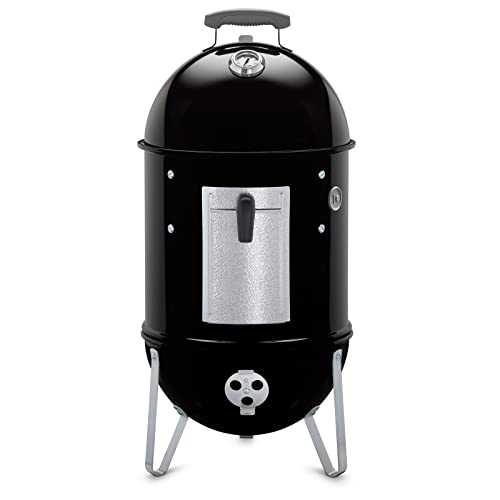
Weber Smokey Mountain Cooker 14-inch — Best Overall Travel Smoker
The smallest Smokey Mountain earns the top travel spot because its design is secretly a packing design. The mid-section, water pan and grates nest into the base, the lid caps the stack, and the whole cooker becomes one carryable cylinder that sits in a boot corner instead of dominating it. One person carries it by its handles without drama. Then, at the site, it is simply a real smoker: porcelain-enamelled steel, two cooking grates, a water pan buffering the charcoal heat, and the bullet format’s natural convection doing what it does on the 18 and 22 at home.
Capacity is the honest limit: the 14-inch grates suit a couple of chickens, a small pork butt, ribs laid with a rack or cut, and fish beautifully — group cooking for four to six, not a festival. Charcoal management at this size is forgiving; a small chimney of coals and the minion method will hold smoking temperatures for hours, and the whole fuel supply for a weekend fits in a small bag. For campers, tailgaters and small households whose ‘travel’ includes balconies and tiny patios at home, this is the pick that will actually be used weekly rather than admired seasonally.
Strengths
- Nests into one compact cylinder for transport
- Real charcoal smoke with no power requirement
- Water-pan stability in a genuinely small footprint
Trade-offs
- Capacity suits small groups, not events
- Charcoal skill required — no thermostat to hide behind
- Runs best sheltered from strong wind, like all bullets
| Detail | What to know |
|---|---|
| Type | Charcoal bullet smoker |
| Size | 14-inch, dual grates |
| Fuel | Charcoal — available anywhere |
Best for: Campers and tailgaters cooking for small groups / Not suited for: Large groups or set-and-forget cooks
Check on Amazon — check price on Amazon.

Smokehouse Little Chief Front Load Smoker — Best Ultralight Travel Smoker
The Little Chief is the travel extremist of this guide: an aluminium box, a simple electric element, a chip pan and racks, in a package one person can carry under one arm with the rest of the trip’s gear in the other hand. It has been the fishing-camp standard for decades for a simple reason — it is built around what travel smoking most often actually is: the day’s catch, strips of jerky for the trail, cheese and nuts for the evening. For those jobs its gentle, low-temperature smoke is not a limitation but the entire point.
The honesty paragraph matters here: this is a low-temperature smoker, not a barbecue cooker. It does not bark a brisket or crisp a chicken skin, and its fixed gentle heat means cooking times are long and weather-dependent. Buy it knowing that, and it is perfect — the lightest, simplest, most packable smoker in the guide, with a front-loading door that makes tending racks easy and a flavour-wood pan system that uses a handful of chips at a time. Cabins, boats, RVs and fishing camps are its natural habitat; a socket is its only infrastructure demand.
Strengths
- Lightest pick in the guide — carries under one arm
- Superb for fish, jerky, cheese and sausage
- Packs nearly flat; minimal parts to lose
Trade-offs
- Low-temperature only — not a brisket or bark machine
- Needs mains power at the site
- Long, weather-sensitive cook times
| Detail | What to know |
|---|---|
| Type | Electric low-temperature smoker |
| Build | Aluminium, front-load |
| Speciality | Fish, jerky, cheese, sausage |
Best for: Fishing trips, cabins and RV travellers smoking fish and jerky / Not suited for: Anyone expecting barbecue temperatures and bark
Check on Amazon — check price on Amazon.

Smokehouse Big Chief Electric Smoker, 50 lb Capacity — Best Travel Smoker for Big Batches of Fish and Jerky
When the travel brief is volume — a salmon run, a hunting camp, a jerky-making weekend — the Big Chief is the Little Chief concept grown up. The manufacturer rates it at 50 lb of capacity across its racks, and the format stays travel-true: aluminium construction keeps the weight manageable for its size, the front door loads racks without dismantling the stack, and the chip-pan system flavours big loads with modest amounts of wood.
Everything said about the family’s character applies at this scale: gentle electric heat, long slow smokes, results that shine on fish, jerky, sausage and cheese rather than on bark-driven barbecue. The larger box is more exposed to wind and cold, so site it sheltered and expect ambient weather to stretch times on a mountain morning. For the specific, common travel mission of processing a lot of fish or meat into smoked provisions — the kind of trip where the smoker is the reason for going — nothing else in this guide carries this much capacity this portably. That specialisation is a compliment, not a caveat, as long as it matches your trips.
Strengths
- Stated 50 lb capacity in a still-portable format
- Front-load racks suit batch processing
- Same simple, proven chip-pan flavour system
Trade-offs
- Low-temperature specialist — not for brisket-style barbecue
- Larger box feels the weather more; site it sheltered
- Mains power required
| Detail | What to know |
|---|---|
| Type | Electric low-temperature smoker |
| Capacity | 50 lb (manufacturer rating) |
| Build | Aluminium, front-load |
Best for: Fishing and hunting camps processing big batches / Not suited for: Barbecue-style cooks needing high heat
Check on Amazon — check price on Amazon.

recteq RT-B380 Bullseye Pellet Smoker Grill — Best Travel Pellet Option
The Bullseye answers the traveller who wants pellet cooking’s consistency without a barrel on a cart. Its kettle format is the most compact shape in the pellet world, the control is the set-and-hold experience pellet owners expect, and it grills as willingly as it smokes — a genuine advantage on a trip, where the same machine that smokes ribs at noon can sear burgers at six without a second cooker in the car.
The travel caveats are the pellet category’s own. It is the heaviest design philosophy here relative to capacity, it needs mains power (or a generator/inverter setup at a site without hookups), and pellets must travel dry — a wet bag of pellets is firewood-shaped disappointment. Wind affects kettle cooking less than bullet smoking thanks to the fan-driven fire, which is a real campsite advantage. Choose the Bullseye when your trips have power, your group wants barbecue-style results without fire-tending, and your vehicle has room for the kettle plus a sealed pellet tub. It is the least ‘roughing it’ option in the guide, proudly.
Strengths
- Pellet temperature consistency — minimal fire tending
- Smokes and grills in one travel machine
- Fan-driven fire shrugs off wind better than charcoal
Trade-offs
- Needs mains power or a generator setup
- Pellets must be kept dry in transit
- Heavier approach than the charcoal bullet per serving
| Detail | What to know |
|---|---|
| Type | Pellet grill-smoker, kettle format |
| Control | Set-and-hold pellet controller |
| Fuel | Wood pellets (keep dry) |
Best for: Powered sites and tailgates wanting consistent barbecue / Not suited for: Off-grid camping without a power plan
Check on Amazon — check price on Amazon.
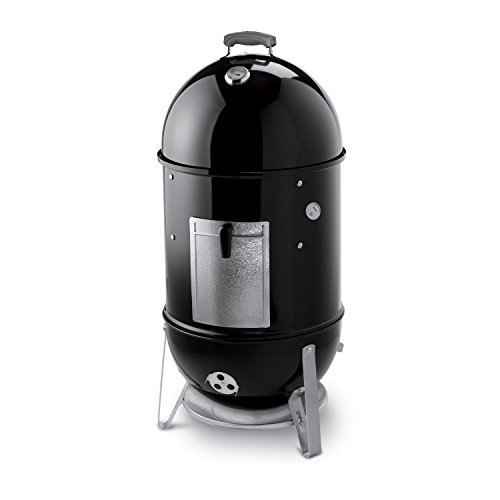
Weber Smokey Mountain Cooker 18-inch — Best for Bigger Travel Groups
The 18-inch Smokey Mountain is the largest smoker in this guide that still passes the travel test honestly. It nests like the 14, carries like the 14 (with a bit more commitment), and then opens up into a cooker that handles the group-trip menu properly: a full brisket fits, two pork butts are comfortable, and ribs for eight stop being a geometry puzzle. For the annual cabin weekend or the tailgate crew, that capacity jump is the difference between smoking the main event and smoking a side attraction.
Everything that makes the bullet format good travel gear scales with it — water-pan stability, charcoal from any petrol station, no power cord — and so do its demands: more charcoal per cook, a longer cool-down before pack-up, and a boot footprint that now competes seriously with the cool box. The working pattern for groups is to make the 18 the designated smoker of a multi-car convoy, where its packed size is planned rather than squeezed. If your trips are solo or couple-scale, the 14 is the smarter carry; if a group eats what you smoke, the 18 earns its space every single trip.
Strengths
- Full-brisket capacity in a nesting travel format
- Same charcoal-anywhere, no-power freedom
- Two grates handle group menus without juggling
Trade-offs
- Packed size now competes with the cool box
- Uses more charcoal; longer cool-down before packing
- Two-hand carry — plan the load, don’t squeeze it
| Detail | What to know |
|---|---|
| Type | Charcoal bullet smoker |
| Size | 18-inch, dual grates |
| Fuel | Charcoal |
Best for: Group trips, tailgates and cabin weekends / Not suited for: Solo travellers — the 14-inch carries easier
Check on Amazon — check price on Amazon.
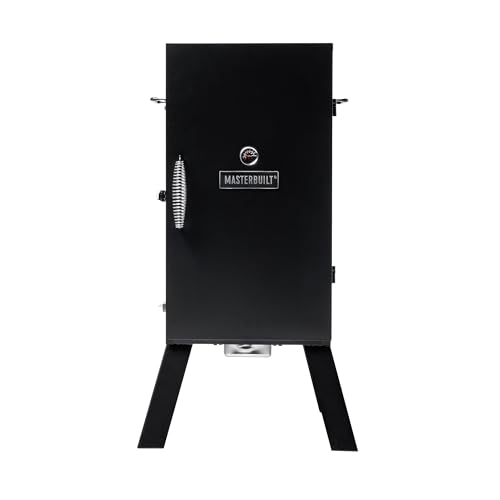
Masterbuilt 30-inch Analog Electric Smoker MB20070210 — Best for Cabin and RV Basecamps
This Masterbuilt closes the guide with a definitional honesty: it is the least portable smoker here in the carry-it-daily sense, and the right ‘travel’ pick for a different pattern — the cabin, RV site or holiday rental where the smoker rides in the vehicle once, sets up on the deck, and cooks all week. Its 535 square inches of rack space out-capacities everything else in this guide, the analog control is a dial with no app, no pairing and no firmware, and the side-loading wood chip system keeps smoke rolling without opening the door.
Electric verticals like this are the set-and-check school of smoking: load the chips, set the dial, and tend occasionally — ideal when the trip’s point is the lake, not the fire. The travel checks are practical: it needs a proper mains socket, it should ride packed against road vibration with its racks and tray secured, and it wants a dry, level spot at the site. If your travel is basecamp-style and your group is large, this is the capacity answer. If your travel is a tent and a rucksack-adjacent boot, the bullets and Chiefs above are your smokers — which is exactly why this guide separates the two patterns instead of pretending one machine does both.
Strengths
- Largest capacity in this guide — 535 sq in of racks
- Analog dial simplicity: no app, no pairing
- Side chip loader adds smoke without opening the door
Trade-offs
- Basecamp-portable only — not a daily carry
- Needs mains power and a dry, level site
- Secure racks and trays before road transport
| Detail | What to know |
|---|---|
| Type | Electric vertical smoker |
| Capacity | 535 sq in (Amazon title) |
| Control | Analog dial |
Best for: Cabins, RV sites and week-long basecamps with power / Not suited for: Tent campers or daily pack-down travel
Check on Amazon — check price on Amazon.
Comparison Table
| Pick | Badge | Key spec | Best for |
|---|---|---|---|
| Weber Smokey Mountain Cooker 14-inch | Best Overall Travel Smoker | 14-inch bullet, nesting pack-down | Campers and tailgaters cooking for small groups |
| Smokehouse Little Chief Front Load Smoker | Best Ultralight Travel Smoker | Ultralight electric, low-temp specialist | Fishing trips, cabins and RV travellers smoking fish and jerky |
| Smokehouse Big Chief Electric Smoker, 50 lb Capacity | Best Travel Smoker for Big Batches of Fish and Jerky | 50 lb rated, portable electric | Fishing and hunting camps processing big batches |
| recteq RT-B380 Bullseye Pellet Smoker Grill | Best Travel Pellet Option | Kettle pellet, dual smoke/grill | Powered sites and tailgates wanting consistent barbecue |
| Weber Smokey Mountain Cooker 18-inch | Best for Bigger Travel Groups | 18-inch bullet, group capacity | Group trips, tailgates and cabin weekends |
| Masterbuilt 30-inch Analog Electric Smoker MB20070210 | Best for Cabin and RV Basecamps | 535 sq in electric vertical | Cabins, RV sites and week-long basecamps with power |
How to Choose a Travel Meat Smoker
Start with your power reality, because it halves the field instantly. No hookups, ever: charcoal bullets are your category — fuel is sold everywhere and the cooker asks for nothing but skill. Reliable mains at the site: the electrics and the pellet kettle enter, bringing consistency and low effort. Occasional power: choose the charcoal bullet and never plan a cook around a socket that might not exist. More travel smokers disappoint through power mismatch than through any cooking flaw.
Next, size by the group that actually eats. Solo and couple travellers over-buy capacity and under-use the cooker; the 14-inch bullet and Little Chief exist precisely for them. Group trips justify the 18-inch or the Big Chief’s batch capacity. The packed size matters as much as the cooking size — measure your boot with the rest of the trip’s gear in it, because a smoker that only fits an empty car fits no real trip at all.
Finally, match the machine to the meat of your trips. Fish-and-jerky travel is the Smokehouse family’s home turf. Barbecue travel — ribs, butts, brisket — belongs to the bullets and the pellet kettle. Basecamp weeks with a crowd point at the vertical electric. The categories overlap less than marketing implies, and choosing by menu first prevents the classic error: a wonderful smoker for food your trips never cook.
Fuel and Logistics on the Road
Charcoal travels well if you respect two rules: keep it dry (a lidded plastic tub, not the paper bag it came in) and carry a small chimney starter, which lights coals with newspaper and no lighter fluid taste. Budget charcoal generously for a bullet — wind and cold at altitude burn fuel faster than your patio ever did — and remember you can buy more almost anywhere, which is the charcoal traveller’s structural advantage over every other fuel.
Pellets are the opposite logistics: superb fuel, terrible travellers when wet. Carry them in a sealed tub with the lid taped for rough roads, store the tub inside the vehicle rather than in an open truck bed, and never pour the dregs of a damp bag into the hopper mid-trip. Chips for the electric smokers are the easiest fuel of all — a weekend’s worth is a small bag that packs flat and forgives any storage sin short of soaking.
The forgotten logistics are disposal and cool-down. Plan where ash and grease go at a site that is not yours: a metal bucket with a lid for ash (cold before it travels), foil liners for drip trays, and a hard rule that the smoker is packed only when it is cool to a bare hand. Most travel-smoker damage — melted car trim, scorched decks, one memorable tent incident — happens after the cook, in the hurry to leave. Build cool-down time into the trip plan like you build in the drive.
Cooking Well Away from Home: Wind, Altitude and Cold
Travel smoking happens in weather you did not choose. Wind is the first enemy: it strips heat from thin-walled cookers and fans charcoal fires into temperature spikes. Site the smoker in the lee of the vehicle or a windbreak, vents managed deliberately, and expect a bullet’s water pan to earn its keep as a thermal buffer. The pellet kettle’s fan-driven fire is the least wind-sensitive system here; the big aluminium electrics are the most — another reason their owners site them against a cabin wall rather than on an open point.
Altitude thins the air and slows everything: charcoal burns leaner, boiling points drop (which matters to a water pan), and cook times stretch. The adjustment is patience plus fuel — carry more charcoal than the same cook takes at home, start earlier, and cook to tenderness and probe feel rather than to the clock. Cold mornings do the same work as altitude through pure heat loss; a welding-blanket wrap over a bullet (kept clear of vents and firebox) is the experienced traveller’s trick, used with respect for clearances.
None of this should discourage the trip — smoked fish eaten where it was caught and ribs at a tailgate are among cooking’s great pleasures. It should calibrate the plan: simpler menus in harder conditions, generous timelines, and a smoker chosen for the conditions your trips actually meet. The best travel smoker is not the one with the best patio manners; it is the one still behaving at 7 a.m. on a cold, windy shoreline.
Packing the Travel Smoking Kit
The smoker is half the kit. The other half, packed as one grab-bag so nothing is forgotten at dawn: an instant-read thermometer and a leave-in probe if you use one, tongs and a wide spatula, heat gloves, heavy foil, a spray bottle for spritzing, paper towels, a small cutting board and knife roll, and the sanitation basics — soap, a water container and hand towels — that make outdoor meat handling responsible rather than hopeful.
Food safety deserves direct words in a travel guide. Raw meat travels in a properly cold cool box, cooked meat rests and is served promptly or chilled fast, and the two-hour window in warm weather is a rule, not a guideline. A second small cool box for cooked food prevents the raw-to-cooked cross-contamination that ruins more trips than any smoker fault. Smoke is not a preservative at these temperatures and timescales; treat smoked food with the same respect as any cooked food.
Pack the smoker itself with its consumables inside it — chips in the chip pan, the chimney nested in the bullet, pellets in their sealed tub strapped beside the kettle. A travel smoker packed this way is a single lift from car to site, and the trip where everything is in the machine is the trip where nothing essential is sitting in a garage three hundred miles away.
How to Set Up a Travel Smoker at a Campsite
A good travel cook is mostly decided in the first fifteen minutes at the site. This sequence works for every design in the guide, with the fuel step adapted to your machine.
- Choose the spot like a local. Level ground, downwind of tents and seating, clear of overhangs and dry brush, on a surface that can take heat — gravel, dirt or a fire mat, never a wooden deck without protection.
- Assemble and inspect. Build the smoker fully before any fire: racks seated, water pan in place for bullets, chip pan or hopper loaded for electrics and pellet units, vents moving freely.
- Light or power up early. Charcoal in the chimney with time to spare; electrics plugged in and preheating while you prep. Travel cooks run long — an early start is the cheapest insurance on the trip.
- Stabilise before meat. Let the cooker sit at temperature for a full fifteen minutes. A travel smoker’s thin walls and outdoor setting make early readings liars; stable is when the needle stops wandering.
- Load with a plan. Cold meat, arranged with air gaps, biggest cuts where your cooker runs hottest. Note the time, close the lid, and resist opening it — every peek at a windy site costs real minutes.
- Manage the environment, not just the fire. Rotate the cooker or add a windbreak if one side runs hot; top up water pans; add chips or charcoal in small amounts before they are desperately needed.
- Rest, serve and start cool-down promptly. Rest cooked meat wrapped while the cooker burns down or is switched off. The moment service ends, cool-down begins — your departure time depends on it.
- Pack cold, pack clean. Ash into the metal bucket only when cold, grease contained, racks scraped. A smoker packed cold and roughly clean is ready to cook on arrival home — or at the next site.
Run this sequence twice and it becomes trip muscle memory. The travellers whose smoked dinners are legendary are not doing anything exotic — they are doing these ordinary steps, in order, while everyone else is still looking for the matches.
The Two-Trip Rule and Other Field Wisdom
Experienced travel smokers apply a rule that sounds like pessimism and functions as freedom: any new smoker, new site or new menu gets two trips before it is trusted with an occasion that matters. The first trip is reconnaissance — how the cooker behaves in real wind, how the packing actually fits beside real luggage, how long cool-down truly takes when departure is pressing. The second trip confirms the fixes. By the third, the system is boring, and boring is the highest state a travel cooking system can achieve, because the trip’s attention belongs on the water, the game or the family — not on the smoker.
The corollary is to change one variable at a time. A new cooker and a new campsite and a new cut of meat on the same trip manufactures mysteries: when the cook runs long, which of the three did it? Travellers who keep a small notebook — cooker, site, weather, fuel used, times — find their notes becoming the most valuable page of the trip kit within a season. It is the same logbook discipline the catering crews keep, scaled to a pocket notebook, and it converts every trip into tuition for the next one.
Menus That Travel Well (and Those That Do Not)
Some smoked foods are born travellers. Fish and jerky are the obvious pair — they are the Smokehouse family’s entire design brief, they forgive timing, and they improve the trip’s own provisions. Ribs travel well: a defined cook, a forgiving window, and a crowd-pleasing result that tolerates the campsite’s distractions. Pulled pork from a butt is the group traveller’s champion — the most forgiving cut in barbecue, happy to rest wrapped while the day does other things, and generous in quantity per inch of grate.
Brisket is the ambitious traveller’s test: it can be done beautifully on a bullet at a basecamp, and it punishes the departure-day schedule like nothing else, because its rest is sacred and its timing is its own. Whole chickens sit in between — superb from a bullet, but they want serving soon after cooking, which suits a settled evening rather than a pack-up afternoon. The menu wisdom of this guide is simple: match the cook’s temperament to the trip’s shape. Save the brisket for the basecamp weekend, take the ribs to the tailgate, and let the fish smoker do what it was born to do at the lake. The best travel smoker is only ever as good as the menu it was asked to cook.
One more menu note belongs to the pellet and electric picks: their consistency makes them the right choice for the trip’s non-cook — the partner, parent or friend who has agreed to ‘watch the smoker’ while the group is on the water. A cooker that holds its temperature without fire craft is a cooker that can be delegated, and delegation is a travel feature no specification sheet lists.
Renting, Borrowing and the First-Trip Strategy
Before buying any travel smoker, consider making your first trip on somebody else’s. Outdoor retailers and outfitters in barbecue country rent smokers; competition and camping friends own bullets that sit idle between their own trips; and a borrowed Smokey Mountain for one weekend teaches more about your real brief — your car, your group, your patience for charcoal — than any guide, including this one. The rental or borrowed trip converts the purchase from a guess into a specification: you will know your packed size because you packed it, your capacity because you fed people from it, and your fuel preference because you managed it at 6 a.m. in weather.
If borrowing is not possible, buy for the trip you have already booked rather than the trips you imagine. A dated trip is a real specification — its site, its power, its headcount — while imagined trips optimise for a fantasy and strand the smoker in the garage. And buy the accessories in the same order as the smoker: the chimney, the thermometer, the fire mat and the ash bucket are not garnish, they are the difference between a system and a sculpture. The travellers who love this category bought a working system for a real trip. Everyone else bought an object, and objects stay home.
The Case for the Second, Smaller Smoker
Households that travel-smoke often converge on a two-smoker answer, and it is worth understanding why before dismissing it as excess. The big trip — the group, the basecamp, the full menu — justifies the 18-inch bullet or the Masterbuilt’s capacity. The small trip — two people, one night, a couple of fish or a rack of ribs — is punished by that same capacity: too much cooker to pack, heat and clean for a small cook. A Little Chief or the 14-inch bullet as the second, small smoker removes the punishment, and the pair together cost less, in money and in garage, than the one oversized compromise that serves neither trip well.
The pattern generalises beyond this category: match the tool count to the trip count’s real distribution. Most travel is small. The smoker that serves the majority of trips should be bought first and best; the event smoker can be the older, the borrowed or the second-hand one. Travellers who invert that order spend their lives hauling a festival cooker to two-person campsites, and their smoking quietly dwindles to the big occasions — the exact opposite of what the gear was bought to encourage.
The Departure-Day Menu, Solved
Every travel smoker eventually faces the same scheduling knot: the last day, when the cooker must be cold by noon and lunch should still be smoked. The experienced answer is a menu designed backwards from the departure — fast, forgiving cooks that finish early and travel well in the cool box: sausages and fish in the morning on the electrics, chicken pieces or ribs started at dawn on a bullet, nothing whose rest or finish collides with the packing hour. The brisket belongs to the settled middle days of the trip, and the departure day belongs to the cooks that respect the clock. Plan the week’s menus against the itinerary once, on paper, and the knot never forms — the smoker serves the trip instead of scheduling it, which was the point of bringing it.
Common Buying Mistakes
Buying a wheeled patio smoker and calling it travel
Wheels solve a patio problem. Travel demands packed size, carry weight and one-person loading, which is why this guide’s test was the boot, not the driveway. A ‘portable’ smoker that needs two people and a ramp will travel twice and then live at home, too big for the car and too small for the garden’s main cooker — the worst seat in the house.
Planning a cook around campsite power you have not confirmed
Hookups get booked, breakers trip, and the socket on the pitch is further than your cable. If an electric or pellet smoker is the plan, confirm the site’s power in writing and carry a cable rated for the distance — or choose the charcoal bullet and make power somebody else’s problem. Trips fail on assumptions, not equipment.
Under-fuelling to save boot space
Charcoal and pellets are the two things you cannot improvise at a remote site. Travellers shave the fuel bag to fit one more chair, then watch temperatures die an hour before the meat is done. Fuel is the last thing to cut and the first thing to over-pack slightly; leftover charcoal travels home happily, but a half-cooked pork butt does not travel at all.
Packing a warm smoker to make a departure time
The schedule pressure is real and the answer is still no. A warm smoker in a vehicle is a fire and fume hazard and a melted-trim story waiting for its narrator. Start cooks earlier, choose faster menus on departure day, or leave the smoker to a later pickup — any of these is cheaper than the alternative.
Forgetting that travel smoking is public cooking
Campsites and tailgates have neighbours, site rules and sometimes explicit fire restrictions that change with drought conditions. Check the site’s fire rules before the trip, keep smoke neighbourly, and leave the pitch cleaner than you found it. The travel smoker’s reputation — and access — depends on the last crew as much as on you.
Final Recommendation
For most travellers, the Weber Smokey Mountain 14-inch is the answer: it packs like luggage, cooks like a real smoker and asks for nothing but charcoal. Fishing and jerky travellers should take a long look at the Little Chief — or the Big Chief when the batch is the point — while powered-site travellers who want consistency should choose the recteq Bullseye. Groups graduate to the 18-inch bullet, and basecamp weeks with a crowd belong to the Masterbuilt vertical.
Whichever design fits your trips, buy it for the boot, the power reality and the menu you actually travel with. A travel smoker chosen that way stops being gear and becomes the reason the trip gets planned again next year.
Related reading: Best Towable Smokers Best Food Smokers Best Gas Meat Smokers Best Electric Smokers For Jerky.
Frequently Asked Questions
What is the most portable type of meat smoker?
For pure portability, the Smokehouse electrics — the Little Chief especially — are the lightest and flattest-packing smokers in this guide. Among full barbecue-capable cookers, the 14-inch Weber Smokey Mountain is the travel benchmark because it nests into one cylinder and needs no power. Portability rankings change with the job: fish and jerky favour the electrics; ribs and brisket favour the bullet.
Can I smoke meat while camping without electricity?
Yes — charcoal bullets like the Smokey Mountain 14 and 18 are built for exactly that, with fuel available almost anywhere. The pellet and electric picks in this guide need mains power or a generator setup, which is why the guide separates them by power reality rather than pretending all travel is the same.
How long does a travel smoker take to cool down for packing?
Plan on at least an hour for a charcoal bullet after the fire is starved and vents are closed, and check with a bare hand before it goes near a vehicle. Electrics cool faster once unplugged but their racks and chip trays stay hot longer than expected. Departure-day menus should be chosen with cool-down in the plan.
Is a pellet smoker a good travel choice?
For powered sites and tailgates, yes — the Bullseye’s kettle format is the most car-friendly pellet design and its controller removes fire-tending from a day meant for other things. For off-grid camping it is the wrong tool unless you bring serious battery or generator capacity, and its pellets must be kept dry, which is one more system to manage on the road.
What can a Little Chief actually cook?
Fish, jerky, cheese, nuts, sausages and other low-temperature specialities — the foods it was designed for, it does superbly, in a package lighter than your tackle box. It is not a barbecue cooker: brisket, ribs and chicken at barbecue temperatures are outside its design. Bought for its real menu, it is one of the most-loved travel smokers ever made.
How do I keep smoked food safe on a trip?
The same rules as any outdoor cooking: raw meat properly chilled until it cooks, cooked food served promptly or chilled quickly, separate cool boxes or strict separation for raw and cooked, and the two-hour warm-weather limit respected. Smoke flavour is not preservation at these temperatures — refrigeration discipline is what keeps a great trip great.


