Disclosure: airfryerkitchensupply.com is reader-supported. When you buy through links on our site, we may earn an affiliate commission at no extra cost to you.
Where to buy
Every linked rug below was confirmed, with the size, construction and origin taken from the verified listing title. Transitional rugs sell in many sizes of the same design, so confirm the exact dimensions on the listing before ordering, and check price on Amazon at checkout rather than relying on any third-party screenshot.
- SAFAVIEH Madison Area Rug 8×10, Transitional Ogee Cream & Orange MAD604H — Check the current price on Amazon
- SAFAVIEH Brentwood Area Rug 8×10, Transitional Ogee Blue & Yellow BNT899M — Check the current price on Amazon
- SAFAVIEH Adirondack Area Rug 8×10, Transitional Damask Gray & Gold ADR114D — Check the current price on Amazon
- SAFAVIEH Madison Area Rug 8×10, Transitional Medallion Cream & Blue MAD474B — Check the current price on Amazon
- SAFAVIEH Pine Wool Area Rug 8×10, Transitional Ogee Beige PNE101B — Check the current price on Amazon
- Loloi Layla Olive/Charcoal 7′-6″ x 9′-6″ Area Rug (LAY-03) — Check the current price on Amazon
The best transitional area rugs solve a specific decorating problem: your furniture does not all come from one era. A transitional rug blends a traditional motif — a medallion, an ogee lattice, a damask — with a modern, softened color palette, so a classic sofa and a clean-lined coffee table can share the same floor without arguing. Every pick in this guide was verified, and where the listing title itself says Transitional, that word is doing real work: those designs were patterned specifically to sit between traditional and contemporary rooms.
That middle position is exactly why transitional rugs outsell both extremes in living rooms. A fully traditional Persian-style rug can make a modern room feel like a period set, while a flat geometric modern rug can leave traditional furniture looking stranded. Transitional patterns keep the structure and symmetry people find restful in classic rugs, then mute the contrast, distress the edges of the motif, or recolor it in gray, taupe, ivory and washed blue. The result reads finished from the doorway and calm up close.
This guide concentrates on the most useful size, roughly 8 by 10 feet, because that is the size that anchors a standard living-room seating group. All six picks are verified in that class. Construction splits between power-loomed polypropylene, which is the practical default for families, and one hand-tufted wool option for buyers who want natural fiber and are willing to care for it. Pile height is uniformly low, around 3/8 inch where the listing states it, which keeps doors clearing and chair legs stable.
Key Takeaways
- Transitional means a traditional motif redrawn in a modern, muted palette — it is a design category, not a vague compliment.
- Four of the six picks carry the word Transitional in the verified listing title itself, so the classification is confirmed, not assumed.
- Power-loomed polypropylene at 3/8-inch pile is the low-maintenance default; the one wool pick trades easy care for natural-fiber feel.
- Measure for an 8×10-class rug first: front legs of all seating on the rug is the layout that makes a room look intentional.
- Low pile is a feature here — it suits dining chairs, doors and robot vacuums better than plush shag.
In this guide
Quick Picks
Best Overall: SAFAVIEH Madison Area Rug 8×10, Transitional Ogee Cream & Orange MAD604H — a true transitional ogee in warm cream and orange, power-loomed in Turkey at a low 3/8-inch pile. — Check price on Amazon
Best for Cool Color Schemes: SAFAVIEH Brentwood Area Rug 8×10, Transitional Ogee Blue & Yellow BNT899M — the same proven ogee idea recolored in blue and yellow for cooler rooms. — Check price on Amazon
Best Neutral with a Formal Edge: SAFAVIEH Adirondack Area Rug 8×10, Transitional Damask Gray & Gold ADR114D — a gray-and-gold damask that reads neutral from a distance and dressy up close. — Check price on Amazon
Best Classic Medallion: SAFAVIEH Madison Area Rug 8×10, Transitional Medallion Cream & Blue MAD474B — a cream-and-blue medallion for buyers who want one strong traditional centerpiece, softened for modern rooms. — Check price on Amazon
Best Natural Fiber: SAFAVIEH Pine Wool Area Rug 8×10, Transitional Ogee Beige PNE101B — the only wool pick: a hand-tufted transitional ogee in quiet beige for buyers who want natural fiber. — Check price on Amazon
Best Vintage-Leaning Flatweave Feel: Loloi Layla Olive/Charcoal 7′-6″ x 9′-6″ Area Rug (LAY-03) — a printed traditional design in olive and charcoal with a flat, vintage-rug surface. — Check price on Amazon
How These Picks Were Chosen
Each rug below was found by searching Amazon listing data for transitional designs, then matched by hand: the ASIN in this guide comes from the listing response, the product name is the Amazon title, and any spec quoted — size, pile height, construction, country of origin — appears in that verified title. Listings that were only rug pads, tape or accessories were excluded; only complete area rugs were considered. Where the same design appeared in several colors, only one colorway was kept so the six slots show six genuinely different choices.
The shortlist was then balanced on purpose. Four picks are Safavieh transitional lines because that brand’s transitional catalog is deep and its titles state construction honestly, but the guide also includes a printed Loloi design for buyers who prefer a flat, vintage-leaning surface. Pattern scale was varied deliberately: ogee lattices repeat small and read almost like texture, medallions make one strong central statement, and damask sits between the two. Color temperature was varied too, from warm cream and orange through cool blue and yellow to neutral gray and gold, because the right transitional rug is mostly a color decision.
Finally, a honesty note on care claims: none of these listings promises machine washability, so none is described that way here. Power-loomed polypropylene is spot-cleanable and does not shed the way new wool can, and that is the level of claim the verified titles support. If washability is your top priority, the companion guide to transitional rugs for modern tile floors covers verified washable options instead.
The 6 Best Transitional Area Rugs

SAFAVIEH Madison Area Rug 8×10, Transitional Ogee Cream & Orange MAD604H — Best Overall
This is the safest first choice for a mixed living room: the verified title names the pattern Transitional Ogee, the cream ground keeps it light, and the orange in the lattice warms up gray or beige upholstery without turning the floor into the loudest thing in the room. It suits households that want pattern with structure — the ogee repeat is geometric enough for modern furniture and curvy enough for traditional pieces.
Strengths
- Listing title confirms a genuinely transitional ogee pattern, not a relabeled traditional rug
- Power-loomed polypropylene: durable, low-shedding and practical for everyday traffic
- 3/8-inch low pile works under dining chairs and clears most interior doors
Trade-offs
- Warm orange tones will fight with cool blue-gray paint schemes
- Synthetic pile lacks the soft, dense hand of a wool rug
- 8×10 is the verified size here; other sizes of this design were not confirmed for this guide
| Detail | Verified from listing title |
|---|---|
| Size | 8′ x 10′ |
| Construction | Power-loomed polypropylene |
| Pile | 3/8 in low pile |
| Origin | Made in Turkey |
| Pattern | Transitional ogee, cream & orange (MAD604H) |
The ogee is the hardest-working transitional motif because it is really two patterns at once: from across the room it reads as a calm lattice texture, and only up close does the Moroccan curve of each cell register. That dual scale is what lets this rug sit under both a rolled-arm sofa and a glass coffee table. The cream ground does most of the brightening work in a north-facing room, while the orange is concentrated in the lattice lines rather than flooded across the field, so the color accents rather than dominates.
In daily use, the low polypropylene pile is the practical story. Crumbs and pet hair sit on top of the fibers instead of sinking in, so a standard vacuum pass actually removes them, and the rug does not need the beater-bar caution that a tufted wool rug does. Expect the usual new-rug routine: a day or two flat for the corners to relax after unrolling, and a rug pad underneath on hard floors both for grip and to give the thin pile a little borrowed cushion.
Best for: mixed traditional-and-modern living rooms that need warmth / Not suited for: cool-toned rooms built around blue and gray
Check the current price on Amazon

SAFAVIEH Brentwood Area Rug 8×10, Transitional Ogee Blue & Yellow BNT899M — Best for Cool Color Schemes
Choose the Brentwood if your room already leans cool — blue-gray walls, navy upholstery, white oak floors. The verified title confirms the transitional ogee pattern in blue and yellow, and that small amount of yellow is the detail that stops a blue rug from feeling cold: it reads as a warm highlight inside a cool field, the way brass hardware warms a navy kitchen.
Strengths
- Blue-and-yellow palette designed for cool rooms that still need a warm accent
- Same practical power-loomed polypropylene, 3/8-inch pile construction
- Ogee repeat hides everyday dust and footprints better than a solid rug
Trade-offs
- Yellow accents will clash with strongly warm orange or red decor
- Pattern is regular and symmetrical, which some buyers find formal
- Synthetic fibers can show a slight sheen under very bright lighting
| Detail | Verified from listing title |
|---|---|
| Size | 8′ x 10′ |
| Construction | Power-loomed polypropylene |
| Pile | 3/8 in low pile |
| Origin | Made in Turkey |
| Pattern | Transitional ogee, blue & yellow (BNT899M) |
Blue is the most requested rug color and the easiest to get wrong, because a saturated navy field can darken a whole room. This design avoids that by keeping the ogee structure visible: the pattern breaks the blue into a lattice, so light catches the lines and the floor keeps some movement. The yellow is used sparingly, as an accent inside the motif, which makes it a useful bridge if you own both blue upholstery and warm wood or brass pieces — the rug quietly agrees with both.
Construction matches the Madison pick, so the ownership experience is the same: low, dense, easy to vacuum, and forgiving of chair legs and door swings. It is a sensible dining-room candidate for the same reason — chairs slide rather than sink — although, as with any patterned rug under a table, center the table on the pattern repeat so the layout looks deliberate rather than accidental.
Best for: cool-toned living and dining rooms with blue or navy furniture / Not suited for: rooms decorated in warm reds and oranges
Check the current price on Amazon

SAFAVIEH Adirondack Area Rug 8×10, Transitional Damask Gray & Gold ADR114D — Best Neutral with a Formal Edge
The Adirondack is for the buyer who wants neutral but not plain. Its verified title confirms a transitional damask in gray and gold: the gray keeps it compatible with the most common upholstery color of the last decade, and the gold thread in the damask gives it a slightly formal, grown-up register that suits dining rooms and primary bedrooms as much as living rooms.
Strengths
- Gray ground pairs with almost any sofa color; gold adds warmth without color risk
- Damask motif is traditional in origin but softened, which is the transitional formula exactly
- Power-loomed polypropylene, low pile, made in Turkey — the low-care specification
Trade-offs
- Damask reads more formal than the ogee picks; very casual rooms may prefer the Loloi
- Gold tones can look yellow under warm bulbs — check it in your own lighting
- Large central motifs need centering under furniture to look their best
| Detail | Verified from listing title |
|---|---|
| Size | 8′ x 10′ |
| Construction | Power-loomed polypropylene |
| Pile | 3/8 in low pile |
| Origin | Made in Turkey |
| Pattern | Transitional damask, gray & gold (ADR114D) |
Damask is a weaving pattern before it is a print, and even in a power-loomed interpretation the motif carries a woven, tonal quality: the design emerges from contrast in the pile rather than from loud color changes. That makes this the most forgiving pick for a room that is still evolving, because it does not commit you to a strong color story. Add rust cushions this year and blue ones next year and the rug stays out of the argument.
The gray-and-gold combination also handles a common flooring problem — warm oak or walnut floors under gray furniture. The rug’s gray speaks to the upholstery while its gold speaks to the wood, which is precisely the bridging job a transitional rug exists to do. As with the other Safavieh picks, plan on a pad for hard floors and a short flattening period after unrolling.
Best for: gray-based rooms that need a warm, slightly formal bridge / Not suited for: very casual, beachy or bohemian rooms
Check the current price on Amazon

SAFAVIEH Madison Area Rug 8×10, Transitional Medallion Cream & Blue MAD474B — Best Classic Medallion
Some buyers do not want pattern-as-texture; they want the classic medallion. This Madison delivers it in cream and blue, with the verified title confirming the transitional medallion design. The cream field keeps the medallion from feeling heavy, and blue is the most traditional rug color there is — this is the pick for a room with real antiques or traditional wood furniture that needs the floor to meet it halfway.
Strengths
- True medallion layout — the strongest traditional statement among the six picks
- Cream and blue is the most versatile classic palette for wood furniture
- Power-loomed polypropylene at 3/8-inch pile keeps a formal rug practical
Trade-offs
- A centered medallion looks wrong if furniture placement pushes it visibly off-center
- Cream fields show dark spills more readily than mid-tone patterns
- Traditional lean is stronger here; ultra-modern rooms should choose the Loloi instead
| Detail | Verified from listing title |
|---|---|
| Size | 8′ x 10′ |
| Construction | Power-loomed polypropylene |
| Pile | 3/8 in low pile |
| Origin | Made in Turkey |
| Pattern | Transitional medallion, cream & blue (MAD474B) |
A medallion rug is a commitment to symmetry, and it rewards rooms that can honor it: a sofa centered on the long side, paired chairs, a coffee table in the middle. In that layout this rug does something the lattice patterns cannot — it gives the room a ceremonial center, the feeling of a Persian carpet, while the washed cream-and-blue palette keeps it from reading as a museum piece. In an asymmetrical room, be honest with yourself and pick the ogee instead.
The practical specification is unchanged from its Madison sibling: power-loomed polypropylene, low pile, Turkish manufacture. That matters with a cream field, because polypropylene releases most household spills with prompt blotting far more willingly than wool does. It is the rare formal-looking rug you can put under a family sofa without anxiety, provided spills are treated quickly rather than left to set.
Best for: traditional-leaning rooms and antique or dark wood furniture / Not suited for: asymmetrical layouts or ultra-modern interiors
Check the current price on Amazon

SAFAVIEH Pine Wool Area Rug 8×10, Transitional Ogee Beige PNE101B — Best Natural Fiber
Every other pick here is polypropylene, which is the right default for most households — but some buyers simply prefer wool underfoot, and this is the verified natural-fiber option: the title confirms a hand-tufted wool rug with a transitional ogee pattern in beige, made in India. Beige is the quietest colorway in the guide, which suits bedrooms and calm, layered-neutral rooms.
Strengths
- Hand-tufted wool — natural fiber with a denser, warmer feel than synthetic pile
- Transitional ogee pattern confirmed in the verified title
- Beige palette layers with almost any neutral scheme without competing
Trade-offs
- Wool sheds when new and needs gentler vacuuming — no aggressive beater bar
- Not the pick for homes expecting frequent spills or muddy paws
- Hand-tufted construction typically costs more than the power-loomed picks
| Detail | Verified from listing title |
|---|---|
| Size | 8′ x 10′ |
| Construction | Hand-tufted wool |
| Pile | 3/8 in low pile |
| Origin | Made in India |
| Pattern | Transitional ogee, beige (PNE101B) |
Wool’s advantages are tactile and thermal rather than visual: it feels dense and slightly springy even at a low pile height, it insulates a cold floor in winter, and its fibers hide dry dust within the pile rather than showing it on the surface. The trade is maintenance discipline. New hand-tufted wool sheds loose fiber for the first weeks — that is the construction settling, not a defect — and it should be vacuumed with suction only or a gentle brush setting, and spot-cleaned with wool-appropriate care rather than harsh detergents.
The beige ogee is the most understated design in this guide, and that is its role: it is the pick for a room where the art, the bedding or the view should lead and the floor should support. In a primary bedroom, an 8×10 placed under the lower two-thirds of the bed gives both sleepers a warm, quiet landing, and wool’s natural sound absorption is a genuine bonus in a sleeping space.
Best for: bedrooms and calm neutral rooms; buyers who specifically want wool / Not suited for: high-spill households or anyone who wants zero-maintenance flooring
Check the current price on Amazon
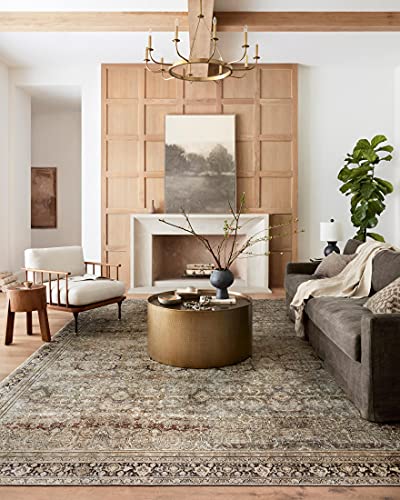
Loloi Layla Olive/Charcoal 7′-6″ x 9′-6″ Area Rug (LAY-03) — Best Vintage-Leaning Flatweave Feel
The Layla is the outlier in construction and in spirit: the verified title describes a printed rug in olive and charcoal that the listing itself characterizes as traditional, timeless and classic. It earns its place in a transitional guide because a printed, distressed-look surface is exactly how many modern rooms borrow a traditional pattern — the motif is classic, the flat finish and moody olive-charcoal palette are contemporary.
Strengths
- Printed flat surface: no pile to trap crumbs, excellent under dining chairs and doors
- Olive and charcoal is a sophisticated, forgiving mid-dark palette
- Slightly smaller 7′-6″ x 9′-6″ footprint suits apartments and smaller seating groups
Trade-offs
- Printed surface has none of the plush feel of a piled rug — use a cushioned pad
- Listing describes the style as traditional rather than transitional; the transitional case rests on its distressed printed finish
- Olive tones need testing against very warm wood floors
| Detail | Verified from listing title |
|---|---|
| Size | 7′-6″ x 9′-6″ (approx. 8×10 class) |
| Construction | Printed (LAY-03) |
| Palette | Olive / charcoal |
| Rooms per listing | Living room, dining room, bedroom |
Printed rugs reproduce the look of a worn antique — including the low-contrast, faded areas — on a flat, stable surface. For dining rooms that is close to ideal: chairs glide, crumbs vacuum straight off, and there is no pile to crush into traffic lanes. The olive and charcoal palette is also the most forgiving in this guide for real life, sitting in the mid-tone range where neither dust nor dark pet hair announces itself.
Be clear about what you are trading away: there is no softness underfoot from the rug itself, so the pad choice carries the comfort. A thicker felt-and-rubber pad under a printed rug gives you the vintage look with modern cushion, and it also keeps the light, flat rug from migrating on hard floors. In a living room, this is the pick for households that prefer their pattern quiet and their maintenance minimal.
Best for: dining rooms, apartments and buyers who love the worn-antique look / Not suited for: anyone whose priority is plush softness underfoot
Check the current price on Amazon
Comparison Table
| Pick | Badge | Key spec | Best for |
|---|---|---|---|
| SAFAVIEH Madison Area Rug 8×10, Transitional Ogee Cream & Orange MAD604H | Best Overall | 8×10, power-loomed polypropylene, 3/8 in pile | mixed traditional-and-modern living rooms that need warmth |
| SAFAVIEH Brentwood Area Rug 8×10, Transitional Ogee Blue & Yellow BNT899M | Best for Cool Color Schemes | 8×10, transitional ogee, blue & yellow | cool-toned living and dining rooms with blue or navy furniture |
| SAFAVIEH Adirondack Area Rug 8×10, Transitional Damask Gray & Gold ADR114D | Best Neutral with a Formal Edge | 8×10, transitional damask, gray & gold | gray-based rooms that need a warm, slightly formal bridge |
| SAFAVIEH Madison Area Rug 8×10, Transitional Medallion Cream & Blue MAD474B | Best Classic Medallion | 8×10, transitional medallion, cream & blue | traditional-leaning rooms and antique or dark wood furniture |
| SAFAVIEH Pine Wool Area Rug 8×10, Transitional Ogee Beige PNE101B | Best Natural Fiber | 8×10, hand-tufted wool, transitional ogee beige | bedrooms and calm neutral rooms; buyers who specifically want wool |
| Loloi Layla Olive/Charcoal 7′-6″ x 9′-6″ Area Rug (LAY-03) | Best Vintage-Leaning Flatweave Feel | 7′-6″ x 9′-6″, printed, olive/charcoal | dining rooms, apartments and buyers who love the worn-antique look |
How to Choose a Transitional Area Rug
Start with the honest question a transitional rug exists to answer: which pieces in the room are traditional, and which are modern? List them. If the split is roughly even — a classic sofa with modern lighting, or a modern sectional with an antique sideboard — a transitional rug is not just an option, it is the intended solution, and the pattern should borrow one element from each side: a traditional motif shape, rendered in the modern side’s colors. If your room is actually all one style, buy that style’s rug instead; transitional designs earn their keep as bridges, and a bridge to nowhere looks indecisive.
Pattern scale is the second decision. Large medallions need room to be seen — they belong in centered, symmetrical layouts. Small repeats like ogee lattices are more flexible: they survive being partly covered by furniture because any visible section still shows the whole idea. Damask sits in between and reads as texture at conversational distance. A practical test: if more than half the rug will be hidden under furniture, choose a repeat pattern; if the center will be visible, a medallion can carry the room.
Color deserves more care than pattern, because color is what you will notice every day. Pull the rug’s ground color from something already large in the room — wall color, sofa fabric, floor tone — and let the accent colors echo smaller pieces. All six picks here use a light-to-mid ground for a reason: dark grounds shrink rooms visually and show light dust, while very pale grounds show dark spills. The mid-tone, patterned middle is where family life and good looks overlap.
- Bridge test: the rug should share a motif with your traditional pieces and a palette with your modern ones
- Covered rug = repeat pattern; visible center = medallion is safe
- Ground color from a large existing element; accents from small ones
- Low pile (around 3/8 in) for dining chairs, doors and easy vacuuming
- Always budget for a rug pad on hard floors — grip, cushion and floor protection in one layer
Sizing and Placement Rules That Actually Matter
The standard living-room layout for an 8×10 rug is front legs on: the front legs of the sofa and chairs rest on the rug, the back legs off it. This connects the seating into one island without requiring a room-sized rug, and it is the layout the 8×10 class was made for. All legs on demands a 9×12 in most rooms; no legs on — a small rug floating in front of the sofa — almost always looks like a mistake, as if the rug shrank. If your seating group is compact or the room is an apartment living area, the slightly smaller Loloi footprint in this guide is proportioned for exactly that case.
In dining rooms the rule changes: the rug must extend at least 24 inches beyond the table on every side so chairs stay on the rug when pulled out. For a standard six-person table that usually means an 8×10 is the minimum, and low pile matters more than pattern — chair legs on plush pile wobble and drag. In bedrooms, place a large rug under the bed extending beyond both sides and the foot, or use it to define the sleeping zone in a studio; wool’s quiet warmth, as in the Pine pick, is most appreciated in this room.
Leave a consistent border of bare floor around the rug — roughly 8 to 18 inches in most rooms. A rug that nearly touches every wall reads as failed carpet. And before ordering any size, tape the outline on the floor with painter’s tape and live with it for a day; it is the cheapest possible way to discover that your room really wants the next size up.
Polypropylene vs Wool: An Honest Comparison
Five of the six picks are power-loomed polypropylene, and that is a deliberate reflection of how people actually live. Polypropylene is solution-dyed synthetic fiber: it resists fading, releases most spills with blotting and a mild cleaner, does not shed, and tolerates a vacuum’s beater bar. Its limits are feel and fire behavior — it has a lighter, sometimes slightly shiny hand compared with wool, and it should be kept away from high heat sources. For homes with children, pets, dining traffic or rental timelines, it is the rational default.
Wool, represented here by the hand-tufted Pine rug, is the traditional rug fiber for good reasons: dense, resilient, naturally flame-resistant, and it ages by developing character rather than wearing shiny. Its costs are real too — new wool sheds, it wants gentler cleaning chemistry, professional cleaning is recommended for major spills, and the purchase price is generally higher. Neither fiber is ‘better’; they optimize different lives. Choose polypropylene for forgiveness, wool for feel, and do not let anyone sell you a blend claim that the listing itself does not make — every construction claim in this guide comes from the verified listing title.
How to Set Up and Care for a New Area Rug
A new rug needs about a week of light attention to look its best for years. The routine below applies to every pick in this guide, with wool-specific notes where they differ.
- Unroll the rug in its room and let it rest flat for 24–48 hours; reverse-roll stubborn corners or weight them with books overnight.
- Vacuum both sides once before first use to remove loose manufacturing fiber — expect more of this from the wool pick, and use suction-only settings for it.
- Lay a rug pad cut about an inch smaller than the rug on hard floors; position the rug over it and check that doors still clear the combined height.
- Arrange furniture using the front-legs-on rule, then step back to the doorway and check the pattern is centered on the seating, not on the room’s walls.
- Rotate the rug 180 degrees after the first month and every six months after, to even out sunlight and traffic wear.
- Blot spills immediately with a clean cloth — never rub — and test any cleaner on a hidden corner first; book professional cleaning for the wool rug’s serious spills.
Two habits preserve appearance more than any product: vacuuming the traffic lanes weekly before grit works into the pile, and keeping a consistent pad under the rug so it cannot creep and bunch. Bunching is not just untidy — a folded rug edge is a trip hazard and a permanent crease in the making. If a corner keeps curling after the first week, a night under a flat weight usually finishes the job; persistent curl on a new rug is worth a message to the seller while the return window is open.
Reading Pattern Like a Designer: Motif, Repeat and Border
Three elements decide how a transitional rug behaves in a room, and listings rarely discuss any of them, so it is worth learning to read them from a product photo. The motif is the individual shape — ogee cell, damask flourish, medallion rosette. The repeat is how that motif tiles across the field: small, tight repeats read as texture and forgive furniture placed anywhere, while large repeats demand that you think about what a chair leg will cut in half. The border is the rug’s frame, and transitional rugs handle it in two ways — a defined border band that formalizes the rug, or a borderless field where the pattern runs to the edge for a more modern, carpet-like calm. None of the three is better; they are tools. A defined border suits a traditional-leaning room and a centered layout, because the frame announces the rug as a deliberate object. A borderless repeat suits open-plan and modern rooms, where the rug is a zone rather than an object.
Scale the motif to the room’s viewing distance. In a living room you see the rug from six to twelve feet away, seated; a motif that reads clearly at that distance is correctly scaled, and one that dissolves into noise is too small, however pretty it looked in a close-up photo. Dining rooms are viewed standing and from above, which flatters larger patterns. Bedrooms are viewed from the doorway and from the bed itself — two very different angles — which is why the quiet beige ogee of the wool pick works there: it has no wrong angle. When you study a listing photo, zoom out rather than in; the thumbnail, not the detail shot, is what your room will actually look like.
Transitional Rugs in Open-Plan Spaces
Open-plan living is where transitional rugs earn their highest wages, because the rug is doing architectural work: it must define a seating zone inside a space that also contains a kitchen and a dining area, without building a wall. The transitional style is uniquely suited to the job because it can agree with the kitchen’s modern lines and the sofa’s traditional comfort at the same time. Practically, anchor the zone on the seating, not on the room: the rug’s edges should relate to the sofa and chairs, with a consistent margin of floor showing, and the pattern should be centered on the seating group even if that leaves it off-center in the architectural space — people read the furniture grouping, not the ceiling plan.
In a long open space, resist the temptation to fill the whole living zone with one enormous rug. A correctly sized 8×10 that gathers the seating reads as intentional; an oversized rug that reaches toward the kitchen reads as carpet that lost its way. Let the floor material show between zones — that strip of visible floor is the corridor, the breathing space, the thing that makes each zone legible. If two rugs share one open space, relate them by palette rather than by identical pattern: the same ground color with different motifs looks collected, while two identical large rugs look like a hotel function room.
A Final Word on Value in This Category
Value in transitional rugs is rarely about finding the cheapest 8×10; it is about cost per year of a room looking right. A power-loomed polypropylene rug in this guide’s class will serve a family room for many years with nothing more than vacuuming and prompt blotting, and its pattern will outlast several cycles of cushion and curtain changes precisely because transitional design refuses to commit to one era. That refusal, which can look like indecision in a listing, is in practice the longest-lived aesthetic decision you can make for a floor: the rug that agrees with both your grandmother’s sideboard and your new sofa is the rug you will not be replacing when either one changes.
Spend the saved money where it compounds: on the pad beneath, on the correct size rather than the almost size, and on the colorway your room’s light flatters. Those three choices determine ninety percent of how a rug performs and is perceived, and none of them appears in a headline price. Buy the design that bridges your actual furniture, in the size your tape measure approved, over a pad that suits your floor — and the category will repay you with the rarest outcome in home furnishing: a purchase you stop thinking about because it simply works, every day, in every light.
Common Buying Mistakes
Buying the pattern before the size. A beautiful medallion in a too-small size still looks wrong. Tape the outline on the floor first, confirm the front-legs-on layout works, and only then fall in love with a design.
Matching the rug to the wall color exactly. An exact match makes the floor disappear into the walls and flattens the room. The rug should relate to the walls — same family, different depth — and pick up its accents from furniture and textiles instead.
Assuming ‘transitional’ means ‘goes with everything’. Transitional rugs bridge two specific styles in one specific room. An ogee in orange will not bridge a blue coastal room, which is why this guide varies palette as carefully as pattern.
Skipping the pad to save money. On hard floors the pad is what stops slipping, adds the cushion a low-pile rug lacks, and prevents the rug backing from grinding grit into your floor finish. It is part of the purchase, not an accessory.
Using a beater bar aggressively on wool. Hand-tufted wool, like the Pine pick, should be vacuumed with suction or a gentle setting. Aggressive brushing pulls fiber, accelerates shedding and can fuzz the pattern within a season.
Final Recommendation
If you want one recommendation: the Safavieh Madison ogee in cream and orange is the most complete expression of what transitional means — a classic motif, a modern warmth, and a construction that forgives family life. Cool rooms should take the Brentwood’s blue and yellow instead, and gray-based rooms the Adirondack damask. Buyers set on a medallion should choose the Madison cream and blue and commit to a centered layout; buyers set on natural fiber should choose the Pine wool and accept its gentler care routine; and dining rooms and apartments should look first at the flat printed Loloi.
Whichever you choose, order the pad at the same time, tape the size on your floor before the box arrives, and judge the color in your own evening light before removing any tags — rug color is the one variable no listing photo can settle for you. For washable options that pair with hard modern floors, see the companion guide below.
- SAFAVIEH Madison Area Rug 8×10, Transitional Ogee Cream & Orange MAD604H — Check price on Amazon
- SAFAVIEH Brentwood Area Rug 8×10, Transitional Ogee Blue & Yellow BNT899M — Check price on Amazon
- SAFAVIEH Adirondack Area Rug 8×10, Transitional Damask Gray & Gold ADR114D — Check price on Amazon
- SAFAVIEH Madison Area Rug 8×10, Transitional Medallion Cream & Blue MAD474B — Check price on Amazon
- SAFAVIEH Pine Wool Area Rug 8×10, Transitional Ogee Beige PNE101B — Check price on Amazon
- Loloi Layla Olive/Charcoal 7′-6″ x 9′-6″ Area Rug (LAY-03) — Check price on Amazon
Best Transitional Rugs Matching Modern Tile Best Washable Rugs Best Area Rugs For Family Rooms Best 8 X 10 Wool Area Rugs Best Area Rugs For Grey Floors
Frequently Asked Questions
What makes a rug ‘transitional’ rather than traditional or modern?
The motif comes from traditional design — medallions, damasks, ogee lattices — while the coloring and contrast come from modern interiors: muted, washed, gray- or taupe-leaning palettes. Four picks in this guide carry the word Transitional in their verified listing titles, so the category is confirmed by the makers, not assigned by this guide.
Is an 8×10 rug big enough for a living room?
For most seating groups, yes, using the front-legs-on layout. Very large sectionals or rooms over roughly 14 by 18 feet usually need a 9×12 so the rug does not look stranded. Tape the outline on the floor before ordering to be sure.
Are polypropylene rugs a cheap compromise?
No — they are the practical mainstream. Power-loomed polypropylene resists stains and fading, does not shed, and tolerates family traffic. Wool feels denser and more luxurious, which is why one wool pick is included, but it asks for gentler care in return.
Do these rugs need a pad?
On hard floors, yes: a pad prevents slipping, adds cushion under low pile, and protects the floor finish. On wall-to-wall carpet a pad is optional, though a thin grip layer can stop a rug from creeping and wrinkling.
Will a low-pile rug feel thin?
A 3/8-inch pile feels firm rather than plush, which is why it works under chairs and doors. If barefoot softness is the priority, pair the rug with a thicker felt pad, or accept the trade-offs of a higher-pile style outside this category.
How do I stop a new rug’s corners from curling?
Let it rest flat for a day or two, reverse-roll the corners, and weight them overnight. Most curl is shipping memory and relaxes within the first week, especially once furniture and a pad are in place.


