Disclosure: airfryerkitchensupply.com is reader-supported. When you buy through links on our site, we may earn an affiliate commission at no extra cost to you.
Where to buy
An 8 x 10 wool rug is a serious purchase — the largest common rug size in the fiber that costs the most per square foot — and the market splits into hand-knotted heirlooms, hand-tufted mid-range rugs, flatweaves, and machine-made wool blends at the budget end. The picks below are organized by construction, because construction decides price tier, lifespan and feel more than pattern ever will.
- SAFAVIEH Samarkand Hand-Knotted Wool Area Rug (8×10, Rust & Beige) — premium tier; check the current price on Amazon
- RUG BARN Solid Hand-Tufted 100% Wool Area Rug (8×10, Coastal Blue) — mid-range tier; check the current price on Amazon
- SAFAVIEH Kilim Collection Flat Weave Wool Area Rug (8×10, Dark Grey & Orange) — mid-range tier; check the current price on Amazon
- Machine-Made 100% Wool Rug — budget tier; search Amazon by the full product name to check price and availability
- Shilucheng Wool Blend Rug, 80% Wool / 20% Cotton (8×10, Beige) — budget tier; check the current price on Amazon
- SAFAVIEH Braided Wool Oval Rug (8×10, Farmhouse Black) — mid-range tier; check the current price on Amazon
Five of the six picks below were matched to live listings verified through Amazon’s catalog data on 2026-11-22 and carry purchase links; the machine-made pick remains without a link because that verification found no machine-made rug in genuine wool at this size — the machine-made results were faux-wool synthetics, which this guide will not present as wool. On any listing, find the exact fiber content — ‘100% wool pile’ and ‘wool blend’ are different products at different prices — confirm the 8 x 10 is a true 8’0″ x 10’0″ and not a rounded-down metric size, and check price on Amazon there, since freight promotions move large-rug pricing significantly.
The best 8 x 10 wool area rugs earn their premium the slow way. Wool is the only common rug fiber that is naturally resilient — each fiber is a spring that recovers from furniture and foot traffic — naturally flame-resistant, naturally soil-hiding thanks to its scaly surface, and capable of looking better in year five than a synthetic rug looks in year two. At 8 x 10, those properties cover eighty square feet of your most-lived-in room, which is why buyers who have owned one rarely go back, and why the size-and-fiber combination is worth researching properly rather than impulse-buying on a pattern.
The honest complications come first. Wool sheds — new wool rugs release loose fiber for months, and the amount varies by construction. Wool costs more, weighs more, and asks for a pad beneath it and a vacuum without a beater bar’s aggression. And ‘wool’ on a listing can mean a pure wool pile, a wool blend, or a wool-look synthetic wearing the word as a costume, which is why every pick below names its construction and its fiber claim precisely, and the guide teaches you to verify both.
Size is the other decision hiding in the search: 8 x 10 is the living-room standard because it takes the front legs of a sofa and chairs comfortably in most rooms, anchors a dining set for six, and slides under a queen bed with a generous border. The picks assume that living-room-first use, with notes where a construction suits dining or bedroom duty better.
In this guide
Quick Picks
SAFAVIEH Samarkand Hand-Knotted Wool Area Rug (8×10, Rust & Beige) — Best Overall / Heirloom
The buy-once answer: a hand-knotted wool rug in a traditional pattern that will anchor the room for decades, hide real life in its pattern, and outvalue every cheaper rug you would have replaced twice.
RUG BARN Solid Hand-Tufted 100% Wool Area Rug (8×10, Coastal Blue) — Best Plush Comfort
The barefoot pick: a thick, plush wool pile in modern patterns at a mid-range tier — the rug children and dogs vote for, with a lifespan set honestly by its backing.
SAFAVIEH Kilim Collection Flat Weave Wool Area Rug (8×10, Dark Grey & Orange) — Best Low-Profile / Dining
No pile, no problem: a flatweave wool rug that slides under doors, lets dining chairs glide, shrugs off crumbs, and flips over when you want the room to change.
Machine-Made 100% Wool Rug — Best Value in Pure Wool
Pure wool without the hand-made price: machine-woven consistency, honest fiber, and the budget tier’s most defensible route to a real wool rug.
Shilucheng Wool Blend Rug, 80% Wool / 20% Cotton (8×10, Beige) — Best Budget-Conscious Blend
The pragmatic blend: wool’s resilience married to a second fiber for sheen or savings. Chosen knowingly — with percentages checked — it is a smart buy; chosen blindly, it is how buyers overpay.
SAFAVIEH Braided Wool Oval Rug (8×10, Farmhouse Black) — Best Rustic Character
Texture as the design: braided and heavily textured wool rugs for farmhouse, cabin and country rooms, with a forgiving surface that treats dirt and dog hair as camouflage.
How These Picks Were Chosen
We chose by construction first, because in wool rugs construction is destiny. Hand-knotted rugs — each knot tied by hand — are the heirloom tier: densest, longest-lived, most expensive. Hand-tufted rugs punch yarn through a backing with a tufting gun and glue it in place: plush and affordable, with a lifespan set by that latex backing. Flatweaves are woven without pile: durable, low-profile, door-friendly and easy to clean. Machine-made wool and wool-blend rugs trade some purity for price and consistency. A balanced six needs the constructions a real buyer weighs, so the picks span them deliberately.
Within each construction we weighed what owners actually report: shedding behavior, how the rug takes a vacuum, whether the edges lie flat at 8 x 10 scale, and how the pattern hides real life — crumbs, pet hair, the traffic lane from door to sofa. Pile height was matched to room duty: low pile for dining chairs that must slide, plusher pile for living rooms where bare feet vote.
Fiber honesty was the final filter. Every pick below states the claim to verify on its listing — pure wool pile, wool blend with the blend named, or wool with a cotton foundation (normal and desirable in hand-knotted work). A listing that will not state its fiber percentages plainly is a listing to leave, whatever its photographs promise.
The 6 Best 8 x 10 Wool Area Rugs for Living Rooms

SAFAVIEH Samarkand Hand-Knotted Wool Area Rug (8×10, Rust & Beige) — Best Overall / Heirloom
Key specs (from the verified listing): Hand-knotted wool pile; 8′ x 10′; 1/4 in low pile; made in India.
Our verified pick for this slot is the SAFAVIEH Samarkand hand-knotted rug.
Hand-knotting is the construction rugs are judged against: yarn tied knot by knot into a cotton warp, producing a pile that is part of the rug’s structure rather than glued to it. There is no backing to fail, no latex to crumble in year eight; the rug can be professionally cleaned for decades and even repaired by re-knotting. In a traditional pattern — the medallions, borders and all-over motifs refined over centuries — an 8 x 10 becomes the room’s foundation piece, the thing the furniture arranges itself around.
It suits a living room you intend to keep, in a home you intend to stay in. It is wasted under a dining table where chair legs and crumbs punish it daily, and its premium tier demands the pad and the care habits the guide below describes.
Strengths
- No glued backing — the longest-lived construction in the category
- Dense wool pile resists crushing and hides soil in pattern
- Repairable and professionally cleanable for decades
Trade-offs
- Premium tier; the most expensive route per square foot
- Heavier to move, clean and rotate than any other pick
- New rugs shed for a season; traditional patterns fix the room’s palette
Judge a hand-knotted listing by its back: the pattern should be visible on the reverse nearly as clearly as on the face, because the knots are the rug. A listing that shows only the face, or shows a back covered in fabric or latex, is describing a different construction wearing this one’s name. Knot density claims vary in meaning, but a rug you can examine — face, back, edge finish — tells you more than any number.
In the room, give it the good pad: a dense felt-and-rubber pad protects the knots from grit grinding beneath, keeps eighty square feet from creeping, and adds the underfoot cushion the low-medium pile does not supply itself. With that, the rug’s famous wool resilience does the rest — furniture dents recover with an ice cube and patience, and the traffic lane refuses to appear.
Best for: living rooms in long-term homes / Not suited for: dining rooms or short tenancies
This pick sits in the premium tier — check the current price on Amazon.
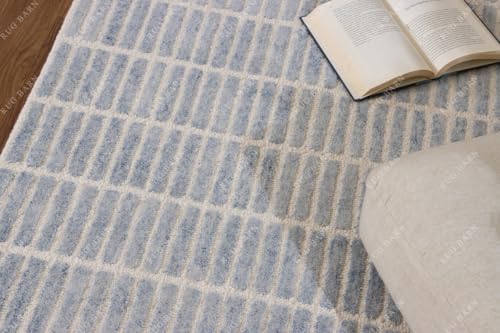
RUG BARN Solid Hand-Tufted 100% Wool Area Rug (8×10, Coastal Blue) — Best Plush Comfort
Key specs (from the verified listing): Hand-tufted 100% wool pile; 8×10 ft; plush dense pile; cotton backing; rectangular.
Our verified pick for this slot is the RUG BARN hand-tufted wool rug.
Hand-tufted rugs are how most households afford a thick wool pile. A tufting gun punches yarn through a canvas backing, the pile is sheared even and plush, and a latex layer locks it in place. The result feels luxurious from day one — deep, soft, warm underfoot — in the modern abstracts, geometrics and soft solids that traditional knotted rugs rarely offer. For a living room whose life happens on the floor, this is the construction that gets loved hardest.
The honest trade is lifespan: the latex backing is the rug’s clock, typically giving many good years before it dries and the rug must be retired, where a knotted rug has no such clock. Buy it as a ten-year rug at a mid-range price and the arithmetic is fair; buy it as an heirloom and it is not.
Strengths
- Thickest, softest underfoot feel in the wool category
- Modern patterns and colors traditional rugs do not offer
- Mid-range tier for genuine wool pile
Trade-offs
- Latex backing sets a finite lifespan
- Shedding is heaviest in this construction for the first months
- Plush pile shows furniture dents and vacuum tracks
Shedding deserves management, not despair: a new tufted wool rug will fill a vacuum canister repeatedly for weeks, which is loose surface fiber leaving, not the rug unraveling. Vacuum gently and often at first — suction without aggressive beater action — and the shed slows to the wool-normal whisper. Buyers who expect it report satisfaction; buyers ambushed by it write the angry reviews, so consider yourself briefed.
Place it where plush pays: living rooms, bedrooms, reading corners. Keep it out of the dining room, where chair legs drag across deep pile and crumbs vanish into it, and out of the entry path, where grit plus plush equals premature wear. In its right room, it is the rug guests sit on the floor to enjoy.
Best for: living rooms and bedrooms where bare feet rule / Not suited for: dining rooms or buyers expecting heirloom lifespan
This pick sits in the mid-range tier — check the current price on Amazon.

SAFAVIEH Kilim Collection Flat Weave Wool Area Rug (8×10, Dark Grey & Orange) — Best Low-Profile / Dining
Key specs (from the verified listing): Handmade flat weave wool; 8×10; Kilim collection; no pile.
Our verified pick for this slot is the SAFAVIEH Kilim flat weave rug.
Flatweaves — kilims, dhurries and their modern descendants — are woven like heavy fabric, with the pattern built into the weave itself and no pile at all. That makes them the problem-solvers of the wool world: thin enough for doors to clear, smooth enough for dining chairs to slide, light enough at 8 x 10 to shake out or flip, and — being woven on both faces — often reversible, which doubles their life and lets you change the room by turning the rug over.
It suits dining rooms first, then entries, kitchens’ eating areas and any living room with a door swinging over the rug. It does not suit buyers seeking plush: a flatweave over a hard floor is a textile, not a cushion, and the pad beneath it supplies whatever softness the setup has.
Strengths
- Low profile clears doors and glides under dining chairs
- Reversible weave doubles usable life
- Easiest wool construction to clean and maintain
Trade-offs
- No pile means no plush — comfort comes from the pad
- Light weight can creep without a good rug pad
- Geometric patterns dominate; soft or plush looks are unavailable
The dining-room case is decisive: chairs slide instead of catching, crumbs sweep off instead of vanishing, and a spill blots from a flat surface rather than a pile’s depths. In a house with children at a table, a flatweave is the difference between a rug that serves dinner and a rug that archives it. Choose the densest weave you can find in the tier — weight per square foot is the quality tell — and the rug will lie flatter and wear longer.
Because there is no pile to crush, flatweaves also handle the front-legs furniture arrangement gracefully and forgive the traffic lane better than any plush rug. If your living room is also your thoroughfare, this may quietly be your Best Overall wearing a dining badge.
Best for: dining rooms, entries and high-traffic living rooms / Not suited for: buyers whose first priority is plush softness
This pick sits in the mid-range tier — check the current price on Amazon.
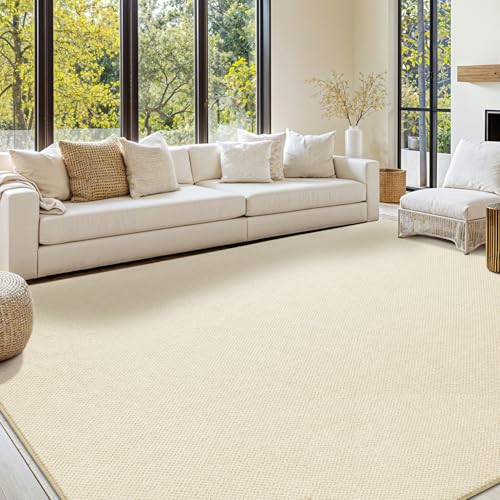
Machine-Made 100% Wool Rug — Best Value in Pure Wool
Machine-made wool rugs are woven on power looms that produce a consistent, durable pile at a fraction of hand-made cost. You give up the irregularities and romance of handwork; you gain a rug whose quality is uniform edge to edge, whose pattern registration is exact, and whose price — still in wool’s budget tier rather than cheap in absolute terms — makes an 8 x 10 in pure fiber reachable for ordinary rooms.
It suits first wool-rug buyers, family living rooms that will test the rug hard, and anyone who wants wool’s properties — resilience, soil-hiding, flame resistance — without paying for handcraft. It will not appreciate, impress a rug dealer, or be repaired by re-knotting; it will simply work, for a long time, which is most households’ actual requirement.
Strengths
- Genuine wool pile at the category’s most accessible tier
- Uniform construction with no weak patches
- Wool’s resilience and soil-hiding without hand-made pricing
Trade-offs
- Patterns and colors are competent rather than characterful
- Edges and finishing are functional, not crafted
- Still costs more than synthetic rugs of the same size
Verify the fiber claim with care in this tier, because it is where ‘wool’ language gets creative: you want ‘100% wool pile’ or a stated wool percentage in the pile, not ‘wool-look’ or a wool fringe on a synthetic body. The listing’s materials line, not its title, is the document that counts — and a seller whose materials line is evasive has answered your question.
In service, treat it exactly like its expensive cousins: pad beneath, gentle vacuum, blot spills fast. Machine-made wool repays the same care with the same virtues, and owners consistently report that the fiber — not the loom — is what they notice in year three, when the traffic lane still refuses to show.
Best for: family living rooms and first-time wool buyers / Not suited for: collectors or buyers wanting hand-made character
This pick sits in the budget tier — check the current price on Amazon.
Shilucheng Wool Blend Rug, 80% Wool / 20% Cotton (8×10, Beige) — Best Budget-Conscious Blend
Key specs (from the verified listing): Blend of 80% wool and 20% cotton (per the verified listing); 8×10; non-slip; cotton backing.
Our verified pick for this slot is the Shilucheng 80/20 wool-cotton blend rug.
Blends exist for two different reasons, and the buyer must know which one is on offer. Wool-viscose blends add silk-like sheen and softness to pattern highlights — prettier, but viscose is weaker when wet and the blend needs gentler cleaning. Wool-polyester blends cut cost and add stain resistance while diluting wool’s resilience in proportion to the synthetic share. Both can be the right rug; neither should be sold or bought as if it were pure wool.
It suits buyers whose budget stops short of pure wool at 8 x 10, and rooms where a blend’s specific virtue — sheen in a formal living room, toughness in a family room — matches the job. The condition is literacy: read the percentages, price the rug as the blend it is, and the purchase is sound.
Strengths
- Lower tier than pure wool at the same size
- Viscose blends offer sheen; polyester blends offer stain toughness
- Retains much of wool’s feel and soil-hiding at blended prices
Trade-offs
- Properties dilute with the non-wool share — resilience included
- Viscose blends dislike wet cleaning; polyester blends feel less rich
- Listings foreground ‘wool’ and footnote the blend — read the footnote
The shopping skill here is arithmetic: a rug that is mostly wool behaves mostly like wool; a rug with a minority of wool behaves like its majority fiber with good marketing. As a working rule, keep wool the clear majority for a living-room rug, and let the blend partner be a deliberate choice — sheen or savings — rather than a discovery after delivery.
Care follows the weakest fiber: a wool-viscose rug gets the viscose rules (blot, never soak, professional cleaning for real stains), whatever the wool could have tolerated. Buy the blend with its care label in mind and it will serve as honestly as any pick on this page.
Best for: budget-limited buyers who read fiber percentages / Not suited for: buyers wanting pure-wool performance and longevity
This pick sits in the budget tier and remains without a link: the fresh catalog verification on 2026-11-22 found no machine-made rug in genuine wool at 8 x 10 — the machine-made results were faux-wool synthetic rugs, which are a different product — so no purchase link is offered for this slot. If a genuine machine-made wool listing appears, check price on Amazon there and verify the fiber line before buying.

SAFAVIEH Braided Wool Oval Rug (8×10, Farmhouse Black) — Best Rustic Character
Key specs (from the verified listing): Hand-woven wool and cotton braid; 8′ x 10′ oval; 3/8 in low pile; made in India.
Our verified pick for this slot is the SAFAVIEH braided wool oval rug.
Some rooms do not want a pattern; they want a material. Braided and textured wool rugs — concentric braids, chunky weaves, nubby looped surfaces — bring wool in its most tactile form, and in farmhouse, cabin, lodge and country interiors they look less like a purchase and more like a birthright. The texture is also the most forgiving surface in this roundup: dirt, crumbs and pet hair disappear into it between cleanings in a way no smooth pile permits.
It suits rustic rooms, homes with dogs, and living spaces that run informal and hard-used. It does not suit sleek modern interiors, and its textured surface is the wrong choice under a dining table, where chair legs snag and crumbs lodge in the texture’s valleys.
Strengths
- Texture hides dirt, hair and wear better than any smooth rug
- Rustic character that completes farmhouse and cabin rooms
- Wool resilience in a construction that shrugs off traffic
Trade-offs
- Texture traps crumbs — a shake-out rug more than a vacuum rug
- Chair legs and claw traffic can pull at braids and loops
- Style-specific: commits the room to a rustic direction
Construction quality in braided rugs lives in the stitching between braids: look for tight, even joins in the listing’s close-ups, because a braid rug fails by separating, not by wearing through. A well-stitched example is nearly indestructible in family service and can be spot-repaired with a needle and matching thread — one of the few rugs an owner can genuinely mend at home.
Vacuum with suction only and patience, or take it outside for the traditional shake-and-beat that textured rugs have received for a century. In a dog-owning rustic household, that rhythm — plus wool’s natural resistance to absorbing odors — makes this the lowest-stress beautiful rug on the list.
Best for: rustic rooms and homes with dogs / Not suited for: sleek interiors or under dining tables
This pick sits in the mid-range tier — check the current price on Amazon.
Comparison Table
Construction is destiny in wool: the table compares the six by how they are made, because that decides lifespan, feel and price tier.
| Pick | Badge | Key spec | Best for |
|---|---|---|---|
| SAFAVIEH Samarkand Hand-Knotted Wool Area Rug (8×10, Rust & Beige) — Check on Amazon | Best Overall / Heirloom | Hand-knotted wool pile on cotton foundation, low-medium pile | living rooms in long-term homes |
| RUG BARN Solid Hand-Tufted 100% Wool Area Rug (8×10, Coastal Blue) — Check on Amazon | Best Plush Comfort | Hand-tufted wool pile, latex-backed, medium-high plush pile | living rooms and bedrooms where bare feet rule |
| SAFAVIEH Kilim Collection Flat Weave Wool Area Rug (8×10, Dark Grey & Orange) — Check on Amazon | Best Low-Profile / Dining | Woven flatweave wool, no pile, reversible patterns | dining rooms, entries and high-traffic living rooms |
| Machine-Made 100% Wool Rug | Best Value in Pure Wool | Machine-woven pure wool pile, consistent construction | family living rooms and first-time wool buyers |
| Shilucheng Wool Blend Rug, 80% Wool / 20% Cotton (8×10, Beige) — Check on Amazon | Best Budget-Conscious Blend | Wool/cotton blended pile — 80% wool, 20% cotton per the verified listing | budget-limited buyers who read fiber percentages |
| SAFAVIEH Braided Wool Oval Rug (8×10, Farmhouse Black) — Check on Amazon | Best Rustic Character | Braided or heavily textured wool construction, rustic patterns | rustic rooms and homes with dogs |
How to Choose an 8 x 10 Wool Area Rug
An 8 x 10 wool rug is expensive enough to buy once and large enough to dominate the room it lands in, so the buying decisions deserve their full weight: construction, fiber truth, size-in-room, and the pad-and-care system that protects the investment. The sections below take them in the order a careful buyer meets them.
None of this requires expertise — it requires reading listings like documents and knowing which photographs to demand.
Construction: knotted, tufted, woven or machine-made?
Hand-knotted is the heirloom construction: pile tied into the rug’s structure, no backing to fail, decades of life, premium tier. Hand-tufted is the comfort construction: plush pile locked by latex, mid-range tier, a lifespan the backing sets. Flatweave is the practical construction: no pile, reversible, dining-and-door friendly, mid-range. Machine-made is the value construction: uniform, honest, budget-for-wool tier. Braided and textured constructions trade smoothness for character and camouflage.
Match construction to the room’s next ten years, not its next photograph. A household with toddlers and a dog, in a house it will leave in five years, is honestly served by tufted or machine-made; a settled living room that will host the same furniture for decades is where hand-knotted earns its tier. The wrong pairing in either direction wastes money — on lifespan you will not use, or on replacements you did not budget.
Fiber truth: reading ‘wool’ like a contract
The materials line is the rug’s contract, and it rewards literal reading. ‘100% wool pile’ on a cotton foundation is the classic honest claim. ‘Wool blend’ must come with percentages — wool’s share decides how much of wool’s resilience and soil-hiding you are actually buying. ‘Wool-look’, ‘wool-style’ and ‘wool-inspired’ mean no wool at all, and appear on synthetic rugs priced to be mistaken. New Zealand and highland wools are marketed for whiteness and resilience respectively; staple length — longer fibers — quietly predicts less shedding and longer wear in any origin.
Judge shedding expectations by construction and staple, not by promises: all new wool rugs shed loose fiber, tufted and long-pile most, flatweaves least, and a rug still shedding heavily after six months of gentle vacuuming is telling you its staple was short. Buy from listings that show the rug’s back and state fiber plainly; in this category, transparency is the most reliable quality signal there is.
Sizing the 8 x 10 in a real room
The standard living-room arrangement puts the front legs of the sofa and chairs on the rug and the back legs off — an 8 x 10 achieves this in most rooms, unifying the seating into one island. All-legs-on requires larger; floating the rug with no legs on it makes even an 8 x 10 look like a postage stamp in a big room, so measure your seating span before assuming the size. Under a dining table, 8 x 10 serves a table for six with chairs staying on the rug when pulled out — the test that matters. In a bedroom, the same rug under a queen bed leaves a wool border to land on, which is the size’s quietest luxury.
Leave a consistent border of bare floor — a hand’s width to a foot and a half — between rug edge and wall; a rug that nearly touches walls reads as carpet that failed. And buy the pad with the rug: at eighty square feet, a rug without a pad creeps, wears from beneath, and feels thinner than it is.
Why Wool Outlasts Every Other Rug Fiber in a Busy Room
Wool’s advantages are structural, not sentimental. The fiber’s outer scales overlap like shingles, which is why soil sits on a wool pile’s surface — available to the vacuum — instead of sinking as it does into smooth synthetics, and why wool rugs famously look cleaner than they are. The fiber’s natural crimp makes it a spring: it compresses under a sofa leg and recovers, where synthetic piles crush permanently into traffic lanes. Wool absorbs moisture vapor — up to a third of its weight — without feeling damp, buffering a room’s humidity and releasing the moisture when the air dries. And it is inherently flame-resistant, charring rather than melting or igniting readily, which is why wool has clothed ships and aircraft for a century.
The same biology explains the care rules. Scales that hide soil also felt under heat, agitation and alkaline detergents — hence gentle vacuuming and wool-appropriate cleaning. Keratin is a protein, so wool is moth food when stored dirty and undisturbed — hence cleaning before storage and vigilance in dark, quiet corners. None of this is fragility; it is a natural material with known rules, and owners who learn the five-minute version of them get the decades of service that make wool’s price per year the lowest in the rug store.
How to Lay and Care for an 8 x 10 Wool Rug
A wool rug’s first week sets its years. Lay it properly, pad it properly, and establish the care rhythm while the rug is new.
- Unroll the rug and let it relax for a day; reverse-roll or weight curled corners rather than forcing them, and let packing creases fall out under their own weight.
- Cut the rug pad an inch or two smaller than the rug on every side, and lay it first — dense felt with a rubber grip face is the standard for wool on hard floors.
- Position the rug on the pad with front furniture legs planned onto it, and check the floor border is even on all sides before furniture lands.
- Vacuum the new rug gently and often in the first weeks — suction-focused, beater bar off or raised — to lift loose fiber without worrying at the pile.
- Rotate the rug 180 degrees every six months so traffic and sunlight distribute across the whole surface.
- Blot every spill immediately with a clean cloth and cool water; never rub, never soak, and keep a wool-safe cleaner for the stains water will not lift.
- Schedule a professional clean every year or two in busy rooms, and always before any long storage — clean wool is the only wool moths ignore.
Keep one habit above all: shoes off in houses that can manage it. Grit is a rug’s true enemy — it sinks, cuts fibers from beneath, and no construction outlasts it. The pad, the rotation and the gentle vacuum handle the rest.
Common Buying Mistakes
Buying ‘wool-look’ believing it is wool
The category’s most expensive misunderstanding. Read the materials line, demand the fiber percentages, and price the rug as what it is. A synthetic rug knowingly bought can be a fine purchase; the same rug bought as wool is a fraud you paid for.
Skipping the rug pad
At 8 x 10 the pad is not an accessory: it stops creep, prevents grit from grinding the rug’s underside, protects the floor’s finish, and adds the cushion flat constructions lack. A wool rug without a pad wears out faster and feels cheaper — the worst economy in the category.
Attacking new-rug shedding with aggressive vacuuming
Shedding is loose fiber leaving, worst in tufted and long-pile rugs, and it slows with gentle, frequent vacuuming. A beater bar at full aggression pulls more fiber, frays edges and shortens the rug’s life to cure a condition that time cures free.
Putting plush pile under the dining table
Chair legs drag, crumbs vanish, spills soak deep — dining duty wants flatweave or low pile. Match pile height to the room’s furniture in motion, not to the showroom’s stillness.
Guessing the size from the room’s name
‘Living room’ is not a measurement. Measure the seating span, plan the front-legs arrangement, and confirm the 8 x 10 against your actual furniture before the rug ships — returns on eighty square feet of wool are nobody’s favorite errand.
Final Recommendation
If the budget allows one rug for a settled living room, the hand-knotted wool rug is the purchase the category exists for: buy it once, pad it well, and let decades arbitrate the price. Most households will land, happily, one tier down — the plush hand-tufted for floor-living rooms, the machine-made pure wool for family service, the flatweave wherever chairs slide and doors swing.
Choose the blend with percentages read and eyes open, the braided texture where rustic life needs camouflage, and any of the six with the same closing ritual: verify the fiber, buy the pad, and give the rug its gentle first weeks. An 8 x 10 in wool is not a decoration decision; it is the floor of the next decade of evenings, and it rewards being chosen like one.
Keep exploring the same cluster: Best Braided Wool Rugs Best Area Rugs For Family Rooms Best Area Rugs For Homes With Dogs Best Affordable Moroccan Rugs Best 4 Round Area Rugs Best Area Rugs For A Grey Couch
Wool Rugs and Allergies, Pets and Real Floors
Wool’s reputation among allergy-conscious households is better than its ‘natural fiber’ label might suggest, and the reasons are mechanical. Wool pile traps dust and allergens down in the pile where they stay until vacuuming removes them, rather than letting them circulate on a hard floor’s air currents — a rug functions as the room’s largest filter, provided it is vacuumed like one. Wool also resists the static that makes synthetic rugs attract and hold pet hair against extraction; a vacuum pass over wool genuinely empties it, where synthetics keep a static-clung fraction forever. Households managing sensitivities usually pair the rug with the habits that make it work: shoes off, weekly suction vacuuming, and a professional clean on schedule, since a neglected rug of any fiber becomes a reservoir instead of a filter.
Pets vote for wool with their feet and their accidents. Dogs choose wool rugs to lie on with notable consistency — the fiber’s temperature buffering makes it the coolest-feeling surface in summer and the warmest in winter — and the practical accidents of pet life blot out of wool more forgivingly than out of most fibers, because wool’s scaly surface resists absorbing liquids quickly, buying the owner the minute that matters. The cautions are constructional: looped and braided surfaces can catch claws, so smooth cut pile or flatweave suits clawed households best, and any rug in a puppy’s first year should be a rug whose loss the household could survive philosophically, whatever its fiber.
Underneath everything sits the floor itself, and wool is kind to it in one way and demanding in another. Kind: a wool rug with a proper pad protects wood finishes from chair legs, grit abrasion and sunlight fading far better than a thin synthetic. Demanding: a rug this size traps moisture against a floor if spills or steam cleaning leave it wet underneath, so the rule is absolute — a wool rug goes back down only on a dry floor, over a dry pad, itself fully dry. Owners who keep that one rule find wool and hardwood to be the oldest and happiest partnership in the house.
What an 8 x 10 Wool Rug Should Cost — and Why the Range Is Enormous
Buyers new to the category are often startled that one 8 x 10 wool rug can cost several times another, and the range is honest once its drivers are visible. Labor is the largest: a hand-knotted rug represents months of a weaver’s work, a hand-tufted rug days, a machine-made rug minutes of loom time — and the prices descend in that order for reasons no marketing can repeal. Fiber is the second driver: long-staple, well-sorted wool costs more than short or recycled fiber, and shows it in shedding behavior and decades of wear rather than in the showroom. Dyeing and finishing — vegetable or quality synthetic dyes, careful washing and shearing — add the third layer, visible in color depth that synthetics imitate at arm’s length and never at the fiber.
The practical use of this knowledge is calibration, not extravagance. A household should spend to the level of its tenure and traffic: the settled living room justifies the knotted tier because its cost divides across decades; the five-year home is honestly served by machine-made or tufted wool whose quality is real but whose lifespan matches the plan. What never calibrates is the too-cheap wool rug — the listing priced like a synthetic while claiming handwork and pure fiber — because the arithmetic of labor and material says something in the claim is false, and what is false is always the part you cannot see in the photographs. In this category, a plausible price is itself a quality signal, and the guide’s insistence on reading materials lines is how a buyer collects on it.
Styling an 8 x 10 Wool Rug Without Letting It Swallow the Room
A rug this size is the room’s largest single design decision after the walls, and wool’s material richness means it should be styled as the foundation rather than competed with. The working approach is to let the rug set the room’s temperature: a warm-toned wool rug wants wood, leather and warm metals around it; a cool grey or blue wool wants the furniture’s fabrics to pick up one of its secondary colors rather than match its main one — matching exactly is what makes rooms look like showrooms and feel like them too. Pattern scale follows room scale: an 8 x 10 can carry a large motif that would overwhelm a runner, and traditional medallion designs are drawn for exactly this expanse, with borders engineered to frame the furniture island the rug creates.
Layering is the stylist’s second tool, used sparingly: a smaller flatweave or hide over a wool field rug can define a reading corner within the larger seating island, though on plush wool the layered piece needs weight or a pad to sit honestly. Lighting completes the picture — wool’s matte, light-absorbing surface deepens under warm light and flattens under cold, so the evening lamp test tells you more about a wool rug’s true color than the showroom’s noon. Judge the rug in the room’s own light, at the hour the room is most lived in, and the choice you make will still please you in year five.
Frequently Asked Questions
Is wool worth the extra cost over synthetic rugs?
For a main living space, usually yes: wool resists crushing, hides soil, and stays presentable for years after synthetics flatten and dull — its cost per year of good appearance is often the lowest in the store. For short tenancies or disposable décor, synthetics make more sense.
How much will a new wool rug shed?
All new wool sheds loose fiber; tufted and long-pile rugs shed most, flatweaves least. Expect weeks of noticeable shedding that fades with gentle, frequent vacuuming. Heavy shedding persisting past six months suggests short staple fiber.
What size room does an 8 x 10 rug suit?
Most living rooms, using the front-legs-on arrangement for sofa and chairs; dining setups for six; and queen bedrooms with a generous border. Measure your seating span — the rug should unite the furniture group, not float inside it or touch the walls.
Can a wool rug handle dogs and kids?
Wool is one of the better fibers for both: it hides hair and soil, resists absorbing odors, and cleans well. Choose low pile or flatweave for the messiest years, keep nails trimmed to protect loops and braids, and blot accidents fast.
How do I clean a wool rug?
Vacuum gently and regularly, blot spills immediately with cool water, use wool-safe cleaners sparingly, and book a professional clean every year or two. Avoid heat, harsh alkalis and soaking — the three things wool genuinely dislikes.
Do I really need a pad under an 8 x 10 wool rug?
Yes. The pad stops creeping, protects both rug and floor, and adds cushioning. Cut it slightly smaller than the rug so it stays hidden, and choose dense felt with a gripping face for hard floors.


