Disclosure: airfryerkitchensupply.com is reader-supported. When you buy through links on our site, we may earn an affiliate commission at no extra cost to you.
Where to buy
Every rug below was confirmed. This guide’s lens is specific: rugs that sit correctly on modern tile — large-format, cool-toned, often glossy — which means low pile that will not fight grout lines, washable or easy-care builds where the listings state them, and palettes that bridge tile’s coolness with warm furniture. Check the current price on Amazon and confirm dimensions on the listing.
- OLANLY 8×10 Washable Area Rug, Beige Distressed Abstract Modern — Check the current price on Amazon
- Noifamo Machine Washable Rug 8×10, Vintage Distress Boho — Check the current price on Amazon
- Yarooge 8×10 Washable Vintage Retro Rug, Rust Clay — Check the current price on Amazon
- SAFAVIEH Evoke Area Rug 8×10, Vintage Medallion Ivory & Taupe EVK256E — Check the current price on Amazon
- Loloi Magnolia Home Pace Taupe / Wheat Rug 7′-10″ x 10′ (PAC-03) — Check the current price on Amazon
- SAFAVIEH Reflection Area Rug 8×10, Beige & Cream (RFT667A) — Check the current price on Amazon
The best transitional rugs matching modern tile solve a flooring problem that did not exist twenty years ago. Modern tile — large-format porcelain, cool gray or greige tones, matte or polished finishes, minimal grout — is beautiful and hard: acoustically bright, cold underfoot, slippery when wet, and visually stark under furniture. A transitional rug is the ideal mediator because its traditional motifs warm tile’s modernity without clashing with it, but only if the rug’s construction respects the floor: low pile that lies flat over grout lines, a build that can be washed or easily cleaned where the listing states it, and a palette that negotiates between cool tile and warm wood furniture. All six picks were verified with those constraints in view.
Tile changes the rug rules in three concrete ways. First, thickness: a plush rug on tile creates a trip lip at its edge and telegraphs every grout line through its backing, while a low-pile or flat rug lies like it belongs there. Second, care: tile kitchens and entryways are splash and grit zones, so washable constructions — three picks here carry washable or machine-washable in their verified titles — earn their place honestly. Third, color temperature: gray tile under warm furniture is the classic modern mismatch, and a transitional rug with both cool and warm threads in its pattern is the piece that makes the room stop arguing with itself.
The six picks divide into washable low-pile rugs for kitchens, dining areas and entries, and low-pile power-loomed or printed neutrals for living areas laid over tile. Sizes center on the 8×10 class, with construction and palette varied deliberately. If your floors are wood rather than tile, the companion guide to transitional area rugs is the better starting point; this one assumes tile and all it implies.
Key Takeaways
- Tile demands low pile: it lies flat over grout lines and avoids a trip lip at the rug’s edge.
- Three picks carry washable or machine-washable in their verified titles — the right builds for tile kitchens and entries.
- Transitional patterns bridge cool gray tile and warm wood furniture by carrying both temperatures in one design.
- Neutral ivory, taupe and beige grounds are the safest tile partners; they calm large-format tile’s starkness.
- A pad made for hard floors is non-negotiable on tile: grip protects both the rug and anyone stepping from tile onto it.
In this guide
Quick Picks
Best Overall for Tile: OLANLY 8×10 Washable Area Rug, Beige Distressed Abstract Modern — a washable, non-slip, low-profile 8×10 in beige distressed abstract — the tile brief in one listing. — Check price on Amazon
Best Machine Washable Vintage: Noifamo Machine Washable Rug 8×10, Vintage Distress Boho — machine washable, ultra-soft, non-slip positioned, low pile — with a vintage distressed boho pattern. — Check price on Amazon
Best Warm Color for Cool Tile: Yarooge 8×10 Washable Vintage Retro Rug, Rust Clay — a washable, ultra-thin, non-slip low-pile vintage rug in rust clay — warmth as a strategy. — Check price on Amazon
Best Formal for Tiled Living Rooms: SAFAVIEH Evoke Area Rug 8×10, Vintage Medallion Ivory & Taupe EVK256E — a power-loomed vintage medallion in ivory and taupe at 3/8-inch pile — the dressiest tile partner here. — Check price on Amazon
Best Designer Neutral: Loloi Magnolia Home Pace Taupe / Wheat Rug 7′-10″ x 10′ (PAC-03) — a vintage-inspired neutral in taupe and wheat from the Magnolia Home by Joanna Gaines line, per the title. — Check price on Amazon
Best Easy-Care Neutral: SAFAVIEH Reflection Area Rug 8×10, Beige & Cream (RFT667A) — a beige-and-cream 8×10 whose title promises non-shedding, easy cleaning — the quiet workhorse for tile. — Check price on Amazon
How These Picks Were Chosen
Rugs were found by searching Amazon listing data for transitional and vintage-style area rugs, then filtered through the tile lens: pile had to be low or flat where stated, washable claims were credited only where the verified title makes them, and palettes were chosen to work against cool modern tile rather than warm wood. Rug pads, tapes and accessories were excluded; only complete area rugs were considered. Near-identical colorways of one design were deduplicated to a single representative listing.
The resulting six split by room. The OLANLY, Noifamo and Yarooge are the washable team — each title states washable or machine washable, each is low-pile and non-slip positioned, which is the correct specification for tile kitchens, dining rooms and entry halls where spills and grit are weekly events. The Safavieh Evoke and the two Loloi designs are the living-area team: low-pile or printed-flat constructions in ivory, taupe and neutral palettes that soften a tiled living room’s acoustics and temperature while keeping the floor’s modern character visible around the rug’s border.
A note on backing honesty: ‘non-slip’ appears in several washable titles and is reported as the listings’ positioning; on polished tile, no rug should be trusted without a hard-floor pad beneath it, and the how-to section below treats the pad as part of the installation, not an accessory. That caution costs nothing and prevents the one genuinely dangerous failure mode in this category.
The 6 Best Transitional Rugs Matching Modern Tile

OLANLY 8×10 Washable Area Rug, Beige Distressed Abstract Modern — Best Overall for Tile
The OLANLY’s verified title is almost a checklist for this guide: washable, soft, non-slip positioned, beige, with a distressed abstract modern pattern, spill and stain resistant positioning, and a low profile suited to family rooms and under dining tables. Abstract distressing is the modern end of transitional — no formal motif to align, just a warm, worn texture that takes the edge off large-format tile. For a tiled open-plan kitchen-diner, this is the default recommendation.
Strengths
- Washable with spill and stain resistant positioning, per the verified title
- Beige distressed abstract pairs with gray, white and greige tile alike
- Low profile lies flat over grout lines and under dining chairs
Trade-offs
- Abstract pattern offers less traditional character than the medallion picks
- Non-slip positioning still wants a hard-floor pad on polished tile
- Beige shows dark spills more than mid-tone patterns — washable build is the countermeasure
| Detail | Verified from listing title |
|---|---|
| Size | 8 x 10 |
| Care | Washable (per listing title) |
| Pattern | Distressed abstract modern, beige |
| Positioning | Non-slip, spill & stain resistant (per title) |
The distressed abstract is the pattern family that modern tile was made for. Tile’s geometry is already strong — long straight grout lines, big flat fields — so a rug with its own strong geometry fights it, while a soft, irregular, worn-looking pattern relaxes the whole floor plane. Beige is the correct ground for the same reason: it warms cool tile without introducing a color the room must then repeat, and it hides the pale dust that tile shows relentlessly.
Washability changes the ownership math in a kitchen-diner. A rug that can be washed is a rug that can live where food happens, which is exactly where tile floors concentrate. Combined with the low profile — chairs slide, doors clear, grout lines stay invisible beneath — the OLANLY is the pick that treats tile as a workplace rather than a showroom, and it is no accident that it leads this guide.
Best for: tiled kitchen-diners, family rooms and open-plan spaces / Not suited for: formal rooms wanting a defined traditional motif
Check the current price on Amazon

Noifamo Machine Washable Rug 8×10, Vintage Distress Boho — Best Machine Washable Vintage
Where the OLANLY is abstract, the Noifamo’s verified title promises a vintage distressed pattern with a boho character — the more traditional-leaning of the washable team, for buyers who want a recognizable vintage rug look over their tile. Machine washable, ultra-soft and low pile per the title, it is positioned for living rooms and bedrooms as well as dining areas, and its high-traffic positioning suits tiled halls.
Strengths
- Machine washable stated in the verified title — the strongest care claim in this guide
- Vintage distressed pattern gives real transitional character, not just texture
- Low pile and non-slip positioning suit tile and high traffic
Trade-offs
- Boho character is a style commitment; formal rooms should choose the Evoke
- Ultra-soft low pile still feels firm compared with plush rugs
- Washing an 8×10 requires a large-capacity machine — check yours before relying on it
| Detail | Verified from listing title |
|---|---|
| Size | 8 x 10 |
| Care | Machine washable (per listing title) |
| Pattern | Vintage distress, boho |
| Pile | Low pile (per title) |
Machine washable is the claim to weigh most carefully in this category, because it is the one buyers will actually test. An 8×10 rug, even a low-pile one, is a substantial load; the honest advice is to confirm your machine’s capacity and to treat full washes as seasonal events, with spot care between them. On tile that rhythm works well, because tile itself handles the daily mess and the rug only needs its periodic reset.
The vintage distress pattern earns its transitional label the classic way: a traditional rug design, pre-worn in appearance, so it mediates between a sleek modern floor and furniture of any age. On cool gray tile, the distressed warmth is doing visible work from the doorway — the room reads furnished rather than floored. If your tile is warm-toned porcelain instead, the same rug reads as tone-on-tone calm; it is the most palette-forgiving of the washable three.
Best for: vintage lovers over tile; high-traffic tiled halls and living rooms / Not suited for: formal dining rooms or small washing machines relied on weekly
Check the current price on Amazon

Yarooge 8×10 Washable Vintage Retro Rug, Rust Clay — Best Warm Color for Cool Tile
The Yarooge’s verified title adds the color argument: a washable vintage retro design in rust clay. Rust is the classic antidote to cool tile — a warm, earthy, traditional-rug color that makes gray porcelain feel intentional rather than cold. Ultra-thin and low pile per the title, it is the flattest of the washable team, which makes it the dining-under-table and door-clearance specialist of the three.
Strengths
- Rust clay palette warms gray and white tile decisively
- Ultra-thin low pile: the best door clearance and chair glide in the guide
- Washable and non-slip positioned, per the verified title
Trade-offs
- Rust is a commitment color — it will set the room’s accent direction
- Ultra-thin means minimal cushion; the pad must supply comfort
- Retro vintage styling suits casual rooms better than formal ones
| Detail | Verified from listing title |
|---|---|
| Size | 8 x 10 |
| Care | Washable (per listing title) |
| Profile | Ultra thin, low pile, non-slip (per title) |
| Color | Rust clay |
Color temperature is the invisible half of ‘matching modern tile’. Large-format tile trends cool — gray, white, greige — while most furniture and most people trend warm. A rust-toned rug does not merely decorate that gap; it closes it, giving the eye a warm field that makes cool tile read as a deliberate contrast instead of a chill. The vintage distress keeps the rust from feeling like a solid block of color, breaking it into the tonal variation that traditional rugs have always used.
The ultra-thin profile deserves respect as a functional choice. Under a dining table on tile, thin is what lets chairs move without bunching the rug; at an entry, thin is what lets the door swing. What thin removes — cushion — the pad returns, and on tile a good pad is already mandatory for grip. Specify the pad, and this becomes the most practical warm rug in the guide.
Best for: gray-tile dining rooms and entries that feel cold / Not suited for: warm-toned tile or rooms already saturated with warm color
Check the current price on Amazon
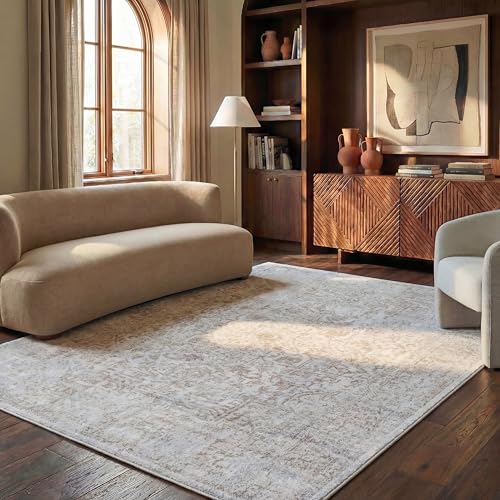
SAFAVIEH Evoke Area Rug 8×10, Vintage Medallion Ivory & Taupe EVK256E — Best Formal for Tiled Living Rooms
The Evoke is the living-area team’s formal option: its verified title confirms a vintage medallion in ivory and taupe, power-loomed polypropylene at a 3/8-inch low pile, made in Turkey. Ivory and taupe is the palette modern tile asks for — light enough to lift a tiled room, warm enough to mediate its coolness, neutral enough to let furniture lead. This is the pick for a tiled living room that hosts adults, conversation and the occasional glass of wine rather than daily toddler traffic.
Strengths
- Vintage medallion gives a tiled living room a genuine focal point
- Ivory and taupe is the most tile-compatible neutral palette in the guide
- Power-loomed polypropylene at low pile: durable, low-shedding, spot-cleanable
Trade-offs
- Not a washable listing — care is spot-cleaning, unlike the washable team
- Ivory fields show spills; better for adult living rooms than play spaces
- A centered medallion needs a centered layout to look right
| Detail | Verified from listing title |
|---|---|
| Size | 8′ x 10′ |
| Construction | Power-loomed polypropylene |
| Pile | 3/8 in low pile |
| Origin | Made in Turkey |
| Pattern | Vintage medallion, ivory & taupe (EVK256E) |
A medallion over tile is a study in contrasts that works: the tile supplies the grid, the rug supplies the curve, and each makes the other look more deliberate. Ivory and taupe keep that contrast gentle. In a tiled living room — a floor type that can make even good furniture look like it is waiting in a showroom — the Evoke is the piece that declares the room inhabited, and its low polypropylene pile keeps it practical under coffee tables and chair legs.
The care boundary is stated plainly: this is a spot-clean rug, not a washable one, and on tile that is a reasonable division — the tile takes the traffic abuse, the rug takes the visual weight. Choose it where spills are occasional and adult; choose the washable team where spills are a schedule. That honesty, applied room by room, is how a house ends up with the right rug in each space rather than one compromise everywhere.
Best for: tiled living rooms and adult entertaining spaces / Not suited for: playrooms or anywhere spills are daily
Check the current price on Amazon

Loloi Magnolia Home Pace Taupe / Wheat Rug 7′-10″ x 10′ (PAC-03) — Best Designer Neutral
The Pace’s verified title describes a vintage-inspired, neutral area rug in taupe and wheat, from the Magnolia Home by Joanna Gaines collaboration. Taupe and wheat is a warmer neutral than ivory and gray — it is the palette for tile installations in greige, travertine-look porcelain and warm white, where a cooler rug would clash by a half-tone. It suits living and dining areas over tile where the goal is calm cohesion rather than contrast.
Strengths
- Taupe and wheat warms warm-neutral tile that cooler rugs fight
- Vintage-inspired design reads transitional without a dominant motif
- Designer collaboration line with a restrained, livable palette
Trade-offs
- The listing does not claim washability — treat it as a spot-care rug
- Warm neutrals can look muddy under very cool LED lighting; check your bulbs
- Slightly nonstandard dimensions (7′-10″ x 10′) — tape it out before ordering
| Detail | Verified from listing title |
|---|---|
| Size | 7′-10″ x 10′ |
| Line | Magnolia Home by Joanna Gaines (PAC-03) |
| Palette | Taupe / wheat |
| Style | Vintage inspired, neutral (per title) |
Half-tone clashes are the subtle failure of rug buying: a rug and a floor that are each ‘neutral’ and yet wrong together, because one leans warm and the other cool. The Pace exists for the warm side of that line. Against greige and travertine-look tile — among the most installed modern floors — taupe and wheat sit inside the floor’s own family and extend it under the furniture, which is why rooms with this pairing photograph so calmly.
The vintage inspiration is kept quiet, more texture and tone than motif, which suits dining areas where a strong medallion would compete with the table. As a non-washable listing it belongs in the living-area team: spot care, a good pad, and the protection of being placed where life is lived gently. Judge its color in your own light, warm and cool bulbs both, before committing — neutral rugs are the most lighting-sensitive purchases in this guide.
Best for: warm-neutral and greige tile; calm, cohesive living and dining rooms / Not suited for: cool gray tile, where the Evoke’s ivory-taupe fits better
Check the current price on Amazon

SAFAVIEH Reflection Area Rug 8×10, Beige & Cream (RFT667A) — Best Easy-Care Neutral
The Reflection’s verified title makes two practical promises — non-shedding and easy cleaning — in a beige and cream palette suited to living rooms, bedrooms and dining spaces. On tile, non-shedding matters more than on other floors, because every shed fiber shows on a hard surface and migrates across it. This is the low-drama pick: a neutral, easy-care rug that softens a tiled room without asking for attention or a washing machine.
Strengths
- Non-shedding and easy-cleaning positioning stated in the verified title
- Beige and cream is the safest possible partner for any tile tone
- Suits living room, bedroom and dining space per the listing
Trade-offs
- The listing does not state pile height or construction in the verified title — confirm details on the listing
- Quiet neutrality will underwhelm buyers wanting pattern as a feature
- Not a washable listing; care is routine vacuuming and spot cleaning
| Detail | Verified from listing title |
|---|---|
| Size | 8′ x 10′ |
| Palette | Beige & cream |
| Positioning | Non-shedding, easy cleaning (per title) |
| Collection | Reflection (RFT667A) |
There is a buyer this guide should serve plainly: the one whose tiled room needs softening, quieting and warming, and who experiences pattern as visual noise. For that buyer the Reflection is not the boring pick but the correct one — a beige-cream field that takes the acoustic edge off tile, gives bare feet a warm landing, and lets art, plants and people supply the room’s interest. Non-shedding construction keeps the surrounding tile looking clean with ordinary sweeping, which on hard floors is a daily, visible benefit.
Its limits are the mirror of its virtues. It will not anchor a room’s design, warm a cold palette by color, or survive a toddler’s juice the way the washable team can. Placed in a bedroom or a calm living room over tile, with a proper pad beneath, it does its quiet job for years — and in a guide full of statements, there is an honest place for the rug that makes none.
Best for: calm bedrooms and living rooms over any tile tone / Not suited for: design-led rooms or high-spill zones
Check the current price on Amazon
Comparison Table
| Pick | Badge | Key spec | Best for |
|---|---|---|---|
| OLANLY 8×10 Washable Area Rug, Beige Distressed Abstract Modern | Best Overall for Tile | 8×10 washable, beige distressed abstract | tiled kitchen-diners, family rooms and open-plan spaces |
| Noifamo Machine Washable Rug 8×10, Vintage Distress Boho | Best Machine Washable Vintage | 8×10 machine washable, vintage distress | vintage lovers over tile; high-traffic tiled halls and living rooms |
| Yarooge 8×10 Washable Vintage Retro Rug, Rust Clay | Best Warm Color for Cool Tile | 8×10 washable, ultra-thin, rust clay | gray-tile dining rooms and entries that feel cold |
| SAFAVIEH Evoke Area Rug 8×10, Vintage Medallion Ivory & Taupe EVK256E | Best Formal for Tiled Living Rooms | 8×10 medallion, ivory & taupe, 3/8 in pile | tiled living rooms and adult entertaining spaces |
| Loloi Magnolia Home Pace Taupe / Wheat Rug 7′-10″ x 10′ (PAC-03) | Best Designer Neutral | Taupe/wheat neutral, vintage inspired | warm-neutral and greige tile; calm, cohesive living and dining rooms |
| SAFAVIEH Reflection Area Rug 8×10, Beige & Cream (RFT667A) | Best Easy-Care Neutral | 8×10 beige & cream, non-shedding per title | calm bedrooms and living rooms over any tile tone |
How to Choose a Rug for Modern Tile Floors
Start with the floor’s two facts: its temperature and its finish. Temperature is color — hold a white sheet of paper against your tile in daylight; tile that makes the paper look yellow is cool, tile that makes it look blue is warm, and your rug should lean the opposite way by a step to create balance, or match it deliberately for a tonal room. Finish is grip and glare: polished tile is slippery and reflective, so it demands a grippy pad and rewards a matte, textured rug that absorbs light; matte tile is more forgiving on both counts. Every other decision in this category is secondary to those two.
Pile comes next, and on tile the answer is almost always low. Low pile lies flat over grout lines instead of tenting on them, keeps the rug’s edge a shallow step rather than a trip lip, lets dining chairs and doors move, and vacuums clean of the grit that tile tracks everywhere. The picks here are low-pile, ultra-thin or printed-flat for exactly these reasons. If you crave softness, buy it in the pad — a thicker felt-and-rubber pad under a low rug gives tile rooms the cushion they lack without any of plush pile’s problems.
Care is the third decision, and it is a room decision, not a rug decision. Tile kitchens, entries and dining rooms are spill environments: choose the washable team. Tile living rooms and bedrooms are dust environments: low-pile spot-care rugs like the Evoke, Pace and Reflection are entirely sufficient, and their stronger patterns and palettes become available to you. Deciding room by room, instead of demanding one rug type serve the whole house, is the mark of a well-rugged tiled home.
- Test tile temperature with white paper in daylight; balance or match it deliberately
- Polished tile = grippy pad mandatory, matte textured rug preferred
- Low pile always on tile; buy softness in the pad, not the pile
- Washable team for kitchens, entries and dining; spot-care team for living rooms and bedrooms
- Leave a consistent tile border visible — the rug should float on the floor, not replace it
The Rug Pad on Tile: A Short, Non-Negotiable Guide
On tile, the pad does three jobs at once. It grips, because a rug on glazed porcelain without grip is a rug waiting to skate under a hurried foot. It cushions, because tile offers none and a low-pile rug offers little. And it protects, because grit trapped under a rug on tile becomes sandpaper that dulls glaze with every step. The correct product is a pad made for hard floors — a felt-and-natural-rubber combination is the common recommendation — cut an inch smaller than the rug on every side so it never peeks out.
Avoid thick foam pads on tile: they add a spongy step at the rug’s edge, can react with some floor finishes, and do less gripping than their bulk suggests. Avoid tape as a primary solution on quality tile; adhesives and glazed surfaces are a poor long-term pairing. And re-check the pad whenever you wash or move the rug — pads migrate in small increments, and a pad corner folded under a rug is a lump that will wear a hole in both. Two minutes of attention at each reset keeps the whole system invisible, which is what a good installation should be.
Sound, Warmth and Light: What a Rug Fixes in a Tiled Room
Tile’s drawbacks are physical, and a rug addresses each one measurably. Sound: hard parallel surfaces — tile floor, drywall, glass — reflect noise until a room rings; a rug over the central floor area absorbs the first reflection and drops the echo noticeably, which is why a rugged tiled room feels calmer before it looks different. Warmth: tile conducts heat away from bare feet faster than almost any other floor, so even a thin rug transforms morning comfort, and the washable team’s thin profiles still deliver most of that benefit.
Light is the third effect, and the least discussed. Large matte or polished tile fields bounce window light evenly, which can flatten a room into glare; a patterned transitional rug breaks the field, gives the eye a resting place, and restores the sense of a furnished interior. This is the deep reason transitional patterns suit tile so well: the floor already supplies modern order, and the rug’s traditional warmth is the missing human element. Choose the rug that supplies what your tile lacks, and the pairing will look inevitable.
How to Install and Care for a Rug on Tile
Installation on tile is a fifteen-minute job with one extra step compared with wood: managing grip on a smooth, hard surface. The routine below covers placement through seasonal care.
- Sweep and then damp-mop the tile where the rug will sit, and let it dry fully — grit left underneath becomes sandpaper underfoot.
- Lay the hard-floor pad first, cut an inch smaller than the rug on all sides, and smooth it flat with no folded corners.
- Unroll the rug over the pad, align it to the tile’s grout lines or the room’s furniture axis — choose one reference and be consistent — and let it relax flat.
- Test the grip by pushing the rug’s edge firmly with a foot; any skating means the pad is wrong or missing, and should be fixed before furniture goes on.
- Place furniture using the front-legs-on rule, then vacuum the rug and the surrounding tile border in one pass to set your weekly rhythm.
- For washable picks, wash seasonally or after major spills per the listing’s care guidance; for spot-care picks, blot spills immediately and vacuum grit weekly before it migrates under the rug.
Recheck two things monthly: the pad’s position (it migrates in small increments) and the rug’s edges (a curling corner on tile is a trip hazard, weighted flat overnight before it sets). Tile rooms also reward a quarterly lift-and-sweep beneath the rug — the grit that collects at the border will otherwise work its way under and dull the glaze in a visible frame around your rug.
Rug Layering and Borders on Tile: The Design Details
Once the practical questions are settled, two design decisions separate a tiled room that looks finished from one that looks floored. The first is the border relationship: a transitional rug with a defined border band acts as a picture frame laid on the tile, and it suits formal living areas where the Evoke’s medallion does the same work at the center. A borderless, all-over pattern acts as a field, and it suits open-plan tile where the rug is a zone in a larger floor. Mixing the two logics — a strong border and a strong medallion and a busy tile pattern — is the one combination to avoid; choose a single protagonist per room and let the tile be the supporting grid it is good at being.
The second decision is the visible tile margin, and it deserves a number: in most rooms, twelve to twenty-four inches of tile showing between the rug’s edge and the walls or cabinetry reads as deliberate. Less than that and the rug looks like it is trying to be carpet; more and it starts to float. In kitchens, align the rug to the cabinetry run rather than the room’s walls, because the eye reads the kitchen from its counters. In entries, center the rug on the door’s swing and sightline, not on the hall’s geometry. These are small alignments, invisible when right and nagging when wrong, and they cost nothing but a tape measure and ten patient minutes before the furniture goes down.
Seasonal and Rental Realities for Rugs on Tile
Tile floors change temperature with the seasons more dramatically than any other common floor, and a rug strategy can change with them. In winter, the rug is insulation — the difference between a kitchen you cook in comfortably barefoot and one you cross in shoes — and the washable team’s thin profiles still deliver most of that comfort while remaining washable through the mud season. In summer, some households roll the living-area rug away entirely to enjoy the tile’s coolness, which is a legitimate choice the low-pile picks here accommodate gracefully: they roll without cracking, store in a fraction of the space a plush rug demands, and return in autumn without a memory of the cupboard. A rug that can leave is a rug that fits a real house’s year.
Renters on tile have a particular version of this calculation, because the rug is also the deposit’s bodyguard: it catches the drips, grit and chair-leg traffic that would otherwise mark a landlord’s floor, and a washable low-pile rug over a full-coverage pad is the cheapest floor protection that also happens to be decor. Document the tile’s condition at move-in, keep the pad between rug and floor without exception, and the arrangement protects both the deposit and the downstairs neighbors’ quiet — tile transmits impact sound cruelly, and a rug is the politest soundproofing a tenant can install without asking anyone’s permission.
Coordinating Two Rugs in One Tiled Space
Homes with tiled open plans often need the rug decision twice — once for the seating zone, once for the dining zone — and the relationship between the two rugs decides whether the floor reads as designed. The safe strategies are few and learnable. Strategy one: same family, different scale — two transitional rugs sharing a palette, with the larger pattern in the larger zone. Strategy two: one patterned rug and one quiet rug, where the quiet one borrows a single color from its partner, as the Reflection in this guide could borrow the Evoke’s taupe. Strategy three, the one to avoid: two unrelated statement rugs, each demanding to be the room’s protagonist, with the tile refereeing a contest nobody wins.
Sightlines decide which strategy your home needs. If both zones are visible in one glance from the main doorway, the rugs must be coordinated as a pair, full stop. If a kitchen island, a level change or a wall breaks the view, each zone may be judged on its own and the pairing rules relax. Stand in your doorway with this guide’s shortlist open and make the call from there — the doorway is where guests form the impression your floor will spend years confirming, and it is the cheapest design consultation available: one step back, one honest look.
Common Buying Mistakes
Putting a plush rug on tile. High pile tents over grout lines, creates a trip lip, and traps grit at its edges. On tile, low pile plus a cushioned pad beats plush every time.
Trusting ‘non-slip’ without a pad on polished tile. Non-slip positioning in a title is not a guarantee on glazed porcelain. A hard-floor pad is part of the installation, not an optional extra.
Matching a cool gray rug to cool gray tile. Tone-on-tone cool rooms feel like lobbies. A warm thread in the pattern — rust, wheat, gold, warm beige — is what makes tiled rooms feel inhabited.
Buying a washable rug your machine cannot hold. An 8×10, even low-pile, is a large load. Confirm your machine’s capacity, or plan on a laundromat’s large drum for seasonal washes.
Covering all the tile. A rug wall-to-wall over tile hides the floor you chose and reads as carpet. Leave a consistent border of tile visible — the contrast is the design.
Final Recommendation
For tiled kitchen-diners and family spaces, start with the OLANLY — washable, beige, abstract, and built for the way those rooms are actually used. Vintage lovers should take the Noifamo’s machine-washable distress, and cold gray rooms the Yarooge’s rust warmth. In tiled living rooms, the Evoke’s ivory-and-taupe medallion is the formal anchor, the Loloi Pace serves warm-neutral tile with designer calm, and the Reflection is the quiet easy-care neutral for bedrooms and understated rooms.
Whichever team you buy from, install it on a hard-floor pad, align it deliberately, and keep the tile border visible. Tile plus a transitional rug, done this way, is not a compromise between modern and traditional — it is the room each style was waiting for the other to complete.
- OLANLY 8×10 Washable Area Rug, Beige Distressed Abstract Modern — Check price on Amazon
- Noifamo Machine Washable Rug 8×10, Vintage Distress Boho — Check price on Amazon
- Yarooge 8×10 Washable Vintage Retro Rug, Rust Clay — Check price on Amazon
- SAFAVIEH Evoke Area Rug 8×10, Vintage Medallion Ivory & Taupe EVK256E — Check price on Amazon
- Loloi Magnolia Home Pace Taupe / Wheat Rug 7′-10″ x 10′ (PAC-03) — Check price on Amazon
- SAFAVIEH Reflection Area Rug 8×10, Beige & Cream (RFT667A) — Check price on Amazon
Best Transitional Area Rugs Best Washable Rugs Best Area Rugs For Grey Floors Best Area Rugs For Family Rooms Best Area Rugs For Vinyl Floors
A brief word for buyers whose tile is not gray: the principles in this guide travel. Warm travertine-look tile wants the cooler threads in a transitional pattern to supply contrast; black or charcoal tile wants a mid-tone rug with enough pattern to hold its own against a dramatic floor, and rewards the rust and medallion picks here; white marble-look tile, with its own veining acting as pattern, wants the quietest rugs in this guide — the abstract beige and the beige-cream neutral — so the floor and the rug do not compete in two different languages of ornament. Read your tile as a participant with its own pattern and temperature, choose the rug that completes rather than repeats it, and the pairing will look designed in any palette.
If you take only one habit from this guide, let it be the doorway test: after any rug is placed — and again after the furniture returns — stand in the doorway at the hour your household actually uses the room, and look at the floor the way a guest will. Alignment, border, color temperature and scale all announce themselves in that single glance, and every one of them is still adjustable in the first ten minutes and none of them is adjustable in the tenth week without real effort. The rugs in this guide were chosen to pass that test on tile; the test itself, faithfully applied, is what turns a correct purchase into a finished room.
Frequently Asked Questions
Why low pile specifically for tile?
Low pile lies flat over grout lines instead of tenting, keeps the rug’s edge shallow enough not to trip on, lets chairs and doors move freely, and vacuums clean of grit. Softness on tile should come from the pad underneath, not from pile height.
Do I really need a pad on tile?
Yes — for grip on glazed surfaces, for cushion tile cannot provide, and to stop trapped grit from dulling the glaze under the rug. Choose a pad made for hard floors, cut slightly smaller than the rug.
Which rugs here are actually washable?
The OLANLY (washable), Noifamo (machine washable) and Yarooge (washable) carry the claim in their verified titles. The Evoke, Pace and Reflection are spot-care rugs, and this guide labels them as such rather than borrowing the washable team’s credentials.
What colors match gray tile?
Warm ones, by a step: beige, taupe-and-wheat, ivory with warm threads, and rust as an accent field. A purely cool gray rug on cool gray tile produces the lobby effect — correct, and lifeless. The white-paper test in the buying guide settles your tile’s temperature in daylight.
Can a rug damage tile?
A rug itself, no; grit trapped beneath it, yes — it abrades glaze underfoot. The defenses are a pad, a weekly vacuum of the border, and a quarterly lift-and-sweep under the rug.
What size rug for a tiled open-plan room?
Use the rug to define the seating or dining zone, not the room: 8×10 under a standard seating group with front legs on, a visible tile border all around. In open-plan spaces the tile border is what keeps the zones reading as one designed floor.


