Disclosure: airfryerkitchensupply.com is reader-supported. When you buy through links on our site, we may earn an affiliate commission at no extra cost to you.
Where to Buy
Every chair in this guide is sold through Amazon, and each linked pick below was matched to a live listing whose title we verified before adding a link. Prices move often on toddler gear, so instead of printing a number that could be stale by the time you read this, each pick says check price on Amazon. If you are shopping for a second bathroom or a grandparent’s house, the compact and multi-stage picks travel and store the easiest.
- BabyBjörn Potty Chair (White/Gray) — Check on Amazon
- Jool Baby Potty Chair for Toddlers — Check on Amazon
- Ingenuity My Size Potty Pro 2-in-1 — Check on Amazon
- BabyBjörn Smart Potty (Gray/White) — Check on Amazon
- Munchkin Arm & Hammer Multi-Stage 3-in-1 Potty — Check on Amazon
- The Baby Potty Mini V2.0 — Check on Amazon
Finding the best toddler potty chairs sounds simple until you stand in front of the choices: tiny standalone chairs, seats that drop onto the family toilet, ladder seats, and realistic mini toilets that flush with sound. They all promise an easier transition out of diapers, but they solve different problems. A standalone potty chair keeps everything at toddler height, which matters because a child whose feet dangle from a tall toilet seat braces instead of relaxing. A reducer seat on the real toilet saves cleanup but asks more of a nervous beginner. This guide sorts the verified options by the job each one actually does well.
A few ground rules before the picks. Every chair here is a complete, standalone potty or a complete training seat — no replacement inserts, liners, or accessory parts dressed up as products. Where a listing title was cut short in the source data, we say so rather than guessing the missing words. Specs in the mini boxes come only from those verified titles; anything the title does not state is marked as not stated instead of being filled in from habit.
One safety note that shapes the whole list: a potty chair is a supervised tool. Toddlers should never be left alone on any potty or toilet seat, lids and step stools need the same attention as any bathroom fixture, and the chair belongs on a flat floor where little feet can plant firmly. With that said, the right chair genuinely makes training calmer — mostly because the child feels stable, the cleanup stays quick, and the routine is the same every single time.
In this guide
Quick Picks
BabyBjörn Potty Chair (White/Gray) — Best Overall. The classic standalone chair: a removable inner potty for fast emptying, a non-slip base, and a shape toddlers can back onto without help. If you buy one chair and stop reading, this is the sensible default. Check the current price on Amazon.
Jool Baby Potty Chair for Toddlers — Best for Nervous Beginners. Built around security: side handles to grip, a backrest to lean on, and a splash guard up front. For a child who is wary of sitting on anything new, those handholds change the conversation. Check the current price on Amazon.
Ingenuity My Size Potty Pro 2-in-1 — Best Realistic Trainer. A miniature toilet that looks like the real thing, makes a realistic flushing sound, and later donates its seat to the family toilet. The listing states ages 18 months and up, up to 50 lb. Check the current price on Amazon.
BabyBjörn Smart Potty (Gray/White) — Best Compact. The small-footprint option from the same maker as our overall winner, in Gray/White. Choose it when floor space, a second location, or travel matters more than a full-size chair. Check the current price on Amazon.
Munchkin Arm & Hammer Multi-Stage 3-in-1 Potty — Best Multi-Stage. One purchase, three stages: a floor potty that converts as training progresses, in Grey. For families who would rather convert than replace, this is the long-game pick. Check the current price on Amazon.
The Baby Potty Mini V2.0 — Best for Early Training. A mini potty made for early training and elimination communication, with a portable, lightweight design. It serves a specific approach — starting young — and serves it deliberately. Check the current price on Amazon.
Key Takeaways
- Standalone potty chairs suit most beginners because feet stay flat on the floor and the child can sit and stand without help.
- A removable inner potty is the single feature that most reduces daily cleanup effort.
- Multi-stage and 2-in-1 designs cost more effort to store but can replace a second purchase later.
- Splash guards and backrests matter more for confidence and aim than any decorative feature.
- Buy for the bathroom the child will actually use most; the best chair in the wrong room gets skipped.
How These Picks Were Chosen
We started from the standalone potty chairs and complete training seats that Amazon’s catalog data could confirm, then filtered hard. Out went camping and portable travel toilets for adults, replacement parts, and listings whose titles described accessories rather than a chair a toddler can use on day one. Color and size variants of the same model were deduplicated, so each model appears once, in one clearly named configuration. What survived had to be a complete product, sized for toddlers, with a design a caregiver can clean in under a minute.
The six finalists were then ranked by the training stage they serve: a first chair for a cautious beginner, a realistic trainer for a child who wants to copy adults, a compact chair for small bathrooms and travel, a multi-stage seat that grows past the first stage, and an early-training mini potty for families starting young. Badges reflect those jobs rather than a single league table, because the best chair for an eighteen-month-old starting early is genuinely not the best chair for a three-year-old who is nearly done.
The 6 Best Toddler Potty Chairs
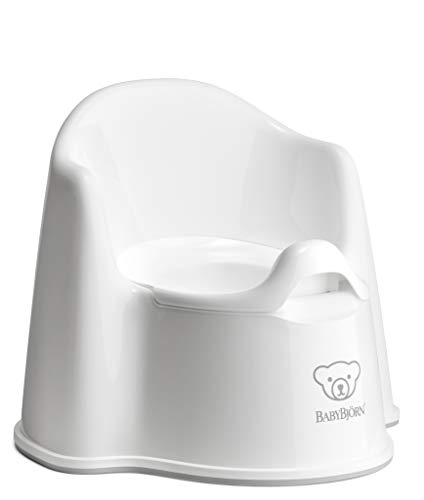
BabyBjörn Potty Chair (White/Gray) — Best Overall
The BabyBjörn Potty Chair in White/Gray is the chair most training routines end up built around, and the reasons are boring in the best way. It is a single-purpose standalone potty: a sturdy outer chair with a removable inner potty that lifts out for emptying and rinsing. The listing confirms the three details that matter daily — easy-to-clean surfaces, that removable inner potty, and a non-slip base — and nothing about the design asks a toddler to climb, balance, or perch.
Strengths
- Removable inner potty lifts out, so emptying and rinsing takes seconds rather than a scrub at the sink
- Non-slip base keeps the chair planted when a toddler backs up and sits down with more enthusiasm than aim
- Easy-to-clean, smooth design with no seams or hinges around the seat area to trap mess
Trade-offs
- It is a single-stage chair, so a child who outgrows it moves to a separate toilet seat solution later
- The White/Gray colorway shows every mark, which is honest but demands a quick wipe to look tidy
- No splash guard is named in the listing title, so check the current listing photos if that feature is a priority for your child
| Specification | As listed |
|---|---|
| Format | Standalone potty chair |
| Inner potty | Removable |
| Base | Non-slip |
| Colorway | White/Gray |
| Splash guard | Not stated in listing title |
What makes this chair work is the sitting position. The seat height lets a toddler plant both feet flat, and flat feet are what let a child relax enough to actually go — pediatric guidance on toilet training repeats this point constantly, and it is why a well-sized floor potty often beats a tall reducer seat for beginners. The backrest gives a cautious child something to lean against, which turns a wobbly perch into a place they are willing to sit for the minute or two that success sometimes takes.
Cleanup is the second half of the story. Because the inner potty lifts straight out, the routine is empty, rinse, wipe, done — and a routine that takes under a minute is a routine caregivers actually keep up three, five, eight times a day. The outer chair rarely needs more than a wipe. For a first purchase that has to survive months of daily use in the main bathroom, this combination of stable seating and fast cleanup is why it takes the Best Overall badge.
Check the current price on Amazon
Best for: Most families starting training with a toddler who needs a stable, floor-level seat / Not suited for: Families who specifically want one product to cover every stage through to the adult toilet

Jool Baby Potty Chair for Toddlers — Best for Nervous Beginners
The Jool Baby Potty Chair is designed for the toddler who is not sure about this whole project. Its listing leads with the features that address exactly that hesitation: handles the child can hold, a backrest to lean against, and a splash guard at the front. It is a standalone floor potty, sized — in the maker’s words — to make training more comfortable, and the emphasis throughout is on helping the child feel secure rather than on novelty features.
Strengths
- Handles give a nervous toddler something to grip, which steadies both the sit-down and the stand-up
- Backrest supports a relaxed, leaned-back posture instead of a tense perch
- Splash guard helps keep early, unpracticed aim inside the bowl, especially for boys learning to sit
Trade-offs
- Handles and a backrest add bulk, so it takes more floor and storage space than a minimalist potty
- More contours mean one or two extra wipes compared with a completely smooth one-piece design
- It is a dedicated floor potty only; there is no second stage that moves onto the family toilet
| Specification | As listed |
|---|---|
| Format | Standalone potty chair |
| Handles | Yes, as listed |
| Backrest | Yes, as listed |
| Splash guard | Yes, as listed |
Confidence is the real curriculum of the first weeks. A child who feels like they might fall grips the sides, tenses up, and wants down — and a tense child rarely succeeds, which makes the next attempt harder. Handles break that cycle by giving the toddler control: they lower themselves, they hold on, they get up when they choose. Trainers who work with reluctant starters often recommend exactly this kind of supported seat for that reason.
The splash guard earns its keep in a less glamorous way. Early sits are not aimed, and a guard at the front of the bowl keeps the floor and the child’s clothes drier, which keeps everyone’s patience intact. Combined with the backrest, the Jool Baby is the chair we would hand to a family whose child has been avoiding the potty altogether: it is the most reassuring seat in this guide, and reassurance is what unlocks progress at that stage.
Check the current price on Amazon
Best for: Cautious or reluctant toddlers who need to feel held and stable before they will sit / Not suited for: Very small bathrooms where a wide, handled chair will not fit beside the toilet

Ingenuity My Size Potty Pro 2-in-1 — Best Realistic Trainer
Some toddlers are motivated by imitation, and the Ingenuity My Size Potty Pro is built for them. It is a floor potty styled as a realistic miniature toilet, complete with a flushing sound, and its 2-in-1 design means the potty seat later lifts off and fits standard toilets for the next stage. The verified listing gives two hard numbers worth planning around: it is intended for toddlers aged 18 months and up, and it is rated up to 50 lb.
Strengths
- Realistic toilet styling and flushing sound turn practice into imitation, which motivates many toddlers
- 2-in-1 design: the removable seat transitions to standard toilets, extending the product’s working life
- Published limits are clear in the listing — ages 18+ months and up to 50 lb — so sizing is not guesswork
Trade-offs
- The realistic tank-and-seat shape has more parts and crevices to wipe than a simple one-piece potty
- A flushing sound needs batteries and can become the main attraction for a child who would rather play than sit
- The 50 lb ceiling means a larger toddler may outgrow it before training is finished
| Specification | As listed |
|---|---|
| Format | Floor potty with removable seat for standard toilets |
| Sound | Realistic flushing sound |
| Age guidance (as listed) | 18+ months |
| Weight limit (as listed) | Up to 50 lb |
The case for a realistic trainer is routine transfer. A child who learns on something that looks, and even sounds, like the family toilet has less to re-learn when they graduate, and the removable seat shortens that jump further because the child keeps sitting on a familiar seat, just at full height with a step stool. Families with a child who insists on copying everything adults do — flushing included — tend to get real mileage out of that imitation loop.
The honest costs are maintenance and focus. More molded detail means slower cleaning, and a sound button will be pressed forty times a day for the first week. Neither is a deal-breaker, but they are why this is a badge pick for the imitation-driven child rather than the overall winner. Check your child’s weight against the stated 50 lb limit before ordering, and plan on the seat stage still needing a sturdy step stool, which is sold separately.
Check the current price on Amazon
Best for: Toddlers motivated by copying adults, and families who want the seat to carry over to the real toilet / Not suited for: Caregivers who want the absolute fastest cleanup, or toddlers already close to the 50 lb limit

BabyBjörn Smart Potty (Gray/White) — Best Compact
The BabyBjörn Smart Potty in Gray/White is the compact member of this lineup: a small standalone potty intended for tight bathrooms, second locations, and travel bags. A note on honesty: the verified listing title for this model is unusually short — it confirms the product name and the Gray/White colorway and little else — so this review sticks to what the Smart Potty format is and does not invent a feature list the listing itself does not state. Check the current listing for the detailed specifications before ordering.
Strengths
- Compact format fits small bathrooms and tucks beside a toilet where a full chair will not
- Light, simple format suits a second location — grandparents’ house, or the car for travel stops
- Same maker’s design language as the full-size Potty Chair, so a child moving between the two meets a familiar shape
Trade-offs
- The listing title states few specifics, so features like a removable inner section must be confirmed on the current product page
- A smaller potty gives a bigger toddler less room and less back support than a full chair
- Compact potties can tip more easily if a child climbs in from the side, so placement on a flat floor matters
| Specification | As listed |
|---|---|
| Format | Compact standalone potty |
| Colorway | Gray/White |
| Detailed features | Not stated in listing title — confirm on the product page |
There is a real training argument for a second, smaller potty. Consistency speeds learning, and a child who has a potty available in the bathroom they actually run to — rather than one room away — gets more successful repetitions per day. A compact model is what makes that practical in an apartment, and it is also the format that fits in a car footwell or a large tote for the travel-heavy months when training cannot pause for a road trip.
The trade is support. A compact potty is a perch more than a chair: less backrest, less margin for a wiggly sitter, and a child who is already tall for their age may look folded on it. Our advice is to treat the Smart Potty as the satellite and keep a full chair as the home base if your toddler is on the bigger side — or as the only potty if space genuinely rules that out and your child is petite. Either way, verify the current listing’s stated features, because the catalog title we verified is minimal.
Check the current price on Amazon
Best for: Small bathrooms, second locations, travel, and petite toddlers / Not suited for: Large toddlers who need a full chair’s support, or buyers who need a long confirmed feature list before purchasing
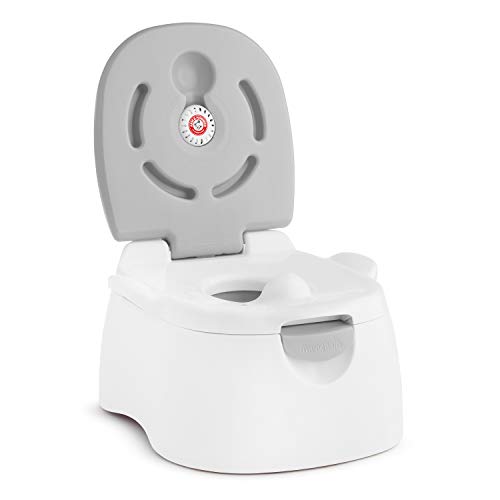
Munchkin Arm & Hammer Multi-Stage 3-in-1 Potty — Best Multi-Stage
The Munchkin Arm & Hammer Multi-Stage 3-in-1, in Grey, takes the opposite approach to a single-stage chair: it is designed to change jobs as your child grows. Multi-stage trainers of this type typically start as a standalone floor potty, then provide a seat for the family toilet, with the base doing duty as a step — the listing confirms the 3-in-1 multi-stage format, and the current product page will show the exact configuration for this model. For families who dislike buying three separate products, that arc is the appeal.
Strengths
- 3-in-1 multi-stage format is designed to span from first sits to the family toilet, reducing repeat purchases
- A convertible base that serves as a step helps a child reach the adult seat and the sink afterward
- Neutral Grey colorway hides wear and suits a shared family bathroom
Trade-offs
- Convertible designs have more parts to keep track of, and a lost component can sideline a stage
- Assembling and reconfiguring between stages takes more effort than using a dedicated single-purpose chair
- The listing title does not enumerate each stage’s configuration, so confirm the stage details on the current product page
| Specification | As listed |
|---|---|
| Format | Multi-stage 3-in-1 potty training seat |
| Colorway | Grey |
| Stage configuration | See current listing for stage-by-stage detail |
The financial logic is straightforward: three dedicated products — floor potty, toilet seat reducer, step stool — cost more in total than one convertible, and they take more storage space in between stages. A multi-stage design also keeps one familiar seat under the child across the whole journey, and familiarity is a genuine training aid; the surface they learned on is the surface they graduate with, just raised up.
The counterargument is friction. Every conversion is a small project, parts migrate to the back of cupboards, and a dedicated chair is always ready in a way a convertible mid-change is not. Families who value simplicity per day over economy per year should look at the BabyBjörn Potty Chair instead. Families who think in whole-journey terms — and who are good at keeping parts together — will get the most from this Munchkin, and should confirm the exact stage layout on the listing before buying.
Check the current price on Amazon
Best for: Families who want one purchase to cover the whole training journey / Not suited for: Caregivers who prefer a single-purpose tool that never needs reconfiguring

The Baby Potty Mini V2.0 — Best for Early Training
The Baby Potty Mini V2.0 exists for a different philosophy of training: elimination communication and early potty practice, where caregivers offer a potty from a young age rather than waiting for toddler readiness signs. The verified listing describes it as a chair with a portable and lightweight design aimed at early training. One transparency note: this listing’s title was truncated in the catalog data we verified — it ends mid-phrase — so we report only what the visible portion states and do not guess at the rest.
Strengths
- Purpose-built for early training and elimination communication rather than adapted from a toddler chair
- Portable, lightweight design suits the EC routine, where the potty needs to be wherever the baby is
- Mini scale matches small babies and young toddlers who would swim in a standard chair
Trade-offs
- A mini potty is outgrown quickly by a child starting at a typical toddler age — it is a specialist tool
- The truncated listing title means several specifics are not stated in our verified data; confirm details on the product page
- Families not practicing early training will get more life from a standard-size chair
| Specification | As listed |
|---|---|
| Format | Mini potty chair |
| Intended approach | Early training / elimination communication |
| Design | Portable and lightweight, as listed |
| Full feature list | Not stated — listing title truncated in source data |
Elimination communication reframes the potty as a communication tool from infancy: the caregiver watches for cues and offers the potty, and a small, light potty that can live in the room where the baby spends the day is the enabling equipment. A standard toddler chair is simply too big for that job in the early months, and too heavy to move room to room all day. Within that approach, a mini potty is not a compromise — it is the correct tool.
Outside that approach, be clear-eyed: most families starting at eighteen months or later should buy a standard chair their child can use for a year or more. The Mini’s value is concentrated in the early-start window, and its resale and hand-me-down life is shorter. If you are EC-curious but not committed, the full-size chairs in this guide forgive a change of plan; if you are committed, this is the one pick in the list designed around you.
Check the current price on Amazon
Best for: Families practicing elimination communication or starting potty practice early / Not suited for: Families starting at a typical toddler age who need a chair with a long usable life
Comparison Table
| Pick | Badge | Key spec | Best for |
|---|---|---|---|
| BabyBjörn Potty Chair (White/Gray) Check on Amazon | Best Overall | Standalone potty chair | Most families starting training with a toddler who needs a stable, floor-level seat |
| Jool Baby Potty Chair for Toddlers Check on Amazon | Best for Nervous Beginners | Standalone potty chair | Cautious or reluctant toddlers who need to feel held and stable before they will sit |
| Ingenuity My Size Potty Pro 2-in-1 Check on Amazon | Best Realistic Trainer | Floor potty with removable seat for standard toilets | Toddlers motivated by copying adults, and families who want the seat to carry over to the real toilet |
| BabyBjörn Smart Potty (Gray/White) Check on Amazon | Best Compact | Compact standalone potty | Small bathrooms, second locations, travel, and petite toddlers |
| Munchkin Arm & Hammer Multi-Stage 3-in-1 Potty Check on Amazon | Best Multi-Stage | Multi-stage 3-in-1 potty training seat | Families who want one purchase to cover the whole training journey |
| The Baby Potty Mini V2.0 Check on Amazon | Best for Early Training | Mini potty chair | Families practicing elimination communication or starting potty practice early |
How to Choose the Best Toddler Potty Chairs for Your Bathroom and Your Child
Start with the sitting position, because it decides more than any feature list. A toddler learning to use a potty needs feet flat on a surface, knees roughly level with or slightly above the hips, and enough stability to relax. Standalone floor chairs deliver that by default. Seats that sit on the family toilet can deliver it too, but only when paired with a step stool tall enough to give the same flat-footed posture — budget for the stool if you go that route, and treat the combination as the real product you are choosing.
Next, think about who cleans it, and how often. In the first weeks a potty may be emptied six or more times a day, and the difference between a lift-out inner potty and a one-piece design you carry to the sink is the difference between a ten-second job and a two-minute job, multiplied by months. Smooth surfaces, few seams, and no fabric anywhere near the splash zone all pay rent daily. Novelty features — sounds, character shapes, lights — pay nothing after the first week unless your specific child is genuinely motivated by imitation or play.
Finally, match the chair to the room and the routine. Measure the floor space beside your toilet before ordering a wide handled chair. Decide whether you need one chair or two locations covered. And be honest about your training philosophy: a family starting early with elimination communication needs a different tool from a family doing a focused long-weekend start with a two-year-old. The badges in this guide map to those situations on purpose.
Standalone Chair, Toilet Seat, or Multi-Stage: Which Format Fits?
A standalone potty chair is the lowest-friction start. It lives where you put it, the child can use it with minimal help, and cleanup is contained in a removable bowl or the chair itself. Its limits are lifespan and floor space: it serves the floor stage only, and it is one more object in the bathroom. For most families beginning with a child under about two and a half, it is the format we recommend as the home base.
A seat on the family toilet — whether a reducer ring, a drop-down family seat, or the removable seat from a 2-in-1 trainer — skips the bowl-emptying step entirely, which some caregivers consider the whole game. The costs are height and dependence: the child needs a stool and usually a hand up, and the family toilet is occupied during long, contemplative sits. These seats shine in the second half of training, once the concept is established and only the venue is changing.
Multi-stage and 2-in-1 designs try to sell you both halves in one box. They make economic sense and keep the seat familiar across stages, at the price of parts management and conversion effort. Whichever format you choose, the through-line is the same: the best system is the one that is set up, clean, and in the right room at the moment your toddler announces they need it — which is always sooner than you expect.
Sizing and Fit: Weight Limits, Seat Height, and Growing Room
Check published limits before anything else. One pick in this guide states its envelope plainly — ages 18 months and up, up to 50 lb — and that kind of clarity is what you want. A child near the top of a stated weight range will also be near the top of the seat’s comfort range, and a potty that feels cramped produces avoidance that looks like stubbornness. When a listing does not state limits, that absence is itself information: verify on the product page or choose a model that publishes its numbers.
Seat height deserves the same attention as weight. Sit your toddler on the chair with bare feet: both feet should rest flat with knees bent comfortably. If the heels dangle, the chair is too tall for now; if the knees come up near the chest, it is too small and will be outgrown within the season. Boys benefit from a splash guard with real height at the front of the bowl; girls generally do fine either way. Handles and backrests are fit features, not decorations — they determine whether a child can mount and dismount the chair independently, which is the milestone that makes the whole system sustainable.
What About Travel, Grandparents’ Houses, and Second Bathrooms?
Training collapses fastest at the boundaries of the home routine: the weekend at grandparents’, the road trip, the upstairs bathroom that is somehow always the one your toddler runs to. The equipment answer is boring and effective — duplicate the setup, cheaply and compactly, rather than upgrading the main chair. A compact potty like the BabyBjörn Smart Potty in this guide exists precisely for the satellite role: it stores in a cupboard, rides in a car footwell, and presents the same basic sitting experience in the second location, so the child’s skill transfers instead of resetting at every new address.
For travel specifically, plan the routine rather than the gear. Offer a sit before leaving, at every stop, and on arrival, using the same words and the same short, cheerful format as at home; familiarity of sequence matters more to a toddler than familiarity of plastic. Keep the travel potty in a washable bag with wipes and a change of clothes, and empty and rinse it at the first available toilet rather than letting it ride. Grandparents’ houses deserve one extra conversation: where the potty lives, who empties it, and that the household’s job is encouragement without pressure — a child trained by three different pressure levels learns the average, which helps no one.
Second bathrooms follow the same logic at home. If your toddler’s life happens on two floors, two modest chairs beat one excellent chair and a flight of stairs between urgency and porcelain. This is also where a multi-stage design can quietly pay off twice: its later toilet-seat stage can colonize the second bathroom while the floor stage continues in the main one. The principle underneath all of it is the one this whole guide runs on — training succeeds on repetition in the moment of need, and equipment’s job is simply to be there, clean and familiar, in that moment.
Training Boys and Girls: Small Differences That Change the Setup
The equipment differences between training boys and girls are smaller than the marketing suggests, but they are not zero. Boys learning to sit — the recommended starting posture, since standing aim is a later skill — benefit most from a splash guard with real height at the front of the bowl, because early aim points forward more often than down. Two picks in this guide name splash guards in their listings and one conspicuously does not state one; that is exactly the kind of detail to check against your child’s needs rather than discovering it on the bathroom floor. A removable seat that later moves to the family toilet also helps boys’ progression, because the standing stage arrives with the big toilet as its venue.
Girls, on average, are ready slightly earlier and are often more motivated by independence — the ability to get on and off the chair entirely alone. For them, handles, a stable non-slip base, and a seat height their feet can manage are the features that convert willingness into solo success. Wiping technique is a caregiver-taught skill in this stage, front to back, and a chair stable enough to let a child twist slightly without tipping makes teaching it safer and calmer.
For every child, the shared rules dominate the differences: feet flat, clothing they can manage alone — elastic waists over buttons and belts — and a potty placed where accidents on the way are cheapest, which in practice means the bathroom they can reach fastest. Choose the chair for the child’s body and your home’s layout first; the boy-girl adjustments are a final filter on splash guards and independence features, not a separate product category, whatever the pink-and-blue packaging in the wider market implies.
How to Set Up and Use a Toddler Potty Chair: A Calm First-Week Routine
Equipment only helps inside a routine. This is the setup-and-first-week sequence that gives a new potty chair its best chance, whichever model you chose.
- Place the chair in the bathroom where training will happen, on a flat floor, before any pressure begins. Let your toddler sit on it fully clothed for a day or two so it becomes furniture before it becomes an assignment.
- Add a small basket within your reach: wipes, a change of clothes, and a book or two that lives only by the potty. Everything you need should be reachable without leaving a seated toddler unattended.
- Offer sits at predictable moments — waking, after meals, before bath — rather than asking constantly. Predictability teaches the association; constant asking teaches refusal.
- Keep each early sit short and cheerful. A song or a short book is plenty. If nothing happens, thank them for sitting and move on without commentary or disappointment.
- Empty and rinse the bowl immediately after each success, ideally with your toddler watching the contents go into the real toilet and flushing if that delights them. This closes the loop between the chair and the toilet it imitates.
- Wipe the chair daily and wash it properly at least weekly, following the maker’s care guidance. A chair that smells clean is a chair a toddler will keep using.
- After the first week, review fit and placement honestly: feet flat, chair in the room the child actually uses, cleanup routine sustainable. Adjust placement before concluding the chair is wrong.
Most training stalls are routine problems, not equipment problems — but the routine only works when the chair fits the child and the room. Get those two things right in week one and the rest is repetition.
Common Buying Mistakes
Buying for the photo, not the floor plan. Character shapes and wide novelty designs look charming online and then do not fit beside a real toilet. Measure your floor space first, and let the room veto designs before your toddler falls in love with one.
Skipping the step stool with a toilet seat. A reducer seat without a tall, stable stool leaves feet dangling, and dangling feet make children brace and hold back. The stool is not an accessory to the seat; it is half the product.
Ignoring the stated weight and age limits. Limits printed in a listing — like the 50 lb ceiling on one pick here — are the maker’s sizing guidance. A child at the edge of the range needs the next format, not encouragement to squeeze in.
Making cleanup harder than it has to be. Fabric pads, deep seams, and multi-part novelty designs multiply the worst job in training. If you cannot see how a chair rinses clean in under a minute, pick a simpler one.
Owning one chair for a two-bathroom life. Training fails in the gap between ‘I need to go’ and the room with the potty. A compact second chair in the other bathroom or at a grandparent’s house is often worth more than upgrading the main one.
Final Recommendation
If you buy one chair, buy the BabyBjörn Potty Chair: flat-footed seating, a lift-out inner potty, and a non-slip base cover the daily reality of training better than any novelty. If your toddler is reluctant rather than ready, the Jool Baby’s handles and backrest are the confidence features that matter. For the imitation-driven child, the Ingenuity My Size Potty Pro adds a realistic look, a flushing sound, and a seat that later moves to the family toilet — mind its stated 50 lb limit. Small spaces and second locations belong to the BabyBjörn Smart Potty, whole-journey value to the Munchkin 3-in-1, and early starters to The Baby Potty Mini V2.0.
Whichever you choose, verify the current listing details before ordering — one listing in this guide had a truncated title in the catalog data, and another states few specifics — and set the chair up in the right room before the first sit. The chair is the easy part; the calm routine around it is the actual product.
Related guides on this site:
- Best Booster Chairs For Toddlers
- Best First Chairs For Toddler
- Best First Pillows For Toddlers
- Best Toddler Bathtubs
- Best Toddler Blankets
Related guides
Frequently Asked Questions
What age should a toddler start using a potty chair?
Most children show readiness signs somewhere between about 18 months and 3 years — interest in the toilet, staying dry for longer stretches, and communicating before or after going. One pick in this guide states 18 months and up in its listing. Families practicing elimination communication start much earlier with a mini potty and caregiver assistance. Readiness matters more than the calendar; a chair bought a month early and introduced without pressure does no harm.
Is a standalone potty chair better than a seat on the family toilet?
For beginners, usually yes: a floor chair gives flat feet and independence, which build confidence and success. Toilet seats win later, when the concept is learned and skipping bowl cleanup matters more. Many families use both in sequence — which is exactly what 2-in-1 and multi-stage designs package into one purchase.
How do I clean a potty chair properly?
Empty the bowl into the toilet after each use, rinse it, and wipe all surfaces with your usual bathroom cleaner; wash the chair thoroughly at least weekly. Smooth, seamless designs — and removable inner potties — make this a one-minute job. Avoid letting residue sit, both for hygiene and because a clean-smelling chair keeps a toddler willing to use it.
What if my toddler is scared of the potty chair?
Slow the sequence down. Let the chair live in the bathroom, let your child sit on it clothed, read books there, and only then try bare sits at predictable times. A chair with handles and a backrest, like the Jool Baby pick in this guide, helps because the child can hold on and feel secure. Fear usually fades within days once the chair becomes familiar furniture rather than a test.
Do boys need a splash guard?
It helps. Boys learning to sit often do not aim down reliably at first, and a raised splash guard at the front of the bowl keeps urine in the potty instead of on the floor and their clothes. If a listing does not mention a guard and that matters to you, check the current product photos — one of our picks does not state a guard in its title, and we flagged that rather than assuming.
How long will one potty chair last?
A standard chair typically serves from the start of training until your child transitions to the family toilet — often six months to well over a year of daily use, and then it hands down well. Mini potties for early training are outgrown fastest. Multi-stage designs last longest by design, since their later stages replace separate purchases.


