Disclosure: airfryerkitchensupply.com is reader-supported. When you buy through links on our site, we may earn an affiliate commission at no extra cost to you.
Where to buy
Every blanket below was checked against Amazon’s catalog data, with its size, material and construction taken from its own listing: the CLoucl 100% Cotton Muslin Quilt (41×48) for a breathable all-season toddler-bed blanket, the CARUILI Toddler Blanket (50×60) for the biggest, coziest minky option, the BuLuTu Muslin Toddler Quilt (47×59) for a full-coverage cotton quilt, the Lukeight Dinosaur Toddler Blanket (30×40) for a plush nap and travel size, the HOMRITAR Minky Blanket with Dotted Backing for a soft printed minky, and the J-pinno 6-Layer Muslin Blanket for a layered cotton gauze build. Check the current price on Amazon for the one that fits your child’s bed and climate — and read the safety notes first, because with toddler blankets, when and where a blanket is used matters as much as which one you buy.
Introduction: Toddler Blankets Are a Different Purchase From Baby Blankets
Shopping for the best toddler blankets starts with an age line that matters. Loose blankets do not belong in a crib with an infant: safe-sleep guidance is consistent that babies under 12 months should sleep on a bare, firm surface, on their backs, with nothing soft in the crib. The blankets in this guide are for the stage after that — toddlers, generally 12 months and up, who are moving to a toddler bed, napping at daycare, riding in a stroller on a cold day, or claiming a corner of the couch as their own. Every pick below was chosen for that stage: big enough to cover a child who kicks, light enough for a small body to move under and push off, and washable enough to survive the reality of toddler life. You will notice there are no weighted blankets in this guide. That is deliberate. Weighted blankets are not appropriate for infants, and for young toddlers they raise the same basic problem — a small child must always be able to move out from under a blanket freely — so we left the category out entirely rather than rank it.
Within those guardrails, the real choice is material and size. Cotton muslin — two of the picks here, plus a six-layer muslin — breathes, washes beautifully, and works in every season; it is the fabric pediatric nurses and daycare teachers tend to reach for because it does not overheat. Minky and plush fleece — the other three picks — are the comfort objects: softer against skin, warmer, and usually the blanket a toddler actually asks for by name. Size is the second decision: a 30×40 is a nap, travel and lovey size; a 41×48 or 47×59 covers a toddler bed properly; a 50×60 is a grow-with-them blanket that will still work on a twin bed’s foot in a few years. We verified each pick’s listed size and material against the catalog data before including it, and where a listing’s size information was incomplete, we say so under that pick rather than guess.
In this guide
Quick Picks
| Pick | Badge | Why it is here | Link |
|---|---|---|---|
| CLoucl 100% Cotton Muslin Quilt, 41×48 | Best Overall | Breathable cotton muslin, reversible, machine washable, true toddler-bed size | Check on Amazon |
| CARUILI Toddler Blanket, 50×60 | Best Big and Cozy | Largest pick; soft minky face with dotted backing, room to grow into | Check on Amazon |
| BuLuTu Muslin Toddler Quilt, 47×59 | Best Full-Coverage Cotton | 100% muslin cotton quilt sized for full toddler-bed coverage | Check on Amazon |
| Lukeight Dinosaur Toddler Blanket, 30×40 | Best for Naps and Travel | Plush, thick, small enough for daycare cots, strollers and car seats | Check on Amazon |
| HOMRITAR Minky Blanket, Dotted Backing | Best Soft Minky | Minky face with dotted texture backing and a toddler-loved dinosaur print | Check on Amazon |
| J-pinno 6-Layer Muslin Blanket | Best Layered Muslin | Six layers of 100% cotton muslin — warmth from layers, not from synthetic fill | Check on Amazon |
Short on time? The CLoucl muslin quilt is the default recommendation for a toddler bed, and the Lukeight is the one to buy in duplicate for daycare and the car.
How These Picks Were Chosen
Safety framing came first. Every pick is a loose blanket intended for toddlers — children past the first birthday, sleeping in a toddler bed or napping supervised — and the guide states the infant safe-sleep rules openly rather than pretending a blanket is a crib product. One listing below uses the word “crib” in its own title; we kept the blanket because its size and material are genuinely right for a toddler bed, and we flag the wording under that pick so no one mistakes it for an infant crib blanket. Weighted blankets were excluded as a category. So were swaddles and sleep sacks: those are infant products with their own rules, and a toddler blanket guide has no business ranking them.
The second filter was verification. Each pick’s material, size and construction were confirmed from its Amazon listing data — cotton muslin where we say muslin, minky where we say minky — and no blanket was given a size or a fabric its listing does not state. The third filter was washability and weight: a toddler blanket gets washed constantly, so machine-washable builds were required, and every pick is light enough for a small child to push off, drag around and carry — which, anyone who has lived with a toddler knows, is the actual job description. Finally, we balanced the list across the two real use patterns: breathable cotton for sleeping, plush minky for comfort and naps, in sizes from daycare-nap to grow-with-them.
The 6 Best Toddler Blankets
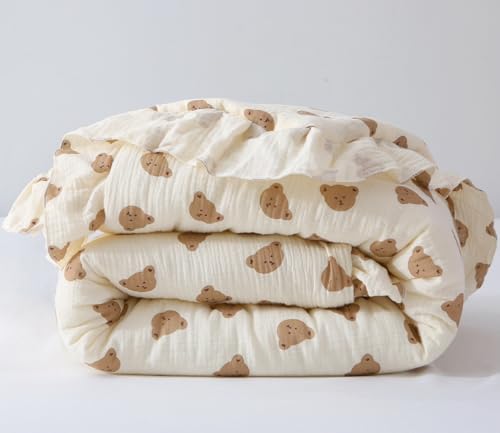
CLoucl 100% Cotton Muslin Quilt, 41×48 — Best Overall
This is the blanket we would hand to a parent furnishing a first toddler bed. The listing states 100% cotton muslin in a reversible quilt, 41 by 48 inches, machine washable, in an all-season weight. Muslin is the right default for sleep: the open weave breathes, so a toddler who runs warm does not wake up sweaty at 2 a.m., and cotton tolerates the hot, frequent washing that toddler bedding demands without pilling or thinning the way plush fabrics do. At 41×48 it covers a toddler in a toddler bed with drape to spare, and it is light enough for the child to rearrange — an underrated safety and comfort feature, because a blanket a toddler can move is a blanket a toddler can move off. One honest flag: the listing’s own title calls this a “Crib Comforter.” Do not use it as one. Loose comforters do not belong in an infant’s crib; this is a toddler-bed blanket, for a child past 12 months, and used that way it is an excellent one.
Strengths
- 100% cotton muslin — breathable, all-season, and kind to warm sleepers
- Reversible quilt in a true toddler-bed size, 41×48 inches as listed
- Machine washable cotton that survives frequent hot washing
Trade-offs
- Muslin is not plush — comfort-object seekers will prefer the minky picks
- Listing title says “Crib Comforter”; it must be used as a toddler-bed blanket only, never in an infant crib
- Lightweight weave gives little warmth on its own in a cold room — layer clothing, not more blankets
Spec box
- Size: 41 x 48 in (as listed)
- Material: 100% cotton muslin (as listed)
- Construction: reversible quilt (as listed)
- Care: machine washable (as listed)
The case for muslin strengthens the longer you own it. Cotton gauze gets softer with washing rather than tired, it dries fast on a line or a low dryer setting, and it packs small for travel without the static and cling of fleece. For a child transitioning out of a crib, a familiar, light, breathable blanket also makes the new bed feel like theirs — and because it is not heavy, a half-asleep toddler who rolls will roll out from under it as easily as under it. Buy two if your child adopts it as the blanket: one for the bed, one in the wash, because the night the favorite blanket is in the laundry is a night nobody in the house sleeps.
Best for: toddler beds and warm sleepers, in every season / Not suited for: infant cribs — ever — or children who want a plush comfort blanket
Check on Amazon — check the current price on Amazon.

CARUILI Toddler Blanket, 50×60 — Best Big and Cozy
Most toddler blankets are outgrown in a year. This one is sized like a small throw — 50 by 60 inches as listed — in a soft minky face with a dotted backing, which makes it the pick for parents who would rather buy once. The dotted minky back is not a gimmick: the raised dots give small hands something to hold and rub, which is why dotted minky is the texture toddlers self-soothe with, and the smooth face keeps the blanket from feeling busy against skin. At 50×60 it covers a toddler completely, works as a couch blanket for a preschooler, and will still be useful at the foot of a twin bed later. It suits families in cooler climates and children who sleep cold. It is less suited to warm sleepers and summer nights — minky is a warm fabric — and its size is more than a small toddler needs for a daycare cot, where the Lukeight below is the right scale.
Strengths
- Largest size in this guide — 50×60 inches as listed — so it is not outgrown in a season
- Minky face with dotted backing: the texture toddlers actually reach for
- Warm enough to be the single blanket in a cool room
Trade-offs
- Minky warmth is too much for hot sleepers and summer
- Too large for daycare cots and stroller use
- Synthetic plush needs gentler washing than cotton to keep its hand feel
Spec box
- Size: 50 x 60 in (as listed)
- Material: minky with dotted backing (as listed)
- Style: large toddler/kids blanket (as listed)
Think of this as the blanket that becomes furniture. It will live on the couch for movie nights, get dragged to forts, and still be the right size when its owner is five. The trade for that longevity is heat: minky traps warmth the way muslin never will, so in a warm house it belongs in the living room rather than on the bed. Wash it cool and dry it low; high heat is what turns minky from silky to scratchy over a year, and the dotted backing keeps its texture longest when it is not baked. If your toddler runs cold and your winters are real, this is the cozy end of the guide, honestly labeled.
Best for: cool rooms, cold sleepers, and buy-it-once sizing / Not suited for: warm sleepers, summer, or daycare cots
Check on Amazon — check the current price on Amazon.

BuLuTu Muslin Toddler Quilt, 47×59 — Best Full-Coverage Cotton
If the CLoucl is the standard-size muslin answer, the BuLuTu is the generous one: the listing states a 100% muslin cotton quilted blanket at 47 by 59 inches — nearly throw-sized — and, notably, lists a weight of 1.5 pounds. That weight figure deserves a clear explanation, because parents searching toddler blankets are right to be alert to it: 1.5 pounds is simply what this light quilt itself weighs. It is not a weighted blanket, it has no added weight fill, and it should not be confused with one. What the size buys you is coverage: a tall toddler, a child who sleeps diagonally, or a bed that needs the blanket to stay put through a night of rolling. The muslin construction keeps it breathable despite the size. It suits bigger toddlers and preschoolers moving toward a twin bed. It is more blanket than a small two-year-old needs, and its size makes it a home blanket rather than a travel one.
Strengths
- 100% muslin cotton — breathable even at near-throw size
- 47×59 inches as listed: full coverage for tall toddlers and restless sleepers
- Quilted construction keeps the light fill evenly distributed wash after wash
Trade-offs
- Oversized for small toddlers and for travel or daycare
- The listed 1.5 lb is the blanket’s own weight — light, but more to launder than a 30×40
- Muslin softness is a quiet pleasure; it will not win a plush contest against minky
Spec box
- Size: 47 x 59 in (as listed)
- Material: 100% muslin cotton (as listed)
- Construction: quilted crib-to-toddler quilt (as listed)
- Blanket weight: 1.5 lb as listed — this is the product’s own weight, NOT a weighted blanket
The BuLuTu is the pick that respects how toddlers actually sleep: everywhere. A blanket that still covers a child after three rolls and a 90-degree turn prevents the 3 a.m. cold wake-up that smaller blankets allow, and it does it with the most breathable fabric in the guide. Parents of preschoolers should look here first, because the jump from toddler bed to twin bed usually strands the old blanket; at 47×59, this one makes the jump with the child. As with the CLoucl, keep it out of infant cribs entirely — its place is the toddler bed and up.
Best for: tall toddlers, restless sleepers, and the move toward a twin bed / Not suited for: travel, daycare, or small two-year-olds
Check on Amazon — check the current price on Amazon.

Lukeight Dinosaur Toddler Blanket, 30×40 — Best for Naps and Travel
Every toddler household needs the small blanket: the one that goes to daycare, lives in the car, and comes out for stroller walks. The Lukeight is that blanket in this guide — the listing states a plush, thick build at 30 by 40 inches with a dinosaur design. The size is the point. A 30×40 fits a daycare cot without trailing on the floor, folds into a diaper bag or a cubby, and is light enough for a toddler to carry to the car themselves, which — as any parent knows — is the difference between a blanket that gets used and a blanket that gets left. The plush build makes it warmer per inch than the muslin picks, so it doubles as the car-seat lap blanket on cold mornings (over the buckled harness, never under it — bulky layers under harness straps are a safety problem, while a blanket over a secured child is fine). It suits daycare naps, travel and dinosaur devotees. It is not a bed blanket for a child over two; at 30×40, a tall toddler will outgrow its coverage for overnight sleep.
Strengths
- 30×40 inches as listed — the correct scale for daycare cots, strollers and travel
- Plush, thick build: warm for its size, and a genuine comfort object
- Dinosaur print in the listing is the kind of design toddlers claim as their own
Trade-offs
- Too small for overnight coverage for older or taller toddlers
- Plush synthetic needs cool washing to stay soft
- Thick build is warm — not a summer nap blanket in a hot room
Spec box
- Size: 30 x 40 in (as listed)
- Material: plush (as listed)
- Design: dinosaur (as listed)
- Use: nap, travel, stroller (as listed for toddlers)
Buy this one in duplicate if your daycare allows a nap blanket. The economics of toddlerhood are simple: the blanket that goes to daycare will get lost, left, or sent home in a bag with someone else’s glitter on it, and a matched spare at home prevents a bedtime negotiation nobody wins. The dinosaur print is doing real work too — a blanket a child chooses is a blanket a child uses, and at nap time in a strange room, familiar and chosen is the whole game. Keep it out of infant cribs like every pick here; its world is the cot, the car and the couch.
Best for: daycare naps, travel, strollers and car rides / Not suited for: overnight coverage for taller toddlers
Check on Amazon — check the current price on Amazon.

HOMRITAR Minky Blanket with Dotted Backing — Best Soft Minky
The HOMRITAR is the pure comfort-object pick: a minky blanket for kids with a dotted backing and a multicolor dinosaur print, per its listing. Minky’s short, dense pile is the softest common blanket fabric against skin, and the dotted reverse side gives it the two-texture feel that makes a blanket interesting to small hands for years. One transparency note: the listing data we verified confirms the minky construction, the dotted backing and the toddler sizing class, but the exact dimensions were cut off in the catalog title we could verify — so check the listing’s size options before ordering, and choose the size that matches your use (nap sizes around 30×40, bed sizes larger). It suits toddlers who are texture-first — the ones who rub a blanket edge to fall asleep. It is a synthetic plush, so it will not breathe like the muslin picks, and it belongs in supervised, awake-and-nap life more than in a hot bedroom.
Strengths
- Minky face with dotted backing — two textures, both toddler favorites
- Soft enough to serve as the designated comfort object
- Printed dinosaur design per the listing — high child appeal, which drives actual use
Trade-offs
- Exact dimensions were truncated in the verified catalog title — confirm size on the listing before buying
- Synthetic minky does not breathe; warm sleepers should choose muslin
- Dotted backing texture flattens if washed hot or dried on high heat
Spec box
- Material: minky with dotted backing (as listed)
- Design: dinosaurs, multicolor (as listed)
- Size: toddler sizes offered — exact dimensions not stated in the verified title; check the listing
There is a reason minky dominates the lovey market: it is the fabric children bond with. If your toddler already has a favorite soft thing, this blanket is cut from that cloth, literally. Treat it gently in the wash — cool water, low dry, no fabric softener, which coats the pile and dulls the softness you bought it for — and it will keep its hand feel through the toddler years. Pair it with a muslin blanket for sleep if your child runs warm: minky for the couch and the car, muslin for the bed is a division of labor many families land on.
Best for: texture-loving toddlers and comfort-object duty / Not suited for: warm sleepers or buyers who need a confirmed size without checking the listing
Check on Amazon — check the current price on Amazon.

J-pinno 6-Layer Muslin Blanket — Best Layered Muslin
The J-pinno takes muslin in the other direction from the light quilts: six layers of 100% cotton muslin, per its listing, in a big dinosaur-print blanket that works as a bed blanket, a sofa throw and a travel layer. Layered gauze is a clever way to get warmth from cotton — the air trapped between layers insulates — while staying fully breathable and fully washable, with no synthetic fill to bunch or melt in a hot wash. It suits families who want one cotton blanket that covers more of the year, and children who like a blanket with a little substance to burrow under. It is heavier and bulkier than the two-layer muslin quilts, so it is not the daycare pick, and the layered build takes longer to dry — plan laundry accordingly.
Strengths
- Six layers of 100% cotton muslin — warmth from layered natural fiber, not synthetic fill
- Breathable like all muslin, but with more loft for cooler nights
- Large format works as bed blanket, throw and travel layer in one
Trade-offs
- Bulkier to wash and slower to dry than thin muslin
- More blanket than a small toddler needs for naps away from home
- Cotton layers wrinkle and crinkle — the classic muslin texture is part of the deal
Spec box
- Material: 100% cotton muslin, 6 layers (as listed)
- Design: dinosaur print (as listed)
- Use: bed, sofa, travel (as listed for toddler/kids)
Muslin’s crinkled texture is a feature parents learn to love: it keeps the blanket from lying flat and airless against a sleeping child, and it hides the wrinkles of a life spent being dragged around by a three-year-old. The six-layer build makes this the muslin to choose in a house that keeps bedrooms cool, or for the shoulder seasons when the thin quilts feel like not quite enough and a plush blanket feels like too much. Wash it warm, dry it fully — layered cotton that goes into a drawer damp will smell like it — and expect it to get softer and more flexible with every cycle.
Best for: cool bedrooms and one-blanket households that prefer cotton / Not suited for: daycare kits or fast-laundry routines
Check on Amazon — check the current price on Amazon.
Comparison Table
| Pick | Badge | Key spec (as listed) | Best for |
|---|---|---|---|
| CLoucl Muslin Quilt, 41×48 | Best Overall | 100% cotton muslin, reversible, washable | Toddler beds, all seasons |
| CARUILI Toddler Blanket, 50×60 | Best Big and Cozy | Minky, dotted backing, largest size | Cold sleepers, growing kids |
| BuLuTu Muslin Quilt, 47×59 | Best Full-Coverage Cotton | 100% muslin, quilted, 1.5 lb own weight | Tall, restless sleepers |
| Lukeight Dinosaur Blanket, 30×40 | Best for Naps and Travel | Plush, thick, daycare-cot size | Daycare, car, stroller |
| HOMRITAR Minky Blanket | Best Soft Minky | Minky, dotted backing, dinosaur print | Comfort-object duty |
| J-pinno 6-Layer Muslin | Best Layered Muslin | 6-layer 100% cotton muslin | Cool rooms, cotton purists |
How to Choose a Toddler Blanket
Start with the safety frame, every time. Blankets are for children 12 months and older, in a toddler bed or a supervised nap setting — never in an infant’s crib, where the safe setup is a bare, firm mattress and a baby on their back. If your child is still in a crib and under one, the right product is a wearable blanket or sleep sack in the correct size, not anything in this guide. And stop using any loose blanket arrangement the moment it stops being safe for your child’s stage: children who are still rolling into face-down positions or who cannot yet push a blanket off should be in wearable options under their pediatrician’s guidance.
Choose the fabric by sleeper, not by softness contest. Warm sleepers and summer houses: cotton muslin, full stop — it breathes, and a toddler who overheats wakes up. Cold sleepers and winter houses: minky and plush earn their warmth honestly. Children with eczema-prone or sensitive skin often do best in smooth natural fibers washed fragrance-free; whatever you choose, wash it before first use and skip scented softeners, which coat fibers and dull both muslin’s breathability and minky’s softness.
Size it to the job. Nap and travel: 30×40. Toddler bed: 41×48 covers with drape. Big toddlers, restless sleepers, and beds that will soon be twin beds: 47×59 or 50×60. A blanket that is too small gets kicked off and complained about; a blanket that is too big for a small child is heavy to move and hard for them to manage — match the size to the child you have now, with one eye on the next year, not the next five.
Check that the child can move it. Pick the blanket up with two fingers. If it feels substantial to you, it is a lot for a 25-pound person. Toddlers must be able to push a blanket off, drag it, and carry it; every pick here passes that test, and it is the test that quietly rules out heavy quilts and all weighted blankets for this age.
Plan for the wash. A toddler blanket will be washed after illnesses, accidents, spills and daycare exposures — sometimes twice a week. Cotton muslin improves with that treatment; minky survives it if you wash cool and dry low; anything that demands special care will quietly stop being used. Buy the duplicate of the favorite while it is available; prints and lines disappear, and a discontinued favorite is a household crisis out of all proportion to its size.
Muslin vs. Minky: A Closer Look at the Two Fabrics
Almost every toddler blanket you will ever consider is one of these two fabrics, and they behave so differently that the choice deserves more than a sentence. Muslin is a plain-weave cotton gauze: thin yarns, an open weave, and a slightly crinkled texture that develops with washing. Its virtues are all about air and water. Air moves through it, so a sleeping child’s temperature stays steadier; water moves through it, so it washes clean in a normal cycle and dries in a fraction of the time of a plush blanket. It is also the same blanket in every season — in summer it is the whole covering, in winter it layers over pajamas in a heated house without turning the bed into a sauna. Its limits are tactile: muslin feels like cloth, not like a stuffed animal, and a child shopping with their hands will walk past it toward the plush.
Minky is a knitted synthetic microfiber with a short, dense pile, sometimes dotted on one side. Its virtue is a single overwhelming one: it is the softest thing in the room, and toddlers — who experience the world through their hands and cheeks — bond with it in a way they rarely bond with cotton. That bonding is not trivial; the blanket a child loves is the blanket that gets them down for a nap at daycare and settles them in a strange bed at a grandparent’s house. Minky’s costs are heat and care. It insulates rather than breathes, so it is the wrong sleep blanket for a warm child in a warm room, and it keeps its famous softness only under gentle washing — cool water, low drying heat, no softener. The families who get this category right usually stop asking which fabric is better and assign each its job: muslin where the child sleeps, minky where the child lives. The picks in this guide were balanced three-and-three with exactly that division in mind.
Toddler Blanket Safety, In Full
Because this category sits next to infant sleep, the safety picture deserves one complete statement rather than scattered warnings. For babies under 12 months: sleep on the back, on a firm flat mattress, in a bare crib — no loose blankets, quilts, comforters, pillows or soft toys — with warmth provided by a wearable blanket or sleep sack in the correct size and tog for the room. When a baby can roll both ways, keep following the bare-crib rule for loose bedding; rolling changes positioning guidance, not the loose-blanket rule. Stop using a wearable blanket or sleep sack according to its maker’s guidance — typically when a child can climb out of the crib or when the sack restricts a standing toddler — and that transition, usually somewhere in the second year, is when a light loose blanket on a toddler bed becomes the appropriate tool. Weighted blankets do not enter the picture for infants at all and are not a toddler product in this guide’s judgment; neither are blankets with cords, ties, hoods heavy enough to cover a face, or loose embellishments a small child can work free. Finally, blankets and car seats: warmth goes over a buckled harness, never under the child, because anything bulky between a child and the straps adds slack the harness cannot take up in a crash. Follow those five rules and the blankets in this guide are what they should be — comfort, at the right age, in the right place.
How to Introduce a Blanket at the Toddler Bed Transition
1. Wait for the right stage: 12 months at the earliest, and when your child moves to a toddler bed or sleeps where a blanket cannot end up over their face unnoticed. 2. Start at nap time, supervised, with a light breathable blanket — a muslin pick from this guide — placed over the legs and lower body, not pulled up to the chin. 3. Dress the child for the room temperature in pajamas, so the blanket is comfort rather than the only warmth; a child who is warm enough without the blanket cannot be chilled by kicking it off. 4. Keep the rest of the sleep space bare — the blanket is the only soft addition; pillows and stuffed animals follow their own age guidance. 5. Check in during the first nights: most toddlers end up on top of the blanket or beside it, which is normal and safe at this stage. 6. Once the blanket is accepted, buy the duplicate for laundry rotation and daycare. 7. Reassess as they grow: by preschool age, a bigger blanket and a pillow become reasonable, and the nap blanket retires to the car with honors.
Building the Daycare and Travel Blanket Kit
A toddler blanket rarely has one job, and the households that struggle least treat it as a small kit rather than a single purchase. The kit has three pieces. First, the sleep blanket, which lives on the toddler bed and follows the fabric logic above — muslin for most sleepers, the six-layer muslin or a large minky for cold rooms and cold children. Second, the away blanket, sized 30×40, which goes to daycare in the cubby, rides in the car, and covers laps in strollers; this is the blanket that will be lost, borrowed and returned smelling of someone else’s lunch, so it should be the one you can replace without grief — buy it in duplicate from the start and rotate the pair so both age evenly and both smell like home. Third, optionally, the comfort object: the minky a child rubs to fall asleep, which some families keep as a separate, smaller lovey so that the sleep blanket and the lovey can be washed on different days. Label everything with the child’s name before daycare — an iron-on label survives the washes that a marker does not — and send the away blanket in a wet bag, because the trip home after a spill or an accident is exactly when you will be glad the bag, and not your car seat, is washable. None of this requires expensive blankets; it requires the right sizes in the right places, which is the entire philosophy of the picks above.
Common Buying Mistakes
Putting a toddler blanket in an infant’s crib. The most serious mistake in this category. Under 12 months, cribs stay bare — no blankets, comforters or quilts, however soft, light or “breathable” the marketing claims. One pick’s own title even uses the word “crib”; use it on a toddler bed, not in a crib.
Buying a weighted blanket for a toddler. Weighted blankets are an adult and older-child product. A young toddler must always be able to move out from under a blanket freely; added weight works against exactly that. None of the picks here are weighted, deliberately.
Confusing a blanket’s own weight with a weighted blanket. The BuLuTu lists 1.5 lb because that is what the quilt itself weighs on a scale. Read weight figures carefully in both directions before buying or before worrying.
Choosing minky for a hot sleeper because it feels softest in the store. Softness at the shelf is not comfort at 2 a.m. Warm sleepers need muslin’s airflow; save minky for couches, cars and cold rooms.
Buying one blanket in a print a toddler adores. It will be in the wash on the worst possible night. Favorites get duplicates — this is the cheapest sleep insurance in the whole nursery.
Washing minky hot with fabric softener. Heat and softener coatings are what turn minky rough and flat. Cool wash, low dry, no softener, and the texture lasts for years.
Final Recommendation
For the toddler bed itself, choose cotton: the CLoucl muslin quilt for a standard toddler bed, the BuLuTu for a big or restless sleeper, and the J-pinno six-layer muslin if your rooms run cool. For comfort, naps and travel, choose plush: the Lukeight 30×40 for daycare and the car, the HOMRITAR minky as the designated lovey, and the CARUILI 50×60 when you want one big cozy blanket that will not be outgrown next year. Most families end up with one from each family — muslin for sleep, minky for everything else — and that pairing, plus a duplicate of whichever becomes the favorite, is the whole strategy.
Related guides in this series: Best Toddler Thick Blankets, Best Baby Blankets Organic, Best Baby Stroller Blankets, Best Baby Receiving Blankets, Best Crib Toddler Sheet Sets.
Frequently Asked Questions
When can a child start sleeping with a blanket?
The standard safe-sleep guidance is 12 months at the earliest, and most families introduce a light blanket when the child moves to a toddler bed. Before that, cribs stay bare and warmth comes from a wearable blanket or sleep sack in the right size. Place babies on their backs to sleep, and if your child still cannot roll both ways or push a blanket off reliably, wait and use wearable options — your pediatrician can advise on your child’s stage.
Are weighted blankets safe for toddlers?
They are not recommended for infants, and for young toddlers they work against the core requirement that a small child be able to move out from under bedding freely. That is why this guide contains no weighted picks at all. If an older child’s clinician suggests one, that is a separate, supervised decision with weight matched to the child — not a toddler purchase.
Which is better for a toddler, muslin or minky?
For sleep, muslin: it breathes, washes hot and often, and does not overheat a warm sleeper. For comfort — naps, cars, couches, and the blanket a child bonds with — minky’s softness wins. Most households use both, which is why this guide splits its picks between the two rather than crowning one fabric for every job.
What size toddler blanket do I need?
Match the size to the job: 30×40 for daycare cots, strollers and travel; around 41×48 for a toddler bed; 47×59 or 50×60 for tall toddlers, restless sleepers, or a blanket that should survive the move to a twin bed. When in doubt for overnight use, size for coverage — a blanket a child kicks off for being too small teaches them to sleep cold and wake you up about it.
How do I keep a toddler blanket soft through constant washing?
Cotton muslin is the easy case — it gets softer with washing and tolerates warm water. For minky and plush, wash cool, dry on low, and skip fabric softener, which coats the pile and makes it feel rough and less absorbent over time. Wash a new blanket before first use, and keep a duplicate of the favorite so the wash cycle never has to win an argument with bedtime.
How many toddler blankets do we actually need?
Three covers most households: one sleep blanket on the bed, one away blanket for daycare and the car, and one spare of whichever becomes the favorite. Grandparents’ houses, if your child naps there weekly, deserve a fourth — a basic muslin that lives in their linen closet saves a year of packing and forgetting. If your child adopts a specific blanket as a comfort object, the spare of that exact blanket matters more than the rest of the kit combined — buy it while the print is still sold, because the worst time to discover a blanket has been discontinued is the night the original is in the wash.
Can a toddler blanket go in the car seat?
Yes — over the top of a buckled harness, never under the child or behind their back. Bulky layers between a child and the harness, or under the straps, create slack that compromises the restraint. Buckle the child in their normal clothing, then lay a blanket like the 30×40 Lukeight over their lap for warmth. The same rule covers coats: a puffy coat under harness straps is the same problem in a different shape, so dress the child in normal layers, buckle snugly, and let the blanket do the warming from outside the straps.


