Disclosure: airfryerkitchensupply.com is reader-supported. When you buy through links on our site, we may earn an affiliate commission at no extra cost to you.
Where to buy
A note on language before the links: the word ‘therapeutic’ in this search describes a category of contoured, supportive pillows — it is not a promise that any pillow treats a medical condition, and nothing in this guide claims one does. The picks below are presented strictly by their comfort and support features as stated in their verified listings: contour shapes, memory foam, cooling covers, adjustability and dual heights. If you have persistent, worsening or injury-related neck pain, or pain with numbness or weakness, see a clinician rather than shopping for a pillow. Every linked listing was verified on this site.
- Osteo Cervical Pillow (Best Hollow-Centre Contour): check price on Amazon
- Ultra Pain Relief Cooling Pillow (Cervical Contour) (Best Adjustable Cooling Contour): check price on Amazon
- EPABO Contour Memory Foam Pillow (Best Established Contour): check price on Amazon
- DONAMA Cervical Pillow (Best Dual-Height Design): check price on Amazon
- Bedsure Cervical Neck Pillow (Best Mainstream-Brand Contour): check price on Amazon
- Cool Gel Cooling Pillow for Side Sleepers (Best for Side Sleepers Who Dislike Deep Contours): check price on Amazon
Shoppers searching for the best therapeutic pillows for neck pain are usually looking for one thing: a pillow whose shape supports the neck instead of leaving it bent, propped or unsupported through the night. The products sold in this category are contoured bed pillows — most often memory foam with a raised edge for the neck and a dip for the head — and the honest way to judge them is by those physical features: the contour, the heights on offer, whether the loft can be adjusted, and how the cover feels against the skin.
It is equally important to say what these pillows are not. They are not medical devices in any sense this guide can verify, and this article makes no treatment claims for them. Marketing language in some listing titles goes further than that; where it does, this guide reports the physical feature underneath the claim — a contour, a hollow centre, a cooling case — and leaves the claim itself in the listing, where it belongs. Persistent pain deserves a professional assessment, not a product page.
With that framing settled, the category is genuinely useful to shop in. Six verified pillows are compared below, spanning hollow-centre designs, adjustable contours, dual-height profiles and a cooling gel option for side sleepers. The guide sections then explain how to match loft and contour to your sleeping position, how to trial a new pillow fairly, and the mistakes that make people abandon a good pillow after two nights.
Key Takeaways
- Judge these pillows by physical features — contour, height, adjustability, cover — not by treatment claims, which this guide does not make.
- Side sleepers generally need a higher, firmer neck edge; back sleepers a lower, gentler contour.
- Adjustable and dual-height designs reduce the risk of guessing the wrong loft in one purchase.
- Give any new pillow a fair trial of several nights; the first night on a new contour is not representative.
- Persistent or worsening neck pain, or pain with numbness or weakness, is a reason to see a clinician — not to buy another pillow.
In this guide
Quick Picks
Osteo Cervical Pillow — Best Hollow-Centre Contour. The defining feature here is in the listing title itself: a hollow design. — check price on Amazon
Ultra Pain Relief Cooling Pillow (Cervical Contour) — Best Adjustable Cooling Contour. This adjustable cervical pillow is built from ergonomic contour memory foam and positioned as a cooling design — the listing describes it as an odorless pillow for cosy sleeping, which matters more than it sounds: fresh memory foam smell is a common reason new pillows get banished to the spare room, and a pillow you are trialling needs to stay on your bed.. — check price on Amazon
EPABO Contour Memory Foam Pillow — Best Established Contour. The EPABO contour is one of the category’s familiar shapes: an ergonomic cervical pillow in memory foam, positioned for side sleepers and back sleepers. — check price on Amazon
DONAMA Cervical Pillow — Best Dual-Height Design. Dual-height is the quietly clever idea in this category: the two long edges of the pillow are built at different heights, so rotating the pillow 180 degrees gives you a higher or lower neck support. — check price on Amazon
Bedsure Cervical Neck Pillow — Best Mainstream-Brand Contour. Bedsure is a name many shoppers already know from sheets and blankets, and its entry here is a memory foam cervical pillow with an orthopedic contour that, per the listing, gently cradles the head and provides support for side and back sleepers. — check price on Amazon
Cool Gel Cooling Pillow for Side Sleepers — Best for Side Sleepers Who Dislike Deep Contours. Not everyone gets on with a deep cervical contour, and this pillow is the gentler on-ramp: a standard-size, medium-firm memory foam pillow with a cool gel element and an ergonomic contour, positioned for side sleepers, with back-sleeper neck and shoulder support also described in its listing. — check price on Amazon
How These Picks Were Chosen
Every linked pick was verified, and the listing title had to confirm the physical features this guide discusses: a cervical or ergonomic contour, memory foam construction, and where claimed, a cooling case, adjustable height or dual-height profile. Travel pillows and recliner headrests that surfaced in searches were excluded — they solve different problems.
The six were chosen to span the category’s real design families: a hollow-centre contour, an adjustable contour with a cooling case, a long-established contour model for side and back sleepers, a dual-height cooling contour, a mainstream contour from a bedding brand, and a gel cooling pillow in a more standard profile for people who dislike deep contours.
No prices and no ratings are printed. Check the current price on Amazon for the size you are considering, and treat any pillow as a comfort purchase with a trial period, not as therapy.
The 6 Best Therapeutic Pillows for Neck Pain
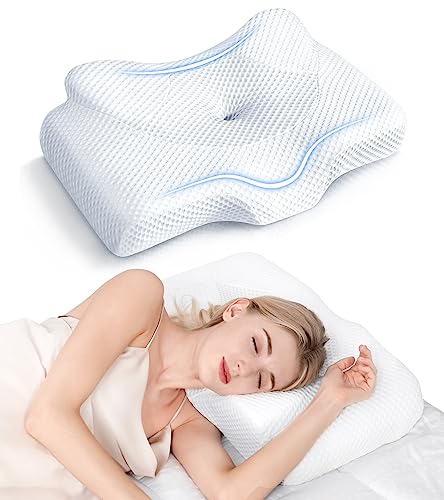
Osteo Cervical Pillow — Best Hollow-Centre Contour
The defining feature here is in the listing title itself: a hollow design. Instead of a uniform mound, the centre of this memory foam contour dips so the head rests lower while the neck sits on the raised, supportive edge — the classic cervical contour idea, executed with a deeper centre than most. The listing also states a cooling case and an adjustable design, which together address the two commonest complaints about contour pillows: sleeping warm, and guessing the wrong height.
Strengths
- Hollow centre cradles the head while the raised edge supports the neck
- Adjustable design lets you tune the feel instead of accepting one fixed loft
- Cooling case suits sleepers who find memory foam warm
Trade-offs
- The pronounced contour feels strange for the first few nights
- Hollow-centre shape is aimed at back and side sleeping, not stomach sleeping
- Adjustability means some setup time before the pillow feels right
| Construction | Memory foam (per listing title) |
| Design | Hollow design contour |
| Case | Cooling case |
| Adjustability | Adjustable (per listing title) |
Approach it as a pillow you set up, not a pillow you simply unwrap. Spend the first evening adjusting it and lying on it while reading, so the shape stops feeling foreign before you ask it to carry a full night. The contour will still feel deliberate for a few nights — that is the nature of changing the geometry under your head — and the fair test is how you feel after a week, not after a night. For back sleepers especially, the hollow centre is the feature to focus on: it is designed to stop the head being pushed forward, which is the failure mode of thick standard pillows.
Best for: Back and side sleepers who want a defined contour with tuning options / Not suited for: Stomach sleepers and anyone who wants a pillow that feels like a standard pillow
Check on Amazon — check the current price on Amazon before you decide.
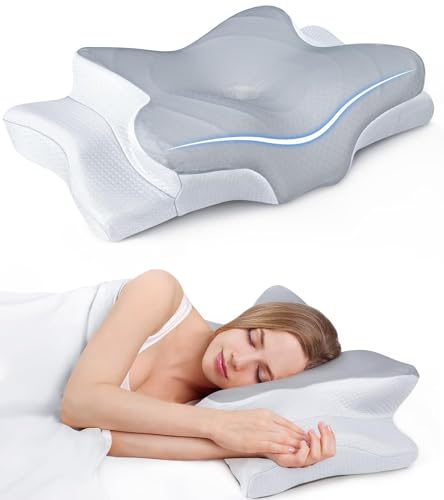
Ultra Pain Relief Cooling Pillow (Cervical Contour) — Best Adjustable Cooling Contour
This adjustable cervical pillow is built from ergonomic contour memory foam and positioned as a cooling design — the listing describes it as an odorless pillow for cosy sleeping, which matters more than it sounds: fresh memory foam smell is a common reason new pillows get banished to the spare room, and a pillow you are trialling needs to stay on your bed.
Strengths
- Adjustable loft reduces the one-size guessing game
- Cooling positioning suits hot sleepers moving to memory foam
- Ergonomic contour supports the neck edge for side and back sleeping
Trade-offs
- Brand is less established than the mainstream names in this roundup
- Adjustable systems need re-checking after the cover is washed
- Contour shape will not suit stomach sleepers
| Construction | Ergonomic contour memory foam |
| Design | Adjustable cervical pillow |
| Feel | Cooling (per listing title) |
| Odour note | Described as odorless in listing title |
The adjustability is the substantive point. Loft — the effective height under your neck — is the variable that decides whether a contour pillow feels supportive or strained, and it depends on your shoulder width, mattress firmness and sleeping position in ways no size chart fully captures. A pillow that lets you change that height converts an expensive guess into a tunable setup. Pair that with a cooling surface and this becomes the natural shortlist entry for warm sleepers who have avoided memory foam contours until now. As with every pick here, judge it on those physical features and on your own week’s trial — not on the boldest words in its title, which this guide deliberately does not repeat as claims.
Best for: Hot sleepers who want a contour they can tune / Not suited for: Anyone wanting a pillow from a long-established bedding brand
Check on Amazon — check the current price on Amazon before you decide.
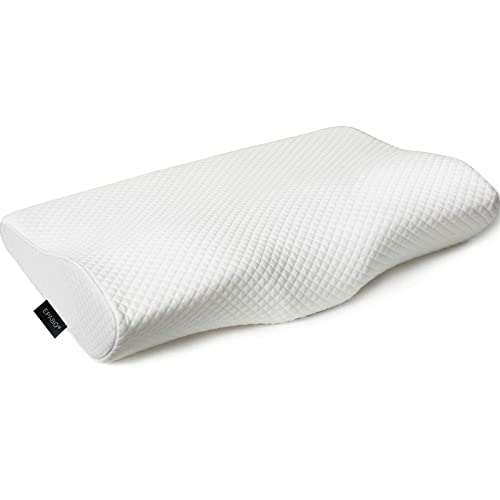
EPABO Contour Memory Foam Pillow — Best Established Contour
The EPABO contour is one of the category’s familiar shapes: an ergonomic cervical pillow in memory foam, positioned for side sleepers and back sleepers. Its listing confirms the essentials — contour memory foam construction and an ergonomic profile — without the elaborate feature stack of newer rivals, and for many buyers that simplicity is the appeal: one well-understood shape, done consistently.
Strengths
- A long-running contour design with a shape many switchers find familiar
- Ergonomic profile supports side and back sleeping in one pillow
- Memory foam holds its contour consistently night after night
Trade-offs
- Fixed loft — no adjustment if the height misses your needs
- Contour edge can feel firm against the shoulder at first
- Not designed for stomach sleeping
| Construction | Contour memory foam |
| Design | Ergonomic cervical pillow |
| Positions | Side sleepers and back sleepers (per listing title) |
A fixed contour is a commitment, so the homework matters. On your side, the raised edge should fill the space between shoulder and head so your neck stays level with your spine; on your back, the lower central area should support without pushing your chin down. If you are between sizes or unsure of your loft, an adjustable pick elsewhere in this roundup is the safer first step. If you already know a standard contour height works for you — perhaps you are replacing a worn contour pillow — this is the straightforward like-for-like choice, and its long presence in the category means its shape is a known quantity rather than an experiment.
Best for: Side and back sleepers who want a proven, fixed contour / Not suited for: Anyone who needs adjustable height from their pillow
Check on Amazon — check the current price on Amazon before you decide.

DONAMA Cervical Pillow — Best Dual-Height Design
Dual-height is the quietly clever idea in this category: the two long edges of the pillow are built at different heights, so rotating the pillow 180 degrees gives you a higher or lower neck support. The DONAMA listing confirms exactly that — a dual-height ergonomic design in cooling contour memory foam — and it solves the category’s biggest buying risk, which is discovering on night three that your pillow is simply the wrong height.
Strengths
- Two heights in one pillow: turn it around to change the neck edge
- Cooling contour surface suits warm sleepers
- Dual-height design covers back and side positions with one purchase
Trade-offs
- You must test both orientations to find your fit, which takes patience
- Cooling covers feel cool initially rather than all night
- Contour shape remains unsuitable for stomach sleeping
| Construction | Cooling contour memory foam |
| Design | Dual-height ergonomic neck support |
| Feel | Cooling (per listing title) |
For combination sleepers the benefit is practical rather than theoretical: use the higher edge on side-sleeping nights and the lower edge when you settle on your back, without keeping two pillows in the room. The cooling contour surface addresses the warmth complaint that follows memory foam around. The discipline this design asks of you is testing: spend at least two nights on each orientation before judging, because the first night on any new contour measures unfamiliarity as much as fit. Judged on features alone — two heights, cooling cover, defined contour — this is one of the most risk-resistant purchases in the roundup.
Best for: Sleepers who alternate between back and side, or are unsure of their loft / Not suited for: Anyone who wants one fixed, familiar pillow shape
Check on Amazon — check the current price on Amazon before you decide.

Bedsure Cervical Neck Pillow — Best Mainstream-Brand Contour
Bedsure is a name many shoppers already know from sheets and blankets, and its entry here is a memory foam cervical pillow with an orthopedic contour that, per the listing, gently cradles the head and provides support for side and back sleepers. For buyers who are wary of unfamiliar marketplace brands — a reasonable instinct in a category full of bold titles — a mainstream bedding label is a legitimate deciding factor.
Strengths
- From a mainstream bedding brand rather than a marketplace-only label
- Contour cradles the head while supporting the neck edge
- Aimed at both side and back sleepers in one profile
Trade-offs
- Fixed profile, so loft cannot be tuned
- Brand familiarity does not guarantee the contour height suits you
- Contour newcomers still face an adjustment period
| Construction | Memory foam |
| Design | Orthopedic contour (per listing title) |
| Positions | Side and back sleepers (per listing title) |
Strip away the branding and the physical offer is the category standard: a fixed memory foam contour, higher at the neck edge, lower under the head, intended to keep the neck in line whether you settle on your side or your back. That makes the same pre-purchase checks apply as for any fixed contour: estimate your loft from your current pillow, consider your mattress firmness, and commit to a multi-night trial. What the brand buys you is predictability of manufacture and an easier returns conversation, not a different geometry. If the contour height suits you, this is a sound, uncomplicated version of it.
Best for: Buyers who prefer an established bedding brand / Not suited for: Sleepers who need adjustable or dual-height flexibility
Check on Amazon — check the current price on Amazon before you decide.

Cool Gel Cooling Pillow for Side Sleepers — Best for Side Sleepers Who Dislike Deep Contours
Not everyone gets on with a deep cervical contour, and this pillow is the gentler on-ramp: a standard-size, medium-firm memory foam pillow with a cool gel element and an ergonomic contour, positioned for side sleepers, with back-sleeper neck and shoulder support also described in its listing. The shape guides rather than dictates, which makes the first nights far less strange.
Strengths
- Gentler contour than the deep cervical designs — an easier transition
- Cool gel positioning targets the warmth side sleepers feel against foam
- Medium firm feel suits side sleepers who sink too far into soft pillows
Trade-offs
- Standard size only in this listing
- Gel surfaces feel cool at first touch rather than refrigerating all night
- Shallower contour gives less defined neck edge than the cervical picks
| Construction | Memory foam with cool gel (per listing title) |
| Profile | Standard size, medium firm ergonomic contour |
| Positions | Side sleepers; back sleeper support (per listing title) |
For side sleepers, the medium firmness is the working feature. A side sleeper’s head weight concentrates through one shoulder gap, and a too-soft pillow lets the head drop and the neck angle downward all night; a medium-firm foam holds the loft it promises. The gel element should be understood honestly: surfaces like this feel cool when you first lie down and moderate temperature build-up, rather than actively chilling for eight hours — set expectations at ‘less warm than plain foam’ and you will judge it fairly. If you have tried a deep contour and hated it, or are leaving a standard pillow for the first time, this is the pick in the roundup most likely to feel like an upgrade rather than an experiment.
Best for: Side sleepers moving from a standard pillow for the first time / Not suited for: Anyone who wants a pronounced hollow-centre cervical shape
Check on Amazon — check the current price on Amazon before you decide.
Comparison Table
| Pick | Badge | Key spec | Best for |
|---|---|---|---|
| Osteo Cervical Pillow | Best Hollow-Centre Contour | Memory foam (per listing title) | Back and side sleepers who want a defined contour with tuning options |
| Ultra Pain Relief Cooling Pillow (Cervical Contour) | Best Adjustable Cooling Contour | Ergonomic contour memory foam | Hot sleepers who want a contour they can tune |
| EPABO Contour Memory Foam Pillow | Best Established Contour | Contour memory foam | Side and back sleepers who want a proven, fixed contour |
| DONAMA Cervical Pillow | Best Dual-Height Design | Cooling contour memory foam | Sleepers who alternate between back and side, or are unsure of their loft |
| Bedsure Cervical Neck Pillow | Best Mainstream-Brand Contour | Memory foam | Buyers who prefer an established bedding brand |
| Cool Gel Cooling Pillow for Side Sleepers | Best for Side Sleepers Who Dislike Deep Contours | Memory foam with cool gel (per listing title) | Side sleepers moving from a standard pillow for the first time |
How to Choose a Supportive Pillow for Neck Comfort
Start from your sleeping position, because it decides the geometry you need. Side sleepers need the tallest, firmest neck support: your shoulder holds your head away from the mattress, and the pillow must fill that gap so the neck stays level. Back sleepers need less height and a gentler contour — too much loft pushes the head forward. Stomach sleepers are the honest exception in this category: most contours work against that position, and a thin, soft pillow is usually the more comfortable choice, which is why no pick here is aimed at stomach sleeping.
Next, loft and adjustability. If you are replacing a contour pillow that worked, match its type and choose a fixed design. If this is your first supportive pillow, reduce your risk: adjustable designs and dual-height designs (both represented above) let you change the effective height after purchase. Mattress firmness plays a hidden role — on a soft mattress your shoulder sinks, shrinking the gap a side sleeper’s pillow must fill; on a firm mattress the gap is larger and the loft must be too.
Then consider temperature and cover. Memory foam contours hold heat more than loose-fill pillows. Cooling cases and gel elements moderate that; they do not refrigerate. If you sleep hot, weight those features heavily, and check whether the case is removable for washing. Finally, plan the trial: decide in advance to give the pillow at least five to seven nights, alternating orientations or adjustments methodically, before judging it. A pillow returned after one night tells you nothing except that new shapes feel new.
What “Therapeutic” Can and Cannot Mean on a Pillow Listing
This search contains a medical-sounding word, so the guide states its position plainly. A pillow is a comfort product. The features that can be assessed honestly are physical: foam type, contour shape, height, firmness, adjustability and cover material. Whether a given person finds a pillow comfortable, and whether their sleep improves with it, are personal outcomes that vary and that no listing can guarantee.
What a pillow cannot do, on any evidence available to a shopping guide, is treat a condition. Neck pain has many causes — posture, strain, injury, arthritis, disc problems and more — and they do not share a single product-shaped solution. Buy the pillow for comfort and support; get the diagnosis from a professional.
Contour, Hollow-Centre and Standard Profiles Compared
The three profile families in this roundup feel genuinely different, and choosing the family matters more than choosing within it. A standard contour (EPABO, Bedsure) has a raised neck edge and a shallower centre — a clear step up in structure from a flat pillow, and the easiest to adapt to. A hollow-centre design (Osteo) deepens the middle so the head sits lower and the neck edge does more of the work; back sleepers often prefer it, and it feels the most ‘designed’ of the three. A gentle ergonomic profile (the Cool Gel pick) keeps a recognisable pillow shape with mild contouring — the transition option.
Dual-height and adjustable designs cut across these families by changing the height rather than the shape. If your uncertainty is ‘which height’, choose adjustability. If your uncertainty is ‘which shape’, start with the gentlest profile and move deeper only if you want more structure. Changing both shape and height at once, then judging after one night, is how good pillows end up returned and good sleepers end up back on a worn-out flat pillow.
Your Mattress, Your Shoulders, Your Pillow: The System View
A pillow never works alone, and many failed pillow purchases are really mattress mismatches. On a soft, enveloping mattress, your shoulder sinks deep, the gap between shoulder and head shrinks, and a tall contour pillow that would be perfect on a firm bed becomes too much pillow — your neck angles upward all night. On a firm mattress, the same shoulder barely sinks, the gap stays wide, and a low pillow leaves the neck drooping. Before blaming or praising any pillow in this roundup, locate your setup in that system: firm bed, broader shoulders, side sleeping — you are shopping at the tall, firm end of the category; soft bed, narrower frame, back sleeping — at the low, gentle end.
Shoulder width is the measurement nobody takes and everybody should. It, more than height or weight, sets a side sleeper’s required loft. If you are between the category’s standard offerings, that is precisely the case the adjustable and dual-height picks exist for: they let the pillow meet a body that falls between sizes. Pillow protectors and cases play a small role too — a thick, quilted protector adds a little effective height and softens a contour’s edge, which can fine-tune a pillow that is almost right. Treat the pillow as the last adjustable component in a system, and adjust it last, after the bed and the case are settled.
Position habits complete the system. Many self-described back sleepers spend half the night on a side, and many side sleepers roll partially toward their stomach, twisting the neck against a tall contour. If your mornings suggest position changes you do not remember, favour the forgiving designs — dual-height, gentler contours — over the most structured hollow-centre shapes. The best pillow for your neck comfort is the one matched to the sleeper you actually are at 3 a.m., not the one you intend to be at 11 p.m.
Reading Pillow Listings Without Being Read by Them
This category’s listings are written to sell certainty, and a calm reader’s skill is separating the specification from the slogan. The specifications are concrete and checkable: foam type, contour shape, heights, adjustability, dual-height edges, cover material and whether it removes for washing. Those are the words this guide has built its comparisons on, and they are the words you should search for in any listing, in this roundup or beyond it.
The slogans are the other layer — superlatives about outcomes. A useful habit is to translate every outcome claim back into the feature underneath it and judge the feature. A claim about waking transformed usually rests on a contour; a claim about coolness rests on a case material or a gel layer; a claim about customisation rests on adjustability. The feature can be real and valuable even when the slogan overreaches, and buying the feature at a fair price is good shopping. Buying the slogan is how disappointment gets ordered.
Finally, use the returns window as part of the product. In a category this body-specific, a seller’s willingness to take a trialled pillow back is worth real money, and a slightly higher price with a genuine trial beats a bargain with none. Keep the packaging until your five-to-seven-night trial is done, judge on the trend of your mornings, and let your own neck — assessed honestly, in comfort terms — be the only reviewer whose verdict counts. And if the verdict across several well-matched pillows is that nothing changes a persistent problem, that is the signal to stop shopping and start asking a professional, which is the most valuable conclusion a pillow trial can produce.
Sleep Position Transitions: When Your Pillow Needs Change
The pillow that suits you at thirty may argue with you at fifty, and the reason is rarely the pillow. Bodies change their sleeping positions across decades: stomach sleepers migrate to sides, side sleepers spend more of the night on their backs, injuries and pregnancies rewrite habits in a season. Each transition silently changes the loft and contour the neck wants, which is why a pillow can go from beloved to blamed without wearing out at all. When a trusted pillow stops working, the first hypothesis should be that the sleeper changed, not that the foam failed — and the fix is to re-shop your current position with the method in this guide, not to reorder the same model and hope.
Weight change, a new mattress and a new bed partner’s mattress choice all belong to the same story: the system moved. The adjustable and dual-height picks in this roundup are, in effect, insurance against that movement — they absorb a change of position or bed that would retire a fixed pillow. If your life is in a settled stretch, a fixed contour fitted carefully will serve for years. If your life is in transition — new home, new bed, new habits, a body in flux — buy the adjustability and let the pillow keep up with you.
There is a discipline that ties this together: when something changes in your sleep, change one thing at a time and give it the fair trial. A new pillow bought the same week as a new mattress, judged after two nights, teaches nothing and costs twice. The sleepers who end up well-matched to their pillows are not the ones who bought the most expensive model; they are the ones who treated their own changing body as data, adjusted a single variable, and kept notes. Your neck spends a third of your life on this equipment. It is worth the notebook.
Which Supportive Pillow Suits Which Sleeper?
If you are a back sleeper who wakes with your head pushed forward by a thick hotel-style pillow, start with the Osteo’s hollow centre. Its whole geometry exists to let the head rest lower while the neck is carried — the specific correction your current setup is missing. Give it the full trial; back sleepers often adapt fastest to contours because the position is stable, and a week is enough to know.
If you are a side sleeper with broad shoulders, or a combination sleeper who genuinely splits the night between side and back, your risk is height in both directions — which makes the dual-height DONAMA or the adjustable Ultra contour your rational first buy. You are not being indecisive; you are matching the product’s adjustability to your own variability, which is the most evidence-based purchase this category offers a first-time buyer.
If you are replacing a contour pillow that worked for years and simply wore out, resist the urge to upgrade into novelty. Buy the familiar geometry — the EPABO or the Bedsure — in the same spirit as replacing a favourite pair of shoes with the same model. Your body has already done the research; the trial was five years long. Spend your attention instead on confirming the new pillow’s height against the old one’s remains before the old one is thrown away.
If you sleep hot, let temperature arbitrate among equals: the cooling cases and the gel layer in this roundup are not garnish for you, they are the difference between a pillow trialled fairly and a pillow abandoned in week one for reasons that had nothing to do with its shape. And whoever you are, keep the guide’s boundary intact — the moment a pillow decision starts feeling like a medical decision, it has left the shop and entered the clinic, where it belongs.
How to Set Up and Trial a New Contour Pillow Fairly
A contour pillow deserves a structured trial, not a one-night verdict. This is the process that separates a genuine mismatch from ordinary unfamiliarity.
- Before the first night, set the pillow up: if it is adjustable, start at the middle or manufacturer-default configuration; if it is dual-height, choose the edge that matches your main sleeping position.
- Use your normal pillowcase unless the pillow comes with a fitted cooling case — in that case, trial it as supplied first, since the case is part of the design.
- Lie on it awake for fifteen minutes on the first evening, in your actual sleeping position, and make one adjustment if the height is clearly wrong. Small early corrections prevent a whole night of fighting the pillow.
- Nights one and two: expect the shape to feel deliberate. Note only two things each morning — whether you woke because of the pillow, and how your neck felt compared with your old pillow.
- Nights three to five: change one variable only if needed — the other height edge, or one adjustment step. Changing everything at once teaches you nothing.
- By night seven, judge on the trend across the week, not the worst night. A pillow whose mornings are improving is adapting with you; one that is still actively uncomfortable after a fair week is the wrong height or shape for you.
- If you return it, note exactly why — too high, too low, too firm, too warm. That note turns the next purchase from a guess into a correction, and the roundup above is organised by precisely those variables.
One more honest note: no setup process turns a comfort product into a treatment. If a fair trial leaves you with the same persistent pain you started with, the next step is a clinician’s assessment, not a more expensive pillow.
Common Buying Mistakes
Believing the boldest claim on the listing. Listing titles in this category promise a great deal. Buy the physical features — contour, height, foam, cover — and let your own week-long trial deliver the verdict.
Judging a contour pillow after one night. New geometry feels strange before it feels right. One night measures unfamiliarity. Five to seven nights, with methodical adjustments, measure fit.
Ignoring your sleeping position. A tall, firm contour that suits a broad-shouldered side sleeper can be actively wrong for a back sleeper, and most contours are wrong for stomach sleeping altogether. Position comes first.
Forgetting the mattress. Your shoulder sinks into a soft mattress and barely dents a firm one, which changes the loft you need. A pillow that failed on one bed can be right on another — and vice versa.
Chasing a pillow for persistent pain. Ongoing, worsening or injury-related neck pain, and any pain with numbness or weakness, needs professional assessment. A pillow is for comfort; it is not a diagnostic or a treatment.
Keeping a flattened old pillow as the backup plan. If your trial fails and you return to a pillow that has lost its loft, you have learned nothing except that change is hard. Note why the trial failed and correct that one variable next time.
Final Recommendation
Start with your risk profile. First-time contour buyers should choose the adjustability of the Ultra cooling contour or the dual-height DONAMA, because height is the variable most people guess wrong. Back sleepers drawn to a defined cradle should look at the Osteo hollow-centre design. Confident contour users replacing a worn pillow can go straight to the EPABO or the Bedsure for a fixed, familiar shape, and side sleepers who dislike deep contours should start with the Cool Gel pillow.
Whichever you choose, run the fair trial described above, judge features rather than claims, and remember the boundary this guide has kept throughout: comfort and support are what a pillow sells; persistent pain is a clinician’s job. Related reading in this programme:
Best Contour Neck Pillows For Sleeping Best Contour Side Sleeping Pillows Best Foam Pillows For Neck Best Pillows For A Neck That Hurts Best Knee Pillows For Side Sleepers Best Hypoallergenic Pillows For Neck Pain
Frequently Asked Questions
Can a pillow actually fix neck pain?
This guide makes no such claim, and you should be sceptical of any listing that does. A well-matched pillow can improve comfort and support your neck in a neutral position while you sleep, which is a legitimate reason to buy one. Pain that persists, worsens, follows an injury, or comes with numbness or weakness should be assessed by a clinician.
How high should a supportive pillow be?
It depends on your position and build. Side sleepers need enough loft to fill the shoulder-to-head gap and keep the neck level; back sleepers need less, so the head is not pushed forward. If you are unsure, an adjustable or dual-height design lets you find the height at home instead of guessing it in a shop.
How long does it take to get used to a contour pillow?
Plan on five to seven nights. The first two nights usually feel strange because the geometry is new; by the end of a week, mornings should be trending better if the pillow suits you. Judge the trend, not the first night.
Are cooling cases and gel layers worth it?
If you sleep warm, yes — with realistic expectations. Cooling covers and gel elements feel cool on contact and slow heat build-up in memory foam; they do not actively chill the pillow all night. For hot sleepers moving from loose-fill pillows to foam, that moderation is often the difference between keeping and returning the pillow.
Which pick suits stomach sleepers?
Honestly, none of them is designed for stomach sleeping — contours generally work against that position, which usually calls for a thin, soft pillow instead. If you are a committed stomach sleeper, shop that specific category rather than forcing a cervical contour to do a job it is not shaped for.
What is the difference between adjustable and dual-height?
An adjustable pillow changes its loft by adding or removing material or inserts. A dual-height pillow has two built edges at different heights, and you rotate the pillow to choose between them. Both solve the same problem — height uncertainty — and both are safer first purchases than a fixed loft you have never tried.

