Disclosure: airfryerkitchensupply.com is reader-supported. When you buy through links on our site, we may earn an affiliate commission at no extra cost to you.
Where to buy
A stand mixer is a decade-long counter commitment, so check the current price on Amazon from the listings below and confirm exactly which attachments are in the box — bowl size, beaters and any bundled extras vary by listing and change the real value of the same model considerably.
- KitchenAid 5.5-Qt Bowl-Lift Stand Mixer KSM55 — Check the current price on Amazon
- KitchenAid 7 Quart Bowl-Lift Stand Mixer KSM70 — Check the current price on Amazon
- Bosch Universal Plus Stand Mixer — Check the current price on Amazon
- Ankarsrum Original Stand Mixer AKM6230 — Check the current price on Amazon
- Cuisinart Stand Mixer SM-50 — Check the current price on Amazon
- Hamilton Beach 4 Qt Electric Stand Mixer — Check the current price on Amazon
A stand alone mixer — a freestanding stand mixer that lives on your counter and works hands-free — is the appliance that quietly reorganises a kitchen around itself. Bread dough that used to be a project becomes a Tuesday habit. Meringues happen because the machine does the standing there. The best stand alone mixers earn that transformation through three things: a motor and gearbox that knead heavy dough without strain or drama, a bowl and beater geometry that actually reaches all the mixture, and a build you will not be replacing in four years.
The category splits into design philosophies that matter more than brand badges. Tilt-head mixers are friendly and compact but can flex under heavy dough loads. Bowl-lift models trade a little convenience for a rigid frame that stays composed under exactly those loads. And two European designs in this guide — Bosch’s compact drive and Ankarsrum’s rotating bowl — rethink the whole machine, kneading in ways that bread bakers specifically swear by. This guide covers all of it, because ‘best’ here depends entirely on what you bake.
One measurement discipline before the picks: judge capacity by flour weight, not bowl volume. A bowl that holds six quarts of soup may struggle with a kilo of stiff bread dough, and it is dough — not liquid — that tests every part of a stand mixer. Each review below therefore talks about real loads: pizza dough, enriched dough, cookie batches and whipped work, in the quantities home bakers actually make.
In this guide
Quick Picks
Six freestanding mixers across every design philosophy — tilt-head, bowl-lift and the two European alternatives bread bakers love.
KitchenAid 5.5-Qt Bowl-Lift Stand Mixer KSM55 — Best Overall. The bowl-lift sweet spot: eleven speeds, a half-speed for folding, and a rigid frame that kneads without flexing. Check price on Amazon.
KitchenAid 7 Quart Bowl-Lift Stand Mixer KSM70 — Best for Big Batches. Seven quarts and the same bowl-lift rigidity, scaled for double batches, big families and small-scale selling. Check price on Amazon.
Bosch Universal Plus Stand Mixer — Best Compact Power. A 500-watt, 6.5-quart machine with the motor in the base — astonishing dough capacity from a mixer you can actually lift. Check price on Amazon.
Ankarsrum Original Stand Mixer AKM6230 — Best for Bread Purists. The Swedish rotating-bowl icon: the bowl turns, the tools stay still, and bread dough is kneaded the way hands do it. Check price on Amazon.
Cuisinart Stand Mixer SM-50 — Best Value Full-Featured Pick. Twelve speeds, a 5.5-quart steel bowl and a tilt-head design at a mid-tier price — the sensible all-rounder. Check price on Amazon.
Hamilton Beach 4 Qt Electric Stand Mixer — Best Budget Stand Mixer. Planetary mixing, seven speeds and a carry handle at an entry price — the honest first stand mixer. Check price on Amazon.
How These Picks Were Chosen
From the verified stand-mixer pool we selected six machines that represent the category’s real choices rather than six colour variations of one idea: KitchenAid’s bowl-lift line at two sizes, the European Bosch and Ankarsrum designs, Cuisinart’s value flagship and Hamilton Beach’s honest budget entry.
Judging centred on dough, because dough is destiny for a stand mixer. We weighed motor behaviour under sustained load — does it labour, heat up, walk across the counter? — beater-to-bowl contact, which decides whether you scrape constantly, and the practical flour capacity behind each bowl’s headline volume. Whipping and mixing performance, attachment ecosystems and counter footprint were assessed as the supporting criteria they are.
We excluded novelty mixers and ultra-budget machines whose motors cannot survive weekly bread. A stand mixer is bought for years of service; every pick here, including the budget one, is a machine a household can plausibly still be using, happily, a decade from now.
The 6 Best Stand Alone Mixers

KitchenAid 5.5-Qt Bowl-Lift Stand Mixer KSM55 — Best Overall
The 5.5-quart bowl-lift is where KitchenAid’s line makes the most sense for serious home bakers. The bowl-lift frame — the bowl rises to the head on a lever, rather than the head tilting — gives the machine a rigidity that shows up the moment stiff dough starts climbing the hook: no flex, no rocking, just steady planetary work. Eleven speeds include a gentle half-speed for folding, a detail bakers of delicate batters genuinely use.
It suits households baking weekly: bread, pizza dough, big cookie batches, holiday production. The attachment ecosystem is the industry’s deepest, so the machine can grow into pasta, grinding and more. Its trade-offs are the bowl-lift rituals — removing the bowl is a touch less casual than a tilt-head, and the machine is tall and heavy enough to claim its counter space permanently. Bakers with low cupboards should measure before falling in love.
Strengths
- Rigid bowl-lift frame stays composed under heavy dough
- 11 speeds including a true gentle folding speed
- The deepest attachment ecosystem in the category
Trade-offs
- Tall and heavy: needs permanent counter space and cupboard clearance
- Bowl removal is less casual than tilt-head designs
- Premium tier pricing before attachments
Key specs: 5.5-qt stainless bowl, bowl-lift, 11 speeds, flat beater, dough hook and wire whip included.
The honest way to judge this mixer is a double batch of pizza dough on a Friday night, weekly, for a year. That rhythm is where lesser mixers loosen, overheat or start their slow decline, and where the bowl-lift’s overbuilt calm becomes the entire point. If your baking life looks like that — regular, heavy, joyful — this is the machine the rest of the guide is measured against.
Best for: weekly bread and dough bakers who want one mixer for a decade / Not suited for: small kitchens needing a mixer that hides in a cupboard
Check the current price on Amazon

KitchenAid 7 Quart Bowl-Lift Stand Mixer KSM70 — Best for Big Batches
The 7-quart KSM70 exists for the baker whose standard unit is the double batch. Its bowl swallows the flour loads that crowd the 5.5-quart — multiple loaves, party-scale cookie dough, the enriched doughs of a holiday weekend — while the bowl-lift frame and eleven speeds, including the folding half-speed, keep the same composed behaviour at the larger scale. The included accessory set, with a double flex-edge beater, addresses the big-bowl weakness of mixture hiding at the edges.
It suits large families, bakers who sell at markets, and households that batch-cook for the freezer. The cautions scale with the bowl: small jobs — two egg whites, a half-batch of dough — are genuinely less at home in a seven-quart bowl, and the machine’s size and weight make it the most permanent counter resident in this guide. If your baking is mostly modest batches, the 5.5-quart is the smarter buy; if ‘double it’ is your catchphrase, this is your mixer.
Strengths
- Seven-quart capacity built for double batches
- Accessory set includes edge-scraping beater for big-bowl coverage
- Same 11-speed finesse, including the folding half-speed
Trade-offs
- Small batches underperform in the large bowl
- Largest footprint and weight in this guide
- Costs more machine than modest bakers will ever use
Key specs: 7-qt stainless bowl, bowl-lift, 11 speeds, multiple accessories included.
Market and community bakers should note the workflow virtue here: one mixer that handles the whole morning’s production without batch-splitting changes the economics of small-scale baking. Fewer, larger mixes mean consistent dough, faster shaping and a kitchen that stays sane at scale. The KSM70 is not a commercial mixer and should not be run like one all day — but for the serious home-production tier, it is the ceiling of what a domestic machine sensibly does.
Best for: big-batch bakers, large families and home sellers / Not suited for: small-batch bakers and small kitchens
Check the current price on Amazon
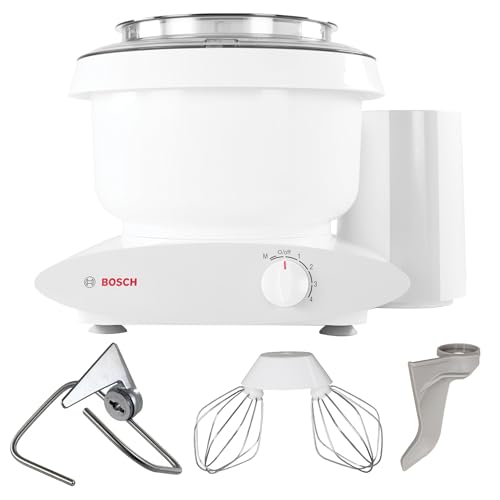
Bosch Universal Plus Stand Mixer — Best Compact Power
The Bosch Universal Plus inverts the stand mixer. Instead of a heavy head full of motor looming over the bowl, its 500-watt motor lives in the base and drives the tools from below, which makes the machine light, compact and stable — and gives its open-top bowl a working style bakers adore: ingredients are added easily while it runs, and the bowl’s dough hook system kneads large, heavy batches with an efficiency that embarrasses bigger-looking rivals.
It suits bread bakers above all: wholegrain and high-volume doughs are its home territory, and its capacity for flour exceeds what its footprint suggests. The bundled wire whips and dough hook extender cover the range from meringue to a table’s worth of loaves. Its compromises are real: the plastic bowl and unconventional design divide opinion, whipping tiny quantities is not its strength, and it will never have KitchenAid’s attachment universe. As a dough machine per inch of counter, though, nothing else here touches it.
Strengths
- Base-drive design: light, compact, exceptionally stable
- Outstanding flour capacity for heavy and wholegrain doughs
- Open bowl makes adding ingredients mid-mix effortless
Trade-offs
- Unconventional design and plastic bowl divide opinion
- Small whipping jobs are not its forte
- Smaller attachment ecosystem than KitchenAid
Key specs: 500W motor, 6.5-qt bowl, wire whips, dough hook and extender bundle.
The Bosch rewards a specific baker: the one whose mixer lives or dies by the weekly wholegrain loaf, the batch of rolls, the pizza night for eight. That baker should weigh this machine’s dough record more heavily than its looks. Kitchens are full of beautiful tilt-heads that strain at exactly the jobs the Bosch treats as routine — design philosophy is not an aesthetic footnote, it is the product.
Best for: bread-focused bakers wanting maximum dough capacity in minimum space / Not suited for: attachment collectors and tiny-batch whippers
Check the current price on Amazon
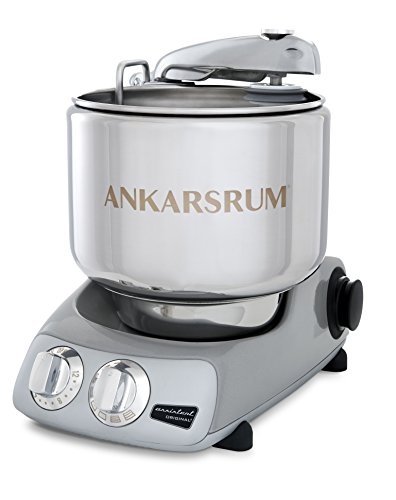
Ankarsrum Original Stand Mixer AKM6230 — Best for Bread Purists
The Ankarsrum is the most distinctive machine in this guide. Its large stainless bowl rotates while the roller and scraper stay in place, kneading dough by rolling and folding it in a motion that genuinely resembles hand work — and bread bakers who make the switch routinely report dough texture they could not get from a hook. The design also leaves the bowl completely open, so additions are effortless and nothing hides under a motor head.
It suits dedicated bread bakers, large-batch households and cooks who value a machine built, in Sweden, to a decades-long standard — these mixers are famous for being inherited. The learning curve is real: the roller-and-scraper method asks you to unlearn hook habits and supervise dough differently, and the price is the highest in this guide. Bakers who want a familiar, do-everything Western mixer should take the KitchenAid; bakers whose heart is in the loaf should at least understand what the Ankarsrum is offering before they decide.
Strengths
- Rotating-bowl kneading produces exceptional bread dough
- Huge open bowl: easy additions, easy monitoring
- Legendary build quality and longevity
Trade-offs
- Highest price in this guide
- Roller technique has a genuine learning curve
- Unfamiliar method for bakers raised on dough hooks
Key specs: Rotating stainless bowl, roller and scraper system, Swedish-built.
Ankarsrum ownership has a particular rhythm: the first month is adjustment, the first year is conversion, and the following decades are quiet satisfaction. Its kneading is also notably gentle on enriched and delicate doughs that hooks can tear. If your baking identity is bread — real bread, weekly, in quantity — this machine is less an appliance purchase than joining a tradition, and it should be budgeted and judged that way.
Best for: dedicated bread bakers baking in quantity for the long term / Not suited for: casual bakers wanting a familiar all-rounder
Check the current price on Amazon

Cuisinart Stand Mixer SM-50 — Best Value Full-Featured Pick
The Cuisinart SM-50 is the mixer for households that want the full stand-mixer experience — twelve speeds, a proper 5.5-quart stainless bowl, chef’s whisk, paddle and dough hook in the box, and a splash guard with a pour spout — without paying the flagship brands’ premium. Its tilt-head design is the friendly, familiar format, and its performance across cakes, cookies, whipped work and moderate doughs is thoroughly capable.
It suits generalist bakers: the household that bakes something most weeks, in normal quantities, across the whole repertoire. Its limits appear exactly where its price predicts — sustained heavy dough work is a job it can do occasionally rather than a lifestyle it is built for, and its attachment ecosystem is smaller than KitchenAid’s. Judged as the complete, honest all-rounder at its tier, it is the pick most households would be happiest with if brand romance were set aside.
Strengths
- Full accessory set in the box, including splash guard
- 12 speeds cover delicate to vigorous work
- Mid-tier price for a genuinely complete package
Trade-offs
- Heavy daily dough duty is beyond its design brief
- Attachment ecosystem trails KitchenAid’s
- Tilt-head frame flexes more than bowl-lift under stiff loads
Key specs: 5.5-qt stainless bowl, tilt-head, 12 speeds, whisk, paddle, hook and splash guard.
The SM-50’s value is clearest in a first-year audit: count the jobs a normal baking household actually does — birthday cakes, cookie batches, pizza Fridays, whipped cream, the occasional loaf — and this mixer does all of them well, today, at its price. The flagship picks earn their premiums in year five of weekly bread, not in week one of normal baking. Buy for your real calendar and the Cuisinart is very hard to argue with.
Best for: generalist home bakers wanting the complete package for less / Not suited for: daily heavy-dough bakers
Check the current price on Amazon

Hamilton Beach 4 Qt Electric Stand Mixer — Best Budget Stand Mixer
Hamilton Beach’s stand mixer makes one promise and keeps it: real stand-mixer convenience — planetary mixing action that reaches around the bowl, seven speeds, whisk, beater and dough hook included — at a price that lets a household find out whether stand mixing suits their life before committing flagship money. The easy-carry handle acknowledges its reality: this is a mixer that may live in a cupboard and travel to the counter, unlike the permanent residents above it.
It suits beginners, small households, occasional bakers and anyone equipping a second kitchen, a student flat or a holiday home. Its four-quart bowl and 300-watt motor define its honest ceiling: cakes, cookies, mashed potatoes and light doughs are its world, and heavy bread dough in quantity is not. Within that world it is cheerful, capable and astonishing value; outside it, it will tell you so by labouring, at which point the correct response is a smaller batch, not more throttle.
Strengths
- Planetary mixing action at an entry-level price
- Light enough to store and carry, with a handle to prove it
- Full basic attachment set included
Trade-offs
- 300W motor: heavy dough is beyond its brief
- Four-quart bowl limits batch size
- Build is functional plastic rather than heirloom metal
Key specs: 4-qt bowl, 7 speeds, 300W, whisk, flat beater and dough hook.
There is no shame tier in this guide, and the Hamilton Beach is why: a household that bakes monthly will get more joy from this mixer plus great ingredients than from a flagship gathering dust as a monument to intentions. It is also the perfect diagnostic purchase — a year with it teaches you exactly which jobs you actually do, so the eventual upgrade, if it comes, is bought with knowledge instead of hope.
Best for: beginners, occasional bakers and small households on a budget / Not suited for: bread bakers and large-batch households
Check the current price on Amazon
Comparison Table
| Pick | Badge | Key spec | Best for |
|---|---|---|---|
| KitchenAid 5.5-Qt Bowl-Lift Stand Mixer KSM55 | Best Overall | 5.5qt bowl-lift, 11 speeds | weekly bread and dough bakers who want one mixer for a decade |
| KitchenAid 7 Quart Bowl-Lift Stand Mixer KSM70 | Best for Big Batches | 7qt bowl-lift, 11 speeds, accessory bundle | big-batch bakers, large families and home sellers |
| Bosch Universal Plus Stand Mixer | Best Compact Power | 500W base-drive, 6.5qt bowl | bread-focused bakers wanting maximum dough capacity in minimum space |
| Ankarsrum Original Stand Mixer AKM6230 | Best for Bread Purists | Rotating bowl, roller kneading system | dedicated bread bakers baking in quantity for the long term |
| Cuisinart Stand Mixer SM-50 | Best Value Full-Featured Pick | 5.5qt tilt-head, 12 speeds | generalist home bakers wanting the complete package for less |
| Hamilton Beach 4 Qt Electric Stand Mixer | Best Budget Stand Mixer | 4qt, 7 speeds, 300W, planetary action | beginners, occasional bakers and small households on a budget |
How to Choose a Stand Alone Mixer: Dough Load, Design and Footprint
Start with your heaviest regular job and be truthful about its frequency. Weekly bread dough points to bowl-lift rigidity or the European dough specialists — the KSM55, Bosch or Ankarsrum. A repertoire of cakes, cookies and occasional dough points to the tilt-head all-rounders. A monthly bake points honestly to the budget pick. Stand mixers fail their owners not by breaking, but by being bought for an imagined baking life instead of the real one.
Understand the three designs before comparing brands. Tilt-head mixers are convenient and compact, but the hinge can flex under stiff dough. Bowl-lift mixers fix the head and move the bowl, buying rigidity at the cost of a taller, heavier machine. Base-drive and rotating-bowl designs — Bosch and Ankarsrum — abandon the overhead head entirely, gaining dough ability and open bowls while asking you to learn their methods. None is universally best; each is best at something specific.
Finally, measure your kitchen like you mean it. A bowl-lift KitchenAid needs headroom under wall cupboards to be usable in place, and every machine here except the Hamilton Beach effectively becomes a permanent counter resident. Measure the space, the cupboard height and the route to the sink before ordering; the best mixer in the world is a bad purchase if it must be wrestled out of a cupboard every time inspiration strikes.
Flour Capacity: The Only Capacity Number That Matters
Bowl volume is a soup measurement applied to a dough problem. What tests a stand mixer is flour weight under load: a stiff dough at sixty percent hydration climbs hooks, torques frames and heats motors in ways no liquid ever will. As a working guide, treat a mixer’s comfortable flour capacity as the number that decides your batch size, and halve any heroic implication a headline bowl size seems to make.
The picks separate cleanly on this axis. The Bosch and Ankarsrum handle the largest flour loads in this guide relative to their size, because their designs were drawn around dough. The 7-quart KitchenAid wins on absolute batch volume. The 5.5-quart bowl-lift covers serious home batches comfortably. The Cuisinart handles moderate doughs well, and the Hamilton Beach is a light-dough machine that should be loaded accordingly.
Whatever you buy, learn its sound. A mixer working comfortably has a steady, unstrained note; a mixer in trouble slows, labours and heats. Splitting a batch is always cheaper than a gearbox, and a baker who respects flour capacity will still be using the same machine in a decade.
Attachments and Ecosystems: Buying the Machine’s Future
A stand mixer’s attachment port is a promise about its future. KitchenAid’s ecosystem is the deepest in the category — pasta rollers, grain mills, grinders, spiralizers and more — turning one motor into a counter of appliances. For households that will genuinely use them, that ecosystem is a legitimate reason to choose the brand, and second-hand attachments are plentiful.
Be honest about the conditional, though. Attachments bought aspirationally become cupboard archaeology; the pasta roller used twice costs more per use than a restaurant meal. The European picks make the opposite trade — fewer attachments, deeper excellence at the core job — and the value picks include what most households use and little more.
The disciplined approach: buy the mixer for the jobs you already do weekly, and let attachments be earned by demonstrated habits. Three months of hand-cranked pasta earns the roller. A year of weekly loaves earns the grain mill. The mixer itself, chosen for your real baking, will never be the wrong purchase.
Care, Cleaning and the Habits That Make a Mixer Last Fifteen Years
A stand mixer’s enemies are unglamorous: overload, heat and dried dough. The care routine that defeats them takes minutes. Never exceed the flour loads the design handles comfortably, and split batches without embarrassment — two relaxed mixes are faster than one gearbox replacement. Give the motor cooling pauses during marathon sessions, the way you would rest any hard-working tool, and keep the vents clear of the flour dust that baking joyfully generates.
Cleaning technique matters more than cleaning products. Wash the bowl and tools promptly; dough left to dry becomes a construction material that tempts owners into soaking the wrong parts and prising at seals. Wipe the machine body with a damp cloth only — a stand mixer is an electrical appliance wearing a kitchen costume — and dry everything fully before reassembly, especially around the attachment hub, where moisture does quiet damage over years.
Finally, use the machine. Seals, lubricants and bearings all prefer regular work to attic storage, and a mixer exercised weekly will outlast an identical one pulled out twice a year and shocked with a Christmas marathon. The best maintenance schedule for the mixers in this guide is simply the baking habit you bought them for.
Accessories Worth Owning — and the Ones That Stay in the Box
Across every brand in this guide, the accessories owners actually use share a trait: they extend a job the household already does weekly. A second bowl is the universal champion — one batch rising or chilling while the next mixes — and it is unglamorous enough that people underrate it until they own one. A flex-edge beater that scrapes as it mixes earns its place in any kitchen that makes batters and frostings regularly, quietly deleting the stop-and-scrape ritual from every recipe.
Splash guards and pouring shields divide households: bakers of fine, dusty mixtures swear by them, dough-focused bakers never touch them. Grain mills and pasta rollers, where a brand’s ecosystem offers them, follow the rule from the guide section above — they are excellent purchases the month a real habit demands them and expensive sculptures the month before. Buy accessories in the order your notebook of actual baking asks for them.
Storage is the hidden accessory. A mixer that must be hauled from a cupboard gets used half as often as one with a permanent, reachable home — which makes a clear stretch of counter, or a lift shelf in a base cabinet, the highest-value ‘accessory’ in this entire article. Measure for it the way you measured for the mixer, and your stand alone mixer will repay the space every single week.
Reading a Mixer in the First Week: Tests That Tell You the Truth
A new stand mixer deserves a structured first week, because that is when a wrong purchase can still become a right one. Day one, whip egg whites and cream: you are testing low-end finesse, bowl geometry and whether the whisk truly reaches the bottom. Midweek, make your standard cake or cookie batch and count the scraping stops — a well-matched beater and bowl will need few, and each stop you do not make is a small dividend paid forever.
The weekend test is dough, at your real recipe’s full size. Watch and listen: the machine should settle into a steady working note, the dough should gather and knead rather than batter the bowl, and the head or frame should stay composed. Photograph the result and write two sentences in your baking notebook. If the machine strains at your normal load, that is not a character flaw to live with — it is sizing information, and acting on it early is what returns windows are for.
Finish the week with the logistics audit: lifting, cleaning, storing, the route from counter to sink. A mixer that delights in use and annoys in cleaning will slowly stop being used, and the finest motor in this guide cannot help a machine that lives in its box. The right mixer passes all three tests — finesse, dough and daily life — without drama.
Stand Mixer vs Food Processor vs Hand Mixer: Owning the Right Motor
Kitchens accumulate motors, and wisdom is knowing which one a job belongs to. The hand mixer owns small, quick, liquid work: a single cake batter, whipped cream for tonight, a bowl of frosting. It is cheap, washes in a minute and stores in a drawer — and it should never be asked to knead, because its motor, gearing and your wrist are all wrong for the job. The food processor owns cutting: pastry rubbed in seconds, doughs for flatbreads and crackers, slicing and grating at a speed no knife matches.
The stand mixer owns time and torque. Its kingdom is anything that must be worked continuously for minutes — dough developing, meringue climbing, butter and sugar creaming to a specific lightness — while your hands do something else. That hands-free continuity is not a luxury; it changes what a cook attempts on a weeknight, which changes what a household eats, which is the entire quiet argument of this guide.
Own them in the order your cooking demands. Most baking households find the stand mixer becomes the anchor and the others orbit it; bread-free households may honestly never need one. The picks above are ranked for the stand mixer’s kingdom — judge them there, and let the smaller motors keep their own honest thrones.
The Second Year: When a Stand Mixer Stops Being an Appliance
Something shifts in a stand mixer’s second year of honest use. The recipes that were projects become reflexes: the Friday dough mixed while the oven heats, the birthday cake whose batter comes together while you find the candles. Neighbours and family begin, half-joking, to place orders. This is the stage where the machine’s true specification reveals itself — not its wattage or its bowl size, but the number of times it turned ‘we should make that’ into the thing actually being made.
It is also the stage where the differences in this guide compound. A mixer that strained at your standard load in month two is now the ceiling on your ambitions; a mixer bought with headroom has quietly become infrastructure. Bakers planning to sell, to teach, or simply to feed a growing family’s growing appetites should read that paragraph twice before choosing between the sensible all-rounder and the overbuilt bowl-lift. The price difference is paid once; the capacity difference is collected weekly.
Keep the notebook going through the second year, too: the recipes that worked, the loads that laboured, the attachment that earned its shelf. That record is how the third year’s purchases — a second bowl, a grain mill, perhaps a second specialised machine like the Ankarsrum for a now-serious bread practice — get made with evidence instead of appetite. Great kitchens are not bought; they are accumulated, one justified tool at a time, and the stand mixer is usually where the accumulation starts.
Key Takeaways
Judge by flour, not quarts. Bowl volume is a soup number; comfortable flour load under dough torque is the capacity that decides your batch size, your motor’s lifespan and your satisfaction in year three.
Design is destiny. Bowl-lift rigidity serves heavy dough, tilt-head convenience serves general baking, and the Bosch and Ankarsrum designs serve bread specialists by rethinking the machine entirely. Choose the philosophy before the brand.
Buy for the baking you actually do. Weekly bread justifies the premium, rigid picks; a monthly cake makes the budget pick the smartest purchase in this guide. Imagined habits are the most expensive ingredient in any kitchen.
Measure the kitchen as carefully as the mixer. Cupboard clearance, counter permanence and the route to the sink decide whether a great machine gets used weekly or wrestled with monthly. Space is a specification.
Attachments are earned, not aspirational. A second bowl and a flex-edge beater pay rent immediately; ecosystems pay off only when real habits demand them. Let your baking notebook, not the catalogue, write the shopping list.
One Last Thought Before You Spend
A stand mixer is a bet on your future self: the baker you will be in three years, with stronger habits and bigger appetites than the one reading this page. Bet honestly. If the trajectory is bread, buy the rigidity and the dough capacity now and grow into it; if the trajectory is joyful general baking, buy the all-rounder and spend the difference on ingredients, books and the second bowl you will actually use. Either way, measure the counter, respect the flour loads, keep the notebook, and bake something this week. The best stand alone mixer is the one that turns intentions into habits — everything else is specifications.
How to Use a Stand Mixer for Better Bread Dough
A stand mixer changes bread from labour to timing. This method works, with the noted adjustments, on every machine in this guide — hook, base-drive or rotating bowl.
- Add flour and liquid to the bowl and mix on the lowest speed just until no dry flour remains, then rest the shaggy dough for twenty minutes; this autolyse does half the kneading for free and protects the motor.
- Add salt and any enrichments after the rest, then knead on a low-medium speed — never high for dough — watching the dough rather than the clock.
- Knead until the dough is smooth, elastic and pulls a thin, translucent windowpane without tearing when stretched gently; under-kneaded dough is the most common home-bread fault.
- If the dough climbs the hook repeatedly or the motor note labours, stop: split the batch or finish by hand. The machine serves the dough, not the reverse.
- For the Ankarsrum, let the roller do the work with the scraper fitted, adding flour gradually; for the Bosch, use the dough hook and resist overfilling beyond its comfortable flour load.
- Turn the dough into a lightly oiled container for its rise, and clean the bowl and tools immediately — dried dough is cement with ambitions.
- Record what worked: flour weight, hydration, kneading time and the dough’s feel. Your notebook is how a good loaf becomes a repeatable one.
Notice how little of that method is about the mixer. Good dough is flour, water, salt, time and attention; the machine contributes consistent energy and frees your hands. Choose the mixer that fits your kitchen and your loads, then invest your learning in the dough itself — that is where bread greatness actually lives.
Common Buying Mistakes
Buying by bowl size instead of flour capacity. A big bowl that cannot knead your dough load is a big disappointment. Judge by comfortable flour weight for your real recipes, not by quarts.
Kneading dough on high speed. Dough speeds are the low ones. High speed overheats motors, tears developing gluten and can walk a mixer off the counter. Slow is not cautious; slow is correct.
Choosing a tilt-head for a heavy daily dough habit. Hinges flex under sustained stiff loads. Weekly serious bread deserves bowl-lift rigidity or a dough-specialist design.
Ignoring cupboard clearance and counter permanence. Most of these machines will live where they first land. Measure height under cupboards and claim the counter space honestly before the mixer arrives.
Paying for an attachment ecosystem you will never use. Attachments are wonderful when used and archaeology when not. Buy the core machine for your real baking; earn attachments with demonstrated habits.
Final Recommendation
If one stand alone mixer has to be named for most serious home bakers, it is the KitchenAid 5.5-Qt Bowl-Lift: rigid under dough, refined in its speeds and backed by the deepest ecosystem in the category. Scale up to the 7-quart KSM70 if double batches are your normal, and look seriously at the Bosch Universal Plus or the Ankarsrum if bread is the centre of your baking life — their dough work is genuinely special.
For the great majority of general baking, the Cuisinart SM-50 delivers the complete experience at a friendlier tier, and the Hamilton Beach is the honest, capable first step for new and occasional bakers. Whichever you choose, check the current price on Amazon, confirm the included attachments on the listing, measure your counter and cupboards — and then bake something this week that your old self would have called a project.
Keep exploring this programme: Best Spice Mixers Best Commercial Mixers For Kitchen Best Small Kitchen Mixers Best Small Food Mixers
Best Spice Mixers Best Commercial Mixers For Kitchen Best Small Kitchen Mixers Best Small Food Mixers
Frequently Asked Questions
What is the difference between a stand alone mixer and a hand mixer?
A stand mixer is a freestanding machine with its own motor, bowl and attachments that works hands-free — you walk away while it kneads or whips. A hand mixer is held and guided by you, suits light jobs, and cannot knead serious dough. Households that bake regularly, especially bread, get transformative value from a stand mixer; occasional cake-makers may not need one.
Tilt-head or bowl-lift: which is better?
Bowl-lift is more rigid and composed under heavy dough loads, and suits serious, frequent bakers. Tilt-head is more compact, a little friendlier for bowl access, and entirely adequate for cakes, cookies and moderate doughs. Choose by your heaviest regular job: weekly stiff dough argues bowl-lift; a general repertoire argues either, with tilt-head usually cheaper.
How much flour can a home stand mixer really handle?
Less than the bowl size implies. Comfortable flour capacity — the load a mixer kneads without labouring — is the number to plan batches by, and it varies by design: the Bosch and Ankarsrum in this guide excel at dough loads, the big KitchenAid wins on total volume, and the budget pick should be kept to light doughs in modest quantities. When in doubt, split the batch.
Is a stand mixer worth it if I do not bake bread?
It can be: cakes, meringues, whipped cream, cookie dough, mashed potatoes and shredding cooked meat with the paddle are all stand-mixer jobs that have nothing to do with bread. But bread is where the machine is irreplaceable by hand for most people. If your baking is a few cakes a year, a hand mixer or the budget pick here is the honest purchase.
Why does my dough climb the hook, and what do I do?
Dough climbs when it is stiff, elastic and the hook gives it a path upward. Pause, push the dough down, and continue at a low speed; a properly sized batch climbs less. Chronic climbing usually means the batch is too large or too stiff for the machine — reduce the load rather than fighting it, and never reach into a running bowl.
How long should a good stand mixer last?
The quality picks in this guide are decade-class machines with ordinary care: do not overload them, knead dough at low speeds, and keep vents clear. Longevity is the core argument for the premium tier — spread over ten or fifteen years of weekly baking, the cost per use of a great mixer becomes trivially small.


