Disclosure: airfryerkitchensupply.com is reader-supported. When you buy through links on our site, we may earn an affiliate commission at no extra cost to you.
Where to buy
All six chairs below are sold on Amazon, and every linked pick has been verified against Amazon data held for this site, with the exact listing title recorded in the matching _SOURCES.md file. Use the Check on Amazon links in each review to see the current listing, confirm the configuration you want, and check the delivery options for your address. Compact chairs sell in several near-identical variants, so confirm arm style and colour on the listing itself before ordering.
Finding the best small space ergonomic office chairs is really a problem of geometry meeting anatomy: the chair has to support your back for a full working day, then get out of the way in a room that also has to function as a bedroom, a living room or a guest space. The six chairs in this guide solve that problem in different ways — one removes the arms entirely, several fold their armrests up so the chair parks under the desk, and all keep the footprint in the compact mid-back class. Every pick below was verified against real Amazon listing data, and where a listing title does not state a feature, this guide says so instead of guessing.
In this guide
Quick Picks
Short on time? Start with the armless BERYTH if storage space is your hardest constraint, the Sweetcrispy if you want flip-up arms and mesh, and the MUXX.STIL if adjustable lumbar support matters most. The full reasoning for each chair follows in the detailed reviews.
1. BERYTH Home Office Chair No Arms (Walnut Style, Black) — Best Overall — check price on Amazon
The only truly armless chair in this roundup, and that is exactly why it wins for small spaces: with no armrests to collide with the desk edge, it tucks fully under most desks and frees up floor area on both sides. The verified listing describes a mid-back PU leather design with adjustable height, 360-degree swivel and a stated 300 lb capacity.
2. Sweetcrispy Ergonomic Computer Desk Chair (Mesh, Gray) — Best for Tight Desks — check price on Amazon
Flip-up arms are the small-space trick this chair is built around: raise them and the chair parks under the desk; lower them and you have support while you read or take calls. The verified listing describes a mesh mid-back with lumbar support and rolling swivel, positioned for home office, bedroom and study use.
3. TRALT Office Chair with Headrest and Flip-up Armrests (Black) — Best with a Headrest — check price on Amazon
Most compact chairs drop the headrest to save space; this TRALT keeps one and still offers flip-up armrests for under-desk storage. The verified listing states a 330 lb capacity and lumbar support, and positions the chair for both desk work and reading, which fits small rooms where one chair has to do everything.
4. MUXX.STIL Office Chair with Flip up Armrest (Khaki Mesh) — Best Breathable Mesh — check price on Amazon
The differentiator in the verified listing is adjustable lumbar support — a step up from the fixed lumbar shaping most compact chairs offer — paired with a flip-up armrest and a breathable mesh back. The khaki finish also stands apart in a category dominated by black chairs, which matters when the desk is part of a living room.
5. Furmax Office Chair, Ergonomic Mesh Desk Chair (Black) — Best Budget Mesh — check price on Amazon
A straightforward mid-back mesh chair with lumbar support, adjustable height and a breathable backrest, positioned by its verified listing for home, office and conference use. It skips flip-up arms, so measure your desk opening before choosing it — but as a simple, widely bought compact work chair it covers the essentials without complication.
6. BestOffice Ergonomic Office Chair, Mid-Back Swivel Desk Chair (Black) — Best Simple Sponge-Seat Pick — check price on Amazon
The verified listing pairs a breathable backrest with a sponge seat — a useful distinction, because some sitters find mesh seats too firm and prefer padded cushioning under them while keeping airflow at the back. Lumbar support, adjustable height and rolling wheels complete a compact mid-back package for home and office use.
How These Picks Were Chosen
Picks were chosen for verified compact credentials first and marketing claims second. Each chair had to be a complete desk chair — not a cushion, a mat or an accessory — with an Amazon listing verified through Amazon data held for this site. Within that pool, priority went to designs that demonstrably save space: armless profiles, flip-up armrests and mid-back footprints, because those are the features that change how a chair behaves in a small room.
Ergonomic screening looked for the adjustments that matter in daily use: seat-height adjustment on every pick, lumbar support stated in the listing, and breathable back materials where available. Where a listing states a weight capacity, it is reported exactly as stated; where a listing is silent about a feature, the review says ‘not stated’ rather than filling the gap with assumptions. Two near-duplicate configurations of the same design were never counted as separate picks.
Finally, each chair was matched to a distinct small-space scenario — parking under a desk, doubling as a reading chair, serving a second workstation — so the six picks are alternatives for different rooms, not six versions of the same chair. Prices are never printed in this guide because they change; use the Amazon links to check the current price on Amazon for the exact configuration you want.
The 6 Best Small Space Ergonomic Office Chairs, Reviewed
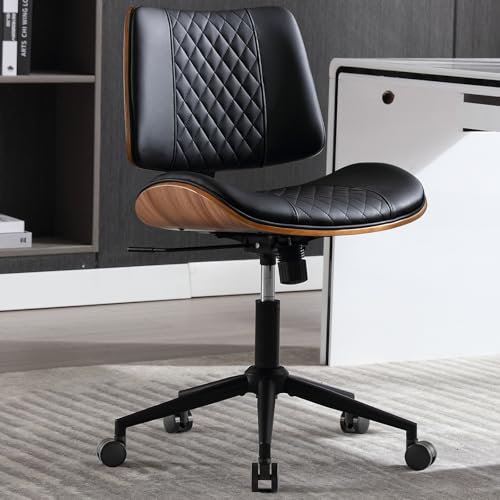
BERYTH Home Office Chair No Arms (Walnut Style, Black) — Best Overall
This BERYTH chair suits anyone whose desk sits in a bedroom corner, a studio apartment or a shared room where every inch of clearance matters. Because it has no arms, it slides completely under the desktop when you stand up, which is the single most effective space-saving behaviour a task chair can have. It also suits people who play an instrument at their desk, type with their elbows low, or simply dislike armrests pressing into their sides.
Strengths
- Armless profile tucks fully under the desk, reclaiming floor space
- Adjustable height and 360-degree swivel cover the core ergonomic adjustments
- Listing states a 300 lb capacity, generous for a compact chair
Trade-offs
- No armrests at all, so there is nowhere to rest your forearms during calls
- No lumbar adjustment is stated in the verified title, so back support is fixed by the backrest shape
- PU leather is not stated as breathable, so it may feel warmer than mesh in summer
Key specs (from the verified listing title):
- Arms: None (armless, per listing title)
- Back: Mid back, PU leather
- Capacity: 300 lbs (as stated in listing title)
- Adjustments: Height adjustable, 360 swivel
What makes this chair work in a small room is subtraction rather than addition. Most compact-chair marketing shrinks the seat, which punishes anyone who sits for more than an hour. This design instead removes the arms, which are the part of a chair that most often dictates how much room it needs: arms set the effective width, arms hit the desk, and arms stop a chair parking under the worktop. The walnut-style mid back also reads more like furniture than office equipment, which matters when the desk shares space with a bed or a sofa and the chair is always on show. The honest limits are support-related. The verified title does not claim an adjustable lumbar mechanism, so the backrest curve is what it is; if you know you need pronounced, dialled-in lumbar pressure, a chair with an explicit adjustable lumbar support is a better match. Pair it with a separate lumbar cushion only if the seat depth still leaves room for your thighs afterwards. For keyboard work at a standard desk, though, the combination of a small footprint, a stated 300 lb capacity and full under-desk parking is hard to beat at the compact end of the market.
Best for: Studio apartments, bedroom desks and anyone who wants the chair to disappear under the desk between sessions / Not suited for: People who rely on armrests for support when standing up, or who need adjustable lumbar mechanisms
Check the current price on Amazon

Sweetcrispy Ergonomic Computer Desk Chair (Mesh, Gray) — Best for Tight Desks
The Sweetcrispy suits the classic small-desk problem: a chair that is comfortable for eight hours but too wide to store. Flip-up armrests solve the storage half of that problem without giving up arm support entirely, which is why this design pattern shows up again and again in compact roundups. The mesh back also suits warmer rooms and anyone who finds padded backs clammy by mid-afternoon.
Strengths
- Flip-up arms let the chair tuck under the desk for storage
- Mesh mid-back breathes better than solid padded backs
- Lumbar support is stated in the verified listing title
Trade-offs
- Mid-back height gives no head or upper-back support for reclining
- Flip-up arms are usually fixed in height when lowered, limiting fine adjustment
- Mesh tension is not adjustable on chairs of this type, so support feel is set at the factory
Key specs (from the verified listing title):
- Arms: Flip-up
- Back: Mesh, mid-back
- Support: Lumbar support (as stated in listing title)
- Base: Rolling swivel
Judge a flip-up arm chair by two measurements: the height of the lowered armrest against your desk underside, and the width across the raised arms against your desk’s knee-hole. If the raised-arm width clears the opening, the chair effectively vanishes after work, which in a one-room flat is the difference between a workspace and a permanent obstacle. The mesh back is the second practical win. In small rooms, which tend to run warm because the desk often sits near a bed, a radiator or a sunlit wall, airflow through the backrest is a genuine comfort feature rather than a spec-sheet decoration. Where this chair asks for compromise is in adjustability depth. The verified title promises lumbar support but does not describe it as adjustable, and it says nothing about seat-depth adjustment or tilt tension controls. That is normal at this tier. It means the chair fits the broad middle of body sizes well and outliers poorly: very tall users may find the mid-back ends too low, and anyone who leans back to think will miss a headrest. Within its intended job — a breathable, storable chair for a compact desk — it is a well-judged set of trade-offs.
Best for: Small desks in bedrooms and studies where the chair must park under the worktop after hours / Not suited for: Tall users who want head support, or anyone who reclines deeply to read
Check the current price on Amazon

TRALT Office Chair with Headrest and Flip-up Armrests (Black) — Best with a Headrest
This TRALT suits small-space workers who lean back between tasks — to read, watch training videos or take calls — and want somewhere for their head to land. In a compact flat the office chair often doubles as the reading chair and the extra seat for a guest, so a headrest earns its small amount of extra height. The flip-up arms keep the storage story intact despite the taller back.
Strengths
- Headrest included while keeping flip-up arms for compact storage
- Listing states a 330 lb capacity, above most compact chairs
- Lumbar support stated in the verified listing title
Trade-offs
- The taller back needs more vertical clearance when parked under low shelving
- Headrest position is not described as adjustable in the verified title
- A headrest adds visual bulk in a very small room
Key specs (from the verified listing title):
- Arms: Flip-up armrests
- Back: With headrest
- Capacity: 330 lbs (as stated in listing title)
- Support: Lumbar support (as stated in listing title)
The design question here is whether a headrest belongs on a small-space chair at all. The case for it is behavioural: people in small homes rarely have a second comfortable chair, so the desk chair absorbs reading, gaming and video calls as well as typing. A headrest changes those secondary uses from tolerable to genuinely restful, and it helps taller users whose shoulders sit above a mid-back’s top edge. The case against is pure geometry — a high back is taller to store and can look oversized against a small desk. TRALT’s answer is to keep the footprint compact in the dimension that matters most for storage, the width with arms raised, and accept the extra height. The stated 330 lb capacity is also worth noting because compact chairs often quietly cap out lower; a stated figure in the listing title gives heavier users something concrete to check against their needs. What the verified title does not promise is adjustability for the headrest itself or for the lumbar support, so treat both as fixed-position features: sit in the chair early in the return window and confirm the headrest meets the back of your head, not your neck, before committing.
Best for: Small-space users who also read, game or take calls in the same chair and want head support / Not suited for: Rooms with low shelving above the desk, or anyone who wants a chair that looks minimal
Check the current price on Amazon

MUXX.STIL Office Chair with Flip up Armrest (Khaki Mesh) — Best Breathable Mesh
The MUXX.STIL suits buyers who have been caught out before by fixed lumbar humps that press in the wrong place. An adjustable lumbar support lets you move the pressure point to match your own back, which is the adjustment that most changes how a chair feels over a long day. Combined with flip-up arms for storage, it is aimed squarely at compact home offices that still take ergonomics seriously.
Strengths
- Adjustable lumbar support stated in the verified listing title
- Breathable mesh back for warm rooms
- Flip-up armrest keeps under-desk storage possible
Trade-offs
- Khaki mesh shows marks more readily than black mesh
- Only one armrest style is offered, with no armless option
- Seat material and cushion details are not stated in the verified title
Key specs (from the verified listing title):
- Arms: Flip up armrest
- Back: Breathable mesh
- Support: Adjustable lumbar support (as stated in listing title)
Adjustable lumbar support deserves its reputation as the highest-value ergonomic feature, because backs differ more than almost any other dimension a chair must fit. A fixed curve is a bet that your spine matches the designer’s template; an adjustable one lets you correct the bet. In a small space the feature matters even more, because you cannot solve a bad fit by swapping to a second chair — there is nowhere to put one. The breathable mesh back supports the same long-session goal from the temperature side, and the flip-up armrest preserves the park-under-desk behaviour that defines this category. The cautions are modest but real. The verified title does not describe the seat cushion, so if you are sensitive to thin padding, plan to test the chair early and consider a cushion only after checking that it does not push your knees above your hips. The khaki colour is a genuine lifestyle plus in a living-room workspace and a genuine maintenance minus if the chair will be used with pens, coffee and pets nearby. Neither point undermines the core proposition: this is the pick for compact-desk buyers who refuse to give up lumbar adjustment.
Best for: Compact home offices where back comfort over long sessions is the priority / Not suited for: Buyers who want a black, low-maintenance finish or a fully armless design
Check the current price on Amazon
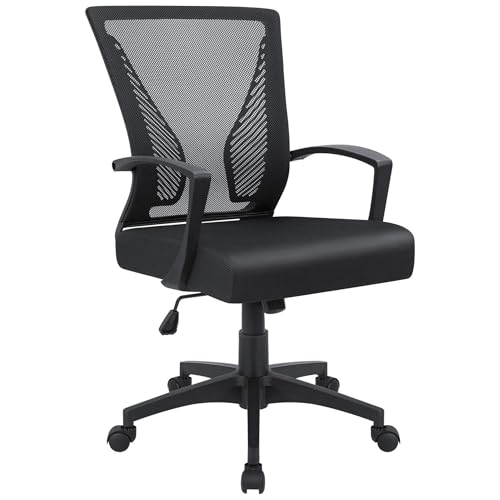
Furmax Office Chair, Ergonomic Mesh Desk Chair (Black) — Best Budget Mesh
The Furmax suits buyers setting up a first small home office who want the proven basics — mesh back, lumbar support, height adjustment, swivel — in a mid-back footprint that does not dominate a spare room. It is also a sensible second chair for a household where two people work from home in different corners and the second setup needs to stay inexpensive and compact.
Strengths
- Breathable mesh backrest with lumbar support stated in the listing
- Adjustable height and 360-degree swivel cover daily basics
- Mid-back footprint suits spare rooms and shared spaces
Trade-offs
- Fixed armrests mean it may not park fully under every desk
- No headrest and no stated lumbar adjustment
- Easy-assembly designs reward careful bolt tightening during setup
Key specs (from the verified listing title):
- Arms: Fixed armrests (per listing title)
- Back: Mesh, mid-back, breathable backrest
- Support: Lumbar support (as stated in listing title)
- Adjustments: Adjustable height, 360 swivel
There is a reason the mid-back mesh task chair is the default recommendation for small first workspaces: it is light enough to move when the room needs to change roles, breathable enough for all-day sitting, and small enough not to visually swallow a spare bedroom. The Furmax follows that template closely, and its verified listing is honest about the scope — lumbar support, height adjustment, swivel, armrests — without claiming advanced mechanisms it does not have. The planning point is storage. With fixed armrests, whether the chair parks under your desk depends on the arm height versus your desk’s underside clearance, so measure both before ordering; if the arms are too tall, the chair will live beside the desk and you should be sure the room can absorb that footprint gracefully. Assembly is the other place this tier asks something of you: entry-level chairs reward methodical assembly, with bolts tightened evenly and re-checked after the first week as parts settle. Do that, keep the castors clean of hair and grit — small rooms concentrate both — and a chair of this type gives reliable service as a compact everyday seat.
Best for: First home offices, spare-room desks and second workstations on a tight budget / Not suited for: Desks with low undersides where fixed arms cannot park underneath
Check the current price on Amazon
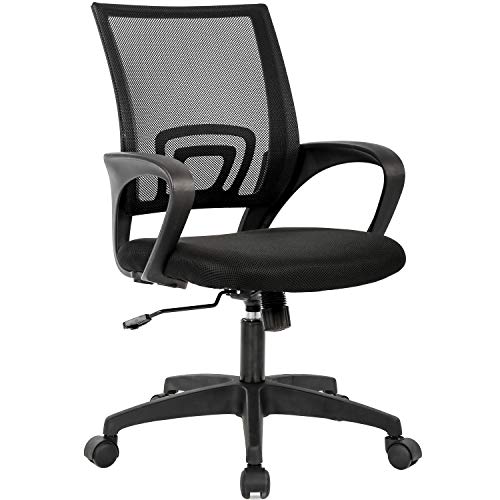
BestOffice Ergonomic Office Chair, Mid-Back Swivel Desk Chair (Black) — Best Simple Sponge-Seat Pick
The BestOffice chair suits sitters who like a padded seat but a breathable back, a combination that is less common than all-mesh or all-padded designs. In a small room that doubles as a guest room, its conventional mid-back silhouette also blends in quietly. It is a pack-of-one listing, so households equipping two desks should plan quantities accordingly.
Strengths
- Sponge seat cushioning with a breathable backrest, per the verified listing
- Lumbar support and adjustable height stated in the title
- Rolling wheels and swivel suit desks used from multiple angles
Trade-offs
- Fixed armrests are not stated as flip-up, so check desk clearance
- Sponge seats compress over time faster than high-resilience foam or mesh
- No headrest for leaning back
Key specs (from the verified listing title):
- Seat: Sponge seat (per listing title)
- Back: Mid-back, breathable backrest
- Support: Lumbar support (as stated in listing title)
- Adjustments: Adjustable height, rolling wheels
Seat construction is the quiet divider in compact chairs. Mesh seats stay cool and hold their shape, but some sitters feel the frame through them; padded sponge seats feel welcoming on day one and gradually pack down with use. This BestOffice design splits the difference by padding the seat and ventilating the back, which matches how bodies actually generate heat: the back is where a chair feels clammy first. For a small-space buyer the practical questions are the usual ones, sharpened by the fixed-arm design: measure the arm height against the desk underside, check the overall width against the gap the chair must roll through, and confirm the seat height range puts your feet flat with your knees near a right angle. The verified listing states lumbar support without describing adjustment, so expect shaped support rather than a movable pad. None of that prevents this from being a sensible compact chair; it simply defines who should choose it — the sitter who prioritises a cushioned seat and a cool back over storage tricks and fine adjustment, in a room where the chair can live beside the desk if it cannot park beneath it.
Best for: Sitters who prefer a padded seat with a breathable back in a compact footprint / Not suited for: Anyone who needs the chair to park under a low desk every night
Check the current price on Amazon
Comparison Table
| Pick | Badge | Key spec | Best for |
|---|---|---|---|
| BERYTH Home Office Chair No Arms (Walnut Style, Black) | Best Overall | Armless mid-back, 300 lb stated capacity | Studio apartments, bedroom desks and anyone who wants the chair to disappear under the desk between sessions |
| Sweetcrispy Ergonomic Computer Desk Chair (Mesh, Gray) | Best for Tight Desks | Mesh mid-back, flip-up arms, lumbar support | Small desks in bedrooms and studies where the chair must park under the worktop after hours |
| TRALT Office Chair with Headrest and Flip-up Armrests (Black) | Best with a Headrest | Headrest plus flip-up arms, 330 lb stated capacity | Small-space users who also read, game or take calls in the same chair and want head support |
| MUXX.STIL Office Chair with Flip up Armrest (Khaki Mesh) | Best Breathable Mesh | Adjustable lumbar support, breathable mesh, flip-up arm | Compact home offices where back comfort over long sessions is the priority |
| Furmax Office Chair, Ergonomic Mesh Desk Chair (Black) | Best Budget Mesh | Mesh mid-back, lumbar support, adjustable height | First home offices, spare-room desks and second workstations on a tight budget |
| BestOffice Ergonomic Office Chair, Mid-Back Swivel Desk Chair (Black) | Best Simple Sponge-Seat Pick | Sponge seat, breathable mid-back, lumbar support | Sitters who prefer a padded seat with a breathable back in a compact footprint |
How to Choose the Best Small Space Ergonomic Office Chairs for Your Room
Start with three measurements, taken before you fall for any product photo. First, the width of the gap the chair must roll through or park in, usually the knee-hole of your desk. Second, the height from the floor to the underside of the desktop, which decides whether armrests — fixed or flipped — can pass underneath. Third, the clear floor area behind the desk, because a chair that fits at the desk but cannot roll back far enough to let you sit down has not actually saved any space. Write the three numbers down and compare them against every listing’s dimensions before ordering.
Next, rank the ergonomic adjustments by how you actually sit. Seat-height adjustment is non-negotiable: your feet should rest flat with your thighs roughly level. Lumbar support is next in value, and an adjustable support beats a fixed curve because it can be moved to your back rather than the designer’s average back. Breathable mesh earns its place in small rooms, which run warm and often lack the airflow of a dedicated office. Headrests, tilt locks and armrest padding are genuine comforts, but in a compact chair they are the first things to trade away, because they add bulk in exactly the dimensions a small room cannot spare.
Budget framing for this category is best done in tiers rather than fixed prices. Entry-tier compact chairs cover the basics — height adjustment, shaped lumbar support, mesh or padded backs — and suit first workspaces and second desks. Mid-tier chairs add the refinements that matter in small spaces: flip-up or removable arms, adjustable lumbar mechanisms and better castors. Premium compact chairs exist, but in a small room the extra money often buys adjustability rather than size, so spend it only when you know which adjustment your body is missing.
Armless, Flip-Up or Fixed Arms: Which Saves the Most Space?
Armless chairs save the most space, full stop. Without armrests the chair’s width is the seat’s width, it parks completely under almost any desk, and it never fights the desktop when you pull in close. The cost is real: there is nowhere to rest your forearms, and people who use armrests to help them stand will feel the loss every time they get up.
Flip-up arms are the compromise most small-space buyers end up happiest with. Lowered, they support your arms during reading and calls; raised, they let the chair park nearly as tightly as an armless design. Check two things on any flip-up model: that the arms lock firmly enough not to wobble when lowered, and that the raised-arm width still clears your desk opening.
Fixed arms are the simplest and often the cheapest option, and they are fine when the chair does not need to park under the desk — for example at a table in an open corner. They become a problem only when storage is tight, which is why every fixed-arm pick in this guide carries an explicit reminder to measure your desk clearance first.
Small Rooms, Long Days: Making a Compact Chair Work for Full-Time Hours
A compact chair in a small room is usually asked to do full-time work, and the honest question is whether a smaller chair can support eight-hour days as well as a large executive model. The answer, for most bodies, is yes — with conditions. What long hours actually punish is not chair size but chair mismatch: a seat too high, a lumbar curve in the wrong place, arms that shrug the shoulders. A compact chair that matches on those three points will out-comfort a flagship chair that misses on one of them, which is why this guide weights fit features over feature counts throughout.
The conditions are behavioural as much as mechanical. In a small room the chair is also the room’s largest movable object, and its position drifts — pulled out for cleaning, turned for conversation, parked at an angle after a call. Re-establish your working position deliberately each morning: chair square to the desk, screen at arm’s length, feet flat. Small rooms also concentrate heat and stale air around a desk nook, so the mesh-backed picks in this guide earn a second, environmental justification beyond their ergonomics. Finally, rotate your sitting: perch on the seat edge for calls, sit fully back for reading, stand for one meeting a day if your work allows. A compact chair used dynamically will serve a full-time worker better than a large chair used as a mould.
Castors, Floors and Neighbours: The Overlooked Compact-Chair Details
Small-space chairs live on small-space floors, and the interface between them is the castor. On hard floors, standard hard castors chatter, mark and transmit every roll to the room below — a real consideration in flats with neighbours underneath. If your floor is wood or laminate, plan on soft-floor castors or a chair mat sized to the desk nook; a mat also defines the workspace visually, which small rooms benefit from more than large ones. On carpet, the problem reverses: compact chairs with small castors dig in and resist rolling, turning every reposition into a shove that strains both the chair’s base and your back.
Noise deserves its own sentence in shared and small homes. A chair that creaks at midnight in a studio flat is not a minor flaw. Most creaks in new chairs are assembly artefacts — unevenly tightened bolts settling — and the one-week re-tighten described in the setup section cures the majority. What remains after that is information: a chair that still complains under normal movement is telling you about its joints early, while returns are still easy. Listen during the first fortnight, while listening is still free.
A Compact Chair Buying Checklist You Can Run in Ten Minutes
Tape measure in hand, start at the desk. Record the knee-hole width, the underside height, and the depth from the desk edge to the wall — the chair must fit all three, in its parked position, with your legs’ space considered too. Then record yourself: seated height from floor to knee crease, which sets the seat-height range you need, and your desk’s working height, which decides whether armrests help or hinder. Five numbers, ten minutes, and every listing you open afterwards becomes a comparison instead of a gamble.
Next, interrogate the listing in a fixed order: dimensions before features, capacities before colours. Confirm the overall width and the arm configuration — armless, flip-up or fixed — from the title and specifications, because photography routinely shows a different variant than the one selected. Where a capacity is stated, as two picks in this guide state theirs, weigh it; where it is absent, find it on the product page before ordering rather than assuming the category average. Ergonomic claims come last in the order, not because they matter least but because they are the easiest to exaggerate and the hardest to verify from a screen.
Finally, plan the ownership, not just the arrival. Keep the Allen key, calendar the one-week re-tighten, decide where the chair parks at night and what it shares that space with, and read the returns terms for a bulky item while the decision is still free. Compact chairs reward this diligence disproportionately: in a small room there is nowhere to hide a wrong chair, so the ten minutes of checking is the difference between a workspace that disappears at night and a daily negotiation with furniture.
How to Set Up a Compact Desk Chair for Healthy Sitting
Assembly comes first, and it deserves more care than entry-level chairs usually get. Lay out every part before you start, tighten bolts in a cross pattern a little at a time rather than fully one by one, and keep the Allen key — you will want it again in a week, when a re-tighten removes the creaks that appear as parts settle. Fit the castors fully into the base until each one seats with a firm push; a half-seated castor is the most common cause of a wobbly new chair.
Set the seat height so your feet rest flat on the floor with your knees at roughly a right angle and a small gap between the seat edge and the back of your knees. If the chair has adjustable lumbar support, position it so the pressure sits in the curve of your lower back, just above the belt line; if the support is fixed, shuffle your sitting position until the backrest’s curve meets the same place. Set armrests, where fitted, so your shoulders stay relaxed rather than shrugged — if fixed arms force a shrug, you are better off flipping them up or treating the chair as armless.
Finish with the desk, not the chair. Your screen’s top third should sit near eye level, which in small spaces often means a laptop stand and a separate keyboard rather than hunching over the laptop itself. Then build movement into the day: a compact chair supports sitting well, but no chair makes eight motionless hours healthy. Stand, refill your water and roll the chair aside once an hour — in a small room, that small ritual also keeps the space feeling like a room rather than a workstation.
Common Buying Mistakes
The most common mistake is buying by room size instead of by desk geometry. A chair marketed as compact can still fail in your room if its armrests are taller than your desk’s underside or wider than the knee-hole. Measure first; the three numbers in the buying guide take five minutes and prevent the most frustrating returns in this category.
The second mistake is assuming ergonomic means heavily adjustable. Several excellent compact chairs offer shaped, fixed lumbar support rather than an adjustable mechanism, and for many backs that is enough. The reverse error is just as common: paying for adjustments you will set once and never touch, in a chair whose extra bulk your room cannot absorb. Buy the adjustments your body has actually asked for.
Third, do not judge a chair in the first ten minutes. Mesh tension, sponge cushioning and lumbar curves all reveal themselves over a full working day, and sponge seats in particular feel firmer in week three than in hour one. Use the return window properly: work real days in the chair before deciding.
Finally, beware accessory listings dressed as chairs. Chair mats, seat cushions and replacement arm pads all appear in searches for compact office chairs, and none of them is a chair. Every pick in this guide is a complete, verified chair; when you browse beyond it, check that the listing is for the whole product before comparing prices.
Key Takeaways
- Armless and flip-up-arm designs save the most space because they park under the desk.
- Adjustable lumbar support is the highest-value ergonomic feature in a compact chair.
- Measure desk knee-hole width and underside height before ordering any chair.
- Mesh backs suit small, warm rooms; sponge seats suit sitters who dislike mesh firmness.
- Every pick here is a complete chair verified against real Amazon listing data.
Final Recommendation
If your room is genuinely tiny, start with the BERYTH armless chair: nothing else in this guide disappears as completely at the end of the day. If you want arm support without giving up storage, the Sweetcrispy and the TRALT both flip their arms up, and the TRALT adds a headrest for readers and callers. If your back is the priority, the MUXX.STIL’s adjustable lumbar support is the feature to pay for. The Furmax and BestOffice chairs round out the list as simple, honest compact chairs for first and second workstations.
Whichever you choose, confirm the current configuration and check price on Amazon before ordering, and re-check your three room measurements against the listing dimensions one last time. A compact chair that fits both your body and your room will be used all day, every day — which is the whole point of getting the choice right.
Best Ergonomic Office Chairs Home Best Inexpensive Ergonomic Office Chairs Best Ergonomic Office Chairs Back Pain Best Mid Back Armless Ergonomic Office Chairs Best Customizable Office Chairs
Frequently Asked Questions
What makes an office chair good for a small space?
Three things: a compact footprint, a way to reduce that footprint further when stored — armless sides or flip-up armrests that let it park under the desk — and a mid-back profile that does not dominate the room visually. Ergonomics should not be sacrificed for size: seat-height adjustment and lumbar support matter just as much in a small chair.
Are armless office chairs bad for your posture?
Not inherently. Posture comes mainly from seat height, back support and how you sit. Armless chairs remove forearm support, which some people miss during long typing sessions, but they also encourage pulling in close to the desk, which can improve back contact with the backrest. If you use armrests to help you stand up, choose a flip-up design instead.
How much clearance does a chair need to park under a desk?
The chair’s widest point — usually across the armrests, or the seat if armless — must be narrower than the desk’s knee-hole, and the highest fixed point must be lower than the underside of the desktop. Flip-up arms help on width but check the raised-arm height too. Measure both before ordering.
Is mesh or a padded seat better for long hours?
Mesh breathes and holds its shape, which suits warm rooms and people who run hot. Padded sponge seats feel softer initially and suit people who find mesh seats too firm, though sponge gradually compresses with use. Several chairs in this guide split the difference with a padded seat and a breathable back.
What weight capacity should I look for in a compact chair?
Choose a chair whose stated capacity comfortably exceeds your weight, and treat the figure in the listing as the authority — capacities vary widely among compact chairs. Two picks in this guide state their capacities in their listing titles (300 lbs and 330 lbs); where a listing does not state a capacity, check the full product page before ordering.
Can a compact chair work for a tall person?
It can, with checks. Tall users should confirm the seat-height range reaches high enough for their legs, and prefer a headrest model like the TRALT pick if a mid-back ends below their shoulders. Seat depth matters too: if the seat is too short, thigh support suffers on long days.


