Disclosure: airfryerkitchensupply.com is reader-supported. When you buy through links on our site, we may earn an affiliate commission at no extra cost to you.
Where to buy
Every vacuum below was verified against Amazon’s catalog data before being listed: Bissell Featherweight Stick (2033M) for the classic featherweight stick, Eureka Blaze 3-in-1 for a corded stick that converts to a handheld, BLACK+DECKER dustbuster AdvancedClean for a cordless handheld with a charging station, Shark Cyclone PET Handheld (AA701) for pet-hair pickup in a handheld, Bissell Zing Bagged Canister (2154A) for a compact canister, and Shark Pet Cordless Stick (IX141) for a 40-minute cordless stick that converts to a handheld. Small vacuums are bought for specific jobs, so match the format to your mess before you match the brand to your loyalty.
What “small” should mean in a home vacuum
People searching for the best small home vacuums are rarely looking for a toy. They are looking for the vacuum that fits their actual life: the apartment where a full-size upright has nowhere to live, the small house where the mess is daily but modest, the second vacuum that handles the kitchen crumbs and the entryway grit so the big machine can stay in the closet. A good small vacuum is defined by three honest traits — it is light enough to grab without deliberation, it stores in the space a small home actually has, and it is genuinely capable on the floors it will meet, which in small homes are mostly hard floors, low-pile rugs, and stairs.
The category splits into four formats, and this guide keeps them distinct: corded stick vacuums (featherweight, always ready, tethered), cordless sticks (freedom, a battery budget), handhelds (spot duty, stairs, upholstery), and compact canisters (a small body with a hose’s reach). Every pick below is a complete vacuum cleaner — no desk vacuums, no replacement parts, no food-sealing machines that wander into this search wearing the word “vacuum.” Each was verified from its manufacturer’s catalog data, and where a listing leaves a figure unstated, the review flags it instead of guessing.
In this guide
Quick Picks
| Pick | Badge | Format | Best for |
|---|---|---|---|
| Bissell Featherweight Stick 2033M | Best Overall | Corded stick / electric broom | Small apartments, daily hard floors |
| Eureka Blaze 3-in-1 | Best Convertible | Corded stick + handheld | Dorms, first apartments, pet households |
| BLACK+DECKER dustbuster AdvancedClean | Best Handheld | Cordless handheld, charging station | Crumbs, cars, quick spot duty |
| Shark Cyclone PET Handheld AA701 | Best for Pet Hair | Corded handheld, XL dust cup | Upholstery and pet zones |
| Bissell Zing Bagged Canister 2154A | Best Canister | Compact bagged canister | Mixed floors, above-floor reach |
| Shark Pet Cordless Stick IX141 | Best Cordless | Cordless stick, 40-min runtime | Cord-free whole-home small cleaning |
How These Picks Were Chosen
Verification ran cache and fresh catalog data. Four filters shaped the list. First, completeness: only finished vacuum cleaners — the searches in this category surface food vacuum sealers, desk vacuums, replacement filters, and toy vacuums, and all were excluded. Second, genuine smallness: each pick is a lightweight or compact format whose reason to exist is a small home, a small job, or a second-vacuum role — full-size uprights with “lightweight” in the marketing were mostly set aside in favor of true small formats. Third, format spread: two corded sticks, two handhelds (one cordless, one corded), one compact canister, and one cordless stick, so the guide answers the format question with real alternatives instead of six near-identical sticks. Fourth, stated capability: each listing names its surfaces or its job — hard floors and carpets, pet hair, upholstery — and the reviews hold each vacuum to exactly the job its own listing claims.
One honesty note about suction numbers: small-vacuum listings rarely publish comparable suction figures, and the ones that do use incompatible units. This guide therefore judges capability by format, design, and the manufacturer’s stated surfaces rather than by invented head-to-head numbers — and says so wherever a figure is missing.
The 6 Best Small Home Vacuums

Bissell Featherweight Stick (2033M) — Best Overall
The Featherweight is the archetype of this category: a lightweight bagless stick vacuum that doubles as an electric broom, with a crevice tool in the box, built for hard floors and carpets in the quick-clean sense. Its listing is refreshingly plain — no miracle claims, just a small machine for small jobs — and that plainness is the point. A featherweight stick lives in a kitchen corner or a closet door hook, weighs little enough to carry with two fingers, and turns a five-minute crumb-and-grit session into a non-event instead of a production.
Strengths
- Featherweight format: grab, clean, and re-store in minutes, with no setup friction.
- Bagless with a crevice tool included for edges and corners.
- Corded power means it is always ready — no battery to find dead before guests arrive.
Trade-offs
- A cord sets its radius; open-plan spaces mean outlet hopping.
- It is a quick-clean machine, not a deep-cleaner for thick carpet — set expectations by format.
- Dust cup is small, as the format dictates; heavy debris sessions mean mid-job emptying.
Spec box: Format: stick / electric broom (per listing). Filtration: bagless (per listing). Tools: crevice tool (per listing). Surfaces: hard floors and carpets (per listing). Weight and cord length: not stated in the listing title data — check the product page.
Daily life with a Featherweight is about frequency: because it is effortless, you use it three times a week for four minutes instead of once a fortnight for forty, and the small home stays ahead of its own mess. It is the right only-vacuum for a hard-floored studio or one-bedroom, and the right second vacuum for any house whose main machine is a chore to deploy. If your floors are mostly plush carpet, look at the canister pick; if they are mostly hard, start here and stop shopping. Check the current price on Amazon.
Best for: apartments, hard floors, and daily quick cleans. / Not suited for: deep carpet cleaning or cord-free purists.

Eureka Blaze 3-in-1 — Best Convertible
The Blaze’s listing describes exactly what it is: a 3-in-1 small vacuum for the home — a corded stick that converts to a handheld, positioned for dorms and small spaces, with pet-hair duty named in its data. Convertibility is the value here: the same motor that runs the length of a studio floor pops out as a handheld for the sofa, the stairs, and the car’s footwells (within cord reach of the door). For a first apartment or a dorm, where one machine must be every machine and storage is a single closet, that 3-in-1 logic is hard to beat at its tier.
Strengths
- 3-in-1 conversion covers floors, stairs, and spot duty with one motor.
- Corded: unlimited runtime for whole-space sessions, no battery aging to budget for.
- Featherweight class handling suits small-space maneuvering around furniture.
Trade-offs
- The cord limits the handheld mode’s range — car cleaning needs an outlet strategy.
- Small dust cup, like every pick in this format class.
- As a stick it is a quick-clean tool; thick carpet remains out of its brief.
Spec box: Format: 3-in-1 stick / handheld (per listing). Power: corded (per listing). Positioning: dorm and small home, pet hair (per listing). Colorway verified: Blue. Suction figures: not stated in the listing title data.
The Blaze is the pragmatist’s pick: it does not pretend any single configuration is best-in-class, but it is present for every job a small home generates, at a tier that suits first homes and student budgets. Students, first renters, and small-space pet owners — the listing names pet hair explicitly — get the most from it. If you already own a full-size vacuum and want only a spot machine, the handhelds below are purer tools; if you own nothing and live small, the Blaze is a complete answer. Check the current price on Amazon.
Best for: dorms, first apartments, and one-machine households. / Not suited for: large homes or deep-pile carpet.

BLACK+DECKER dustbuster AdvancedClean — Best Handheld
The dustbuster name is practically the generic word for this format, and the AdvancedClean is its considered form: a cordless handheld with a crevice tool, a rotating nozzle, and a charging station that keeps it docked, charged, and findable. The rotating nozzle is the detail that separates it from basic handhelds — it angles into the gaps between cushions, along baseboards, and around car seats where crumbs actually live. As a spot machine for a small home — kitchen floor after cooking, entryway after shoes, sofa after snacks — it is the fastest tool in this guide from decision to done.
Strengths
- Charging station keeps it perpetually ready and gives it a home in a small kitchen.
- Rotating nozzle reaches the angles where debris actually collects.
- Cordless freedom for stairs, cars, and quick room-to-room duty.
Trade-offs
- A handheld is a spot tool: it will not vacuum a whole floor plan, and its dust cup fills fast on big spills.
- Battery runtime is finite per charge — the listing title data does not state minutes, so check the product page if session length matters.
- Not a carpet tool beyond surface litter on low pile.
Spec box: Format: cordless handheld (per listing). Tools: crevice tool, rotating nozzle (per listing). Charging: charging station (per listing). Runtime: not stated in the listing title data.
Every small home has a mess geography: three square feet by the stove, the doormat’s fallout zone, the high chair’s blast radius. The dustbuster owns that geography. Paired with any stick in this guide it forms the classic small-home system — stick for floors, handheld for everything else — and on its own it serves homes whose floors are handled by a robot or a weekly big clean. Dock it where the mess happens and it will be used daily; hide it in a closet and you have bought a paperweight. Check the current price on Amazon.
Best for: spot duty, stairs, cars, and the kitchen mess zone. / Not suited for: whole-floor cleaning.

Shark Cyclone PET Handheld (AA701) — Best for Pet Hair
Where the dustbuster is the generalist handheld, the Cyclone PET is the specialist: Shark’s listing names HyperVelocity suction, pet hair pickup, an XL dust cup, and an upholstery tool. Pet hair on upholstery is a specific mechanical problem — hair weaves into fabric and resists plain suction — and a handheld built for it, with a tool shaped for fabric, is the right answer for the sofa, the pet bed, and the car seats of a small home with animals. The XL cup matters more than it sounds: pet sessions generate volume, and a handheld that needs emptying mid-sofa loses its convenience argument.
Strengths
- Pet-hair focus with an upholstery tool included, per the listing.
- XL dust cup handles a full pet session without mid-job emptying.
- Corded handheld format means full power for the whole session — no battery fade on the last cushion.
Trade-offs
- Corded: its world is within reach of an outlet, unlike the cordless dustbuster.
- A specialist’s shape: as a general crumb machine it is more tool than the job needs.
- Handheld format only — floors still need a stick or canister partner.
Spec box: Format: handheld (per listing). Suction: HyperVelocity (manufacturer’s term, per listing). Dust cup: XL (per listing). Tool: upholstery tool (per listing). Model: AA701. Cord length: not stated in the listing title data.
Small homes with pets concentrate the pet problem: fewer rooms, the same animal, hair on every soft surface. The Cyclone PET is the pick that treats that as the main job rather than an afterthought, and its corded design quietly suits long upholstery sessions better than a battery would. If your pet sheds lightly and your messes are mostly crumbs, the dustbuster is the better-balanced buy; if you brush pet hair off the sofa with your hand every evening, this is your machine. Check the current price on Amazon.
Best for: pet owners, upholstery, and car interiors near an outlet. / Not suited for: cord-free spot duty or whole floors.
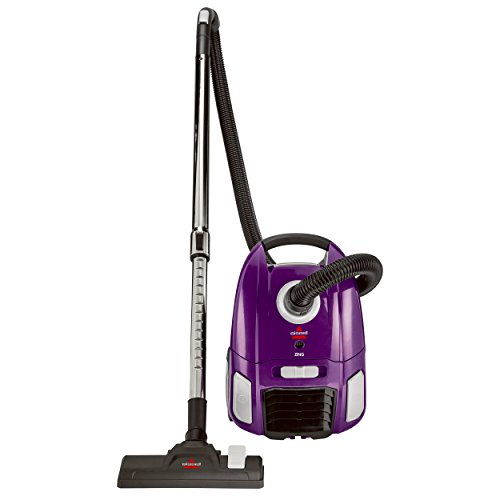
Bissell Zing Bagged Canister (2154A) — Best Canister
The Zing is the format outlier that earns its place: a lightweight, compact bagged canister, in purple, model 2154A. A canister separates the motor (which trails behind you on the floor) from the cleaning head (which weighs almost nothing in your hand), and that division buys things sticks cannot: easy above-floor reach with a hose for shelves, blinds, and ceiling corners; a head that slips under furniture; and a bagged system that empties without a dust cloud — a real consideration in small spaces where you empty the vacuum in the same air you live in. For a small home with mixed surfaces and a lot of edges, the canister is quietly the most capable format here.
Strengths
- Hose reach handles above-floor cleaning that sticks and handhelds cannot.
- Bagged emptying keeps dust contained — tidy in small living spaces.
- Compact, lightweight body stores in a closet corner and carries between floors easily.
Trade-offs
- Bags are a running cost and a thing to remember to stock.
- A trailing canister is less instant than a grab-and-go stick for a 60-second crumb job.
- Tool set and cord length are not detailed in the listing title data — check the product page for the full kit.
Spec box: Format: bagged canister (per listing). Model: 2154A. Colorway verified: Purple. Weight class: lightweight (per listing). Included tools: not enumerated in the listing title data.
Choose the Zing if your small home is furnished rather than minimal — bookcases, blinds, upholstered pieces, a rug or two — because the hose turns one machine into a whole-home system, dusting high and vacuuming low in the same session. Allergy-conscious households often prefer bagged emptying for the contained disposal; that preference is legitimate and this is the pick that honors it. For a bare hard-floor studio, it is more system than you need; the Featherweight is your machine. Check the current price on Amazon.
Best for: furnished small homes, above-floor cleaning, and bagged-emptying fans. / Not suited for: instant spot duty or bag-free households.

Shark Pet Cordless Stick (IX141) — Best Cordless
The IX141 is the premium expression of the small-vacuum idea: a cordless stick with a stated 40-minute runtime, an XL dust cup, LED headlights, and a removable handheld mode, in grey. Cordless changes cleaning behavior more than any other feature — no cord to unwind, plug, and rewind means the vacuum gets used for the two-minute jobs that actually keep a small home clean. The LED headlights sound like garnish until they reveal the dust film under the sofa you have been missing for months, and the removable handheld covers the dustbuster’s territory when the mess is above the floor.
Strengths
- 40-minute stated runtime — a full small-home session per charge.
- Converts to a handheld, covering spot and above-floor duty.
- LED headlights expose under-furniture dust; XL cup reduces emptying stops.
Trade-offs
- Battery is a consumable over years; runtime is the listing’s figure under its test conditions, and max-power modes drain it faster.
- Premium tier within this list — you are paying for cordless freedom and the Shark feature set.
- Pet-positioned design; non-pet homes pay for capability they may not need, though the format serves everyone.
Spec box: Format: cordless stick with removable handheld (per listing). Runtime: up to 40 minutes (per listing). Dust cup: XL (per listing). Lighting: LED headlights (per listing). Model: IX141. Colorway verified: Grey.
This is the one-vacuum answer for a small home that wants no compromises on convenience: floors on Monday, stairs on Wednesday, the car on Saturday (park near an outlet or carry it out — it is cordless, the car comes to it or it goes to the car). Pet households get the design’s intended best; everyone else gets the format’s best. If the tier gives you pause, the corded Featherweight delivers 80% of the daily experience at a fraction of the commitment — but the cordless convert is real, and this is its strongest representative here. Check the current price on Amazon.
Best for: cord-free whole-home cleaning in small spaces, pet households. / Not suited for: the tightest budgets or very large homes.
Small Vacuum Formats, in Depth
The corded stick: the featherweight philosophy
A corded stick is essentially a powered broom with a dust cup: a slim body, a floor head, and a motor sized for surface dirt rather than deep extraction. Its genius is behavioral. Because it weighs almost nothing and starts the instant you squeeze the trigger, it collapses the distance between noticing a mess and removing it — and in household cleaning, frequency beats intensity almost every time. The cord, its supposed flaw, matters least exactly where these machines belong: small homes have short distances and plentiful outlets. What a corded stick cannot do is deep-clean carpet or leave its outlet’s radius, and it does not pretend otherwise.
The cordless stick: freedom with a budget
Removing the cord changes the user’s psychology even more than the machine’s mechanics: cleaning becomes a series of thirty-second decisions instead of a scheduled event. The costs are a battery that ages, a runtime that shrinks on high modes, and a purchase tier a step above corded equivalents. In a small home the runtime budget is rarely binding — the whole home fits inside one charge — which is why cordless sticks are disproportionately satisfying in apartments. The IX141’s conversion to a handheld extends the same freedom above the floor, and its stated 40 minutes is honestly sized for the homes this guide serves.
The handheld: a specialist, proudly
A handheld vacuum is a crevice-and-crumb instrument. Its virtues are immediacy and access: it goes where the mess is — between cushions, under the high chair, inside the car — in the hand, at arm’s length, in seconds. Its limits are capacity and session length, and they are not flaws to apologize for but the boundaries of the tool. The two handhelds here split the specialty: the dustbuster generalizes with a rotating nozzle and a dock, the Shark Cyclone PET concentrates on the single hardest handheld job, pet hair in fabric. Households that understand the handheld as a complement buy once and stay happy; households that buy it as a whole-home solution blame the tool for their own category error.
The compact canister: the quiet all-rounder
The canister is the oldest format here and, in furnished homes, still the most complete. Separating the motor from the head makes the working end nearly weightless, lets it lie flat under beds and sofas, and puts a hose in your hand for the third of household dirt that lives above the floor — shelves, blinds, vents, the tops of door frames. The Zing’s bagged design adds the small-home-specific virtue of clean emptying. Its costs are storage footprint and the trailing body, which is why minimal hard-floor flats should choose a stick and furnished small homes should give the canister its due.
Suction numbers: a note on honest comparisons
Shoppers will encounter suction claims in incompatible units — air watts, pascals, CFM, or pure adjectives — across this category, and the listings summarized here mostly decline to publish comparable figures at all. That is worth respecting rather than lamenting: within a format class, design and tools predict real-world pickup better than a cross-brand numbers contest measured under different conditions. Judge a small vacuum by whether its format and tools match your surfaces, keep its cup and filter clean, and its real performance will track its promise. Any guide that ranks these six by a single suction figure is selling false precision.
Comparison Table
| Pick | Badge | Key spec | Best for |
|---|---|---|---|
| Bissell Featherweight 2033M | Best Overall | Corded stick, bagless, crevice tool | Daily hard-floor quick cleans |
| Eureka Blaze 3-in-1 | Best Convertible | Corded stick + handheld | Dorms and first apartments |
| BLACK+DECKER dustbuster | Best Handheld | Cordless, rotating nozzle, charging station | Spot duty and cars |
| Shark Cyclone PET AA701 | Best for Pet Hair | Corded handheld, XL cup, upholstery tool | Pet hair on fabric |
| Bissell Zing 2154A | Best Canister | Compact bagged canister, hose reach | Furnished homes, above-floor |
| Shark IX141 Cordless | Best Cordless | 40-min runtime, handheld mode, LED | One-vacuum small homes |
How to Choose a Small Home Vacuum
Choose the format by the mess, not by the marketing. Floors-only mess in a hard-floored flat: a stick. Crumbs and spot spills: a handheld. Furnished rooms with shelves, blinds, and upholstery: a canister’s hose or a convertible. Most small homes are honestly served by a stick plus comfort with its limits — and the households that struggle are the ones that bought a handheld to do a stick’s job or a stick to do a canister’s.
Corded versus cordless is a lifestyle question. Corded machines are always ready, cost less, and never age a battery; they ask you to manage a cord in small spaces where outlets are usually close — in a studio, the cord is nearly a non-issue. Cordless machines get used more often for small jobs, which is their entire virtue, and ask you to accept a runtime budget and an eventual battery replacement. In genuinely small homes, both answers are defensible; pick the one matching your patience.
Weight is a feature; check it where it is stated. The virtue of every pick here is that using it is not an event. A vacuum you can carry in one hand while holding a mug in the other gets used; one that requires two hands and a plan gets used on Saturdays. Listings do not always state weight in their title data — several here do not — so confirm the figure on the product page if one-handed use is your deciding factor.
Plan storage before purchase. A stick needs a corner or a closet slot; a canister needs a floor footprint; a handheld needs a dock spot near an outlet. In a small home, the vacuum that has a home gets used, and the one that must be excavated does not. Measure the corner, then buy the machine that fits it.
Think in systems if one machine is not enough. The most satisfied small-home owners rarely own exactly one vacuum; they own a division of labor. The classic pairings from this list: Featherweight plus dustbuster (floors plus spots, both budget-friendly), IX141 alone as the convertible system, or Zing plus Cyclone PET for furnished pet homes (hose reach plus upholstery power). Buying a system sounds like buying more, but each half is cheaper and better at its job than one premium machine asked to be everything — and when one half is down for a filter wash, the other still works.
Be honest about carpet.
Small vacuums are hard-floor and low-pile specialists. If your small home is wall-to-wall medium carpet, none of these replaces a full-size machine’s deep clean — the honest setup is a small vacuum for the daily 90% plus periodic deep cleaning by a bigger machine, a rental, or a service. Pretending a featherweight stick deep-cleans plush carpet is how buyers end up hating a good product for failing at a job it never claimed.
How to Use and Maintain a Small Vacuum
Clean little and often — that is the format’s whole philosophy. Small vacuums reward frequency: a four-minute pass every other day keeps a small home visibly cleaner than a heroic monthly session, because grit never accumulates enough to grind into floors and rug fibers. Anchor the habit to an existing routine — after breakfast, before the evening shower — and let the machine’s lightness do the persuading.
Empty the cup before it is full, and wash the filter on schedule. Small cups and small filters lose suction fast when loaded; a bagless small vacuum at half-full is already working below its best. Empty after every substantial session, tap or wash the filter per the manual (and let it dry fully), and the machine will perform like its listing for years. Bagged canister owners: a bag is full when suction dips, not when it physically cannot accept more.
Use the tools — they are the difference between formats. The crevice tool is not an accessory; along baseboards and between cushions is where small-home dirt concentrates. The upholstery tool on the Shark handheld, the rotating nozzle on the dustbuster, the Zing’s hose — each pick’s stated tool is its reason to exist. A month of using the right attachment teaches more than any review.
Run a weekly rhythm, not a daily negotiation. A workable pattern for a small home: a full stick or canister pass twice a week (entry, kitchen, bathroom, and the traffic lanes between), handheld spots as they happen, and a monthly above-floor circuit with the hose or handheld for shelves, vents, and upholstery. The rhythm matters more than its exact shape — a mediocre vacuum on a rhythm keeps a cleaner home than an excellent vacuum awaiting motivation. Put the two weekly passes on fixed days so they become appointments rather than decisions, and let the handheld handle everything the schedule misses.
Store it charged, docked, or plugged by its home corner.
Cordless handhelds live on their stations so they are always ready; sticks live where the mess is densest (usually the kitchen’s orbit); canisters live where the hose can start its rounds. Readiness is a storage decision made once, not a daily act of will.
Common Buying Mistakes
Buying a handheld as an only vacuum. Handhelds are spot tools with small cups and short sessions. A home whose only vacuum is a handheld is a home whose floors are never really vacuumed.
Buying a desk or toy vacuum for home duty. Mini USB desk vacuums surface constantly in this search; they clean keyboards, not homes. Every pick in this guide is a full household machine — hold any candidate to that standard.
Confusing food vacuum sealers with vacuum cleaners. They share a word and nothing else. If the listing mentions bags, sous vide, or food storage, you are in the wrong aisle.
Ignoring the emptying experience. In a small home you empty the vacuum in your living air. Bagless cups puff dust; bags contain it. Neither is wrong — but choose consciously, especially if anyone in the home is dust-sensitive.
Storing the vacuum where it cannot be reached. A small vacuum buried behind the water heater or under a pile of storage bins is functionally a vacuum you do not own. The format’s entire value is zero-friction access; if the storage spot requires moving two other objects, the four-minute clean becomes a ten-minute project and quietly stops happening. Give the machine the kitchen corner, the closet door hook, or the dock by the entry — visible, reachable, and slightly in the way is exactly right for a tool whose job is to be used daily.
Expecting runtime figures to survive max mode.
A cordless stick’s stated runtime is measured under standard conditions; turbo modes cut it sharply. Size the machine so your whole home fits in a standard-mode session.
Small Vacuums in Real Homes: Five Scenarios
The studio apartment. One room, hard floors, a rug if you are lucky, and a closet that is also the pantry. The Featherweight is your vacuum and your broom in one corner-standing tool; add the dustbuster later if crumbs under the counter become a daily irritation. Total storage consumed: one corner.
The dorm room. Shared air, tracked-in everything, and a budget with opinions. The Blaze’s 3-in-1 conversion handles the floor, the desk chair’s crumbs, and the rug your roommate swears is clean, at a tier a student can defend. Its cord is a feature here: dorm batteries die at the worst times, outlets never do.
The small house with a big dog. Hard floors below, hair on every fabric above. Pair the formats: the IX141 or Featherweight for the daily floor pass, the Cyclone PET for the sofa, the dog bed, and the car. This is the scenario the two-machine system was invented for, and both halves earn their storage space weekly.
The furnished cottage or older home. Real furniture, real blinds, radiators, stairs with carpet treads, and no open-plan anything. The Zing’s hose and bagged canister body were designed by decades of exactly this housing stock. It dusts the shelves and vacuums the treads in one circuit, and empties without perfuming the parlor.
The tidy minimalist. You own few things and use all of them; cleaning is a five-minute ritual, not a weekend. The IX141 cordless is your single machine — floors, spots, above-floor — docked on the wall like the considered object it is. One machine, no cord, no closet excavation, no excuses.
Final Recommendation
For most small homes, start with the Bissell Featherweight: it is the format’s purest form and the daily habit it builds is worth more than any spec. Dorms and first apartments should take the convertible Eureka Blaze; spot-mess households the docked dustbuster; pet owners the upholstery specialist Shark Cyclone PET; furnished homes the hose-equipped Bissell Zing; and anyone ready to go cordless with one machine the Shark IX141. Buy the format your mess demands, store it where the mess lives, keep its cup empty and its filter clean, forgive it the deep-carpet jobs it never claimed, and use it little and often — the small home does not need a bigger vacuum nearly as often as it needs a nearer one, and every pick on this list was chosen to be the machine that is already in your hand when the crumbs hit the floor, the dog shakes off, or the guests text that they are five minutes away.
More from the vacuums cluster: Best All Around Vacuums, Best Affordable Upright Bagless Vacuums, Best Bagged Vacuums For Carpet And Hardwood, Best Battery Carpet Vacuums, Best 12volt Vacuums.
Frequently Asked Questions
Can a small vacuum be my only vacuum?
In a hard-floored apartment or small house, yes — a stick like the Featherweight or the cordless Shark IX141 covers the real workload of such homes. In a carpeted home, treat a small vacuum as the daily driver and arrange periodic deep cleaning separately. The honest test is your floors: mostly hard and low-pile, a small vacuum suffices; mostly plush carpet, it does not.
Stick, handheld, or canister — which format is best?
They partition the work rather than compete. Sticks own floors. Handhelds own spots, stairs, upholstery, and cars. Canisters own furnished rooms and above-floor reach. Most small homes end up happiest with a stick plus a handheld — or a convertible like the Blaze or IX141 that covers both roles with one motor.
Are bagged or bagless small vacuums better?
Bagless costs nothing to feed and shows you when it is full; it also puffs dust on emptying. Bagged costs a modest stream of bags and empties cleanly and hygienically — which is why the Zing carries this guide’s canister badge. In small living spaces where emptying happens indoors, the bagged argument is stronger than most buyers expect.
How long do cordless small vacuums run?
The cordless stick here states up to 40 minutes; handhelds typically run shorter sessions suited to spot duty. Treat every runtime figure as measured under the manufacturer’s standard mode — high-power modes reduce it substantially. For a small home, 40 standard-mode minutes is a full clean with room to spare; the figure only becomes a constraint in larger homes.
Do small vacuums work on pet hair?
On hard floors, yes — pet hair is light and any of these picks gathers it. On upholstery and carpet, hair is a tool problem: the Shark Cyclone PET’s upholstery tool and pet-focused design exist precisely for fabric. Match the tool to the surface and pet hair stops being a special category of mess.
Is a small vacuum a good choice for stairs?
Stairs are where small vacuums shine brightest. A handheld — the dustbuster for general duty, the Cyclone PET for carpeted treads with pet traffic — cleans a staircase in minutes without balancing a full-size machine on a step. A convertible stick’s handheld mode does the same job, and a canister’s hose reaches a full flight from a single position. If stairs are your main pain point, weight and conversion matter more than any other spec in this guide.
What about robot vacuums — do they replace a small vacuum?
They complement rather than replace. A robot maintains open floor between your sessions but cannot do stairs, upholstery, crevices, or the inside of a car — the exact jobs handhelds and convertibles exist for. Many small homes run the honest trio: a robot for background floor duty, a handheld for spots, and nothing else. If you are choosing only one machine and your home has stairs or furnished rooms, a stick or convertible from this guide covers more of real life than a robot does.
How long will a small vacuum last?
Corded sticks and canisters have the simplest longevity story: no battery to age, few moving parts, and performance that holds as long as filters are cleaned and cups emptied — years of daily service is a reasonable expectation. Cordless models add a battery that will gradually lose runtime over years of charge cycles; that is a known, budgetable wear item rather than a failure. Across all formats, the machines that die young are almost always the ones whose filters were never cleaned — maintenance, not price tier, is the lifespan variable you control.
Should I buy an extended warranty or spare filters at checkout?
Spare filters, yes, if your model uses washable ones — a second filter lets the machine run while the first dries, which removes the only real friction in its maintenance. Spare bags for the Zing, likewise, belong in the closet from day one. Extended warranties on machines at these tiers are rarely the value they promise; the maintenance habits in this guide protect your purchase more reliably than a contract does.
Are small vacuums loud?
Generally they are kinder to the ears than full-size machines, simply because their motors are smaller — but “small” is not a noise guarantee, and the listings summarized here do not publish comparable decibel figures, so this guide will not invent a ranking. What you can control is usage: hard floors transmit sound, evening quick cleans disturb households less than early-morning ones, and a machine kept clean (unclogged filters, empty cups) runs at its designed pitch instead of straining. If noise is a deciding factor — a sleeping baby, a thin-walled apartment — check the specific model’s product page for a stated decibel figure before ordering, and favor the formats you will run briefly and often over any machine you must run long.
What size home is too big for a small vacuum?
There is no square-footage law, but the practical boundary is session length and carpet share. A small vacuum comfortably covers a studio, a one- or two-bedroom apartment, or a compact house in one corded pass or one cordless charge — the IX141’s stated 40 minutes is the benchmark. Beyond roughly three bedrooms, or where carpet dominates, the small machine becomes the second vacuum and a full-size model should carry the weekly deep clean. Many larger households still keep one pick from this guide by the kitchen; the format’s spot value does not expire with house size.
Can a small vacuum handle a shedding season?
Yes, with the right pairing and a faster emptying rhythm. Shedding season multiplies volume, not difficulty: hair is light and lifts easily from hard floors with any stick here. The strain shows in dust cups, which fill several times faster — empty mid-session without resentment, and lean on the Cyclone PET for the fabric surfaces where the season’s hair actually accumulates. If your pet’s coat defeats a standard floor head’s brush with wrapping, clear the brush weekly; two minutes with scissors preserves the pickup you paid for.
How do I keep a small vacuum’s suction strong?
Empty the cup early and often, clean or wash the filter on the manual’s schedule and let it dry completely, and clear hair from any brush or intake promptly. Small machines have small air paths, so small blockages cost them proportionally more than they cost a full-size vacuum. Ninety seconds of maintenance per week preserves the performance you paid for.


