Disclosure: airfryerkitchensupply.com is reader-supported. When you buy through links on our site, we may earn an affiliate commission at no extra cost to you.
Where to buy
The fastest route to any verified pick in this guide to best sleeping pillows for neck support is Amazon, where you can confirm the exact size, colour and configuration on the listing page before ordering. Use the links below to check price on Amazon for each verified pick; unlinked slots carry no link until their listing is verified, and that is deliberate — we would rather leave a gap than send you to the wrong product.
- Coop Home Goods Cool+ Adjustable Pillow (Queen Plus) (Best Overall): Check on Amazon
- Osteo Cervical Pillow — Hollow Design Memory Foam Pillow (Best Hollow-Centre Design): Check on Amazon
- UTTU Cervical Pillow — Adjustable Contour (Queen) (Best Published Dimensions): Check on Amazon
- Royal Therapy Memory Foam Pillow (Queen) (Best Classic Contour): Check on Amazon
- EPABO Contour Memory Foam Pillow (Best Budget-Tier Contour): Check on Amazon
- VYLEE Cervical Neck Pillow — Dual-Height Contour (Grey) (Best for Combination Sleepers): Check on Amazon
Shopping for the best sleeping pillows for neck support is really shopping for shape. A neck-support pillow earns its name from geometry — a contour that cradles the head while filling the curve between neck and mattress, or an adjustable fill you can raise or lower until that curve is supported without being pushed. This guide compares six verified pillows across those two philosophies, and it does so in comfort terms only: how a pillow feels, fits and holds its shape through the night is something a buyer can judge; treating a medical condition is not something a pillow listing — or this guide — should promise.
So a note before the picks: if you wake with persistent pain, numbness or headaches, the right next step is a clinician, not a shopping cart. What the right pillow can honestly offer is a sleeping surface matched to your position — side, back or stomach — at a height that keeps your head settled rather than tilted. Several verified titles use medical wording; we record those titles exactly in each article’s source file, but we describe the pillows here by their construction: contour memory foam, adjustable shredded fill, hollow-centre designs and dual-height edges.
The practical variables are loft, firmness and adjustability. Side sleepers generally need the tallest, firmest support to fill the shoulder gap; back sleepers need a moderate cradle; stomach sleepers need the least height of all, and several contour pillows are simply wrong for them — each review says so plainly. Cooling covers, washable cases and certifications stated in titles are covered pick by pick, using only what each verified title actually states.
In this guide
Quick Picks: Our Shortlist at a Glance
Six verified neck-support pillows: adjustable shredded fill, classic contours, a hollow-centre design and a dual-height option. Badges match the reviews, and links go to the verified listings so you can confirm size and configuration.
Best Overall — Coop Home Goods Cool+ Adjustable Pillow (Queen Plus): The adjustable all-rounder: shaped memory foam with cooling gel, stated for back, stomach and side sleepers, with two certifications named in its title. — Check on Amazon
Best Hollow-Centre Design — Osteo Cervical Pillow — Hollow Design Memory Foam Pillow: A hollow-centre memory foam pillow with a cooling case, stated as adjustable and aimed at side and back sleepers — a distinct shape from the standard contour. — Check on Amazon
Best Published Dimensions — UTTU Cervical Pillow — Adjustable Contour (Queen): The spec-sheet pick: exact dimensions stated (23.6 x 13.8 x 5.2 in), an adjustable layered ‘sandwich’ contour, stated for side, back and stomach sleepers. — Check on Amazon
Best Classic Contour — Royal Therapy Memory Foam Pillow (Queen): The straightforward one-piece contour: memory foam, Queen size, stated dimensions of 24 x 14 x 5 inches, no layers to manage. — Check on Amazon
Best Budget-Tier Contour — EPABO Contour Memory Foam Pillow: A plain ergonomic contour in memory foam for side and back sleepers — the budget-tier entry point to shaped pillows, without extras you may not need. — Check on Amazon
Best for Combination Sleepers — VYLEE Cervical Neck Pillow — Dual-Height Contour (Grey): Two heights in one pillow: rotate between the higher and lower contour edges as you change position — built for sleepers who never stay in one position. — Check on Amazon
Key Takeaways
- Match loft to sleep position first: side sleepers need the most height, stomach sleepers the least — no contour suits everyone.
- Adjustable pillows (shredded fill or layered designs) are the safer buy when you do not know your ideal height yet.
- Stated dimensions matter: two picks publish exact sizes, which makes pillowcase and fit checks possible before ordering.
- Judge these pillows on comfort and fit only — persistent pain is a reason to see a clinician, not to keep buying pillows.
- Give any new contour a fair trial of several nights; the first night on a new shape is not a verdict.
How These Picks Were Chosen
We searched Amazon listing data for cervical, contour and neck-support pillows and kept only bed pillows for sleeping — travel neck pillows, bolster rolls, recliner headrest cushions and knee pillows were excluded even though they share vocabulary with this category. Each surviving pick had to state its support mechanism in its title: a contour shape, an adjustable fill, a hollow centre, a dual-height edge, or a named fill such as shredded memory foam. Pillows that promised support with no stated mechanism were dropped.
We then spread the six across the real decision space: one adjustable shredded-fill pillow for people who need to tune height, classic one-piece contours for side and back sleepers, a hollow-centre design, a dual-height contour for combination sleepers, and one pillow whose title states a cooling gel feature for hot sleepers. Variant discipline applied throughout — the same pillow in two sizes counts once.
Two editorial rules shaped the writing. First, comfort-only framing: titles in this category use medical language freely, and while we record each title verbatim in the source file, the article itself describes construction and comfort, never treatment. Second, no ratings, no review counts and no prices appear anywhere — only checkable facts from the verified titles, plus fitting guidance any sleeper can apply at home.
The 6 Best Sleeping Pillows for Neck Support, Reviewed
Each review covers who the pillow suits, three strengths, three trade-offs, a spec box limited to the verified title, and a verdict. Where a title states dimensions, they are printed; where it does not, the box says Not stated.

Coop Home Goods Cool+ Adjustable Pillow (Queen Plus) — Best Overall
The Coop Cool+ leads because adjustability solves this category’s core problem — not knowing your height until you sleep on it. The title states an adjustable, shaped memory foam pillow with cooling gel, positioned for back, stomach and side sleepers, in a Queen Size Plus format.
Strengths
- Adjustable loft means one pillow can be tuned across positions instead of replaced
- Cooling gel is stated in the title — relevant if you sleep warm
- Two certifications are stated in the title (CertiPUR-US and GREENGUARD Gold), a level of documentation most rivals omit
Trade-offs
- Shaped foam pieces feel different from a one-piece contour — some sleepers prefer the solid cradle
- Queen Plus sizing needs a pillowcase check before ordering
- Tuning takes a few nights of adding or removing fill to dial in
| Spec | Detail (from the verified listing title) |
|---|---|
| Fill | Shaped memory foam with cooling gel (as stated) |
| Adjustability | Adjustable (as stated) |
| Size | Queen Size Plus |
| Sleep positions | Back, stomach or side (as stated) |
| Certifications stated | CertiPUR-US / GREENGUARD Gold |
| Exact dimensions | Not stated |
Most neck-support disappointment is a height problem wearing a shape problem’s clothes. An adjustable pillow attacks the height directly: start at the delivered loft, sleep three nights, then adjust once, in a small step, and repeat. That process is slower than unboxing a contour, and the first week asks patience — but it ends at your height rather than the manufacturer’s guess. The stated cooling gel addresses the other common memory-foam complaint, warmth, at least at the surface. For couples buying two different positions’ worth of pillows, one adjustable model in two cases is also the tidiest purchase in this guide.
Best for: Sleepers unsure of their ideal loft, combination sleepers, and hot sleepers who want adjustability / Not suited for: Sleepers who want a fixed one-piece contour with nothing to tune
Check on Amazon — check price on Amazon before you buy, because sizes and colours change the final cost.
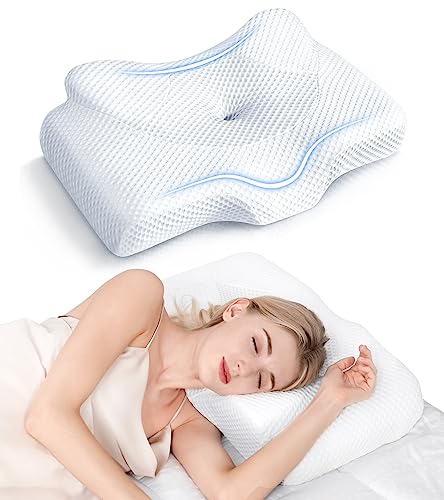
Osteo Cervical Pillow — Hollow Design Memory Foam Pillow — Best Hollow-Centre Design
The Osteo’s distinguishing feature is stated plainly in its title: a hollow design. Instead of a raised contour meeting the head everywhere, the centre is recessed, so the head settles into the hollow while the surrounding foam supports around it. The title also states a cooling case and adjustability, for side and back sleepers.
Strengths
- Hollow-centre geometry is a genuinely different feel from ridge-style contours — worth trying if contours feel pushy
- Cooling case stated, which helps memory foam’s warmth problem
- Adjustable, per the title, so height is not fully fixed
Trade-offs
- Stated for side and back sleepers only — stomach sleepers should look elsewhere in this guide
- Hollow designs feel strange for the first nights if you are used to a flat pillow
- No dimensions are stated in the title, so check the listing for fit
| Spec | Detail (from the verified listing title) |
|---|---|
| Design | Hollow design (as stated) |
| Fill | Memory foam, described as odorless in the title |
| Case | Cooling case (as stated) |
| Adjustability | Adjustable (as stated) |
| Sleep positions | Side and back (as stated) |
| Exact dimensions | Not stated |
Think of the hollow design as the inverse of a contour pillow: rather than building a ridge up to meet your neck, it lets your head drop into a cradle and builds support around the perimeter. Sleepers who find contours intrusive — who feel pushed rather than held — are the audience. The cooling case and stated adjustability round out a thoughtful spec, but note the position limit in the title itself: side and back. That honesty is useful. A stomach sleeper on a raised-perimeter pillow will end up with their head turned and elevated, the opposite of what that position needs.
Best for: Side and back sleepers who find standard contours too pushy and want a cradled feel / Not suited for: Stomach sleepers, or buyers who need published dimensions before ordering
Check on Amazon — check price on Amazon before you buy, because sizes and colours change the final cost.

UTTU Cervical Pillow — Adjustable Contour (Queen) — Best Published Dimensions
The UTTU earns its badge by publishing what rivals omit: full dimensions in the title — 23.6 by 13.8 by 5.2 inches in Queen — wrapped around an adjustable, layered contour design the maker calls a sandwich pillow, in memory foam, stated for side, back and stomach sleepers.
Strengths
- Exact dimensions stated, so loft (5.2 in at the high side) can be judged against your shoulder width before buying
- Layered adjustability lets you lower the pillow if the full height feels like too much
- Stated for all three sleep positions, the broadest position claim in this guide
Trade-offs
- A 5.2-inch high edge is a lot for smaller-framed back sleepers — use the adjustment rather than enduring it
- Memory foam feel is firmer in a cold room and softer in a warm one
- No certifications are stated in the title
| Spec | Detail (from the verified listing title) |
|---|---|
| Dimensions stated | 23.6 x 13.8 x 5.2 inches (Queen) |
| Design | Adjustable ‘sandwich’ contour (as stated) |
| Fill | Memory foam |
| Sleep positions | Side, back and stomach (as stated) |
| Cooling | Contour cooling (as stated) |
| Certifications stated | Not stated |
Dimensions turn pillow shopping from vibes into arithmetic. A side sleeper can compare the 5.2-inch loft against the distance from mattress to the side of their head; a back sleeper can see immediately whether the contour’s lower edge suits them. The layered construction then forgives estimation errors — remove a layer and the pillow drops a class. The all-positions claim should still be read with the usual caution: stomach sleepers will use this at its lowest configuration, if at all, and many will be better served by the adjustable Coop. But as a measured, adjustable contour, this is the most transparent listing in the set.
Best for: Buyers who shop by measurements, and side/back sleepers who want a layered, adjustable contour / Not suited for: Sleepers who dislike memory foam’s slow-response feel
Check on Amazon — check price on Amazon before you buy, because sizes and colours change the final cost.

Royal Therapy Memory Foam Pillow (Queen) — Best Classic Contour
The Royal Therapy is the classic of the group — a one-piece memory foam contour in Queen size with stated dimensions of 24 x 14 x 5 inches. No layers, no fill to add: the shape you unbox is the shape you sleep on, which is precisely its appeal for many buyers.
Strengths
- Stated dimensions make fit and pillowcase checks straightforward
- One-piece contour means zero setup and a consistent feel night after night
- Queen footprint suits sleepers who move and re-centre during the night
Trade-offs
- No adjustability is stated — if the 5-inch loft misses your fit, there is no tuning it
- Stated for stomach sleepers too, but a 5-inch contour is rarely a stomach sleeper’s friend in practice
- White cover shows wear sooner than patterned or grey cases
| Spec | Detail (from the verified listing title) |
|---|---|
| Dimensions stated | 24 x 14 x 5 inches |
| Design | Contour cervical pillow (as stated) |
| Fill | Memory foam |
| Size | Queen |
| Sleep positions | Side, back and stomach (as stated) |
| Adjustability | Not stated |
There is a real virtue in a pillow that cannot be misconfigured. Adjustable designs reward patient tuners and punish everyone else with a week of experiments; a fixed contour simply asks one question — does this height fit me? The stated dimensions let you answer it with unusual confidence: measure your current pillow’s effective height under your head, compare it to the 5-inch figure, and decide. If the numbers are close, this is the lowest-effort good purchase in the guide. If they are far apart, the honest move is to choose an adjustable pick instead of hoping a fixed contour will feel different from its measurements.
Best for: Side and back sleepers who want a set-and-forget contour with published dimensions / Not suited for: Sleepers who need to fine-tune loft, or committed stomach sleepers
Check on Amazon — check price on Amazon before you buy, because sizes and colours change the final cost.
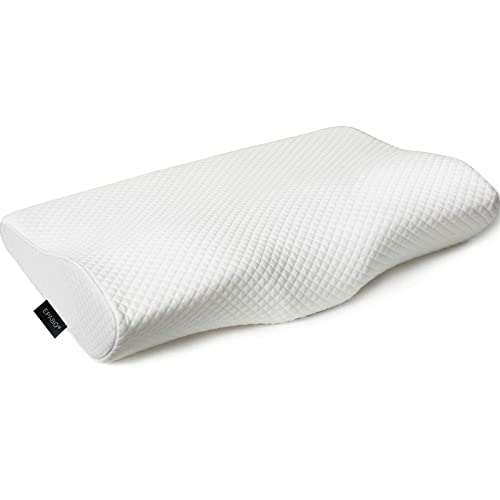
EPABO Contour Memory Foam Pillow — Best Budget-Tier Contour
The EPABO represents the category’s entry tier honestly: an ergonomic contour memory foam pillow for side and back sleepers, without the cooling cases, layered systems or certification lists of the pricier picks. For a first experiment with shaped pillows, that simplicity is a feature.
Strengths
- Simple one-shape design — the lowest-friction way to test whether contours suit you
- Memory foam contour aimed squarely at side and back sleepers
- Budget-tier positioning in this line-up, judged by its feature set rather than any printed price
Trade-offs
- No dimensions, adjustability or certifications are stated in the verified title
- No cooling feature is stated, so warm sleepers should weigh the Coop or Osteo instead
- Title in the cache is truncated; confirm full specifications on the listing before ordering
| Spec | Detail (from the verified listing title) |
|---|---|
| Design | Contour / ergonomic cervical shape (as stated) |
| Fill | Memory foam |
| Sleep positions | Side and back (as stated; title truncated in cache) |
| Dimensions | Not stated |
| Adjustability | Not stated |
| Certifications stated | Not stated |
Every category needs its honest baseline, and this is it. If you have never slept on a contour, spending at the top of the category before knowing whether you like the shape is poor sequencing; a plain contour answers the shape question cheaply in effort, if not in money. The trade-offs are informational as much as physical — with no stated dimensions, use the listing page’s size chart and measure your shoulder width as the fitting guide suggests below. If the experiment succeeds and you want cooling or adjustability later, you will upgrade with knowledge instead of hope.
Best for: First-time contour buyers and side/back sleepers who want the simple version / Not suited for: Hot sleepers, or buyers who want published dimensions and adjustability
Check on Amazon — check price on Amazon before you buy, because sizes and colours change the final cost.

VYLEE Cervical Neck Pillow — Dual-Height Contour (Grey) — Best for Combination Sleepers
The VYLEE’s answer to the position problem is stated in its title: a dual-height contour. One edge sits higher, one lower, and the sleeper rotates the pillow to match the position they are in — higher for side sleeping, lower for back or stomach — in a grey memory foam format.
Strengths
- Dual-height design covers position-changers without any fill to add or remove
- Rotation is instant — flip the pillow when you flip yourself
- Grey cover is the practical colour choice in this guide
Trade-offs
- Two fixed heights still may not include your exact height — combination sleepers with very broad or narrow shoulders should compare the adjustable picks
- No dimensions are stated in the title, so the two heights cannot be compared numerically before ordering
- Discipline required: the pillow only works if you actually rotate it
| Spec | Detail (from the verified listing title) |
|---|---|
| Design | Dual-height contour (as stated) |
| Fill | Memory foam |
| Sleep positions | Side, back and stomach (as stated) |
| Colour | Grey |
| Dimensions | Not stated |
| Adjustability | Two fixed heights (dual-height design); fill adjustability not stated |
Combination sleepers are the underserved majority, and dual-height is the most elegant low-effort answer: the pillow carries both answers and the sleeper picks by turning it around. In practice the habit forms quickly — side sleepers learn the tall edge by feel within a few nights. The honest limitation is precision: two heights is a choice between two manufacturer’s guesses, whereas the adjustable picks offer a continuum. If your fit falls between the VYLEE’s edges, you will feel it. But for the sleeper whose current complaint is ‘my pillow is right on my back and wrong on my side’, this design targets the complaint directly.
Best for: Combination sleepers who change position through the night / Not suited for: Sleepers who want continuously adjustable loft or published dimensions
Check on Amazon — check price on Amazon before you buy, because sizes and colours change the final cost.
Comparison Table
| Pick | Badge | Key spec | Best for |
|---|---|---|---|
| Coop Home Goods Cool+ Adjustable Pillow (Queen Plus) | Best Overall | Adjustable shaped memory foam; cooling gel stated; Queen Plus | Sleepers unsure of their ideal loft, combination sleepers, and hot sleepers who want adjustability |
| Osteo Cervical Pillow — Hollow Design Memory Foam Pillow | Best Hollow-Centre Design | Hollow design; memory foam; cooling case stated | Side and back sleepers who find standard contours too pushy and want a cradled feel |
| UTTU Cervical Pillow — Adjustable Contour (Queen) | Best Published Dimensions | 23.6 x 13.8 x 5.2 in stated; adjustable layered contour | Buyers who shop by measurements, and side/back sleepers who want a layered, adjustable contour |
| Royal Therapy Memory Foam Pillow (Queen) | Best Classic Contour | 24 x 14 x 5 in stated; one-piece memory foam contour | Side and back sleepers who want a set-and-forget contour with published dimensions |
| EPABO Contour Memory Foam Pillow | Best Budget-Tier Contour | Ergonomic contour; memory foam; side/back | First-time contour buyers and side/back sleepers who want the simple version |
| VYLEE Cervical Neck Pillow — Dual-Height Contour (Grey) | Best for Combination Sleepers | Dual-height contour; memory foam; grey | Combination sleepers who change position through the night |
How to Choose the Best Sleeping Pillows for Neck Support
Begin with your dominant sleep position, because it sets the height you need. Side sleepers rest on the width of a shoulder, so the pillow must fill that whole gap to keep the head level — this is the tallest, firmest brief, and it is why side sleepers benefit most from contours and high lofts like the 5.2-inch edge stated on the UTTU. Back sleepers need a moderate cradle: enough fill under the neck curve to support it, little enough under the head that the chin is not pushed toward the chest. Stomach sleepers need the least of everything; height is their enemy, and the adjustable or lowest configurations in this guide are their only sensible options among shaped pillows.
Then choose your adjustability philosophy. Fixed contours (Royal Therapy, EPABO) are consistent and effortless but binary — they fit or they do not. Layered and shredded adjustable pillows (UTTU, Coop) forgive uncertainty and reward a week of patient tuning. Dual-height designs (VYLEE) split the difference for position-changers. Neither philosophy is superior; they suit different temperaments and different levels of certainty about your own measurements.
Use measurements wherever they are offered. Two picks state full dimensions; for the others, the listing’s size information plus your own shoulder width — measured from neck to shoulder tip — is the best predictor of side-sleeping fit. Finally, weigh the surface: memory foam warms and softens through the night, so stated cooling features (gel, cooling cases) matter if you sleep hot, and a washable or replaceable case matters if you want the pillow to stay fresh across years of use. And keep the framing honest throughout: you are buying comfort and fit. A pillow that delivers both has done its whole job.
How to Set Up and Trial a Neck-Support Pillow Properly
Night one is not a verdict. A new contour changes the geometry your neck has adapted to, sometimes for years, so judge any pillow across at least several nights — a week is fairer — before deciding. Set up deliberately: for contour pillows, confirm orientation before bed (the higher edge belongs under your neck for side sleeping on most designs; dual-height pillows rotate by position), and use a pillowcase that fits the stated dimensions without compressing the shape.
If your pick is adjustable, change one variable at a time. Sleep at the delivered loft for three nights, note whether your head feels tilted up, dropped, or level on waking, then adjust once — a layer out, or a small handful of fill — and repeat. Adjusting nightly teaches you nothing, because you never learn which change did what. Keep the removed fill; you may want it back in a different season or on a different mattress, since mattress firmness changes effective pillow height: a soft mattress lets your shoulder sink, reducing the gap a side sleeper’s pillow must fill.
Care keeps the shape honest. Air a new memory foam pillow before first use, as the category’s ‘odorless’ claims suggest makers know fresh foam has a smell worth airing. Wash cases on the maker’s stated cycle, keep the foam itself out of the washing machine unless the listing says otherwise, and re-fluff or re-settle adjustable fills monthly so the loft you tuned is the loft you keep.
A Note on Comfort Claims and When to Seek Advice
Pillow marketing borrows medical vocabulary, and this category’s verified titles are no exception — the exact titles are recorded in this article’s source file for transparency. This guide deliberately does not repeat that vocabulary as a promise. No pillow in this guide is presented as treating, curing or preventing any condition, and none should be bought on that basis.
What a well-fitted pillow can do is simpler and still valuable: support your head at a height matched to your position, hold that support consistently, and feel comfortable enough that you sleep undisturbed. If you experience persistent or worsening pain, tingling or numbness in the arms or hands, frequent morning headaches, or disturbed sleep that continues after a fair pillow trial, treat those as reasons to consult a qualified clinician. That is not a disclaimer ritual — it is the correct sequence, and no purchase in this category should delay it.
Neck-Support Pillows by Sleep Position: A Closer Look
Side sleepers are this category’s core customer, and their fitting problem is the most mechanical: the pillow must occupy the full height between the mattress and the side of the head, or the neck bends toward the bed all night. That is why the stated lofts in this guide — 5.2 inches on the UTTU’s high edge, 5 inches on the Royal Therapy — are side-sleeping numbers first. A side sleeper with narrow shoulders on a soft mattress may need less than those figures, because the shoulder sinks and shortens the gap; a broad-shouldered side sleeper on a firm mattress may need all of them and the adjustable Coop’s extra fill besides. Your mattress is part of your pillow’s height, whether the pillow’s listing mentions it or not.
Back sleepers need the opposite discipline: restraint. The cradle should fill the neck’s curve while letting the head rest low, because a back sleeper on a tall contour wakes with their chin pressed toward their chest — a position nobody would choose awake. Dual-height designs earn their keep here, offering the low edge for the back hours; the Osteo’s hollow centre achieves a similar settling by a different geometry. Stomach sleepers, finally, should read this whole category with suspicion, including this guide: the honest advice is the lowest adjustable configuration you can build, or a thin soft pillow outside the contour family altogether. A guide that sells every reader the same shape is selling, not guiding.
Combination sleepers live in the transitions, and their enemy is the pillow that is perfect twice a night and wrong four times. Their realistic options are the ones this guide badges for them: a dual-height pillow rotated by feel, or an adjustable fill set to the compromise height that is acceptable in every position rather than ideal in one. Acceptability, sustained all night, beats perfection interrupted — sleep is a long game, and the pillow that never forces a 3 a.m. adjustment is the one still in the bed in month six.
Materials and Feel: Memory Foam, Shredded Fill and Cooling Surfaces
One-piece memory foam, the material of the contour picks, responds slowly: it softens with body heat, moulds to the head’s exact geography, and holds that mould until you move. Sleepers who stay put love its consistency; restless sleepers sometimes fight it, because each new position must wait for the foam to re-mould. It also sleeps warm by nature — it is an insulating foam in close contact — which is why so many titles in this category state a cooling answer: gel in the Coop’s fill, a cooling case on the Osteo, contour cooling on the UTTU. Those features moderate the surface feel; none of them refrigerates, and hot sleepers should set expectations at ‘less warm’, which in practice is often enough.
Shredded and layered fills trade that moulded consistency for tuneability. A shredded fill can be gathered higher under the neck and thinned under the head — a hand-made contour, revised nightly if you wish — while layered designs adjust in steps. The cost is maintenance: shredded fills settle and need re-fluffing, and the sleeper must be the kind of person who will actually tune, once, patiently, rather than nightly and at random. Neither material is better; they are answers for different temperaments, and this guide’s badges try to route each temperament to its material.
Covers and cases are the unglamorous deciders. A stated cooling case, a washable cover, a certification named in the title — these determine whether the pillow you love in week one is the pillow you still love in year two, because the case takes the wear, the washing and the summer. When two pillows tie on shape, buy the one whose surface life is better documented. It is the part of the pillow you will actually touch every night.
When a New Pillow Feels Worse Before It Feels Better
It is common — and worth saying plainly in a guide that refuses medical promises — for the first nights on a correctly shaped pillow to feel strange, and for strange to be misread as wrong. Your sleeping posture is a habit held in muscle memory; a contour that changes your head’s height by an inch changes the length at which a dozen small muscles rest, and they register the novelty before they register the improvement. This is why the trial guidance in this guide insists on several nights and single, small adjustments: you are not only testing a pillow, you are letting a habit re-form around it.
There are, however, honest stop signals. Sharp discomfort, new numbness or tingling, headaches that arrive with the pillow and leave without it, or sleep that is plainly worse after a fair week — these are not adjustment, they are information, and the correct responses are to stop, revert, and, where symptoms persist, consult a clinician rather than another product page. Comfort equipment should be judged with the same sense as any other part of a sleep routine: the goal is unremarkable, restorative sleep, and anything that moves you away from it — however impressive its specification — is the wrong purchase for you.
The encouraging symmetry is that the right pillow usually announces itself quietly: not with a dramatic morning, but with the absence of one — waking without having thought about your pillow since lights-out. That unremarkableness is the product working. Chase it patiently, one variable at a time, and let any pillow that cannot deliver it be returned without regret; the category is large, your measurements are now known, and the second choice, made with data, is usually the keeper.
Pillowcases, Protectors and the Fit Nobody Thinks About
A contour pillow lives inside a case, and the wrong case quietly undoes the right pillow. A case cut for a flat pillow, stretched over a contour, compresses the raised edges — exactly the parts doing the supporting — and can lower effective loft by enough to change the fit you so carefully chose. Use a case sized for the pillow’s stated dimensions where they are given, as two picks here give them, and prefer a case with enough give to follow the shape rather than iron it flat. Envelope closures sit flatter against contours than tight zips pulled drum-taut; if a zip case is what you have, leave the last inch of zip open rather than strangling the pillow into it, and judge the fit again after a night — the pillow in its case, not the pillow naked, is the object you actually sleep on.
A protector under the case earns its place twice over. It takes the moisture and oils that break foam down and yellow covers, extending the working life of a pillow whose shape is its value; and it washes in minutes, which means the pillow’s hygiene routine can be weekly even though the pillow itself should be washed rarely, gently, or never, depending on the maker’s instructions for its fill. For adjustable pillows, the protector has a third job: it keeps shredded fill contained during the undignified business of opening the pillow to tune it, ideally over a bed, with the removed fill going straight into a bag you label and keep — future you, changing mattresses in a year, will want that fill back and will not remember where it went unless past you was kind.
Finally, retire pillows by shape, not by age. A contour that no longer springs back, a shredded fill that clumps despite fluffing, a dual-height edge that has slumped toward its sibling — these are a pillow announcing that its geometry, the thing you bought, has left. Note what you replace and why, and the next purchase starts from measurements and evidence instead of from the beginning; that notebook habit, unglamorous as it is, is how households eventually stop buying pillows and start simply reordering the right one.
A Final Word on Expectations
Set the expectation this category deserves and it will serve you well: a pillow is the most personal object in the bedroom, its success is measured in unremarkable mornings, and its purchase is a fitting exercise, not a leap of faith. You now have the measurements that matter — your position, your shoulder width, your mattress’s give — and six verified constructions to match against them, each described by what its maker actually stated. Choose the one whose stated shape answers your stated needs, trial it with the patience the process requires, and keep the clinician’s door in mind for anything that feels like more than comfort. Sleep, in the end, is not a product; but the right pillow, honestly chosen, is one of its most reliable supporting acts.
Common Buying Mistakes
Buying the tallest contour for every position. Height serves side sleepers and works against stomach sleepers. The position statement in each title is a filter, not a slogan.
Judging a new shape after one night. Your neck adapts over several nights. A fair trial is a week, with one adjustment at a time on adjustable models.
Ignoring stated dimensions. Two picks publish exact sizes. Measuring your shoulder width and comparing lofts prevents the most common failure in this category: the almost-right height.
Expecting a pillow to treat a condition. Buy for comfort and fit. Persistent symptoms belong in a clinician’s office, not in a product comparison.
Forgetting the mattress. A soft mattress reduces the height a side sleeper needs; a firm one increases it. Re-tune adjustable pillows when you change mattresses.
Counting size variants as different pillows. The same model in Queen and Standard is one pick. Compare mechanisms — contour, hollow, dual-height, adjustable — not listings.
Final Recommendation
If you buy one pillow from this guide, buy the Coop Cool+: adjustability forgives the uncertainty everyone brings to this category, and its stated cooling gel and certifications complete the strongest overall brief. Side and back sleepers who find contours pushy should try the Osteo’s hollow-centre alternative; measurement-led buyers should start with the UTTU’s published dimensions and layered adjustment; set-and-forget sleepers with a known fit will be happiest with the Royal Therapy; first-time contour buyers can start at the EPABO’s simpler tier; and combination sleepers should rotate the dual-height VYLEE. Give whichever you choose a full week, adjust once at a time, and judge it on morning comfort — nothing else.
Related reading in the same cluster: Best Affordable Pillows, Best Affordable Pillows For Stomach Sleepers, Best 100 Down Pillows, Best Alternative To Down Pillows.
Frequently Asked Questions
What pillow height is right for side sleepers?
Side sleepers need the most height, because the pillow must fill the gap between mattress and head created by the shoulder. Use stated lofts as your guide — the UTTU states 5.2 inches at its high edge — and prefer adjustable models if your shoulder width is unusually broad or narrow.
Can stomach sleepers use contour pillows?
Mostly no, or only at the lowest configuration. Height works against the stomach position. Adjustable pillows lowered to their minimum, or the low edge of a dual-height design, are the only sensible shaped options; many stomach sleepers do best with a thin, soft pillow instead.
How long should I trial a new neck-support pillow?
At least several nights, ideally a week. Change adjustable loft once every few nights at most, so you can tell what each change did. The first night on a new shape is the least reliable data point.
Do these pillows treat neck pain?
This guide makes no such claim, and you should be wary of any listing that reads as a treatment promise. These pillows are compared on comfort, fit and construction. Persistent pain, numbness or headaches are reasons to consult a clinician.
What is the difference between contour, hollow and dual-height designs?
A contour builds a ridge to support the neck curve. A hollow design recesses the centre so the head settles in and support surrounds it. A dual-height pillow offers two contour edges of different heights, rotated to match your position.
How do I keep an adjustable pillow at the height I tuned?
Keep the removed fill stored, re-settle the fill monthly, and re-check loft whenever you change mattresses — a softer or firmer mattress changes the height your position actually needs.

