Disclosure: airfryerkitchensupply.com is reader-supported. When you buy through links on our site, we may earn an affiliate commission at no extra cost to you.
Where to buy
The fastest route to any pick below is Amazon, where sizing, finish and configuration options are listed on one page and delivery is straightforward for bulky items. Direct links to the verified picks in this guide: Continental Bedding 50/50 Down Feather Pillow; East Coast Bedding 50/50 Goose Down & Feather Pillow, Standard; DOWNLITE Hotel & Resort 50-50 Down & Feather Blend Pillow, King; puredown Goose Feathers and Down Pillows, Set of 2, Standard; Pacific Coast Goose Feather and Down Pillows, Set of 2, Standard; Eastwarmth Goose Feather Down Pillow, King 20×36. Picks described as unlinked are covered by type, so search Amazon by the type name and compare specification-for-specification.
The best affordable pillows are the ones that understand what a pillow budget should actually buy: a breathable natural-fibre shell, a fill that supports your sleep position, and construction that survives the wash — not a hotel photograph and a foam brick. This guide’s verified picks are all down-and-feather pillows, because that is where the affordable tier hides its best value: feather-and-down blends deliver the mouldable, cool-sleeping support that sleepers have trusted for a century, at a tier the premium pillow market hopes you will not notice. Every pick below was confirmed, and they differ where it matters — fill ratio, size from standard to king, singles versus pairs — so the list works as a decision ladder rather than six copies of one pillow. One honest framing note: affordable here means the attainable tier of quality pillows, judged on cost per year of good sleep, and as everywhere in this programme no prices are printed — check the current price on Amazon for each pick.
In this guide
Quick Picks
- Continental Bedding 50/50 Down Feather Pillow (Best Overall): a 50/50 down-feather pillow in a 300TC cotton shell, positioned for side sleepers — the balanced all-round affordable pick. — Check on Amazon
- East Coast Bedding 50/50 Goose Down & Feather Pillow, Standard (Best Medium Support): a goose down and feather pillow in standard size with a stated medium support — the back-and-combination sleeper’s pick. — Check on Amazon
- DOWNLITE Hotel & Resort 50-50 Down & Feather Blend Pillow, King (Best King Size): a king-size 50-50 blend from a hospitality supplier, listed as hypoallergenic — the big-bed pick with hotel-programme heritage. — Check on Amazon
- puredown Goose Feathers and Down Pillows, Set of 2, Standard (Best Pair Value): a matched pair of goose feather-and-down pillows in cotton covers — the whole bed solved in one affordable-tier purchase. — Check on Amazon
- Pacific Coast Goose Feather and Down Pillows, Set of 2, Standard (Best Medium-Firm Pair): a medium-firm pair with a downproof shell from a heritage feather company — the firmer end of this list’s natural-fill range. — Check on Amazon
- Eastwarmth Goose Feather Down Pillow, King 20×36 (Best Budget King Single): a single king pillow, 20 by 36 inches, in a striped cotton cover — the one-at-a-time king purchase for solo sleepers and proppers-up. — Check on Amazon
How These Picks Were Chosen
Every pick was verified; only listing-confirmed products carry purchase links. Selection centred on down-and-feather blends because the 50/50 class offers the best support-to-tier ratio in the affordable market: enough down for softness, enough feather for the structure that keeps a pillow from collapsing flat by February. Shell quality was the second filter — a downproof cotton shell is what keeps feathers inside the pillow and off the bed — and thread counts and RDS or OEKO-TEX certifications in the listing titles were noted where present. Sizes were deliberately spread across standard and king so both bed formats are covered, and pairs were favoured where offered, because a pillow purchase is usually a bed purchase. No prices or ratings appear anywhere in the guide; affordability is expressed as tier positioning, and the final check is always the current price on Amazon.
The 6 Best Affordable Pillows

Continental Bedding 50/50 Down Feather Pillow — Best Overall
The Continental Bedding pillow takes the classic 50/50 recipe — half down for softness, half feather for support — and wraps it in a breathable 300-thread-count cotton shell, with RDS and OEKO-TEX credentials in its listing for buyers who check sourcing. Its listing positions it for side sleepers, which is where a mouldable natural fill earns its keep: the pillow can be punched into shape to fill the shoulder-to-ear gap that decides whether a side sleeper’s neck wakes up happy. It suits the majority of sleepers and the majority of beds, which is what a Best Overall pick is for.
Strengths
- Balanced 50/50 fill moulds to shape instead of springing back like foam
- 300TC cotton shell breathes — a cooler sleep surface than synthetic shells
- Certifications in the listing for buyers who verify sourcing claims
Trade-offs
- Natural fill needs regular fluffing to hold its loft
- Not the choice for sleepers who want a firm, unmoving pillow
- Feather pillows carry a faint natural scent when new that airs out over days
Key specs: 50/50 down and feather fill, 300TC cotton shell, RDS and OEKO-TEX noted (per Amazon title)
Living with a down-feather pillow is a small daily ritual with a real payoff: a morning fluff — grab opposite corners, punch, shake — restores the loft that the night compressed, and a pillow protector under the pillowcase keeps the fill cleaner for far longer between washes. Side sleepers should shape the pillow before lying down rather than after; the fill holds the shape you give it, which is the entire advantage over rebound foams. Expect the first nights to feel different from a synthetic pillow — cooler, quieter, more responsive — and expect to stop noticing it within a week, which is what a pillow is supposed to achieve.
Best for: side sleepers and anyone upgrading from synthetic pillows / Not suited for: sleepers wanting firm, fixed-shape support
Check on Amazon — check the current price on Amazon before you decide.

East Coast Bedding 50/50 Goose Down & Feather Pillow, Standard — Best Medium Support
East Coast Bedding’s 50/50 goose pillow states its intent plainly in its title: medium support, in a 300-thread-count all-cotton shell, standard size. Medium is the honest centre of the pillow world — enough loft and structure for back sleepers to keep the head cradled without being propped, and enough give for combination sleepers who change position through the night. Goose fill at this blend gives a slightly loftier hand-feel than duck equivalents. It suits the sleeper who has tried firm and soft and been failed by both.
Strengths
- Stated medium support suits back and combination sleepers
- Goose down-feather blend in a full cotton shell
- Standard size fits the pillowcases most households already own
Trade-offs
- Medium will feel under-filled to dedicated side sleepers with broad shoulders
- A single pillow format — pairs and king sizes are other listings’ games
- Like all natural fills, loft depends on the daily fluff
Key specs: 50/50 goose down and feather, medium support, 300TC cotton shell, standard size (per Amazon title)
Medium-support pillows are the hardest to buy because ‘medium’ is doing real work: judge this one by your first week’s neck, not your first night’s impression, because natural fill settles into your shape over several nights. Back sleepers should check that the head rests cradled rather than tilted forward — if your chin tucks, the pillow is too lofty for you and a flatter profile from this list’s pair options, doubled or singled, may suit better. The cotton shell keeps the sleep surface neutral in temperature, a quiet advantage over the warm microfibre shells common at this tier.
Best for: back sleepers and combination sleepers / Not suited for: broad-shouldered side sleepers needing maximum loft
Check on Amazon — check the current price on Amazon before you decide.

DOWNLITE Hotel & Resort 50-50 Down & Feather Blend Pillow, King — Best King Size
DOWNLITE supplies the hotel trade, and this king-size 50-50 pillow is that programme in retail form: a generous king format, a down-and-feather blend balanced for the broad middle of sleepers, and a hypoallergenic listing that reflects the cleaning processes hospitality fills go through. King pillows are their own decision — they fill a king bed’s width properly, double as reading props, and demand king pillowcases — and this is the pick for households already committed to the format. It suits king-bed owners who want the hotel sleep feel without the hotel gift-shop tier.
Strengths
- True king size that dresses a king bed correctly
- Hospitality-grade fill processing, listed hypoallergenic
- Blend balance suits the broad middle of sleep positions
Trade-offs
- King size needs king pillowcases — factor them into the purchase
- Too much pillow for a twin or double bed’s proportions
- Natural fill care routine applies, at a larger scale
Key specs: 50/50 down and feather blend, king size, hypoallergenic (per Amazon title)
A king pillow changes bed geometry: two of them span the bed, one of them props a reader like a bolster, and in the night a side sleeper gets a longer mouldable surface to shape. The hypoallergenic processing matters for the dust-sensitive, with the honest caveat that no pillow stays allergen-free without its protector and wash routine — the listing’s processing is the start, your laundry is the maintenance. DOWNLITE’s hotel heritage also means the fill specification is consistent from pillow to pillow, a quiet virtue when you buy the second one a year after the first.
Best for: king beds and hotel-feel seekers / Not suited for: smaller beds or standard-case households
Check on Amazon — check the current price on Amazon before you decide.
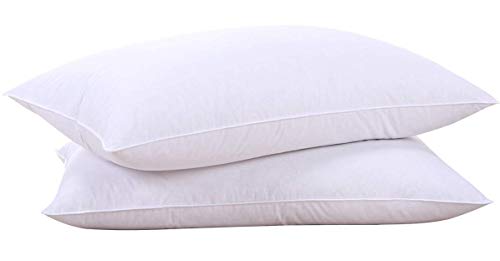
puredown Goose Feathers and Down Pillows, Set of 2, Standard — Best Pair Value
Most pillow buying is secretly pair buying, and the puredown set answers it directly: two standard goose feather-and-down pillows with cotton covers, positioned as a hotel-collection pair. A matched pair matters more than it sounds — two pillows of the same fill and age behave identically, dress the bed evenly, and age together, instead of the lopsided marriage of one new pillow and one survivor. It suits anyone setting up a bed from scratch, a guest bed, or replacing a mismatched pair that has annoyed them for years.
Strengths
- A matched pair in one purchase — even loft, even ageing, even look
- Goose feather-down fill in full cotton covers
- Standard size suits the cases households already own
Trade-offs
- A pair commits you to one firmness for both sides of the bed
- Guest-bed duty may prefer the budget spent across more, simpler pillows
- Natural fill fluffing routine, now times two
Key specs: Goose feathers and down, 100% cotton cover, set of 2, standard size (per Amazon title)
Run a pair as a system: rotate the two pillows between sides weekly and each wears evenly, and fluff both in the morning as one habit. If one sleeper wants more height, the pair format offers the classic solution — a pillow-and-a-half arrangement or a folded shape that natural fill holds obligingly — without a separate purchase. The cotton covers keep the pair sleeping cool, and protectors over both are the cheapest longevity insurance in bedding. For a guest bed, this pair is the upgrade guests actually remark on, because guest pillows are usually where old pillows go to be endured.
Best for: couples and guest beds wanting a matched pair / Not suited for: couples with very different firmness needs
Check on Amazon — check the current price on Amazon before you decide.

Pacific Coast Goose Feather and Down Pillows, Set of 2, Standard — Best Medium-Firm Pair
Pacific Coast has built its name on feather bedding, and this standard pair states the two specifications that matter most in its title: downproof shell and medium-firm support. Downproof is the unglamorous hero of feather pillows — the tightly woven shell that keeps quills from migrating through the fabric at 3am — and medium-firm is the support class for sleepers who found the softer blends in this list under-supportive. It suits back sleepers wanting structure and side sleepers who prefer their mouldable pillow on the firmer side.
Strengths
- Downproof shell keeps feathers where they belong
- Medium-firm is the firmest natural-fill support in this guide
- Heritage specialist maker with a consistent fill specification
Trade-offs
- Medium-firm will feel unyielding to stomach sleepers
- Feather-forward blends can present an occasional quill feel even through good shells
- Pair format only in this listing
Key specs: Goose feather and down, downproof shell, medium-firm, set of 2 standard (per Amazon title)
Judge a medium-firm feather pillow after a week, not a night: the fill packs into your shape and the support becomes personal, which is the natural-fill bargain — it learns you, slowly. The downproof shell deserves its emphasis because it is the difference between a feather pillow and a feather problem; if a pillow ever sheds quills through its case, the shell was the failure, and this listing makes the shell a headline for a reason. Pair the firmer support with a protector and the morning fluff, and this is the set in the guide most likely to satisfy the sleeper who has been doubling up two tired pillows to get one pillow’s worth of height.
Best for: back and side sleepers wanting firmer natural support / Not suited for: stomach sleepers, who need this list’s flattest option
Check on Amazon — check the current price on Amazon before you decide.

Eastwarmth Goose Feather Down Pillow, King 20×36 — Best Budget King Single
Not every king pillow is bought in pairs: the solo sleeper on a big bed, the reader who wants one long prop, and the buyer replacing a single failed pillow all need the single format, and the Eastwarmth king — a full 20 by 36 inches in a striped cotton cover, sold as a one-pack — is this guide’s answer. The goose feather-down fill keeps it in the same natural-fill family as the rest of the list. It suits deliberate single purchases and mixed-bed arrangements where the two sides of the bed run different pillows by choice.
Strengths
- True king dimensions in a single-pack purchase
- Striped cotton cover has the classic bedding look
- Lets mixed-preference couples run different pillows per side
Trade-offs
- One pillow dresses half a king bed — the pair buyers are served elsewhere in this list
- King cases required, as with all king formats
- Natural fill at king scale is a bigger fluffing job each morning
Key specs: Goose feather and down, cotton cover, king 20x36in, 1 pack (per Amazon title)
A single king pillow earns its place in three routines: the solo sprawler who uses its length diagonally, the reader who folds its length into a backrest — natural fill holds a fold better than rebound foam — and the side sleeper who hugs the far half. If you are replacing one of a pair, be honest that a new pillow beside an old one will sit higher and feel firmer for months; that mismatch is sometimes the point and sometimes an argument for the pair listings above. The striped cotton cover is the traditional ticking look, and like every natural fill here it wants a protector between it and the pillowcase from day one.
Best for: solo king sleepers, readers and single replacements / Not suited for: buyers dressing a whole king bed in one purchase
Check on Amazon — check the current price on Amazon before you decide.
Comparison Table
| Pick | Badge | Key spec | Best for |
|---|---|---|---|
| Continental Bedding 50/50 Down Feather Pillow | Best Overall | 50/50 down-feather, 300TC cotton shell | side sleepers and anyone upgrading from synthetic pillows |
| East Coast Bedding 50/50 Goose Down & Feather Pillow, Standard | Best Medium Support | 50/50 goose down-feather, medium, standard size | back sleepers and combination sleepers |
| DOWNLITE Hotel & Resort 50-50 Down & Feather Blend Pillow, King | Best King Size | 50-50 blend, king size, hypoallergenic listing | king beds and hotel-feel seekers |
| puredown Goose Feathers and Down Pillows, Set of 2, Standard | Best Pair Value | Goose feather-down, set of 2, standard | couples and guest beds wanting a matched pair |
| Pacific Coast Goose Feather and Down Pillows, Set of 2, Standard | Best Medium-Firm Pair | Goose feather-down, downproof, medium-firm, pair | back and side sleepers wanting firmer natural support |
| Eastwarmth Goose Feather Down Pillow, King 20×36 | Best Budget King Single | Goose feather-down, king 20×36, single | solo king sleepers, readers and single replacements |
How to Choose an Affordable Pillow
Choose by sleep position first, because position decides loft and support more than any material claim. Side sleepers need the pillow to fill the shoulder-to-ear span and hold it — the mouldable, fuller picks in this list. Back sleepers need medium support that cradles without pushing the chin down. Stomach sleepers need the flattest, softest option available and should treat most of this list as too much pillow. Second, understand fill honestly: down is softness, feather is structure, and the blend ratio is the pillow’s personality — 50/50 is the balanced centre this guide is built on. Third, interrogate the shell: a downproof, all-cotton shell keeps feathers in, sleeps cool, and outlasts the microfibre shells common at this tier. Finally, do the affordability maths per year, not per purchase: a quality natural-fill pillow with a protector and a fluffing habit serves for years, which is how the affordable tier is won — not by buying the cheapest object, but by buying the cheapest object that lasts.
Down, Feather and the Blends Between
Down is the soft cluster under a bird’s feathers — light, insulating, and the source of a pillow’s plush first impression. Feather is the structured quill-bearing fill that gives a pillow body and its mouldable, punch-it-into-shape character. Pure down is a luxury tier and too collapsible for most sleepers’ support needs; pure feather is firm, heavy and quill-prone. The blends are where affordable quality lives: at 50/50, the pillow greets you with down and holds you with feather, and it can be reshaped nightly for side, back and reading positions in a way no moulded foam allows. The trade is maintenance — natural fill wants fluffing, airing and a protector — and a faint natural character that synthetic fills do not have. For the great majority of sleepers, that trade is the best value exchange in bedding, which is why every verified pick in this guide is a blend.
Pillow Sizes and When Each Makes Sense
Standard pillows fit the cases most households own and suit twin, double and queen beds dressed conventionally. King pillows, at around 20 by 36 inches, exist to span a king bed’s width and double as body-length props for reading and side-sleeping support; on smaller beds they overwhelm the proportions and the pillowcase drawer. Buy size by bed and by case inventory, not by the luxury of the word king. Pairs deserve their own logic: a matched pair ages evenly and dresses a bed symmetrically, while singles serve solo sleepers, replacements and mixed-preference couples. The list above covers both logics deliberately — pairs from puredown and Pacific Coast, king singles and pairs across DOWNLITE and Eastwarmth, standards from Continental and East Coast — so the size decision and the support decision can be made independently.
Pillow Loft and Fill Amount: Reading Between the Listings
Two pillows with identical descriptions can sleep completely differently, and the hidden variable is fill amount — how much down and feather is actually inside the case. Listings rarely state it prominently, which is why this guide’s picks lean on established makers whose fill specifications are consistent from unit to unit: with a specialist, the second pillow matches the first, and the pair you buy next year matches the pair you own. Loft as photographed is also a staging art — pillows are fluffed, angled and lit — so judge by the support class and blend, then by your own week’s trial. A practical test on arrival: the pillow should recover most of its loft within a minute of a hard punch-and-shake, and it should hold a folded shape briefly rather than springing flat like foam or collapsing like a bag of air. If a new natural pillow feels under-filled for your position, the honest fixes are a second slimmer pillow beneath it or a step to the firmer pick — not a different category of complaint, because fill amount is a specification you can act on precisely once you know it governs the feel.
The Pillow System Around the Pillow: Protectors, Cases and Rotation
A pillow never sleeps alone, and its system decides its lifespan as much as its fill. The protector is the foundation — a zippered, washable barrier that intercepts moisture and oils, washed monthly in minutes, and the single purchase that doubles a natural pillow’s good years. The pillowcase above it is the sleep surface: cotton percale stays cool and crisp for hot sleepers, sateen feels smoother and warmer, and either should be changed with the sheets, because the case is where the night’s evidence accumulates. Rotation is the third element and the one nobody does: swap the bed’s pillows side to side weekly, flip and fluff them in the making of the bed, and air them when the bedding is stripped, and a pair wears evenly instead of one pillow ageing into the favourite and the other into the spare. Keep one retired-but-clean pillow as the household utility — the reading prop, the guest-overflow, the knee pillow — and the system is complete. None of this costs much; all of it is the difference between the affordable pillow as a category promise and the affordable pillow as your actual decade of sleep.
Troubleshooting Your Current Pillow Before You Replace It
Some pillow problems are purchases; others are maintenance wearing a disguise, and the affordable move is knowing which. A natural-fill pillow that has gone flat may simply be a pillow that has not been fluffed or aired in months — an afternoon of airing and a proper wash-and-complete-dry cycle resurrects more pillows than any sale. A pillow that feels lumpy after washing was dried incompletely; another full drying cycle with dryer balls usually finishes the job the first cycle started. A pillow that smells musty is reporting moisture, and the cure is drying and a protector, in that order. Neck discomfort that arrives with a new bed, a new mattress or a new sleep position is often geometry, not pillow failure — retest your existing pillow for a week in the new setup before blaming it.
The genuine replacement signals are different: fill that no longer recovers loft after fluffing and airing, a shell worn thin or shedding fill despite being downproof, a persistent odour after a proper wash and complete dry, or a fold test the pillow fails outright — folded in half, a living pillow pushes back open; a dead one stays folded. When those signals appear, the picks in this guide are the replacement ladder, and the troubleshooting week you spent first means you will buy the right support class this time, informed by what your old pillow taught you on its way out.
Pillows for Guest Beds, Children and Travel: Spending Where It Counts
Not every pillow in a house deserves the main-bed budget, and allocating honestly is its own affordability skill. The guest bed deserves better than the household’s retired pillows — guests sleep worst in strange beds anyway — and the matched pairs in this guide are priced as attainable-tier purchases precisely so a guest bed can be genuinely comfortable; a guest who sleeps well remembers the visit differently. Children’s pillows are a separate logic: smaller, flatter, and age-appropriate, and the adult blends here should wait until a child is old enough for a full-size pillow under current guidance — when that day comes, a standard from this list is a sound first adult pillow. Travel is the third case: a compressed natural-fill pillow travels worse than its loft suggests, and most travellers are better served by their destination’s pillows plus their own pillowcase from home, which delivers the familiar sleep surface at zero packing cost.
The allocation principle across all three: spend the pillow budget where the hours are. Your own bed, slept in nightly for years, earns the best verified pick you can reasonably buy; the guest bed earns the honest pair; the travel bag earns a pillowcase. Affordable was never about spending the least — it is about spending in proportion to use, and pillows, used eight hours a day, repay proportionate spending more reliably than almost anything else in the home.
Foam, Latex and Synthetic Pillows: The Honest Comparison
This guide’s verified picks are natural-fill blends, but a complete affordable-pillow education owes the reader the alternatives’ honest cases. Memory foam offers a fixed, slow-response shape that some back sleepers and neck-pain sufferers genuinely prefer, and its affordable tier is crowded — with the caveats that foam sleeps warm, varies enormously in density and durability between listings, and cannot be reshaped or easily washed. Latex is the premium natural alternative — springy, durable, cool-er than foam — and sits mostly above this guide’s tier. Synthetic cluster-fibre pillows are the true budget floor: light, washable, hypoallergenic by material, and typically the shortest-lived support in the category, which is why their low purchase price so often loses the per-year maths this guide keeps returning to. Shredded-fill adjustable pillows solve the loft-guessing problem elegantly by letting you remove fill, at the cost of a lumpier hand-feel than any intact fill. None of these is a wrong answer; each is a different exchange of money, maintenance and feel. The blends in this guide won the verification because they offer the mouldable middle — reshaped nightly, cool, long-lived — at an attainable tier, but the sleeper who knows they love a fixed foam shape should follow that knowledge, not this list.
When to Replace, When to Add: The Second-Pillow Strategy
Many pillow complaints are actually one pillow being asked to do two jobs, and the affordable solution is a division of labour rather than an upgrade. The sleeper who reads in bed and then sleeps flat owns a geometry conflict: the reading position wants height and firmness, the sleeping position wants the opposite, and a single compromise pillow serves both badly. Two pillows — the main verified pick for sleeping, a firmer or older one for propping — resolve it for the price of a pillowcase. The side sleeper whose head is supported but whose knees ache has the same structure of problem, answered by the second pillow between the knees rather than a more expensive first pillow. Pregnancy, recovery from injury, and a partner’s snoring season all create temporary second-pillow jobs that a household utility pillow should absorb instead of triggering a main-pillow replacement. Keep the strategy honest in the other direction too: a main pillow that has failed the fold test is not demoted to second-pillow duty, it is retired, because a dead pillow props nothing. Run the two-tier system — stars and supporting cast — and the bed’s pillow budget lands where the hours are, which is the same allocation principle this guide has applied from its first pick to its last.
Pillow Myths That Cost Sleepers Money
Four myths keep pillow buyers spending wrongly, and each deserves a calm correction. The first is that a pillow should be replaced on a fixed calendar — condition, tested by the fold and the loft recovery, is the honest clock, and a cared-for natural pillow outlasts the calendar while a neglected synthetic dies inside it. The second myth is that firmness is a quality grade, as if firmer meant better; firmness is a fit specification, right only relative to a body and a sleep position. The third is that hotel pillows can be identified and bought by asking the hotel — hotels buy programme pillows by specification, and the retail equivalents in this guide, several from hospitality suppliers, are the honest route to the same sleep. The fourth myth is that price tiers map neatly onto sleep quality: above the attainable tier, pillow spending buys marginal refinements and luxury fibres, while the large gains — right support class, breathable shell, a protector, a fluffing habit — are all available at the tier this guide verifies. Sleepers who internalise those four corrections stop buying pillows by anxiety and start buying them by fit, which is when pillows stop being a recurring disappointment and become what they should be: a solved problem.
The First Fortnight: Dialling In a New Pillow
A new natural-fill pillow deserves a structured trial, because its first night is its least representative. Nights one to three are settling: fluff the pillow fully each morning, note where your neck sits relative to your old pillow’s memory, and resist verdicts. Nights four to seven are adjustment: experiment with the shape you give the fill — side sleepers punch a hollow for the shoulder, back sleepers flatten the centre — because a mouldable pillow has settings, and finding yours is the trial’s purpose. The second week is judgement: morning neck comfort across several days, how often you wake to reshape, and whether the pillow’s support at 4am matches its support at midnight. If the verdict is wrong-loft, the fixes are ordered by cost — a slimmer pillow beneath or the fill redistributed first, an exchange within the returns window second, a different support class third. Keep the packaging until the fortnight ends, keep the old pillow as the control, and the purchase becomes an experiment with a conclusion rather than a gamble with a receipt. That discipline, applied once, usually ends a household’s pillow churn for years.
A Word on Trial Periods and Returns
Pillows are intimate, returnable-in-theory products, and the trial rules deserve a buyer’s attention before the purchase rather than after a bad fortnight. Buy from sellers whose returns policy explicitly covers slept-on pillows within a stated window, because a pillow that cannot be trialled is a pillow bought blind, and this guide’s fortnight method requires a real exit if the support class proves wrong. Keep the packaging, keep the protector on from night one — it keeps the pillow in returnable condition and is good hygiene regardless — and run the structured trial rather than a single night’s verdict. If the exchange happens, exchange within the system: a different support class from the same verified list, informed by what the first pillow taught you about your loft and firmness needs. And if the pillow proves right, complete the purchase properly — register nothing, file nothing, just add the protector routine and the morning fluff, and close a category of household spending that, done this way, stays closed for years.
How to Care for Down and Feather Pillows
Natural fill rewards a light, regular routine. Daily: fluff every morning — hold opposite corners, punch the fill back to the centre, shake — because loft is the support, and thirty seconds preserves it. Always run a pillow protector under the pillowcase; it intercepts the moisture and oils that age fill, and it washes in minutes while the pillow washes rarely. Monthly: air the pillows for a few hours, ideally in moving air, which refreshes natural fill better than any spray. Washing, when needed: check the care label, use a large machine, wash two pillows together to balance the load, rinse thoroughly, and dry completely — completely is the operative word — with dryer balls or clean tennis balls breaking up the fill as it dries. A down-feather pillow dried fully and fluffed daily will outlast several synthetic pillows, and that lifespan, divided into its affordable-tier price, is the whole argument of this guide.
Common Buying Mistakes
- Choosing firmness by habit instead of position. The pillow that suited your back-sleeping decade will fight your side-sleeping one. Position decides loft: side needs fill and height, back needs medium, stomach needs flat — reassess when your sleep changes.
- Skipping the pillow protector. Protectors are the cheapest longevity in bedding. Without one, moisture and oils migrate into natural fill, and a pillow that should serve for years is tired in one.
- Judging a natural pillow on the first night. Down-feather fill settles into your shape over several nights and needs its daily fluff to show its real support. A fair trial is a week of mornings, not one impression.
- Washing without drying completely. Damp fill clumps and mildews. Dry until the pillow is light, cool and odour-free all the way through — then dry it a little longer. Incomplete drying ruins more feather pillows than washing ever does.
- Buying king pillows for a queen bed’s looks. Oversized pillows on a smaller bed crowd the sleepers and demand cases you may not own. Size follows the bed and the case drawer, not the catalogue photograph.
Final Recommendation
For one pillow that suits most sleepers, the Continental Bedding 50/50 is the balanced centre of this list. Back and combination sleepers should take the East Coast medium; firmness seekers, the Pacific Coast medium-firm pair; couples and guest beds, the puredown matched pair; king beds, the DOWNLITE for a pair-grade hotel feel or the Eastwarmth when a single king is the honest purchase. Every pick is a verified natural-fill blend in a cotton shell, because that is where affordable quality actually lives in this category. Add protectors, fluff daily, and judge each after a week — the affordable pillow you keep for years beats the cheap pillow you replace annually, every time the maths is done.
Check on Amazon for the Continental Bedding 50/50 Down Feather Pillow. Check on Amazon for the East Coast Bedding 50/50 Goose Down & Feather Pillow, Standard. Check on Amazon for the DOWNLITE Hotel & Resort 50-50 Down & Feather Blend Pillow, King. Check on Amazon for the puredown Goose Feathers and Down Pillows, Set of 2, Standard. Check on Amazon for the Pacific Coast Goose Feather and Down Pillows, Set of 2, Standard. Check on Amazon for the Eastwarmth Goose Feather Down Pillow, King 20×36.
Related reading on this site: Best Built Chairs; Best Baby Large Blankets; Best And Lightest Miele Vacuums; Best Budget Bathroom Vanities; Best Granite Bathroom Sinks.
Frequently Asked Questions
Are down and feather pillows good for side sleepers?
Yes — a mouldable blend is arguably the classic side-sleeper fill, because you can shape it into the shoulder-to-ear gap and it holds the shape. The fuller, firmer picks in this list — the Continental and the Pacific Coast medium-firm — suit side sleepers best; broad shoulders want the most loft on offer.
How long do affordable down-feather pillows last?
With a protector, daily fluffing and proper washing, a quality blend serves for years — substantially longer than the typical synthetic pillow’s useful life. That lifespan is the core of their affordability: divide the purchase across years of good sleep and the tier maths favours natural fill.
Do feather pillows poke through?
They can when the shell is not downproof — quills migrate through loose weaves. That is why this guide favours listings that specify downproof or tightly woven cotton shells, like the Pacific Coast pair. A protector adds a second barrier and is recommended regardless.
Are these pillows suitable for allergy-sensitive sleepers?
Quality down and feather is cleaned and processed before filling, and the DOWNLITE pick is listed hypoallergenic. Sensitivity varies by person, however, and no pillow stays low-allergen without its protector and wash routine. If you have a diagnosed feather allergy, this category is not for you — choose a synthetic alternative instead.
Can I wash a down and feather pillow at home?
Most can, following the care label: a large-capacity machine, a gentle cycle, a thorough rinse, and complete tumble drying with dryer balls. The drying must be total — damp fill clumps and mildews. If your home machine is small, a launderette’s large machines are the better venue for both washing and drying.
Why is there no foam pillow in this guide?
Because the verified affordable quality in this category, confirmed through the API for this list, sits in natural-fill blends — mouldable, cool-sleeping and long-lived. Foam serves sleepers who want a fixed, unmoving shape; that is a legitimate preference, but it is a different purchase from the value proposition this guide set out to verify.

