Disclosure: airfryerkitchensupply.com is reader-supported. When you buy through links on our site, we may earn an affiliate commission at no extra cost to you.
Where to buy
All six chairs are sold on Amazon, and each link goes to the exact verified listing this article describes. Rocking and glider chairs are large furniture: before ordering, check the listing’s dimensions against your doorway and the floor space the chair needs to rock — a glider needs clearance behind it, and a recliner-glider needs it in front as well.
- Storkcraft Tuscany Glider & Ottoman with Lumbar Pillow (Best Overall for Backs) — check price on Amazon
- High-Back Nursery Rocking Chair — Sherpa, 250 lb Capacity (Best Upright Support) — check price on Amazon
- CANMOV Swivel Rocker Recliner Chair (Best Rock + Recline) — check price on Amazon
- Korser Glider Rocking Recliner — Chenille, Beige (Best Soft Upholstery) — check price on Amazon
- Korser 360° Swivel Rocker Recliner with Massage and Heat (Best Comfort Extras) — check price on Amazon
- Amazon Basics Outdoor Portable Folding Rocking Chair (Best for the Porch) — check price on Amazon
People searching for the best rocking chairs for bad backs are usually chasing a feeling they remember: the way a good rocker lets a stiff, aching back loosen up through gentle motion instead of bracing against a static seat. This guide takes that search seriously and honestly. It ranks six verified rocking and glider chairs on the design features that matter to a sensitive back — high backs, lumbar support where a listing states it, recline, smooth glide or rock motion — and it is upfront about the boundary: a chair is furniture, not treatment, and nothing in this article is medical advice.
The verified shortlist for this search is dominated by two modern families. The first is the upholstered glider and rocker-recliner: chairs from Korser and CANMOV that swivel, glide or rock and recline, built for living rooms and nurseries but equally suited to an adult who wants motion plus a footrest. The second is the classic glider-and-ottoman, represented by Storkcraft’s Tuscany, which adds the single most back-relevant accessory in the roundup — a lumbar pillow included in the listing. A high-back nursery rocker and a portable outdoor rocker round out the six.
Read the spec boxes literally, as always here. Where a listing states a capacity — 250 lb on the high-back rocker — we print it. Where a listing’s title was truncated in the API response, we say so and print only what was visible. And where a chair offers heat or massage functions, we describe them as comfort features, because that is what they are; this article makes no claim that any chair treats, fixes or prevents back pain.
Key Takeaways
- Motion is the point: gliding and rocking let a sensitive back change position continuously instead of locking into one posture.
- The Storkcraft Tuscany is the only pick whose listing includes a lumbar pillow — the most directly back-relevant extra in the roundup.
- High backs and recline matter as much as the rock: a chair that supports the shoulders and lets the feet rise unloads the lower back twice.
- No chair here is a medical device. Persistent or radiating back pain needs a clinician; a chair is a comfort decision, not a treatment plan.
- Test the geometry, not the showroom minute: seat height, back height and how easily you can stand up again decide daily comfort.
In this guide
Quick Picks
Best Overall for Backs — Storkcraft Tuscany Glider & Ottoman with Lumbar Pillow. A solid-wood-base glider with a matching ottoman and a bonus lumbar cushion included — the only pick that ships with dedicated lower-back support. Check the current price on Amazon.
Best Upright Support — High-Back Nursery Rocking Chair — Sherpa, 250 lb Capacity. An ergonomic high-back rocker in sherpa fabric with a removable pillow and side pocket, and a stated 250 lb capacity — support that sits you upright. Check the current price on Amazon.
Best Rock + Recline — CANMOV Swivel Rocker Recliner Chair. A manual rocker recliner that also swivels and glides, in white — three motions in one chair for backs that hate sitting still. Check the current price on Amazon.
Best Soft Upholstery — Korser Glider Rocking Recliner — Chenille, Beige. A swivel glider rocking recliner in beige chenille with modern armrests, sized for living rooms and smaller spaces alike. Check the current price on Amazon.
Best Comfort Extras — Korser 360° Swivel Rocker Recliner with Massage and Heat. A 360-degree swivel rocker recliner in dark gray fabric with cup holder, plus massage and heat functions — described here strictly as comfort features. Check the current price on Amazon.
Best for the Porch — Amazon Basics Outdoor Portable Folding Rocking Chair. A portable folding rocker with an ergonomic design and headrest in weather-resistant textilene — back-friendly rocking that travels to the porch, deck or campsite. Check the current price on Amazon.
How These Picks Were Chosen
We worked from verified rocking, glider and rocker-recliner listings and excluded everything that was not a complete chair — the cache is full of rocking chair covers, slipcovers, replacement mechanisms and repair bolt kits, none of which rock anybody anywhere. What remained was filtered for back-relevant design: a high or supportive back, a recline or ottoman to raise the feet, a smooth glide or rocking motion, and upholstery that supports rather than swallows.
The six picks divide by use. The Storkcraft Tuscany glider with ottoman and lumbar pillow is the traditional answer. The high-back nursery rocker is the upright answer, with a stated 250 lb capacity and an ergonomic high back in its (truncated) listing title. The CANMOV and the two Korser rocker-recliners are the modern answer — swivel plus rock plus recline in one chair. The Amazon Basics outdoor rocker is the portable answer for porches, with an ergonomic design and headrest stated in its listing. Each model appears once; the several colour variants of the Storkcraft Hoop glider in the cache were treated as one design and not multiplied into fake variety — we chose the Tuscany instead for its included lumbar pillow.
Health framing is deliberate throughout: we describe comfort, support and ergonomics as the listings state them, and we do not repeat any seller’s therapeutic language as fact. Two listings mention massage and heat; those appear in spec boxes as features, and the reviews discuss them as comfort features only.
The 6 Best Rocking Chairs for Bad Backs in Detail
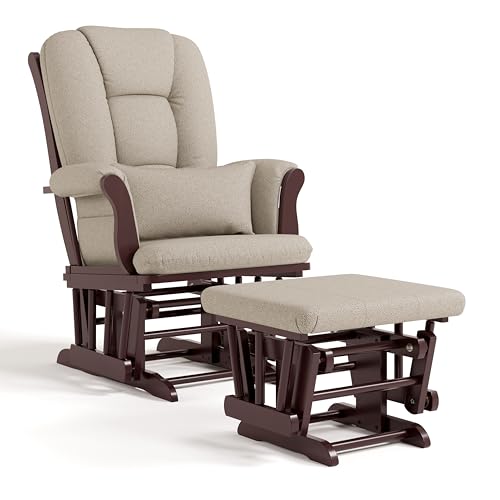
Storkcraft Tuscany Glider & Ottoman with Lumbar Pillow — Best Overall for Backs
The Tuscany pairs a glider chair with a matching ottoman on a solid wood base, and its listing includes the detail that wins it this roundup: a bonus lumbar cushion. For a back-focused buyer, that included pillow is not a garnish — it is the one accessory that lets you tune lower-back support to your own spine, and it arrives in the box.
Strengths
- Lumbar pillow included — adjustable lower-back support you can position exactly
- Ottoman raises the feet, so the glide happens with the whole body supported
- Smooth glider motion on a solid wood base, with storage-friendly design from an established nursery-and-living-room line
Trade-offs
- Glider-plus-ottoman takes more floor space than a single chair
- Espresso/taupe swirl colourway in the verified listing will not suit every room
- GREENGUARD Gold certification on sibling Storkcraft gliders is not claimed for this listing here — the verified Tuscany title does not state it, so we do not either
| Included | Matching ottoman and lumbar pillow |
| Base | Solid wood base, per listing |
| Motion | Glider (smooth motion, per listing) |
| Colour verified | Espresso / Taupe Swirl |
| Capacity | Not stated in listing title |
The glider mechanism deserves its reputation among back-sensitive sitters: the motion is a flat, horizontal glide rather than an arc, so your back is not repeatedly flexed as you move — you drift. Add the ottoman and your feet come off the floor, which lets the lower back settle instead of anchoring your posture through your heels. Then the lumbar pillow does the fine work, filling the gap between chair back and spine that a fixed curve can never match for every body. Position it, glide gently, and adjust over the first week as you learn where your back wants support. It is the most considered answer to this search in the verified shortlist, and the least gimmicky: no motors, no modes, just geometry and a cushion.
Best for: daily gentle motion with tunable lumbar support / Not suited for: small rooms that cannot spare ottoman space

High-Back Nursery Rocking Chair — Sherpa, 250 lb Capacity — Best Upright Support
This high-back rocker is the upright option: an ergonomic high back with curved armrests, sherpa fabric, a removable pillow and a side pocket, with a stated 250 lb capacity. A fairness note: this listing’s title was truncated in the API response we verified from, so we describe only the features visible in that title and flag the rest as not stated rather than completing the seller’s sentence for them.
Strengths
- High back supports the shoulders and head — rare among classic rockers
- Stated 250 lb capacity gives an honest sizing anchor
- Removable pillow lets you add support where your back wants it
Trade-offs
- Listing title was truncated in verification — full dimensions must be confirmed on the listing itself
- Upright rockers do not recline; feet stay on the floor unless you add your own ottoman
- Sherpa fabric is warm and textured — a feel you should want, not merely accept
| Stated capacity | 250 lb |
| Back | Ergonomic high back, curved armrests — per visible title |
| Fabric | Sherpa |
| Included | Removable pillow, side pocket |
| Full title | Truncated in API search response — see Sources |
Not every sore back wants to recline. For readers, knitters and anyone who rocks a grandchild, an upright chair with a genuinely high back keeps the spine stacked and the shoulders supported, and the rocking motion does the loosening. The curved armrests matter more than they photograph: they give your arms a rest at a height that lets the shoulders drop, and shoulder tension is half of what many people call upper-back ache. Treat the truncated listing as a prompt to do five minutes of homework on the full product page — dimensions especially — before ordering. What is visible is promising and honestly reported; what is not visible, we decline to invent.
Best for: upright sitters who read, knit or rock children and want head support / Not suited for: buyers who need recline or a footrest in the same chair

CANMOV Swivel Rocker Recliner Chair — Best Rock + Recline
The CANMOV combines the motions: a swivel rocker recliner that also glides, with a manual recline, in white upholstery. For the sitter whose back stiffens in any fixed position, a chair that lets you rock, glide, swivel and recline is a chair that lets you keep changing the question your spine is answering.
Strengths
- Rock, glide, swivel and recline in a single chair — maximum position variety
- Manual recline means no motor to fail and no cord to place
- Upholstered living-room styling rather than medical-looking equipment
Trade-offs
- White upholstery is a brave choice around pets, children and coffee
- Capacity and dimensions are not stated in the verified title — confirm on the listing
- A multi-motion base is heavier to move for cleaning than a simple rocker
| Motion | Swivel, rocker, glider — per listing |
| Recline | Manual |
| Colour verified | White |
| Capacity | Not stated in listing title |
| Style | Upholstered recliner chair |
Position variety is a legitimate comfort strategy: movement distributes load across tissues instead of concentrating it, which is why restless sitters are often wiser than still ones. The CANMOV industrialises that instinct — when the rock stops helping, glide; when gliding palls, recline and raise your feet. The manual mechanism keeps the price tier and the failure modes simple. The white upholstery is the honest asterisk: it is beautiful in a calm room and a liability in a busy one, so buy it for the household you have. As with several picks here, confirm dimensions and capacity on the full listing; the verified title sells the motion story and leaves the numbers to the product page.
Best for: restless sitters who need constant position change / Not suited for: busy households where white upholstery will not survive the month

Korser Glider Rocking Recliner — Chenille, Beige — Best Soft Upholstery
Korser’s chenille rocker recliner combines swivel, glide, rock and recline in a beige chenille chair with modern-designed armrests, positioned for living rooms and smaller spaces. Chenille is the soft-touch upholstery of the group — a consideration for sitters whose skin or sensory preference makes leather and sherpa non-starters.
Strengths
- Four-way motion (swivel, glide, rock, recline) in a compact-footprint chair
- Chenille upholstery is soft against skin and quiet in a room
- Beige colourway is the most forgiving neutral here
Trade-offs
- Capacity is not stated in the verified listing title
- Soft upholstery shows wear paths sooner than tight weaves
- Small-space sizing means larger bodies should verify seat width on the listing
| Motion | Swivel glider rocking recliner — per listing |
| Upholstery | Chenille, beige |
| Armrests | Modern-designed, per listing |
| Capacity | Not stated in listing title |
| Positioning | Living room, small spaces |
This Korser and the CANMOV chase the same sitter with different manners: where the CANMOV is crisp and white, the Korser is soft and beige, and for a chair you will sink into daily, upholstery feel is a real specification. Chenille’s pile is kind to forearms during long reads and does not go cold in winter the way leather-effect fabrics do. The small-space positioning cuts both ways — it fits the apartment, and it obliges a larger sitter to check the seat width on the full listing before committing. Do that check, and this is the gentlest all-motion chair in the roundup.
Best for: smaller living rooms and sitters who prioritise soft upholstery / Not suited for: larger bodies until the listing’s seat width is confirmed

Korser 360° Swivel Rocker Recliner with Massage and Heat — Best Comfort Extras
The second Korser is a different chair, not a variant: a 360-degree swivel rocker recliner in dark gray fabric with a cup holder, a manual recline, and massage and heating functions per its listing. We include it for buyers who want those comfort extras, and we describe them exactly as that — comfort features, not therapy.
Strengths
- Widest motion set here: 360-degree swivel, rock, glide and recline
- Heat and massage functions for buyers who enjoy them as comfort features
- Cup holder and dark gray fabric suit real living rooms
Trade-offs
- Powered extras add cost, weight and eventual failure modes a manual chair avoids
- Massage and heat are comfort features — do not buy this chair expecting treatment for a back condition
- Fabric colour and functions are per the verified listing; capacity is not stated in the title
| Motion | 360° swivel rocker recliner, manual recline |
| Extras | Massage and heating functions, per listing |
| Included | Cup holder |
| Colour verified | Dark Gray, fabric |
| Capacity | Not stated in listing title |
Heat on a stiff back at the end of a workday feels wonderful, and a gentle massage function is a pleasant way to unwind — full stop, that is the honest case for this chair, and it is enough. What this article will not do is upgrade those pleasures into promises: if your back pain is persistent, worsening, or accompanied by leg symptoms, the correct purchase is a medical appointment, and this chair can be the comfortable place you sit while you wait for it. Judged as furniture, it is the most complete motion chair here, in the most practical colour, from the same Korser line as the chenille pick — two genuinely different chairs that happen to share a brand, which is why both appear.
Best for: buyers who want motion plus heat and massage as comfort extras / Not suited for: anyone shopping for treatment, or minimalists who dislike powered furniture

Amazon Basics Outdoor Portable Folding Rocking Chair — Best for the Porch
The Amazon Basics outdoor rocker takes the category outside: a portable folding rocking chair with an ergonomic design and a headrest, in weather-resistant textilene fabric, in blue. Not every back wants an upholstered recliner — some want twenty minutes of rocking on the porch with the evening air, and this is the chair built for exactly that.
Strengths
- Ergonomic design and headrest stated in the listing — support in a camp-chair format
- Folds and carries, so the rocking goes where the view is
- Weather-resistant textilene shrugs off dew and dries fast
Trade-offs
- Outdoor rockers need flat, firm ground — on soft grass the rock becomes a wobble
- No recline, ottoman or upholstery; this is the lightest-duty comfort here
- Capacity is not stated in the verified listing title
| Style | Portable folding rocking chair |
| Fabric | Textilene, weather-resistant — per listing |
| Included | Headrest |
| Colour verified | Blue |
| Capacity | Not stated in listing title |
There is a real argument that the best rocking chair for a bad back is the one placed where you will actually use it daily, and for many households that place is the porch, not the living room. The Amazon Basics chair earns its slot by making the rock portable and the posture considered: an ergonomic frame and a headrest in a category — folding camp rockers — that usually offers neither. Its limits are the format’s limits: it wants a deck or patio slab under it, it offers no recline, and its comfort is measured in pleasant half-hours rather than evening-long sessions. Within that honest brief, it is a well-judged chair at a house-brand tier.
Best for: porch, deck and campsite rocking in short daily sessions / Not suited for: indoor all-evening use or soft-ground camping
Comparison Table
| Pick | Badge | Key spec | Best for |
|---|---|---|---|
| Storkcraft Tuscany Glider & Ottoman with Lumbar Pillow | Best Overall for Backs | Glider + ottoman + lumbar pillow included | daily gentle motion with tunable lumbar support |
| High-Back Nursery Rocking Chair — Sherpa, 250 lb Capacity | Best Upright Support | High back, 250 lb stated capacity, sherpa | upright sitters who read, knit or rock children and want head support |
| CANMOV Swivel Rocker Recliner Chair | Best Rock + Recline | Swivel rocker recliner with glide, manual | restless sitters who need constant position change |
| Korser Glider Rocking Recliner — Chenille, Beige | Best Soft Upholstery | Chenille swivel rocker recliner, beige | smaller living rooms and sitters who prioritise soft upholstery |
| Korser 360° Swivel Rocker Recliner with Massage and Heat | Best Comfort Extras | 360° swivel rocker, massage + heat (comfort features) | buyers who want motion plus heat and massage as comfort extras |
| Amazon Basics Outdoor Portable Folding Rocking Chair | Best for the Porch | Folding outdoor rocker, ergonomic, headrest | porch, deck and campsite rocking in short daily sessions |
Ergonomics for a Sensitive Back: What Actually Helps
Strip away the marketing and three chair properties consistently matter to people with aching backs. The first is movement. A spine held in one posture loads the same tissues continuously; gentle rocking or gliding varies that load minute by minute, which is the entire mechanical case for this category — and it is a comfort case, not a cure. The second is support geometry: a backrest tall enough to reach the shoulders, a seat that lets feet rest flat (or an ottoman that takes them entirely), and lumbar contact that fills the small of the back rather than leaving it hanging. The Tuscany’s included lumbar pillow is the only pick that ships that third element in the box.
The third property is the one showrooms hide: getting up. A deep, soft chair that rocks beautifully can still be the wrong chair if standing from it requires a lurch that your back punishes. Seat height near your knee height, firm armrests you can push through, and a base that does not glide away as you rise — rehearse the exit before you commit, in the shop or during the return window at home. A chair you dread leaving will not be used, however kind its rock.
And the boundary, stated plainly once more: chairs manage comfort, clinicians manage backs. Pain that persists beyond a few weeks, pain that travels into a leg, numbness, weakness, or pain after an injury all belong in a medical conversation. The best outcome of this guide is that you sit more comfortably while life — and, where needed, proper care — does the healing.
Glider vs Rocker vs Rocker-Recliner: Choosing Your Motion
A traditional rocker moves in an arc on curved rails: simple, durable, and happiest on hard floors, where the rails can travel. The arc means your body angle changes through the stroke — pleasant for most, occasionally unsettling for sitters who dislike the tipping sensation. The high-back rocker and the Amazon Basics outdoor chair carry this motion, with the outdoor chair adding portability and the indoor one adding upholstery and a pillow.
A glider moves flat, on a mechanism, travelling horizontally without the arc. The posture stays constant while the position changes, which many back-sensitive sitters prefer, and the chair needs no floor clearance for rails — but it does need space behind it, and its mechanism wants the chair kept indoors and dry. The Tuscany is the pure glider here, ottoman included.
The rocker-recliner — CANMOV and both Korsers — stacks motions: rock or glide for movement, recline for rest, swivel for orientation. It is the most versatile and the most complex: more mechanism, more weight, more to verify in dimensions before it comes through your door. Choose it when one chair must serve reading, television, napping and conversation. Choose the simpler motions when you know exactly which single job the chair will do — simplicity in furniture is a feature that compounds over years.
Setting Up the Chair: Height, Pillows and Daily Habits
However good the chair, its setup decides its comfort. Start with feet: in a rocker or glider without an ottoman, your feet should rest flat with knees near a right angle; a chair too low makes standing an effort, and one too high leaves legs dangling and pressure under the thighs. The ottoman picks — the Tuscany above all — sidestep the question by supporting the calves, which is why they suit longer sessions.
Pillows are tuning, not decoration. A lumbar cushion belongs at the belt line, filling the curve — not up between the shoulder blades, where it pushes the whole spine forward. The Tuscany includes one; the high-back rocker’s removable pillow can serve the same role. Give each position three days before judging it: backs adapt slowly, and the first evening’s verdict is the least reliable one. Small changes — an inch of pillow height — produce outsized differences, so adjust in inches, not in chairs.
Finally, use the motion. Ten unhurried minutes of rocking after a day of sitting is the habit these chairs exist to support; a rocker used as a static chair is just a chair with extra parts. Stand up regularly anyway — no chair, however kind, replaces moving around — and treat the rocker as the pleasant base camp between movements rather than a destination for the whole evening.
Rocking Chairs Around the House: Reading, Television, Grandchildren and Work
For reading, the winning formula is upright support plus a place for the feet: the high-back rocker for the spine-stacked reader, the Tuscany with its ottoman for the reader who stays for chapters. What reading punishes is a deep, soft recline — the book sinks, the arms tire, the neck cranes. Readers should weight the picks with backs and armrests, and treat the recline-first chairs as television furniture that can read, rather than reading furniture that can recline.
For television and film, the equation inverts: recline, swivel toward the screen, and a cup holder stop being extras and become the spec. The two Korser rocker-recliners and the CANMOV own this use, and the dark gray Korser’s heat is the one that will be switched on during every winter film night. Grandchildren rewrite the brief again — a glider’s smooth, finger-safe motion and a chair an adult can rise from while holding a baby outrank every other feature, which is why the nursery-bred Tuscany and the high-back rocker, both born in that world, read so well for grandparents.
For work — the laptop hour that now happens in every living room — honesty requires a warning: no rocking chair in this roundup is a desk chair, and an evening of email in a recliner is a posture compromise your back will invoice. Use the rocker for the reading and the calls, keep a proper chair for the keyboard hours, and let each do the job it was built for. Furniture chosen per task outlasts furniture asked to multitask, in comfort as in everything else.
What Rocking Chairs Cost to Own: Mechanism Care, Upholstery and Resale of Your Patience
A glider or recliner mechanism is the only part of these chairs that can truly wear out, and its enemies are grit, moisture and being moved by its arms. Vacuum around the base monthly, keep the chair indoors and dry, and lift it by its base — never by the armrests — when it has to move. A mechanism treated that way should outlast the upholstery around it; a mechanism dragged across a patio and left in the rain will notch and knock within a few seasons, and no warranty conversation will call that a defect.
Upholstery is the visible clock. Chenille and sherpa — the Korser chenille and the high-back rocker — feel wonderful and show their traffic honestly, rewarding owners who vacuum with an upholstery tool and rotate the chair’s position relative to sunlight. The CANMOV’s white is the bravest choice here and the least forgiving; the Korser dark gray is the pragmatist’s. Buy the colour your household’s actual life — dogs, grandchildren, coffee — can keep, because a chair you are anxious about is a chair you will not relax in, and relaxation was the entire purchase.
Finally, budget your patience as part of the price. Large chairs arrive boxed, heavy and occasionally in need of the return window this guide keeps recommending. That friction is normal for furniture of this size and is priced into buying online; the households that end up happy are the ones that planned the audition week — doorway measured, space cleared, verdict date chosen — before the box arrived, rather than improvising around a 40-kilogram surprise.
A Note on Evidence: Why This Guide Trusts Geometry Over Testimonials
Chair comfort is the most testimonial-driven category in furniture: every listing blooms with owners declaring their backs saved, and every one of those declarations may be sincere — for a spine that is not yours. This guide has deliberately built its rankings on the transferable evidence instead: the motions a chair offers, the support elements its listing states, the accessories in its box, the dimensions and capacities a buyer can verify. A lumbar pillow included in the Tuscany’s listing will be in your box too; a stranger’s miraculous recovery says nothing about your Tuesday.
That discipline cuts both ways, and it is worth being transparent about the cost: it cannot tell you which chair your back will love. No honest guide can. What it can do — what this one has tried to do — is narrow the field to chairs whose designs contain the elements sensitive backs generally need, flag every place where a listing’s evidence runs out, and hand you a first-week testing protocol that converts the remaining uncertainty into a decision you make on your own spine, inside a return window, rather than on a stranger’s enthusiasm.
Hold every future chair purchase to the same standard and the category becomes navigable: What motions? What support, stated where? What is in the box? What are the numbers, and who published them? A seller who answers those questions plainly — as the better listings behind this roundup do — is a seller whose chair deserves your audition. A seller who answers with adjectives is selling the adjectives. Your back can tell the difference within a week; this guide’s job was to make sure the week is not wasted on chairs that never contained the elements at all.
Rocking Chairs and Sleep: The Evening Wind-Down, Considered Carefully
A gentle rock in the last hour before bed is one of the oldest sleep rituals there is, and the chairs in this roundup serve it in ascending order of commitment: the Amazon Basics on the porch for the final daylight, the high-back rocker for the last chapter, the gliders and recliners for the full evening descent from upright to horizontal. What the ritual asks of a chair is smoothness and quiet — a mechanism that knocks or a rock that catches will wake a drowsy sitter more effectively than it soothes them — which is why this guide’s first-week protocol includes listening to the chair as carefully as sitting in it.
Keep the claim honest, as this article has kept all of them: a rocking chair is a pleasant ritual object, not a sleep treatment, and a household with real insomnia has medical doors to knock on that furniture cannot open. But rituals are not nothing. A chair that is always in the same place, with the same motion and the same lumbar pillow waiting, becomes a signal the body learns — the day’s last posture, deliberately chosen. For a sore back especially, ending the day in supported motion rather than collapsed on a sofa is a small, repeatable kindness, and small repeatable kindnesses are most of what comfort furniture, at its best, actually provides.
How to Test and Adjust a Rocking Chair in Its First Week
Furniture this size should be auditioned, not assumed. Use the return window deliberately with this sequence, and any pick in this roundup will reveal whether it suits your back before the decision is final.
- Day one: sit for twenty minutes, then stand. Judge the exit as hard as the sit — push through the armrests, note any lurch or base movement, and repeat twice. A chair that fails the exit fails the week.
- Set the lumbar support at belt height. On the Tuscany, position the included pillow at the small of your back; on the high-back rocker, place its removable pillow the same way. Sit, rock gently, and adjust by an inch at a time.
- Test the full motion range. Rock or glide through the chair’s whole travel, then recline if it offers it. Listen for knocks, feel for catches — mechanisms should be silent and smooth from day one, not ‘wearing in’.
- Check the clearances in place. Gliders need space behind; recliners need it in front. Rock fully with the chair in its final position and confirm nothing strikes a wall or table.
- Run a real evening. Read, watch a programme, get up for a drink twice. Note where you fidget — fidgeting is data about pressure points, and it points at the pillow adjustment or the chair verdict.
- Decide by day seven, in writing if needed. Comfort that is ‘almost right’ on day seven is the chair telling you its geometry is not yours. Use the return window without guilt; that is what it is for.
Once a chair passes its audition, keep it passing: gliders and recliner mechanisms appreciate a dust-free life, and a soft brush around the base monthly prevents the grit that makes mechanisms notch. Upholstery care follows each listing’s guidance — and when in doubt, vacuum with an upholstery tool rather than experimenting with solvents on chenille or sherpa.
Revisit the lumbar position seasonally. Bodies change — fitness, weight, a new mattress, a healed injury — and the pillow position that was perfect in January may be an inch off by June. The chairs in this roundup that let you adjust, rather than merely sit, are the ones that keep earning their floor space.
Keep the audition honest by inviting the chair’s real life into the test week: the grandchild’s visit, the long film, the hour of reading after a working day. A chair tested only in calm ten-minute sits has been tested for a life nobody lives. If it passes your actual evenings — including the standing-up at the end of them — it has passed the only examination that matters, and the return window can close with confidence.
Common Buying Mistakes
- Shopping for treatment. A rocking chair can be genuinely more comfortable for a sore back; it cannot diagnose or fix one. Persistent or radiating pain belongs to a clinician.
- Ignoring the exit. Deep, low chairs punish the standing-up moment. Test it twice before the return window closes.
- Buying motion you do not need. A four-motion recliner for a dedicated reading corner is cost, weight and mechanism without benefit. Match the motion to the job.
- Trusting a truncated or number-free listing. Where capacity and dimensions are not stated — flagged in several spec boxes here — confirm them on the full listing before a large chair ships to your door.
- Placing a glider against a wall. Gliders travel backwards. Leave the clearance the mechanism needs or every rock ends in a knock.
- Judging on the first sit. Backs adapt over days. A week of honest testing beats a showroom minute every time.
Final Recommendation
Start with the Storkcraft Tuscany if your back wants one considered answer: a smooth glide, an ottoman to unload your legs, and the roundup’s only included lumbar pillow to tune the support. Choose the high-back rocker for upright hours, the CANMOV or chenille Korser for constant position change, the dark gray Korser if heat and massage are comforts you genuinely enjoy, and the Amazon Basics when the porch is where your back relaxes best.
Buy with the return window as part of the plan, test the exit as hard as the sit, and keep the medical boundary bright: comfort here, care from clinicians. A rocking chair chosen that way is not a compromise purchase — for a great many sore backs, it is the seat in the house that gets chosen first. Related chair reading from the same programme follows.
Best Reviewed Zero Gravity Chairs Best Chairs For Back And Neck Best Chairs For Bad Knees
Frequently Asked Questions
Can a rocking chair actually help a bad back?
It can be more comfortable, through gentle motion that varies the load on your back instead of fixing it in one posture, plus support geometry — high backs, ottomans, lumbar pillows like the one included with the Storkcraft Tuscany. It cannot treat a back condition, and this guide claims nothing more than comfort.
Glider or traditional rocker — which is gentler?
Many back-sensitive sitters prefer the glider’s flat, horizontal motion because the body’s angle stays constant, while a rocker’s arc changes the angle through each stroke. It is a preference, not a rule — the first-week test in this guide is how to find yours inside a return window.
What should I check before a large chair is delivered?
Dimensions against your doorway and room, the clearance the motion needs (behind a glider, in front of a recliner), and — where the listing title does not state them, as flagged in several spec boxes here — the capacity and seat width on the full listing.
Are massage and heat features worth it?
As comfort features, for buyers who enjoy them — the dark gray Korser in this roundup offers both. Buy them for pleasure, never as treatment; persistent or radiating back pain needs a clinician, and no function on a chair changes that.
How do I know if a chair is the wrong height?
Your feet should rest flat with knees near a right angle, or rest fully on an ottoman, and standing up should not require a lurch. If the exit hurts, the chair is wrong for you however pleasant the sit — test the exit twice during the first week.
Where should a lumbar pillow sit?
At belt height, filling the small of your back — not between the shoulder blades, where it pushes the whole spine forward. Adjust in inches and give each position a few days; small changes have outsized effects.
Best Chairs Chronic Pain Best Chairs For Good Posture Inexpensive Best Chairs For Book Reading


