Disclosure: airfryerkitchensupply.com is reader-supported. When you buy through links on our site, we may earn an affiliate commission at no extra cost to you.
Where to buy
Every pick below for the best reviewed non convection toaster ovens is a verified, live Amazon listing matched to the exact model described, and every one is a genuine non-convection oven — no fan, no air fry mode — checked from its own listing’s function list. Models in this category are sold in several colors and regional variants, so confirm the model number on the listing before ordering. Prices move frequently, so each pick links to the live listing instead of quoting a figure.
- Panasonic FlashXpress Toaster Oven (NB-G110P) — the infrared legend — double infrared heating that toasts almost instantly with no preheat, in a compact 4-slice footprint.
- Cuisinart Custom Classic Toaster Oven (TOB-40NNAS) — the traditional countertop oven done right — a 0.5-cubic-foot interior, brushed stainless finish, and Cuisinart’s shade-control toasting.
- Hamilton Beach Easy Reach 4-Slice Toaster Oven (31123) — the roll-top door oven — the door rolls up over the top instead of dropping down, so food is easy to reach and the crumb tray slides out the front.
- Breville Mini Smart Oven (BOV450XL) — the premium compact — Breville’s Element IQ system directing heat between elements, in a brushed stainless 4-slice mini oven.
- BLACK+DECKER 4-Slice Toaster Oven (TO1745SSG) — the honest budget oven — Even Toast technology, four functions including keep warm, and a removable crumb tray at an entry-level tier.
- Proctor Silex 4-Slice Countertop Toaster Oven (31260G) — the minimalist oven — bake, broil, and toast with a 30-minute timer and auto shutoff, in a compact black and silver box.
The shoppers hunting for the best reviewed non convection toaster ovens are usually fleeing something: a convection fan that dries out their toast, an air fryer oven that cooks too aggressively for delicate baking, or simply the noise and complexity modern countertop ovens have accumulated. A non-convection toaster oven is the original formula — heating elements above and below, a thermostat, a timer — and for toast, reheating, broiling, and small-batch baking it remains quietly excellent. One honesty note before the picks: this guide describes these ovens’ reputations and designs in qualitative terms only, because review scores and rating counts change daily and printing them would mislead you within a month.
Why choose still air on purpose? Convection fans cook faster and brown more aggressively, which is wonderful for roast vegetables and terrible for some jobs: delicate pastries and cakes can lean and crust too early, cheese can fly off a pizza slice in the fan’s breeze (a real and comic failure), and toast — the job these ovens do most — needs radiant heat, not moving air, to brown evenly without drying the crumb. Non-convection ovens are also simpler: fewer parts, no fan to fail or to whine, and controls a guest can operate without a manual. They are typically the most affordable countertop ovens worth owning.
The six verified picks below are all true non-convection models — confirmed from their own listings’ function lists, which offer bake, broil, toast, and warm with no fan in sight. They range from Panasonic’s infrared cult favorite to a classic Cuisinart, a roll-top Hamilton Beach, and two honest budget ovens. If your cooking is toast-first with reheating and small baking behind it, this category — not the air fryer aisle — is where your oven lives.
In this guide
Quick Picks
Six verified fan-free ovens. All toast, bake, broil, and warm with elements only — no convection, no air fry, no fan noise.
- Best Overall: Panasonic FlashXpress Toaster Oven (NB-G110P) — the fastest toast in the category and a devoted long-term following — the fan-free oven enthusiasts name first.
- Best Classic Design: Cuisinart Custom Classic Toaster Oven (TOB-40NNAS) — the full-size-feeling classic — bigger interior, handsome finish, and even-shade toast control.
- Best Easy Access: Hamilton Beach Easy Reach 4-Slice Toaster Oven (31123) — the ergonomic pick — no reaching over a hot drop-down door, and the easiest crumb cleanup in the roundup.
- Best Premium Compact: Breville Mini Smart Oven (BOV450XL) — the smartest still-air oven here — Element IQ manages the elements so a compact oven cooks like a bigger one.
- Best Budget: BLACK+DECKER 4-Slice Toaster Oven (TO1745SSG) — the value standard — everything a toaster oven must do, nothing it needn’t, at the friendliest tier here.
- Best Simple and Compact: Proctor Silex 4-Slice Countertop Toaster Oven (31260G) — for buyers who want three functions, two dials, and no learning curve whatsoever.
How These Picks Were Chosen
Verification for this guide had two layers. First, every model was matched against Amazon’s live catalog by brand and model number, with the ASIN recorded only on a certain title match. Second — and specific to this search — each pick’s own listing was checked for its function list: the ovens below list bake, broil, toast, and warm functions with no convection or air fry mode, which is what makes them genuinely non-convection rather than convection ovens with the fan switched off in marketing copy. Several popular models were excluded precisely because their listings revealed a fan.
On the word ‘reviewed’: this guide treats it as buyers mean it — ovens with long market histories and established owner reputations — expressed qualitatively. We do not print star ratings or review counts anywhere in this article, because those figures change constantly and a printed number would be wrong soon after publication. Instead, picks earned their places through longevity in the market, design soundness, and the consistency of their reputations over years of sale. Catalog prices were likewise used only for internal tier placement, never printed.
The practical bars were toast quality first — even browning across slices is the daily job — then temperature honesty, crumb tray access, and interior size relative to footprint. A toaster oven lives on the counter and works every day; the picks below are the fan-free models that owners keep rather than replace.
The exclusion list for this guide was unusually active, and it is worth a paragraph. Several of the most visible countertop ovens on the market — including popular air fry toaster ovens from major brands that appear in our own catalog research — were checked and removed because their listings include convection or air fry functions. That is not a criticism of those machines; it is the definition of this search. A buyer who searches for a non-convection oven has usually made a considered decision about fans, noise, and gentle heat, and a guide that quietly includes fan ovens ‘with the fan off’ would betray that decision. Every oven above is fan-free by design and by listing, verified model by model — which is why the list is six ovens long rather than twelve.
The 6 Best Reviewed Non Convection Toaster Ovens
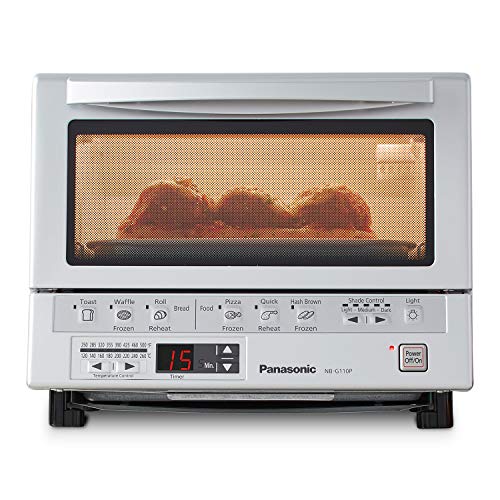
Panasonic FlashXpress Toaster Oven (NB-G110P) — Best Overall
The FlashXpress is the non-convection oven with a genuine cult, and the reason is physics. Instead of conventional heating elements that warm up slowly and cycle, Panasonic’s double infrared system uses near and far infrared emitters that reach cooking temperature almost the moment you close the door. Toast that takes four minutes elsewhere is done in a fraction of the time, frozen waffles and reheats skip the preheat entirely, and the browning — the thing this category lives or dies by — is remarkably even from center to edge.
Six auto cook options cover the standard repertoire and the precise temperature control handles small baking jobs well: a couple of salmon fillets, a small tray of cookies, a gratin for two. The compact 4-slice footprint is the point for many buyers — this is the oven for small kitchens, offices, dorms, and second ovens, and its fit and finish have the engineered feel that explains why owners replace a worn one with the same model rather than shopping around.
The limits are size and intensity. The interior is honestly compact — a 9-inch pizza is the ceiling, not a 12-inch — and infrared heat is fierce near the elements, so delicate items placed too close can over-brown before their centers cook; the middle rack position is your friend. It is also the priciest oven in this roundup relative to its size. You are paying for the heating system and the build, and for toast-led households, that trade has kept this model beloved for years.
Strengths
- Infrared elements reach temperature almost instantly — no preheating ritual
- Toast browning is famously even, the benchmark for the whole category
- Compact footprint with a build quality owners keep for years
Trade-offs
- 4-slice interior is compact — this is not a 12-inch pizza oven
- Infrared heat is intense near the elements; delicate items need watching
- Premium pricing within the non-convection class
| Heating | Double infrared heating elements |
| Capacity | 4-slice |
| Programs | 6 auto cook options |
| Controls | Precise temperature control |
Best for: toast-first households, small kitchens, and anyone who hates preheating / Not suited for: families needing 6-slice or 12-inch pizza capacity
Check the current price on Amazon

Cuisinart Custom Classic Toaster Oven (TOB-40NNAS) — Best Classic Design
The Custom Classic is what a toaster oven looked like before the category went to air fryer school, executed by a company that knows the format deeply. The 0.5-cubic-foot interior is the largest among the classic-format picks here — room for a proper small casserole, a 11-inch pizza class load, or six slices with breathing room — wrapped in brushed stainless and black that sits handsomely on a counter instead of apologizing for being there.
Cuisinart’s contribution to the format is its shade control system, designed to deliver the same toast color on the same setting across consecutive batches — the quiet frustration of lesser ovens, whose second round always browns darker than the first because the elements are already hot. Bake and broil functions behave with the predictability of a small conventional oven, because that is exactly what this is: elements, thermostat, timer, no fan theatrics.
Expect dials, not displays. There are no presets, no digital countdown, and no smart features, which buyers in this category generally count as virtues. The size that makes it capable also makes it the largest footprint among the traditional picks, so apartment counters should measure. For households that want the classic oven experience at the highest level of fit and finish — and toast that comes out the same color twice in a row — this is the pick.
Strengths
- 0.5 cu ft interior is the roomiest classic-format oven here
- Always Even shade control targets consistent toast color slice after slice
- Brushed stainless build looks and feels a tier above budget ovens
Trade-offs
- Dial-era controls — no digital display or presets
- Footprint is full-size; small counters should measure first
- No convection is the point, but speed seekers will notice on roasts
| Interior | 0.5 cubic feet |
| Finish | Brushed stainless and black |
| Toasting | Always Even shade control |
| Functions | Toast, bake, broil |
Best for: households wanting a roomy, handsome, traditional oven / Not suited for: tiny counters or buyers who want digital presets
Check the current price on Amazon

Hamilton Beach Easy Reach 4-Slice Toaster Oven (31123) — Best Easy Access
The Easy Reach solves the toaster oven’s two oldest ergonomic sins. First, the door: instead of dropping down toward you — forcing a reach over hot metal with a tray of food — it rolls up and back over the top of the oven, leaving the opening completely clear. Food goes in and out at counter level, and for shorter cooks, older cooks, and anyone who has ever brushed a wrist on a hot door, the difference is immediate and permanent. Second, the crumb tray: it slides out from the front, because the door is not in the way, turning a chore most owners skip into a five-second habit.
As an oven it is a sound, conventional performer: bake, broil, and toast across a 200 to 450°F range, with auto shutoff for peace of mind. Toast is even, reheats are straightforward, and small baking jobs behave as still-air baking should. The door also removes for cleaning, a feature that sounds minor until the first time you wipe down an interior without fighting a sprung door — then it sounds like the reason you bought it.
Capacity is the honest limit: four slices, a personal pizza, a small side dish. Families will outgrow it, and its styling is functional rather than decorative. But for the enormous number of households whose oven serves one or two people daily, the Easy Reach is the most thoughtfully designed object in this roundup — proof that in a mature category, the remaining progress is ergonomic.
Strengths
- Roll-top door removes the reach-over-a-hot-door problem entirely
- Front-access crumb tray makes the worst cleanup job in the category trivial
- Door lifts off for proper interior cleaning — rare at any price
Trade-offs
- 4-slice capacity — compact households only
- Roll-top mechanism takes a use or two to become habit
- Utilitarian styling next to the Cuisinart and Breville
| Door | Roll-top door for easy access |
| Temperature | 200 to 450°F adjustable |
| Functions | Bake, broil, toast |
| Safety | Auto shutoff |
Best for: one- and two-person households, and anyone who values easy access and cleanup / Not suited for: families or 12-inch pizza households
Check the current price on Amazon
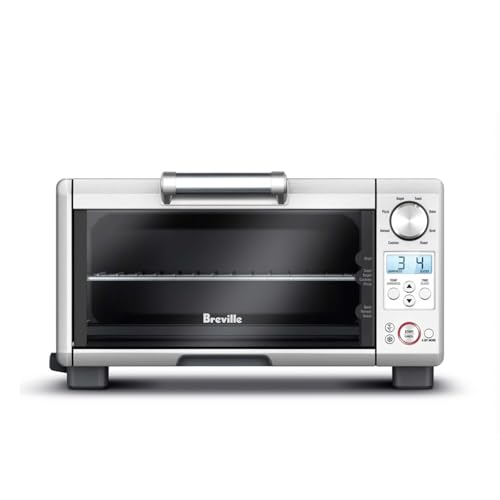
Breville Mini Smart Oven (BOV450XL) — Best Premium Compact
The Mini Smart Oven is the pick for buyers who want a non-convection oven but not a primitive one. Breville’s Element IQ system is the intelligence: instead of running all elements at full tilt, it directs wattage between the upper and lower elements according to the function chosen — more top heat for broiling, balanced heat for baking, the right profile for toast, pizza, and cookies. The result is a compact oven that behaves with unusual evenness, the still-air equivalent of good manners.
Everything tactile is a step above the rest of this roundup: the dials turn with weight, the door closes with a damped certainty, the brushed stainless body feels milled rather than folded. For a small kitchen, a design-conscious counter, or a second oven beside a range that is too big to heat for two cookies, the Mini Smart Oven delivers full-oven competence in a genuinely compact box, with presets for the jobs — pizza and cookies among them — that small ovens actually get used for.
The price is the discussion. This is premium money for a 4-slice oven, and buyers measuring value in cubic inches will walk away. The value is in the engineering and the ownership experience — even results, pleasant controls, a machine that feels made. If your budget logic is cost-per-slice, take the BLACK+DECKER below. If it is cost-per-year of daily satisfaction, the Breville argues its case every morning at breakfast.
Strengths
- Element IQ shifts power between elements for even, job-appropriate heat
- Breville build and control feel is the best in this roundup
- Compact footprint with big-oven manners — ideal second oven
Trade-offs
- Premium price for a 4-slice oven — you pay for engineering, not size
- Interior is compact; measure pans before assuming they fit
- More technology than the purists in this category strictly want
| Heating | Element IQ element management |
| Capacity | 4-slice |
| Functions from listing | Bake, toast, broil, pizza, cookies |
| Finish | Brushed stainless steel |
Best for: small kitchens wanting premium build and even cooking / Not suited for: budget shoppers or anyone needing 6-slice capacity
Check the current price on Amazon

BLACK+DECKER 4-Slice Toaster Oven (TO1745SSG) — Best Budget
BLACK+DECKER has sold more toaster ovens than almost anyone, and the TO1745SSG shows the discipline that comes from that volume: the essentials done properly, the frills left on the shelf. Its Even Toast technology shapes the heating pattern to brown four slices consistently — the daily job, done right — and the four functions (bake, broil, toast, and a keep-warm setting many budget rivals omit) cover the realistic workload of a countertop oven without a single mode you will never touch.
The removable crumb tray deserves its own sentence, because at the budget tier it is the feature that separates a pleasant appliance from a slowly crusting one, and this oven has it. The timer, the stay-on option for longer bakes, and the compact 4-slice footprint make it a natural for dorms, offices, first apartments, RVs, and as a second oven for sides and reheats — the roles where most countertop ovens actually live their lives.
The savings are visible in the hand: the door and dials feel lighter than the Cuisinart or Breville, and the thermostat’s idea of a temperature is a neighborhood rather than an address, which matters for precise baking and not at all for toast, nuggets, and reheats. Judged against its tier and its jobs, this is the budget oven to beat — the one this guide recommends without a caveat paragraph when money is the main constraint.
Strengths
- Even Toast design spreads heat for consistent browning at a budget tier
- Keep-warm function is genuinely useful and often missing at this price
- Removable crumb tray — the budget feature that matters most daily
Trade-offs
- Fit and finish are built to the price — lighter door, simpler dials
- 4-slice interior limits it to smaller households and side dishes
- Temperature accuracy is approximate compared with the premium picks
| Capacity | 4-slice |
| Functions | Bake, broil, toast, keep warm |
| Toasting | Even Toast technology |
| Cleanup | Removable crumb tray |
Best for: budget buyers, dorms, offices, and second-oven duty / Not suited for: precision bakers or large households
Check the current price on Amazon

Proctor Silex 4-Slice Countertop Toaster Oven (31260G) — Best Simple and Compact
The Proctor Silex 31260G is the toaster oven reduced to its essence, and there is a real market that wants exactly that. Bake, broil, toast. A temperature dial spanning 200 to 450°F, a 30-minute timer that shuts the oven off when it rings. That is the entire interface, and a first-time user — a grandparent, a teenager, a colleague in an office kitchen — will operate it correctly within ten seconds of meeting it. In a category drifting toward touchscreens, this minimalism is a feature with a constituency.
Performance is honest, conventional still-air cooking: toast browns evenly enough for daily satisfaction, frozen snacks and reheats come out as expected, and small baking jobs within the timer’s half-hour horizon behave properly. The automatic shutoff deserves emphasis — the timer is the safety system, so the oven cannot be left baking indefinitely by a distracted cook, a property landlords, dorm managers, and families all appreciate.
Its boundaries are plain. Thirty minutes is the longest bake it will run, so slow-roasting projects are out; the build is light and basic; the 4-slice interior is small-batch only. But not every oven needs to be an heirloom or a workstation. For a break room, a dorm, a rental, a camper, or a minimalist counter, this little oven does the three jobs, safely, at a budget tier — and asks nothing of you in return.
Strengths
- As simple as the category gets — anyone can operate it instantly
- Auto shutoff on the timer removes the classic left-it-on worry
- Compact, light, and easy to store — ideal for tight or temporary kitchens
Trade-offs
- 30-minute timer ceiling rules out long, slow bakes
- Basic build and controls — the minimum viable oven, proudly
- Compact interior is strictly small-batch
| Capacity | 4-slice |
| Functions | Bake, broil, toast |
| Temperature | 200–450°F adjustable |
| Timer | 30-minute timer with automatic shutoff |
Best for: minimalists, dorms, offices, rentals, and first kitchens / Not suited for: long bakes, big batches, or feature seekers
Check the current price on Amazon
Comparison Table
| Pick | Badge | Key spec | Best for |
|---|---|---|---|
| Panasonic FlashXpress Toaster Oven (NB-G110P) | Best Overall | Double infrared heating, 4-slice, 6 auto cook options | toast-first households, small kitchens, and anyone who hates preheating |
| Cuisinart Custom Classic Toaster Oven (TOB-40NNAS) | Best Classic Design | 0.5 cu ft interior, Always Even shade control | households wanting a roomy, handsome, traditional oven |
| Hamilton Beach Easy Reach 4-Slice Toaster Oven (31123) | Best Easy Access | Roll-top door, 200–450°F, auto shutoff | one- and two-person households, and anyone who values easy access and cleanup |
| Breville Mini Smart Oven (BOV450XL) | Best Premium Compact | Element IQ heating, 4-slice compact, brushed stainless | small kitchens wanting premium build and even cooking |
| BLACK+DECKER 4-Slice Toaster Oven (TO1745SSG) | Best Budget | 4-slice, Even Toast, 4 functions, removable crumb tray | budget buyers, dorms, offices, and second-oven duty |
| Proctor Silex 4-Slice Countertop Toaster Oven (31260G) | Best Simple and Compact | 4-slice, 200–450°F, 30-min timer, auto shutoff | minimalists, dorms, offices, rentals, and first kitchens |
How to Choose a Non-Convection Toaster Oven
Start by confirming the oven is truly non-convection, because the modern market defaults to fans. Check the function list on the listing itself: bake, broil, toast, and warm with no convection or air fry mode is the signature of a still-air oven. A convection oven with the fan turned off is not the same product — its elements, cavity, and controls were designed around moving air, and its still-air performance is an afterthought. Every pick in this guide passed that listing check.
Then size the interior to your real loads. Four-slice ovens — most of this roundup — handle toast for two, personal pizzas around 9 inches, and side dishes, in footprints small kitchens can spare. If you regularly cook a 12-inch pizza or a family casserole, you need the larger classic formats like the Cuisinart’s half-cubic-foot interior, and you should measure both the cavity and your pans: an oven that fits the pizza but not your favorite baking dish is a daily irritation. Height matters too — still-air ovens need clearance between the top element and tall food, or the top browns before the center cooks.
Finally, judge the daily details. A removable crumb tray is close to mandatory. A timer with auto shutoff is a genuine safety feature, not a luxury. Toast shade consistency across consecutive batches separates the engineered ovens (the Panasonic and Cuisinart here) from the approximate ones. And consider your tolerance for technology: Element IQ-style management genuinely improves evenness, while two-dial simplicity genuinely improves operability. The best reviewed non convection toaster ovens all share one trait — owners keep them for years because the daily experience has no friction in it.
Non-Convection vs. Convection: When Still Air Wins
Convection’s advantages are real: fans circulate hot air, cooking food faster and browning it more aggressively and evenly at scale. For roast chicken, sheet-pan vegetables, and frozen foods, a good convection or air fry oven is the better tool, and this guide is not going to pretend otherwise. The case for still air is narrower and, for the right jobs, decisive.
Toast is the headline. Bread browns best under radiant heat; moving air dries the crumb while the surface colors, producing toast that is crisp all the way through instead of crisp outside and tender inside. Delicate baking is the second case: cakes, soufflés, and custards can lean, dome unevenly, or crust prematurely in fan-driven heat, while still air lets them rise and set gently. Light toppings are the comic but real third case — shredded cheese and herbs stay on the food in a still oven instead of decorating the cavity. Add silence (no fan), simplicity (no fan to fail), and price (still-air ovens cost less to build well), and the category’s persistence explains itself.
The practical verdict: if your countertop oven’s life is toast, bagels, reheating leftovers, broiling small items, and gentle small-batch baking, non-convection is not a compromise — it is the correct tool, and the ovens in this guide are its best current examples. If your life is roast vegetables, wings, and speed, buy the fan. Many serious kitchens eventually run both: a still-air oven for the morning and a convection machine for dinner, each doing what it does best.
Reading Toaster Oven Reputations Without Star Ratings
This guide deliberately prints no ratings or review counts, so it owes you an account of what it uses instead — because ‘well reviewed’ should mean something more durable than a number that changes by Friday. The first signal is market longevity: a model that remains in production and in demand for many years, like the Panasonic FlashXpress and the Cuisinart Custom Classic here, has survived the only review process that cannot be gamed — thousands of owners deciding whether to recommend, repurchase, or replace. Manufacturers discontinue unloved ovens quickly; the survivors in this roundup have each earned their continued existence across many product cycles in a ruthless category.
The second signal is design coherence: whether the oven’s engineering serves its stated job. The Panasonic’s infrared system exists to make toast fast and even; the Hamilton Beach’s roll-top door exists to make access and cleaning easy; the Breville’s Element IQ exists to make a small oven cook evenly. Models whose features form a coherent answer to a real problem accumulate the consistent owner satisfaction that buyers mean by ‘well reviewed’ — while feature-stuffed models accumulate mixed feelings and early replacements. The third signal is the absence of a known fatal flaw: in this category, the recurring ones are inaccurate thermostats, doors that scorch counters or hands, and crumb systems that make cleaning so unpleasant the oven slowly fouls. Every pick here was chosen partly for not carrying its category’s characteristic sins.
Use the same framework on any model you consider beyond this list. Ask how long it has been sold, what problem its design actually solves, and whether owners’ complaints converge on something structural or scatter across trivia. Then check the live listing for the current numbers yourself, where they are at least current. A reputation read this way survives contact with reality far better than a decimal copied from a page — including this one.
The Small Oven’s Place in the Modern Kitchen
It is worth asking why the humble fan-free toaster oven persists in an era of air fryers, smart ovens, and combi-steam everything — and the answer is the shape of daily cooking. Most oven tasks in most households are small: two slices of toast, a reheated portion, a side dish for two, a small bake while the main course rests. Heating a full-size range oven for those jobs wastes time and energy in quantities that compound daily; heating a toaster oven’s small cavity is proportionate. The non-convection versions add a further virtue the smart machines have engineered away: silence and simplicity at 7 a.m., when nobody wants a fan’s whine or a touchscreen’s opinions with their toast.
There is also a resilience argument. A simple oven with elements, a thermostat, and a timer has almost nothing in it that obsolesces: no firmware, no app, no fan motor, no proprietary ecosystem. The picks in this roundup can plausibly serve a decade or more, and several of their designs already have, in earlier production runs, in ordinary kitchens. In a decade of appliances designed as subscriptions and screens, a machine that simply heats, browns, and dings — and will do so for years — is not a compromise purchase. For a large class of cooks it is the considered one.
None of this argues against owning a convection or air fry oven too, if your cooking wants one; the categories are complements, as this guide’s comparison section sets out. It argues for choosing the oven that matches the majority of your actual oven jobs rather than the minority of your most ambitious ones. For toast-led, reheat-rich, small-batch kitchens — which is to say, most kitchens — the majority tool is the still-air oven, and the six above are its best current forms.
How to Get the Best Results from a Non-Convection Toaster Oven
Still-air ovens reward a few simple techniques, because without a fan, placement and patience do the work the fan would have done. These habits apply to every pick in this roundup.
- Preheat for baking, not for toast. Toast and reheats can start cold — the Panasonic barely needs warming at all — but cakes, cookies, and casseroles want a five-minute preheat so the thermostat settles and the first minutes of baking are honest.
- Use the middle rack position as your default. Still air stratifies: food near the top element browns fast, food near the bottom cooks gently. The middle is the compromise position, and it is where most food belongs most of the time.
- Rotate the tray halfway through longer bakes. Without a fan, the back of the cavity runs hotter than the front in most ovens. One 180-degree turn at the midpoint evens everything out — the oldest trick in oven cooking, and it works here too.
- Watch the last two minutes. Element heat is direct, and the gap between golden and gone is short, especially under the broiler. Stay nearby for broiling cheese, nuts, and anything sugary.
- Give toast a consistent routine. Same rack, same shade setting, bread from the same storage — still-air ovens are consistent machines, and a consistent routine produces the same slice every morning.
- Empty the crumb tray weekly and wipe the interior while it is merely warm. Crumbs near elements are both a flavor problem and a smoke problem, and a clean cavity is the cheapest performance upgrade in this category.
One more habit separates good results from great ones: let the oven’s small size work for you. A toaster oven heats a tiny cavity, so it reaches temperature fast and recovers fast after the door opens — batch small items back to back with confidence, and use it instead of the big range oven for anything that fits. That energy and time saving, repeated daily, is the quiet economic case for the whole category.
A note on placement and care closes the technique section, because still-air ovens are unusually honest about their environment. Give the oven clearance on all sides — these machines radiate heat in every direction, and a toaster oven wedged against a wall or under a low cabinet cooks its surroundings along with the food. Keep the cord clear of the hot back panel, a detail manuals mention and owners forget. And when the interior eventually takes on the patina of a thousand breakfasts, resist the harsh oven cleaners meant for full-size ranges; a warm wipe-down after use, maintained as a habit, keeps a small oven’s interior bright for years with nothing stronger than dish soap and consistency. The oven you wipe weekly never needs rescuing.
Common Buying Mistakes
Buying a convection oven by accident. Most modern countertop ovens have fans whether you want one or not. If still air is the point, verify the function list on the listing — this guide excluded several popular models whose listings revealed convection or air fry modes.
Judging by printed ratings and review counts. Those numbers change constantly and say little about whether an oven suits your jobs. Longevity in the market, heating design, and the daily details — crumb tray, shutoff, shade consistency — are the durable signals. This guide prints no ratings for exactly that reason.
Overloading the cavity. Still air needs room to radiate. A pan that touches the elements or fills the cavity wall to wall cooks unevenly and risks scorching. If the load does not fit with clearance, it belongs in the big oven.
Ignoring the crumb tray. In a fan-free oven, accumulated crumbs sit under the elements and smoke, flavoring everything faintly of burnt toast. A removable tray, emptied weekly, is the difference between a fresh-tasting oven and a tired one.
Using the toaster oven like a microwave. It is slower and it browns — that is the point. Reheats take a few minutes longer than a microwave but come out crisp instead of steamed. Shoppers who expect microwave speed from an oven will be disappointed by the right product.
Final Recommendation
For most buyers, the Panasonic FlashXpress is the best reviewed non-convection toaster oven to own: the infrared system makes the fastest, most even toast in the category and the machine’s long-standing following is earned. Traditionalists with room should take the Cuisinart Custom Classic, ergonomics-first households the Hamilton Beach Easy Reach, design-and-engineering buyers the Breville Mini Smart Oven, and budget or minimalist shoppers the BLACK+DECKER or Proctor Silex with complete confidence in either.
Whichever you choose, verify the model number and function list on the listing before ordering — still-air models sit beside convection siblings with similar names — and check the current price on Amazon rather than relying on any quoted figure. A fan-free oven chosen well is a ten-year appliance: quiet, simple, and right about toast every single morning.
One last piece of advice before you order: measure the space, including the clearance above — still-air ovens vent heat upward and want breathing room under cabinets. Then buy the oven whose daily manners suit your mornings. Toast is a small ritual performed ten thousand times in a life; it deserves a machine chosen with this much care.
Verify the function list on the listing one last time — bake, broil, toast, warm, and nothing with a fan — and you will take delivery of the oven you actually decided to buy, which in this category is a rarer outcome than it should be, and the whole reason this guide checked every model twice.
And if your household turns out, as so many do, to run its little oven more often than its big one — breakfasts, lunches, reheats, and small bakes flowing through it daily while the range sits cold — that is not the appliance exceeding its station. That is the category’s quiet thesis proven once again: the right-sized, right-heated oven, chosen on purpose, becomes the center of the kitchen’s ordinary life. Choose yours on purpose, and let it.
Keep exploring the cluster: Best Conventional Toaster Ovens, Best 4 Slice Toaster Ovens, Best Basic Toaster Ovens, Best Affordable Toaster Ovens, Best 6 Slice Toaster Ovens, Best Easy To Clean Toaster Ovens.
Frequently Asked Questions
What does non-convection actually mean in a toaster oven?
It means the oven cooks with radiant heat from its elements only — there is no fan circulating the air. Food cooks the way it does in a traditional full-size oven, just in a smaller cavity. All six picks here were verified as fan-free from their own listings’ function lists.
Is a non-convection toaster oven better for toast?
For most tastes, yes. Radiant heat browns the surface while leaving the crumb tender, whereas fan-driven air tends to dry toast through. It is the main reason this category persists alongside air fryer ovens, and why the toast-led picks here — especially the Panasonic — have such loyal followings.
Why doesn’t this guide print star ratings or review counts?
Because they change constantly. A rating printed in a guide is stale within weeks and can mislead a purchase. This guide instead judges these long-market-life ovens qualitatively — design, heating system, daily usability — and leaves the live numbers on the listing, where they are current, for you to check before ordering.
Can a non-convection toaster oven bake a cake?
Yes, small ones, and gently — still air is actually kind to cakes and custards, which can lean or crust too early under a fan. Use the middle rack, preheat properly, rotate the pan halfway, and respect the oven’s capacity: if the pan does not fit with clearance from the elements, use the big oven.
How long do toaster ovens like these last?
Simpler machines tend to live longer, and the absence of a fan removes a common failure point. The established models in this guide have multi-year market histories and owners commonly keep them for many years; a removable crumb tray and regular crumb control do more for lifespan than any other habit.
Will a 4-slice oven fit a pizza?
Typically a personal pizza around 9 inches, depending on the model — check the interior dimensions on the listing. If 12-inch pizzas are a regular event, choose a larger-format oven like the Cuisinart Custom Classic in this guide, and measure your pans against the cavity before ordering.