Disclosure: airfryerkitchensupply.com is reader-supported. When you buy through links on our site, we may earn an affiliate commission at no extra cost to you.
Where to buy
Vacuums are sold in model variants that differ in tools and colors, and the same model name can span several generations. Use the links below to reach the exact model reviewed — Navigator NV352, WindTunnel Swivel Pet, PowerSpeed NEU280, IX141, V8 Plus, Kenmore 600 Series — and confirm the included tools on the product page before ordering. On variants and model years: vacuum model names persist across quiet revisions, and a listing’s included-tools list is the fingerprint of the exact variant you are buying. Check it against the review — if the tools differ, the price difference usually lives there, not in the motor. For cordless models, also confirm whether a second battery or a wall dock is included or sold separately, because that accessory decision can matter more to your routine than any specification in this guide.
- Shark Navigator Lift-Away Upright Vacuum (NV352) (Best Overall) — check price on Amazon
- Hoover WindTunnel Swivel Pet Upright Vacuum (Best for Pet Hair (Upright)) — check price on Amazon
- Eureka PowerSpeed Lightweight Upright (NEU280) (Best Budget Upright) — check price on Amazon
- Shark Pet Cordless Stick Vacuum (IX141) (Best Cordless Value) — check price on Amazon
- Dyson V8 Plus Cordless Vacuum (Best Premium Cordless) — check price on Amazon
- Kenmore 600 Series Bagged Canister Vacuum (81615) (Best Canister) — check price on Amazon
Residential vacuums — the machines that clean actual homes, as opposed to workshops, job sites, and cars — divide into four honest formats: corded uprights that never run out of power, cordless sticks that trade runtime for grab-and-go ease, canisters that follow you with a hose, and the bagged-versus-bagless argument running through all of them. The best residential vacuums are not the most powerful or the most expensive; they are the ones matched to a home’s floors, occupants, and storage, because a vacuum that suits the house gets used, and a used vacuum is the only kind that cleans.
This guide deliberately spans the formats rather than crowning one. A corded upright anchors the list, joined by a pet-focused upright, a lightweight budget upright, two cordless sticks at different tiers, and a bagged canister for mixed floors and above-floor work. Every pick was verified against Amazon listing data, and the specifications quoted — runtimes, filtration, included tools — come from the listings themselves.
After the reviews, the buying guide walks through the decisions that actually predict satisfaction: corded versus cordless, bagged versus bagless, filtration for allergy-conscious homes, and the weight question nobody asks until the stairs appear. Read the reviews for products; read the guide for the choice.
Price tiers in this guide are described in words rather than numbers, as our standing rule requires — but the shape of the market is worth knowing. The budget upright here costs a fraction of the premium cordless, and the honest surprise of modern vacuums is how much of the expensive machines’ cleaning the modest ones deliver on ordinary floors. What the tiers really buy is refinement: quieter motors, better heads, sealed filtration, lighter handling, and parts ecosystems that keep a machine serviceable for a decade.
In this guide
Quick Picks
A Lift-Away upright as the all-rounder, a pet upright, a featherweight budget upright, two cordless sticks, and a bagged HEPA canister.
- Shark Navigator Lift-Away Upright Vacuum (NV352) — Best Overall: The long-running Lift-Away upright: swivel steering, an XL dust cup, HEPA filtration, and a canister that detaches for stairs and above-floor work. Check on Amazon
- Hoover WindTunnel Swivel Pet Upright Vacuum — Best for Pet Hair (Upright): A bagless corded upright built for pet hair on carpet and hard floors, with swivel steering and a lightweight design. Check on Amazon
- Eureka PowerSpeed Lightweight Upright (NEU280) — Best Budget Upright: A lightweight bagless upright with an upgraded cyclone system and a washable filter — the accessible whole-home starter vacuum. Check on Amazon
- Shark Pet Cordless Stick Vacuum (IX141) — Best Cordless Value: A cordless stick with a stated 40-minute runtime, XL dust cup, LED headlights, and a removable handheld — the grab-and-go pet pick. Check on Amazon
- Dyson V8 Plus Cordless Vacuum — Best Premium Cordless: Dyson’s V8 Plus: 115AW of suction in the listing, detangling head, handheld conversion, two power modes, and up to 40 minutes stated runtime. Check on Amazon
- Kenmore 600 Series Bagged Canister Vacuum (81615) — Best Canister: A bagged canister with a Pet PowerMate head, two-motor suction, HEPA filtration, and a retractable cord — the mixed-floor thoroughbred. Check on Amazon
How These Picks Were Chosen
We defined ‘residential’ strictly: full-size home floor-care machines. Handhelds, car vacuums, shop vacuums, and vacuum sealers — all of which crowd this search’s search results — were excluded, as were replacement parts and batteries. Each surviving pick is a complete home vacuum whose identity was verified, its name matched to the listed title before a link was allowed.
The six were then balanced across the real decision axes of home cleaning: corded and cordless, bagged and bagless, upright and canister, and three tiers of investment. Filtration claims are quoted as listings state them (HEPA filters and sealed claims are distinguished in the guide), pet features were required to be structural — brushrolls, tools, filtration — rather than a paw print on the box, and runtimes for cordless models are the manufacturers’ stated figures, read as best-case numbers like all battery claims.
Longevity shaped the final list as much as cleaning power. Every pick comes from a maker with a real parts and filter supply chain — Shark, Hoover, Eureka, Dyson, Kenmore — because a residential vacuum is a five-to-ten-year appliance, and an unrepairable bargain is the most expensive kind. We also favored models with a track record over this season’s redesigns: in floor care, the mature model with known quirks beats the launch model with unknown ones, and the reviews note each machine’s known compromises plainly.
One more word about the also-rans, because the exclusions teach the category: robot vacuums were left out not from disdain but because they are a different purchase — a maintenance system rather than a cleaning tool — with their own guide elsewhere in this program. Steam mops, wet-dry hybrids, and central systems likewise answer different briefs. ‘Residential vacuum’ here means the machine a person pushes, pulls, or carries through a home, and the six above are its best current answers at their respective briefs.
The 6 The 6 Best Residential Vacuums, Reviewed

Shark Navigator Lift-Away Upright Vacuum (NV352) — Best Overall
The NV352 has been a default home vacuum for years because it answers the upright’s two classic weaknesses. Its Lift-Away pod detaches from the floor head, turning the machine into a portable canister for stairs, upholstery, and car interiors; and its swivel steering makes an upright feel nimble around furniture. The listing confirms HEPA filtration, an XL dust cup, and included crevice and upholstery tools, across carpet, area rugs, and hard floors. For a mixed-floor home buying one vacuum, this is the safest pair of hands in the guide.
Strengths
- Lift-Away pod detaches for stairs and above-floor cleaning
- HEPA filtration with an XL dust cup
- Swivel steering and tools included for whole-home duty
Trade-offs
- Corded — you manage an outlet, not a battery
- Lavender colorway in this listing will not suit every taste
- Heavier than the cordless sticks for quick pickups
| Detail | What the listing confirms |
|---|---|
| Format | Corded upright, Lift-Away detachable pod |
| Filtration | HEPA (per listing) |
| Dust cup | XL dust cup |
| Tools | Crevice tool and wide upholstery tool |
| Surfaces | Carpet, area rug, hard floor |
The Navigator’s genius is that it is two vacuums in one footprint: a full upright for the weekly clean and a lift-away for everything above the floor. Homes with stairs feel this most — carrying a pod and a hose beats wrestling a whole upright onto a staircase. It is also the pick that ages gracefully: a mature model with widely available filters and parts. If your home is mostly carpet with real above-floor needs, start and very possibly finish here.
Two ownership notes seal the Navigator’s case. Its filters wash or replace cheaply and are stocked everywhere, so maintenance never becomes a research project; and the Lift-Away pod’s hose reach makes it the rare upright that cleans a car interior respectably at the driveway. Homes comparing it with the Hoover should decide on one question — how much above-floor cleaning do you honestly do? If the answer is weekly, the pod wins; if it is never, the Hoover’s simpler focus may suit you better.
Best for: Mixed-floor homes, stairs, and one-vacuum households / Not suited for: Anyone who hates cords more than they value runtime

Hoover WindTunnel Swivel Pet Upright Vacuum — Best for Pet Hair (Upright)
Hoover’s WindTunnel Swivel Pet aims squarely at the pet household: a bagless upright whose listing states it is built for pet hair across carpet and hard floors, with swivel steering and a lighter build than traditional uprights. WindTunnel is Hoover’s long-standing suction-channel design, intended to pull debris evenly across the head rather than scattering it — the failure mode pet owners know well, where litter and hair get pushed ahead of the vacuum. As a corded machine, it runs as long as the mess requires.
Strengths
- Purpose-positioned for pet hair on both carpet and hard floors
- Swivel steering in a lightweight upright frame
- Corded runtime — no battery anxiety mid-clean
Trade-offs
- Bagless cup needs emptying and filter care in dusty pet homes
- Pet tools vary by listing — confirm what is in the box
- Cord management, like all corded uprights
| Detail | What the listing confirms |
|---|---|
| Format | Corded bagless upright |
| Focus | Pet hair, carpet and hard floors |
| Steering | Swivel steering |
| Design | Lightweight (per listing) |
| Brand | Hoover WindTunnel |
Pet hair is a systems problem — floor head, filtration, and the discipline of emptying the cup before it packs down — and this Hoover is the upright-shaped answer. It suits homes where carpet still dominates and the dog or cat dominates the carpet. Pair it with a handheld or the cordless stick below for furniture duty, or choose the Navigator if above-floor work matters more than the pet specialization. Within its brief, it is the straightforward, corded, always-ready choice.
The WindTunnel’s bagless cup is sized for pet reality, but pet households should adopt the rhythm anyway: empty after every full-house session, tap the filter clean outdoors, and wash what the manual allows on schedule. Pet hair plus household dust packs a cup faster than either alone. Treated that way, the Hoover holds its suction month after month, which is the entire battle in a pet home — the machine is ready whenever the tumbleweed of hair rolls across the hallway.
Best for: Pet households with mostly carpet and hard floors / Not suited for: Homes needing extensive above-floor or stair tools in the box

Eureka PowerSpeed Lightweight Upright (NEU280) — Best Budget Upright
The PowerSpeed NEU280 is the vacuum for first apartments, downsizers, and anyone whose current machine is too heavy to face. The listing confirms the essentials: a lightweight upright build, an upgraded cyclone system for bagless separation, suitability for pet hair, carpet, and hard floors, and a washable filter that trims running costs. Eureka pitches it as senior-friendly, which translates honestly to: light enough to carry, simple enough to empty, cheap enough to replace without grief in some distant year.
Strengths
- Lightweight build that is easy to carry between floors
- Washable filter lowers running costs
- Cyclone bagless design for carpet, hard floor, and pet hair
Trade-offs
- Budget build — plastics and fit feel a tier below the Shark
- Smaller dust capacity than the XL-cup machines
- Basic tool set compared with premium uprights
| Detail | What the listing confirms |
|---|---|
| Format | Corded bagless upright |
| System | Upgraded cyclone system |
| Filter | Washable filter |
| Surfaces | Pet hair, carpet, hard floor |
| Model | NEU280 |
Every home needs a vacuum that nobody dreads. The PowerSpeed’s lightness is its feature: it comes out for small messes because carrying it is nothing, and small messes handled early are most of home cleaning. It will not out-clean the Navigator on deep carpet or out-feature the Dyson, and it does not pretend to. As a primary vacuum for a small home or a second vacuum for a big one, its value case is complete.
The PowerSpeed’s washable filter deserves emphasis because it changes the budget math: no bags, no pricey cartridges, just a rinse-and-dry rhythm that keeps a cheap vacuum cleaning like a cheap vacuum should — adequately, everywhere, without ongoing spend. It is also the pick most likely to be borrowed by neighbors and adult children, and to come back still working. As a household’s second machine for an upstairs or a basement, it may be the highest-value slot in this entire guide.
Best for: Apartments, small homes, second vacuums, and anyone prioritizing light weight / Not suited for: Large homes with deep-pile carpet as the main challenge

Shark Pet Cordless Stick Vacuum (IX141) — Best Cordless Value
The IX141 is built around the way homes actually get dirty: in small, frequent messes that a corded upright feels too heavy to deploy against. The listing confirms a stated 40-minute runtime, an XL dust cup for a stick, LED headlights that reveal the debris field under furniture, and a removable handheld with crevice and pet tools for above-floor work. As Shark’s pet-positioned cordless, it is aimed at the hair-on-hardwood reality of pet homes, where a daily five-minute pass beats a weekly expedition.
Strengths
- Stated 40-minute runtime with an XL dust cup
- LED headlights expose under-furniture debris
- Converts to a handheld with pet and crevice tools
Trade-offs
- Runtime is a best-case figure — high power drains it faster
- Cordless suction trails the corded uprights on deep carpet
- Battery ages over years, as all cordless batteries do
| Detail | What the listing confirms |
|---|---|
| Format | Cordless stick, removable handheld |
| Runtime | Up to 40 minutes (per listing) |
| Dust cup | XL dust cup |
| Extras | LED headlights, crevice and pet tools |
| Color of this listing | Grey |
Judge a cordless stick by whether it changes your habits, and the IX141 is designed to: light, always charged, and honest about pet work. Hard-floor homes with pets will use it daily and wonder how the corded era felt normal. Carpet-heavy homes should treat it as the daily driver beside a corded deep-cleaner — or step up to the Dyson below. Either way, the headlights alone will convert you; seeing what lives under the sofa is a permanent change in standards.
Battery discipline decides cordless happiness: store the IX141 on its charger, avoid leaving it flat for weeks, and treat the stated 40 minutes as a budget to spend — eco and standard modes for the daily pass, boost reserved for the rug that needs it. Used that way, one charge covers a typical apartment or a home’s daily zones with room to spare. Pet owners should also know the handheld conversion makes sofa and stair hair a two-minute job rather than a production.
Best for: Pet homes with hard floors, daily quick cleans, apartments / Not suited for: Deep-pile carpet as the primary surface

Dyson V8 Plus Cordless Vacuum — Best Premium Cordless
The V8 Plus is the premium cordless of this guide, and its listing quantifies why: 115AW suction, a detangling cleaner head that resists hair wrap, conversion to a handheld, two power modes, and a stated runtime of up to 40 minutes. Dyson’s cyclone separation and whole-machine build quality are the brand’s long-standing claims, and the V8 generation is the mature, widely understood version of the formula — powerful enough for carpet in a way budget sticks are not, refined enough for daily hard-floor duty.
Strengths
- Strong stated suction (115AW) for a cordless
- Detangling head reduces hair-wrap maintenance
- Converts to handheld; two power modes balance power and runtime
Trade-offs
- Premium tier — the most expensive direction in this guide
- Stated runtime is in the gentler mode; max mode is far shorter
- Trigger-style operation divides users — check the format suits your hand
| Detail | What the listing confirms |
|---|---|
| Format | Cordless stick, converts to handheld |
| Suction | 115AW (per listing) |
| Runtime | Up to 40 minutes (per listing) |
| Modes | 2 power modes |
| Head | Detangling cleaner head |
Buy the V8 Plus if you want one cordless machine to be your only vacuum and your floors include real carpet. It is the pick here that most nearly closes the corded-cordless gap, and the detangling head answers the cordless era’s most annoying chore — cutting hair off a brushroll. The honest cautions are battery physics (max mode is a sprinter) and price. For a hard-floor home, the Shark IX141 delivers most of the lifestyle for less; for a mixed home wanting a single premium machine, this is it.
The V8 Plus’s two modes are best understood as two vacuums: an everyday cleaner with family-car range, and a short-burst deep cleaner for the entryway rug and the car mats. Owners who live in the first and visit the second love this machine; owners who demand the second everywhere conclude the battery is small. Set the expectation before purchase and the Dyson’s engineering — the detangling head above all — will feel like money spent on the right things.
Best for: Mixed-floor homes wanting one premium cordless as the only vacuum / Not suited for: Budget shoppers or very large homes needing hour-plus runtime
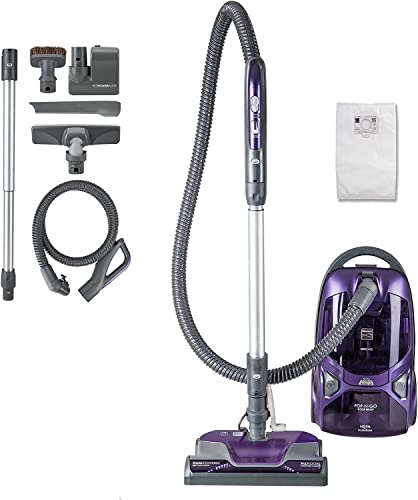
Kenmore 600 Series Bagged Canister Vacuum (81615) — Best Canister
Canisters are the connoisseur’s format: a body that trails behind you, a hose and wand that reach under furniture and up stairs without lifting the machine, and — in this Kenmore — a motorized Pet PowerMate head for carpet. The listing confirms two-motor power, HEPA filtration, a retractable cord, and a pet-friendly brief across carpet and hard floors. The bagged design is a feature, not a throwback: bags seal dust in on disposal, which is why bagged canisters remain the recommendation for dust-sensitive households.
Strengths
- Motorized Pet PowerMate head for carpet, gentle tools for hard floors
- Bagged HEPA system seals dust away at disposal
- Canister format excels on stairs, upholstery, and under furniture
Trade-offs
- Bags are an ongoing purchase, unlike bagless rivals
- Two-part machine takes more storage thought than a stick
- Trailing body takes a day to stop catching on doorframes — then it is second nature
| Detail | What the listing confirms |
|---|---|
| Format | Bagged canister with wand |
| Motors | 2-motor power suction |
| Filtration | HEPA filter |
| Head | Pet PowerMate motorized head |
| Cord | Retractable cord |
Choose the Kenmore if your home mixes bare floors, area rugs, and carpet, and if above-floor cleaning — stairs, upholstery, curtains, car interiors at the driveway — is a weekly reality rather than a spring event. No upright matches a canister’s reach or its manners on hard floors, and the bagged HEPA system is the cleanest emptying experience in this guide: the dust you collected leaves sealed, not in a cloud over the bin. It is the thorough, old-school-correct answer, updated with a pet head.
Canister technique is a small skill with a big payoff: pull the machine by the hose and let it follow, work from the far side of the room toward the door, and use the wand’s reach to clean under beds and sofas in the same pass as the open floor. The 600 Series’ retractable cord finishes the ritual — one press and the cord homes itself. Households switching from uprights typically need a week to stop fighting the format, after which most refuse to go back for mixed-floor work.
Best for: Mixed-floor homes, dust-sensitive households, stairs and upholstery duty / Not suited for: Anyone who wants a bagless, grab-and-go stick lifestyle
Comparison Table
Format is destiny: pick the shape that matches your floors and habits, then compare within it. Runtimes are manufacturer-stated best cases, as with all cordless claims. Read the table by household, not by hierarchy. The Dyson does not ‘beat’ the Eureka in a small apartment with two rugs; it merely costs more to do the same job. The Kenmore does not lose to the sticks on stairs; it was built for them. Every row is the best answer to a different house, and the badge column names the house. Find your house in the table and the vacuum chooses itself.
| Pick | Badge | Key spec | Best for |
|---|---|---|---|
| Shark Navigator Lift-Away Upright Vacuum (NV352) | Best Overall | Lift-Away upright, HEPA, XL dust cup, swivel steering | Mixed-floor homes, stairs, and one-vacuum households |
| Hoover WindTunnel Swivel Pet Upright Vacuum | Best for Pet Hair (Upright) | Bagless pet upright, swivel steering, corded | Pet households with mostly carpet and hard floors |
| Eureka PowerSpeed Lightweight Upright (NEU280) | Best Budget Upright | Lightweight cyclone upright, washable filter | Apartments, small homes, second vacuums, and anyone prioritizing light weight |
| Shark Pet Cordless Stick Vacuum (IX141) | Best Cordless Value | Cordless stick, 40-min stated runtime, LED headlights | Pet homes with hard floors, daily quick cleans, apartments |
| Dyson V8 Plus Cordless Vacuum | Best Premium Cordless | 115AW cordless, detangling head, up to 40 min stated | Mixed-floor homes wanting one premium cordless as the only vacuum |
| Kenmore 600 Series Bagged Canister Vacuum (81615) | Best Canister | Bagged canister, HEPA, Pet PowerMate, retractable cord | Mixed-floor homes, dust-sensitive households, stairs and upholstery duty |
How to Choose a Residential Vacuum: Corded vs. Cordless
Corded vacuums offer unlimited runtime and the strongest sustained suction per dollar, at the price of managing a cord and an outlet map of your home. They suit larger homes, deep carpet, and single-session whole-house cleaning. Cordless sticks invert the trade: freedom and instant deployment for daily messes, bounded by a battery that delivers its stated runtime only in gentle modes. The honest pattern in most homes is that cordless machines get used five times as often for a fifth as long each time — and total cleanliness rises.
Decide by your dominant mess. If your life is weekly deep cleans of carpeted rooms, corded wins and the Navigator or Hoover is your shape. If your life is daily pet hair on hard floors and crumbs under a highchair, cordless wins and the argument is only Shark versus Dyson. Homes with both lives, and the storage for it, often end with one of each — a corded anchor and a cordless daily driver — which is not excess but specialization.
Bagged vs. Bagless, and What HEPA Really Means Here
Bagless cups are convenient and bag-free, but emptying one releases a puff of the finest dust back into the room, and their filters need regular washing or replacement to keep suction honest. Bags cost money per change and produce waste, but they hold far more, filter as they fill, and leave sealed — which is why the Kenmore’s bagged HEPA design remains the dust-sensitive household’s classic answer. Neither is morally superior; they are different relationships with dust.
On filtration language: a ‘HEPA filter’ in a listing means the filter media meets the HEPA standard; a ‘sealed HEPA system’ means the machine’s whole airflow path is sealed so air cannot bypass the filter. The listings in this guide claim HEPA filtration; where a sealed system matters to you — typically in allergy-conscious homes — verify it on the product page for the specific model, and maintain filters on schedule, because a clogged premium filter underperforms a fresh ordinary one.
Weight, Stairs, and Storage: The Unasked Questions
Specifications list suction; daily life lists weight. A vacuum crosses thresholds, climbs stairs, and gets carried to the car, and every pound is paid weekly. Lightweight picks like the Eureka, and sticks generally, win homes with multiple levels or any lifter with a bad back. Canisters cheat the problem elegantly — the heavy part rolls on the floor while you carry only the wand — which is part of their enduring appeal in stair-heavy homes.
Storage is the twin question. An upright needs a closet corner; a stick can hang on a wall mount in a utility space; a canister wants a shelf or floor spot for body plus wand. Measure the intended home before the vacuum arrives, and factor in the cord or charger: the best vacuum is the one that lives where using it is easy, because proximity is destiny in home cleaning.
Suction, Airflow, and Brushrolls: What Actually Cleans
Suction figures impress in listings and mislead in practice. Carpet cleaning is a trio: agitation from the brushroll loosens debris, airflow carries it away, and suction seals the head to the floor. A machine with moderate suction and a great brushroll out-cleans a suction monster with a lazy brush on carpet, while hard floors care mostly about airflow and head design — too much suction on a hard-floor head just seals it down and makes it push dirt. This is why the guide describes formats and heads before it ever mentions power numbers.
Brushroll maintenance is the hidden variable. Hair wrap strangles agitation within weeks in pet homes, which is why detangling heads (Dyson) and easy-access brushrolls matter more than launch-day suction tests. When you demo or unbox any vacuum, check how the brushroll comes out. If it needs tools and patience, you will not do it; if it pops free in seconds, you will — and your carpet will know the difference.
Planning for Pets, Kids, and Allergies at Once
Real households stack challenges: a shedding dog, a toddler redistributing crumbs, and a parent who wants the dust kept down. The stack is solved by layers, not by one hero machine. A cordless stick handles the daily visible layer; a corded upright or canister does the weekly deep layer; filtration — maintained filters, bagged disposal for the dust-sensitive — handles the invisible layer. The picks in this guide were chosen so any two of them form a coherent system without duplicating strengths.
If you must choose one machine for the full stack, choose by the invisible layer: sealed disposal and HEPA filtration protect the household member who cannot speak for their own lungs, while the visible layer can always be chased with a broom in a pinch. That logic points to the Kenmore canister or the Navigator — and it is the same logic hospitals and schools use when they spec floor care, scaled down to a home.
Noise, Storage Manners, and Living With the Machine
Two vacuums with identical cleaning scores can be very different housemates. Corded uprights are the loudest format here; canisters move the motor away from your ears and feel calmer; cordless sticks are quiet enough for a sleeping-household pass in their gentle modes. If your home vacuums around naps, calls, or thin walls, weight noise as a first-class specification and favor the formats and modes that respect it — a vacuum that must wait for an empty house gets used a third as often.
Storage manners decide the rest. A stick on a wall mount in a hallway closet is a vacuum that exists in your daily life; an upright buried behind coats is a weekend project. Before buying, stand where the vacuum will live and mime taking it out. If the mime involves moving anything else, choose the format that fits the space you actually have — several picks here exist precisely because they disappear gracefully between uses.
How to Get the Most From a Home Vacuum
Whatever format you chose, these habits separate homes that feel clean from homes that merely own a vacuum.
Step 1: Set the height or mode for the floor
On adjustable uprights, set the head height so the brushroll engages carpet without bogging; on sticks, use the gentle mode for hard floors and reserve max power for carpet and rugs. The wrong setting either scatters debris or leaves it behind — thirty seconds of adjustment per room is the cheapest performance upgrade there is.
Step 2: Vacuum in slow, overlapping passes
Suction needs dwell time, especially on carpet, where dirt sits at the pile’s base. Push at half the speed you want to, overlap passes by a third, and give high-traffic lanes a second cross-pass at right angles. Fast vacuuming is mostly theater; slow vacuuming is cleaning.
Step 3: Empty and maintain on a rhythm
Empty bagless cups at the half-full mark, not the brim — airflow dies as the cup packs. Check brushrolls monthly for hair wrap (less often with a detangling head), wash or replace filters per the manual, and change bags before they are drum-tight. Maintenance is suction, preserved.
Step 4: Work top-down and room-out
Dust and vacuum in the same direction gravity does: above-floor surfaces first with the hose and tools, floors last, working from the far corner toward the door. You will stop re-cleaning floors you just finished, and the room will feel finished rather than merely visited.
Step 5: Use the tools for their named jobs
The crevice tool is for edges and between cushions, the upholstery tool for fabric, the dusting brush for shelves and blinds. Attachments are not box-fillers; a weekly pass along baseboards and under furniture edges removes the reservoir that migrates back into the room’s center.
Step 6: Store it ready
Coil the cord or dock the stick, empty the cup, and park the machine where the next mess will find it fastest. A vacuum stored ready gets used for the two-minute mess; a vacuum stored as a project does not, and two-minute messes are most of home dirt.
Step 7: Finish with the entry and the edges
Dirt enters at doors and migrates to edges. End every session with a slow pass over the entry mat zone and along the baseboards of the main room — the two reservoirs that refill the center of the floor between cleans. It takes ninety seconds and visibly extends the life of the whole job.
Step 8: Do the cord and charger audit monthly
For corded machines, run the cord out fully once a month and look for nicks, kinks, and a plug that still grips the outlet; for cordless, check the dock contacts and let the battery run a full cycle rather than living at a permanent top-off sip. Power delivery is the invisible half of suction, and it degrades silently until a mid-clean failure announces it.
The best residential vacuum is a habit with a handle. Choose the format your home rewards, maintain it lightly and regularly, and the floors will take care of themselves. And when the machine finally ages — suction faded despite clean filters, a brushroll motor silent, a cord frayed past tape — read the signs as a system: one wear item is maintenance, two are a decision, three are a retirement. The brands in this guide all sell the parts to make that decision honestly, which is the last reason they are in it. A vacuum you can diagnose is a vacuum you can keep.
Common Buying Mistakes
Buying maximum suction for a hard-floor home
Hard floors need airflow, the right head, and edge cleaning — not record suction, which can seal a head to the floor and scatter debris. Match the machine to the surface: sticks and canisters with parquet-friendly heads shine on bare floors.
Believing the runtime on the box
Cordless runtimes are measured in the gentlest mode, often without a motorized head. On max power, expect a fraction of the headline. Size your purchase by your home’s area in realistic mode, or plan a corded anchor for deep cleans.
Neglecting filters until suction dies
By the time suction loss is obvious, the filter has been strangling the machine for weeks. Wash and replace filters on the manual’s schedule, and keep a spare for bagless machines so a washing day is not a no-vacuum day.
Skipping the brushroll check
Hair wrap quietly converts a good vacuum into a floor polisher. A monthly two-minute check — seconds with a detangling head — preserves the agitation that carpet cleaning depends on.
One vacuum, wrong format, forever
Homes change: a baby, a dog, a move from carpet to hardwood. The format that was right can become wrong, and loyalty to it just preserves the mismatch. Re-run the corded/cordless and format questions when the home changes, not when the machine dies.
Vacuuming a wet or damp floor with a dry-only machine
Residential dry vacuums — every pick here — are not wet pickups. Damp debris cakes brushrolls, ruins filters, and can damage motors. Let spills dry fully or blot them first, and keep the shop vacuum concept for the garage. The mistake is common after kitchen and entryway incidents, exactly where patience is shortest.
Using the vacuum as a mop substitute after spills
It bears repeating in specific form: cereal milk, pet accidents, and tracked-in slush are blot-and-clean events, not vacuum events, for every dry machine in this guide. Ten patient minutes with towels protects a motor, a filter set, and a brushroll that took real money to buy. The vacuum’s turn comes when the floor is dry.
Final Recommendation
For one vacuum that does everything respectably, buy the Shark Navigator NV352 — the Lift-Away design covers floors, stairs, and above-floor work in a single footprint. Pet households on carpet should shortlist the Hoover WindTunnel Swivel Pet; light-weight and budget-first shoppers, the Eureka PowerSpeed; daily hard-floor pet duty, the Shark IX141 cordless; buyers wanting one premium cordless for everything, the Dyson V8 Plus; and mixed-floor, dust-sensitive homes, the bagged Kenmore 600 canister.
Finally, buy the vacuum your household will still be using in year three, not the one that wins a spreadsheet today. Handling, storage, maintenance temperament, and parts availability are the year-three specifications; suction is the day-one specification. The six machines above were chosen because they score on both clocks — pick the one whose compromises you will mind least, and you will not shop this category again for a long while.
Match format to floors, maintain lightly, and vacuum slower than feels natural. For narrower briefs, see our related guides: Best Lightweight Vacuum For Hardwood Floors And Area Rugs and Best Metal Canister Vacuums, then check price on Amazon for the exact model and tool set you chose.
Shark Navigator Lift-Away Upright Vacuum (NV352) Hoover WindTunnel Swivel Pet Upright Vacuum Eureka PowerSpeed Lightweight Upright (NEU280)
Best Lightweight Vacuum For Hardwood Floors And Area Rugs Best Metal Canister Vacuums Best Ranked Vacuums Best Powerful Vacuums For Small Spaces Best Lightweight Vacuums With Bags
Frequently Asked Questions
What type of vacuum is best for a typical home?
A mixed-floor home is best served by a versatile upright with above-floor tools — the Navigator pattern — or by a canister if stairs and upholstery dominate. Hard-floor homes increasingly choose a cordless stick as the primary machine. The right answer follows your floors and habits, not a universal ranking.
Is a cordless vacuum powerful enough as the only vacuum?
Premium cordless models like the Dyson V8 Plus handle mixed floors credibly as sole machines in small-to-medium homes. The limits are runtime on high power and deep-carpet endurance in very large homes, where a corded anchor still earns its closet space.
Bagged or bagless — which is better?
Bagless wins on running cost and convenience; bagged wins on dust containment at disposal and capacity. Dust-sensitive households generally prefer bagged HEPA designs like the Kenmore; everyone else usually prefers the bagless routine. Both clean equally when maintained.
How often should I vacuum?
High-traffic areas and pet zones benefit from brief, frequent passes — a cordless stick makes this painless — with a deeper weekly clean for the whole home. Frequency with a light machine beats intensity with a dreaded one, every time.
What does Lift-Away or convertible design actually buy me?
Reach. Detaching the pod or converting to a handheld moves the cleaning to stairs, upholstery, shelves, and the car without a second machine. If your home has stairs or you clean above the floor weekly, the feature pays for itself in the first month.
How long should a residential vacuum last?
A maintained corded upright or canister should serve for many years; filters, belts, and brushrolls are the wear items. Cordless models add a battery that gradually loses capacity over the years. Buying a mature model with available parts — several picks here qualify — extends service life more than any specification does.


