Disclosure: airfryerkitchensupply.com is reader-supported. When you buy through links on our site, we may earn an affiliate commission at no extra cost to you.
Where to buy
Comparing the best metal canister vacuums? Every canister below was confirmed against Amazon’s catalog before earning a link, so model names and floorhead configurations match live listings. Canister vacuums are configuration-sensitive — the same body ships with different floorheads at different tiers — so check the current price on Amazon for the exact configuration described, and buy from Amazon or an authorized dealer so the motor warranty is honored.
- Miele Guard L1 Allergy Canister Vacuum — Check on Amazon
- SEBO Airbelt K3 Premium Canister Vacuum — Check on Amazon
- Miele Classic C1 Pure Suction Vacuum — Check on Amazon
- Kenmore 600 Series Bagged Canister Vacuum (81615) — Check on Amazon
- Miele Complete C3 Calima Canister Vacuum — Check on Amazon
- Eureka Bagged Canister Vacuum 3670H — Check on Amazon
Shoppers searching for the best metal canister vacuums usually want one thing: a vacuum that does not feel disposable. Here is the honest state of the market, because the listings will not tell you plainly. Almost no modern canister vacuum has an all-metal body — the shells are high-grade polymers, chosen because a canister gets dragged, bumped into baseboards and hauled up stairs, and polymer absorbs that abuse without denting or weighing a ton. The metal that matters lives where the wear lives: stainless or chromed steel wands, metal soleplates and brushroll housings on powered floorheads, steel-reinforced hose cuffs, and motors built to be serviced rather than sealed shut. A ‘metal canister vacuum’ worth buying is really a durability specification: metal in the wear path, a bagged system that protects the motor, and a manufacturer that still sells parts a decade later.
Judged that way, six machines stand out, and they are all confirmed in Amazon’s catalog data. The German makers — Miele and SEBO — dominate the top because they build canisters the way appliances used to be built, with long warranties and dealer service networks. Kenmore’s 600 Series is the mainstream value with a powered pet floorhead, and the Eureka 3670H is the featherweight budget canister that trades frills for simplicity. We will be straight about what is and is not metal on each pick, because pretending a polymer shell is steel helps no one. What all six share is the canister format’s real advantages: a low, stable body that follows you, a long hose-and-wand reach that cleans stairs and ceilings without lifting anything heavy, and quiet, sealed filtration that uprights rarely match.
In this guide
Quick Picks
- Miele Guard L1 Allergy Canister Vacuum (Best Overall) — Miele’s current-generation bagged canister with HEPA filtration, built for allergy households and long service life. — Check on Amazon
- SEBO Airbelt K3 Premium Canister Vacuum (Best Built) — German-made canister with a seven-year motor warranty, ET-1 powerhead, parquet brush and a 37-foot cleaning radius. — Check on Amazon
- Miele Classic C1 Pure Suction Vacuum (Best for Hard Floors) — The entry point into Miele ownership: a suction-only canister tuned for hard floors and low-pile carpet. — Check on Amazon
- Kenmore 600 Series Bagged Canister Vacuum (81615) (Best Value with Powerhead) — Mainstream-priced bagged canister with a Pet PowerMate motorized head, two motors, HEPA filtration and a retractable cord. — Check on Amazon
- Miele Complete C3 Calima Canister Vacuum (Best Full-Size Miele) — Miele’s larger Complete C3 body with a turbobrush floorhead for low-to-medium pile carpet and hard floors. — Check on Amazon
- Eureka Bagged Canister Vacuum 3670H (Best Lightweight Budget) — A featherweight bagged canister with a blower function, sold with bags, for hard floors, cars and small spaces. — Check on Amazon
How These Picks Were Chosen
Our selection put durability evidence first: metal wands and floorhead construction, bagged filtration that keeps dust out of the motor, published warranty terms, and a parts pipeline — bags, filters and belts still in production. Second came floor coverage: a canister earns its keep by handling both hard floors and carpet, so we checked which floorheads ship in the box, since a suction-only head and a motorized brushroll head are different machines in practice. Third, livability: cord length and total cleaning radius, bag capacity, weight on stairs, and how the machine stores. Lightweight car-and-garage canisters and disposable bagless models were cut; this list is for buyers keeping a vacuum for years.
The 6 Best Metal Canister Vacuums

Miele Guard L1 Allergy Canister Vacuum — Best Overall
The Guard L1 Allergy is Miele’s modern take on its own classic formula: a bagged canister with HEPA filtration, confirmed in the Amazon listing, from the brand whose canisters routinely stay in service for a decade or more. It is the pick for buyers who want the durability brief — metal wand hardware, serviceable design, sealed system — in its current form.
Strengths
- HEPA filtration in a sealed bagged system, so emptied dust never re-enters the room air
- Miele’s bag and filter ecosystem is stocked everywhere and changes are genuinely hygienic
- Current-generation ergonomics and controls improve on the older Classic line
Trade-offs
- Premium tier, and Miele consumables are priced accordingly
- Confirm which floorheads the listing configuration includes before assuming carpet performance
- Polymer shell like every modern rival — the durability is in the hardware and motor, not a steel body
Key specs: Bagged canister; HEPA filter (Amazon listing); Allergy configuration.
The Allergy configuration exists for households where the vacuum itself must not be a dust source. The bagged, sealed path means the dirt you pick up stays captured through disposal — you never shake out a bin or wash a foam filter in the sink. On floors, Miele’s suction control lets you drop power for curtains and rugs or run full strength on hard floors where canisters excel. The wand hardware is where the metal brief shows up: it telescopes, locks positively and survives the levering forces that snap cheap plastic wands within a couple of years.
Budget for genuine Miele bags and the HEPA filter on its interval; the bag is the filtration system’s first stage, and off-brand bags that seal poorly cost motor life. Register the warranty, and note that Miele’s dealer network can service these machines — a genuine difference from brands whose support answer is a replacement unit. Store it with the hose looped loosely to protect the cuffs.
Best for: allergy households wanting a sealed, serviceable canister for the long term / Not suited for: buyers who want a motorized brushroll for deep-pile carpet in the base configuration
Check on Amazon — check the current price on Amazon before you buy, because bundle and filter options change.

SEBO Airbelt K3 Premium Canister Vacuum — Best Built
If the metal brief means ‘built like equipment,’ the SEBO Airbelt K3 Premium is the answer: made in Germany, confirmed in the listing with the ET-1 powerhead for pet hair and carpets, a parquet floor brush, a 37-foot reach and a seven-year motor warranty. The airbelt itself — a foam bumper ring around the canister — exists because SEBO expects the body to be dragged around furniture for years.
Strengths
- Seven-year motor warranty is the strongest durability promise in this guide
- ET-1 powerhead with manual height adjustment cleans carpet the way suction-only heads cannot
- Both a powerhead and a dedicated parquet brush ship in the premium configuration
Trade-offs
- Premium tier pricing across machine, bags and parts
- Heavier in the hand than the lightweight picks — the wand and head are built sturdily
- Styling is functional German, not decorative
Key specs: Made in Germany (Amazon listing); ET-1 powerhead; parquet brush; 37-foot reach; 7-year motor warranty.
The K3 is the canister professionals buy for buildings they maintain, adapted for homes. The powerhead’s height adjustment matters more than raw suction on carpet: set right, the brushroll agitates the pile without bogging or scattering; set wrong, every vacuum feels weak. On hard floors you swap to the parquet brush — thirty seconds — and get soft, thorough pickup that will not scratch timber. The 37-foot radius means most apartments and many house floors are cleaned from one or two outlets, which changes how a cleaning session feels more than any spec-sheet suction number.
SEBO bags and filters are widely stocked through dealers and Amazon, and the machine is designed to be opened and serviced, not glued shut. The airbelt cover is replaceable when it eventually scuffs. Keep the brushroll clear of hair — the head is built to be opened for exactly that — and this is realistically a ten-plus-year appliance.
Best for: mixed-floor homes that want commercial build quality and a real carpet powerhead / Not suited for: buyers prioritizing the lightest possible stair carry
Check on Amazon — check the current price on Amazon before you buy, because bundle and filter options change.

Miele Classic C1 Pure Suction Vacuum — Best for Hard Floors
The Classic C1 Pure Suction is the simplest Miele canister in the catalog listing — a bagged, suction-only machine for hard floors and low-pile carpet. It strips the formula to its essentials: Miele motor, Miele bags, metal wand hardware, and a combination floorhead you switch with a toe tap.
Strengths
- The most accessible route to Miele build quality and parts support
- Suction-only head glides on hard floors and will not scatter debris or mark timber
- Compact, light canister body is easy on stairs and in small homes
Trade-offs
- No motorized brushroll — deep-pile carpet is beyond its brief
- Smaller bag capacity than the larger Miele bodies
- Accessories beyond the core tools cost extra
Key specs: Bagged canister; suction-only combination floorhead; hard floors and low-pile carpet (Amazon listing).
Hard-floor homes are where canisters humiliate uprights, and the C1 is the distilled version: quiet, sealed, and gentle on surfaces that scratch. The combination head retracts its bristles for low-pile rugs and drops them for boards and tile, and suction control at the body lets you clean sheer curtains without eating them. What you give up is carpet agitation — on anything plusher than low pile, a suction head skates over embedded grit instead of beating it loose. Buy it for the floors it is actually for, and it is superb.
Running costs follow the standard Miele pattern: genuine bags, a filter on schedule, and nothing else much to buy. The machine’s simplicity is its longevity story — fewer moving parts, fewer failures. If your next home adds thick carpet, the honest move is a second machine or the SEBO, not an accessory head pretending to be a powerhead.
Best for: hard-floor and low-pile homes wanting Miele quality without powerhead pricing / Not suited for: homes with medium or deep-pile carpet as the main surface
Check on Amazon — check the current price on Amazon before you buy, because bundle and filter options change.
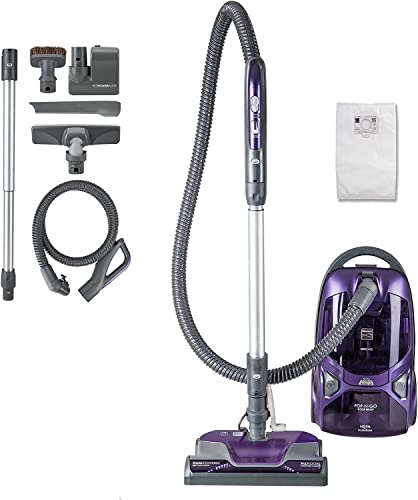
Kenmore 600 Series Bagged Canister Vacuum (81615) — Best Value with Powerhead
The Kenmore 600 Series is the value argument in this guide: a bagged canister confirmed in the listing with a Pet PowerMate motorized floorhead, a two-motor system, HEPA filtration and a retractable cord — the configuration mainstream buyers actually need for mixed floors with pets, at a mainstream tier.
Strengths
- Motorized Pet PowerMate head handles carpet and upholstery pet hair properly
- HEPA filtration in a bagged system at a mid-market tier
- Retractable cord and onboard tools make it an easy daily driver
Trade-offs
- Fit and finish trail the German picks — this is value engineering, done well
- Kenmore bags are a specific fit; stock up so you are never caught without
- Heavier feature set means more small parts to keep track of
Key specs: Bagged canister (Amazon listing); Pet PowerMate; 2-motor system; HEPA filter; retractable cord.
The two-motor layout is the substance here: suction at the canister, brushroll drive at the head, each doing its own job. On carpet, that means agitation that lifts pet hair from the pile instead of combing the surface; on stairs, the smaller powered hand tool format tackles treads and upholstery where a full head cannot fit. For households whose floors split between timber, tile and real carpet, this is the configuration that avoids the classic canister compromise — and it does it without German pricing.
Keep genuine Kenmore bags on hand; the HEPA system depends on the bag sealing correctly. The brushroll accumulates hair like every powered head — the design lets you clear it, and five minutes monthly keeps performance honest. Cord rewind mechanisms reward a guiding hand rather than a full-speed snap; treat it gently and it lasts.
Best for: pet households with mixed floors that need a powered head at a fair tier / Not suited for: buyers who rank decade-scale build quality above configuration value
Check on Amazon — check the current price on Amazon before you buy, because bundle and filter options change.

Miele Complete C3 Calima Canister Vacuum — Best Full-Size Miele
The Complete C3 Calima steps up to Miele’s full-size body: bigger bags, a longer reach, and an air-driven turbobrush floorhead confirmed in the listing for low-to-medium pile carpet and hard floors. It is the Miele for larger homes where the Classic C1’s compact capacity would mean constant bag checks.
Strengths
- Full-size body means larger bags and fewer changes across a big home
- Turbobrush adds real carpet agitation without a powerhead’s weight or cord-in-hose complexity
- Miele’s sealed system and filtration discipline carry over intact
Trade-offs
- Turbobrush performance depends on suction — it is not a substitute for a motorized head on deep pile
- Larger body is more to carry between floors
- Premium tier, like all Miele ownership
Key specs: Bagged canister (Amazon listing); turbobrush floorhead; low-medium pile carpet and hard floors.
The Calima’s turbobrush is a clever middle path: the vacuum’s own airflow spins the brush, so carpet gets agitation with no electrical connections in the hose and no second motor to fail. On low and medium pile — which describes most installed carpet — it lifts grit that a suction head leaves behind. The C3 body adds the ownership comforts that matter over years: a generous cleaning radius, tidy onboard tool storage, and a bag compartment that seals itself as you remove the bag, so the dust cloud at change time simply does not happen.
As with every Miele, genuine bags and filters are the running cost and the warranty’s best friend. The turbobrush’s brush strip wears over years and is replaceable. If your carpet is genuinely deep pile, cross-shop the SEBO K3’s electric head honestly rather than hoping the turbo will cope — it is excellent within its stated range and merely adequate beyond it.
Best for: larger hard-floor homes with low-to-medium carpet wanting full-size Miele refinement / Not suited for: deep-pile carpet homes that need an electric powerhead
Check on Amazon — check the current price on Amazon before you buy, because bundle and filter options change.

Eureka Bagged Canister Vacuum 3670H — Best Lightweight Budget
The Eureka 3670H is the honest budget pick: a lightweight bagged canister, confirmed in the listing with two bags in the box and a blower function, aimed at hard floors, carpet spot work, cars and apartments. It is not built like the German machines and does not pretend to be — it is simple, light and cheap to keep.
Strengths
- Genuinely light — the canister anyone can carry up stairs or out to the car one-handed
- Bagged design keeps the motor cleaner than budget bagless rivals
- Blower function clears leaves from a garage threshold and dust from vents
Trade-offs
- Suction-only cleaning; plush carpet is beyond it
- Plastic hardware throughout — this is the value end of the durability scale
- Small bags fill quickly in pet homes
Key specs: Bagged canister (Amazon listing); includes 2 bags; blower function; lightweight body.
Every category needs the pick that respects a tight budget without being junk, and the 3670H has held that role for years because its simplicity is real: a motor, a bag, a hose, tools that fit. For hard-floor apartments, dorms, RVs and as a second vacuum for the garage and car, its weight is the feature — machines that live in a closet because they are heavy clean nothing. The blower port is more useful than it sounds, clearing dryer vents, inflating and deflating, and blowing out the garage. Just buy it with clear eyes about carpet: area rugs and low pile, yes; the deep living-room carpet, no.
Bags are inexpensive and widely available; keep a pack in the closet. The light build rewards gentle handling — do not drag it by the hose over thresholds. Treated as the appliance it is, it returns years of service for very little money; treated like the SEBO, it will disappoint.
Best for: apartments, RVs, cars and second-vacuum duty on a tight budget / Not suited for: whole-house deep-carpet cleaning or buyers seeking decade-grade hardware
Check on Amazon — check the current price on Amazon before you buy, because bundle and filter options change.
Comparison Table
| Pick | Badge | Key spec | Best for |
|---|---|---|---|
| Miele Guard L1 Allergy Canister Vacuum | Best Overall | Bagged; HEPA; current-generation Miele | allergy households wanting a sealed, serviceable canister for the long term |
| SEBO Airbelt K3 Premium Canister Vacuum | Best Built | ET-1 powerhead + parquet brush; 37-ft reach; 7-yr motor warranty | mixed-floor homes that want commercial build quality and a real carpet powerhead |
| Miele Classic C1 Pure Suction Vacuum | Best for Hard Floors | Suction-only; hard floor specialist | hard-floor and low-pile homes wanting Miele quality without powerhead pricing |
| Kenmore 600 Series Bagged Canister Vacuum (81615) | Best Value with Powerhead | Pet PowerMate head; 2 motors; HEPA; retractable cord | pet households with mixed floors that need a powered head at a fair tier |
| Miele Complete C3 Calima Canister Vacuum | Best Full-Size Miele | Full-size body; air-driven turbobrush | larger hard-floor homes with low-to-medium carpet wanting full-size Miele refinement |
| Eureka Bagged Canister Vacuum 3670H | Best Lightweight Budget | Lightweight; bagged; blower mode | apartments, RVs, cars and second-vacuum duty on a tight budget |
How to Choose a Metal Canister Vacuum That Actually Lasts
Look for metal where wear happens. Run this checklist against any listing: a stainless or chromed steel telescopic wand; a floorhead with a metal soleplate; hose cuffs that are reinforced rather than thin molded plastic; and wheels and latches that are replaceable parts, not glued assemblies. A polymer body shell is normal and even desirable — it is lighter and dent-proof. What separates a ten-year canister from a two-year one is the hardware in the wear path and whether the manufacturer sells parts.
Choose bagged if longevity is the goal. A bag is a sacrificial filter that protects the motor from the fine dust that kills bagless machines slowly. Every pick in this guide is bagged for exactly that reason. Check bag price and availability before buying — a vacuum whose bags go out of production is a vacuum with an expiry date.
Match the floorhead to your floors, not your hopes. Hard floors and low pile: suction or turbo heads excel. Medium and deep carpet: only a motorized brushroll head agitates properly. The most common canister disappointment is a suction-only machine bought for plush carpet.
- Confirm the exact floorheads in the box for the configuration you are buying.
- Check total cleaning radius — cord plus hose — against your largest room.
- Read the motor warranty length; it is the manufacturer’s own durability estimate.
- Verify bags and filters are current-production items, not old stock.
Canister vs Upright: Which Format Suits Your Home?
Canisters win on stairs, above-floor cleaning and hard floors. The motor unit sits stable on a tread while the wand works; the same wand reaches ceiling corners, tops of cabinets and under beds where uprights cannot go. They are typically quieter and their sealed systems filter better. Uprights win on deep carpet convenience — one pass, no trailing body — and on storage simplicity in a single closet.
Multi-surface homes with stairs are canister country, which is why this guide exists. Single-floor, wall-to-wall plush carpet homes are the one layout where an upright with a strong brushroll can be the simpler answer. Many households end up with the canister as the main machine and a stick for daily crumbs; that pairing covers everything without asking one appliance to be two.
Understanding Floorheads: Suction, Turbo and Electric
Suction heads rely on airflow alone, often with retractable bristles. They are light, gentle and perfect for hard floors and flat-weave rugs — and inadequate on plush carpet. Turbo heads spin a brushroll using the vacuum’s own airflow; they add real agitation on low-to-medium pile with no electrics, at the cost of some suction at the head and performance that fades as the bag fills. Electric powerheads carry their own motor and deliver consistent agitation at any bag state; they are heavier, cost more, and are the only correct answer for deep pile and heavy pet hair in carpet.
The practical rule: buy the head your worst floor needs, because the worst floor is where dissatisfaction lives. Everything else — reach, weight, bag size — is comfort. The floorhead is capability.
Bags, Filters and the True Cost of Owning a Canister
The purchase price of a canister is the down payment; bags and filters are the mortgage, and at this end of the market the mortgage is honest but real. A bagged canister consumes a bag every one to three months in an average home — faster with pets, slower in a shoes-off apartment — plus an exhaust or HEPA filter on a six-to-twelve-month rhythm. Genuine Miele and SEBO consumables sit at the premium end of those costs; Kenmore’s are mid-market; the Eureka’s bags are among the cheapest in the category. None of this should scare a durability buyer — spread across a ten-year service life, even premium consumables cost little per clean — but it should be budgeted with open eyes, because the false economy in this category is the cheap bagless machine replaced four times in the same decade.
Two ownership habits protect the investment. First, change the bag when it is two-thirds full, not when suction dies: an overfilled bag strangles airflow, overheats the motor and voids the point of the sealed system. Second, treat the exhaust filter as a calendar item, not a suggestion — it is the last defense between the motor’s cooling air and the room you breathe in. Owners who keep a small stock of bags and one spare filter in the closet never face the mid-clean crisis that sends people to buy whatever the nearest store stocks, genuine or not.
Cleaning Technique: Getting the Most from a Canister on Every Floor
Technique multiplies hardware. On hard floors, slow passes win: the suction head needs a beat over each section, and a figure-eight overlap pattern prevents the striped misses that fast, straight pushes leave behind. Let the bristles lead on the push stroke and the smooth soleplate glide on the pull. On carpet with a powered head, set the height so the brushroll just engages the pile — you should hear the note change without the head bogging — and make two slow passes in perpendicular directions on traffic lanes, where grit works deepest into the backing.
Edges and transitions are where canisters embarrass uprights, so use the advantage: the crevice tool along baseboards weekly keeps the gray line from ever forming, and the wand’s reach makes ceiling corners and the tops of kitchen cabinets a monthly two-minute job instead of an annual ladder event. Work rooms from the far corner toward the door, and from high surfaces to low, so everything you dislodge lands on a floor you have not cleaned yet. Finish by emptying nothing — that is the bagged system’s gift — but do check the brushroll for hair while the machine is in your hands; thirty seconds then saves a belt or a motor later.
Service, Parts and the Dealer Question: Keeping a Canister for a Decade
A ten-year vacuum is not bought; it is maintained, and the maintenance ecosystem differs sharply across this guide’s brands. Miele and SEBO sell through dealer networks that stock bags, filters, belts and floorheads and employ people who repair the machines — when a SEBO’s powerhead brushroll bearing tires in year seven, it is a part and an afternoon, not a replacement vacuum. Kenmore occupies the middle ground: parts are widely available online and through appliance channels, and the designs are conventional enough that independent vacuum shops service them without drama. The Eureka plays a different contract honestly: at its tier, the economics favor the machine’s long, simple service and eventual replacement over a repair ecosystem, and its bags remain cheap and ubiquitous.
Whichever brand you choose, three records future-proof the purchase: the purchase receipt (warranties run from it), the model and serial plate photographed into your phone, and a note of which bag and filter types the machine takes, kept where the bags live. Add one habit — an annual five-minute inspection of hose cuffs, cord, brushroll and wheels, ideally when you change the exhaust filter — and you have replicated the entire maintenance regime of the professional users who keep these same canisters in service for the buildings they clean. Durability, in the end, is a partnership between a manufacturer who builds repairably and an owner who spends five minutes a year. This guide has chosen the manufacturers; the five minutes are yours.
Suction, Airflow and Watts: Reading Vacuum Specs Without Being Fooled
Vacuum marketing leans on numbers that describe the motor rather than the cleaning. Wattage and amps measure electricity consumed, not dirt removed — a thirsty motor in a leaky body cleans worse than a modest motor in a sealed one. What matters at the floor is the combination of suction (which lifts and holds debris against the head) and airflow (which carries it to the bag), and the two trade against each other through every hose bend and filter. This is why canister design — smooth air paths, sealed joints, a bag that stays porous as it fills — outperforms raw power on paper, and why the German machines in this guide feel stronger than their spec sheets suggest while some high-wattage rivals feel breathless by the bag’s second month.
The floorhead then converts air into cleaning: a suction head spends airflow on transport, a turbo head taxes it to spin a brush, an electric head brings its own power and leaves the airflow whole. When you compare listings, discount the wattage headline and interrogate the system instead — bagged or bagless, sealed or open, which heads included, what the warranty promises. Those four answers, all of which this guide has chased for its six picks, predict your Saturday mornings far better than any number printed in a starburst on the box.
A Short History of the Canister, and Why the Format Endures
The canister is the oldest powered vacuum architecture still in front-line service, and its survival is not nostalgia. Separating the motor and dirt collection into a body that rolls behind you, and putting only a wand and floorhead in your hands, solved problems in the 1950s that uprights still struggle with: weight distribution, above-floor reach, stability on stairs, and a sealed dirt path that does not pass through the handle you hold. European makers — Miele and SEBO among this guide’s picks — refined the format into the quiet, bagged, filtration-first machines that professional cleaners and allergy households still specify, while American brands like Kenmore carried it into the mainstream with powered heads and pet configurations, and simple utility canisters like the Eureka kept its budget end honest for apartments, cars and workshops.
What changed across those decades is instructive. Motors grew more efficient rather than merely stronger. Bags became engineered filtration stages with self-sealing collars instead of paper sacks. Floorheads specialized — parquet brushes that treat timber like furniture, electric heads with height adjustment that treat carpet like a system. And the disposable era tested the format and found it stubborn: a canister built around replaceable bags, filters, belts and brushrolls simply refuses the two-year replacement cycle, because every wear item on it was designed to be renewed. That is the deepest answer to the ‘metal’ question this guide opened with. Buyers searching for a metal vacuum are really searching for permanence in a category that went plastic and disposable around them. The canister — in steel-wanded, dealer-supported, bagged form — is where permanence went to live, and the six machines in this guide are its current addresses.
How to Use a Canister Vacuum for Stairs and Above-Floor Cleaning
Start at the top of the stairs with the canister body resting flat on a tread two or three steps below where you are working — never balanced on an edge. Work the wand downward, one tread at a time, moving the body down only when the hose reaches its comfortable limit; a canister pulled off a step falls on the person below it, which is you. For carpeted treads, use the powered or turbo head if you have one; for bare wood, the suction head with bristles down protects the finish.
Above-floor work is where the format shines. Extend the wand fully and clean ceiling corners, light fittings (power off, dry dusting only), the tops of door frames and curtain rails, working from the highest point down so dust falls onto surfaces you have not cleaned yet. Finish with upholstery using the dedicated tool at reduced suction — most canisters have a suction control on the body or handle for exactly this. Coil the hose in a loose loop for storage and retract the cord with a guiding hand; both habits double the life of the two parts that wear first.
Common Buying Mistakes
- Expecting an all-metal body. It essentially does not exist in modern home canisters, and chasing the phrase leads to novelty products. Buy metal in the wand, head and hardware instead.
- Buying a suction-only model for plush carpet. The most common and most avoidable disappointment in this category. Match the head to the pile.
- Ignoring bag availability. A discontinued bag turns a working vacuum into landfill. Check current production status before purchase.
- Using off-brand bags that seal poorly. The bag is the first filtration stage; leaks coat the motor in the dust you were trying to capture.
- Dragging the canister by its hose. Hose cuffs are the number-one wear item. Move the body with its handle and let the hose follow.
- Skipping the brushroll clean-out. Hair-wrapped rollers on powered heads lose agitation and strain belts and motors. Five minutes monthly prevents it.
Final Recommendation
The Miele Guard L1 Allergy is the default buy: current-generation, sealed and HEPA-filtered, built to be kept. The SEBO Airbelt K3 Premium is the choice when build quality is the entire point and carpet needs a true electric powerhead. Hard-floor homes should take the Miele Classic C1 Pure Suction and enjoy its simplicity, while larger homes step up to the Complete C3 Calima. The Kenmore 600 Series delivers the powered pet configuration at a mainstream tier, and the Eureka 3670H covers apartments, cars and second-vacuum duty for very little.
Working through the rest of your cleaning kit? Compare the sibling guides in this program: Best Lightweight Vacuums With Bags, Best Mini Upright Vacuums, and Best Mini Pet Vacuums.
Frequently Asked Questions
Are any canister vacuums actually made of metal?
Not the body — modern canister shells are engineered polymer because it is lighter and dent-resistant. The meaningful metal is in the telescopic wand, floorhead soleplates, brushroll housings and hose hardware, and that is where this guide concentrated. Brands like Miele and SEBO earn their durability reputation through those components, motor quality and parts support.
Why do all your picks use bags?
Because the bag protects the motor. Fine dust that passes a bagless bin’s cyclones accumulates on motor components and shortens service life; a bag captures it in a sealed, disposable stage. For a vacuum bought to last a decade, bagged is the engineering-correct choice.
Can a canister vacuum clean thick carpet?
Yes — with the right floorhead. A motorized powerhead, like the SEBO K3’s ET-1 or Kenmore’s Pet PowerMate, agitates deep pile properly. Suction-only and turbo heads suit hard floors and low-to-medium pile; expecting them to deep-clean plush carpet is the category’s classic mistake.
How long should a good canister vacuum last?
A serviceable German canister with genuine bags and filters is realistically a ten-year-plus appliance, and the SEBO’s seven-year motor warranty shows the manufacturer expects similar. Budget machines like the Eureka trade some of that lifespan for weight and price, which is a fair trade when bought knowingly.
Are canister vacuums better for allergies than uprights?
The sealed bagged systems in this guide are among the best options: dust is captured in a bag that seals on removal, and HEPA exhaust filtration keeps the fine fraction out of the room. The format helps too — the exhaust stays at floor level behind you rather than at breathing height.
What does cleaning radius mean and why does it matter?
It is the cord length plus hose and wand reach — the distance from the outlet you can clean. The SEBO’s 37-foot radius means most rooms are done from one socket. A short radius forces constant replugging, which is the small daily friction that makes people dread using an otherwise good vacuum.
How often do canister vacuum bags need changing?
In an average home, every one to three months; pet homes and renovation dust shorten that, small apartments lengthen it. The honest signal is performance and fullness — change at roughly two-thirds full to protect airflow and the motor, rather than waiting for suction to fade.
Can I use a canister vacuum on stairs safely?
Yes — it is the format’s home ground. Set the body flat on a tread a few steps below you, never balanced on an edge, and work downward with the wand. Move the body only when the hose reaches its limit, and keep one hand free for the rail on the way down.
Are canister vacuums good on stairs and for older users?
They are the kindest format for both: the heavy motor stays parked on a tread or the floor while only the light wand travels, and there is no upright to wrestle or balance. Users with limited lifting strength consistently find a canister plus a lightweight head easier than any full-weight alternative.
How loud are canister vacuums compared with uprights?
Generally quieter, for structural reasons: the motor sits in an insulated body on the floor behind you rather than at handle height beside your ear, and bagged European designs in particular are engineered for low noise. You can hold a conversation over most picks in this guide at working power — one more reason the format suits apartments and homes with sleeping children.
Do canister vacuums work for car and garage cleaning?
The format is ideal — the body stays outside the car while the wand and tools reach under seats and into footwells. The Eureka 3670H is the pick here purpose-suited to it, light enough to carry out and with a blower mode for clearing the garage; the premium machines do it beautifully too, though most owners keep them for the house.
What accessories should I buy with a canister vacuum?
Start with a stock of genuine bags and one spare filter — the consumables you will certainly need — before any accessory head. After that, let your floors decide: a dedicated parquet brush if your hard floors are extensive and your configuration lacks one, and a mini turbo tool if stairs and upholstery carry pet hair. Buy accessories against a named task in your home, not against a catalog’s completeness.
Where should I store a canister vacuum?
In a closet or utility space where the hose can hang or loop loosely and the cord retracts without a kink — storage bends are how hoses and cords age. Keep the bag stock with the machine, and if the space is a garage, choose a dry corner off the concrete; the premium machines in this guide deserve indoor storage, while the Eureka tolerates the garage it was partly bought for.

