Disclosure: airfryerkitchensupply.com is reader-supported. When you buy through links on our site, we may earn an affiliate commission at no extra cost to you.
Where to buy
All six pillows below were verified against Amazon’s catalogue data, and each is sold through Amazon, where you can confirm the current size options and case details before ordering:
- EPABO Contour Memory Foam Pillow — check price on Amazon
- Osteo Cervical Pillow — check price on Amazon
- DONAMA Cervical Pillow — check price on Amazon
- UTTU Cervical Pillow — check price on Amazon
- Bedsure Cervical Neck Pillow — check price on Amazon
- Royal Therapy Memory Foam Pillow — check price on Amazon
Introduction
Looking for the best recommended pillows for side sleepers with neck problems usually means you are waking up with a stiff neck, a dull ache between the shoulder blades, or that familiar morning ritual of rotating your head slowly to check what still moves. One clarification before the picks: “recommended” in this guide means recommended by this guide, against the transparent comfort and fit criteria set out below. No pillow here is endorsed by doctors or physiotherapists, and a pillow is a comfort product, not a medical treatment. If your neck symptoms persist, worsen, or come with numbness, weakness or pain travelling into an arm, stop shopping and see a doctor — that pattern needs assessment, not bedding.
With that said, pillow fit genuinely matters for side sleepers, because side sleeping creates the largest gap any pillow has to fill: the distance between the side of your head and the tip of your shoulder. Too low, and your head tilts down toward the mattress all night; too high, and it tilts up. A contoured cervical-style pillow addresses this with a shaped surface — higher support under the neck curve, a cradle for the head — and the six picks below were chosen because their own listings state the shaping, height options or adjustability that let a side sleeper dial in that fit. Every product was verified, so the features described are the features the listings themselves claim. We compare a long-running contour pillow, a hollow-design adjustable model, a cooling dual-height design, a height-adjustable sandwich pillow, a value pick from a mainstream bedding brand, and a pillow with clearly stated dimensions for buyers who want to measure before they buy.
In this guide
Quick Picks
- Best Overall — EPABO Contour Memory Foam Pillow: an ergonomic contour shape made for side, back and stomach sleepers, and the most proven design in this guide. Check on Amazon
- Best Adjustable Fit — Osteo Cervical Pillow: a hollow-design, adjustable memory foam pillow with a cooling case, built so the head can settle into the centre. Check on Amazon
- Best for Hot Sleepers — DONAMA Cervical Pillow: a cooling contour pillow with a dual-height profile, so side sleepers can choose the taller edge. Check on Amazon
- Best Height-Adjustable — UTTU Cervical Pillow: an adjustable sandwich construction with a contour cooling cover, letting you change loft instead of replacing the pillow. Check on Amazon
- Best Budget — Bedsure Cervical Neck Pillow: memory foam contour support that gently cradles the head, from a mainstream bedding brand. Check on Amazon
- Best Measured Fit — Royal Therapy Memory Foam Pillow: a contour cervical pillow with stated dimensions of 24x14x5 inches, so you can check the loft against your shoulder width before buying. Check on Amazon
How These Picks Were Chosen
Selection started from side-sleeping geometry. A side sleeper’s pillow has one job: keep the head and neck roughly in line with the spine while filling the shoulder gap, without pushing the head forward. We therefore prioritised contoured shapes (a raised neck edge with a head cradle), dual-height profiles that offer a taller side for side sleeping, adjustable loft for fine-tuning, and cooling covers or cases, because memory foam’s warmth is the most common reason side sleepers abandon contour pillows in summer. Listings had to state these features themselves; pillows whose listings offered only generic comfort language were left out.
Two honesty rules shaped this guide. First, manufacturer listings for this category use medical-sounding language freely; we have not repeated treatment claims in the body of this guide, because a pillow can support comfortable alignment but cannot diagnose or cure a neck condition. Second, every sleeper’s neck is different, so each review below is explicit about who a pillow suits and who it does not — shoulder width, mattress firmness and your current pillow’s height all change what “correct” loft means for you, and the buying-guide sections explain how to measure yours before choosing.
The 6 Best Recommended Pillows for Side Sleepers with Neck Problems
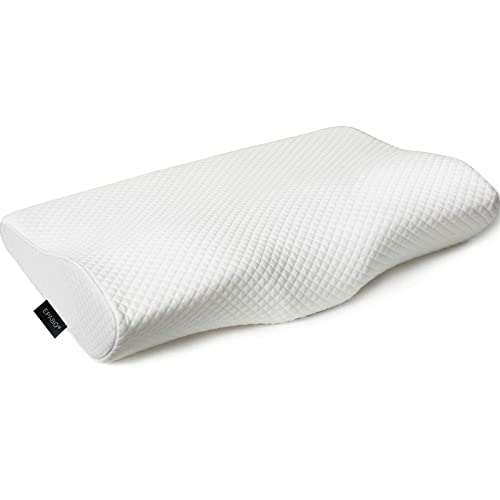
1. EPABO Contour Memory Foam Pillow — Best Overall
The EPABO is the contour pillow that has defined this category for years, and it remains the safest first recommendation for a side sleeper whose neck complains in the morning. Its listing describes an ergonomic contour memory foam pillow designed for side, back and stomach sleepers — the classic butterfly-style profile with a raised edge that sits under the neck and a dip where the head rests. For side sleeping, that raised edge is the point: it fills the shoulder gap and supports the neck curve while the head stays cradled rather than perched.
Strengths
- True contour profile: the neck edge and head cradle work together, which is the geometry side sleepers need.
- Memory foam moulds to your individual neck curve instead of presenting one fixed shape to every sleeper.
- One design serves side, back and stomach positions, useful if you change position through the night.
Trade-offs
- Fixed loft: if the contour height does not match your shoulder width, there is no layer to add or remove.
- Memory foam sleeps warmer than fibre or latex fills, and this is not the cooling-focused pick.
- The contoured shape feels unusual for the first few nights if you are coming from a soft hotel-style pillow.
| Mini spec box | |
|---|---|
| Fill | Memory foam |
| Shape | Ergonomic contour |
| Sleep positions (per listing) | Side, back and stomach |
| Loft adjustability | Not stated |
| Cooling features | Not stated |
The EPABO earns Best Overall because it gets the fundamentals right without gimmicks: a proven contour, honest memory foam, and a shape that has been refined over a long production run. It is the pillow to start with if you have never tried a cervical-style contour and your mattress is of medium firmness — on a very soft mattress your shoulder sinks deeper, effectively widening the gap, and you may need the taller or adjustable options below instead. Give any contour pillow a week of nights before judging it; necks adapted to years of a flat pillow rarely vote fairly on night one.
Best for: first-time contour pillow buyers and combination sleepers who spend most of the night on their side. / Not suited for: very broad-shouldered sleepers who need maximum loft, or hot sleepers who want a cooling cover. Check on Amazon
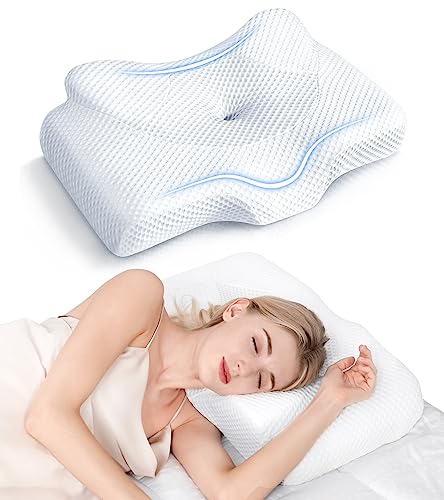
2. Osteo Cervical Pillow — Best Adjustable Fit
The Osteo takes the contour idea and adds two things side sleepers with sensitive necks often ask for: adjustability and a hollow centre. Its listing describes an adjustable memory foam pillow with a hollow design, an odorless foam and a cooling case. The hollow centre lets the back or side of the head settle into the pillow rather than riding on top of it, while the surrounding contour maintains support under the neck — a combination aimed at sleepers who find solid contour pillows push their head too far forward.
Strengths
- Hollow-centre design cradles the head, reducing the “perched” feeling of solid contour pillows.
- Adjustable construction lets you tune the feel instead of accepting one factory loft.
- Cooling case addresses memory foam’s warmth, and the foam is described as odorless — a real concern with new foam pillows.
Trade-offs
- The hollow design is a love-it-or-not shape; dedicated side sleepers who never roll to their back may prefer a firmer full contour.
- Adjustable pillows need a few nights of experimentation before they are dialled in.
- Cooling cases cool the surface, not the room — very hot sleepers should still compare the DONAMA.
| Mini spec box | |
|---|---|
| Fill | Memory foam, described as odorless |
| Shape | Hollow-design contour |
| Adjustability | Adjustable (per listing) |
| Case | Cooling case |
| Loft figures | Not stated |
Choose the Osteo if your main complaint with pillows is that they feel like a ramp shoving your head forward, or if you alternate between side and back sleeping and want the head cradled in both positions. The adjustability is its quiet advantage for neck comfort: small changes in loft change neck angle more than most people expect, and being able to tune at home beats ordering a second pillow. As with every pick here, treat it as a comfort aid — persistent symptoms deserve a professional opinion alongside any pillow change.
Best for: side-and-back combination sleepers and anyone who finds solid contour pillows too pushy. / Not suited for: sleepers who want a firm, high, one-piece contour with nothing to adjust. Check on Amazon

3. DONAMA Cervical Pillow — Best for Hot Sleepers
The DONAMA pairs a cooling contour with a dual-height profile, and that second feature is the side-sleeper detail: one edge of the pillow is taller than the other, so you sleep with the tall edge under your neck when on your side and can rotate to the lower edge if you roll onto your back. Its listing describes a cooling contour memory foam pillow with dual-height ergonomic neck support, aimed squarely at sleepers who run warm and wake with neck stiffness.
Strengths
- Dual-height profile: a taller edge for side sleeping, a lower edge for back sleeping, in one pillow.
- Cooling contour design targets the heat build-up that makes memory foam uncomfortable in summer.
- The contour keeps the neck supported at both heights rather than offering one shaped side and one flat side.
Trade-offs
- Two fixed heights still may not match every shoulder width; very narrow or very broad shoulders should compare the adjustable UTTU.
- Cooling features moderate foam warmth rather than eliminating it.
- Position changers must rotate the pillow when they roll, which some sleepers find disruptive at first.
| Mini spec box | |
|---|---|
| Fill | Memory foam |
| Shape | Cooling contour, dual-height |
| Height options | Two heights (dual-height profile) |
| Cooling features | Cooling design (per listing) |
| Exact loft figures | Not stated |
Heat is an underrated cause of bad neck nights: a warm sleeper tosses, folds the pillow, and ends up in twisted positions no contour can fix. The DONAMA attacks that chain at the start, and its taller edge gives side sleepers the loft that standard single-height contours often lack. It is the pick we would hand to a warm sleeper with a medium-to-firm mattress who mostly stays on one side but wants the option of the lower edge on back-sleeping nights.
Best for: hot sleepers and side sleepers who occasionally roll onto their back. / Not suited for: sleepers who need fully adjustable loft or who dislike rotating a pillow mid-night. Check on Amazon

4. UTTU Cervical Pillow — Best Height-Adjustable
The UTTU’s sandwich construction is the practical answer to the hardest question in pillow buying: what if the loft is wrong? Its listing describes an adjustable sandwich pillow with a contour cooling cover, made for side, back and stomach sleepers. Instead of a single moulded block, the layered design lets you change the pillow’s height — which means the pillow can be tuned to your shoulder width and re-tuned if you change mattresses, something fixed pillows simply cannot do.
Strengths
- Adjustable height via its sandwich construction — the strongest fit insurance in this guide.
- Contour shape with a cooling cover, combining shaping with surface temperature control.
- One pillow can serve different mattresses: raise it on a soft bed, lower it on a firm one.
Trade-offs
- Layered pillows feel slightly less uniform than a single moulded contour.
- Getting the height right takes experimentation over several nights.
- The contour is gentler than the EPABO’s, which dedicated side sleepers with wide shoulders may find insufficient at maximum setting.
| Mini spec box | |
|---|---|
| Fill | Memory foam |
| Construction | Adjustable sandwich layers |
| Shape | Contour |
| Cover | Cooling cover (per listing) |
| Sleep positions (per listing) | Side, back and stomach |
For neck comfort, adjustability is the closest thing to a fitting service a mail-order pillow can offer. Shoulder width varies by many inches across adults, mattress firmness changes the effective gap nightly, and the UTTU is the pick that respects both variables. Buy it if you have already returned a fixed-loft pillow for being too high or too low — the problem was probably not the category, it was the lack of adjustment — and expect to spend the first week finding your setting, after which it simply stays right.
Best for: sleepers between sizes, anyone changing mattresses, and buyers burned by fixed-loft pillows before. / Not suited for: sleepers who want a firm one-piece contour and zero setup. Check on Amazon

5. Bedsure Cervical Neck Pillow — Best Budget
Bedsure is a mainstream bedding brand, and its cervical neck pillow is the straightforward value entry here: memory foam with an orthopaedic-style contour that, in the listing’s words, gently cradles the head. There are no layers to adjust and no dual heights — just a shaped foam pillow at the accessible end of the category, which is exactly what some buyers want from a first experiment with contour sleeping.
Strengths
- Simple, proven contour concept from a known bedding brand, at the budget tier of this guide.
- Memory foam cradle supports the head without the complexity of adjustable systems.
- A low-risk way to test whether contour sleeping suits your neck before spending more.
Trade-offs
- Fixed shape and loft: no adjustment if your shoulders are unusually narrow or broad.
- No cooling features are stated in the listing.
- Budget foam typically softens faster over years than the denser foams in premium picks.
| Mini spec box | |
|---|---|
| Fill | Memory foam |
| Shape | Contour, head-cradling |
| Adjustability | Not stated |
| Cooling features | Not stated |
| Brand type | Mainstream bedding brand |
The Bedsure makes sense as the experiment pillow: if you are contour-curious but not ready to commit to a premium model, it tests the concept honestly. Its limits are the budget tier’s usual limits — fixed geometry, no cooling story — and average-shouldered side sleepers on medium mattresses are its natural audience. If the experiment succeeds and you later want adjustability or cooling, the UTTU and DONAMA above are the natural upgrades; if it fails, you have learned cheaply that your neck prefers a different shape entirely.
Best for: first-time contour buyers on a budget with average shoulder width. / Not suited for: hot sleepers, or anyone who needs to fine-tune loft. Check on Amazon

6. Royal Therapy Memory Foam Pillow — Best Measured Fit
The Royal Therapy earns its slot for a number most listings hide: its dimensions are stated right in the listing — 24x14x5 inches — for side, back and stomach sleepers. That 5-inch figure lets a side sleeper do the shoulder-gap maths described in the buying guide below before ordering, instead of guessing from words like “high loft”. Its contour cervical shape pairs with that stated loft to suit sleepers who want a defined, measurable specification.
Strengths
- Stated dimensions (24x14x5 inches, per listing) make pre-purchase fit checks possible.
- Contour cervical profile shaped for the neck curve, in a queen-format footprint.
- Memory foam moulds to the individual sleeper while holding the contour’s structure.
Trade-offs
- Fixed 5-inch loft: too much for narrow shoulders on a firm mattress, possibly too little for very broad shoulders on a soft one.
- No adjustability and no cooling features are stated in the listing.
- The 14-inch width is narrower than standard pillows, which position-changers may notice.
| Mini spec box | |
|---|---|
| Dimensions (per listing) | 24 x 14 x 5 inches |
| Fill | Memory foam |
| Shape | Contour cervical |
| Adjustability | Not stated |
| Cooling features | Not stated |
Do the measurement exercise in the how-to section, and if your shoulder-gap maths lands near five inches of needed support, the Royal Therapy is the most predictable buy in this guide — you know exactly what is arriving. It is also a useful reference purchase for households: one measured pillow teaches you your number, and every future pillow purchase gets easier. Sleepers whose maths lands far from five inches should take the hint and choose the adjustable UTTU instead of forcing a fixed size to fit.
Best for: buyers who measure first and whose shoulder gap suits a 5-inch loft. / Not suited for: sleepers who need cooling features or loft adjustment. Check on Amazon
Key Takeaways
- For side sleepers, pillow loft must fill the shoulder gap so the head and neck stay in line with the spine — contour shapes and taller edges exist to do exactly that.
- Adjustability (UTTU, Osteo) is the best insurance against buying the wrong height; dual-height designs (DONAMA) are the simpler alternative.
- Memory foam sleeps warm; cooling cases and covers (Osteo, DONAMA, UTTU) matter if heat makes you toss and twist.
- “Recommended” here means this guide’s selection on stated criteria — no pillow in this guide carries a medical endorsement, and persistent or radiating symptoms need a doctor.
- Measure your shoulder gap and factor in mattress firmness before choosing a fixed-loft pillow.
Comparison Table
| Pick | Badge | Key spec | Best for |
|---|---|---|---|
| EPABO Contour | Best Overall | Classic contour memory foam | First contour pillow, combination sleepers |
| Osteo Cervical | Best Adjustable Fit | Hollow design, adjustable, cooling case | Side/back sleepers who dislike pushy contours |
| DONAMA Cervical | Best for Hot Sleepers | Cooling contour, dual-height | Warm sleepers, mostly-side sleepers |
| UTTU Cervical | Best Height-Adjustable | Sandwich layers, cooling cover | Between-sizes sleepers, mattress changers |
| Bedsure Cervical | Best Budget | Memory foam contour, head cradle | Budget first experiment |
| Royal Therapy | Best Measured Fit | Stated 24x14x5 inch size | Buyers who measure their shoulder gap |
How to Choose a Pillow for Side Sleeping with a Sensitive Neck
Begin with the shoulder gap. Lie on your side on your own mattress, without a pillow, and have someone look from behind: your head wants to tilt down toward the bed, and the pillow’s job is to fill exactly that drop so your spine runs straight. Broad shoulders need more fill; narrow shoulders need less; a soft mattress lets the shoulder sink in and reduces the gap, while a firm mattress preserves it. This is why the same pillow can be perfect in a guest room and wrong at home — the mattress is half the system.
Then decide how you want to handle height uncertainty. If you know your number from a previous pillow that worked, buy a fixed contour near it (the Royal Therapy publishes its dimensions for exactly this). If you do not know, or your last pillow failed on height, buy adjustability (UTTU, Osteo) or a dual-height profile (DONAMA) so the fitting happens at home. Shape is the third decision: a pronounced contour suits committed side sleepers, while combination sleepers who roll onto their back usually prefer a hollow centre or gentler contour that does not push the head forward in the back position. Finally, temperature: if you wake hot, prioritise the cooling-case picks, because a sleeper who overheats will abandon any shape by 3 a.m. and finish the night in the twisted positions that caused the problem.
How to Measure Your Shoulder Gap and Set Up Your Pillow
- Lie on your side on your mattress, head on a folded towel stack instead of a pillow.
- Add or remove towel layers until your nose lines up with the centre of your chest and your head feels level, neither tilted up nor dropped.
- Measure the towel stack height — that is your approximate working loft on this mattress.
- Compare with stated pillow dimensions where available, and remember foam compresses under head weight, so effective loft is a little less than the tape-measure figure.
- With a contour pillow, position the raised edge under your neck, head resting in the cradle — not with the edge under your head.
- For dual-height pillows, start with the tall edge for side sleeping; rotate only if you settle onto your back.
- Judge after five to seven nights, not one — and change one variable at a time if you adjust layers.
Common Buying Mistakes
- Buying the tallest pillow “for support”. Excess loft tilts the head upward all night and is as unhelpful as too little; support means level, not high.
- Ignoring the mattress. A pillow fitted on a firm shop bed behaves differently on your soft mattress at home — measure on your own bed.
- Expecting a pillow to treat a condition. Pillows support comfortable alignment; ongoing pain, numbness or weakness needs professional assessment.
- Judging on night one. Necks adapted to an old pillow need several nights to vote fairly on a new shape.
- Folding or bunching a contour pillow. That defeats the shaping you paid for; if you need more height, choose an adjustable or taller model instead.
Final Recommendation
Start with the EPABO if you want the proven contour and your build is average; it is the reference point of this category for a reason. Choose the UTTU if height uncertainty is your real problem, the Osteo if solid contours push your head forward, and the DONAMA if heat ruins your nights. The Bedsure is the honest budget experiment, and the Royal Therapy is the pick for measurers whose shoulder gap matches its stated 5-inch loft. Whichever you choose, run the towel-stack measurement first and give the pillow a week — and keep the disclaimer from the introduction in view: these are comfort products chosen on transparent criteria, and a neck that keeps complaining despite a well-fitted pillow deserves a clinician’s attention, not a seventh pillow. For neighbouring needs, see also Best Cold Pillows For Side Sleepers, Best Bamboo Memory Foam Pillows, Best Affordable Firm Pillows, Best Back Side Pillows and Best 100 Down Pillows. Your neck spends a third of your life on this decision, so it deserves the measured approach this guide has laid out.
Side-Sleeping Positions and Where the Pillow Actually Goes
Most pillow disappointment is placement, not product. On a contour pillow, the raised edge belongs under your neck — in the curve between shoulder and head — with your head resting in the cradle beyond it. Sleepers who place the raised edge under their head itself end up with their neck unsupported and their chin pushed toward their chest, then blame the pillow. Check your position in a mirror or with a partner’s help on the first night: your ear should sit roughly above your shoulder, and you should be able to breathe with your chin in a neutral position, neither tucked nor tilted back.
Your shoulder position matters as much as the pillow. Side sleepers who roll slightly forward, half onto their stomach, twist the neck relative to the spine no matter what pillow they use; a body pillow or a pillow hugged in front can stop that forward roll and keep the top shoulder from dragging the neck with it. Sleepers who curl tightly into a foetal position shorten the shoulder gap, while straight “log” sleepers maximise it — another reason adjustable loft earns its keep for people whose position changes between falling asleep and waking. Finally, your free arm changes things: tucking a hand under the pillow raises its effective height on one side, a habit worth noticing before concluding a pillow is too tall.
Mattress Firmness and Pillow Loft: The Two-Variable Problem
Every pillow recommendation silently assumes a mattress. On a firm mattress, your shoulder stays high, the gap stays wide, and you need the pillow’s full loft — this is the scenario most showroom tests reproduce. On a soft or heavily topped mattress, your shoulder sinks several centimetres into the bed, the gap narrows by the same amount, and a pillow that was perfect in the shop now holds your head tilted upward all night. Memory foam mattresses sit between the extremes and change with temperature and age, which is why a pillow that suited a new mattress can feel wrong three years later without the pillow changing at all.
The practical responses are the ones built into this guide’s picks. Adjustable pillows (UTTU, Osteo) let you remove or add height when the mattress changes. Dual-height pillows (DONAMA) give you a second setting without opening the pillow up. Stated dimensions (Royal Therapy) let you compute the pairing in advance: towel-stack loft measured on your own bed, minus a little for foam compression, is the number to match. And if you split your nights between two beds — a partner’s firmer mattress, a guest room, a caravan — accept that one fixed pillow may not serve both, and either choose adjustability or keep a second pillow where the second bed is.
If a New Pillow Does Not Help: A Sensible Sequence
Suppose you measured, chose carefully, gave the pillow a fair week, and your neck still complains. Work through the cheap explanations first. Check placement again — contour pillows drift, and a pillow that has rotated so the low edge is under your neck supports nothing. Check the mattress for a sagging shoulder zone, which quietly changes the gap. Check your screen habits: eight hours of laptop hunch loads the neck far more than eight hours of sleep unloads it, and no pillow outruns a workstation problem. Check whether you are folding the pillow, sleeping with an arm under it, or combining it with a second pillow “for reading” that stays under your head all night.
If the basics are right and symptoms persist — and especially if there is numbness, weakness, pain travelling into an arm, or stiffness that is getting worse rather than better — the next step is a doctor or physiotherapist, not another product. This guide’s role is honest comfort shopping: helping you choose a well-made, well-fitted pillow on stated criteria. Diagnosis belongs to clinicians, and a reputable guide should say so plainly rather than implying a purchase will resolve a medical problem. Many readers will find a properly fitted contour pillow genuinely improves their mornings; the ones it does not help deserve a clearer answer than a bigger shopping list.
Contour, Dual-Height and Traditional Shapes Compared
It helps to see the three families in this category side by side. A classic single contour — the EPABO, Bedsure and Royal Therapy pattern — offers one shaped surface: raised neck edge, head cradle, fixed loft. It is the simplest to use and the easiest to manufacture consistently, and for the average side sleeper on a medium mattress it is usually enough. Its weakness is binary: the height either matches your shoulder gap or it does not, and the only fix is a different pillow. A dual-height contour, represented by the DONAMA, keeps the shaped surface but offers two edges of different heights, which quietly covers two body positions — side and back — and two mattress scenarios, at the cost of needing to orient the pillow correctly each night.
Adjustable designs — the UTTU’s layers and the Osteo’s adjustable hollow construction — trade simplicity for range. They fit the widest span of shoulders and mattresses, they adapt when you travel between beds, and they forgive measurement errors. Their costs are setup time and a slightly less monolithic feel. Traditional non-contour pillows, by contrast, rely on the sleeper bunching the fill into place; they can work for side sleepers who actively manage them, but the fill migrates during the night and the neck angle drifts with it, which is why this guide’s shortlist is entirely shaped designs. None of these families is a medical device; they are three engineering answers to one geometry problem, and the right choice is the one whose adjustment range covers your body and your bed.
Caring for a Memory Foam Contour Pillow
Foam care is mostly about protecting the shape you bought. Never machine-wash a memory foam core — water breaks down the cell structure and the pillow dries unevenly, losing the contour’s precision. Wash the removable case or cover instead, on the schedule you would wash any pillowcase, and use a pillow protector under it to keep oils and moisture away from the foam. Air a new foam pillow in a ventilated room before first use; even listings that describe their foam as odorless benefit from a day of airing, and the smell of fresh foam fades fastest with airflow rather than sprays.
Keep foam out of prolonged direct sunlight and high heat, both of which age it, and rotate the pillow end-to-end periodically if your model is symmetric so wear distributes evenly. Expect a quality foam contour to hold its working shape for a few years of nightly use; when the raised edge no longer springs back after pressure, or the cradle has developed a permanent hollow, the pillow has stopped delivering the geometry you measured for, and replacement matters more than usual in this category because the whole point of the product is its shape. A flattened contour pillow is not a neutral old pillow — it is a wrong-shaped one.
Matching the Picks to Specific Side-Sleeper Profiles
The broad-shouldered side sleeper is the most underserved profile in this category, because most fixed contours are built around average dimensions. If your shoulders are wide and your mattress is firm, start from the taller end of the range: the DONAMA’s tall edge, the UTTU at its higher settings, or the Royal Therapy’s stated 5-inch loft if your towel-stack measurement agrees. The narrow-shouldered or petite sleeper has the opposite problem — standard contours hold the head tilted upward — and should favour the adjustable picks at their lower settings, where the ability to remove height matters more than any shaping detail. Petite sleepers should also note pillow width: a very wide pillow can push against the shoulder and shorten the effective cradle.
The hot sleeper’s profile is defined by behaviour, not body shape: heat causes tossing, tossing causes position drift, and position drift undoes pillow geometry. For this reader the cooling cases on the Osteo and DONAMA and the UTTU’s cooling cover are not luxuries but the mechanism by which the pillow keeps working at 3 a.m. The traveller and the two-home sleeper should weight adjustability highest of all, because their mattress variable changes weekly. And the reader whose neck trouble began after a mattress change should suspect the pairing, not the pillow: re-run the towel measurement on the new bed before replacing a pillow that served you well on the old one. Across all profiles, the pattern is the same — identify which variable is actually yours (gap width, temperature, mattress, position drift) and let that variable choose the pick, rather than defaulting to the most popular model.
What Words Like “Cervical” and “Orthopedic” Mean on a Pillow Listing
Buyers deserve a plain translation of this category’s vocabulary. “Cervical” on a pillow listing simply means the pillow is shaped with the neck’s curve in mind — a raised support for the neck and a cradle for the head. It describes geometry, not a medical certification. “Orthopedic” is used even more loosely, generally signalling that a product is designed around body support rather than decoration. Neither word means a product has been tested as a medical device, prescribed by clinicians, or proven to treat a condition, and this guide has chosen its picks on the measurable features behind the vocabulary — shape, height options, adjustability, stated dimensions — rather than on the words themselves.
The same caution applies to comfort claims generally. A listing can promise many things; what you can verify before buying is construction. Read every category this way — vocabulary last, geometry first — and the marketing noise in this corner of bedding becomes much easier to shop through.
The Other Half of Side Sleeping: What Goes Between Your Knees
Side sleepers focused on their neck often miss that the pelvis talks to the neck through the whole spine. When the top leg drops forward and down across the bottom leg, the pelvis rotates, the lower spine twists, and that twist travels upward — one reason some side sleepers wake with both a stiff lower back and a stiff neck despite a good pillow. A slim pillow or folded cushion between the knees keeps the hips stacked and the spine’s line straighter from pelvis to head, letting the head pillow do its job on a stable foundation. It does not need to be a specialised product to test the idea: a spare bed pillow for a few nights will tell you whether your mornings change.
If the experiment helps, treat knee support as part of your pillow system when you shop: total sleep posture is a chain, and this guide’s head pillows are the top link, not the whole chain. If it makes no difference, you have ruled out a variable cheaply — which, as the measurement sections of this guide keep arguing, is how good bedding decisions actually get made.
One final practical note: buy your pillow when you can give it a fair trial — not the night before travel, a house move or a deadline week, when your sleep is disrupted for unrelated reasons and every conclusion you draw will be noise. A calm week, the towel measurement done once, and one variable changed at a time will tell you more about a pillow than a month of rushed, half-measured nights.
Frequently Asked Questions
What pillow height is right for a side sleeper?
The height that keeps your head level with your spine on your own mattress — which depends on your shoulder width and how much your shoulder sinks into the bed. Use the towel-stack measurement in this guide rather than a universal number; adjustable and dual-height pillows exist because no single figure fits everyone.
Are cervical pillows actually recommended by doctors?
This guide does not claim any medical endorsement for any product, and you should be sceptical of listings that imply one. Clinicians may suggest pillow changes as part of general comfort advice for some patients, but that is individual advice, not a product endorsement. “Recommended” in this guide means our own selection against published criteria.
How long does it take to get used to a contour pillow?
Typically several nights to a week. The shape holds your head and neck in a set position, which feels restrictive at first if you are used to a soft pillow you can punch into shape. Judge the pillow after a week of correct positioning, not after the first night.
Can the wrong pillow cause neck stiffness?
A poorly fitted pillow can contribute to morning stiffness by holding the neck tilted or unsupported for hours, which is why fit matters. But stiffness has many causes, and stiffness that persists, worsens, or comes with numbness, weakness or arm symptoms should be assessed by a doctor rather than attributed to bedding.
Memory foam or a traditional pillow for side sleeping?
Memory foam’s advantage is the moulded contour: it holds a shaped neck edge and cradle that fibre fills cannot maintain through the night. Its disadvantage is warmth, which the cooling-case picks in this guide address. If you strongly prefer a plush, scrunchable feel, a contour design may never suit you — fit and sleep quality beat category loyalty.
When should I replace my pillow?
When it no longer holds its shape or loft: fold a fibre pillow and see if it springs back, and check foam pillows for permanent compression or a contour that has flattened. A pillow that has lost its loft has quietly changed your neck angle, which is a common hidden cause of new morning stiffness.

