Disclosure: airfryerkitchensupply.com is reader-supported. When you buy through links on our site, we may earn an affiliate commission at no extra cost to you.
Where to buy
Every pick below for the best recommended can openers electric shoppers can buy is a verified, live Amazon listing matched to the exact model described. Electric can openers come in countertop, handheld battery, and rechargeable formats, and some models are sold in multiple colors under one listing — confirm the format and color before ordering. Prices change often in this category, so each pick links to the live listing instead of quoting a figure.
- Hamilton Beach Smooth Touch Electric Can Opener (76606AG) — the countertop benchmark — a push-down lever, smooth-edge side cutting, and a body tall enough for extra-tall cans.
- Cuisinart Deluxe Electric Can Opener (CCO-50BKN) — the value countertop classic — single-touch operation, a magnetic lid holder, and a removable lever that goes in the wash.
- Cuisinart Deluxe Stainless Steel Electric Can Opener (SCO-60) — the dressed-up countertop — brushed stainless housing and one-touch operation for standard cans, built to sit beside stainless appliances.
- Kitchen Mama Auto Electric Can Opener — the hands-free handheld — press one button and it walks around the can, cutting a smooth edge and stopping on its own.
- Canslab Ultrablade PRO Electric Can Opener — the modern rechargeable — USB charging, smart auto-stop, and a hands-free side cut designed for seniors with arthritis.
- Amazon Basics 3-In-1 Electric Can Opener — the three-in-one value pick — an electric opener with a bottle opener and knife sharpener built in, plus a magnetic lid holder.
Ask a room of home cooks for the best recommended can openers electric models and you will hear the same story told different ways: a hand that aches, a manual opener that slipped, a can of tomatoes needed at exactly the wrong moment. An electric can opener is not a luxury gadget; for anyone with arthritis, weak grip, or a pantry built on canned goods, it is the difference between cooking independently and asking for help. The six verified picks below cover the category’s three real formats — countertop plug-ins, battery handhelds that walk around the can, and modern USB-rechargeable models — because the right format depends on your hands, your counter, and your cans.
The mechanics split two ways. Traditional top-cut openers slice through the top of the rim, leaving an edge that can be sharp but a lid that lifts straight off. Side-cut (smooth-edge) openers cut below the rim, so the lid separates with no sharp edge on either the can or the lid — safer for fingers and for households with children, and the lid can even rest back on the can as a cover. Neither is objectively better; top-cut is faster and more universal, side-cut is safer and cleaner. The picks here include both, and each review says which you are getting.
What separates a recommended electric opener from a frustrating one is alignment and grip: how reliably the cutting wheel engages the rim, whether the magnet actually holds the lid, and whether the machine lets go of the can when the job is done. Every pick below was verified as a current, correctly matched listing, and each earned its place on those practical grounds rather than on novelty. If your hands hurt, start with the handhelds; if your counter has room and your cans are tall, start with the countertop models.
In this guide
Quick Picks
Six verified electric openers across countertop, battery handheld, and rechargeable formats — including smooth-edge options for arthritic hands.
- Best Overall: Hamilton Beach Smooth Touch Electric Can Opener (76606AG) — the electric opener most households should buy — smooth-edge safety with countertop power and reach.
- Best Budget Countertop: Cuisinart Deluxe Electric Can Opener (CCO-50BKN) — the countertop pick for tight budgets — simple, proven, and easy to keep clean.
- Best Stainless Countertop: Cuisinart Deluxe Stainless Steel Electric Can Opener (SCO-60) — for kitchens that want the appliance to match the suite — stainless looks with the same one-touch ease.
- Best Handheld for Arthritic Hands: Kitchen Mama Auto Electric Can Opener — the arthritic-hands favorite — no grip, no squeeze, no sharp edge, and it lives in a drawer.
- Best Rechargeable: Canslab Ultrablade PRO Electric Can Opener — the battery handheld grown up — recharge by USB, no disposable batteries, auto-stop when done.
- Best Multi-Tool Value: Amazon Basics 3-In-1 Electric Can Opener — one small appliance that opens cans and bottles and sharpens knives — the dorm and first-kitchen hero.
How These Picks Were Chosen
Every opener in this guide was cross-checked against Amazon’s live catalog: searched by brand and model, matched against the returned listing title, and recorded only when the match was certain. That verification matters in this category, where dozens of look-alike handhelds share names and stock photos; the picks here are the specific, identifiable models their listings claim them to be. Catalog prices were used only for internal tier placement and are never printed.
Picks were judged on the jobs an electric opener must do without drama: engage the rim on the first try, cut in one continuous pass, hold the lid with its magnet, release the can cleanly, and shut off when finished. We required a spread of formats — at least one countertop anchor, smooth-edge options for safety-led buyers, and cordless options for drawers and travel — and we favored models with detachable or washable cutting assemblies, because dried tomato juice in a cutter head is this category’s quiet hygiene issue.
A note on hands: for arthritic or weak hands, the decisive feature is not power but initiation — how little force starts the cut. The handheld picks below start with a button press and walk themselves around the can; the countertop picks need the can lifted and seated, which is its own consideration. The reviews are explicit about who each machine suits, because the best recommended electric can opener is the one its owner can use on a bad-hand day.
Two exclusions are worth stating. Manual openers, however excellent, are outside this search by definition — they have their own roundups on this site, and the comparison section above treats them fairly. And the long tail of unbranded handheld openers that flood this category with identical bodies and invented names was excluded on verification grounds: where a listing could not be matched with certainty to an identifiable model from a real brand, it did not matter how appealing the price looked. An opener is a safety-adjacent tool that meets a sharp edge a thousand times; the six above are the electric models whose identity, mechanism, and maker this guide could verify completely.
The 6 Best Recommended Can Openers Electric

Hamilton Beach Smooth Touch Electric Can Opener (76606AG) — Best Overall
The Smooth Touch is the electric can opener that owners recommend to each other, and the reason is its cut. Instead of slicing the top off inside the rim, it cuts along the side of the rim, so the lid lifts away whole and neither the can nor the lid presents a sharp edge. For households with children, arthritic fingers, or a healthy respect for tin edges, that difference is not a detail — it is the product. The lid can even be set back on the can as a temporary cover, a small grace no top-cutter offers.
As a countertop machine it is properly capable. The body is tall enough for extra-tall cans — the big tomato and stock cans that make lesser openers tip or stall — and it handles pop-top cans as well, for the cans whose tabs defeat weak thumbs. The push-down lever is the accessibility story: starting the cut takes a palm press rather than a grip and squeeze, and the machine does the rest in one smooth pass, holding the lid with its magnet when done.
The costs are counter space and commitment. This is a plug-in appliance that lives on the counter, and the side-cut mechanism has a one-can learning curve — seat the can as the design intends and it rewards you every time after. For a household that opens cans daily, those are trivial prices for the safest, most capable cut in the category. This is the benchmark the rest of the roundup is measured against.
Strengths
- Side-cut action leaves no sharp edge on can or lid — the safest cut in the roundup
- Tall body opens extra-tall cans that defeat most countertop rivals
- Push-down lever needs minimal hand strength to start the cut
Trade-offs
- Countertop footprint and a cord — it lives out, not in a drawer
- Side-cut lids can be fiddly the first few times you meet the mechanism
- Not the tool for travel or occasional use in a tiny kitchen
| Cut style | Smooth-edge side cut — no sharp edges |
| Can sizes | Standard, extra-tall, and pop-top cans |
| Operation | Easy push-down lever |
| Finish | Black and chrome |
Best for: daily can users, families, and anyone who wants smooth-edge safety with countertop power / Not suited for: drawer-only storage or travel use
Check the current price on Amazon

Cuisinart Deluxe Electric Can Opener (CCO-50BKN) — Best Budget Countertop
The CCO-50BKN is the countertop electric opener reduced to what matters, at a price tier that makes it the default recommendation for budget shoppers. Operation is genuinely single-touch: seat the can, press the activation lever down, and the machine cuts around and stops, holding the severed lid on its magnet so it does not drop into the food. For seniors and anyone with unreliable grip, that press-and-done simplicity is the entire argument, and Cuisinart has sold this design for years because it works.
Its smartest detail is the removable activation lever. The lever and cutter assembly are where can juice accumulates on any electric opener, and on most models they are fixed to the machine and wiped at best. Here the lever lifts off for a proper wash, which keeps the cutter cutting cleanly and the whole appliance hygienic — a feature buyers rarely shop for and owners always appreciate.
The compromises are format ones. It is a traditional top-cut opener, so the can’s edge is the usual tin edge — handle it with normal care. Its stature suits standard cans; the extra-tall stock cans belong to the Hamilton Beach above. And the black plastic build is honest rather than luxurious. None of that dents the verdict for its buyer: a simple, cleanable, dependable countertop opener at the friendliest tier in this roundup.
Strengths
- Single-touch operation — press the lever and the machine does the work
- Removable activation lever washes clean, a real hygiene advantage
- Compact countertop footprint at a budget tier
Trade-offs
- Traditional top cut leaves a sharper edge than side-cut rivals
- Standard can heights — very tall cans are the Hamilton Beach’s territory
- Plastic-forward build compared with the stainless SCO-60 below
| Operation | Single-touch automatic |
| Lid handling | Magnetic lid holder |
| Cleaning | Removable activation lever |
| Finish | Black |
Best for: budget shoppers, seniors, and small households opening standard cans / Not suited for: extra-tall cans or buyers who want a smooth-edge cut
Check the current price on Amazon

Cuisinart Deluxe Stainless Steel Electric Can Opener (SCO-60) — Best Stainless Countertop
The SCO-60 exists because countertop appliances are furniture whether we admit it or not. Its brushed stainless steel housing is designed to sit permanently beside a stainless range and refrigerator without looking like a plastic guest, and that is a legitimate reason to buy it: a can opener lives on the counter for a decade, and the one you enjoy looking at is the one that belongs there. Under the finish is Cuisinart’s established one-touch mechanism — seat the can, press, and the cut proceeds and stops automatically.
In use it has the planted, steady feel its metal housing promises. Standard cans — the soup, bean, vegetable, and pet food cans that make up nearly all real usage — are opened cleanly, and the housing wipes down without the staining and scuffing that age black plastic. For a household outfitting a kitchen properly and expecting to keep its appliances, the SCO-60 is the countertop pick that feels bought once.
The boundaries are printed in its own listing: standard-size cans. The extra-tall cans that the Hamilton Beach Smooth Touch swallows are beyond its brief, and its traditional top cut leaves the familiar edge rather than the Smooth Touch’s sealed-rim finish. It also costs more than its plastic sibling for the same underlying job. Buy it for the kitchen it will live in and the decade it will serve — judged that way, the premium is coherent.
Strengths
- Brushed stainless housing matches modern appliance suites and wipes clean
- One-touch operation with the heft to sit steady on the counter
- Cuisinart’s proven cutting mechanism in its premium housing
Trade-offs
- Standard-size cans only per its listing — tall cans need the Hamilton Beach
- Traditional top cut, with the usual edge to mind
- You pay for the finish; the CCO-50 cuts the same cans for less
| Housing | Brushed stainless steel |
| Operation | One-touch |
| Can sizes | Standard-size cans |
Best for: design-conscious kitchens wanting a permanent stainless countertop opener / Not suited for: extra-tall cans or the tightest budgets
Check the current price on Amazon

Kitchen Mama Auto Electric Can Opener — Best Handheld for Arthritic Hands
The Kitchen Mama Auto is the opener that changed this category’s accessibility story. You set it on the can, press one button, and let go: the little machine walks itself around the rim, cutting as it goes, and stops when the circuit is complete. There is no lever to press down, no handle to squeeze, no grip to sustain — which is why, for arthritic hands, post-surgery hands, or simply tired ones, it is the most recommended handheld in this roundup. The cut is a smooth-edge side cut, so the lid lifts off without a sharp rim on the can or the lid.
The format virtues compound. It is battery operated, so there is no cord and no counter footprint — it lives in the utensil drawer and comes out for one can or ten. It is food-safe in design, cutting outside the rim so the blade does not contact the food, which also keeps the mechanism cleaner than top-cutters that dip into the can’s contents. For small households, occasional can users, and anyone whose kitchen lacks spare counter, the handheld format is not a compromise at all.
Its limits are power logistics and pace. Batteries fade, and a fading battery mid-can is an annoyance a plug-in never has — keep a fresh set in the drawer and the problem mostly vanishes. It also works at a walking pace; a countertop machine is faster across a dozen cans for a big recipe. But measured by the standard that matters most to its buyers — can I open this can, alone, on a bad day, safely — the Kitchen Mama is the pick of this entire guide.
Strengths
- Truly hands-free — one button press and the opener does the entire job
- Smooth-edge cut is the safest option for weak or sensitive hands
- Lives in a drawer; no cord, no counter commitment
Trade-offs
- Battery powered — keep spares or accept the occasional mid-can fade
- Slower than a countertop machine on a big stack of cans
- Small body can be misplaced in a busy drawer — give it a home
| Format | Battery-operated handheld |
| Operation | Automatic, hands-free, one button |
| Cut style | Smooth edge |
| Storage | Drawer-sized, no counter footprint |
Best for: arthritic or weak hands, small kitchens, and drawer storage / Not suited for: high-volume can sessions or battery-averse households
Check the current price on Amazon

Canslab Ultrablade PRO Electric Can Opener — Best Rechargeable
The Ultrablade PRO takes the handheld concept and removes its oldest annoyance: the disposable batteries. It recharges by USB, like everything else in a modern kitchen, so the opener is either ready or visibly charging — never mysteriously dead in a drawer with a can half-open. For the seniors and arthritis sufferers it is explicitly designed for, that reliability matters as much as the cut itself. Set it on the can, start it, and the hands-free side cut proceeds around the rim and stops itself with its smart auto-stop when the circuit completes.
The side cut delivers the same smooth-edge safety as the other smooth-edge picks: no sharp rim on the can, no sharp edge on the lid, and a blade path that stays out of the food. The rechargeable format keeps the drawer-friendly size of the Kitchen Mama while adding the confidence of a device whose power you manage on a cable you already own several of. As a gift for a parent whose hands are changing — a genuinely common purchase in this category — it is the most thoughtfully specified option here.
Two honest caveats. A rechargeable battery still ages over years, and a forgotten charge means reaching for a manual backup, so households that open cans daily at volume may prefer the plug-in certainty of a countertop model. And Canslab is a younger name than the legacy brands anchoring this roundup, with a correspondingly shorter track record. For its intended buyer — hands-first, cordless, modern — those are acceptable trades for the most current design in the category.
Strengths
- USB rechargeable — no disposable battery drawer tax, ever
- Smart auto stop ends the cut precisely without supervision
- Side-cut smooth edge keeps fingers and food safe
Trade-offs
- A rechargeable is a device to manage — dead battery means a wait or a manual backup
- Newer brand than the Hamilton Beach and Cuisinart anchors — shorter track record
- Premium tier among handhelds
| Power | USB rechargeable |
| Operation | Hands-free with smart auto stop |
| Cut style | Side cut, smooth edge |
| Designed for | Seniors and arthritis-friendly use |
Best for: seniors, arthritis sufferers, and anyone who prefers rechargeable to disposable / Not suited for: high-volume daily use or buyers who want a decades-proven brand
Check the current price on Amazon
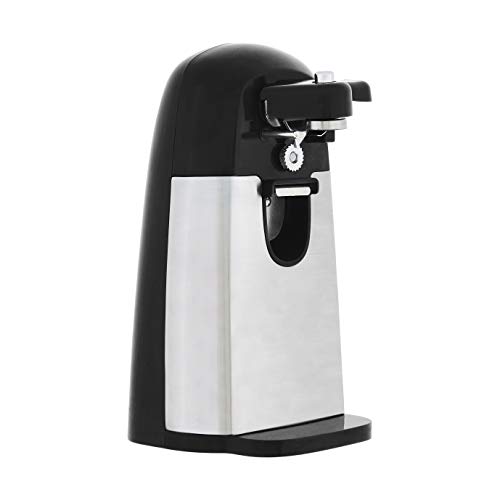
Amazon Basics 3-In-1 Electric Can Opener — Best Multi-Tool Value
The Amazon Basics 3-In-1 is the pragmatic pick: a compact countertop electric opener that also opens bottles and sharpens knives, at the most approachable tier in this roundup. For a first apartment, a dorm-adjacent kitchen, an RV, or a rental where every object must justify its storage twice, the consolidation is the value. The can opener itself is a straightforward traditional design — stainless steel cutting blade, magnetic lid holder to keep the lid out of the food — that handles the standard cans of daily life without ceremony.
The extra functions are honestly graded. The bottle opener is simply useful, full stop. The knife sharpener is a maintenance convenience — fine for keeping a working edge on everyday knives between proper sharpenings, not a substitute for a whetstone or a professional service for good blades. Treated as a bonus rather than a headline, it earns its space in the body.
As an opener, expect the standard top cut and a standard pace, in a basic build that will not out-feel the Cuisinarts. What it will do is open cans reliably for years in kitchens where budget and space rule, while quietly covering two other drawer jobs. Buyers with heavy daily volume or accessibility needs should look up-list; buyers equipping a small kitchen from scratch could do far worse than starting here.
Strengths
- Three tools in one compact body — ideal where storage is scarce
- Magnetic lid holder keeps the lid out of the food
- The friendliest price tier in this roundup
Trade-offs
- Traditional top cut — mind the edge
- The sharpener is a convenience feature, not a replacement for proper knife care
- Basic build; heavy daily users will graduate to the anchors above
| Functions | Electric can opener, bottle opener, knife sharpener |
| Blade | Stainless steel cutting blade |
| Lid handling | Magnetic lid holder |
Best for: first kitchens, small spaces, and value shoppers / Not suited for: accessibility-led buyers or heavy daily users
Check the current price on Amazon
Comparison Table
| Pick | Badge | Key spec | Best for |
|---|---|---|---|
| Hamilton Beach Smooth Touch Electric Can Opener (76606AG) | Best Overall | Smooth-edge side cut, extra-tall can capacity, push-down lever | daily can users, families, and anyone who wants smooth-edge safety with countertop power |
| Cuisinart Deluxe Electric Can Opener (CCO-50BKN) | Best Budget Countertop | Single-touch operation, removable activation lever | budget shoppers, seniors, and small households opening standard cans |
| Cuisinart Deluxe Stainless Steel Electric Can Opener (SCO-60) | Best Stainless Countertop | Brushed stainless housing, one-touch operation | design-conscious kitchens wanting a permanent stainless countertop opener |
| Kitchen Mama Auto Electric Can Opener | Best Handheld for Arthritic Hands | Battery handheld, hands-free, smooth-edge cut | arthritic or weak hands, small kitchens, and drawer storage |
| Canslab Ultrablade PRO Electric Can Opener | Best Rechargeable | USB rechargeable, smart auto stop, side cut | seniors, arthritis sufferers, and anyone who prefers rechargeable to disposable |
| Amazon Basics 3-In-1 Electric Can Opener | Best Multi-Tool Value | 3-in-1: opener, bottle opener, knife sharpener | first kitchens, small spaces, and value shoppers |
How to Choose the Best Electric Can Opener
Choose the format first, because it decides where the machine lives and how your hands meet it. Countertop plug-ins (the Hamilton Beach and both Cuisinarts here) offer the most power and stability and suit daily, multi-can cooking — at the cost of permanent counter space. Battery and rechargeable handhelds (the Kitchen Mama and Canslab) live in a drawer, travel anywhere, and ask the least of your hands — at the cost of battery management and a slower pace. Multi-tools like the Amazon Basics suit small kitchens where consolidation is the priority. None of these is the wrong answer; the wrong answer is buying a countertop machine for a kitchen with no counter, or a handheld for a household that opens fifteen cans every Sunday.
Choose the cut second. Top-cut openers slice inside the rim: fast, universal, and the lid lifts straight off, but both can and lid keep a tin edge. Side-cut smooth-edge openers slice below the rim: the lid comes off whole with no sharp edge anywhere, and can rest back on the can as a cover — the safer choice for children, weak hands, and anyone who has ever been cut by a can. If accessibility is your reason for going electric, the smooth-edge handhelds are the strongest expression of it: one button, no grip, no edge.
Then check the working details. A magnetic lid holder is close to essential — a lid dropped into the food is the category’s classic failure. A removable or washable cutter assembly (the Cuisinart CCO-50’s lever is the example here) keeps the machine hygienic. Tall households should confirm extra-tall can capacity, which only the Smooth Touch in this roundup claims. And if the opener is a gift for aging hands, prioritize initiation force — the effort needed to start the cut — over every other spec.
Electric vs. Manual Can Openers: An Honest Comparison
A good manual opener is cheap, immortal, and fits in any drawer, and for strong hands it remains a perfectly rational tool. The electric case rests on three facts. First, hands change: arthritis, injury, neuropathy, and simple aging turn a manual opener’s sustained grip-and-turn into the hardest task in the kitchen, while an electric asks for a button press or a lever push. Second, consistency: an electric makes the same cut on the fifteenth can as the first, where manual cuts degrade with fatigue. Third, the smooth-edge cut itself is far more common and reliable in electric form.
The manual case rests on different facts. No power, no batteries, no counter, no cost to speak of, and a decent manual opener will outlive three electrics. Many households sensibly own both: the electric for daily life, a manual in the drawer as the outage-and-camping backup. This guide’s recommendation is not that everyone electrify, but that anyone who has started dreading the can opener — or avoiding canned food because of it — should know the electric options have quietly become excellent, safe, and inexpensive.
One more consideration is the cans themselves. Modern cans increasingly ship with pop-top lids, which electric countertop models like the Smooth Touch also handle — useful when the pop tab itself is the problem for weak fingers. And for the very large cans of batch cooking, an electric’s steady torque beats a tiring hand every time. Match the tool to your hands and your pantry, and the can stops being an obstacle between you and dinner.
Can Opener Cutting Geometry: Why the Rim Matters
Every can in your pantry is sealed the same way: the lid is folded and crimped over the body’s rim in a double seam, and every opener is a strategy for defeating that seam. A top-cut opener drives its wheel inside the seam and slices the lid just within the rim, which is fast and universal — but it leaves the rim’s cut edge on the can and a matching edge on the lid, and the cutting wheel passes over the food’s surface. A side-cut opener drives its wheel outside the seam and slices horizontally through the seam’s outer wall, so the entire rim comes away with the lid as one smooth ring: neither piece presents a sharp edge, the wheel never touches the food, and the lid can sit back on the can as a cover. Understanding that geometry explains every design choice in this roundup — the Smooth Touch and the two handhelds cut from the side, the classic countertop models from the top, and each style’s fans are really voting on this paragraph.
The geometry also decides failure modes. Top-cutters fail by slipping off the rim mid-cut and by lids dropping into food when magnets are weak. Side-cutters fail by misalignment at the start — a can seated a few degrees off will not engage — which is why their learning curve is exactly one can long. Dented rims defeat both geometries impartially, and no opener of either style should be forced on a bulging can. When a review in this guide praises a model’s magnet or its seating, it is praising performance at this seam — the only place an opener actually works.
For households choosing between the styles, the deciding factors are hands and habits. Children, weak grip, and a preference for lids-as-covers point to side cutting. Speed, tall-can leverage, and decades of muscle memory point to top cutting. Both are legitimate engineering answers, and the worst purchase is not either style — it is a badly made example of the style you chose, which is what the verification behind this guide exists to prevent.
The Accessibility Case: Matching an Opener to Changing Hands
Grip strength and hand dexterity change across a life — through arthritis, injury, surgery, neurological conditions, and ordinary aging — and the can opener is often the first kitchen tool to announce the change, because its manual form demands the exact combination that fades first: sustained grip plus rotational force plus stabilization of a moving object. The electric category’s real product is not convenience; it is continued independence in the kitchen, and its formats map to stages of need with unusual clarity. A countertop lever model removes the rotation and the grip-squeeze, asking only for a downward press and a steady counter. A one-button handheld removes even that, asking only that the user place the device on the can and press — the opener supplies grip, force, and motion itself.
Choosing for another person — the parent, the recovering spouse — adds two considerations this guide’s reviews keep in view. The first is initiation: how the cut starts matters more than how it proceeds, because starting is where force concentrates. The second is failure behavior: an opener for changing hands should fail safely and obviously, never leaving a half-cut lid under tension or a can that must be wrestled. The handheld picks here were chosen with both tests in mind, and the countertop picks for their presses and magnets.
A final, practical kindness: if you are buying for hands that are changing, buy before the crisis and let the new opener be learned on a good day. The small learning curves in this category — seating a side-cutter, charging a rechargeable — are trivial when unhurried and miserable when a dinner depends on them. The best recommended electric can opener, for the person who needs it most, is the one already familiar in the drawer when the manual one becomes impossible.
How to Use an Electric Can Opener Safely and Keep It Clean
Electric openers are simple machines, and nearly every failure story in this category traces back to seating, cleaning, or one ignored habit. These steps apply across the countertop and handheld picks in this roundup.
- Seat the can correctly before starting. On a countertop model, the rim must engage the cutting wheel squarely — a can seated at an angle will cut a spiral instead of a circle. On a handheld, set the opener flat on the lid so its guide meets the rim, then press the button.
- Let the machine hold the can. Countertop models grip the can themselves once engaged; handhelds walk the rim under their own power. Your hand’s job is supervision, not force — if you are pushing, something is mis-seated.
- Respect the magnet. When the cut completes, lift the lid away with the magnet rather than fishing for it with fingers — that is what the magnet is for, and it keeps fingers off every edge, smooth or otherwise.
- Wipe the cutter after acidic foods. Tomato and fruit juices dry into a residue that dulls cutting wheels and feeds odors. A damp cloth on the cutter head after use — or a wash, where the assembly removes like the Cuisinart’s — keeps cuts clean for years.
- Store handhelds where you can find them, with power ready. A rechargeable lives near its cable; a battery model lives with a spare set of batteries in the same drawer. An opener you cannot find or power is a manual opener with extra steps.
- Never force a stalled opener or open a damaged, bulging can with any opener. A stalled cut means reseat and retry; a bulging can means the contents are unsafe regardless of the tool.
One final habit: run the occasional dented can with extra care or not at all. Dents on the rim defeat cutting wheels of every format, electric and manual alike, and a half-cut dented can is the sharpest object in this whole discussion. The opener is a convenience; your hands are not replaceable.
A final safety note deserves emphasis, because it is the one owners most often improvise wrongly: when an electric opener stalls or a cut goes wrong, the correct move is to stop the machine, lift the can free, and inspect — never to pry at a partially cut lid with a knife or fingers while the can is still engaged. A half-cut lid under tension is the sharpest object this category produces. Set the can down, open it the rest of the way with a manual opener if one is at hand, and treat the incident as information: a mis-seated can, a dented rim, or a cutter due for cleaning. The machine’s job is to make cans boring, and with that one discipline observed, they stay boring for years.
Common Buying Mistakes
Buying a countertop opener for a counter that cannot spare it. An electric opener that must be fetched from a cupboard and plugged in for every can will quietly stop being used. If space is tight, the drawer-sized handhelds in this guide are the honest format.
Ignoring the cut style. Top cut and smooth-edge side cut feel completely different in daily use — different edges, different lid behavior, different safety. Decide which you want before choosing the brand, not after the first can.
Skipping the magnet check. Listings that omit a magnetic lid holder are omitting the feature that keeps lids out of food. Every pick in this roundup holds its lid; hold any other candidate to the same standard.
Never cleaning the cutter. The cutter head touches every can you open. Dried juice dulls it and contaminates the next can’s rim. Wipe it, or choose a model whose lever assembly removes for washing.
Assuming electric means effortless for every hand. Countertop levers still need a press and cans still need lifting and seating. For the weakest hands, the one-button handhelds are the genuinely effortless option — match the machine to the hand, not the advertisement.
Final Recommendation
For most households, the Hamilton Beach Smooth Touch is the best recommended electric can opener: the smooth-edge cut, tall-can capacity, and easy lever make it the safest full-service machine here. Budget countertop shoppers should take the Cuisinart CCO-50, stainless kitchens the SCO-60, and multi-tool minimalists the Amazon Basics 3-In-1. Above all, hands that struggle should take a handheld — the Kitchen Mama Auto for battery simplicity, the Canslab Ultrablade PRO for rechargeable modernity — because the best opener is the one that opens the can on the worst hand day of the year.
Confirm the format and color on the listing before ordering, and check the current price on Amazon rather than trusting any figure quoted elsewhere. Then put the batteries or the cord where they belong, wipe the cutter after tomatoes, and let the smallest appliance in your kitchen quietly remove one of cooking’s oldest small miseries.
One last piece of advice before you order: think about the worst can, not the average one — the extra-tall stock can, the can on the day your hands hurt most, the can at the back of the pantry in February. Choose the opener that opens that can without a thought, and every ordinary can for the rest of the decade is already handled.
Keep exploring the cluster: Best Automatic Can Openers, Best Can Openers For Seniors, Best Battery Operated Can Openers, Best Clean Edge Can Openers, Best Affordable Can Openers, Best Auto Can Openers.
Frequently Asked Questions
Are electric can openers good for arthritis?
Yes — they are one of the most practical kitchen aids for arthritic hands. The easiest options are the one-button handhelds in this guide, the Kitchen Mama Auto and the Canslab Ultrablade PRO, which require no grip or squeezing at all. Countertop models with push-down levers, like the Hamilton Beach Smooth Touch, are the next easiest.
What is the difference between top-cut and smooth-edge openers?
A top-cut opener slices through the top of the lid inside the rim, leaving a conventional edge. A smooth-edge (side-cut) opener cuts below the rim, so the whole lid lifts off and neither the can nor the lid has a sharp edge. Smooth-edge is safer and lets the lid rest back on the can; top-cut is the traditional, slightly faster style.
Can electric can openers handle tall cans?
Countertop models vary. The Hamilton Beach Smooth Touch in this guide is explicitly built for extra-tall cans as well as standard and pop-top cans. Others, like the Cuisinart SCO-60, are specified for standard-size cans — check the listing against the cans your household actually buys.
Do handheld electric openers work as well as countertop ones?
For ordinary cans, yes — the cut quality of the handhelds here is excellent and their smooth-edge action is a genuine advantage. Countertop models win on pace across many cans and never need batteries or charging. The choice is format and hands, not cut quality.
How do I clean an electric can opener?
Unplug it or remove it from the can, then wipe the cutter head with a damp cloth after use — especially after acidic foods like tomatoes. Some models, like the Cuisinart CCO-50, have a removable lever assembly that can be washed properly. Never immerse a countertop opener’s body in water.
Should I keep a manual can opener as well?
It is a sensible backup for power outages, travel, and the rare misshapen can, and it costs almost nothing. Most households in this category run an electric daily and keep a manual in the drawer — the two are complements, not competitors.


