Disclosure: airfryerkitchensupply.com is reader-supported. When you buy through links on our site, we may earn an affiliate commission at no extra cost to you.
Where to buy
Every model in this roundup is sold on Amazon. Prices in this category move constantly with promotions, so instead of printing numbers that would go stale within weeks, each verified pick below links straight to its Amazon listing — use the links to check the current price on Amazon before you buy. Every product here was verified through this site’s Amazon product data feed on 2026-11-20, with each ASIN matched against the manufacturer’s model name before linking. One practical note: most battery operated openers ship without batteries, so check the listing for what the specific model needs before it arrives.
- Kitchen Mama Auto Electric Can Opener — check the current price on Amazon
- Kitchen Mama Auto 2.0 Electric Can Opener — check the current price on Amazon
- Zyliss EasiCan Electric Can Opener — check the current price on Amazon
- Mueller Home SmoothEdge Electric Can Opener — check the current price on Amazon
- Kitchen Mama Mini Plus Rechargeable Electric Can Opener — check the current price on Amazon
- Hamilton Beach FlexCut 2-in-1 Cordless Can Opener 76611FG — check the current price on Amazon
The best battery operated can openers solve a problem countertop machines cannot: they live in a drawer, travel in a picnic bag, and ask nothing of your wrists. You set the unit on top of the can, press one button, and it walks itself around the rim, cuts the lid free from the side, and stops — leaving an edge you can handle without thinking about stitches. For cooks with arthritis or weak grip, for small kitchens with no spare counter, and for anyone who has wrestled a manual opener over a dented can, that is a genuinely better tool.
The honest trade-offs deserve stating up front. Battery models are slower than plug-in machines, they depend on batteries or a charge, and they prefer standard cans to giant or badly dented ones. What you get back is total freedom of placement and the gentlest opening experience in the whole category — no cord, no counter space, no twisting, no squeezing.
All six picks below were verified against Amazon’s own product data for this site. They split into two camps: replaceable-battery handhelds that run for months on a set of AAs, and rechargeable or hybrid designs for people who never want to buy batteries again. We will tell you plainly which camp each pick belongs to and who should buy it.
It is worth pausing on who these tools quietly serve best. Beyond the obvious cases — arthritis, weak grip, post-injury recovery — battery operated openers suit anyone whose kitchen lacks a free outlet near the prep area, anyone renting who cannot justify countertop appliances, and anyone who opens cans where the cans are: at the picnic table, in the camper, beside the barbecue. Portability is not a niche feature of this category; for many households it is the entire reason to buy in.
Key Takeaways
- One button, no grip, no crank: battery handhelds are the gentlest way to open a can.
- Side cutting is the category standard — smooth lids, and the blade never touches food.
- AA models swap back to life in seconds; rechargeable models end battery purchases.
- Keep a manual backup for dented rims, the one job this format genuinely dislikes.
In this guide
Quick Picks
- Kitchen Mama Auto Electric Can Opener — Best Overall. The defining battery operated opener: set it on the can, press the button, and it travels the rim on its own, cutting a smooth edge and stopping by itself. Check the current price on Amazon.
- Kitchen Mama Auto 2.0 Electric Can Opener — Best Upgraded Blade. The second-generation Kitchen Mama with a refined blade for a cleaner cut, the same one-button hands-free travel and smooth-edge result. Check the current price on Amazon.
- Zyliss EasiCan Electric Can Opener — Best for Safe Lid Removal. A one-touch AA-powered opener from an established kitchen brand, with stainless blades and a built-in magnet that lifts the cut lid away safely. Check the current price on Amazon.
- Mueller Home SmoothEdge Electric Can Opener — Best for Seniors. A one-touch cordless opener with a smooth-edge cut and a magnet lid lifter, positioned squarely at seniors and anyone who wants zero hand effort. Check the current price on Amazon.
- Kitchen Mama Mini Plus Rechargeable Electric Can Opener — Best Rechargeable for Travel. A compact USB-C rechargeable version of the Kitchen Mama formula — hands-free auto stop, smooth edge, sized for travel bags and tiny drawers. Check the current price on Amazon.
- Hamilton Beach FlexCut 2-in-1 Cordless Can Opener 76611FG — Best Cordless for Big Cans. A rechargeable cordless opener with a removable walking cut head and easy-clean detachable blade, sized to open all can sizes including extra-tall. Check the current price on Amazon.
How These Picks Were Chosen
Every candidate was checked against Amazon listing data feed, matching ASIN to brand, model and listing title before any link was placed. Unverifiable listings and name-alike products were excluded rather than guessed at — in a category full of near-identical handheld openers sold under rotating brand names, that verification is the difference between a recommendation and a rumor.
We then ranked the verified field on the things that decide daily satisfaction: whether the cut is a smooth side cut, whether the unit stops automatically, how it handles the severed lid, battery format and replacement cost, and how the mechanism cleans after sticky cans.
We also checked the unglamorous details that listings bury: whether batteries are included (on the Zyliss, they are not — plan for it), whether the unit stops by itself or must be switched off mid-orbit, and whether the maker describes the cut as a true side cut. Models that were vague on those points lost ground to models that stated them plainly, because a buyer should not have to guess at the three facts that define the product.
- Verified listing: ASIN matched to brand and model before linking.
- Smooth-edge side cut preferred: safer lids, and the cutter stays out of the food.
- True hands-free operation: one button, self-propelled travel, automatic stop.
- Sensible power: common AA cells or USB charging, with honest running-cost notes.
- Lid control: magnets or grippers that keep the cut lid out of the food and off fingers.
The 6 Best Battery Operated Can Openers

Kitchen Mama Auto Electric Can Opener — Best Overall
The Kitchen Mama Auto is the product most people picture when they type this query, and it earns that status. It sits flat on top of the can, one press of the top button starts the motor, and the unit walks itself around the rim cutting from the side. The lid comes away with a smooth, touchable edge, the cutter never dips into the food, and the machine stops on its own when the circuit is complete. It runs on replaceable AA batteries, so there is no charging cable to lose and no waiting when the power fades — swap the cells and keep cooking.
Strengths
- True one-button, hands-free operation with automatic stop
- Side cut leaves a smooth lid edge and keeps the blade out of food
- Replaceable AA power means zero charging downtime
Trade-offs
- Batteries are a running cost corded models do not have
- Slower around the rim than a countertop plug-in machine
- Struggles more with badly dented rims than top-cut designs
Key specs
- Type: handheld battery operated, self-propelled
- Cut style: side cut, smooth edge
- Power: replaceable AA batteries
- Stop: automatic
The experience is what sells it. There is no alignment ritual and nothing to squeeze: center the opener on the lid, press, and watch it orbit. For arthritic hands this is transformative, because the two hardest parts of manual opening — the initial puncture and the sustained crank — simply disappear. The smooth edge matters just as much at the end, when the lid can be lifted and binned without a second thought.
Keep a spare set of AAs in the same drawer and the battery question becomes a non-issue for months at a time. Judged as a complete package — verified, simple, safe, and genuinely effortless — this is the battery operated opener we recommend first.
Best for: Arthritis, weak grip, small kitchens and drawer storage / Not suited for: High-volume can opening or very large cans
Check on Amazon — check the current price on Amazon before you buy; listings, bundles and included accessories change over time.

Kitchen Mama Auto 2.0 Electric Can Opener — Best Upgraded Blade
The Auto 2.0 is Kitchen Mama’s refinement of its own bestseller. The headline change is a refined blade geometry aimed at a cleaner, more consistent cut around the rim, wrapped in the same formula that made the original work: one button, self-propelled travel, smooth-edge side cutting, automatic stop, battery power. If you are buying your first handheld automatic opener and the price gap to the original is small on the day you shop, this is the version to get.
Strengths
- Refined blade for a cleaner, more even cut
- Same effortless one-button, hands-free operation
- Smooth-edge side cut keeps lids safe to handle
Trade-offs
- Incremental upgrade — original Auto owners gain little by switching
- Still battery-dependent with the same running cost
- Premium step within the brand’s own lineup
Key specs
- Type: handheld battery operated, self-propelled
- Cut style: side cut, smooth edge, refined blade
- Power: replaceable batteries
- Stop: automatic, hands-free
In practice the 2.0 feels a touch more decisive starting the cut and leaves a marginally tidier rim, particularly on thinner modern cans that can crumple under a blunt mechanism. Everything else — the orbit, the stop, the lid behavior — will be familiar to anyone who has used the original, which is exactly the point of a good second generation.
Choose between the two Kitchen Mama models on price on the day. The 2.0 is the better tool; the original is frequently the better deal. Our badge split reflects that: the original is the overall value anchor, this is the one to buy when you simply want the best version of the design.
Best for: First-time buyers who want the most refined version of the design / Not suited for: Owners of the original Auto looking for a big leap
Check on Amazon — check the current price on Amazon before you buy; listings, bundles and included accessories change over time.
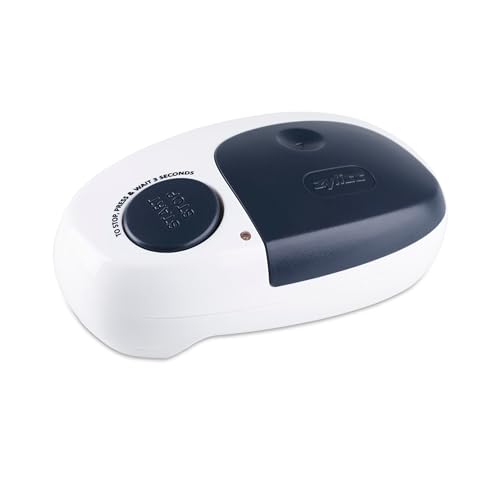
Zyliss EasiCan Electric Can Opener — Best for Safe Lid Removal
Zyliss has made can openers for decades, and the EasiCan applies that heritage to the battery format. It is a one-touch automatic: place it on the can, press, and it opens hands-free while stainless steel blades do the cutting. Its standout detail is the magnet for safe lid removal — once the cut completes, the lid stays with the opener instead of dropping into the food or waiting for your fingers. It runs on AA batteries, which are not included, so add a pack to your first order.
Strengths
- Magnet captures the lid for safe, touch-free removal
- Established kitchen brand with stainless steel blades
- Simple one-touch, hands-free operation
Trade-offs
- Batteries not included — budget for a set of AAs
- White housing shows splashes and needs a wipe to stay fresh
- Less widely stocked in colors and bundles than Kitchen Mama
Key specs
- Type: handheld battery operated, one-touch
- Blades: stainless steel
- Power: AA batteries (not included)
- Lid handling: built-in magnet
The magnet sounds like a footnote and behaves like a headline. The most dangerous moment in can opening is handling the severed lid, and the EasiCan removes that moment entirely: lift the opener, the lid comes with it, tip it over the bin, done. For households with kids helping in the kitchen, or anyone nervous around cut metal, that is a real safety system rather than a convenience.
Buyers who prioritize brand track record over the newest design language will feel at home here. It does everything the category promises — automatic, hands-free, battery powered — with the calm competence of a company that has shipped a lot of openers.
Best for: Safety-first households and brand-loyal buyers / Not suited for: Anyone who forgets to order batteries with it
Check on Amazon — check the current price on Amazon before you buy; listings, bundles and included accessories change over time.

Mueller Home SmoothEdge Electric Can Opener — Best for Seniors
The Mueller Home SmoothEdge takes the proven handheld formula — one touch, hands-free travel, smooth-edge cut — and pairs it with a magnet lid lifter so the entire opening sequence, from first press to lid in the bin, never asks anything of your hands. Mueller positions it for seniors, and the design backs that up: there is nothing to grip, squeeze, align precisely or fish out of the can afterwards.
Strengths
- Fully hands-free sequence including magnetic lid lifting
- Smooth-edge cut leaves no sharp lid to handle
- One-touch start suits limited hand strength and mobility
Trade-offs
- Newer name in the category than Kitchen Mama or Zyliss
- Battery running costs apply, as with all AA models
- Compact travel speed is unhurried compared with corded machines
Key specs
- Type: handheld battery operated, cordless
- Cut style: smooth edge
- Operation: one-touch, hands-free
- Lid handling: magnet lid lifter
What separates the senior-friendly picks from ordinary handhelds is the completeness of the hands-free chain. Many openers cut automatically but leave you pulling a sharp lid off the magnet-less top; the Mueller closes that gap with its lifter, so the user’s hands genuinely never meet metal. If you are buying for a parent, that completeness is the feature that matters.
It competes closely with the Kitchen Mama models on cutting and with the Zyliss on lid handling, and undercuts neither on drama — it simply combines both strengths in one black, drawer-friendly unit. A very sensible gift purchase, especially paired with the batteries it needs.
Best for: Seniors, gift buyers, and hands-free purists / Not suited for: Shoppers who prefer long-established brands only
Check on Amazon — check the current price on Amazon before you buy; listings, bundles and included accessories change over time.

Kitchen Mama Mini Plus Rechargeable Electric Can Opener — Best Rechargeable for Travel
The Mini Plus answers the one objection people raise to battery openers — the batteries — by going rechargeable over USB-C, the same cable that charges everything else in a modern travel kit. It keeps the family formula intact: hands-free operation, auto stop, and a smooth-edge cordless cut, in a compact body explicitly sized for travel. For RVs, camping kitchens, office drawers and holiday rentals, it is the easiest opener to pack and the hardest to leave behind.
Strengths
- USB-C rechargeable — no AA purchases, ever
- Compact body built for travel, RVs and small drawers
- Hands-free auto stop with smooth-edge cut
Trade-offs
- A flat battery means a wait to recharge, unlike an AA swap
- Compact size is happiest with standard cans
- Costs more upfront than basic AA handhelds
Key specs
- Type: handheld rechargeable, cordless
- Charging: USB-C
- Cut style: smooth edge
- Stop: hands-free auto stop
The travel case is where this pick runs away from the field. It weighs little, needs no outlet adapter beyond the USB-C cable already in your bag, and turns any rental kitchen’s can problem into a one-button task. At home it suits the minimalist drawer: one small red unit instead of a countertop machine.
The discipline it asks in return is charging awareness. Treat it like your phone — top it up occasionally rather than running it flat — and the rechargeable format beats disposables on both cost and waste. Frequent travelers and small-space livers should start here.
Best for: Travel, RVs, camping and minimalist kitchens / Not suited for: Forgetful chargers who prefer instant AA swaps
Check on Amazon — check the current price on Amazon before you buy; listings, bundles and included accessories change over time.

Hamilton Beach FlexCut 2-in-1 Cordless Can Opener 76611FG — Best Cordless for Big Cans
The FlexCut is the battery category’s answer to the tall-can problem. Most handhelds are happiest on standard cans; the FlexCut’s walking cut head is built to open all sizes, including extra-tall, while the whole unit runs cordless and rechargeable. The cutting head removes and the blade detaches for easy cleaning — a level of maintainability handheld openers rarely offer — and when docked it behaves like a slim countertop machine rather than a drawer gadget.
Strengths
- Opens all can sizes, including extra-tall, without a cord
- Removable cut head and detachable blade clean properly
- Rechargeable — no disposable battery costs
Trade-offs
- Largest and heaviest of the battery picks here
- Docked footprint gives back some counter space
- Premium tier pricing within the battery category
Key specs
- Type: cordless rechargeable, 2-in-1
- Cut head: removable automatic walking head
- Blade: detachable, easy clean
- Can range: all sizes, extra-tall included
Think of the FlexCut as a countertop opener that happens to run on a battery. That is its strength and its compromise in one sentence: you gain tall-can stability, a genuinely washable cutter and freedom from the outlet, and you give up the grab-and-go smallness of the Kitchen Mama and Mueller handhelds.
For a household whose cans run large and whose counters lack a spare outlet, it is not a compromise at all — it is the only pick here that fits. Everyone else should weigh whether all-size capacity is worth the extra bulk before paying the premium.
Best for: Tall cans, heavy users who hate cords, cleaning sticklers / Not suited for: Travel bags and the smallest drawers
Check on Amazon — check the current price on Amazon before you buy; listings, bundles and included accessories change over time.
Comparison Table
Use this table to compare the six verified battery operated picks at a glance — name, badge, defining specification and best-fit user. The power format of each model is stated in its full review, and it is the first thing to check once the table narrows your shortlist.
| Pick | Badge | Key spec | Best for |
|---|---|---|---|
| Kitchen Mama Auto Electric Can Opener | Best Overall | One-button hands-free side cut, AA powered | Arthritis, weak grip, small kitchens and drawer storage |
| Kitchen Mama Auto 2.0 Electric Can Opener | Best Upgraded Blade | Refined blade, hands-free automatic side cut | First-time buyers who want the most refined version of the design |
| Zyliss EasiCan Electric Can Opener | Best for Safe Lid Removal | Magnetic lid removal, AA powered, stainless blades | Safety-first households and brand-loyal buyers |
| Mueller Home SmoothEdge Electric Can Opener | Best for Seniors | One-touch cordless with magnet lid lifter | Seniors, gift buyers, and hands-free purists |
| Kitchen Mama Mini Plus Rechargeable Electric Can Opener | Best Rechargeable for Travel | USB-C rechargeable, compact travel size | Travel, RVs, camping and minimalist kitchens |
| Hamilton Beach FlexCut 2-in-1 Cordless Can Opener 76611FG | Best Cordless for Big Cans | All-size cordless cutting, removable washable head | Tall cans, heavy users who hate cords, cleaning sticklers |
How to Choose the Best Battery Operated Can Opener for Your Hands and Your Drawer
Decide your power strategy first, because it shapes the whole ownership experience. Replaceable AA models — the Kitchen Mama pair, the Zyliss and the Mueller — are always ready if you keep spare cells in the drawer, and a swap takes ten seconds. Rechargeable models — the Mini Plus and the FlexCut — eliminate battery purchases and waste, but ask you to remember an occasional charge. Neither is better in the abstract; match the choice to your habits honestly.
Then judge the cut and the lid. Every pick here cuts from the side for a smooth edge, which we recommend without reservation in this format: the blade stays out of the food and the lid is safe to touch. After that, look at lid handling — a magnet or lifter turns a good opener into a completely hands-free system — and finally at size: standard-can households can buy small, while tall cans push you toward the FlexCut.
Also consider who else will use the opener. In shared households, the best battery model is the one a guest, a teenager or a grandparent can operate correctly on the first try with no instruction: a single obvious button, a unit that seats in exactly one sensible way, and a stop that needs no judgment. Every pick here passes that test, but the Kitchen Mama and Mueller designs pass it most visibly — a real consideration if your kitchen hosts rotating cooks.
AA Batteries vs. Rechargeable: The Real Running Costs
Disposable AAs are the format’s quiet subscription. A handheld opener sips power — a set of cells typically lasts through months of ordinary family use — so the annual cost is small, but it is perpetual, and dead batteries always announce themselves mid-recipe. Alkaline cells also dislike being left in devices for years, so a little rotation discipline helps.
Rechargeable models fold that cost into a USB-C top-up you were already equipped for. Their built-in cells will slowly lose capacity over years of cycles, as all lithium cells do, but for a low-draw device like a can opener that timeline is long. Travelers gain the most: one cable standard, no hunting for AAs in a foreign supermarket. Homebodies who open cans daily may prefer the swap-and-go certainty of AAs. Both camps are well served in this list — the mistake is only buying against your own habits.
Why Side Cutting Dominates the Battery Category
Nearly every successful battery handheld cuts from the side, and the reason is mechanical sympathy. A top-cut design needs downward clamping force to pierce the lid, which a small battery motor and a lightweight body struggle to deliver consistently. A side-cut mechanism instead grips the rim seam and unrolls it, which suits a compact self-propelled unit perfectly.
The side effects are all pleasant: the lid edge is smooth, the cutter never contacts the food, and the lid can rest back on the can for short fridge storage. The one skill to learn is seating — the unit must sit flat and square on the lid before you press the button. Get that right once and every can after it is automatic.
Sizing Honestly: Standard Cans, Tall Cans and Dented Cans
Battery handhelds are engineered around the standard can, and on standard cans they are flawless. Tall cans ask more of the little motor and the rim grip; most models manage them slowly, and the FlexCut exists precisely for households where tall is normal. Very small cans, like tiny paste tins, can be too light for the unit’s weight distribution and may need a steadying finger on the can body — never on the lid.
Dented rims are the format’s true weakness. A side-cut mechanism follows the rim seam, and a crushed seam can stall it. Keep an inexpensive manual opener in the drawer for the occasional damaged can; using the right tool for that one job protects your battery opener’s blade for the thousand cans it handles beautifully.
Battery Operated Openers for Arthritis: What Actually Helps
Arthritis makes two specific motions painful: the squeeze-and-puncture that starts a manual opener, and the sustained twisting that drives it. A battery handheld eliminates both, replacing them with placement and a single button press. But not all automatic claims are equal — some designs still ask the user to hold the unit against the can throughout the cut, which reintroduces exactly the grip demand the buyer was escaping.
Every pick in this list travels and holds on by itself, which is why they are here. When shopping beyond this list, apply the same test ruthlessly: if a hand must grip, squeeze or steady the opener against resistance at any point, it is not an arthritis solution, whatever the packaging says. The magnet question matters too — a lid that must be pried off by fingernails undoes the benefit at the final step.
Travel, Camping and RV Kitchens: The Portable Case
A battery operated opener is one of the few kitchen electrics that genuinely travels. It needs no outlet, no voltage conversion abroad beyond its batteries, and no counter to call home. In an RV galley it replaces a manual opener that would otherwise be used over a sink the size of a dinner plate; at a campsite it opens the beans and the tomatoes with the same indifference to weather and wind that makes canned food the backbone of outdoor cooking in the first place.
Pack it like the tool it is: batteries in, blade guarded by its own body or a small pouch, and a spare set of cells in the same kit. Rechargeable owners should note that the Mini Plus in this list tops up from vehicle USB and power banks, which makes it the natural travel pick of the six.
When a Battery Opener Is the Wrong Tool
Honesty about limits protects both the reader and the tool. A commercial kitchen opening fifty cans a service needs a bench-mounted manual opener or a heavy-duty electric, full stop. A household whose cans are mostly the giant food-service size will fight a handheld’s geometry daily. And a cook who opens one can a month will find the batteries flat from self-discharge and age more often than from use.
For those readers, this category is the wrong shelf — and the cluster around this article, including the countertop automatic guide, covers the right ones. For everyone between those extremes, which is most home kitchens, the battery handheld is not a compromise purchase. It is the correctly sized tool.
Teaching the Household: The Two-Minute Onboarding
Battery operated openers fail socially before they fail mechanically: one household member tries it tilted, watches it stall, and announces that the gadget does not work. Prevent that verdict with a two-minute onboarding the day it arrives. Show the flat seating, the single press, the hands-off orbit and the magnetic lid lift — once, on one can, with the actual users watching.
Then put the manual opener in a different drawer. Not hidden, not banished — just no longer the path of least resistance. Within a week the battery unit becomes the household default, and within a month nobody remembers the learning curve existed. Tools this simple do not need manuals; they need one demonstration and a fair first week.
The Household Drawer Audit: Making Room for the Tool That Earns It
Every kitchen has the drawer — the one with the dead batteries, the takeaway menus from 2019, three mystery keys and a manual can opener with a loose handle. A battery operated opener asks for a home in that drawer’s front row, and the honest way to grant it is an audit: empty the drawer, return only what has been touched in six months, and let the opener take the prime position its daily use justifies. Owners who do this report the drawer itself becomes calmer, because the audit never stops at one tool.
Placement has a second dimension: proximity to the cans. Kitchens store cans in a pantry, a lazy Susan or a deep cupboard, and the opener should live within one step of that storage, not across the room near the stove. The two-second walk is trivial once and decisive a thousand times — tools migrate toward their materials, or they migrate toward disuse.
Finally, retire the old manual opener to backup status consciously rather than by drift. Keep it — dented cans will need it — but let the battery unit win the default position. Households that make the switch deliberately adapt in days; households that leave both in the front of the drawer split their usage for months and conclude, unfairly, that the new tool changed nothing.
Buying for Someone Else: A Short Field Guide
Battery operated openers are one of the most-gifted kitchen tools in this entire program, usually bought by adult children for parents whose hands have begun to object to manual openers. Gifted well, they are received as independence in a box. Gifted carelessly — no batteries, no demonstration, a model that still demands grip — they become drawer residents within a month, and the giver concludes wrongly that the parent ‘just prefers the old way’.
The protocol that works is unglamorous: include the batteries or choose a rechargeable model, open the first can together, and place the unit in the front of the drawer it will live in before you leave. If the recipient’s kitchen hosts a home-care aide or visiting family, show them too — a tool’s ecosystem is everyone who might reach for it. Follow that protocol and this category’s gift success rate approaches certainty; skip it and you are gambling on packaging to do a teacher’s job.
How to Use a Battery Operated Can Opener (and Make the Batteries Last)
The technique is simple, but a consistent routine gives cleaner cuts, longer battery life and a hygienic cutter. Follow these steps and the opener will feel effortless every time.
- Wipe the lid before you start. Storage dust sits exactly where the mechanism travels, and a quick wipe keeps it out of dinner.
- Seat the opener flat and square on top of the can, so its rim guides grip evenly. A tilted start is the main cause of a stalled or partial cut.
- Press the button once and take your hands away. The unit propels itself; holding it adds friction and can twist the cut.
- Let auto-stop finish the circuit. Interrupting mid-cut leaves a connected hinge of lid that tears into a sharp point.
- Lift the opener away with the lid attached or captured by its magnet, and tip the lid straight into the bin. Never pull a cut lid off with bare fingers if a magnet can do it.
- Wipe the cutter after every use, especially after fish, tomato or pet food. A damp cloth is enough; never submerge a battery unit, and dry it before it goes back in the drawer.
- Manage power deliberately: keep spare AAs in the same drawer for replaceable models, or top up rechargeable models when you notice the motor slowing — not after it stops mid-can.
- Store the opener dry and separate from loose cutlery, so the blade edge is not knocked around between uses.
If the motor slows or the unit stalls on a can it used to open easily, fresh power is the first fix — weak batteries mimic mechanical failure almost perfectly. If new batteries or a full charge do not restore it, clean the cutter wheel and rim guides thoroughly; dried residue adds more drag than most people expect. Only after both checks should you suspect the mechanism itself.
A note on storage that owners learn the hard way: keep the opener in the drawer nearest the stove or prep area, not in the drawer of miscellaneous batteries and takeaway menus. A tool that must be hunted for will be substituted by a manual opener and strong language, and its whole purpose is defeated by thirty seconds of searching. Front of the drawer, same place every time — that is the entire system.
Common Buying Mistakes
Buying batteries separately — later
Several models, the Zyliss EasiCan included, ship without batteries. Ordering the opener alone guarantees a frustrating first evening. Add the right cells to the same order and the problem never exists.
Holding the opener while it works
Hands-free means hands-free. Gripping or guiding the unit twists it against the rim, roughens the cut and can stall the motor. Press the button, step back, and let it orbit.
Expecting countertop speed
Battery handhelds trade speed for freedom. Judging them against a plug-in machine’s pace misses the point: they win on storage, portability and zero hand effort, not on seconds per can.
Forcing dented cans through
A crushed rim seam defeats side-cut mechanisms and can damage the blade. Keep a cheap manual opener for damaged cans instead of sacrificing your good automatic to one bad tin.
Leaving batteries in for years
Alkaline cells left indefinitely in a drawer device can leak and kill the contacts. If the opener will sit unused for months, remove the cells — or choose a rechargeable model and top it up occasionally.
Assuming the batteries are included
It bears repeating because it ruins first evenings constantly: check the listing. The Zyliss EasiCan explicitly ships without batteries, and other models vary. A two-second check at checkout is the difference between a delightful first use and a can of soup opened with a knife and regret.
Final Recommendation
Start with the Kitchen Mama Auto if you want the classic, proven answer: one button, smooth edge, AA power, drawer-sized. Step up to the Auto 2.0 if its refined blade is priced close on the day, and look at the Zyliss EasiCan or Mueller SmoothEdge if magnetic lid handling is your top priority — both make the whole sequence genuinely touch-free.
Choose the Kitchen Mama Mini Plus if you travel, camp or simply refuse to buy batteries again, and the Hamilton Beach FlexCut if your cans run tall and you want cordless power with a washable cutting head. Every pick is verified, so check the current price on Amazon through the links and buy the power format that matches your habits.
- Kitchen Mama Auto Electric Can Opener — Best Overall: Arthritis, weak grip, small kitchens and drawer storage. Check the current price on Amazon.
- Kitchen Mama Auto 2.0 Electric Can Opener — Best Upgraded Blade: First-time buyers who want the most refined version of the design. Check the current price on Amazon.
- Zyliss EasiCan Electric Can Opener — Best for Safe Lid Removal: Safety-first households and brand-loyal buyers. Check the current price on Amazon.
- Mueller Home SmoothEdge Electric Can Opener — Best for Seniors: Seniors, gift buyers, and hands-free purists. Check the current price on Amazon.
- Kitchen Mama Mini Plus Rechargeable Electric Can Opener — Best Rechargeable for Travel: Travel, RVs, camping and minimalist kitchens. Check the current price on Amazon.
- Hamilton Beach FlexCut 2-in-1 Cordless Can Opener 76611FG — Best Cordless for Big Cans: Tall cans, heavy users who hate cords, cleaning sticklers. Check the current price on Amazon.
Keep exploring the cluster: Best Automatic Can Openers, Best Battery Powered Can Openers, Best Cordless Can Openers, Best Can Openers For Seniors, Best Can Openers For Arthritis, Best Can Openers.
Frequently Asked Questions
How long do the batteries last in a battery operated can opener?
A set of quality AA cells typically powers months of normal family use, because opening a can takes under half a minute of motor time. Heavy daily use shortens that, and cheap cells shorten it further. The practical approach is simple: keep one spare set in the drawer and the question stops mattering.
Are battery operated openers strong enough for big cans?
They handle standard and moderately tall cans well, but they work harder and slower as cans grow. If family-size and extra-tall cans are your routine, the Hamilton Beach FlexCut in this list is built for all sizes; otherwise a countertop plug-in model is the better big-can tool.
Do these openers leave sharp edges?
The picks in this roundup cut from the side, so the removed lid has a smooth edge and the can rim is the folded seam — both are safe to handle casually. That is one of the main reasons the battery category standardized on side cutting.
Can I take a battery operated can opener camping or in an RV?
Yes — that is one of its best uses. It needs no outlet, stores in a drawer or kit box, and the rechargeable Mini Plus in this list tops up from the same USB-C power banks and vehicle ports you already carry. Just pack spare batteries for AA models.
Why does my opener stop halfway around the can?
The usual causes are tired batteries, a tilted start, or a dented rim seam. Fit fresh power, reseat the unit flat and square, and try again. If the rim is visibly crushed, finish that can with a manual opener — forcing it risks the blade.
Are battery operated openers good for arthritis?
They are arguably the best opener type for arthritis. There is no grip to squeeze, no handle to crank and no lid to pry — you place the unit, press one button, and lift the lid away by its magnet. Look for the models here with magnetic lid handling for the fully touch-free experience.
Can a battery operated opener open pull-tab cans whose tab has snapped off?
Yes — that is one of its most useful tricks. Seat it on the lid exactly as you would on a plain can; the side-cut mechanism engages the rim seam regardless of the tab’s condition. It is worth keeping the opener accessible for precisely these emergencies, which tend to happen mid-recipe.


