Disclosure: airfryerkitchensupply.com is reader-supported. When you buy through links on our site, we may earn an affiliate commission at no extra cost to you.
Where to buy
Every model in this roundup is sold on Amazon. Prices in this category shift constantly with promotions, so instead of printing numbers that would go stale within weeks, each verified pick below links straight to its Amazon listing — use the links to check the current price on Amazon before you buy. Every product here was verified through this site’s Amazon product data feed on 2026-11-20, with each ASIN matched to the manufacturer’s model name first. Read the listing’s power details carefully before ordering: some of these openers run on replaceable AA cells, others on built-in rechargeable batteries, and the ownership experience differs more than the cutting does.
- Canslab Ultrablade PRO Electric Can Opener — check the current price on Amazon
- Canslab Ultrablade SE Electric Can Opener — check the current price on Amazon
- Kitchen Mama Auto 2.0 Electric Can Opener — check the current price on Amazon
- Kitchen Mama Mini Plus Rechargeable Electric Can Opener — check the current price on Amazon
- Zyliss EasiCan Electric Can Opener — check the current price on Amazon
- Hamilton Beach FlexCut 2-in-1 Cordless Can Opener 76611FG — check the current price on Amazon
Shoppers searching for the best battery powered can openers are really asking a power question: what keeps the motor turning — disposable cells you swap in seconds, or a built-in rechargeable battery you top up over USB? The cutting side of these machines has largely converged on the same excellent formula of one-button, hands-free, smooth-edge side cutting. The power source is where the real differences in cost, convenience and lifespan now live, so this guide is organized around it.
The honest framing first. Disposable AA models never wait for a charge and their power is effectively immortal as long as you stock cells, but they carry a small perpetual running cost. Rechargeable models end the battery purchases and the waste, but a flat unit mid-recipe is a dead unit until it has sipped some charge. Both camps contain excellent openers; the mistake is buying one camp while living the other camp’s habits.
All six picks below were verified against Amazon’s own product data for this site, including two rechargeable Canslab models found through this batch’s live API searches. We will name each pick’s power format in its first paragraph so you can shop the list by the only specification that truly divides it.
There is also a generational story in this category worth naming. The first battery powered openers were novelties — underpowered, short-lived, and bought as gifts that ended in drawers. The current generation, represented by every pick here, is engineered seriously: refined blades, smart auto-stop logic, USB-C charging and brands competing on lid safety. If your opinion of battery openers was formed a decade ago, this list is an invitation to update it with evidence.
Key Takeaways
- The real choice is the power format: swappable AA cells versus built-in USB rechargeables.
- Cutting has converged — nearly every good model side-cuts, auto-stops and controls the lid.
- Charge anxiety is solved by storage: a visible, fixed home beats a bigger battery.
- Frequent users save most with rechargeable; occasional users may rationally prefer AAs.
In this guide
Quick Picks
- Canslab Ultrablade PRO Electric Can Opener — Best Overall Rechargeable. A USB rechargeable handheld with smart auto stop and a hands-free side cut, plus a wall-mountable design that gives a drawer tool a proper home. Check the current price on Amazon.
- Canslab Ultrablade SE Electric Can Opener — Best USB-C Value. The USB-C rechargeable sibling: smooth-edge cordless cutting sized for small and large cans, in a simpler, value-tier package. Check the current price on Amazon.
- Kitchen Mama Auto 2.0 Electric Can Opener — Best Replaceable-Battery Pick. The refined-blade second-generation Kitchen Mama: one-button hands-free cutting on swap-in-seconds AA power. Check the current price on Amazon.
- Kitchen Mama Mini Plus Rechargeable Electric Can Opener — Best Compact Rechargeable. Kitchen Mama’s travel-sized rechargeable: USB-C charging, hands-free auto stop and a smooth-edge cut in the smallest body here. Check the current price on Amazon.
- Zyliss EasiCan Electric Can Opener — Best for Lid Safety. An AA-powered one-touch opener from a heritage kitchen brand, with stainless blades and a magnet that removes the cut lid for you. Check the current price on Amazon.
- Hamilton Beach FlexCut 2-in-1 Cordless Can Opener 76611FG — Best for All Can Sizes. A rechargeable cordless machine with a removable walking cut head and detachable washable blade, built to open every can size including extra-tall. Check the current price on Amazon.
How These Picks Were Chosen
Candidates were verified feed, matching each ASIN to brand, model and listing title before linking. This batch also ran live API searches specifically to widen the rechargeable field beyond the usual AA handhelds, which is how the Canslab Ultrablade pair earned their places alongside the established names.
Ranking then weighed power format and its ownership costs, cut quality and lid safety, auto-stop behavior, size range across cans, and how the cutter cleans — because a battery powered opener lives in a drawer, and drawer tools only survive if they stay pleasant to use.
One methodological note specific to this article: because power format is the organizing question, we verified each pick’s power source from its listing title or listing details before assigning it to a camp, and we say the format in the first lines of every review. A rechargeable model mislabeled as AA — or the reverse — would invert the buying advice, so that single fact got the same verification care as the ASIN itself.
- Verified listing: ASIN matched to brand and model before linking.
- Power format stated plainly for every pick: replaceable AA or built-in rechargeable.
- Smooth-edge side cut and automatic stop as the baseline cutting standard.
- Lid control: magnetic capture or lifting so hands never meet cut metal.
- Drawer practicality: size, cleaning method and storage behavior all considered.
The 6 Best Battery Powered Can Openers

Canslab Ultrablade PRO Electric Can Opener — Best Overall Rechargeable
The Ultrablade PRO is the rechargeable camp’s flagship in this list. It charges over USB, cuts hands-free from the side for a smooth edge, and its smart auto stop ends the cycle the moment the lid is free — no grinding, no guesswork. The detail that quietly changes ownership is wall mountability: instead of rattling around a drawer, the PRO can live on a wall or cabinet door, charged, visible and ready. For seniors and arthritic hands, the whole interaction is one placement and one press.
Strengths
- USB rechargeable — disposable battery costs end entirely
- Smart auto stop finishes the cut cleanly every time
- Wall-mountable storage keeps it charged and findable
Trade-offs
- A fully flat battery cannot be swapped back to life instantly
- Wall mounting asks for a suitable spot near the prep area
- Newer specialist brand than the legacy names in this list
Key specs
- Type: handheld rechargeable, cordless
- Charging: USB
- Cut style: side cut, smooth edge
- Stop: smart auto stop; storage: wall mountable
Rechargeable openers live or die on whether owners actually charge them, and the PRO’s design quietly solves that behavioral problem: a mounted, visible tool gets topped up the way a phone on a nightstand does, while a drawer-buried one gets forgotten until it dies mid-can. If you mount it where you prep, the flat-battery scenario mostly stops existing.
The cutting performance matches the format’s best — a smooth side cut, hands fully clear, lid under control. Buyers who want the rechargeable life without its one classic failure mode should start here.
Best for: Rechargeable converts who will actually mount and top up the tool / Not suited for: Anyone who wants instant AA-swap recovery
Check on Amazon — check the current price on Amazon before you buy; listings, bundles and included accessories change over time.

Canslab Ultrablade SE Electric Can Opener — Best USB-C Value
The Ultrablade SE keeps the essential rechargeable formula — a built-in battery topped up over USB-C, cordless automatic travel, smooth-edge cutting — and aims it at value. It is rated for small and large cans alike, which not every compact handheld can claim, and its charging standard is the modern one: the same USB-C cable that charges your phone and earbuds resurrects this opener. For buyers who want off the disposable-battery treadmill without paying flagship prices, this is the sensible entry point.
Strengths
- USB-C charging matches the cables you already own
- Handles small and large cans in one compact body
- Smooth-edge cut with fully cordless, automatic operation
Trade-offs
- Fewer refinements than the PRO — no wall-mount system
- Rechargeable downtime applies if run completely flat
- Specialist brand without the legacy names’ long track record
Key specs
- Type: handheld rechargeable, cordless
- Charging: USB-C
- Cut style: smooth edge
- Can range: small to large cans
The SE is the pick we would hand a first-time rechargeable buyer. Its proposition is arithmetic: the modest premium over an AA model is repaid by never buying cells again, and the USB-C port means the charger is never the missing piece. In daily use it behaves like the category standard — seat, press, orbit, stop — with the lid edge smooth enough to handle without ceremony.
Choose the PRO instead if the wall-mount storage and smart stop refinements appeal; choose the SE if you want the rechargeable essentials done well for less. Either way, you have left the battery aisle behind.
Best for: Value-minded buyers leaving disposable batteries behind / Not suited for: Buyers who want the PRO’s mounting and smart-stop extras
Check on Amazon — check the current price on Amazon before you buy; listings, bundles and included accessories change over time.

Kitchen Mama Auto 2.0 Electric Can Opener — Best Replaceable-Battery Pick
If your answer to the power question is ‘cells I can replace the second they fade,’ the Auto 2.0 is the strongest expression of that camp. Its refined blade cuts a clean, smooth edge as the unit travels the rim hands-free, it stops automatically, and when the motor eventually slows, a fresh set of AAs restores full power in seconds — at midnight, mid-recipe, with no cable and no wait. That instant-recovery property is the disposable format’s enduring advantage, and this model wraps it in the category’s most polished AA design.
Strengths
- Instant power recovery — swap cells, keep cooking
- Refined blade for a clean, consistent smooth-edge cut
- Proven one-button, hands-free, auto-stop operation
Trade-offs
- Batteries are a perpetual small running cost
- No USB fallback when the drawer spare set runs out
- Premium step over the original Kitchen Mama Auto
Key specs
- Type: handheld battery powered, self-propelled
- Power: replaceable batteries
- Cut style: side cut, smooth edge, refined blade
- Stop: automatic, hands-free
There is a temperament divide in this category, and the Auto 2.0 serves one side of it perfectly: people who would rather stock a consumable than manage a charge state. In homes that open cans daily, that preference is rational — the opener is a utility, and utilities should never be ‘on the charger’ when dinner depends on them.
Pair it with a standing habit — a spare set of cells in the same drawer, rotated yearly — and the format’s weaknesses effectively vanish. This is the AA pick we recommend without hesitation.
Best for: Daily users who prize instant, swappable power / Not suited for: Buyers determined to end battery purchases
Check on Amazon — check the current price on Amazon before you buy; listings, bundles and included accessories change over time.

Kitchen Mama Mini Plus Rechargeable Electric Can Opener — Best Compact Rechargeable
The Mini Plus takes Kitchen Mama’s proven hands-free formula and shrinks it around a USB-C rechargeable battery. The result is the most portable serious opener in this list: compact enough for a travel kit or the shallowest drawer, yet still fully automatic with auto stop and a smooth-edge cut. It is explicitly designed with seniors and arthritis in mind, so the one-button interaction asks nothing of grip strength at any point.
Strengths
- Smallest, most packable body in the roundup
- USB-C rechargeable — one cable standard for travel
- Hands-free auto stop and smooth-edge cut retained in full
Trade-offs
- Compact size suits standard cans best
- Rechargeable format punishes forgetful chargers
- Costs more than basic AA handhelds of similar cut quality
Key specs
- Type: handheld rechargeable, cordless, compact
- Charging: USB-C
- Cut style: smooth edge
- Stop: hands-free auto stop
Where the Canslab PRO optimizes the rechargeable life at home, the Mini Plus optimizes it in motion. It is the opener for the RV drawer, the holiday-let kitchen bag, the office lunch kit and the boat galley — anywhere a can might need opening far from a stocked battery drawer. USB-C means the power bank you already travel with is its spare battery.
At home it doubles as the minimalist’s primary opener, provided your cans are standard size and your charging habits are phone-like. Match those two conditions and it is arguably the most modern tool in this entire guide.
Best for: Travelers, RVers and compact-kitchen minimalists / Not suited for: Tall-can households or charge-and-forget owners
Check on Amazon — check the current price on Amazon before you buy; listings, bundles and included accessories change over time.
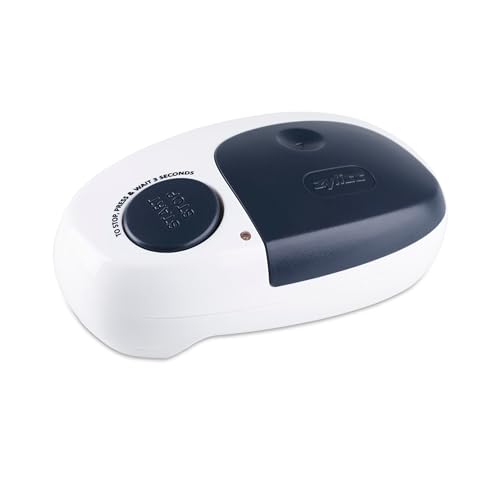
Zyliss EasiCan Electric Can Opener — Best for Lid Safety
The EasiCan represents the traditional end of battery power: AA cells, a one-touch button, stainless steel blades and a brand that has shipped can openers for generations. Its signature is the magnet for safe lid removal — the severed lid stays captured and lifts away with the unit, so the sharpest object in the process never needs a fingertip. Note that batteries are not included; order a set of AAs alongside it.
Strengths
- Magnetic lid capture makes removal completely touch-free
- Heritage brand with stainless steel cutting blades
- Dead-simple one-touch, hands-free operation
Trade-offs
- Batteries not included in the box
- White finish needs wiping to stay presentable
- AA running costs, as with all replaceable-cell models
Key specs
- Type: handheld battery powered, one-touch
- Power: AA batteries (not included)
- Blades: stainless steel
- Lid handling: built-in magnet
Safety analysis of can opening always ends at the same moment: a person holding a freshly cut lid. The EasiCan is engineered around deleting that moment, and for households with children helping, elderly users, or anyone who has ever been nicked by a lid, that focus is worth more than marginal differences in cut speed.
It is also the comfort pick for buyers who distrust newcomer brands. The power format is old-fashioned in the best sense — ubiquitous cells, instant swaps, no firmware, no cables — wrapped around a genuinely modern hands-free cut.
Best for: Safety-first and brand-trusting buyers / Not suited for: Anyone who will forget the separate battery purchase
Check on Amazon — check the current price on Amazon before you buy; listings, bundles and included accessories change over time.

Hamilton Beach FlexCut 2-in-1 Cordless Can Opener 76611FG — Best for All Can Sizes
The FlexCut is what happens when a countertop-opener maker goes battery powered without downsizing its ambitions. The rechargeable unit opens all can sizes — extra-tall included — using a removable automatic walking cut head, and the blade detaches for the kind of real washing most handhelds never get. It is the heavy-duty end of the battery category: bigger than the drawer handhelds, and capable in ways they are not.
Strengths
- All-size capacity, including extra-tall cans, with no cord
- Removable head and detachable blade for proper cleaning
- Rechargeable power with countertop-class stability
Trade-offs
- Bulkiest battery powered pick — not a travel tool
- Premium pricing at the top of the category
- Recharge pauses apply, unlike an AA swap
Key specs
- Type: cordless rechargeable, 2-in-1
- Cut head: removable automatic walking head
- Blade: detachable, easy clean
- Can range: all sizes, extra-tall included
Two ownership problems quietly kill battery openers: they meet a can too big for them, and their cutters get too gunked to enjoy using. The FlexCut is engineered against both — all-size capacity on one side, a washable cutter assembly on the other. That makes it the battery pick for serious home cooks rather than occasional users.
The trade is portability, and it is a fair one to refuse if your life is standard cans and small drawers. But if you want one battery powered machine that behaves like a full appliance, this is the only candidate in the category that truly does.
Best for: Heavy users, tall cans, and cleaning perfectionists / Not suited for: Travel kits and minimal drawers
Check on Amazon — check the current price on Amazon before you buy; listings, bundles and included accessories change over time.
Comparison Table
The six verified picks, side by side: model, badge, defining specification and best-fit owner. Because this article is organized around power format, the table’s ‘best for’ column is the fastest route to your camp — AA-swap certainty or rechargeable freedom — before the reviews settle the model.
| Pick | Badge | Key spec | Best for |
|---|---|---|---|
| Canslab Ultrablade PRO Electric Can Opener | Best Overall Rechargeable | USB rechargeable, smart auto stop, wall mountable | Rechargeable converts who will actually mount and top up the tool |
| Canslab Ultrablade SE Electric Can Opener | Best USB-C Value | USB-C rechargeable, small-to-large can range | Value-minded buyers leaving disposable batteries behind |
| Kitchen Mama Auto 2.0 Electric Can Opener | Best Replaceable-Battery Pick | Refined blade, AA-swap instant recovery | Daily users who prize instant, swappable power |
| Kitchen Mama Mini Plus Rechargeable Electric Can Opener | Best Compact Rechargeable | USB-C rechargeable in a travel-compact body | Travelers, RVers and compact-kitchen minimalists |
| Zyliss EasiCan Electric Can Opener | Best for Lid Safety | Magnetic lid removal, AA powered, stainless blades | Safety-first and brand-trusting buyers |
| Hamilton Beach FlexCut 2-in-1 Cordless Can Opener 76611FG | Best for All Can Sizes | All-size cordless power, washable detachable blade | Heavy users, tall cans, and cleaning perfectionists |
How to Choose the Best Battery Powered Can Opener by Power Source, Not Just by Brand
Choose your camp first. Replaceable-cell openers (Kitchen Mama Auto 2.0, Zyliss EasiCan) offer instant recovery and zero charge management, at the price of buying batteries forever. Rechargeable openers (both Canslab models, the Mini Plus, the FlexCut) end the purchases and the waste, at the price of remembering an occasional top-up. Be honest about which inconvenience you would rather live with — that answer is your shortlist.
Within your camp, choose by cans and by cleaning. Standard cans suit everything here; tall cans point to the FlexCut. Lids are safest where a magnet captures them, as on the Zyliss. And if sticky cans are routine — tuna, tomato, pet food — a detachable, washable cutter like the FlexCut’s will keep the tool pleasant long after sealed mechanisms have gone gummy.
Geography deserves a vote too. If the opener will live in a second home, a boat or a caravan that sits unvisited for months, replaceable cells removed for storage are the robust choice — a rechargeable left flat for a season may not forgive the neglect. If it will live in a kitchen you use daily, that scenario never arises and the rechargeable convenience runs unopposed. Buy for the building the tool will actually sleep in.
The Total Cost of ‘Free’ Power: A Five-Year View
An AA-powered opener’s purchase price is only the first chapter. A household opening cans daily might cycle several sets of cells a year; a light user might make one set last well over a year. Either way the five-year battery bill is real but modest — comparable to a handful of coffees — and it buys absolute readiness. Rechargeable models invert the ledger: a higher upfront price, then effectively free operation, with the caveat that the built-in cell slowly ages whether you use it or not.
The environmental column follows the same shape. Rechargeables win clearly for frequent users, because dozens of avoided disposable cells outweigh one built-in battery. For very light users the math tightens — a rechargeable cell aging in a drawer is its own kind of waste. Frequency of use, more than ideology, should pick your format.
Charge Anxiety Is a Design Problem, Not a User Failure
The standard complaint about rechargeable openers — ‘it was flat when I needed it’ — is usually a storage failure wearing a battery costume. Tools that live visibly get charged; tools buried in drawers get forgotten. That is why the Canslab PRO’s wall mounting matters more than its spec sheet suggests, and why the Mini Plus’s USB-C port matters: charging from the cable already on your counter is a habit, while finding a proprietary charger is a chore.
If you choose rechargeable, engineer the habit on day one: a fixed home, a cable within reach, and a top-up rhythm tied to something you already do monthly. Do that and the format’s one weakness largely disappears.
Motor Power Is Not the Bottleneck — Rim Grip Is
Shoppers compare battery openers by motor claims, but field failures rarely involve power. They involve grip: a unit that cannot hold the rim seam evenly will stall, wander or leave the lid hinged, on any battery chemistry. Weight distribution, rim-guide geometry and blade sharpness decide success far more than wattage, which is why the established designs in this list outperform anonymous high-spec rivals.
Your part of the bargain is a flat, square seating and a wiped lid. Give a good mechanism a clean rim and full contact, and even the smallest rechargeable here will orbit a can without drama. Technique, in this category, is half the machine.
Battery Chemistry, Briefly and Honestly
Replaceable-cell openers run on alkaline AAs: cheap, everywhere, shelf-stable for years, and happiest being swapped the moment the motor note drops. Their weakness is leakage when abandoned in a device for years, and a slow self-discharge that punishes the once-a-month user. Lithium primary AAs exist for those who want longer shelf life and cold-weather performance, at a higher per-cell cost.
Rechargeable models use built-in lithium-ion cells: high energy in a small body, topped up over USB, and slowly aging whether used or not. For a low-draw device the aging timeline is long, but it is real — a rechargeable opener is a five-to-eight-year appliance by chemistry, while an AA opener’s body can outlive several generations of cells. Neither fact should scare anyone; both should inform the choice.
The Drawer Test: Storage Decides Whether Cordless Works
Every cordless tool passes or fails the same examination: when you reach for it, is it where you expect, and is it ready? Countertop machines pass by definition — they never move. Battery powered openers pass only by household discipline. The models that help you pass are the ones with a storage story: the Canslab PRO’s wall mount, the Mini Plus’s tiny footprint that fits the front of any drawer, the FlexCut’s docked presence.
Before buying, decide the tool’s home — a specific drawer front, a specific wall spot — and buy the model whose storage design matches it. This sounds like interior decorating and is actually the highest-leverage decision in the whole purchase, because a ready opener gets used and a buried one gets replaced by a manual and a sigh.
Safety Profile: Battery Powered vs. Manual and Corded
Measured by kitchen injuries, the humble can lid is a repeat offender, and format changes the risk profile materially. Manual openers concentrate risk in the hands throughout the cut; corded countertop machines remove the hands but add a powered appliance to the counter; battery handhelds remove the hands and keep the energy source small, sealed and low-voltage.
The residual risks in this format are mundane: a unit started accidentally in a drawer (store it blade-guarded and it is a non-event), and batteries accessible to small children in AA models (treat spare cells like the choking and ingestion hazard they are, and store them high). Managed with ordinary care, this is the safest can-opening format in the kitchen — one more reason it has become the default recommendation for older cooks living independently.
What Happens at End of Life: Disposal and Recycling, Done Right
Battery powered tools create two waste streams and both have correct exits. Disposable alkaline cells go to battery recycling collection points — most supermarkets and hardware stores host them — and never into general waste. Rechargeable models eventually retire as whole devices: their built-in cells make them e-waste, and they belong in electronics recycling, where the lithium cell and motor metals are recovered rather than landfilled.
The greener calculation, though, starts at purchase. A rechargeable opener that serves seven years displaces hundreds of disposable cells; an AA opener that serves fifteen displaces several rechargeable devices. Longevity is the environmental variable that dwarfs the chemistry debate, which is one more reason this guide ranks build and brand accountability alongside power format. Buy the one you will keep, keep it well, and recycle it properly at the end — in that order.
Power Habits of Happy Owners: Field Notes From Both Camps
Talk to long-term owners in each camp and their routines sound like mirror images. The AA households describe a drawer ritual: a labeled box of cells, a swap performed without looking up from the stove, and a vague awareness that the opener ‘just always works’. Their satisfaction is the satisfaction of infrastructure — the tool behaves like plumbing, invisible until the one day a decade it is not.
The rechargeable households describe a charging corner: a cable that lives by the fruit bowl or the mounted dock by the pantry door, and a top-up folded into some existing rhythm — the first of the month, the day the water filter changes, the evening the bins go out. Their satisfaction is the satisfaction of a maintained system, closer to the pleasure of a sharp knife than of a utility. Neither group envies the other, which is the strongest evidence that the format choice is about temperament, not technology.
The unhappy owners in both camps share one trait, and it is not the camp: they never built the ritual. Their cells are somewhere, their cable is somewhere else, and the opener is wherever it died. If this article persuades you of anything beyond a model name, let it be this — decide the ritual when you decide the machine, and write the spare set or the charging spot into the same shopping trip.
The Ten-Second Test: Evaluating Any Battery Opener in a Store or Listing
Readers who shop beyond this list — a sale, a gift card, a model we did not cover — need a portable evaluation method, and this category conveniently reduces to a ten-second test. First, find the power format stated in plain language; if a listing will not say whether the unit takes AAs or charges by USB, walk away, because that omission is diagnostic. Second, find the words ‘side cut’ or ‘smooth edge’; their absence means a top cut with a sharper lid. Third, find the auto-stop; an opener you must supervise is only half automatic.
Fourth, look for the lid’s fate — a magnet, a lifter, or silence on the subject, in descending order of desirability. Fifth and finally, weigh the brand’s accountability: a named maker with a support channel, against an alphabet-soup label that will not exist next year. Five checks, ten seconds each, and you have reproduced the essential logic this entire guide applied at length. The category is not complicated once its five load-bearing facts are known — which is, of course, why listings that hide them should be read as answers in themselves.
How to Get the Best From a Battery Powered Can Opener
Battery powered openers reward a small amount of routine. These steps keep cuts clean, power ready and cutters hygienic across both power formats.
- Start with a clean, dry lid. Wipe storage dust off the can top so the rim guides grip metal, not grime.
- Seat the opener flat and square. Even contact around the rim is what lets a small motor do a big job.
- Press once and let go. The unit propels and steers itself; guiding it by hand adds drag and twists the cut.
- Wait for the auto stop or the full circuit. Interrupting leaves a hinge of lid that tears into a sharp tab.
- Use the magnet or lifter to move the lid to the bin. Fingers are the backup tool, never the first choice.
- Wipe the cutter after sticky contents, and dry the unit before storing. Never submerge a battery powered opener.
- Keep power boring: a dated spare set of AAs in the drawer for cell models, or a fixed charging spot and monthly top-up for rechargeable models.
- Retire tired rechargeables and disposables responsibly — cells of both kinds belong in battery recycling, not household trash.
Troubleshooting follows a fixed order: power first, cleanliness second, mechanism last. A slow or stalling unit almost always needs fresh cells, a charge, or a thorough cutter clean — in that order — before it needs replacing. Work through those two cheap fixes and you will retire very few openers prematurely.
Keep a tiny log if you choose rechargeable and want to kill charge anxiety forever: note the date of each top-up on a sticky note inside the cabinet door. Most owners discover their real interval is measured in months, not weeks — and once you know your number, you will never think about the battery again, which is exactly the state of mind this category promises.
Common Buying Mistakes
Choosing the power format against your habits
Forgetful chargers buy rechargeable and suffer flat batteries; stockpilers buy AA models and resent the cells. The formats are equally good — the mismatch is the mistake. Audit your actual behavior before you shop.
Judging by motor specifications
Wattage and torque claims do not predict success in this category; rim grip and blade quality do. A proven design with modest specs beats an anonymous powerhouse every week of the year.
Skipping the battery purchase
The Zyliss EasiCan and many AA models ship without cells. An opener that cannot run on delivery day is a self-inflicted disappointment — add batteries to the same order.
Storing the opener where you cannot see it
Out of sight means out of charge and out of mind. Rechargeable models especially should live visibly — mounted, docked or front-of-drawer — so their power state is never a surprise.
Forcing the format onto every can
Battery handhelds are standard-can specialists. Crushed rims and the very largest cans belong to a manual backup or a countertop machine; forcing them dulls blades and drains motors for no benefit.
Mixing old and new disposable cells
When one cell in a set fades, replacing only that cell leaves mismatched capacities that drain unevenly and can leak. Swap the full set together, every time — it costs pennies more and protects the contacts that the whole device depends on.
Final Recommendation
If you want the rechargeable life done best, the Canslab Ultrablade PRO is our first recommendation, with the Ultrablade SE as the value route into USB-C power and the Kitchen Mama Mini Plus as the travel-sized version of the same idea. If your cans run large, the Hamilton Beach FlexCut stands alone in this format for all-size capacity and washable parts.
If you prefer power you can swap in seconds, the Kitchen Mama Auto 2.0 is the AA camp’s flagship, and the Zyliss EasiCan adds the category’s most thoughtful lid safety from a heritage brand. Every pick above is verified — check the current price on Amazon through the links, pick your power camp honestly, and the opener will take care of itself.
- Canslab Ultrablade PRO Electric Can Opener — Best Overall Rechargeable: Rechargeable converts who will actually mount and top up the tool. Check the current price on Amazon.
- Canslab Ultrablade SE Electric Can Opener — Best USB-C Value: Value-minded buyers leaving disposable batteries behind. Check the current price on Amazon.
- Kitchen Mama Auto 2.0 Electric Can Opener — Best Replaceable-Battery Pick: Daily users who prize instant, swappable power. Check the current price on Amazon.
- Kitchen Mama Mini Plus Rechargeable Electric Can Opener — Best Compact Rechargeable: Travelers, RVers and compact-kitchen minimalists. Check the current price on Amazon.
- Zyliss EasiCan Electric Can Opener — Best for Lid Safety: Safety-first and brand-trusting buyers. Check the current price on Amazon.
- Hamilton Beach FlexCut 2-in-1 Cordless Can Opener 76611FG — Best for All Can Sizes: Heavy users, tall cans, and cleaning perfectionists. Check the current price on Amazon.
Keep exploring the cluster: Best Battery Operated Can Openers, Best Automatic Can Openers, Best Cordless Can Openers, Best Can Openers For Seniors Battery Power, Best Can Openers For Arthritis, Best Can Openers.
Frequently Asked Questions
What is the difference between battery operated and battery powered can openers?
In practice, nothing — retailers use the terms interchangeably for cordless openers that run on cells rather than mains power. The distinction that actually matters is inside the category: replaceable AA models versus built-in rechargeable models, which differ in running cost and readiness rather than in how they cut.
How many cans can a rechargeable opener open per charge?
Manufacturers’ figures vary by model and can size, and real numbers depend on battery age, so treat any single figure cautiously. What matters practically is that even a modest charge covers weeks of normal household opening — the risk is not capacity, it is forgetting to top up, which a fixed charging spot solves.
Can I leave batteries in the opener all the time?
For a regularly used opener, yes — that is its normal state. For storage beyond a few months, remove disposable cells to eliminate leak risk, and give rechargeable models an occasional top-up, since lithium cells dislike sitting completely flat for long periods.
Do battery powered openers work on square or oval cans?
They are designed around round rims and work best there. Most will manage oval cans slowly with a steadying hand on the can body, but square and strongly rectangular tins are manual-opener territory. Keep an inexpensive manual backup for those shapes and for dented rims.
Are rechargeable can openers worth the extra cost?
For frequent users, yes: the battery savings repay the premium, and USB charging removes the dead-opener problem when it is paired with a fixed charging spot. For very occasional users, a simple AA model can be the more rational buy, because its cells wait patiently in a way aging rechargeable batteries do not.
Why does my opener chew the paper label instead of cutting?
The unit is seated too low or tilted, so its wheel is tracking the label rather than the rim seam. Lift it off, reseat it flat and square on the lid with the guides on the rim itself, and restart. A wiped, dry lid also helps the guides grip where they should.
Can I use rechargeable AA batteries inside an AA-powered opener?
Generally yes, and it is a sensible hybrid: you keep the instant-swap format while ending disposable purchases. Use quality NiMH cells and keep a charged spare set, since NiMH’s slightly lower voltage can make a tired motor feel weaker sooner than alkalines do. Never mix rechargeable and disposable cells in the same set.
My rechargeable opener’s battery no longer holds a charge. Can it be replaced?
On most sealed handheld models, the built-in cell is not user-replaceable — that is the honest cost of the format’s compactness, and it is why this guide treats a rechargeable opener as a multi-year appliance rather than a lifetime one. Before concluding the battery has died, run the boring checks: a full overnight charge on a known-good USB source, and a thorough cutter cleaning, since a gummed mechanism mimics a weak battery almost perfectly. If performance is still poor, the device belongs in e-waste recycling, and its replacement decision should revisit the format question — a household that wore out a rechargeable through heavy use has proven itself exactly the kind of user the AA camp, or the FlexCut’s heavier build, serves best.


