A raised planter lifts the soil to table or waist height, which suits a patio, deck or balcony where there is no ground to dig. The main differences are material (wood, resin or metal), size, drainage and whether it rolls. Trellis versions add height for climbing plants.
The six planters below range from a compact resin bed with a water gauge to a large metal box with a trellis and locking wheels. Sizes, materials and features come from each product’s listing page. We have not used these planters ourselves. Durability claims are the makers’ own.
As an Amazon Associate we earn from qualifying purchases. Links below are affiliate links, and they do not change the product information we give.
What to Look For
| Feature | Why it matters |
|---|---|
| Material | Wood, resin and galvanized metal weather differently |
| Planting depth | Root crops and vegetables need more soil than herbs |
| Drainage | Holes or a plug let excess water out |
| Wheels | Casters make it easy to follow the sun, but check for locks |
In this guide
Specs at a Glance
| Planter | Size | Material | Notes |
|---|---|---|---|
| OYEAL 32 inch | 32 in tall (width not stated) | Metal frame, plastic boxes | Four pots; trellis; removable tray; no tools needed |
| Keter Urban Bloomer | 32.3 x 14.7 x 30.7 in; 12.7 gal | Resin | Water gauge, reservoir and drainage plug |
| Best Choice 48 x 24 x 30 | 48 x 24 x 30 in | Fir wood | Bed liner; drainage; 200 lb capacity |
| Rolling 32 inch | 38.2 x 14.56 x 32.2 in | Metal | Wheels, handle and storage shelf |
| Land Guard 2 pack | 36 x 12 x 32 in each | Galvanized steel | 21.8 gal each; wheels; 300 lb capacity |
| GarveeLife | 71 x 47 x 16 in | Galvanized, powder-coated metal | Trellis; 15.7 in deep bed; four wheels, three locking |
The 6 Best Raised Planters for Patios
Top pickBest for herbs and flowers on a porch
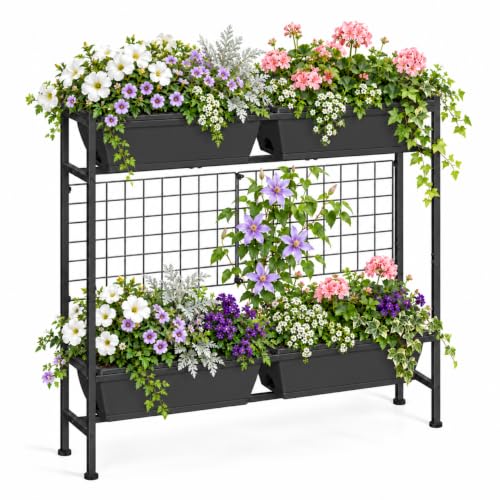
1. OYEAL Raised Garden Bed With Legs and Trellis, 32 Inch
A gray 32 inch tall stand that holds four separate plastic flower boxes on a metal frame with a trellis, a drainage hole and a removable tray. The listing says it assembles without tools and folds. It does not state width or depth.
Suits: herbs and flowers on a porch. Strengths: four separate pots and a trellis. Weaknesses: small boxes and no width given. Skip it if you want one deep bed.

Best for a small herb garden
2. Keter Urban Bloomer 12.7 Gallon Raised Planter
A dark grey resin planter, 32.3 by 14.7 by 30.7 inches, with a built-in water gauge, a reservoir and a drainage system that can be opened or closed.
Suits: a small herb garden. Strengths: a water gauge and reservoir. Weaknesses: modest soil volume. Skip it if you want a large bed.

View Keter Urban Bloomer Raised Planter 12.7 Gallon on Amazon

Best for a deck vegetable bed
3. Best Choice Products Raised Garden Bed, 48 x 24 x 30 Inch
A natural fir wood bed on legs with a bed liner, drainage, about 5 cubic feet of planting space and a listed 200 pound capacity, described as suited to balconies, decks and patios.
Suits: a deck vegetable bed. Strengths: roomy and lined. Weaknesses: wood needs upkeep. Skip it if you want a rolling bed.


Best for a movable patio bed
4. 32 Inch Rolling Metal Raised Garden Bed
A black metal planter on wheels with a handle, built-in drainage holes and a storage shelf for tools. The listing title says 32 inch, while the table shows 38.2 by 14.56 by 32.2 inches, so 32 appears to be the height. No brand name appears in the data we read.
Suits: a movable patio bed. Strengths: wheels and a tool shelf. Weaknesses: no brand shown. Skip it if you want a known maker.


Best for narrow spaces
5. Land Guard 2 Pack Galvanized Raised Planter With Wheels
A set of two silver galvanized steel beds, each 36 by 12 by 32 inches with about 21.8 gallons of planting space, a handle, two large wheels and a listed 300 pound capacity.
Suits: narrow spaces. Strengths: two beds and wheels. Weaknesses: only 12 inches wide. Skip it if you need one wide bed.


Best for a privacy screen of climbers
6. GarveeLife Metal Planter Box With Trellis and Wheels
A large 71 by 47 by 16 inch galvanized, powder-coated metal planter with a 15.7 inch deep bed, drainage holes, a trellis that works as a screen, and four wheels with three locking casters.
Suits: a privacy screen of climbers. Strengths: a trellis and locking wheels. Weaknesses: a big footprint. Skip it if your patio is small.

View GarveeLife Metal Planter with Trellis and Wheels on Amazon
Care and Setup
- Set the planter where it gets the sun your plants need.
- Check that drainage holes stay clear.
- Lock the wheels once the planter is in place.
- Fill with soil gradually and stay under the listed capacity.
Mistakes to Avoid
- Choosing a shallow bed for deep-rooted crops.
- Blocking the drainage.
- Exceeding the listed weight capacity.
- Ignoring width when the patio is narrow.
Questions to Ask Before You Buy
- How many hours of direct sun does your patio get, and does that suit the plants you want?
- Does your lease or building allow weight on the floor or balcony, and what is the combined weight of soil and water?
- Does the maker’s listing describe how drainage works and where the water will go?
- How deep is the soil bed compared with the roots of the herbs or vegetables you want to grow?
- Do you need to move it for winter or to follow the sun?
- Is the finish described as suitable for outdoor use?
Compatibility Checks
Match the container to the crop. Leafy greens and herbs need little depth, while tomatoes, peppers and root vegetables want more room underground. Check that the legs or base sit steadily on your surface, whether that is tile, decking or concrete. Put a saucer or mat under it if runoff could stain the floor or drip onto a neighbor below.
Think about the soil too. Potting mix drains and weighs differently from garden soil, and the maker’s listing may recommend a certain type. Wind is another factor on upper floors, since a tall trellis can act like a sail.
Who Should Skip It
If your patio sits in deep shade most of the day, a raised planter will not change the light and you may be better served by shade-tolerant plants in small pots. Renters on an upper floor with strict weight rules might choose lighter fabric grow bags. People who travel often and cannot water regularly should consider a self-watering container or a simple drip system, and read the maker’s instructions for assembly.
Choosing What to Grow in a Raised Planter
The plants decide which planter makes sense. Herbs such as basil, chives, parsley and thyme have shallow roots and do well in compact boxes or divided pots. Salad greens, radishes and strawberries also manage with modest depth. Tomatoes, peppers, cucumbers and root vegetables like carrots want more soil volume, more water storage and sturdier support.
Climbing crops need something to hold on to. Peas, pole beans and some squash types can use a trellis, which is why trellis models appeal for patios with a bare wall or a view you want to screen. A trellis on a planter does add height, so think about whether it will block light for neighboring plants or catch wind.
Group plants with similar needs. Sun-loving vegetables and herbs can share a bed, while moisture-loving plants should not sit beside those that prefer to dry out between waterings. If a planter is divided into small pots, each section can hold a different plant, but each dries out quickly and needs more frequent watering.
- Shallow roots: herbs, lettuce, radishes, flowers.
- Medium roots: peppers, bush beans, compact tomatoes.
- Deep roots: larger tomatoes, carrots, squash.
Check the listing for planting depth, since a tall stand does not always mean a deep soil bed.
Soil, Fill and Weight Planning
Wet soil is heavy, and a full planter can weigh far more than the empty product. Before filling, work out where it will sit and whether that surface can take the load. Decks, balconies and rooftop patios sometimes have limits, so ask your landlord or building manager if you are unsure. Wheels help you move an empty planter, but moving a full, wet one is another matter.
For potting, use a mix made for containers rather than soil dug from a garden, which tends to compact and drain poorly in a raised box. Some gardeners fill the bottom of a deep bed with lightweight material or coarse stones to save soil and weight, but the maker’s instructions and drainage design should guide you. Never block drainage holes with a dense layer that holds water.
A liner or fabric helps keep soil from washing out through holes while still letting water drain. Check whether the product includes one and whether the maker recommends a particular approach. Leave a little space between the soil line and the rim so water does not spill over when you water.
- Fill in stages and press lightly to avoid large air pockets.
- Water slowly after planting until moisture appears at the drainage point.
- Stay under the listed load figure when soil is wet.
Watering and Seasonal Care
Raised planters lose moisture faster than ground beds because air reaches the soil from several sides, and metal can warm in strong sun. Check the soil with a finger rather than watering on a rigid schedule, and water deeply when the top layer feels dry. Morning watering usually gives plants a full day to use the moisture.
Drainage matters just as much. Roots sitting in water can rot, so confirm the holes stay open and that excess water has somewhere to go. Place a tray or mat if runoff would stain the patio, and empty trays after rain. A reservoir or water gauge, where the product has one, can help you judge how much is left, but follow the maker’s instructions.
Seasonal care keeps the planter lasting. At the end of the growing season, remove spent plants, clean the container and look for loose screws, chipped coatings or worn wood. In cold areas, move a rolling planter to shelter or empty it if the maker warns about freezing water. Wood benefits from a dry spot and a protective finish if the listing recommends one.
- Feed container plants as the plant label suggests, since nutrients wash out with watering.
- Rotate the planter now and then so plants get even light.
- Lock any wheels once the planter is in place.
Material Trade-Offs and Budget Tiers
Each material has its strengths. Wood looks natural and is often roomy but needs sealing or covering over time. Resin resists moisture and does not rot, though some plastics can fade or become brittle in strong sun. Galvanized and coated metal is strong, but metal can heat up, and chips in the coating are worth touching up to slow rust.
Budget tiers are easiest to understand as trade-offs. Lower-cost planters tend to be smaller or lighter in construction, which is fine for herbs and flowers but may limit larger vegetables. Mid-range options often add features such as drainage plugs, liners or wheels. Higher-end planters typically offer larger beds, tougher finishes or built-in trellises. A higher tier is not automatically better for your patio, so compare listings against the plants and space you have.
- Light and portable: good for renters and tight balconies.
- Large and sturdy: good for vegetables and privacy screens.
- Wheeled: good if you follow the sun, but check for locks.
Ask whether the listing explains assembly, whether tools are included and how replacement parts are handled.
A Patio Planter Checklist Worth Printing
A raised planter looks simple, but patios come with quirks that a garden bed never faces: hard surfaces, limited sun, neighbours below, and the need to move things around. Go through the checklist below before you commit to a model, and jot down the answers so that your shortlist stays honest.
- Measure the area where the planter will stand, then add a margin so you can reach every side for watering and harvesting.
- Note how many hours of sun that corner gets, and think about what you want to grow there.
- Decide whether the planter must be movable. If you expect to shift it with the seasons, wheels or a light frame matter more than depth.
- Check where the water will go. A patio floor, a deck or a balcony each reacts differently to drainage, so plan a tray or a safe run-off path.
- Think about your own reach. Waist height legs spare your back, while a low bed suits a seat or a kneeler.
- Look at the manual for the fill depth the maker recommends and the weight the frame is designed to hold.
If you live in an apartment or rent your home, also check the rules for balconies and shared outdoor areas. Some buildings limit the weight allowed or ask you to avoid draining water onto the level below.
Legs, Wheels or Flat Base: A Quick Comparison
| Feature | On legs | On wheels | Flat base |
|---|---|---|---|
| Working height | Comfortable, less bending | Usually knee to waist height | Low, near the ground |
| Moving it | Hard once filled | Easy to roll to the sun | Fixed in place |
| Storage below | Often a shelf underneath | Sometimes none | None |
| Stability | Depends on the frame | Locks help on a slope | Generally the steadiest |
| Best for | Herbs and salad at a good height | Changing light through the day | Deeper rooted plants |
Whichever you pick, follow the assembly instructions closely and check that the legs or wheels are firmly fitted before you add soil, since adjusting a loaded planter is much harder than adjusting an empty one.
How to Read a Planter Listing Properly
Dimensions on listings can confuse, because some figures describe the whole unit including legs and a trellis, and others describe only the bed. Look for a diagram or a plain statement of the inner length, width and depth of the growing space. Depth matters most for root vegetables and for plants that dislike drying out quickly. Next, check the material and finish: wood, metal, resin or fabric each have strengths, and the listing should say how the surface is treated against moisture.
Read the drainage details with care. A bed with holes needs a tray or a safe spot, while a bed with a liner may need holes made by you. Scan the photos for the underside, the corner joints and the hardware. Finally, find out what is included, such as a liner, a trellis or tools, and whether assembly requires extra items that you must buy yourself.
Small Glossary for Planter Shopping
- Liner: a layer inside the bed that holds soil while allowing water to pass.
- Drainage hole: an opening that lets extra water escape so roots do not sit in it.
- Galvanized: steel treated with a zinc layer for protection against rust.
- Trellis: a frame that supports climbing plants.
- Fill depth: the amount of soil the bed is designed to carry.
- Footprint: the floor area the planter occupies, including any wheels or feet.
Quick Decisions by Patio Situation
Small balcony with a railing: choose a narrow planter with light walls, and check the building rules before you load it with wet soil. Sunny paved patio: pick a model with wheels so you can pull it into shade during hot afternoons. Shady corner: use the space for leafy plants and herbs that cope with less light, and keep the bed where you can reach it easily. Family patio with children: look for smooth edges and a stable base, and keep it away from the main play area. Whatever the situation, read the instructions from the maker for fill depth and watering, because they reflect how the planter was designed.
Choosing Raised Planters for Patios With a Clearer Checklist
The reviews above give you the shortlist. This section slows the decision down and looks at the checks that separate a raised planter you will be happy with a year from now from one that only looked right on the product page. None of these checks needs special equipment. Most need a tape measure, a honest look at your patio, and a few minutes spent picturing how the raised planter will be used on an ordinary week rather than on its best day. Work through them in order and you will usually find that two or three of the picks in this guide rule themselves out, which makes the final choice much easier.
Size, depth and root room
Match the planter depth to what you want to grow, since salad leaves, herbs and fruiting vegetables ask for very different root space. In practice, this means comparing the picks above against your own situation instead of against each other in the abstract. Read the individual review of any raised planter you are considering with this one point in mind and note what the review says about it, because the detail that matters to you may be a passing mention in a review written for a general reader. It also helps to think about the trade-off involved. Strength in one area usually costs something somewhere else, whether that is size, weight, simplicity or the time a design asks of you each week. A raised planter that wins on the point you care about most, and is merely adequate on points you care about less, is normally the right buy. Finally, test the decision against your worst realistic day, not your best one. If the choice still works when you are tired, short of time and the weather or the household is against you, it will work the rest of the year as well.
Material and weather behaviour
Wood, metal, resin and fabric planters age differently in sun and rain, so choose for the look and upkeep you are happy to live with. In practice, this means comparing the picks above against your own situation instead of against each other in the abstract. Read the individual review of any raised planter you are considering with this one point in mind and note what the review says about it, because the detail that matters to you may be a passing mention in a review written for a general reader. It also helps to think about the trade-off involved. Strength in one area usually costs something somewhere else, whether that is size, weight, simplicity or the time a design asks of you each week. A raised planter that wins on the point you care about most, and is merely adequate on points you care about less, is normally the right buy. Finally, test the decision against your worst realistic day, not your best one. If the choice still works when you are tired, short of time and the weather or the household is against you, it will work the rest of the year as well.
Drainage and protecting the patio surface
Water must escape freely without staining or pooling on paving, so plan drainage and, if needed, a tray or feet from the start. In practice, this means comparing the picks above against your own situation instead of against each other in the abstract. Read the individual review of any raised planter you are considering with this one point in mind and note what the review says about it, because the detail that matters to you may be a passing mention in a review written for a general reader. It also helps to think about the trade-off involved. Strength in one area usually costs something somewhere else, whether that is size, weight, simplicity or the time a design asks of you each week. A raised planter that wins on the point you care about most, and is merely adequate on points you care about less, is normally the right buy. Finally, test the decision against your worst realistic day, not your best one. If the choice still works when you are tired, short of time and the weather or the household is against you, it will work the rest of the year as well.
Weight when full of wet soil
A filled planter is far heavier than it looks empty, so check the surface or balcony can take the load and position it before filling. In practice, this means comparing the picks above against your own situation instead of against each other in the abstract. Read the individual review of any raised planter you are considering with this one point in mind and note what the review says about it, because the detail that matters to you may be a passing mention in a review written for a general reader. It also helps to think about the trade-off involved. Strength in one area usually costs something somewhere else, whether that is size, weight, simplicity or the time a design asks of you each week. A raised planter that wins on the point you care about most, and is merely adequate on points you care about less, is normally the right buy. Finally, test the decision against your worst realistic day, not your best one. If the choice still works when you are tired, short of time and the weather or the household is against you, it will work the rest of the year as well.
Mobility and repositioning
Wheels, handles or a lightweight build matter if you chase the sun, shelter plants from storms or rearrange the patio often. In practice, this means comparing the picks above against your own situation instead of against each other in the abstract. Read the individual review of any raised planter you are considering with this one point in mind and note what the review says about it, because the detail that matters to you may be a passing mention in a review written for a general reader. It also helps to think about the trade-off involved. Strength in one area usually costs something somewhere else, whether that is size, weight, simplicity or the time a design asks of you each week. A raised planter that wins on the point you care about most, and is merely adequate on points you care about less, is normally the right buy. Finally, test the decision against your worst realistic day, not your best one. If the choice still works when you are tired, short of time and the weather or the household is against you, it will work the rest of the year as well.
Self-watering and watering access
Reservoirs and easy hose access make the difference between thriving plants and a daily chore during hot spells. In practice, this means comparing the picks above against your own situation instead of against each other in the abstract. Read the individual review of any raised planter you are considering with this one point in mind and note what the review says about it, because the detail that matters to you may be a passing mention in a review written for a general reader. It also helps to think about the trade-off involved. Strength in one area usually costs something somewhere else, whether that is size, weight, simplicity or the time a design asks of you each week. A raised planter that wins on the point you care about most, and is merely adequate on points you care about less, is normally the right buy. Finally, test the decision against your worst realistic day, not your best one. If the choice still works when you are tired, short of time and the weather or the household is against you, it will work the rest of the year as well.
Matching Raised Planters for Patios to Real-Life Situations
Most disappointment with a purchase like this comes not from a bad product but from a good product bought for the wrong situation. The scenarios below describe the situations readers most often describe when they write about raised planters for patios, and the priorities that follow from each one. Find the scenario closest to your own life first, then read the reviews above again with those priorities at the front of your mind. You may find that the pick you first leaned towards belongs to a different scenario, and that another pick in the same guide fits you better for reasons that had nothing to do with quality.
Herbs by the kitchen door
A compact planter near the door keeps herbs within snipping distance and makes watering part of the cooking routine. When you compare the picks in this guide for this situation, start with the reviews that speak most directly to it and be sceptical of features that serve a different scenario better than yours. It is easy to pay attention to impressive extras that your routine will never call on, while overlooking the plain detail that will decide whether the raised planter gets used every week or gathers dust. If your situation sits between two of the scenarios described here, weight the one that happens more often. A choice that suits the weekly routine and copes adequately with the occasional event beats a choice that is perfect twice a year and awkward the rest of the time.
Vegetables in a small sunny patio
For tomatoes, peppers or beans, depth, support and the sunniest position matter more than decorative finish. When you compare the picks in this guide for this situation, start with the reviews that speak most directly to it and be sceptical of features that serve a different scenario better than yours. It is easy to pay attention to impressive extras that your routine will never call on, while overlooking the plain detail that will decide whether the raised planter gets used every week or gathers dust. If your situation sits between two of the scenarios described here, weight the one that happens more often. A choice that suits the weekly routine and copes adequately with the occasional event beats a choice that is perfect twice a year and awkward the rest of the time.
Screening and greenery
Taller planters with trellis or bushy planting can soften a fence line or give a seating area a little privacy. When you compare the picks in this guide for this situation, start with the reviews that speak most directly to it and be sceptical of features that serve a different scenario better than yours. It is easy to pay attention to impressive extras that your routine will never call on, while overlooking the plain detail that will decide whether the raised planter gets used every week or gathers dust. If your situation sits between two of the scenarios described here, weight the one that happens more often. A choice that suits the weekly routine and copes adequately with the occasional event beats a choice that is perfect twice a year and awkward the rest of the time.
Accessible gardening
Raised height reduces bending and kneeling, which suits gardeners who want to work comfortably while standing or seated. When you compare the picks in this guide for this situation, start with the reviews that speak most directly to it and be sceptical of features that serve a different scenario better than yours. It is easy to pay attention to impressive extras that your routine will never call on, while overlooking the plain detail that will decide whether the raised planter gets used every week or gathers dust. If your situation sits between two of the scenarios described here, weight the one that happens more often. A choice that suits the weekly routine and copes adequately with the occasional event beats a choice that is perfect twice a year and awkward the rest of the time.
How the Picks in This Guide Compare in Practice
Read side by side, the picks in this guide are less a league table than a set of answers to slightly different questions. This section walks through them in the order they appear above and draws out, for each one, the kind of buyer its review is really describing. It deliberately adds no new claims about the products themselves. Everything said here follows from the reviews you have already read, reorganised around the decision you are trying to make. Use it as a final cross-check before you choose, especially if you have been going back and forth between two favourites.
OYEAL Raised Garden Bed With Legs and Trellis, 32 Inch
The first pick in this guide, the OYEAL Raised Garden Bed With Legs and Trellis, 32 Inch, earns its place for the reasons its review sets out above, and it is worth re-reading that review with your own scenario in mind before deciding. Ask yourself three questions about it. Does the use it is presented for match the way you will actually use a raised planter most weeks? Do its strengths, as described in the review, line up with the criteria at the top of your own checklist from the section above? And can you live comfortably with the limitation the review is honest about, in your space and with your routine? If the answer to all three is yes, the OYEAL Raised Garden Bed With Legs and Trellis, 32 Inch is a sound choice and there is little to gain from agonising over the rest of the list. If one answer is no, the pick below or above it in this guide usually answers that particular concern, which is exactly why the guide keeps several distinct options rather than variations on a single idea.
Keter Urban Bloomer 12.7 Gallon Raised Planter
The second pick in this guide, the Keter Urban Bloomer 12.7 Gallon Raised Planter, earns its place for the reasons its review sets out above, and it is worth re-reading that review with your own scenario in mind before deciding. Ask yourself three questions about it. Does the use it is presented for match the way you will actually use a raised planter most weeks? Do its strengths, as described in the review, line up with the criteria at the top of your own checklist from the section above? And can you live comfortably with the limitation the review is honest about, in your space and with your routine? If the answer to all three is yes, the Keter Urban Bloomer 12.7 Gallon Raised Planter is a sound choice and there is little to gain from agonising over the rest of the list. If one answer is no, the pick below or above it in this guide usually answers that particular concern, which is exactly why the guide keeps several distinct options rather than variations on a single idea.
Best Choice Products Raised Garden Bed, 48 x 24 x 30 Inch
The third pick in this guide, the Best Choice Products Raised Garden Bed, 48 x 24 x 30 Inch, earns its place for the reasons its review sets out above, and it is worth re-reading that review with your own scenario in mind before deciding. Ask yourself three questions about it. Does the use it is presented for match the way you will actually use a raised planter most weeks? Do its strengths, as described in the review, line up with the criteria at the top of your own checklist from the section above? And can you live comfortably with the limitation the review is honest about, in your space and with your routine? If the answer to all three is yes, the Best Choice Products Raised Garden Bed, 48 x 24 x 30 Inch is a sound choice and there is little to gain from agonising over the rest of the list. If one answer is no, the pick below or above it in this guide usually answers that particular concern, which is exactly why the guide keeps several distinct options rather than variations on a single idea.
32 Inch Rolling Metal Raised Garden Bed
The fourth pick in this guide, the 32 Inch Rolling Metal Raised Garden Bed, earns its place for the reasons its review sets out above, and it is worth re-reading that review with your own scenario in mind before deciding. Ask yourself three questions about it. Does the use it is presented for match the way you will actually use a raised planter most weeks? Do its strengths, as described in the review, line up with the criteria at the top of your own checklist from the section above? And can you live comfortably with the limitation the review is honest about, in your space and with your routine? If the answer to all three is yes, the 32 Inch Rolling Metal Raised Garden Bed is a sound choice and there is little to gain from agonising over the rest of the list. If one answer is no, the pick below or above it in this guide usually answers that particular concern, which is exactly why the guide keeps several distinct options rather than variations on a single idea.
Land Guard 2 Pack Galvanized Raised Planter With Wheels
The fifth pick in this guide, the Land Guard 2 Pack Galvanized Raised Planter With Wheels, earns its place for the reasons its review sets out above, and it is worth re-reading that review with your own scenario in mind before deciding. Ask yourself three questions about it. Does the use it is presented for match the way you will actually use a raised planter most weeks? Do its strengths, as described in the review, line up with the criteria at the top of your own checklist from the section above? And can you live comfortably with the limitation the review is honest about, in your space and with your routine? If the answer to all three is yes, the Land Guard 2 Pack Galvanized Raised Planter With Wheels is a sound choice and there is little to gain from agonising over the rest of the list. If one answer is no, the pick below or above it in this guide usually answers that particular concern, which is exactly why the guide keeps several distinct options rather than variations on a single idea.
GarveeLife Metal Planter Box With Trellis and Wheels
The sixth pick in this guide, the GarveeLife Metal Planter Box With Trellis and Wheels, earns its place for the reasons its review sets out above, and it is worth re-reading that review with your own scenario in mind before deciding. Ask yourself three questions about it. Does the use it is presented for match the way you will actually use a raised planter most weeks? Do its strengths, as described in the review, line up with the criteria at the top of your own checklist from the section above? And can you live comfortably with the limitation the review is honest about, in your space and with your routine? If the answer to all three is yes, the GarveeLife Metal Planter Box With Trellis and Wheels is a sound choice and there is little to gain from agonising over the rest of the list. If one answer is no, the pick below or above it in this guide usually answers that particular concern, which is exactly why the guide keeps several distinct options rather than variations on a single idea.
Getting Set Up and Building a Routine That Sticks
The first week with a new raised planter decides whether it becomes part of your routine or an occasional effort. Start by setting it up properly in your patio before you first need it in a hurry, following the maker’s instructions for assembly, placement and any first-use preparation. Check that everything that should be present is present, that moving parts move as they should, and that you understand the basic controls or handling before the first real use. A calm first session, with time to adjust and correct, teaches you more than three rushed ones.
Then keep the early routine deliberately simple. Use the raised planter for its most straightforward job, the one you bought it for, and resist the urge to test every feature in the first few days. Notice what feels awkward, because early awkwardness usually points to a setup detail — position, height, order of steps or a missing accessory — rather than a fault with the product itself. Adjust one thing at a time so you can tell what helped. By the end of the second week most owners have settled into a personal rhythm that no instruction booklet could have predicted, because it is built around their space, their schedule and their habits.
It also helps to decide where everything that goes with the raised planter will live. Accessories, spares and cleaning bits scattered across three cupboards are accessories you will stop using. One box, drawer or shelf near the point of use keeps the whole system together and makes tidy-up quick enough that you actually do it. If other people in the household will use the raised planter too, agree the basics together — how it is left after use, where things go back to, and what to report if something seems wrong — so the routine survives more than one person’s habits.
Raised Planter FAQ
Which material suits a patio?
Wood, resin and metal all appear here; makers describe the metal and resin versions as rust or fade resistant.
Do I need a liner?
Only the Best Choice lists one; the others vary, so check the listing.
How deep should a raised planter be for vegetables?
It depends on the crop. Leafy greens and herbs manage with shallow beds, while tomatoes, peppers and root vegetables prefer more depth. Check the listing for the soil bed depth rather than the overall height of the stand.
Do I need drainage holes in a patio planter?
Yes, in most cases. Without a way for extra water to escape, roots can sit in wet soil and rot. If a planter has a plug or adjustable drain, follow the maker's instructions for when to open it.
Can a raised planter damage my patio surface?
Runoff and moisture can stain or mark some surfaces, and metal legs or wheels can scratch them. Use a tray, mat or pads where needed, and check the surface regularly.
What soil should I use?
A potting mix made for containers is usually the best choice, because it drains well and stays loose. Heavy garden soil can compact in a raised box and hold too much water.
How often should I water?
Check the soil by touch and water when the top layer feels dry. Hot, windy or sunny weather dries containers faster, so you may need to water more often in summer.
Are wheeled planters stable when full?
Locking wheels help hold a planter in place, but a full planter is heavy and should be moved with care or emptied first. Check the listing for lock details and the maker's load figure.
Can I grow vegetables in a wood planter on a balcony?
Often yes, if the bed is lined or the maker describes it as suitable for growing food and your building allows the weight. Keep wood dry between waterings where possible and follow the maker's care notes.
When should I replace a planter?
Replace it when the frame wobbles, the coating is badly corroded, wood has rotted or the container cracks. A planter that can no longer hold soil safely is better retired.
The Short Version
For separate herb pots, the OYEAL. For a water gauge, the Keter. For a roomy wood bed, the Best Choice. For a movable bed, the rolling metal one. For a narrow pair, the Land Guard. For a privacy screen, the GarveeLife.