A gazebo turns a patio or deck into a shaded outdoor room. The main choice is the roof: a hardtop of steel or polycarbonate is meant to stay up all year, while a fabric soft top is lighter and often easier to put up. Frames are aluminum, steel or, in one case, cedar.
The six gazebos below run from 10 by 10 feet to 10 by 14 feet. Sizes, materials and weights come from each listing page. Wind, snow, UV and water figures are the makers’ own claims, and we have not used these gazebos ourselves. Several listings contain conflicting details that we point out.
As an Amazon Associate we earn from qualifying purchases. Links below are affiliate links, and they do not change the product information we give.
What to Look For
| Feature | Why it matters |
|---|---|
| Roof | Steel or polycarbonate hardtops differ from fabric soft tops in weight and upkeep |
| Frame | Aluminum resists rust, steel is heavier, and cedar is a natural wood |
| Footprint | Check the overall size and the column spacing against your patio |
| Anchoring | Ground stakes and expansion screws suit grass or concrete |
In this guide
Specs at a Glance
| Gazebo | Size and weight | Roof and frame | Notes |
|---|---|---|---|
| Oasisphere cedar | 144 x 120 x 108 in; 308.9 lb | Double galvanized steel roof; cedar frame | Maker claims 75 mph wind and 22 in snow load when anchored |
| Outsunny 10 x 12 hardtop | 143.75 x 103.25 x 103.25 in; 209.4 lb | Galvanized steel roof; aluminum frame | Curtains and netting; ground nails included |
| Garvee 10 x 10 | 120 x 120 x 116 in; 199.1 lb | Double polycarbonate roof; aluminum frame | Curtains and zippered netting; UPF 50 |
| Outsunny 10 x 14 hardtop | 164.6 x 119.3 x 115.4 in; 209 lb | Double galvanized steel roof; aluminum frame | 3 x 3 in columns; two ceiling hooks; 1 year warranty |
| Outsunny 10 x 12 soft top | 149.6 x 118.1 x 106.3 in; 101 lb | Double polyester roof, UPF 30+; steel frame | Curtains, netting, ceiling hooks; stakes and screws included |
| Outsunny 10 x 10 soft top | 118 x 118 x 108.5 in; 72 lb | Two-tier vented polyester canopy; steel frame | Netting; corner shelves; ground nails included |
The 6 Best Gazebos for Patios

Top pickBest for a permanent wooden look
1. Oasisphere Wood Gazebo, 10 x 12 ft
A cedar gazebo with 4.72 inch thick posts and a double-layer galvanized steel hardtop with a 15 degree slope. The maker says it is certified for snow loads up to 22 inches and 75 mph winds when properly anchored. It weighs 308.9 pounds. The page lists it as waterproof with UPF 50+, which are the maker’s claims.
Suits: a permanent wooden look. Strengths: a cedar frame and the highest stated wind and snow figures here. Weaknesses: heavy, with a one year warranty. Skip it if you want a lighter metal frame.


Best for a metal roof with bug netting
2. Outsunny 10 x 12 Hardtop Gazebo With Curtains and Netting
A hardtop gazebo with a galvanized steel single roof and a powder-coated aluminum frame, plus polyester privacy curtains and netting sidewalls. It weighs 209.4 pounds, and ground nails are included. The overall size listed is 143.75 by 103.25 inches, narrower than the 10 by 12 foot name suggests.
Suits: a metal roof with bug netting. Strengths: an aluminum frame, curtains and netting. Weaknesses: a single roof and a narrower listed footprint. Skip it if you need a full 12 by 10 foot floor.


Best for a lighter, filtered-light roof
3. Garvee 10 x 10 Hardtop Gazebo With Polycarbonate Roof
A 10 by 10 foot aluminum-frame gazebo with a double-tier polycarbonate roof, zippered mesh netting and outer curtains. It stands 116 inches tall, weighs 199.1 pounds and lists UPF 50 protection.
Suits: a lighter, filtered-light roof. Strengths: a two-tier polycarbonate roof and mesh. Weaknesses: little wind or snow data on the page. Skip it if you want stated load figures.

Best for a larger patio
4. Outsunny 10 x 14 Hardtop Gazebo With UPF50+ Double Roof
The largest here, at 164.6 by 119.3 inches, with a two-tier galvanized steel roof, 3 by 3 inch aluminum columns and built-in netting. Curtains, mesh and two ceiling hooks are included, with a one year warranty against defects.
Suits: a larger patio. Strengths: the largest footprint and a double roof. Weaknesses: needs more space and anchoring. Skip it if your patio is small.
View Outsunny 10′ x 14′ Hardtop Gazebo with UPF50+ Double Roof Canopy Brown on Amazon

Best for a lighter soft top
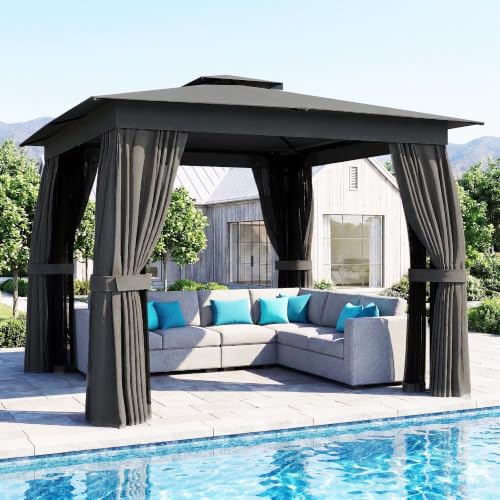
5. Outsunny 10 x 12 Patio Gazebo With Double Roof, Dark Gray
A soft top gazebo with a double-tier UPF 30+ polyester roof, a powder-coated steel frame, curtains, mesh netting and two ceiling hooks. It weighs 101 pounds, with stakes and expansion screws included. The overview calls it not water resistant, while the text mentions drainage holes in the roof.
Suits: a lighter soft top. Strengths: a 101 pound frame with stakes and screws. Weaknesses: conflicting water details. Skip it if you need a hard roof.

View Outsunny 10′ x 12′ Outdoor Patio Gazebo with Double Roof, Dark Gray on Amazon
Best for a light, decorative gazebo
6. Outsunny 10 x 10 Patio Gazebo With Double Roof
The lightest pick at 72 pounds, with a two-tier vented polyester canopy, mesh netting, ground nails and garden-gate-style corner frames with shelves. The frame is listed as alloy steel.
Suits: a light, decorative gazebo. Strengths: corner shelves and the lowest weight. Weaknesses: a fabric roof. Skip it if you want a permanent hard roof.
View Outsunny 10′ x 10′ Patio Gazebo Double Roof with Netting, Gray on Amazon
Care and Setup
- Build on a level surface and anchor all legs.
- Read the maker’s anchoring steps for your ground type.
- Clear leaves and debris from the roof regularly.
- Take down fabric parts and curtains in strong wind.
Mistakes to Avoid
- Skipping the anchors on grass or a deck.
- Judging size by the nominal name instead of the overall dimensions.
- Leaving curtains closed in a storm.
- Counting a maker’s wind figure as a promise.
Site and Footprint Checks Before Ordering
A gazebo needs more room than its roof outline suggests. The post already warns that nominal sizes such as 10 by 12 feet can differ from the overall dimensions on the listing, so measure your space against the stated overall size and not just the name. Leave extra clearance around the structure for walking, for opening curtains and for roof overhang. Allow for nearby walls, fences, trees and overhead lines too.
The ground matters as much as the footprint. A level patio of concrete or pavers is simpler to work with than sloped grass or a wooden deck. Check whether the surface can take anchors, and whether the weight of the frame and roof is appropriate for it. A raised deck may have limits on how much weight it can carry, so look at the deck rating if you are unsure.
- Measure the width and depth of the area, then add space around it.
- Check the overall height against any porch roof, branches or ceilings nearby.
- Note the column spacing on the listing, since furniture and grills must fit between posts.
- Keep the structure well away from open flames, grills and fire pits, and follow the maker’s safety notes.
Sun angle is worth a thought. A gazebo shades the area under it, but the sun moves through the day, so a position that is shady in the afternoon may not be in the morning. Walk the space at different times and consider where you will place seating.
Anchoring and Weather Readiness
Wind is the main risk for any canopy or gazebo. Even a heavy frame can shift or lift if it is not secured to the ground. The post notes that makers provide wind and snow figures and that those are the makers’ own claims, which only apply when the structure is built and anchored as directed. Treat these numbers as a reference, not a promise.
Anchoring methods differ by surface. Ground stakes or nails suit soil and grass, expansion bolts suit concrete, and a deck may need fasteners that reach the framing. Use the hardware the maker recommends, and ask for help if you are not sure what suits your surface. On a deck or patio where you cannot drill, weights or other methods may be needed, but check that they are safe and approved for use with your model.
- Anchor every leg, not only the corners.
- Check anchors after storms and at the start of each season.
- Take down curtains, netting and fabric roofs ahead of strong wind or heavy snow.
- Clear snow from the roof as the maker directs, and do so safely from the ground.
Rain and sun add their own wear. Water that pools on a roof adds weight and can stress the frame or fabric. Debris such as leaves can block drainage. Sunlight can fade and weaken some fabrics over time, so inspect them for fraying or thin spots.
Assembly Planning and Getting Help
Gazebos arrive in heavy boxes with many parts, and some of the models in this guide weigh well over a hundred pounds. Plan for more than one person to carry and build it. Read the manual before you start, sort and count the hardware, and lay out the parts in order. Working on a clear, level area makes the job much easier.
Assembly often takes hours, and some steps, such as lifting the roof onto the frame, need several people at once. Use a stable ladder, wear gloves, and avoid building on a windy day. A large roof panel acts like a sail, so wait for calm weather and secure each section as you go. Do not fully tighten every bolt until the frame is square, then go back and tighten them all so nothing is under stress.
- Check the box contents against the parts list as soon as it arrives, so you can report any missing items.
- Keep the manual and any spare hardware in a safe place for later repairs.
- Ask the seller about assembly help or whether a local installer is an option.
- Follow the maker’s order of assembly, because skipping steps can mean taking things apart again.
If a part is bent, cracked or the wrong size, stop and contact the seller instead of forcing it. A structure built with damaged parts can fail later.
Curtains, Netting and Comfort Features
Curtains and netting change how a gazebo feels in use. Mesh walls keep insects out while letting air through, curtains add privacy and shade, and together they let you adjust the space through the day. Check how each is attached and whether they can be removed easily, because you may want to take them down before wind or for long storage.
Think about extras. Ceiling hooks can hold lights, plants or fans, but each hook has a limit, and the listing or manual should say what is safe to hang. If you plan to add string lights, a ceiling fan or a heater, check that the frame can support them and keep heat sources well away from fabric and netting. Never run electrical cords in a way that creates a trip or water hazard, and use outdoor-rated equipment.
- Pick curtain colors with sun and heat in mind, since darker fabrics may absorb more warmth.
- Check that zippers and ties are easy to use with one hand.
- Wash or wipe fabric parts as the maker directs, and let them dry fully before storing.
- Store curtains and netting in a dry spot during long periods of bad weather.
Comfort also depends on furniture and flooring. A rug or deck tiles can make a patio feel like a room, while a stable table and chairs keep the space useful. Leave walking room around them, so people can move without brushing the walls.
Hardtop or Soft Top: Which One Fits Your Yard?
A patio gazebo is mostly a decision about roof material. Hardtop gazebos use metal or polycarbonate panels, which feel permanent and shed rain and snow more confidently. Soft top models use fabric canopies that are lighter, easier to move and often easier to take down when the season ends.
| Roof type | Pros | Cons |
|---|---|---|
| Hardtop metal | Sturdy, low upkeep, good for year-round use | Heavier, harder to move |
| Polycarbonate | Lets in soft light while blocking rain | Can scratch, may need cleaning |
| Fabric canopy | Light and easy to store | Needs care in wind and heavy weather |
| Vented double roof | Lets hot air escape | More parts to assemble |
Sizing, Placement and Local Rules
Measure your patio before you shop. A gazebo needs space not only for its footprint but also for walking room around it and for the furniture beneath it. A good approach is to mark the outline with tape on the ground and then place your table and chairs inside the lines to see how much room you actually have.
- Confirm the footprint dimensions listed, including legs and any attached curtains.
- Check the ceiling height so tall guests can stand comfortably under the roof.
- Keep it clear of trees, power lines and rooflines.
- Look at your local building rules, since some places require permits or have setback limits.
- If you belong to a homeowners association, ask whether they regulate structures.
Anchoring is a safety point. Follow the maker’s instructions for securing the frame to the ground, whether with stakes, bolts or weights, and ask a licensed professional if you are attaching it to concrete or a deck.
Weather, Wind and Seasonal Care
No gazebo is unconditional protection from storms. Read the manual to see what wind and snow conditions it is designed to handle, and take down or secure soft tops when strong weather is forecast. In heavy snow regions, clear accumulation as the maker advises, using a soft tool that will not scratch the roof.
Routine care keeps the structure steady. Tighten bolts at the beginning of each season, check for rust on metal frames, and touch up chipped paint with a product the maker approves. For fabric, brush off debris and clean with mild soap according to the care label, and let everything dry fully before folding.
Accessories like mosquito netting, side curtains and lighting can extend how often you use the space. Check that they are made to fit your model, and hang lights or fans only where the manual allows. A well-chosen setup makes the patio feel like an extra room.
Frame Materials at a Glance
The frame determines how long the gazebo holds up and how much upkeep it asks for. Powder-coated steel is strong but can rust where the coating chips. Aluminum resists rust and is lighter, though it may flex in strong wind unless the design is braced well. Wood brings a natural look and needs periodic sealing or staining, while vinyl or composite parts ask for little more than washing.
- Check the leg thickness and wall gauge listed, as thicker parts usually add stability.
- Look at the corner brackets, since weak joints are a frequent failure point.
- Read the assembly notes to see whether two people are needed.
- Keep every screw and bolt in a labeled container until the build is finished.
Assembly goes more smoothly on a dry day with a clear patch of ground and a printed copy of the instructions.
Choosing Gazebos for patios With a Clear Head: A Practical Decision Worksheet
The picks above give you the shortlist. This section is about matching one of them to your home, because most disappointment with gazebos for patios has very little to do with the product itself and a great deal to do with a mismatch nobody checked: the wrong size for the space, the wrong format for the routine, or a feature list bought for a household that does not exist. Work through the points below in order, with a tape measure and your phone for photographs, and you will narrow the list in this guide to one obvious answer surprisingly quickly.
Start with the space itself. Before you compare a single model, measure the patio area including room to walk around the gazebo and open doors, check the surface it will stand on and how it can be anchored, and think about sun direction, prevailing wind and overhanging trees before fixing the position. Write the numbers down rather than holding them in your head, and take a photograph of the spot in its ordinary state, not tidied for the occasion. Everyday clutter, the things that genuinely live in your patio or garden, are part of the fitting problem your new gazebo has to solve.
Roof type and weather behaviour
fabric, polycarbonate and hardtop roofs differ hugely in how they handle sun, rain noise, wind and winter, so match the roof to your climate and how many seasons it will stay up. This is also the factor most likely to be glossed over in a listing, because photographs show the product at its best rather than in your space. Re-read the relevant details in the descriptions above with your own situation in mind before you decide.
Frame material and anchoring
a gazebo is a sail in a storm, so frame strength and a real anchoring plan for your surface matter more than any decorative detail. If you are choosing between two otherwise similar picks, let this be one of the tie-breakers. Small daily frictions compound: something slightly awkward in week one becomes the reason a product is barely used by month three.
Size against your furniture
measure the dining set or seating that must fit inside with people moving around it, because a gazebo that only just covers the table leaves chairs in the rain. Think about how this factor behaves over time as well as on day one. Households change, rooms get rearranged and products age, and a choice that still works after those changes is the one that represents real value.
Curtains, netting and privacy
side panels change a gazebo from a sunshade into a room, keeping insects and low sun out and neighbours’ views softened, so decide whether you want them from the start. Ask the awkward version of the question too: what happens on the busiest day, the coldest week, the visit from grandchildren or the evening when you are tired and everything must simply work without fuss.
Assembly and maintenance commitment
large gazebos are serious builds with many parts, and roofs and curtains need cleaning and sometimes removal before winter, so be honest about the effort you will give it. Turn that into something you can check before you order: a measurement, a photograph of the space, a list of what it must work alongside, or a note of who will use it most. A shortlist judged against written notes is far more reliable than one judged from memory in front of a screen.
Finally, decide what good looks like before the item arrives. One sentence is enough: the job this gazebo must do, for whom, and how often. Keep that sentence beside you while you read the product descriptions above. Any pick that serves that sentence is a candidate; any pick that mainly serves a different, more glamorous sentence is a distraction, however well it is made.
Gazebos for patios in Real Life: Matching the Pick to Your Situation
Guides talk about average households, but nobody lives in one. Your gazebo will serve a particular household, in a particular building, on a particular routine. The three situations below cover the most common reasons people shop for gazebos for patios; find the one closest to yours and let it steer which of the picks above deserves your closest attention.
A dining patio used all summer
Meals outside most weeks, with the gazebo as the room’s ceiling for the season. Prioritise coverage that keeps rain off the whole table, netting for evening insects and anchoring that lets you trust it in changeable weather. If your household contains two different scenarios at once, choose for the one that happens most often and check that the other is still workable, rather than compromising so evenly that neither use is properly served.
A hot, sun-exposed patio
Shade is the entire point, with heat building on paving through the afternoon. Prioritise real shade coverage at the hours you use the patio, ventilation at the roof so hot air escapes and curtains for low evening sun. Work through the picks above with that situation in front of you rather than shopping in the abstract. The right choice usually becomes obvious once the scenario is specific, because the features that matter for this use separate themselves from the features that merely sound impressive.
A gazebo that must come down for winter
Your climate or storage means a seasonal rather than permanent structure. Prioritise a design you can dismantle and store without a battle, and keep every fitting and the instructions together between seasons. It also helps to plan the small supporting details at the same time: where things will be stored, who will operate or clean the item, and what happens on the days when the routine breaks down. Those details, decided early, are what make a purchase feel settled rather than improvised.
How the Picks in This Guide Compare When You Line Them Up
Read side by side, the six picks above are less a ranking than a set of trade-offs. Each one gives something up to be better at something else, and the comparison below is a way of reading the descriptions in this guide against your own priorities rather than a verdict that one model beats the rest for everyone.
Oasisphere Wood Gazebo, 10 x 12 ft. Put this one on your shortlist if the description above matches the sentence you wrote down for the job this gazebo must do. Check it first against the measurements of your space and the factor you scored as most important, then against the practical questions of cleaning, day-to-day operation and how it will sit alongside what you already own. If it passes those checks, its remaining differences from the other picks are matters of taste rather than suitability, and you can choose it with confidence.
Outsunny 10 x 12 Hardtop Gazebo With Curtains and Netting. Put this one on your shortlist if the description above matches the sentence you wrote down for the job this gazebo must do. Check it first against the measurements of your space and the factor you scored as most important, then against the practical questions of cleaning, day-to-day operation and how it will sit alongside what you already own. If it passes those checks, its remaining differences from the other picks are matters of taste rather than suitability, and you can choose it with confidence.
Garvee 10 x 10 Hardtop Gazebo With Polycarbonate Roof. Put this one on your shortlist if the description above matches the sentence you wrote down for the job this gazebo must do. Check it first against the measurements of your space and the factor you scored as most important, then against the practical questions of cleaning, day-to-day operation and how it will sit alongside what you already own. If it passes those checks, its remaining differences from the other picks are matters of taste rather than suitability, and you can choose it with confidence.
Outsunny 10 x 14 Hardtop Gazebo With UPF50+ Double Roof. Put this one on your shortlist if the description above matches the sentence you wrote down for the job this gazebo must do. Check it first against the measurements of your space and the factor you scored as most important, then against the practical questions of cleaning, day-to-day operation and how it will sit alongside what you already own. If it passes those checks, its remaining differences from the other picks are matters of taste rather than suitability, and you can choose it with confidence.
Outsunny 10 x 12 Patio Gazebo With Double Roof, Dark Gray. Put this one on your shortlist if the description above matches the sentence you wrote down for the job this gazebo must do. Check it first against the measurements of your space and the factor you scored as most important, then against the practical questions of cleaning, day-to-day operation and how it will sit alongside what you already own. If it passes those checks, its remaining differences from the other picks are matters of taste rather than suitability, and you can choose it with confidence.
Outsunny 10 x 10 Patio Gazebo With Double Roof. Put this one on your shortlist if the description above matches the sentence you wrote down for the job this gazebo must do. Check it first against the measurements of your space and the factor you scored as most important, then against the practical questions of cleaning, day-to-day operation and how it will sit alongside what you already own. If it passes those checks, its remaining differences from the other picks are matters of taste rather than suitability, and you can choose it with confidence.
If two picks still look equal after that process, choose the one whose everyday routine is simpler for your household: the one that is easier to clean, easier to operate when you are tired and easier to live around. In our experience of household products generally, long-term satisfaction follows daily convenience far more reliably than it follows the longest feature list.
Setting Up Your Gazebo: Getting the First Day Right
Setup day decides more about long-term satisfaction than most people expect. Begin by unpacking everything in the room where the gazebo will live, checking every part against the contents list in the manual before any packaging leaves the house. Photograph the unboxing if the item is large or has many parts; if anything is missing or damaged, those photographs and an intact box make resolving it straightforward.
Read the manual’s setup section fully before you start, not as a reference to dip into when stuck. Manuals for gazebos for patios are usually written in the order the work should happen, and the steps people skip, such as levelling, spacing, charging, seasoning, fixing or allowing something to settle, are exactly the steps whose absence causes the problems described later in this guide. Keep every tool, spare fixing and leftover part in a labelled bag stored with the manual.
Once the gazebo is in position, test it gently and completely before the packaging goes: every control, every moving part, every setting you expect to use, in the conditions closest to real use you can create. Check clearances with doors opening, people passing and the room arranged as it normally is, not as it was during installation. Small position adjustments are easy on day one and strangely permanent-feeling a month later, so make them now.
Finish by setting up the routine, not just the product: decide where its accessories, cleaning items and instructions will live, tell the household anything they need to know about using it, and put any recurring care task into your calendar while the intention is fresh. A gazebo that arrives with its routine attached settles into the home; one that does not becomes a small recurring puzzle.
Care, Cleaning and Storage: Keeping Gazebos for patios at Their Best
None of the care below is difficult, and almost all of it is quick. What matters is regularity: gazebos for patios rarely fail from one dramatic neglect, they decline through small things left undone until performance, appearance or safety has quietly slipped. Anchor every gazebo properly for its surface, never rely on weight alone in exposed gardens, and keep heaters, fire pits and barbecues out of or well clear of the structure unless the maker explicitly allows them.
Brush leaves and debris off the roof regularly and wash fabric or panels as the maker directs, because standing dirt and damp grow mildew quickly outdoors. Build this into a routine tied to something you already do, such as a weekly clean or a seasonal changeover, so it happens automatically rather than relying on noticing a problem.
Check and retighten frame fixings through the season, especially after storms, and confirm anchors still hold firmly. Use only the tools and cleaners the maker allows for the materials involved. The wrong product can do more damage in one enthusiastic clean than months of ordinary use.
Remove and store curtains and netting clean and dry when instructed, and never pack fabric away damp. While you do it, look the item over generally: small changes noticed early, such as a loose fitting, a worn edge or a strange smell, are almost always cheaper and easier to deal with than the same issue noticed late.
Clear snow load from roofs where the maker requires it, and bring fabric roofs in ahead of severe weather rather than testing their limits. If several people share the item, agree who owns this job. Shared products age fastest when everyone assumes someone else is doing the maintenance.
Seasonally, give the gazebo one slower, fuller check: a deeper clean, a look at every fixing, seal, surface and moving part, and an honest decision about anything that is wearing out. Doing this at a natural turning point, such as the start of the season the item works hardest, means it enters its busiest period in its best condition rather than failing in the middle of it.
Troubleshooting: The Problems Owners of Gazebos for patios Meet Most
When a gazebo disappoints, the cause is usually ordinary and fixable. Work through the relevant entry below before concluding the product is at fault, and before spending money on replacements or repairs.
Water pools on the roof
Check the roof is tensioned and assembled as designed, clear debris that creates dams and address pooling promptly, because standing water stretches fabric and stresses frames. Note when the problem started and what changed around then: a moved item, a new routine, different weather or a heavier load explains a surprising share of sudden faults.
The gazebo rocks or rattles in wind
Tighten frame joints, improve anchoring and review the site; a gazebo that moves in moderate wind is telling you the fixing, not the weather, is the problem. Work through the simple checks in order and change only one thing at a time, so you know what actually fixed it. If the problem persists after the basics, or anything involves damaged electrical parts, water where it should not be or fixings that no longer hold, stop and get qualified help rather than improvising.
Curtains or netting grow mildew
Wash and dry them thoroughly in open air, store them only when fully dry and improve airflow by opening panels on dry days between uses. It is also worth re-reading the relevant part of the manual at this point, because many products have a specific reset, adjustment or cleaning step for exactly this symptom, described in more precise terms than any general guide can offer.
One general mistake deserves its own warning: judging a gazebo in its first hour. Many products settle, soften, season, charge, acclimatise or simply reveal their routine over the first week of use. Set things up properly, live with them fairly and then judge, while keeping your notes and paperwork in case a genuine fault does need raising with the seller.
A Few More Practical Points Before You Decide
When to stop researching and decide
There is a point where more comparison stops improving the decision. Once a pick fits your space, suits your main scenario, passes your care and safety checks and matches the way your household actually lives, further research mostly trades confidence for delay. Decide, set the item up properly, give it a fair settling-in period and judge it on your routine rather than on the first afternoon.
Seasonal thinking
Many household items live two lives: the season they were bought in and the opposite one. Before you buy, picture the item in the hardest month of the year for it, whether that is deep winter, high summer, the holiday rush or the start of the school year. A choice that still works in that month will rarely disappoint you in the easier ones.
Accessibility and ease for everyone
Consider grip strength, eyesight, height and mobility for everyone who will use the item, including future you. Clear markings, controls that can be worked without force, parts that are not too heavy to lift when wet or full and instructions you can read without hunting for glasses all sound minor until the day they are the whole experience.
Patio Gazebo FAQ
Hardtop or soft top?
Hardtops are heavier and meant for longer use. Soft tops weigh less, but the fabric needs more care.
Do they need a permit?
Rules vary by area, so check with your local office before building a large permanent structure.
How much space do I need around a gazebo?
Allow extra room beyond the listed overall size for walking, curtains and roof overhang. Keep a safe distance from walls, trees, grills and fire features. The manual may include clearance guidance.
Can I put a gazebo on a wooden deck?
Often yes, but the deck must be able to carry the weight and you must be able to anchor the frame safely. Check the deck's capacity and the maker's anchoring advice, and ask a pro if you are unsure.
How many people does it take to assemble a gazebo?
Plan on at least two, and often more for heavier models. The roof is usually the hardest step, so line up helpers before you start and pick a calm day.
Should I leave a gazebo up all winter?
That depends on the model and your local weather. Hardtops are described as built for year-round use, but fabric parts and soft tops often need to come down in harsh weather. Follow the maker's care guidance.
Are gazebos waterproof?
Claims differ by model and by roof material. Look for the maker's wording, and read any conflicting details closely, as noted in this post. Drainage and roof pitch also affect how water behaves.
Can I hang a fan or lights from the frame?
Some frames have hooks or beams meant for light loads, but limits vary. Check the manual for weight guidance, and use outdoor-rated equipment installed as its maker directs.
How do I keep insects out?
Netting panels help if they close fully and have no gaps at the corners or the ground. Check zippers and seams, and keep the door closed. Repair any tears promptly.
What should I do if a storm is forecast?
Remove curtains and netting, clear off loose items, and check that all anchors are tight. Do not stand under the structure during high winds. Inspect the frame after the storm before using it again.
How long should a good gazebo last?
There is no honest single figure, because lifespan depends on how heavily it is used, how well it is maintained and how it is stored or installed. A well-chosen gazebo that is looked after as this guide describes should give years of ordinary household service. The practical signs that replacement is approaching are declining performance that cleaning and adjustment do not restore, wear or damage to parts that affect safety, and repairs becoming frequent enough that a new purchase is the calmer option.
Is it worth paying more for a premium gazebo?
Only when the extra money buys something your household will actually use: better materials where wear happens, a format that fits your space properly, easier cleaning, or parts that can be replaced rather than a product that must be thrown away. Extra features you will not touch add cost and complexity without adding value. Decide your must-haves from the factors in this guide first, then let those, not the range’s ceiling, set your spending.
What should I check before ordering online?
Confirm your own measurements of the space and the route into the room, re-read the product description in this guide for the format and features you are relying on, and check the delivery and returns arrangements for an item of this size. Photograph your space and keep your measurements with the order details. Most failed purchases of gazebos for patios fail on fit and expectations, both of which are checkable in ten minutes before you order.
Can I buy a gazebo second-hand?
You can, and it can be a sensible way to get a better-made item for your budget, but inspect with more care than you would a new one. Check every moving part, fixing, surface and control, ask how it was used and stored, and make sure the manual and any essential accessories are included or obtainable. Avoid second-hand items where safety parts, electrical condition or hygiene cannot be verified to your satisfaction.
How do I know if a gazebo is the wrong size for my space?
The signs show up in daily use: it crowds movement, blocks light, doors, drawers or access, dominates the room visually, or forces workarounds in your routine. Prevention is better than cure, so mark the footprint out with tape on the floor or wall before ordering and live with the outline for a day. If the taped outline already annoys you, the real item will annoy you more.
What is the most common mistake people make with gazebos for patios?
Buying for an imagined household instead of the real one: the larger size for guests who rarely come, the advanced features nobody learns, or the delicate finish in the busiest spot in the house. The second most common mistake is skipping the setup and care basics in the manual, then blaming the product for problems those basics exist to prevent. Both mistakes are easy to avoid with the worksheet approach in this guide.
When should I repair and when should I replace?
Repair when the item is otherwise sound, the fault is in a replaceable part and the fix restores full, safe function. Replace when the structure, safety features or core performance are compromised, when parts are no longer obtainable, or when you find yourself repairing the same item repeatedly. If you are unsure, a reputable local repairer will often give an honest opinion, and that opinion is worth more than guessing either way.
The Short Version
For cedar and stated load figures, the Oasisphere. For an aluminum metal roof, the Outsunny 10 by 12 hardtop. For a polycarbonate roof, the Garvee. For the biggest footprint, the Outsunny 10 by 14. For a steel-frame soft top, the Outsunny 10 by 12 double roof. For the lightest, the Outsunny 10 by 10.