Disclosure: airfryerkitchensupply.com is reader-supported. When you buy through links on our site, we may earn an affiliate commission at no extra cost to you.
Where to buy
The fastest way to check current availability, sizes and options for the verified picks in this guide is Amazon. Use the links below to go straight to the listings we verified; for any slot marked as a pick slot, no listing had been verified at the time of writing, so search Amazon using the criteria described in that section instead of following a link from us.
- Osteo Cervical Pillow — Hollow Design, Adjustable — check price on Amazon
- EPABO Contour Memory Foam Pillow — Orthopedic Cervical — check price on Amazon
- UTTU Cervical Pillow — Adjustable Orthopedic Sandwich, Queen — check price on Amazon
- DONAMA Cervical Pillow — Cooling Contour, Dual-Height — check price on Amazon
- Royal Therapy Memory Foam Pillow — Queen, Contour Cervical — check price on Amazon
- NOFFA Cervical Neck Pillow — Contour with Cooling Pillowcase — check price on Amazon
The best orthopedic pillows share a design idea rather than a miracle: a contoured shape — usually memory foam — that supports the curve of the neck instead of letting the head rest on a flat slab. Every pick in this guide is a verified cervical or orthopedic contour pillow whose listing states its design in its own words. What this guide will not do is promise medical outcomes. These are comfort and sleep-support products; persistent neck or shoulder pain belongs in a conversation with a clinician, not in a pillow’s marketing — ours included.
Within that honest frame, the real differences between these pillows are worth understanding: hollow-centre designs versus classic dual-height contours, adjustable constructions versus fixed foam, cooling cases versus standard covers, and stated dimensions where a listing provides them (one pick states 24x14x5 inches). Those differences decide which pillow suits a side sleeper, a back sleeper, or someone who rotates through both.
A contour pillow also feels wrong before it feels right, for many sleepers: the first nights on a shaped pillow are an adjustment, not a verdict. This guide covers the adaptation period plainly, because returning a pillow on night two is the most common way people conclude — incorrectly — that contour pillows ‘don’t work for them’.
Key Takeaways
- All six picks are verified cervical/orthopedic contour pillows; their listings’ own design words are what we print.
- Comfort and support framing only — no medical claims are made for any pick, whatever its listing’s title says.
- Dual-height contours let you choose the loft by rotating the pillow; adjustable designs go further.
- Expect an adaptation period of several nights on any contour pillow.
- Stated dimensions appear where listings provide them; where they do not, we say so.
In this guide
Quick Picks
Osteo Cervical Pillow — Hollow Design, Adjustable — Best Overall
A hollow-design memory foam cervical pillow with a cooling case, described by its listing as an adjustable orthopedic bed pillow. Check price on Amazon.
EPABO Contour Memory Foam Pillow — Orthopedic Cervical — Best Classic Contour
A classic contour memory foam orthopedic pillow whose listing addresses side, back and stomach sleepers. Check price on Amazon.
UTTU Cervical Pillow — Adjustable Orthopedic Sandwich, Queen — Best Adjustable Height
An adjustable ‘sandwich’ orthopedic pillow in queen size with stated dimensions of 23.6 x 13.8 inches and dual heights of 5.2/4.5 inches. Check price on Amazon.
DONAMA Cervical Pillow — Cooling Contour, Dual-Height — Best for Hot Sleepers
A cooling contour memory foam pillow with a stated dual-height ergonomic neck support design. Check price on Amazon.
Royal Therapy Memory Foam Pillow — Queen, Contour Cervical — Best Stated Dimensions
A queen contour cervical memory foam pillow stating exact dimensions of 24x14x5 inches, in white. Check price on Amazon.
NOFFA Cervical Neck Pillow — Contour with Cooling Pillowcase — Best Medium-Soft Contour
A contour memory foam orthopedic pillow with a cooling pillowcase, described by its listing as medium soft. Check price on Amazon.
How These Picks Were Chosen
We selected from verified listings whose titles state an orthopedic, cervical or ergonomic contour design for a bed pillow. Knee pillows, leg pillows, wedge sets, travel pillows and body pillows were excluded — they are different products answering different questions, however often the word ‘orthopedic’ appears on them. What remained were six distinct contour bed pillows from six different makers.
Ranking weighs design clarity: a listing that states its contour concept (hollow design, dual height, sandwich adjustability, cooling case) gives a buyer something to match against their sleep position.
The 6 Best Orthopedic Pillows
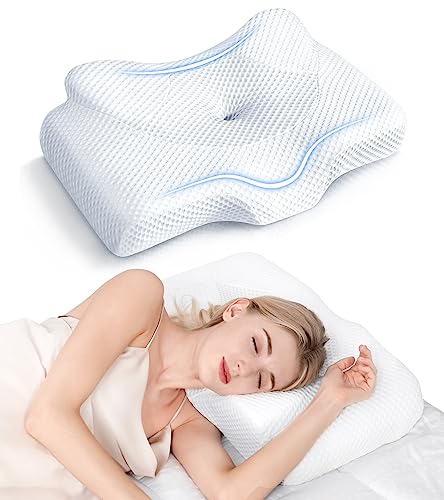
Osteo Cervical Pillow — Hollow Design, Adjustable — Best Overall
The Osteo design is the most distinctive here: a hollow centre that cradles the back of the head while the contour supports the neck, in memory foam its listing describes as odorless, with a cooling case, and an adjustable orthopedic construction. For back sleepers especially, the hollow-centre idea makes ergonomic sense — the head rests in the pillow rather than being pushed forward by it — and adjustability lets you tune a design that otherwise lives or dies by its factory loft.
Strengths
- Hollow-centre contour — a genuinely different design from standard dual-height pillows
- Adjustable construction stated, so loft is not take-it-or-leave-it
- Cooling case stated, suiting warm sleepers
Trade-offs
- The hollow design is the most unusual feel here — the adaptation period matters
- Memory foam feel is not for sleepers who love a plush, sink-in pillow
- Listing title states no dimensions, so check the listing page for size before ordering
| Specification | Detail (from verified listing title) |
|---|---|
| Design | Hollow design contour (as stated) |
| Fill | Memory foam, described as odorless (as stated) |
| Case | Cooling case (as stated) |
| Adjustability | Adjustable (as stated) |
Choose the Osteo if you sleep mainly on your back or rotate between back and side and want the most considered design in the guide. Its adjustability is the safety net: contour pillows succeed or fail on loft, and a pillow you can tune survives the adaptation period that defeats fixed designs.
Best for: back and combination sleepers wanting an adjustable hollow-contour design / Not suited for: stomach sleepers, or anyone wanting a traditional plush pillow feel
Check on Amazon — check the current price on Amazon before you decide.
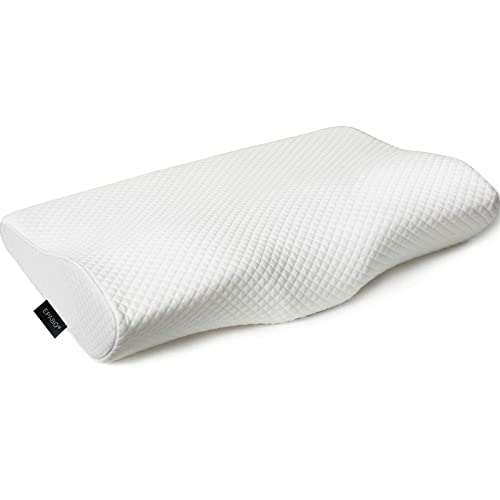
EPABO Contour Memory Foam Pillow — Orthopedic Cervical — Best Classic Contour
EPABO’s pillow is the reference design of this category: a contoured memory foam orthopedic pillow with an ergonomic cervical profile, positioned by its listing for side, back and stomach sleepers alike. If the Osteo is the innovator, this is the standard-bearer — the shape most people picture when they hear ‘orthopedic pillow’, from one of the longest-running names in the contour market. Its breadth of stated sleep positions makes it the natural first contour pillow for a household unsure where to start.
Strengths
- Classic dual-contour ergonomic shape — the category’s reference design
- Listing addresses side, back and stomach sleepers
- Memory foam contour support in a proven format
Trade-offs
- Fixed foam feel — no adjustability is stated in the verified title
- Stomach sleepers should still expect any contour to feel high; test carefully
- Adaptation period applies as with all contour pillows
| Specification | Detail (from verified listing title) |
|---|---|
| Design | Contour, ergonomic cervical (as stated) |
| Fill | Memory foam (as stated) |
| Stated positions | Side, back and stomach sleepers |
Buy the classic when you want the category’s standard answer without experimental geometry. Its honesty point is the stomach-sleeper claim: the listing makes it, we report it, and our own advice is that stomach sleepers should judge any contour pillow by the sit-test equivalent — a week of nights — rather than by any listing’s breadth of welcome.
Best for: first-time contour pillow buyers, especially side and back sleepers / Not suited for: sleepers who know they need adjustable loft
Check on Amazon — check the current price on Amazon before you decide.

UTTU Cervical Pillow — Adjustable Orthopedic Sandwich, Queen — Best Adjustable Height
UTTU’s sandwich design is the engineer’s answer to contour fit: layers that let you adjust height, in a queen pillow whose listing states its dimensions outright — 23.6 by 13.8 inches, with heights of 5.2 and 4.5 inches across its contour. Stated dimensions are gold in this category, and dual heights plus layer adjustment give this pillow the widest fit range here: side sleepers take the high side, back sleepers the low, and the layers fine-tune both. Its listing also states a contour cooling design.
Strengths
- Stated dimensions and dual heights (23.6″×13.8″, 5.2″/4.5″) — fully checkable
- Adjustable sandwich construction stated
- Queen size stated, with contour cooling design stated
Trade-offs
- Adjustment means setup: expect to spend the first week tuning layers
- Queen footprint is narrower than a standard queen pillow’s width — check your cases
- Most complex option here; minimalists should choose a fixed contour
| Specification | Detail (from verified listing title) |
|---|---|
| Size | Queen, 23.6″×13.8″ (as stated) |
| Heights | 5.2″ / 4.5″ dual height (as stated) |
| Design | Adjustable orthopedic sandwich, contour cooling (as stated) |
This is the pick for the sleeper who has already failed with a fixed contour pillow: the failure was almost certainly loft, and loft is what this design lets you change. Use the stated figures — if your current pillow’s height is known, the 5.2/4.5 pairing tells you immediately whether this pillow brackets it.
Best for: sleepers who need tunable loft, and anyone who measures before buying / Not suited for: buyers wanting a pillow that is right out of the box with no setup
Check on Amazon — check the current price on Amazon before you decide.

DONAMA Cervical Pillow — Cooling Contour, Dual-Height — Best for Hot Sleepers
DONAMA pairs the two features warm sleepers ask for: a cooling contour design and a dual-height ergonomic profile, in memory foam. Dual height is the quietly essential feature of classic contour pillows — rotate the pillow and the higher or lower edge supports your neck — and it is stated here alongside the cooling positioning. Memory foam’s known warmth is the trade the cooling design answers; if you have rejected foam pillows for heat before, this is the configuration aimed at you.
Strengths
- Cooling contour positioning stated — aimed at foam’s heat problem
- Dual-height ergonomic design stated: two lofts in one pillow
- Memory foam contour support
Trade-offs
- Cooling here is a design claim, not a refrigeration effect — expect neutrality, not cold
- Fixed dual heights still bracket a range rather than tuning infinitely
- No dimensions stated in the verified title
| Specification | Detail (from verified listing title) |
|---|---|
| Design | Cooling contour, dual-height ergonomic (as stated) |
| Fill | Memory foam (as stated) |
Choose DONAMA if heat has been your objection to contour pillows and you want the classic shape’s simplicity — two heights, no layers to manage. Judge the cooling claim the fair way: against other memory foam, across a week of nights, not against an air conditioner.
Best for: warm sleepers wanting a simple dual-height contour pillow / Not suited for: sleepers needing fine loft adjustment beyond two heights
Check on Amazon — check the current price on Amazon before you decide.

Royal Therapy Memory Foam Pillow — Queen, Contour Cervical — Best Stated Dimensions
Royal Therapy’s pillow states what this category too often hides: exact dimensions — 24 by 14 by 5 inches — for its queen contour cervical memory foam pillow, in white, positioned for side, back and stomach sleepers. A five-inch stated height is real information: it tells a side sleeper the loft on offer and tells a stomach sleeper, honestly, to look lower. We rank stated dimensions highly because they convert pillow shopping from horoscope to arithmetic.
Strengths
- Exact dimensions stated (24x14x5 inches) — compare against your current pillow directly
- Queen contour cervical design in memory foam
- Listing addresses side, back and stomach sleepers
Trade-offs
- A stated 5-inch height is substantial — stomach sleepers, take the hint
- Fixed single-height contour; no adjustability stated
- White cover shows everything; a protector is essential
| Specification | Detail (from verified listing title) |
|---|---|
| Size | 24x14x5 inches, queen (as stated) |
| Design | Contour cervical (as stated) |
| Colour | White (as stated) |
Do the arithmetic this listing invites: measure your current pillow’s height and width, and you will know before ordering whether five inches of contour is your direction. That measurability — rare in this guide — is why a straightforward pillow earns a badge of its own.
Best for: side and back sleepers who shop by measurement / Not suited for: stomach sleepers, for whom the stated 5-inch height argues against
Check on Amazon — check the current price on Amazon before you decide.

NOFFA Cervical Neck Pillow — Contour with Cooling Pillowcase — Best Medium-Soft Contour
NOFFA closes the guide with the feel specification most contour roundups omit: its listing describes the pillow as medium soft, with a contour memory foam construction, a cooling pillowcase, and positioning for side, back and stomach sleepers. Firmness is where contour pillows divide households — one partner’s support is the other’s slab — and a stated medium-soft contour is the gentlest entry into the category for sleepers who found firmer contours hostile.
Strengths
- Firmness stated: medium soft — the gentlest contour feel here
- Cooling pillowcase stated
- Contour memory foam orthopedic design stated
Trade-offs
- Medium soft may under-support larger side sleepers who need firmer loft
- No dimensions stated in the verified title
- Gentler feel still requires the contour adaptation period
| Specification | Detail (from verified listing title) |
|---|---|
| Feel | Medium soft (as stated) |
| Design | Contour memory foam, orthopedic (as stated) |
| Case | Cooling pillowcase (as stated) |
Choose NOFFA if a previous contour pillow felt like sleeping on a speed bump: the shape’s support with a softer landing is a legitimate design answer, not a compromise. Larger-framed side sleepers should weight the firmer, higher picks above it instead — matching firmness to frame is this category’s quiet rule.
Best for: smaller-framed and combination sleepers wanting a gentler contour / Not suited for: larger side sleepers needing firm, high support
Check on Amazon — check the current price on Amazon before you decide.
Comparison Table
| Pick | Badge | Key spec | Best for |
|---|---|---|---|
| Osteo Cervical Pillow — Hollow Design, Adjustable | Best Overall | Hollow contour, adjustable, cooling case | back and combination sleepers wanting an adjustable hollow-contour design |
| EPABO Contour Memory Foam Pillow — Orthopedic Cervical | Best Classic Contour | Classic contour memory foam | first-time contour pillow buyers, especially side and back sleepers |
| UTTU Cervical Pillow — Adjustable Orthopedic Sandwich, Queen | Best Adjustable Height | Adjustable sandwich, 23.6×13.8″, 5.2/4.5″ | sleepers who need tunable loft, and anyone who measures before buying |
| DONAMA Cervical Pillow — Cooling Contour, Dual-Height | Best for Hot Sleepers | Cooling contour, dual-height | warm sleepers wanting a simple dual-height contour pillow |
| Royal Therapy Memory Foam Pillow — Queen, Contour Cervical | Best Stated Dimensions | 24x14x5″ stated, queen contour | side and back sleepers who shop by measurement |
| NOFFA Cervical Neck Pillow — Contour with Cooling Pillowcase | Best Medium-Soft Contour | Medium soft contour, cooling case | smaller-framed and combination sleepers wanting a gentler contour |
How to Choose the Best Orthopedic Pillows
Start from your sleep position, because contour geometry is position-specific. Side sleepers need the highest, firmest support to bridge the shoulder gap. Back sleepers need a contour that supports the neck curve while the head rests back — the hollow-design Osteo speaks directly to this. Stomach sleepers need the least height of all, and should treat every contour claim aimed at them, including ones printed on listings in this guide, as a hypothesis to test over several nights.
Then choose your adjustability appetite. Fixed contours (EPABO, DONAMA, Royal Therapy, NOFFA) are simple and predictable. Adjustable designs (Osteo, and UTTU’s sandwich layers) cost setup effort and repay it when a fixed loft would have missed. If one pillow must serve a couple with different builds, dual-height designs let each partner rotate to their side — the closest thing this category has to a household compromise.
Contour Shapes Explained: Hollow, Dual-Height and Sandwich
The classic contour has two heights: a higher edge and a lower edge, with a valley between. You sleep with one edge under your neck and your head in the valley, choosing the edge by rotating the pillow. It is simple, proven, and represented by most picks here. The hollow design (Osteo) deepens the valley into a cradle, which back sleepers often prefer because the head is held rather than propped.
The sandwich design (UTTU) stacks layers so height itself becomes adjustable — remove or add a layer and the whole geometry scales. It is the most tunable and the most fiddly. None of the three shapes is medically superior in any way this guide can claim; they are ergonomic options whose differences you can feel and judge for yourself over the adaptation period.
Memory Foam, Firmness and Body Size
Every pick here is memory foam, because the category is: foam holds a moulded contour in a way loose fills cannot. Foam’s variables are density and firmness, and listings rarely state density — which is why NOFFA’s stated ‘medium soft’ feel and the stated dimensions on the UTTU and Royal Therapy listings carry unusual weight in our rankings. Where a listing states nothing measurable, you are buying a shape and a hope.
Match firmness to frame honestly. Larger, broader-shouldered side sleepers compress foam further and generally need the higher, firmer end of the range. Smaller sleepers on a firm high contour get pushed rather than supported, and do better at the medium-soft end. Combination sleepers should prioritise their dominant position and accept compromise in the others — no single contour is optimal in three positions at once.
Cooling Cases and Covers: What They Can and Cannot Do
Three picks here state a cooling element — the Osteo’s cooling case, DONAMA’s cooling contour, NOFFA’s cooling pillowcase. Set expectations correctly: a cooling cover makes a foam pillow feel cooler to first contact and less clammy through the night. It does not chill the pillow, and its effect fades as any fabric warms to skin temperature. Judged fairly — foam versus foam — the difference is real and worth having for hot sleepers.
Whatever the cover, use a pillow protector and wash the removable case as the maker directs. Memory foam itself should not be soaked; air it, spot-clean it, and keep it dry. A contour pillow’s shape is its value, and water is how foam shapes go to die.
The Adaptation Period, and When a Pillow Is Not the Answer
Give any contour pillow a fair trial: several nights at minimum, ideally two weeks, using the height or rotation options it offers before judging. Muscles accustomed to a flat pillow need time to trust a shaped one, and night-one verdicts in this category are notoriously unreliable — in both directions. Keep your old pillow in the house during the trial; alternating nights is a legitimate way to adapt gradually.
And the boundary this guide will not cross: a pillow is a comfort product. Pain that persists, radiates, follows an injury, or comes with numbness or weakness is a clinical matter, not a shopping problem. No listing’s title — including titles quoted in our sources — changes that, and no pillow in this guide is presented as a treatment for anything.
How to Set Up and Adapt to a Contour Pillow
Setup takes ten minutes; adaptation takes nights. Both go better with a plan than with hope.
- Air the pillow on arrival until any new-foam scent fades; fit the case or pillowcase it comes with, plus your own protector.
- Choose your starting configuration: back sleepers start on the lower contour edge (or the hollow centre), side sleepers on the higher edge; adjustable models start at their middle setting.
- Align correctly in bed: the contour edge sits under your neck, your head rests in the valley or hollow — the pillow supports the neck first, the head second.
- Commit to a block of nights before judging — several at least — changing only one variable (edge, layer, rotation) at a time so you know what helped.
- If you wake with the old pillow’s ache pattern unchanged after a fair trial at the right height, the shape is not your answer; if discomfort is new, sharp or persistent, stop and treat it as a health question, not a product question.
- Maintain the shape: air the foam regularly, never soak it, wash only the removable covers as directed, and re-check your configuration after any mattress change — pillow fit is relative to the bed beneath it.
Revisit the fit whenever your mattress, weight or sleep position changes materially. A contour pillow is a tuned system, not a permanent verdict — the adjustable picks exist because the tuning sometimes needs redoing.
Sleep Positions in Depth: Matching Contour to Posture
Side sleeping is the most demanding position a pillow serves: the head must be held level across the full width of the shoulder, all night, through the micro-shifts of sleep. That is why side sleepers need the highest and firmest contour a design offers — the tall edge of a dual-height pillow, the UTTU at its 5.2-inch side, the Royal Therapy’s stated five inches — and why a contour that delights a back sleeper can leave a side sleeper’s neck angled downward by morning. If you sleep on your side, shop this guide from the top of the height range downward.
Back sleeping asks the opposite geometry: support the neck’s curve, let the head rest back and slightly down. Too much loft pushes the chin toward the chest; too little abandons the neck. The hollow-centre Osteo design speaks to this position most directly, and medium settings on adjustable models exist for it. Back sleepers who snore or wake with a stiff neck often find the contour’s value here — as comfort and support, in this guide’s careful language — provided the height is tuned rather than assumed.
Stomach sleeping remains the category’s honest problem. The position twists the neck by design, and the kindest pillow for it is the thinnest. Listings in this guide that welcome stomach sleepers are reported as listings’ claims; our advice is narrower: if you must sleep on your stomach, choose the lowest contour available, expect compromise, and consider whether the position itself — rather than any pillow — is the variable worth changing. Combination sleepers should optimise for their dominant position and accept the compromise in the others, because a pillow cannot be three heights at once.
Pillow Height Arithmetic: Using the Stated Dimensions
Two picks in this guide state their dimensions, and they let us demonstrate the arithmetic every contour buyer should do. Measure your current pillow’s height where your neck rests — not its puffed showroom loft, but its compressed working height under your head, which a partner can measure with a ruler while you lie on it. That number is your baseline. A new contour whose stated height brackets your baseline (the UTTU’s 5.2 and 4.5 inches, for instance) is a rational purchase; one whose stated height is far from it is a gamble, whatever its reviews say.
Width and length matter secondarily but really: the Royal Therapy states 24×14 inches, the UTTU 23.6×13.8 — both narrower than a standard pillow’s footprint, because contour pillows are workstations for the head and neck, not landscapes for the shoulders. Check your pillowcases against stated dimensions before ordering; a contour pillow swimming in an oversized case loses its alignment every night, and the fix — a case that fits — costs little and is skipped constantly.
Where a listing states no dimensions — four of our six picks — the honest position is that you are buying a shape described in words. That can still be the right purchase: the Osteo’s hollow design and NOFFA’s stated medium-soft feel are real information of a different kind. But buy those with a returns policy you have actually read, and judge them across the adaptation period, because words-only sizing cannot be pre-checked the way figures can.
Couples, Guest Rooms and the Second-Pillow Problem
Contour pillows are individual in a way flat pillows pretend not to be: height, firmness and shape all interact with one sleeper’s build and position. Couples should expect — and budget for — different picks from this guide: a broader-shouldered side sleeper on the UTTU’s high setting and a smaller back sleeper in the Osteo’s hollow are not a disagreement, they are the category working correctly. Dual-height designs soften the problem for guest rooms, where one pillow must serve unknown sleepers: rotate to the lower edge for most guests, and the pillow offends nobody.
The second-pillow problem is real in the other direction too: many contour users keep a conventional pillow in the house for reading in bed, for illness, for the nights the contour simply is not wanted. That is not failure — it is the normal ecology of a tuned sleep tool. What this guide advises against is the drawer of failed contours: buy one, trial it properly across the adaptation period with one variable changed at a time, and return it inside its window if it fails, rather than accumulating a foam archive.
Travel deserves a footnote: a contour pillow’s benefits do not travel in a suitcase, and hotel pillows will undo a week’s adaptation in a night. Accept it, use the trip’s pillows folded or doubled to approximate your home height, and give your neck a night or two to forgive you on return. Consistency at home is the investment; travel is the exception that proves its value.
What ‘Orthopedic’ Can and Cannot Mean on a Pillow
The word ‘orthopedic’ on a pillow describes a design intent — shaped support aligned with the body’s curves — inherited from the medical field that studies the musculoskeletal system. On a consumer pillow it is not a certification, a clinical endorsement or a treatment claim, and no body awards it. This guide uses the word the way the search does, to name a category of contoured support pillows, and then holds every product in that category to comfort-and-support language only. Listings’ titles, quoted faithfully in our sources, use stronger pain language; that is their marketing, recorded, not adopted.
What a well-matched contour pillow can honestly offer is mechanical: a head and neck held in a neutral line, pressure spread across a shaped surface instead of concentrated, and a consistent sleep geometry night after night. Many sleepers find that genuinely transformative for their mornings; some find a contour merely interesting; a few find it wrong for them at any height. All three outcomes are compatible with this guide, which is why the adaptation trial and the returns window matter more than any badge we award.
And the boundary bears repeating at length, because this category blurs it commercially: pain that is new, severe, radiating into an arm, accompanied by numbness, weakness or fever, or that follows any injury, is not a pillow problem. It deserves a clinician’s examination, promptly. The best orthopedic pillow in this guide is a comfort product that supports sleep posture — chosen well, trialled fairly, and never asked to do a doctor’s work.
The First Fourteen Nights: A Practical Adaptation Diary
Night one on a contour pillow is data, not verdict. Expect awareness: the shape announces itself every time you move, and most sleepers wake once or twice noticing their own neck — a novel sensation that fades as the geometry becomes familiar. Sleep with the configuration you chose in our setup section and change nothing. Nights two and three are for one adjustment only, if the first night produced a clear signal: a neck that feels stretched asks for the lower edge or one fewer layer; a head that feels unsupported asks for the higher edge or one more. One variable, then three more nights to judge it.
By the end of the first week, most successful adaptations share a pattern: the pillow has stopped being noticeable, and the morning comparison against the old pillow — stiffness on waking, the urge to stretch the neck, the quality of the first hour — becomes the real evidence. Keep the comparison honest by alternating nothing during this week; chopping between pillows nightly produces two half-adaptations and a drawer verdict neither pillow deserved. If a week’s fair trial at the best configuration leaves you clearly worse, the shape is wrong for you and the returns window is the correct tool — use it without treating the outcome as a personal failure of sleeping.
Nights eight to fourteen are consolidation: the configuration should now be fixed, the pillow invisible, and the only remaining question the long one — whether your mornings are durably better than the old pillow’s mornings. That fortnight discipline is this guide’s single most valuable instruction, worth more than the difference between any two picks above it, because the category’s graveyard is full of good pillows returned on night two and mediocre ones kept by inertia. Trial fairly, decide once, and then let the pillow do its quiet, unmiraculous work.
Mattresses, Bed Bases and Why Pillow Fit Is a System
A contour pillow never works alone: its effective height is set by how deeply your shoulders sink into the mattress beneath it. On a soft mattress, the shoulders sink, the gap a side sleeper’s pillow must bridge shrinks, and a high contour that was perfect on a firm bed becomes a neck-tilting excess. On a firm mattress or a futon, the same pillow may be exactly right. This is why this guide insists the adaptation trial happen on your own bed, and why a pillow that failed at a partner’s house or a hotel has not failed at all — it has been tested in the wrong system.
Bed bases add their own variable. An adjustable base that raises the head end changes the geometry a contour was tuned for; sleepers who read in bed on a raised base should re-tune their pillow’s configuration for the flat sleeping position, not the reading one. A sagging mattress defeats every pillow in this guide simultaneously — no contour can level a spine whose foundation dips — and a household shopping for pillows because of morning stiffness should honestly check the mattress’s age and flatness before spending anything on foam geometry.
Treat the pillow purchase, then, as the last step of a system check: mattress sound, base flat, sleep position known, current pillow’s working height measured. With those four facts, the picks in this guide sort themselves — heights stated on the UTTU and Royal Therapy against your measurement, adjustability where the system is uncertain, hollow or classic geometry by position. Without them, even the best contour pillow is a lottery ticket, and this guide does not sell lottery tickets.
A Word on Expectations, Placebo and Honest Comfort
Sleep products attract strong feelings, and a fair guide should name one mechanism honestly: expectation itself improves sleep. A new pillow, chosen carefully and trialled hopefully, often coincides with better nights partly because the sleeper is paying attention to sleep — going to bed deliberately, noticing the morning, adjusting the room. That is not a reason to dismiss the improvement, nor a reason to credit the foam with magic. It is a reason to buy the pillow whose measurable facts — height, dimensions, firmness, adjustability — match your body, and then let attention and geometry work together, each credited for its share.
It is also a reason to distrust any guide, unlike this one, that promises transformation. The picks above are well-described ergonomic objects: their listings state their designs, two state their dimensions, one states its firmness, two state their adjustability. Matched to the right sleeper and trialled across a fair fortnight, they offer supported, consistent sleep geometry — a real and sufficient good. Anything beyond that belongs to medicine, and this guide’s refusal to go there is the same refusal that makes its comfort claims worth believing.
The Guide in One Breath
If everything above had to compress into a single instruction, it would be this: measure your current pillow’s working height, match it against the stated heights and adjustability of the picks in this guide, choose the geometry your sleep position demands, and trial the result for a fair fortnight before judging it. Do that, and the category’s noise — the badges, the adjectives, the pain language in titles — falls away, leaving a shaped piece of foam, honestly described, doing mechanical work you can verify with your own mornings. That is all an orthopedic pillow has ever legitimately offered, and for the right sleeper, it is plenty.
Common Buying Mistakes
Judging on night one. Contour pillows have an adaptation period. Several nights, one variable at a time, is the minimum fair trial.
Believing medical promises. Listings use pain language freely; this guide repeats none of it as a claim. Persistent or radiating pain needs a clinician, not a different pillow.
Buying height blind. Where listings state dimensions (24x14x5; 23.6×13.8 at 5.2/4.5), use them against your current pillow. Where they do not, you are guessing — guess with a returns policy.
Ignoring body size. Firm, high contours suit larger side sleepers; medium-soft suits smaller frames. One household may honestly need two different picks from this guide.
Soaking memory foam. Wash covers, air foam, spot-clean only. A soaked contour pillow loses the shape that was its entire point.
Expecting one pillow to perfect three positions. Optimise for your dominant sleep position. Combination perfection is not a product that exists.
Final Recommendation
For most buyers, start with the Osteo if you sleep on your back or rotate, and the EPABO classic contour if you want the category’s standard shape. Choose the UTTU when loft has defeated you before, the DONAMA or NOFFA when heat or firmness is your objection, and the Royal Therapy when you shop by measurement and its stated five inches match your arithmetic.
Give whichever you choose a fair adaptation trial, keep the claims in their comfort-and-support lane, and treat persistent pain as a health question. A well-matched contour pillow is a genuinely better night’s support — that, and nothing grander, is the promise this guide stands behind. Related guides include Best Affordable Pillows For Stomach Sleepers and Best Back Side Pillows.
Best Affordable Pillows For Stomach Sleepers Best Back Side Pillows Best Affordable Pillows Best Bamboo Memory Foam Pillows
Frequently Asked Questions
Are orthopedic pillows medical devices?
No — they are comfort and sleep-support products with contoured ergonomic designs. This guide makes no medical claims for them, and persistent, radiating or injury-related pain should be assessed by a clinician.
How long does it take to get used to a contour pillow?
Several nights at minimum, often up to two weeks. Change one variable at a time — edge, layer or rotation — and keep your old pillow nearby to alternate during the first week if needed.
Which contour height should a side sleeper choose?
The higher option a design offers: dual-height pillows rotate to the tall edge, and the UTTU states heights of 5.2 and 4.5 inches. Broader shoulders generally need the higher end.
Can stomach sleepers use orthopedic pillows?
Cautiously. Stomach sleeping needs minimal height, and even listings that welcome stomach sleepers should be tested over several nights. Many stomach sleepers do better with a thin conventional pillow.
What is the difference between hollow and classic contours?
A classic contour has two heights and a valley; a hollow design deepens the valley into a cradle for the head, which many back sleepers prefer. Adjustable sandwich designs scale the whole geometry by layers.
How do I clean a memory foam contour pillow?
Wash the removable case or pillowcase as directed, use a protector, air the foam and spot-clean it only. Do not soak memory foam — water destroys the moulded shape.

