Disclosure: airfryerkitchensupply.com is reader-supported. When you buy through links on our site, we may earn an affiliate commission at no extra cost to you.
Where to buy
All six chairs below are sold on Amazon, and every link goes to the exact listing verified cache before writing. A note on vocabulary that shapes this whole guide: listings use ‘lumbar support’ for everything from a fixed curve molded into a mesh back to a fully adjustable pad you can raise, lower and push in or out. Those are very different products for a long workday, so each review below states which kind its listing actually confirms — and where the listing only says the words, this guide says only the words.
- SIHOO M18 Ergonomic Office Chair — Best Adjustable Lumbar: check price on Amazon
- TRALT Office Chair with Adjustable Lumbar Support — Best Adjustable Value: check price on Amazon
- Marsail Ergonomic Office Chair — Best High-Back With Headrest: check price on Amazon
- Furmax Office Chair — Best Budget Mesh: check price on Amazon
- BestOffice Ergonomic Office Chair — Best Simple Mid-Back: check price on Amazon
- Sweetcrispy Ergonomic Computer Desk Chair — Best Compact With Flip-Up Arms: check price on Amazon
Shopping for the best office chairs with lumbar support starts with a translation problem. The phrase on the box can mean a shaped mesh back that happens to curve where your lower back is, a separate pillow strapped to the chair, or a genuinely adjustable mechanism that moves the support to your spine and changes how firmly it pushes. For an eight-hour workday, those three products behave nothing alike — yet listings describe them in nearly identical language, and most roundups repeat the language without distinction. This guide’s first job is to make the distinction pick by pick, using only what each verified listing confirms.
Every chair below was matched by brand and model to its Amazon title before earning a link. Where a listing confirms adjustable lumbar support, the review says adjustable; where it confirms a headrest, armrest style or a weight capacity, those facts appear in the spec box; where it is silent — and several capable chairs are silent on the details — the review claims nothing extra. Lumbar comfort also interacts with everything else in the chair: seat height range, armrest position, tilt behavior and mesh versus cushion all change where your lower back ends up at 4 p.m., so the buying guide treats the chair as a system rather than a single feature.
This is a comfort and ergonomics guide, not a medical one: no chair here is presented as treating back conditions. What a well-matched lumbar chair can do is support a neutral sitting posture through a long day, adjust as you change tasks, and stop the slow slump that makes the last hours of work feel longest. The six picks span that brief from adjustable-flagship to honest budget mesh.
Key Takeaways
- ‘Lumbar support’ spans fixed mesh curves to fully adjustable pads — each review states which kind its listing confirms, and nothing more.
- Adjustable lumbar, confirmed on the SIHOO, Marsail-class and TRALT picks here, is what lets one chair fit different spines and tasks.
- Capacity figures appear only where a listing states them — 330 lb is confirmed for two picks in this roundup.
- A lumbar chair works as a system: seat height, armrests and tilt decide where your lower back actually rests at the end of the day.
In this guide
Quick Picks
SIHOO M18 Ergonomic Office Chair — Best Adjustable Lumbar. Adjustable lumbar support confirmed, with a headrest, tilt lock and a stated 330 lb capacity — the fitting-room pick. Check the current price on Amazon.
TRALT Office Chair with Adjustable Lumbar Support — Best Adjustable Value. Adjustable lumbar support confirmed at a value tier, in a breathable mesh home-office chair. Check the current price on Amazon.
Marsail Ergonomic Office Chair — Best High-Back With Headrest. High-back mesh with adjustable lumbar, 3D armrests and a headrest — the full-posture pick. Check the current price on Amazon.
Furmax Office Chair — Best Budget Mesh. The budget mesh standard — lumbar support as a shaped breathable back, with height adjustment and swivel. Check the current price on Amazon.
BestOffice Ergonomic Office Chair — Best Simple Mid-Back. A cushioned-seat mid-back with lumbar support as a built contour — the simple, traditional option. Check the current price on Amazon.
Sweetcrispy Ergonomic Computer Desk Chair — Best Compact With Flip-Up Arms. A compact mesh mid-back with flip-up arms and lumbar support — the small-room, tuck-away pick. Check the current price on Amazon.
How These Picks Were Chosen
Candidates came from Amazon listing data cache for office and desk chairs, matched by brand and model to Amazon titles. Only complete office chairs were eligible — chair mats, seat cushions, recliners, camping chairs and accent chairs that surfaced in the same cache were excluded, however ergonomic their titles sounded. A pick had to be a desk or office chair whose listing names lumbar support in some form; the form was then recorded exactly, because the difference between fixed and adjustable is the core buying decision in this category.
The six were spread deliberately across the adjustment spectrum and the budget tiers: two chairs with confirmed adjustable lumbar mechanisms, mesh mid-backs with lumbar wording at value tiers, and established mainstream models whose listings state the basics plainly. Capacities, armrest types and headrests appear in spec boxes only where the verified listing states them.
The 6 Best Office Chairs With Lumbar Support

SIHOO M18 Ergonomic Office Chair — Best Adjustable Lumbar
The SIHOO M18 leads this guide because its listing confirms the thing the keyword actually asks for: adjustable lumbar support, on a mesh ergonomic chair with a headrest, 2D armrests, a wide cushion, tilt lock and a stated 330 lb capacity. Adjustability is the dividing line in this category. A fixed lumbar curve fits the spines that happen to match it; an adjustable pad moves up, down and in depth until the support sits in the small of your back, and it can change again when you shift from upright typing to a reclined call. For a chair bought online, un-sat-in, that margin of adjustment is the closest thing to a fitting room.
Strengths
- Adjustable lumbar is confirmed — the mechanism that lets support meet your spine instead of a designer’s average spine.
- A confirmed 330 lb capacity and wide cushion broaden who this chair honestly fits.
- Headrest and tilt lock, both confirmed, support the lean-back reading posture as well as upright typing.
Trade-offs
- 2D armrests adjust less than the 3D sets on pricier rivals — height and width, not every angle.
- Mesh back feel is firm and cool, which cushion-seat traditionalists sometimes miss.
- Assembly and adjustment dialing-in take an evening of tweaking to get right.
| Lumbar | Adjustable lumbar support (confirmed in listing) |
| Capacity | 330 lb (confirmed in listing) |
| Armrests | 2D armrests (confirmed in listing) |
| Extras | Headrest, wide cushion, tilt lock (confirmed in listing) |
The supporting cast is confirmed rather than assumed: the headrest extends the chair’s usefulness into lean-back work, the tilt lock holds a chosen recline instead of forcing a constant push against a spring, and the capacity figure is printed here exactly as listed. Set expectations on the armrests — 2D adjustment is useful, not total — and on mesh, which trades plushness for cool, firm support. Judged on the search’s own terms, this is the most complete lumbar answer in the roundup.
Best for: workers who will actually use adjustability — mixed typing, calls and reading postures in one day / Not suited for: buyers who want a plush, executive-style cushioned chair

TRALT Office Chair with Adjustable Lumbar Support — Best Adjustable Value
The TRALT chair is the value route to the same headline feature: its listing names an ergonomic desk chair with adjustable lumbar support, in mesh, for home office use. That plain statement is worth more than a paragraph of ergonomic adjectives, because adjustability — not the word ‘ergonomic’ — is what determines whether the support lands on your spine. If your budget stops below the flagship tier, this is the pick that refuses to make you choose between price and the one mechanism that matters most in this category.
Strengths
- Adjustable lumbar support is confirmed in the listing title itself — the headline feature, stated plainly.
- Mesh construction suits warm rooms and long sessions where foam seats run hot.
- Executive-meets-task styling fits a home office that doubles as a guest room.
Trade-offs
- The cache record confirms fewer extras than the SIHOO — no capacity or headrest figure is stated, so none is claimed.
- Mesh tension is fixed by the frame; you adjust the lumbar pad, not the whole back’s firmness.
- Value-tier hardware rewards gentle treatment of armrests and tilt mechanisms.
| Lumbar | Adjustable lumbar support (confirmed in listing) |
| Format | Mesh computer / executive chair (confirmed in listing) |
| Use | Home office (confirmed in listing) |
| Color shown | Black (listing variant) |
Hold it to an honest standard elsewhere: the cached record does not state a weight capacity, a headrest or armrest specifics, and this guide claims none of them. What is confirmed is a mesh chair with the right lumbar mechanism at a value position — and mesh brings its own dividend, airflow through long afternoons. For the home worker whose current chair is a dining chair with a cushion on it, the TRALT is the single largest upgrade-per-decision in this roundup: one confirmed mechanism, correctly aimed.
Best for: home workers who want confirmed adjustable lumbar without flagship pricing / Not suited for: buyers who need a published high weight capacity

Marsail Ergonomic Office Chair — Best High-Back With Headrest
The Marsail entry earns its slot on a confirmed combination: high-back mesh, adjustable lumbar support, 3D armrests and a headrest, all stated in its listing. The high back changes the lumbar story in a way worth understanding — support that ends at mid-back encourages the upper spine to round forward over a long day, while a full-height back with a headrest lets the whole sitting posture stay neutral from pelvis to head, especially in the reclined positions where reports get read and calls get taken. The 3D armrests then finish the chain, bringing support to the elbows at heights and angles that keep shoulders down, which is where much end-of-day tension actually starts.
Strengths
- High-back mesh plus confirmed adjustable lumbar covers the full spine, not just the typing zone.
- 3D armrests, confirmed, adjust beyond the SIHOO’s 2D set — useful for varied desk heights and tasks.
- Headrest confirmed, completing a lean-back posture chain from lumbar to neck.
Trade-offs
- The cache record states no weight capacity, so none is claimed here.
- High-back frames dominate small rooms visually and physically.
- More adjustment points mean more setup time before the chair disappears under you.
| Lumbar | Adjustable lumbar support (confirmed in listing) |
| Back | High-back mesh (confirmed in listing) |
| Armrests | 3D armrests (confirmed in listing) |
| Extras | Headrest (confirmed in listing) |
As with the TRALT, the record’s silences are respected: no capacity figure is stated, so none appears here. What is confirmed is the most complete posture system in the roundup — lumbar that adjusts, arms that adjust further than its rivals, and a back tall enough to use them. Workers who split the day between upright creation and reclined review will feel that completeness most.
Best for: taller workers and lean-back readers who want headrest-to-lumbar support in one chair / Not suited for: small-desk setups where a high-back frame crowds the room
Furmax Office Chair — Best Budget Mesh
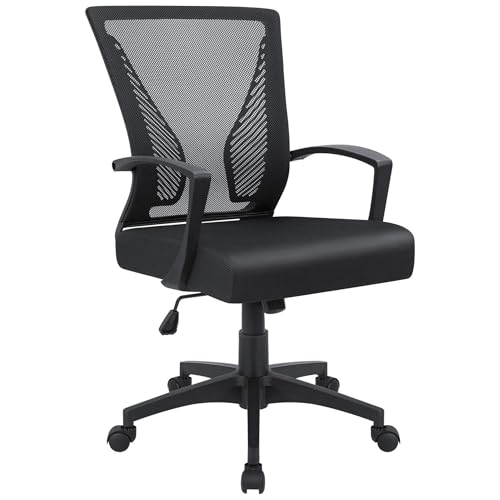
The Furmax chair is the budget mesh standard, and this guide treats its listing with the same discipline as the flagships: it confirms an ergonomic computer desk mesh chair with lumbar support, adjustable height, a breathable backrest, a mid-back 360-swivel design and armrests. What it does not confirm is adjustability of that lumbar support — so this review does not grant it any. Read this chair as a shaped mesh back whose curve provides the support, which fits many backs well and some backs not at all, with no dial to change the outcome.
Strengths
- The mainstream budget mesh chair: listing confirms lumbar support wording, breathable backrest and adjustable height.
- Mid-back format fits under desks and into small rooms the high-backs crowd.
- Swivel and rolling base cover the daily movement basics without complication.
Trade-offs
- The listing says ‘lumbar support’ without confirming adjustability — read it as a shaped back, not a movable pad.
- Budget-tier components reward reasonable use; it is not a two-shift call-center chair.
- No headrest and no stated capacity in the record.
| Lumbar | Lumbar support (as worded in listing — type not specified) |
| Format | Mid-back mesh desk chair (confirmed in listing) |
| Armrests | Armrests included (confirmed in listing) |
| Movement | 360 swivel, adjustable height (confirmed in listing) |
Within that honesty, the Furmax case is strong for its tier: mesh coolness, the full basic movement set, and a mid-back footprint that suits the spare-room desk. It is the right chair for a few hours a day, a first setup, or a household’s second desk. It is the wrong chair to ask for eight daily hours of tailored support — that ask is exactly what the adjustable picks above exist to answer, and the price gap between them is the price of the mechanism, not of branding.
Best for: first home-office setups and spare-room desks on a strict budget / Not suited for: workers who need confirmed adjustable lumbar for long daily hours
BestOffice Ergonomic Office Chair — Best Simple Mid-Back
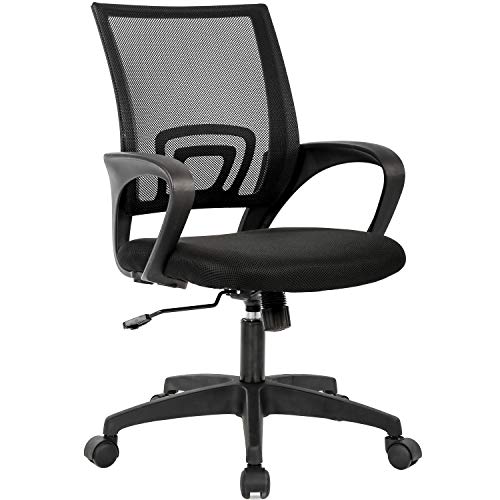
The BestOffice chair is the traditionalist’s mid-back: its listing confirms an ergonomic swivel desk chair with lumbar support, adjustable height, a breathable backrest and a sponge seat on rolling wheels. The sponge seat is its distinguishing choice — where mesh picks suspend you, this chair cushions you, and a real share of workers simply prefer that feel, especially in shorter daily sessions and cooler rooms. The lumbar wording, again, is recorded without promotion: support is named, adjustability is not, so the support here is the backrest’s built contour.
Strengths
- Listing confirms the simple, complete brief: lumbar support, adjustable height, breathable backrest, sponge seat.
- A cushioned sponge seat suits workers who dislike mesh’s firm feel.
- One-pack simplicity — a single chair, set up once, no accessory ecosystem.
Trade-offs
- Lumbar adjustability is not confirmed; support is the back’s built shape.
- Sponge seats warm up over long sessions compared with mesh.
- No headrest, no stated capacity in the record.
| Lumbar | Lumbar support (as worded in listing — type not specified) |
| Format | Mid-back swivel desk chair (confirmed in listing) |
| Seat | Sponge seat (confirmed in listing) |
| Base | Rolling wheels (confirmed in listing) |
That makes this the pick for buyers who know a shaped back suits them — many people sit happily in a well-shaped fixed back for years — and who value a cushioned seat and a simple, long-running design over a panel of adjustments they would set once and forget. If you are unsure whether a fixed contour fits your spine, the adjustable picks above are the safer online purchase; if you already know it does, this chair’s simplicity is its own feature.
Best for: buyers who prefer a cushioned seat and a simple, proven mid-back design / Not suited for: hot-room workers who need mesh airflow through the seat as well as the back

Sweetcrispy Ergonomic Computer Desk Chair — Best Compact With Flip-Up Arms
The Sweetcrispy chair closes the roundup as the space pragmatist. Its listing confirms a mesh office chair with lumbar support, a mid-back rolling swivel design, flip-up arms, and positioning for home office, bedroom and study — and the flip-up arms are the reason to buy it. In the small rooms where most home work actually happens, a chair that cannot tuck under the desk eats the room; arms that flip away return the floor. The lumbar support, recorded here at the listing’s wording without an adjustability claim, is the shaped-back kind, suited to the study-and-work sessions this chair is positioned for.
Strengths
- Flip-up arms are the space feature: the chair tucks fully under the desk and doubles as a study chair.
- Listing confirms comfortable lumbar support wording with a mid-back mesh build.
- Positioned for bedroom and study use, not just the dedicated office.
Trade-offs
- Lumbar adjustability is not confirmed in the record — support is the back’s shape and padding.
- Flip-up arms trade the fine adjustment of 2D/3D sets for their tuck-away trick.
- Compact class sizing suits average frames best.
| Lumbar | Lumbar support (as worded in listing) |
| Armrests | Flip-up arms (confirmed in listing) |
| Format | Mid-back mesh, rolling swivel (confirmed in listing) |
| Use | Home office, bedroom, study (confirmed in listing) |
Choose it with clear eyes: you are trading the adjustment panel of the SIHOO and Marsail for compactness and price, and for a bedroom desk used a few hours a day that trade is correct more often than roundups admit. The mesh keeps it cool, the swivel base keeps it mobile, and the arms keep it out of the way — a coherent small-space answer to a keyword usually answered with ever-larger chairs.
Best for: small rooms, bedroom desks and students who need the chair to disappear under the desk / Not suited for: workers wanting confirmed adjustable lumbar and armrest micro-adjustment
Comparison Table
The decisive column is the lumbar type, stated exactly as each listing confirms it. Adjustable mechanisms fit more spines; shaped backs cost less and suit the spines they match.
| Pick | Badge | Key spec | Best for |
|---|---|---|---|
| SIHOO M18 Ergonomic Office Chair | Best Adjustable Lumbar | Adjustable lumbar support (confirmed in listing) | workers who will actually use adjustability — mixed typing, calls and reading postures in one day |
| TRALT Office Chair with Adjustable Lumbar Support | Best Adjustable Value | Adjustable lumbar support (confirmed in listing) | home workers who want confirmed adjustable lumbar without flagship pricing |
| Marsail Ergonomic Office Chair | Best High-Back With Headrest | Adjustable lumbar support (confirmed in listing) | taller workers and lean-back readers who want headrest-to-lumbar support in one chair |
| Furmax Office Chair | Best Budget Mesh | Lumbar support (as worded in listing — type not specified) | first home-office setups and spare-room desks on a strict budget |
| BestOffice Ergonomic Office Chair | Best Simple Mid-Back | Lumbar support (as worded in listing — type not specified) | buyers who prefer a cushioned seat and a simple, proven mid-back design |
| Sweetcrispy Ergonomic Computer Desk Chair | Best Compact With Flip-Up Arms | Lumbar support (as worded in listing) | small rooms, bedroom desks and students who need the chair to disappear under the desk |
Fixed, Pillow or Adjustable: Reading Lumbar Claims Like an Engineer
Three mechanisms hide behind one phrase. A fixed or shaped support is a curve built into the backrest — mesh tensioned over a contoured frame, or foam molded with a lower-back swell. It costs nothing to maintain, never slips, and fits exactly the range of spines its designer averaged; outside that range, there is nothing to adjust. A lumbar pillow or pad strapped to the chair adds a movable bulge — adjustable in position, prone to sliding, and only as good as its strap. A true adjustable mechanism, confirmed in the SIHOO, TRALT and Marsail listings here, builds the pad into the chair with height and often depth control: the support moves to your spine and stays there through the day’s posture changes.
For an online purchase, adjustability is insurance. You cannot sit in the chair before it arrives, so every confirmed adjustment — lumbar height and depth, seat height, armrest position, tilt lock — is a chance to correct the fit after delivery instead of returning the chair. That is why this guide ranks confirmed-adjustable chairs at the top for full-time workers, while still recommending shaped-back chairs honestly for shorter days and known fits: the mechanism is worth its price exactly in proportion to the hours and uncertainty it has to absorb.
Setting Up a Lumbar Chair So the Support Actually Supports
A lumbar chair delivers its promise only in one position: feet flat, seat height set so thighs rest level, and the lumbar pad or curve settled into the small of the back — the inward curve just above the belt line. Set seat height first, then lumbar height to that spot, then lumbar depth so contact feels like a firm hand resting there, not a fist pushing you forward. Armrests should meet your elbows with shoulders relaxed; a tilt lock, where confirmed, should hold a slight recline for reading rather than forcing a bolt-upright pose all day.
Then live in it for a week before judging. Posture habits built in a bad chair feel strange in a good one for the first days, and the adjustment you need on day five is rarely the one you guessed on day one. The chairs with confirmed adjustments reward that week of tuning; fixed-back chairs ask the simpler question of whether their shape and your spine agree, which a week answers just as honestly.
Budget Tiers in Office Chairs
No prices are printed here, but the tiers map to mechanisms. The budget tier — the Furmax and BestOffice end of this roundup — buys a shaped back, height adjustment and a swivel base: the complete basics, honestly built. The mid tier adds the adjustable lumbar mechanism and better armrests, the TRALT and Sweetcrispy-to-SIHOO span. The upper tier of this guide — Marsail’s high-back system — adds full-height support, headrest and 3D arms. What no tier buys is a medical outcome; chairs support posture and comfort, and the honest reason to climb tiers is fit range and daily hours, not promises.
How to Adjust Your Office Chair for All-Day Comfort
Fifteen minutes of setup, in the right order, is worth more than any single feature on the box — and it is the same order for every chair in this guide.
- Set seat height so your feet rest flat on the floor and your thighs are level or slope very slightly down; use a footrest or a firm box if the chair’s lowest setting still leaves feet dangling.
- Sit fully back so your lower back contacts the backrest, then set lumbar height — where the chair confirms adjustment — so the pad sits in the curve just above your belt line.
- Set lumbar depth, where adjustable, to firm contact: you should feel supported without being pushed forward off the seat.
- Bring armrests to elbow height with shoulders down and relaxed; if the arms force a shrug or cannot reach, lower them or flip them away where the design allows.
- Set tilt tension and lock so a slight recline holds without effort for reading, and returns upright without a shove for typing.
- Place the screen so its top is near eye level at your new sitting height — the chair’s work is undone by a screen that pulls your head down.
- Re-check everything after a week of real work and adjust again; the second setup is the one that lasts.
Stand and move on a rhythm through the day. The best-adjusted chair supports sitting well; it does not make eight motionless hours a good idea, and short standing breaks protect the comfort the chair creates.
Common Buying Mistakes
Reading ‘lumbar support’ as one feature. It is at least three different mechanisms at three quality levels. This guide states each listing’s confirmed kind; do the same detective work on any chair you compare beyond it.
Buying a fixed back blind for full-time hours. A shaped back you cannot adjust is a bet that your spine matches the designer’s average. For eight-hour days bought online, confirmed adjustability is the safer money.
Setting the lumbar pad at belt level or higher. Support belongs in the curve just above the belt. Too low does nothing; too high pushes the mid-back and rounds the lower spine — the opposite of the goal.
Ignoring armrests and screen height. Shoulders hunched to high armrests and a head pulled down to a low screen will defeat a perfect lumbar setting by mid-afternoon. Adjust the system, not the feature.
Judging the chair on the first evening. Posture change feels odd before it feels right. Give any new chair a week of tuned use before deciding it does not fit.
The Rest of the Chair: Seat, Arms and Tilt Decide What Lumbar Can Do
Lumbar support operates inside a system, and the system’s other members can each veto it. The seat comes first: a seat pan too deep pushes you forward off the backrest, marooning the lumbar pad behind a gap; a seat too shallow leaves thighs unsupported and shifts load exactly where you do not want it. Foam seats compress over years into a hammock that rotates the pelvis backward, which is why an older cushioned chair can feel unsupportive even with its lumbar shape intact — the BestOffice-style sponge seat in this roundup will, over a long life, ask for that honest assessment, while mesh seats hold their geometry longer at the price of a firmer sit.
Armrests are the second veto. Set too high, they shrug the shoulders all day and the resulting neck tension gets blamed on the backrest; set too low or too wide, they might as well not exist. This is the practical content behind the armrest specifications in this guide — 2D on the SIHOO, 3D on the Marsail, flip-up on the Sweetcrispy: each is a different answer to how much positioning your elbows need, and the flip-up answer, often dismissed, is the only one that also solves the small-room storage problem. Tilt is the third: a chair that locks only bolt-upright forces one posture for eight hours, while a working tilt lets the day alternate between task and recline, and lumbar contact that survives that alternation is the real test of an adjustable mechanism.
When you test any chair from this guide, test the system in that order — seat depth and height, lumbar placement, arms at relaxed shoulders, tilt through its range — and you will learn in ten minutes what spec sheets cannot say: whether the parts cooperate. The chairs ranked highest here are ranked so because their confirmed adjustments let you make them cooperate, on your body, at your desk.
How Long a Workday Chair Lasts, and What Wears First
A daily-use office chair is a mechanical product with a service life, and knowing the wear order helps you judge both new purchases and the chair you already own. Gas lifts tire first in cheap chairs — the slow sink that resets every morning — followed by armrest pads cracking, casters grinding on hard floors, and foam seats packing down. Mesh backs age most gracefully, which is one reason this roundup’s adjustable end is mesh-heavy; mechanisms with more adjustment, maintained and not forced, generally outlast fixed frames treated roughly, because correct fit reduces the leverage abuse that breaks chairs.
Weight capacity, where a listing states it — the SIHOO’s confirmed 330 lb in this guide — is a durability signal as much as a fit one: a chair engineered and warranted for a higher load carries margin for every load beneath it. Where no capacity is stated, this guide claims none, and the honest buyer reads that silence as a reason to treat the chair gently rather than as a hidden figure to guess at. Wheels deserve a final word for the hard-floor offices most home workers now have: any chair in this roundup will roll better and mark less with its casters kept clean of the hair and grit that accumulate in them monthly.
Expect a well-matched chair, set up as this guide’s how-to describes and given its week of tuning, to deliver years of unremarkable days — which is the entire product. A chair you notice at 4 p.m. is a chair failing; a chair you never think about is the lumbar promise kept, quietly, by a system of adjustments you made once and a posture you no longer have to defend.
Trying a Chair You Bought Online: A Two-Week Protocol
An online chair purchase replaces the showroom’s ten minutes with a fortnight at your own desk, and the fortnight is the better test — if it is run deliberately. Days one and two belong to assembly and the first setup, following this guide’s order: seat height, lumbar placement, arms, tilt. Expect the chair to feel conspicuous; a new sitting geometry always does, and conspicuous is not the same as wrong. Days three through five are for one adjustment at a time — lumbar depth on Monday, arm height on Wednesday — because changing everything daily teaches you nothing about what helped.
The second week is the verdict week. By then the novelty has faded and the question becomes the honest one: at the end of a full workday, what do you notice? A chair passing its protocol is noticed for nothing — no 4 p.m. slump to correct, no cushion-hunting, no standing up to escape it. A chair failing it fails specifically: the fixed back whose curve lands wrong will announce the same wrongness daily, and no further week will convert it, which is the precise risk the adjustable picks in this guide insure against. Use the return window while the information is fresh; a chair is a five-year decision being made with two-week data, and the data deserves respect in both directions.
Keep the protocol’s paperwork: the settings that worked, jotted once, survive every future disassembly, move and cleaning. And if the chair passes, stop adjusting. The endpoint of ergonomic setup is a chair you never think about, and the discipline of leaving a working system alone is the final skill this category asks of its owners — the lumbar support doing its quiet work, the workday doing its own, and neither interrupting the other.
Standing Desks, Shared Desks and Other Real-World Complications
Many home offices no longer hold still: the desk rises for standing hours, a partner shares the chair on alternate days, a gaming session follows the workday in the same seat. Each complication rewards the adjustability this guide has treated as the category’s dividing line. A sit-stand rhythm changes the chair’s job to half-time, which forgives a shaped back more easily — hours are the currency adjustment is bought with, and fewer sitting hours spend less of it. A shared chair spends it twice over: two spines, two setups, and a chair whose lumbar, height and arms reset in seconds is the only kind that serves both people rather than averaging them into mutual discomfort.
The gaming crossover deserves its sentence because it is so common: the work chair that reclines with a headrest and a tilt lock — the SIHOO and Marsail pattern — crosses over gracefully, while the compact study chair serves its room honestly and should not be asked to host a midnight session it was not built for. None of this changes the guide’s rankings; it sharpens their application. Buy for the desk life you actually live — its hours, its sharers, its second shifts — and the lumbar mechanism you choose will be the one your real routine would have specified.
What to Do With the Chair You Already Own
Not every reader of this guide should buy a chair today, and the honest alternative deserves its paragraph. If your current chair’s frame, lift and seat remain sound and only its lumbar story fails you, live with the failure consciously for a defined period: sit fully back, keep sessions broken by standing, and let a month of attention tell you whether the mismatch is the chair’s shape or your habits. Some fixed-back chairs acquit themselves under that scrutiny — the shape was right and the sitting was wrong — and the money stays unspent, which is a legitimate outcome of a buying guide.
If the month convicts the chair, it also writes the replacement’s specification: where contact was missing, what the arms did to your shoulders, whether heat or firmness drove the afternoon restlessness. Take that specification into this roundup’s comparison with your own evidence in hand, and the adjustable-versus-fixed question — this guide’s central distinction — answers itself from experience rather than from anyone’s ranking, including this one. The best chair purchase is the second one, made knowingly; this section exists so that yours, whenever it happens, is made that way.
A Final Note on Floors, Casters and the Room Around the Chair
The chair’s last system is the room itself. Casters chosen for carpet labor on hard floors and can mark them; hard floors deserve the wiped-caster habit this guide mentioned and, beneath a chair that lives in one spot, the protection of the surface it rolls on — a consideration this site’s rug and chair-mat coverage explores in depth. The desk’s edge height, the monitor’s stand, the window’s glare at 3 p.m.: each one reaches into the sitting posture the lumbar support is trying to hold, and each one is cheaper to fix than the chair was to buy. Treat the room as the chair’s final adjustment — the one that costs nothing — and the support you paid for stops fighting its environment and starts, simply, supporting.
Final Recommendation
For most full-time workers, the SIHOO M18 is the buy: confirmed adjustable lumbar, a headrest, tilt lock and a stated 330 lb capacity in one coherent chair. The TRALT delivers the same confirmed mechanism at a value tier, the Marsail adds the full high-back system, and the Furmax, BestOffice and Sweetcrispy serve budget, cushioned-seat and small-room briefs honestly with shaped-back support.
The search promises lumbar support; the listings deliver it in different mechanisms at different tiers. Buy the mechanism that matches your hours and your uncertainty, set it up in the right order, and the chair will do the quiet, daily work you bought it for.
If you are deciding today, the shortlist to check first is: SIHOO M18 Ergonomic Office Chair, TRALT Office Chair with Adjustable Lumbar Support, Marsail Ergonomic Office Chair. Each link goes to the verified listing discussed above, where you can confirm the current details before buying.
Keep exploring related guides: Best Chairs With Adjustable Lumbar Support Best Ergonomic Office Chairs Home Best Customizable Office Chairs Best Easy Rolling Office Chairs Best Ergo Office Chairs Available
Frequently Asked Questions
What is the difference between fixed and adjustable lumbar support?
Fixed support is a curve built into the backrest’s shape; adjustable support is a pad or mechanism you can move — usually up and down, sometimes in and out — to place the support on your own spine. Fixed backs cost less and fit the spines that match their shape; adjustable backs fit a wider range of people and postures, which is why they lead this guide for full-time use.
How do I know where the lumbar support should sit?
In the inward curve of your lower back, just above the belt line. Sit fully back in the chair, find that curve with your hand, and set the pad or check the back’s contour at exactly that height. Support placed at the belt or at mid-back misses the curve it exists to meet.
Is mesh or a cushioned seat better for long days?
Mesh runs cooler and holds its shape; cushions feel softer initially and warmer over hours. In this roundup the mesh picks dominate the adjustable end, while the BestOffice offers the cushioned-seat alternative. Climate, session length and personal feel decide it — neither is a lumbar factor in itself.
What weight capacities do these chairs state?
Only where a listing confirms one does this guide print it: the SIHOO M18 states 330 lb. Several other listings in the roundup state no capacity in their verified titles, so none is claimed for them — check the listing directly if capacity is a deciding factor for you.
Can an office chair fix my back pain?
No chair in this guide is presented as a treatment for any condition. A well-fitted chair supports a neutral posture and daily comfort; persistent pain is a question for a clinician, who can also tell you what seating properties to look for — after which this guide’s mechanism distinctions will help you shop.
How long should I give a new chair before judging it?
About a week of real work, with a second adjustment session partway through. Posture habits adapt slowly, and the settings that feel right on day five are rarely the day-one guesses. If a fixed-back chair still mismatches your spine after that week, believe it — that is the bet a fixed back asks you to make.


