Disclosure: airfryerkitchensupply.com is reader-supported. When you buy through links on our site, we may earn an affiliate commission at no extra cost to you.
Where to buy
Every pick in this guide to the best office chairs for children was confirmed against Amazon’s own product data before it earned a link, so the names, sizes and features below match the live listings. Prices move constantly, so we never print them here — use the links to check the current price on Amazon for each model, and check price on Amazon again before you commit if you are comparing two finalists side by side.
- VIVO Children’s Height Adjustable Desk Chair (DESK-V201G-CH, Gray) — Best Overall: Check the current price on Amazon
- HONEY JOY Kids Desk Chair (Purple) — Best for Adjustable Support: Check the current price on Amazon
- Costzon Kids Desk Chair with Sit-Brake Casters — Best for Younger Children: Check the current price on Amazon
- Primy Kids Desk Chair (Pink) — Best for Ages 4–12: Check the current price on Amazon
- GIANTEX Kids Desk Chair (Purple, Armless) — Best Armless Design: Check the current price on Amazon
- Ergonomic Kids Desk Chair with Footrest (Ages 4–12) — Best with Flip-Up Arms: Check the current price on Amazon
Finding the best office chairs for children is a different job from buying a small adult chair and hoping for the best. A child who sits with feet dangling and a backrest that hits the shoulder blades will fidget, slouch and abandon homework long before the work itself gets hard. The chairs that earn a place in this guide share three things: genuine height adjustment that lets feet rest flat, a seat depth a child’s legs can actually use, and casters and bases that behave safely on home flooring.
We also want to be honest about what this category is. These are study and homework chairs for a desk at home or school, not lounge chairs, not gaming thrones and not toddler furniture. Every pick below is a height-adjustable task chair sized for school-age children, and every one was confirmed against Amazon’s own product data, so the features described are the features the listing actually claims. Where a chair suits younger children better than older ones, or the reverse, we say so plainly rather than pretending one chair fits every age from five to fifteen.
Budget matters here too, because children outgrow chairs. A chair that adjusts widely enough to follow a child through several school years is usually better value than the cheapest fixed option that needs replacing in eighteen months. The six picks are spread across budget, mid-range and premium tiers so you can decide where your own household’s money is best spent, and the buying guide further down explains how to measure your child and the desk before you order anything.
In this guide
Quick Picks
If you are short on time, these are the six best office chairs for children we would put on a shortlist, each chosen for a different household, budget tier and set of priorities. The detailed reviews further down explain exactly who each one suits and where each one falls short.
- VIVO Children’s Height Adjustable Desk Chair (DESK-V201G-CH, Gray) — Best Overall. A height-adjustable study chair in a neutral gray that works for school writing, study and play, from a brand that also makes the desks many families pair it with. Check the current price on Amazon
- HONEY JOY Kids Desk Chair (Purple) — Best for Adjustable Support. A swivel mesh task chair with adjustable height, armrests and a footrest — the most adjustable package in this guide, in purple. Check the current price on Amazon
- Costzon Kids Desk Chair with Sit-Brake Casters — Best for Younger Children. A height-adjustable mesh study chair whose sit-brake casters lock when the child sits down — the safety-minded pick for younger, wrigglier sitters. Check the current price on Amazon
- Primy Kids Desk Chair (Pink) — Best for Ages 4–12. A pink swivel mesh study chair the listing explicitly sizes for ages 4–12 — a clear age range that takes the guesswork out of sizing. Check the current price on Amazon
- GIANTEX Kids Desk Chair (Purple, Armless) — Best Armless Design. An armless swivel mesh chair with lumbar support that slides fully under the desk — the tidy-room, small-desk pick. Check the current price on Amazon
- Ergonomic Kids Desk Chair with Footrest (Ages 4–12) — Best with Flip-Up Arms. A mesh chair for ages 4–12 combining a footrest with flip-up armrests and 360° wheels — support when sitting, clearance when storing. Check the current price on Amazon
Key Takeaways
- Height adjustment is the single most important feature: feet should rest flat on the floor or on a footrest, with knees near a right angle.
- Mesh backs suit children who run warm and sit for long homework sessions; padded seats suit younger children who perch and shift constantly.
- Sit-brake or locking casters are worth having for younger children who treat a rolling chair as a vehicle.
- Buy for the desk height you actually have — measure the underside of the desktop before choosing a chair with fixed armrests.
- Every pick below was verified against Amazon’s product data; no chair here is included on the strength of a brand name alone.
How These Picks Were Chosen
We started from the adjustable children’s desk chairs listed on Amazon and filtered hard. Fixed-height chairs, novelty chairs shaped like animals, toddler armchairs and adult task chairs with a child in the photograph were all removed. What remained had to offer real seat-height adjustment, a backrest proportioned for a child’s torso, and a stable five-point or similarly broad base.
Each surviving model was then checked against Amazon data for this site, matching the exact listing title before any link was added. We compared the adjustment ranges, back materials, caster types and stated age or user ranges in those listings, and we weighted everyday practicality — how easy the chair is to clean, how it behaves on hard floors versus carpet, and whether the arms get in the way of a typical home desk. The result is six chairs that cover the realistic spread of this market rather than six near-identical clones.
The 6 Best Office Chairs for Children

VIVO Children’s Height Adjustable Desk Chair (DESK-V201G-CH, Gray) — Best Overall
This is the chair we would hand to most families first. VIVO builds it as a dedicated children’s desk chair rather than a shrunken office chair, and the listing positions it squarely for school writing, study and play at a home workstation. It suits primary and early secondary school children who need one chair that can be raised as they grow, and the plain gray finish keeps it acceptable to older children who would reject anything that looks like nursery furniture.
Strengths
- Purpose-built children’s sizing rather than a scaled-down adult chair
- Height adjustment lets the chair follow growth over several school years
- Neutral gray finish works in shared rooms and survives the move to a teen desk
Trade-offs
- Sold as chair only — the desk in lifestyle photos is not included
- A single color keeps things simple but gives younger children nothing playful to choose
- Like all rolling chairs, it needs a conversation about not riding it across the room
| Specification | Detail |
|---|---|
| Model | DESK-V201G-CH |
| Color listed | Gray |
| Intended use (per listing) | School writing, study or play |
| Configuration | Chair only |
The reason this chair tops the list is proportion. Children’s chairs fail most often at the seat: too deep, and the child perches on the front edge with no back support at all; too high, and feet dangle, which pulls the whole posture forward. A height-adjustable chair designed around children’s legs avoids both traps, and the adjustment means the same chair can be re-set at the start of each school year instead of replaced. In daily use, expect it to live at a homework desk, roll out for art projects and get borrowed for family laptop time. The gray upholstery hides the pencil marks and snack evidence that lighter fabrics advertise. Assembly is a one-adult job with the usual caster, base, lift and seat sequence, and once built, the adjustment lever is simple enough for an older child to operate — though for younger children, set the height yourself and treat it as fixed until the next growth spurt. If your child is at the very small end of school age, pair it with a footrest box or a low step so feet have somewhere to land while the seat is high enough for the desk.
Best for: Most families wanting one adjustable study chair that lasts several years / Not suited for: Toddlers, or anyone shopping for a lounge or reading chair
Check the current price on Amazon
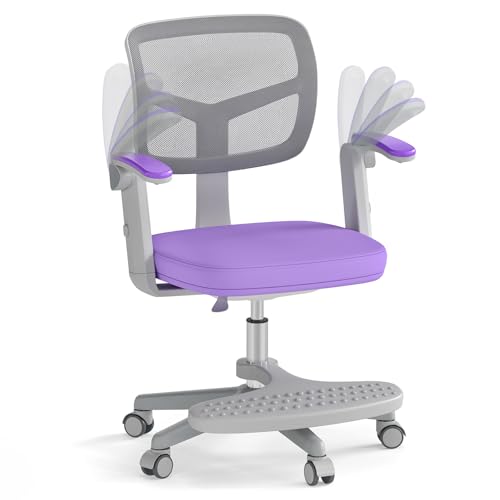
HONEY JOY Kids Desk Chair (Purple) — Best for Adjustable Support
HONEY JOY’s chair is the one to look at when a standard kids’ chair leaves gaps: the listing adds adjustable armrests and a footrest to the usual height adjustment, which makes it a strong fit for children whose feet do not yet reach the floor at desk height. The mesh back suits warm rooms and long homework sessions, and the swivel rolling base matches what older children and teens expect from a ‘real’ desk chair at home, school or a bedroom office corner.
Strengths
- Adjustable height, armrests and footrest cover the widest range of body sizes here
- Mesh back breathes better than padded vinyl in warm rooms
- Footrest solves the dangling-feet problem for smaller children
Trade-offs
- Purple will not suit every child or every room
- More moving parts mean more bolts to check and tighten over time
- Mesh can feel cool in winter without a cushion or layer
| Specification | Detail |
|---|---|
| Back material (per listing) | Mesh |
| Adjustments (per listing) | Height, armrest, footrest |
| Base | Swivel rolling task base |
| Color listed | Purple |
The footrest is the headline. Posture advice for children at desks always comes back to feet: supported feet stabilize the pelvis, which stabilizes everything above it. By building the footrest into the chair, HONEY JOY removes the need for the improvised stack of books most families end up using. The adjustable armrests matter for a subtler reason — fixed arms at the wrong height either shrug a child’s shoulders upward or go unused entirely, and arms that can be set or moved aside also determine whether the chair slides under the desktop at tidy-up time. Mesh backs are the practical choice for children who do homework straight after sports or who share a warm room; air moves, and spills wipe off rather than soaking in. The trade-off for all this adjustability is maintenance: check the armrest and footrest fasteners every few months, because children find every loose bolt eventually. For a child between sizes — too big for a basic kids’ chair, too small for an adult task chair — this is the most accommodating option in the guide.
Best for: Children whose feet dangle at desk height, and growing kids between chair sizes / Not suited for: Families who want the simplest possible chair with nothing to adjust or tighten
Check the current price on Amazon

Costzon Kids Desk Chair with Sit-Brake Casters — Best for Younger Children
Costzon’s sit-brake casters are the detail that earns this chair its badge: the wheels resist rolling while the child’s weight is on the seat, which takes the ride-on temptation out of homework time. It is a height-adjustable mesh task chair with armrests, aimed at boys, girls and teens for home, office or school desks, and it makes most sense for younger school-age children whose parents are (reasonably) nervous about a free-rolling chair on hard floors.
Strengths
- Sit-brake casters calm the chair down while the child is seated
- Mesh back and armrests cover the homework basics well
- Height adjustment extends its useful life as the child grows
Trade-offs
- Braking casters can feel stubborn to a child repositioning the chair unseated
- Armrests may clash with low desk aprons — measure before ordering
- Mesh upholstery is practical but less cozy than padded seats for reading
| Specification | Detail |
|---|---|
| Casters (per listing) | Sit-brake casters |
| Back material (per listing) | Mesh |
| Armrests | Yes |
| Adjustment | Height adjustable |
Every parent who has watched a child push off a desk and sail backwards understands the problem this chair solves. Sit-brake casters use the sitter’s weight to resist rolling, so the chair stays planted during homework but can still be moved when the child stands up. That single feature changes the chair from a toy with a seat into a piece of study furniture, and for younger children it is worth more than any styling. The rest of the package is sensibly mainstream: a breathable mesh back, armrests for longer sitting sessions, and height adjustment to keep pace with growth. Set it up by adjusting the seat so feet rest flat — the brakes make the chair feel stable at the right height, which encourages children to actually sit back and use the backrest rather than perching. On thick carpet the casters will move less freely in any case; on wood or laminate, the brake behavior is where this chair earns its keep. If your child is older and responsible with a rolling chair, the standard casters on other picks will feel freer — this one is deliberately the cautious choice.
Best for: Younger school-age children on hard floors who cannot resist a rolling chair / Not suited for: Older teens who find braking casters annoying when repositioning
Check the current price on Amazon

Primy Kids Desk Chair (Pink) — Best for Ages 4–12
Primy states its target plainly: a study chair for ages 4 to 12, height adjustable, with a swivel mesh build for home, school or office desks. That explicit range is genuinely useful, because most children’s chairs make you guess. This one suits families with a child squarely in the primary-school years who wants a chair that feels grown-up — swivel, mesh, rolling base — in a color that is unapologetically pink.
Strengths
- Stated 4–12 age range makes sizing decisions easier
- Height adjustment stretches value across the primary years
- Mesh back keeps long homework sessions cooler
Trade-offs
- Pink is a commitment — a child may age out of the color before the chair
- Children outside the 4–12 band should look at the other picks instead
- Swivel freedom needs ground rules for younger children
| Specification | Detail |
|---|---|
| Stated age range (per listing) | 4–12 years |
| Back material (per listing) | Mesh |
| Color listed | Pink |
| Adjustment | Height adjustable, swivel |
An honest age range is rarer in this category than it should be, and it changes how you should buy. If your child is six, this chair is designed to fit now and to keep fitting through the primary years as the lift goes up; if your child is thirteen and tall, the listing itself is telling you to choose something else, and we would listen. Within its band, the chair does the important things: the mesh back supports without overheating, the swivel makes it easy for a child to turn between desk, bookshelf and parent-with-a-question, and the rolling base means the chair can be tucked away under the desk at night. Pink upholstery in a child’s bedroom is a feature, not a flaw — children use furniture they like — but think about hand-me-down plans if a younger sibling with different tastes is next in line. Pair it with a desk whose height you have measured: at the lowest seat settings this chair serves small children well, and the foot-on-floor rule still applies, so keep a footrest handy for the youngest users at taller desks.
Best for: Children aged 4–12 who want a grown-up style study chair in pink / Not suited for: Teens over the stated range, or families planning cross-sibling hand-me-downs in neutral colors
Check the current price on Amazon

GIANTEX Kids Desk Chair (Purple, Armless) — Best Armless Design
GIANTEX removes the armrests, and for some rooms that is exactly right. An armless chair slides completely under the desktop, frees up floor space, and cannot clash with desk aprons or drawer units. The listing adds lumbar support to the mesh back, which suits children who sit for longer reading and homework stretches, and the swivel task format works for home study and computer desks alike.
Strengths
- Armless design tucks fully under any desk and saves space
- Lumbar support is a step up from flat mesh backs
- Simple format with fewer parts to loosen or break
Trade-offs
- No armrests for children who like to lean while reading
- Purple only, per this listing
- Children who fidget sideways may miss the boundary armrests provide
| Specification | Detail |
|---|---|
| Armrests | None (armless) |
| Back (per listing) | Mesh with lumbar support |
| Color listed | Purple |
| Adjustment | Height adjustable, swivel |
Armrests are not automatically a feature. On children’s chairs they are frequently at a fixed height that suits nobody, they bang into desk edges, and they stop the chair being stored under the desk — a real problem in the small bedrooms where most homework happens. GIANTEX’s armless approach trades that occasional arm support for total tuck-away convenience and freedom of movement, which many children prefer: they can sit cross-legged, sideways or however they actually sit, and get in and out without climbing around fixed arms. The lumbar support in the backrest does the ergonomic work instead, encouraging the lower back to keep its natural curve during longer sessions. This is the chair for a compact study corner, a desk built into a wardrobe unit, or any setup where the chair must disappear under the desk at bedtime. It is also a sensible second chair for a shared family desk used by children of different sizes, since nothing about it is sized to one child’s arm height. Just confirm your child does not rely on armrests to push themselves up — smaller children sometimes do.
Best for: Small rooms and low desks where the chair must tuck fully away / Not suited for: Children who lean on armrests or use them to stand up
Check the current price on Amazon

Ergonomic Kids Desk Chair with Footrest (Ages 4–12) — Best with Flip-Up Arms
This unbranded ergonomic kids’ chair combines the two features families ask for most: a footrest for smaller children and flip-up armrests that give support during homework and then swing away so the chair stores under the desk. The listing sizes it for ages 4 to 12 and describes a mesh student task chair on 360° wheels for boys and girls, equally at home at a study desk or a first computer setup.
Strengths
- Footrest plus flip-up arms cover both small-child support and tidy storage
- Mesh back suits study and gaming sessions alike
- Stated 4–12 sizing keeps expectations honest
Trade-offs
- Unbranded listing — after-sales support is less predictable than the named brands here
- Flip-up arms and footrest add hardware to keep tightened
- Full-swivel 360° wheels need the usual no-riding rule for young children
| Specification | Detail |
|---|---|
| Stated age range (per listing) | 4–12 years |
| Armrests (per listing) | Flip-up |
| Footrest | Yes |
| Wheels (per listing) | 360° |
Flip-up armrests solve the oldest argument in children’s desk chairs: arms are useful while sitting and annoying the rest of the time. Down, they give elbows somewhere to rest during writing; up, the chair slides under the desk and a child can sit closer or sideways without negotiating fixed obstacles. Combined with the footrest, this chair adapts across the full 4-to-12 span better than most — the youngest users live on the footrest with arms down, older children drop the footrest out of their routine and use the chair like a teen task chair. The mesh back keeps the format light and breathable. The honest caveat is the badge on the box: there isn’t one. This is an unbranded listing, so while the verified feature set is strong, you should expect marketplace-standard rather than brand-standard customer service, and it is worth checking every fastener at assembly and again after the first month. For families who prioritize the feature combination over a name, it is a genuinely well-judged package; for those who want a brand behind the warranty, the VIVO or HONEY JOY above are the safer routes.
Best for: Families wanting footrest support plus arms that flip away for storage / Not suited for: Buyers who want an established brand name behind support and spares
Check the current price on Amazon
Comparison Table
| Pick | Badge | Key spec | Best for |
|---|---|---|---|
| VIVO Children’s Height Adjustable Desk Chair (DESK-V201G-CH, Gray) | Best Overall | Height-adjustable, model DESK-V201G-CH, gray | Most families wanting one adjustable study chair that lasts several years |
| HONEY JOY Kids Desk Chair (Purple) | Best for Adjustable Support | Mesh task chair, adjustable height/armrest/footrest | Children whose feet dangle at desk height, and growing kids between chair sizes |
| Costzon Kids Desk Chair with Sit-Brake Casters | Best for Younger Children | Sit-brake casters, mesh back, height adjustable | Younger school-age children on hard floors who cannot resist a rolling chair |
| Primy Kids Desk Chair (Pink) | Best for Ages 4–12 | Ages 4–12 per listing, mesh, pink | Children aged 4–12 who want a grown-up style study chair in pink |
| GIANTEX Kids Desk Chair (Purple, Armless) | Best Armless Design | Armless mesh chair with lumbar support | Small rooms and low desks where the chair must tuck fully away |
| Ergonomic Kids Desk Chair with Footrest (Ages 4–12) | Best with Flip-Up Arms | Ages 4–12, footrest, flip-up arms, mesh | Families wanting footrest support plus arms that flip away for storage |
How to Choose the Best Office Chairs for Children
Start with your child’s measurements, not the product photos. Seat height is right when your child sits back in the chair with feet flat on the floor and knees at roughly a right angle. Because children grow in spurts, an adjustable chair should be bought so that today’s correct setting sits in the lower half of its range, leaving room to rise. If the desk forces the seat higher than your child’s legs allow, a footrest is not an accessory — it is part of the chair setup, which is why two of our picks build one in.
Next, measure the desk. Note the height of the desktop underside and any apron or drawer unit hanging below it. Fixed armrests that collide with the apron will either stop the chair tucking away or, worse, encourage the child to sit too low and hunch up to the desk surface. Armless and flip-up-arm designs exist precisely for these desks. Also check seat depth informally: when your child sits fully back, there should be a small gap behind the knees rather than the seat edge pressing into them.
Finally, match the back to the child. Mesh backs breathe and wipe clean, and they suit children who sit for long stretches or run warm. Padded backs feel cozier for shorter sessions and younger children. Lumbar shaping is a bonus worth having for older children doing an hour or more of homework, but no backrest compensates for a seat at the wrong height — get height and feet right first, then worry about the back.
Casters, Floors and Safety: What Parents Actually Need to Know
Rolling chairs and children are a joyful, risky combination. On hard floors, a standard caster chair will travel every time a child pushes off the desk, fidgets or leans. Sit-brake casters, as on the Costzon pick, resist that movement under the child’s weight and are the single most effective safety upgrade for younger children. On carpet, friction does much of this work for you, and standard casters are usually fine.
Whatever chair you choose, set three ground rules on day one: no standing on the seat, no riding the chair across the room, and no spinning contests at the desk. Check the base monthly — five-star bases should sit flat with all casters fully inserted — and tighten the seat and back fasteners, because children’s chairs live harder lives than office chairs ever do. A chair mat protects hard floors from caster wear and slightly calms rolling; on carpet, a mat makes rolling easier, which may or may not be what you want.
Budget Tiers for Children’s Desk Chairs, Explained Honestly
We do not print prices, because they change constantly, but the tiers in this category are consistent. Budget-tier children’s chairs cover the basics: height adjustment, a mesh or padded back, standard casters. They are a reasonable choice for a first homework chair or a spare at a grandparent’s house. Mid-range chairs — most of this guide — add the features that change daily life: footrests, flip-up or adjustable arms, sit-brake casters and better lumbar shaping. Premium in this category rarely means luxury materials; it means wider adjustment ranges and brand-backed support.
The value question is years of fit. A chair bought at six that adjusts to fit at eleven has cost you one chair; a fixed chair bought at six is usually replaced twice in the same span. If budget is tight, spend on adjustability before styling, and choose a neutral color that survives changing tastes and younger siblings. Check the current price on Amazon for your finalists, and factor in that a footrest or chair mat bought separately can quietly erase a budget chair’s saving.
Desk Heights and Chair Heights: A Practical Pairing Table in Words
Parents often ask for the matching numbers, so here they are in plain form. For a child around 110–120 cm tall, a desk near 55–60 cm high pairs with a seat around 30–33 cm. For a child around 120–135 cm, look for a desk near 60–65 cm and a seat around 35–38 cm. For a child around 135–150 cm, a desk near 65–70 cm and a seat around 40–43 cm usually lands correctly. These are starting points, not laws — leg length varies independently of height, which is precisely why the feet-flat test in our setup section outranks any table.
The practical consequence is that an adjustable chair should be able to reach below and above today’s ideal number. If your child’s correct seat height today sits at the very top of a chair’s range, that chair is already outgrown in slow motion; choose one whose range is centered on the need instead. All six picks in this guide adjust, but their ranges differ, and the listing pages carry the exact figures — check them against your child’s measured sitting height before ordering, the same way you would check a bicycle size.
Also measure the child’s popliteal height — floor to the back of the knee while seated — if you want the single most useful number in children’s seating. Seat height set a centimeter or two below that figure, with feet supported, is the fit professionals aim for. It takes one minute with a tape measure and a kitchen chair, and it converts chair shopping from guesswork into arithmetic.
Materials, Cleaning and the Reality of Children’s Furniture
Children’s desk chairs live a double life as snack stations, art smocks and occasional climbing equipment, so upholstery choice is a cleaning decision. Mesh — the material on most of our picks — is the forgiving option: crumbs shake out, drinks blot rather than soak, and a vacuum with an upholstery nozzle restores order in a minute. Padded fabric seats feel cozier but hold evidence; if your child’s chair will host juice boxes, factor a washable throw or seat pad into the plan from day one rather than after the first incident.
Monthly maintenance is short and worth scheduling: check that casters are pushed fully home, tighten the bolts under the seat and at the backrest, and wipe the lift column so grit does not score it. Teach your child the one rule that saves chairs — feet on the floor or footrest, never on the seat — and the chair you bought for the primary years has a genuine chance of reaching the secondary ones with its dignity and its gas lift intact.
When to Move Up: From Children’s Chair to Teen and Adult Chairs
Every children’s chair has a graduation day, and recognizing it keeps the last year of use comfortable instead of cramped. The signs are physical, not age-based: the seat at its maximum height still leaves knees angled sharply upward; the child’s shoulders reach the top of the backrest; or the seat depth, once perfect, now ends mid-thigh with the child perched forward. At that point the chair is not worn out — it is outgrown, and the correct replacement is a teen or compact adult task chair, not a bigger children’s model.
The handover is a good moment to involve the child in the ergonomics they have absorbed by osmosis: measure together, apply the feet-flat test to the new chair, and let them set their own height under supervision. A younger sibling, meanwhile, inherits a chair whose bolts should be checked and whose height should be re-set from scratch — hand-me-down chairs fail when they arrive pre-adjusted for the wrong body. Kept in the family loop this way, one good adjustable chair can serve two childhoods, which is the quiet economic argument behind buying the adjustable pick in the first place.
A Note on Homework Posture for Parents
Since you are reading a chair guide, one wider truth is worth the space: children are not small office workers, and no chair should be asked to hold them still for adult durations. Primary-age children do their best focused work in stretches of twenty to forty minutes, after which movement is not a failure of discipline but a requirement of the age. The chair’s job is to make the focused stretches properly supported — feet planted, back met, desk at elbow height — and the household’s job is to punctuate them with the running around that children are built for.
Set the homework environment accordingly: chair and desk as the workstation, a timer as the metronome, and the rest of the house as the reward circuit between sessions. A child who associates the chair with finite, comfortable, successful work sessions will use it willingly for years; a child for whom it means open-ended stillness will resist the best chair in this guide. Furniture is half the system. The other half is rhythm, and rhythm is free.
How to Set Up a Child’s Desk Chair Correctly
A good chair set up badly is just an expensive stool. Ten minutes with this sequence gets the ergonomics as right as home furniture allows, and it is worth repeating at the start of each school term.
- Set the seat height first. Have your child sit in the chair away from the desk, feet flat on the floor. Adjust until knees are at about a right angle and feet rest fully — no tiptoes, no dangling.
- Bring the chair to the desk. The desktop should sit roughly at elbow height when arms hang relaxed, so forearms rest lightly on the desk without shoulders rising.
- Add foot support if needed. If desk height forced the seat up, place the chair’s footrest or a stable box under the feet. Feet must be supported, not swinging.
- Set arms and back. Adjust armrests so elbows rest without shrugging, or flip/slide them away if they hit the desk. The backrest should meet the lower back when the child sits fully back.
- Position screen and books. A laptop or book should be raised so your child is not folding their neck down for long sessions; a stand or a sturdy stack of books works.
- Agree the rules and re-check monthly. No standing, no riding. Put a reminder to re-check seat height each term — growth is the whole point of an adjustable chair.
If your child still fidgets constantly after a correct setup, the chair is rarely the whole answer: homework in 25-minute blocks with movement breaks suits most children better than any ergonomic accessory.
Common Buying Mistakes
Buying an adult chair in a fun color
Adult task chairs have seat depths and heights proportioned for adult legs. A child in one perches on the edge with no back contact, which is worse than a basic chair that actually fits. Children’s chairs exist as a category for a reason — buy the proportions, not the colorway.
Ignoring the desk while choosing the chair
Chair and desk are one system. Fixed arms that clash with the desk apron, or a seat that cannot rise enough for a tall desk, will defeat a good chair on day one. Measure the desktop underside before ordering and favor armless or flip-up designs for low desks.
Setting the height once and forgetting it
An adjustable chair left at one setting for three years is a fixed chair with extra parts. Children can grow several inches in a year; re-check the feet-flat test each school term and raise the seat as needed.
Skipping caster safety on hard floors
A free-rolling chair on laminate is a vehicle waiting for a passenger. For younger children, sit-brake casters or a chair mat are cheap insurance, and ground rules about riding the chair should start the day it is unboxed.
Final Recommendation
For most families, the VIVO Children’s Height Adjustable Desk Chair is the safest first choice: purpose-built proportions, years of adjustment and a finish that survives changing tastes. If your child’s feet dangle at desk height, step up to the HONEY JOY for its built-in footrest and adjustable arms, or the flip-up-arm ergonomic chair if storage space is tight.
For younger children on hard floors, the Costzon’s sit-brake casters are worth prioritizing over styling. The Primy is the cheerful, clearly-sized option for ages 4–12, and the armless GIANTEX is the one that disappears under the desk in small rooms. Whichever you choose, check the current price on Amazon, measure your desk before ordering, and re-set the height every school term.
Still deciding between setups? Compare the sibling guides in this series for adjacent needs, from chairs for older students to dedicated kids’ desk chairs:
The shortlist, if you only click three links: VIVO Children’s Height Adjustable Desk Chair (DESK-V201G-CH, Gray) (Best Overall) · HONEY JOY Kids Desk Chair (Purple) (Best for Adjustable Support) · Costzon Kids Desk Chair with Sit-Brake Casters (Best for Younger Children). Each link goes to the live listing so you can check the current price on Amazon and confirm the details in the seller’s own description before ordering.
Best Office Chairs For College Students Best Desk Chairs For Kids Best Ergonomic Chairs For Children
Frequently Asked Questions
What age should a child start using a desk chair?
Whenever a child has regular desk work — usually from the start of primary school. The chair should fit now, not be bought to grow into from scratch: feet supported, backrest meeting the back. The Primy and the ergonomic pick in this guide state a 4–12 range, which is a realistic span for a first adjustable chair.
How high should a child’s desk chair be?
High enough that, sitting fully back, your child’s feet rest flat on the floor (or a footrest) with knees near a right angle, and the desktop lands around elbow height. If you cannot satisfy both at once, the desk is the mismatch — raise feet support rather than letting legs dangle.
Are mesh backs better than padded backs for children?
Mesh breathes better and wipes clean, which suits long sessions, warm rooms and snack-adjacent homework. Padded seats can feel more inviting for younger children and shorter sessions. Neither is universally better; fit and height matter far more than the back material.
Do children need armrests on a desk chair?
Not necessarily. Armrests help during longer reading or computer sessions if they are at the right height, but fixed arms at the wrong height cause shrugging and desk clashes. Adjustable or flip-up arms are the flexible answer, and armless chairs like the GIANTEX work perfectly well for most homework.
Are rolling chairs safe for young children?
They can be, with the right casters and rules. Sit-brake casters (as on the Costzon pick) resist rolling under the child’s weight, a chair mat calms movement on hard floors, and a firm no-standing, no-riding rule from day one covers the rest. Supervise the first weeks with any new rolling chair.
How long will a children’s desk chair last?
A height-adjustable chair bought in the lower half of its range commonly serves four to six school years. Check fasteners monthly, re-set the height each term, and expect the limiting factor to be your child’s growth or taste rather than the chair wearing out.
Best Chairs For College Students Best Kids Chairs Homeschool Best Teen Desk Chairs


