Disclosure: airfryerkitchensupply.com is reader-supported. When you buy through links on our site, we may earn an affiliate commission at no extra cost to you.
Where to Buy
Every linked pick below was matched against a live Amazon listing before it earned a link. Prices move constantly, so this page never prints a fixed price — use the Amazon links to see the current figure for the exact size, colour and configuration you want.
- Realspace MFTC 200 Multifunction Ergonomic Super Task Chair, Black (Best True Multifunction) — check price on Amazon
- WorkPro Patriot Multifunction Ergonomic Fabric Task Chair, Black (Best Compliance-Listed Pick) — check price on Amazon
- Boss Office Products Multi-Function Fabric Task Chair (B3036-BK) (Best Budget Multifunction) — check price on Amazon
- Office Star ProGrid Manager’s Chair with Multi-Function Tilt and Seat Slider (Best Seat Slider Pick) — check price on Amazon
- Click365 Ergonomic Mesh Office Chair with 3-Paddle Control (Best Modern Value) — check price on Amazon
- Lorell ErgoMesh High-Back Executive Office Chair (Best High-Back Adjustability) — check price on Amazon
Key Takeaways
- For the best multifunction office chairs, “multifunction” is a mechanism, not a mood: it means independent controls for seat angle, back angle and tilt tension — usually two or three paddles under the seat.
- Every pick below names its multifunction control in the verified listing — a 3-paddle control, multi-function tilt, or separately adjustable seat and back angles.
- A seat slider is the rarest and most valuable extra in this class: only one pick here states one, and it is flagged.
- Fabric and mesh split the class — fabric cushions for long still sits, mesh backs for warm rooms and shared desks.
- Prices were checked at verify time for positioning only and are never printed here; use the links for the current figure.
The best multifunction office chairs are defined by a piece of hardware most listings would rather you not ask about: the mechanism under the seat. A multifunction mechanism gives you separate paddles for seat height, seat angle and back angle — often with a tilt lock and tension control — so the chair fits your body and your task instead of offering one recline motion and calling it ergonomics. This guide only admits chairs whose verified listing actually names that control story, which thins the field dramatically and honestly.
The six survivors split into the classic task-chair establishment and the modern mesh generation. The establishment — Realspace, WorkPro, Boss and Office Star — built their names on multi-paddle mechanisms in fabric and mesh, with one of them adding the class’s rarest feature, a seat slider. The modern entries earn their places differently: one states a 3-paddle control at the lowest verify-time price in the guide, and one pairs separately adjustable seat and back angles with arm height and width adjustment.
What “multifunction” does not mean is a chair with many marketing adjectives. Lumbar pillows, headrests and gaming silhouettes were not counted as functions here. The functions that count are the ones your hands can operate from the seat: height, seat tilt, back tilt, lock positions, tension, arm adjustment and seat depth where offered. Judge every chair in this guide by that list and the category suddenly makes sense.
In this guide
Quick Picks
Realspace MFTC 200 Multifunction Ergonomic Super Task Chair, Black — Best True Multifunction. the namesake pick: a multifunction task chair from an office-furniture line, built around the multi-control mechanism this whole category is named for. — check price on Amazon
WorkPro Patriot Multifunction Ergonomic Fabric Task Chair, Black — Best Compliance-Listed Pick. a multifunction fabric task chair whose listing adds the credential facilities buyers look for: BIFMA compliance, stated right in the title. — check price on Amazon
Boss Office Products Multi-Function Fabric Task Chair (B3036-BK) — Best Budget Multifunction. the value entry with the paperwork in order: a multi-function fabric task chair with adjustable arms, at the friendliest verify-time price of the classic four. — check price on Amazon
Office Star ProGrid Manager’s Chair with Multi-Function Tilt and Seat Slider — Best Seat Slider Pick. the connoisseur’s pick: multi-function tilt plus the class’s rarest feature — a seat slider for depth — with a breathable mesh back. — check price on Amazon
Click365 Ergonomic Mesh Office Chair with 3-Paddle Control — Best Modern Value. the modern proof that multifunction is a mechanism: a mesh chair whose listing counts its controls — three paddles — at the lowest verify-time price here. — check price on Amazon
Lorell ErgoMesh High-Back Executive Office Chair — Best High-Back Adjustability. a high-back mesh executive chair whose listing spells out the multifunction test in plain words: seat and back angles adjust separately, and the arms adjust in height and width. — check price on Amazon
How These Picks Were Chosen
Candidates were searched under both the literal keyword and ergonomic-chair terms, then filtered on evidence: the verified listing title had to state a multifunction mechanism, a multi-paddle control, a multi-function tilt, or independently adjustable seat and back angles. Chairs whose listings offered only height adjustment and adjectives were cut, however popular.
The six were then balanced across upholstery and price position — fabric task chairs, mesh-back chairs, and one high-back executive form — with prices checked at verify time for tier positioning only. Spec boxes repeat only what each verified title states: mechanism type, adjustability, compliance or warranty where the listing itself claims it. Where a listing is terse, the spec box is terse too, and that honesty is deliberate.
The 6 Best Multifunction Office Chairs

Realspace MFTC 200 Multifunction Ergonomic Super Task Chair, Black — Best True Multifunction
Realspace is an office-supply house brand, and the MFTC 200’s name is its spec sheet: MFTC stands for the multifunction task chair concept itself. The verified listing describes a multifunction ergonomic super task chair in black — “super task” being the trade’s term for chairs specced for long, daily, multi-shift sitting rather than occasional desk visits.
Strengths
- Multifunction mechanism is the product’s core identity
- Task-chair format suits shared and hot-desking setups
- Black fabric finish fits any office scheme
Trade-offs
- Listing title is terse — arm and lumbar specifics are not stated
- Fabric upholstery warms up more than mesh in hot rooms
- Utilitarian looks; it is equipment, not furniture styling
| Model | MFTC 200 (as listed) |
| Mechanism | Multifunction (as listed) |
| Style | Ergonomic super task chair |
| Colour | Black |
The value of a true multifunction mechanism shows up across a working week: seat angle slightly forward for spreadsheet focus, back angle opened for calls, tilt locked upright for writing, released for reading. Single-lever chairs collapse all of that into one recline gesture. The MFTC 200 belongs to the generation of task chairs designed when offices bought seating by the floor and expected a decade of service, and its listing’s restraint — no gaming adjectives, no lifestyle promises — is itself a clue about the intended buyer. For a home office that is really an office, this is the reference pick.
See the exact configuration and check the current price on Amazon before you decide.
Best for: full-time desk workers who will actually use separate seat and back controls / Not suited for: buyers wanting a plush executive or gaming look

WorkPro Patriot Multifunction Ergonomic Fabric Task Chair, Black — Best Compliance-Listed Pick
The WorkPro Patriot pairs the multifunction formula with the one credential that matters in contract seating: its verified listing states BIFMA compliance — the furniture industry’s structural and durability standard — alongside its multifunction ergonomic fabric task chair description. For anyone buying chairs for a small office, a clinic desk or a rental workspace, that line in the listing does real work.
Strengths
- BIFMA compliance stated in the verified listing
- Multifunction mechanism in a fabric task format
- Contract-grade positioning at a mid verify-time price
Trade-offs
- Fabric seat needs more care than mesh in spill-prone settings
- Listing does not state a seat slider
- Executive styling it is not — task chair through and through
| Mechanism | Multifunction (as listed) |
| Compliance | BIFMA compliant (as listed) |
| Upholstery | Fabric |
| Style | Ergonomic task chair, black |
BIFMA standards test the unglamorous things that decide whether a chair is still tight and safe in year five: base strength, caster durability, mechanism cycling. A listing that states compliance is telling you the chair was built to be tested, which is a different promise from a chair built to be photographed. Combined with independent seat and back control, the Patriot is the pick for buyers furnishing more than one desk — consistency, compliance and a mechanism every sitter can adjust to themselves, which is the entire argument for multifunction in shared spaces.
See the exact configuration and check the current price on Amazon before you decide.
Best for: small offices and shared desks needing compliant, adjustable seating / Not suited for: solo buyers chasing maximum plushness per pound spent
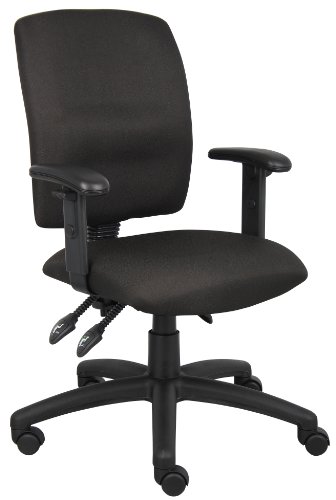
Boss Office Products Multi-Function Fabric Task Chair (B3036-BK) — Best Budget Multifunction
Boss Office Products has sold straightforward office seating for decades, and the B3036-BK is the formula undistilled: a multi-function fabric task chair with adjustable arms in black. Its verified listing is short because the product is — a real multi-paddle mechanism and arm adjustment at the lowest verify-time price among the established task-chair names in this guide.
Strengths
- True multi-function mechanism at a budget position
- Adjustable arms included — often an upsell elsewhere
- Simple, repairable task-chair architecture
Trade-offs
- Listing states no seat slider or headrest
- Fabric and foam are workmanlike, not luxurious
- Styling is plain office black
| Model | B3036-BK (as listed) |
| Mechanism | Multi-function (as listed) |
| Arms | Adjustable arms |
| Upholstery | Fabric, black |
The honest question with budget multifunction chairs is whether the mechanism is genuinely multi-paddle or a single lever wearing the word. This listing’s “multi-function” designation, from a maker whose catalogue distinguishes its mechanism grades, is the real article at this tier: separate control of the seating angles that matter, plus arms that move — the two adjustments that decide most sitters’ comfort. Spend the savings on a good desk light and a footrest if you need one; the chair’s fundamentals are covered. It is the pick for a first proper office chair, bought once and adjusted properly.
See the exact configuration and check the current price on Amazon before you decide.
Best for: first home offices and budget-conscious buyers who still want real mechanism control / Not suited for: anyone wanting mesh cooling or executive presence

Office Star ProGrid Manager’s Chair with Multi-Function Tilt and Seat Slider — Best Seat Slider Pick
Seat depth is the adjustment tall and short sitters both need and almost never get, which is why this Office Star chair leads on specification: its verified listing states adjustable seat height, multi-function tilt control and a seat slider, in a mid-back manager’s format with a breathable ProGrid mesh back and a Coal FreeFlex fabric seat. That combination — full mechanism plus depth — is the most complete control story in this guide.
Strengths
- Seat slider stated — the rarest adjustment in this class
- Multi-function tilt control plus mesh back breathability
- Mid-back format suits smaller rooms and desks
Trade-offs
- Highest verify-time price of the six — specification costs
- Mid back offers no headrest support for reclining
- Mesh back with fabric seat is a mixed-material care routine
| Mechanism | Multi-function tilt control (as listed) |
| Seat depth | Seat slider (as listed) |
| Back | ProGrid breathable mesh, mid back |
| Seat | Coal FreeFlex fabric (as listed) |
The seat slider deserves its headline: sliding the seat pan forward or back sets the gap between seat edge and the back of your knees, which decides circulation comfort across a long day more than any cushion upgrade. Long-legged sitters pushed to a seat’s front edge and short-legged sitters dangling both live with a fixed-depth chair’s compromise; this chair removes it. Add genuine multi-function tilt and a mesh back for warm rooms, and the ProGrid is the enthusiast’s answer — the chair in this guide an ergonomist would spec first and apologise for the price second.
See the exact configuration and check the current price on Amazon before you decide.
Best for: tall or petite sitters and anyone whose current chair fails at the knees / Not suited for: buyers for whom the budget is the first and last criterion
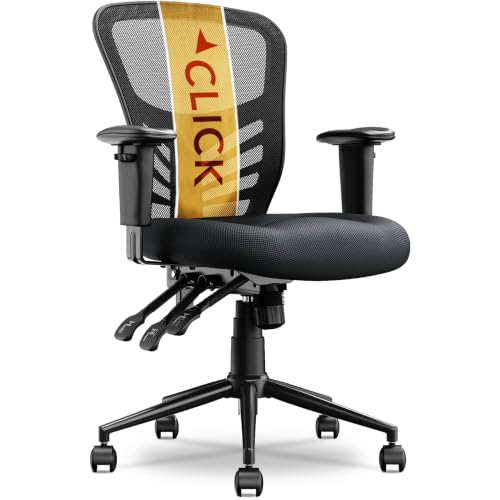
Click365 Ergonomic Mesh Office Chair with 3-Paddle Control — Best Modern Value
The Click365 listing does something refreshingly literal: it counts the paddles. A 3-paddle control is the classic multifunction layout — height, seat angle and back angle on separate levers — and this chair wraps it in a mesh back with lumbar support and a sculpted foam seat cushion, with swivel, adjustable arms and recline all stated. At verify time it was the budget-friendly chair in this guide, which makes its control count the story.
Strengths
- 3-paddle multifunction control, explicitly stated
- Mesh back with lumbar support for warm rooms
- Lowest verify-time price in the guide
Trade-offs
- Newer brand name — long-term track record is shorter
- Gaming-chair language in the listing may not suit formal offices
- Foam seat plus mesh back is a hybrid feel some sitters dislike
| Mechanism | 3-paddle control (as listed) |
| Back | Mesh with lumbar support |
| Seat | Sculpted foam seat cushion (as listed) |
| Movement | 360 swivel, adjustable height, arms and recline (as listed) |
Three paddles matter because they separate decisions a single lever fuses: you can lock the back upright while floating the seat, or recline the back while keeping the seat level for a call. The sculpted foam seat is the other considered touch — at this price many mesh chairs put mesh everywhere and call the hammock feel ergonomic, while a foam cushion supports longer still sits. For a home office that doubles as a gaming desk, the dual identity is a feature; for a client-facing office, choose one of the establishment picks above and keep the room’s tone.
See the exact configuration and check the current price on Amazon before you decide.
Best for: home-office and gaming-desk hybrids wanting real mechanism control cheaply / Not suited for: formal or client-facing office settings

Lorell ErgoMesh High-Back Executive Office Chair — Best High-Back Adjustability
Lorell’s ErgoMesh states the multifunction criterion the way a buyer would phrase it: adjustable seat and back angles — independently — plus customizable arm height and width, in a breathable mesh high-back executive format, with a 5-year limited warranty stated in the listing. Arm width adjustment is the sleeper feature: broad and narrow shoulders need the pads in genuinely different places, and most chairs in this class only move arms up and down.
Strengths
- Independent seat and back angle adjustment, plainly stated
- Arm height AND width adjustment — rare in this class
- 5-year limited warranty stated in the listing
Trade-offs
- High-back executive scale needs room behind the desk
- Mesh throughout — less cushion than fabric rivals
- At the upper verify-time price band of the six
| Angles | Adjustable seat and back angles (as listed) |
| Arms | Customizable arm height and width (as listed) |
| Back | High-back breathable mesh design |
| Warranty | 5-year limited warranty (as listed) |
The high back changes the chair’s job: where mid-back task chairs are for upright work, a high-back mesh chair supports the lean-back reading and calls posture too, and independent back angle is what makes that support land where your spine actually is. Lorell is a contract-furniture name, and the stated warranty length reflects that world’s expectations. Choose it if your workday mixes deep focus with reclined thinking, and if your frame is ill-served by fixed-width arms — the two problems this chair was clearly designed to solve.
See the exact configuration and check the current price on Amazon before you decide.
Best for: taller sitters and mixed work-and-recline days in larger home offices / Not suited for: small rooms or buyers who sit upright at a compact desk all day
Comparison Table
| Pick | Badge | Key spec | Best for |
|---|---|---|---|
| Realspace MFTC 200 Multifunction Ergonomic Super Task Chair, Black | Best True Multifunction | Multifunction mechanism (model name and listing), ergonomic task chair | full-time desk workers who will actually use separate seat and back controls |
| WorkPro Patriot Multifunction Ergonomic Fabric Task Chair, Black | Best Compliance-Listed Pick | Multifunction mechanism, fabric, BIFMA compliant (as listed) | small offices and shared desks needing compliant, adjustable seating |
| Boss Office Products Multi-Function Fabric Task Chair (B3036-BK) | Best Budget Multifunction | Multi-function mechanism, adjustable arms, fabric | first home offices and budget-conscious buyers who still want real mechanism control |
| Office Star ProGrid Manager’s Chair with Multi-Function Tilt and Seat Slider | Best Seat Slider Pick | Multi-function tilt control AND seat slider (both as listed), mesh back, mid back | tall or petite sitters and anyone whose current chair fails at the knees |
| Click365 Ergonomic Mesh Office Chair with 3-Paddle Control | Best Modern Value | 3-paddle control (as listed), mesh, lumbar support, sculpted foam seat | home-office and gaming-desk hybrids wanting real mechanism control cheaply |
| Lorell ErgoMesh High-Back Executive Office Chair | Best High-Back Adjustability | Adjustable seat and back angles separately (as listed), arm height and width adjustable, mesh | taller sitters and mixed work-and-recline days in larger home offices |
How to Choose a Multifunction Office Chair
Start under the seat. A true multifunction mechanism has two or three paddles: one for height, one locking the seat angle, one locking the back angle, plus a tension knob for how hard the tilt pushes back. If a listing cannot describe its controls, assume it has one lever and a recline — a fine chair, perhaps, but not this category. The picks above were admitted on stated control evidence, and your own shortlist should demand the same.
Then fit the chair to the sitter in this order: seat depth first (a slider, as on the Office Star pick, or a pan depth that leaves a fist-width gap behind your knees), seat height second (feet flat, knees near level), back angle third, arms last — arms should meet your elbows without lifting your shoulders, and width adjustment, as on the Lorell, is the difference between meeting them and approximating them. Upholstery is the final call: mesh for heat and shared use, fabric for cushioned stillness.
Multifunction vs Synchro-Tilt: The Distinction That Matters
Synchro-tilt mechanisms recline seat and back together in a fixed ratio — comfortable, simple, and genuinely good. Multifunction mechanisms decouple them: the back can lock at 100 degrees while the seat floats, or the seat can tip forward for perching while the back stays upright. Writers, drafters and anyone who alternates between keyboard focus and call-leaning feel the difference daily. Neither is “better” in the abstract; multifunction is better when your postures vary, synchro when they do not — but only one of them is the subject of this guide, and listings that blur the two should be read with care.
A word on stated credentials: BIFMA compliance, where a listing claims it, speaks to structural testing — bases, casters, mechanism cycling — not to whether a chair will suit your back. Treat it as a durability signal, pair it with the control evidence, and ignore any listing that offers credentials in place of a mechanism description.
Setting Up a Multifunction Chair Properly
Most multifunction chairs are under-adjusted for their entire lives, which wastes the very thing you paid for. Set height so feet rest flat and thighs run level. Set seat depth or position so two or three fingers fit between the seat edge and your calf. Unlock the back, find the angle where the lumbar meets your lower back without pushing you forward, and lock it there for focused work — then experiment with a second, more open lock position for calls, because having two memorised postures is the practical luxury this mechanism buys. Finally set tilt tension so reclining takes a deliberate lean, not a surprise.
The Dimensions That Decide Comfort Before Features Do
Before paddles and warranties, three measurements decide whether any chair in this guide can fit you at all. Seat height range must let your feet rest flat with your desk at elbow height — if your desk is high and fixed, the chair must rise to meet it or a footrest must close the gap. Seat pan depth must leave a fist-width of clearance behind your knees; this is the dimension the Office Star’s slider adjusts and the one most buyers never check, then blame on “bad lumbar” for a year. And seat width must let you sit without the bolsters or arm bases pressing your thighs — the quiet failure mode of narrow gaming-style seats in office clothing.
Check these against your own body with a tape measure and your current chair before ordering: sit, measure the seat height that puts your feet flat, measure from your back to the hollow of your knee, and compare both with the listing’s stated ranges where given. Where a listing does not state dimensions — several in this guide are terse — treat the retailer’s full product page as part of the purchase process, and favour the chairs whose makers publish numbers. A multifunction mechanism can only adjust within the frame it is bolted to; the frame’s dimensions are the first and least forgiving specification of all.
Multifunction Chairs in Shared, Hot-Desk and Hybrid Work
The strongest argument for multifunction mechanisms is not the solo perfectionist — it is the shared chair. In a small office, a clinic, a studio or a home where two partners alternate at one desk, a chair with independent seat and back controls can be refitted between sitters in twenty seconds: height up, back angle reset, arms moved. A single-posture chair in the same setting fits one of its users properly and the other approximately, forever. This is why the contract names in this guide — WorkPro with its stated BIFMA compliance, Lorell with its stated warranty — sell mechanisms over styling.
Hybrid work adds a second argument: the chair now serves two jobs, employed focus and domestic life, often in the same evening. The two-posture habit described in the setup section — a locked focus position and an open reading position — maps neatly onto that double life. If your desk is shared or your day is split, weight the mechanism evidence in this guide even more heavily than the upholstery choice; if the chair is yours alone and your posture never varies, a simpler chair may serve — but it will not be a multifunction one, and this guide’s whole point is that the distinction is mechanical, not rhetorical.
Long-Term Ownership: Casters, Gas Lifts and Upholstery Care
A multifunction chair’s moving parts age on predictable schedules, and knowing them separates a decade chair from a disappointment. Casters clog with hair and grit — pop them off yearly, clear the axles, and hard-floor casters are worth fitting if your chair lives on wood or laminate. The gas lift is the component most likely to end a chair’s life, announcing itself by slow sinking; on the established task-chair designs in this guide it is a standard, replaceable cylinder rather than a death sentence, which is one more reason the establishment names hold their value.
Upholstery care splits by material, as the picks do. Fabric seats want a vacuum with an upholstery tool monthly and prompt attention to spills before they set into foam. Mesh wants dust removal and nothing harsher — its tension is its comfort, and solvents and scrubbing are its enemies. Finally, work the mechanism: once a month, run every paddle through its full travel and re-set your two postures. Mechanisms that move stay free; mechanisms left locked for years seize into the fixed chairs their owners then complain about — the most preventable failure in this entire category.
Trying a Chair When You Cannot Sit in It First
Most chairs in this guide will be bought unseen, which makes the first fortnight a structured trial rather than a leap of faith. Day one, set the chair up by the method in this guide and change nothing for two full workdays — new postures feel wrong before they feel right, and a chair judged in its first hour is judged on unfamiliarity, not fit. Days three to five, adjust one variable at a time: back angle first, then arm height, then tension, living with each change for a day. The multifunction mechanism’s whole value is this search process; a chair that cannot be searched cannot be fitted, which is why the control evidence mattered more than any cushion description at the selection stage.
Keep the packaging until the trial ends, and keep notes — it sounds excessive until you are choosing between two finalists from memory. Note where pressure gathers by late afternoon, whether your feet stayed planted, whether the back met you where your spine wanted meeting. If a chair fails the trial on a dimension its mechanism cannot change — pan depth on a fixed-pan chair, width on a narrow seat — believe the failure early and exchange rather than endure; the chairs in this guide that state their adjustability most completely exist precisely because fit is individual, and no review, including this one, can sit in the chair for you.
Chairs for Two Bodies: Tall, Petite and Broad Sitters
Standard chairs are cut for a statistical middle that describes surprisingly few actual people, and multifunction adjustability is the partial answer this category offers the rest. Tall sitters live or die by seat depth and height range: a pan that ends mid-thigh — concentrates pressure and shortens the working day, which is why the seat-slider pick leads its review on that feature, and why the high-back Lorell, with its independent angles, serves the long-legged recline better than any mid-back here. Petite sitters face the mirror problem: feet that cannot reach the floor from a standard-height seat, and a backrest whose lumbar curve lands at the wrong vertebra — the fixes are the lowest height settings, the shallowest effective depth, and a footrest accepted as equipment rather than as defeat.
Broad sitters should read arm adjustability as a headline, not a footnote: arms fixed at a narrow width press hips and force shoulders inward all day, while the Lorell’s stated width adjustment and the flip-up arms found elsewhere in this category’s wider market remove the constraint entirely. Weight capacities, where listings state them, deserve the same respect as any other specification — they are engineering figures, not marketing. The through-line of this section is the through-line of the guide: fit is a set of measurable relationships between a body and a mechanism, and the chairs that state their mechanisms most completely are the chairs most likely to satisfy the bodies that standard sizing forgets.
Armrests, Headrests and the Accessories That Are Not Functions
This guide has been strict about what counts as a function, and the accessories deserve their own honest paragraph so the strictness is not mistaken for dismissal. Armrests matter — the reviews say so repeatedly — but they matter as fit, not as mechanism: a pad at the wrong height is worse than no pad, which is why adjustability outranks padding in every verdict here, and why flip-up arms, found on several chairs in the wider category, solve the tucked-under-desk problem that fixed arms create in small rooms. Judge arms by their range of movement first and their cushioning a distant second; your elbows will confirm the ranking within a week.
Headrests are the most oversold accessory in the category. On a mid-back task chair there is nowhere honest to mount one, and on high-back chairs the headrest only earns its place for the reclined posture — calls, reading, thinking — never for upright keyboard work, where a correctly set backrest leaves the head balanced without support. If your day is mostly upright, a headrest is furniture jewellery; if your day includes an hour of leaned-back calls, the high-back picks’ integrated support does the job without an accessory at all. Lumbar pillows follow the same rule in miniature: a chair whose back is shaped and adjustable, as the multifunction picks’ are, should be tried thoroughly before a pillow is added to correct a problem the mechanism may already solve.
The accessories that do earn their money are unglamorous: a footrest for the desk-height mismatch described in the dimensions section, hard-floor casters for wood and laminate, and a chair mat where carpet pile fights the base. None of them appears in a headline, all of them appear in a well-fitted working week. Spend on the mechanism first — that is this guide’s thesis — then on the two or three accessories your own room and body actually nominate, and decline the rest with a clear conscience.
Desk, Chair and Monitor: Fitting the Whole Triangle
A multifunction chair is one vertex of a triangle, and fitting it in isolation is the commonest reason a good chair disappoints. The desk sets the second vertex: its height decides the seat height your feet can accept, and a desk that is too high will defeat any chair without a footrest closing the gap — which is why this guide treats the footrest as equipment rather than accessory. The monitor sets the third: its top should sit near eye level at your working distance, because a screen placed for a different posture will drag your neck out of whatever position the chair’s paddles so carefully built. Adjust in the order chair, desk aids, screen — the body’s vertex first, the furniture’s second, the technology’s last.
The triangle explains a diagnostic worth memorising: if your shoulders ache, suspect the desk and arm heights; if your lower back aches, suspect the back angle and seat depth; if your neck aches, suspect the screen before you suspect the chair at all. Multifunction adjustability earns its keep precisely because it lets you run these experiments one variable at a time, in your own room, across real working days. A fixed chair offers one hypothesis about your body. The chairs in this guide offer a method for finding the truth — and the method, once learned, transfers to every desk you will ever sit at.
The 60-Second Shopper’s Checklist
On an index card, this category reads: count the paddles before you read the adjectives; a multifunction chair separates seat angle from back angle, and anything vaguer is a recliner in costume. Check seat depth against your own legs, height against your own desk, and width against your own frame — in that order, because that is the order in which chairs fail people. Treat stated credentials as durability signals, never as fit. Set the chair up over fifteen deliberate minutes, trial it over a fortnight, adjust one variable at a time, and keep two postures — one for focus, one for thought. The Realspace for the pure mechanism, the WorkPro for stated compliance, the Boss for budget honesty, the Office Star for the slider, the Click365 for three paddles at the gentlest price, the Lorell for width and height of back: six ways of keeping one mechanical promise.
How to Adjust a Multifunction Office Chair, Step by Step
Fifteen minutes with the paddles, in this order, turns a multifunction chair from furniture into equipment fitted to you.
- Set seat height first. Sit with feet flat on the floor; adjust until thighs are level and knees bend at roughly a right angle. Use a footrest rather than a too-high chair if your desk forces the height up.
- Set seat depth or position. On a slider model, slide the pan until a fist-width gap sits between the seat edge and the back of your knees. On fixed pans, sit fully back and check the same gap.
- Dial the back angle for focus. Unlock the back paddle, lean to a just-past-upright angle — around 95 to 105 degrees — and lock it. This is your keyboard posture.
- Set tilt tension. Unlock the tilt and lean back; the knob under the front of the seat should make reclining a deliberate push, not a fall or a fight.
- Place the arms. Raise or lower the pads until elbows rest without shoulder lift; on width-adjustable models, bring the pads in until forearms sit parallel, not angled.
- Memorise a second posture. Find your calls-and-reading recline, note the paddle positions, and switch deliberately between the two through the day.
Revisit the setup after a week: foam settles, habits form, and the angle that felt odd on day one is often the one your back votes for on day seven. A multifunction chair rewards this attention precisely because it can hold the answer you find.
Common Buying Mistakes
Buying “ergonomic” adjectives instead of a mechanism. If the listing cannot name its controls — paddles, locks, sliders — the multifunction claim is decoration. Every pick above states its control story in the verified title.
Ignoring seat depth. A chair can have four paddles and still fail at the knees if the pan depth is wrong for your legs. A stated seat slider is the surest fix; otherwise check pan depth against your own measurements.
Locking the tilt forever. A multifunction chair left locked in one position is an expensive fixed chair. The mechanism exists to be used — set two postures and move between them.
Setting arms too high. Arms that lift your shoulders create the neck tension buyers then blame on the backrest. Pads should meet resting elbows, never push them upward.
Choosing mesh or fabric by fashion. Mesh breathes and suits warm rooms and shared desks; fabric cushions long, still sits. Pick for your room and your sitting style, not the showroom photograph.
Final Recommendation
If you want the category in its purest form, the Realspace MFTC 200 is the reference; the WorkPro Patriot adds stated BIFMA compliance for shared and small-office buying, and the Boss B3036-BK delivers the real mechanism at the gentlest verify-time price. The Office Star ProGrid is the specification champion — multi-function tilt plus the seat slider almost nobody else offers — while the Click365 proves a 3-paddle control can anchor the value end, and the Lorell ErgoMesh serves taller sitters with independent angles and width-adjustable arms under a stated 5-year limited warranty.
Whichever chair you choose, spend the fifteen minutes the setup section asks for. A multifunction mechanism is a promise that the chair can fit you; only adjustment keeps it.
Keep exploring the same corner of the range here: Best Customizable Office Chairs Best Ergo Office Chairs Available Best Ergonomic Office Chairs Home Best Inexpensive Comfortable Office Chairs Best Easy Rolling Office Chairs
Frequently Asked Questions
What does multifunction mean on an office chair?
It describes the mechanism: separate controls — usually two or three paddles — for seat height, seat angle and back angle, typically with tilt lock and tension. It does not mean extra cushions, a headrest or gaming styling.
Is multifunction better than synchro-tilt?
For varied postures, yes: the angles adjust independently, so you can perch forward or recline the back alone. Synchro-tilt moves seat and back in a fixed ratio, which suits sitters whose posture barely changes.
What is a seat slider and do I need one?
A seat slider moves the seat pan forward and back to set depth. Tall and petite sitters benefit most, because fixed pans are cut for average legs. Only one pick in this guide states one — the Office Star ProGrid.
Are mesh or fabric chairs better for long days?
Mesh breathes, suits warm rooms and wipes clean for shared desks. Fabric over foam cushions longer, stiller sits. Both appear in this guide; choose by your room temperature and sitting style.
What does BIFMA compliant mean?
It means the chair model has been tested against the furniture industry’s structural and durability standards — base, casters and mechanism endurance. It is a build-quality signal, not a personal ergonomic fit guarantee.
How many paddles should a multifunction chair have?
Two is the working minimum (height plus one angle lock with the other angle on the same control family); three — as stated on the Click365 pick — separates height, seat angle and back angle fully. Count the paddles in the listing before you buy.


