Disclosure: airfryerkitchensupply.com is reader-supported. When you buy through links on our site, we may earn an affiliate commission at no extra cost to you.
Where to buy
All six pillows in this guide are sold through Amazon, and each name below links to its listing so you can check the current price on Amazon and confirm sizes, colors, and cover details before ordering.
- Chunful Long Lumbar Pillow / Bolster Pillow for Bed — Check on Amazon
- AMCATON Reading Pillow / Backrest Pillow with Arms — Check on Amazon
- Kayfia Reading Pillow, Gel Memory Foam Back Rest Pillow — Check on Amazon
- LUGRAOT Lumbar Support Pillow for Bed, Memory Foam — Check on Amazon
- CRAURU Memory Foam Lumbar Support Pillow for Bed, Ergonomic Wedge — Check on Amazon
- Fledano Lumbar Support Pillow for Bed, Memory Foam — Check on Amazon
Introduction: one keyword, two different pillows
The best lumbar bed pillows turn out to be two families of products sharing one search term, and the first job of this guide is to separate them. The first family supports your lower back while you are lying down: long bolster-style lumbar pillows that run along the bed, and contoured lumbar pillows that fill the curve of the lower back for back sleepers. The second family supports your back while you are sitting up in bed — reading, working on a laptop, watching television, recovering on bed rest — and those are the backrest and reading pillows, whose job is to hold your whole back, lumbar region included, at a comfortable angle against the headboard. Both families are legitimately “lumbar bed pillows” to the people searching for them, but they solve different evenings, and buying one to do the other’s job is the category’s standard disappointment.
A note on framing that this guide will keep throughout: these are comfort products. A well-shaped pillow can make reading in bed more comfortable and can support a relaxed, neutral posture while you rest, and that is the claim we make. This guide makes no medical claims — no pillow here is presented as treating back pain or any condition, and anyone with persistent pain should be talking to a clinician, not a buying guide. Within that honest frame, design still matters enormously: the right height, firmness, and shape for your body and your bed is the difference between a pillow used nightly and a pillow exiled to the closet.
All six picks below are verified through Amazon’s catalog data: a true long lumbar bolster, two leading bed backrests, and three memory foam lumbar pillows designed specifically for sleeping — a contoured model, a non-slip wedge, and an ergonomic model for side and back sleepers. The buying guide that follows the picks teaches the fit rules that decide comfort in this category, so you can judge these six — and any other pillow you meet — by the same standard.
In this guide
Quick Picks
| Pick | Badge | Why it stands out | Link |
|---|---|---|---|
| Chunful Long Lumbar Pillow / Bolster Pillow for Bed | Best True Lumbar Bolster (Verified) | 47″ x 7.87″ long round lumbar roll for the bed, removable flannel cover | Check on Amazon |
| AMCATON Reading Pillow / Backrest Pillow with Arms | Best Backrest for Sitting Up (Verified) | Arms, cup holder, phone pocket, adjustable headrest, corduroy fabric, 21-inch back | Check on Amazon |
| Kayfia Reading Pillow, Gel Memory Foam | Best Memory Foam Backrest (Verified) | Gel memory foam back rest, 19″, three storage pockets, detachable armrests, dual-use back and leg support | Check on Amazon |
| LUGRAOT Lumbar Support Pillow for Bed | Best Contoured for Back Sleepers | Ergonomic contour, high-density memory foam, removable washable cool-touch cover | Check on Amazon |
| CRAURU Memory Foam Lumbar Support Pillow for Bed | Best Stay-in-Place Wedge | Ergonomic wedge design with a non-slip base and removable cover | Check on Amazon |
| Fledano Lumbar Support Pillow for Bed | Best for Side & Back Sleepers | Ergonomic memory foam shape for side and back sleeping, washable cooling cover | Check on Amazon |
How These Picks Were Chosen
We required every pick to be a complete pillow — not a cover, not an insert sold for a decorative sham, and not a chair cushion wandering in from the office category. That last exclusion removed most of the “lumbar” catalog at a stroke: the majority of lumbar pillows sold are desk-chair products, and a chair lumbar pillow in a bed is a small, hard, wrong-shaped object. Bed lumbar pillows must be sized and softened for a bed — longer, gentler, and covered in sleep-friendly fabrics.
Within the category, we scored shape honesty: does the pillow’s form actually meet the lower back where the lower back is? For lying-down pillows, that means a roll or contour of modest height — the lumbar curve is a shallow curve, and a pillow that props it aggressively is uncomfortable within the hour. For sitting-up backrests, it means a back tall enough to support the lumbar region and the shoulders together, arms that hold a book at a natural height, and a base that does not slide down the bed. Fill mattered next: memory foam for molded support, standard fills for softness, natural fills for adjustability — each with real trade-offs the reviews state plainly.
One verification finding is worth stating openly: this category’s listings lean heavily on pain-relief language in their titles. We selected products on their shapes, fills, and covers, and this guide repeats none of that language as a claim — a pillow here is a comfort product, full stop. We also deduplicated aggressively: one maker alone (vamorry) lists what is effectively the same memory foam waist pillow under at least five ASINs, and it appears here zero times rather than five, because the three sleeping-pillow places went to three genuinely different designs.
The 6 Best Lumbar Bed Pillows

Chunful Long Lumbar Pillow / Bolster Pillow for Bed — Best True Lumbar Bolster (Verified)
The Chunful is the most literal answer to this search in the guide: a long lumbar pillow for the bed — 47 inches long and 7.87 inches in diameter, a round bolster format with a removable flannel cover, in sky blue. A bolster of this shape earns the name “lumbar” in several honest ways. Placed along the lower back while you lie on your back, it fills the lumbar curve gently. Run lengthwise under the knees, it relaxes the lower back’s posture for back sleepers. Propped behind you while sitting up, it is the lumbar roll that keeps a stack of ordinary pillows from feeling hollow at the waist. And along the bed’s edge, it is simply a comfortable body-length cushion to lean an arm or a leg over.
Strengths
- A genuine bed lumbar format — long roll, modest diameter — rather than a chair cushion in disguise
- 47-inch length serves the lumbar zone, the knees, or the whole side of the body
- Removable flannel cover: soft against skin and washable, which bed pillows must be
Trade-offs
- A round bolster rolls — it needs the headboard, a wall of pillows, or your own body to stay where you put it
- 7.87-inch diameter is a real presence in the bed; couples should agree on its territory
- One color family verified (sky blue); check the listing for others
Mini spec box
- Dimensions: 47″ x 7.87″ (round bolster)
- Cover: removable flannel
- Color verified: sky blue
- Format: long lumbar / body roll pillow for bed
Buy the Chunful if your need is lying-down lumbar support or a multi-position bed roll. It is the pick in this guide we would hand to a back sleeper who wants the curve of the lower back filled without a wedge, a mechanism, or a chair-shaped object in the bed. Pair it with ordinary pillows for sitting up, or step to the backrests below if sitting up is the main event.
Best for: back sleepers and anyone wanting one flexible bed roll for lumbar, knee, or side support. Not suited for: readers who mainly sit up in bed (see the backrests), or anyone who dislikes a pillow that can roll.
Check on Amazon to check the current price on Amazon.

AMCATON Reading Pillow / Backrest Pillow with Arms — Best Backrest for Sitting Up (Verified)
The AMCATON is the full-featured bed backrest: a 21-inch backrest pillow with arms, an adjustable headrest, a cup holder, and a phone pocket, in corduroy fabric (off-white verified). Its relevance to a lumbar search is direct: when you sit up in bed, the place ordinary pillows fail first is the lower back — the stack compresses, a gap opens at the waist, and within twenty minutes you are sliding down and rearranging. A structured backrest holds the lumbar region and the shoulders on one continuous, angled surface, and the arms carry the book or tablet so your shoulders can stay down. The adjustable headrest is the thoughtful detail: it lets taller and shorter readers put the top support where their head actually is.
Strengths
- Structured, continuous back support — the lumbar gap problem of loose pillows, solved by design
- Adjustable headrest adapts the same pillow to different heights of reader
- Cup holder and phone pocket are small features that get used every single evening
Trade-offs
- A backrest is furniture-sized: it lives on the bed or beside it, and small beds feel its footprint
- Corduroy in off-white shows spills; the cover situation should be checked on the listing if washability is critical
- It is a sitting-up pillow — it does nothing for lying-down lumbar support, which is the Chunful’s job
Choose the AMCATON if your bed is also your reading chair, your cinema seat, or your recovery couch. For bed-rest situations especially — where someone will sit up in bed for hours daily — a structured backrest is not an indulgence but the difference between a sustainable posture and a daily negotiation with a pile of pillows. This guide makes no medical claims for it; it simply supports sitting up, comfortably, for a long time.
Best for: readers, laptop-in-bed workers, and anyone on extended bed rest who sits up for hours. Not suited for: sleeping support, small beds, or anyone wanting a pillow that disappears into the bedding.
Check on Amazon to check the current price on Amazon.

Kayfia Reading Pillow, Gel Memory Foam Back Rest Pillow — Best Memory Foam Backrest (Verified)
The Kayfia takes the same backrest idea and builds it in gel memory foam: a 19-inch back rest pillow in gray, with three storage pockets, detachable armrests, and a dual-use design the listing describes as serving both back and leg support. Memory foam changes the backrest experience in a specific way — where a fiberfill backrest is a shaped cushion you lean against, foam molds at the contact points, so the lumbar region and shoulder blades meet a surface that has taken their shape. The gel element is the maker’s answer to foam’s known warmth; we report it as the product’s stated design, and note honestly that “gel” foams feel cooler to the first touch rather than refrigerated all night.
Strengths
- Memory foam molds to the back’s contact points, including the lumbar curve
- Detachable armrests let you slim the pillow for smaller beds or use the arms separately
- Three storage pockets and a dual-use back/leg design make it the most configurable pick here
Trade-offs
- At 19 inches, the back is shorter than the AMCATON’s 21 — tall readers should compare against their torso
- Memory foam sleeps warmer than fiberfill despite gel marketing; hot sleepers take note
- Foam backrests are heavier to move on and off the bed than fiberfill ones
Between the two verified backrests, the choice is character: the AMCATON is the structured, feature-led, taller option; the Kayfia is the molding, configurable, foam option. A reader who loves a memory foam mattress topper’s feel will recognize and prefer the Kayfia’s version of support; a reader who finds foam warm and slow will prefer the AMCATON.
Best for: memory-foam fans and anyone wanting a configurable backrest with detachable arms. Not suited for: tall readers needing maximum back height, or hot sleepers wary of foam.
Check on Amazon to check the current price on Amazon.

LUGRAOT Lumbar Support Pillow for Bed — Best Contoured for Back Sleepers
The LUGRAOT is the precision instrument of this guide: a memory foam lumbar pillow for bed whose listing describes an ergonomic contour that fits under the lower back, in high-density memory foam, with a removable, washable cool-touch cover. That combination is the whole checklist for a sleeping lumbar pillow done right — a shape that meets the lumbar curve where it lives, a foam dense enough to hold the shape at 3 a.m. rather than flattening by midnight, and a cover that comes off for the wash, in a cool-touch fabric that answers foam’s warmth problem at the surface.
Strengths
- Purpose-shaped contour for the lower back — the most targeted lying-down support here
- High-density memory foam holds its geometry through the night
- Removable, washable cool-touch cover: the hygiene and temperature details handled together
Trade-offs
- Contour fit is individual: a ridge height that suits one back is wrong for another, and a return is a real possibility to plan for
- Primarily a back-sleeper’s pillow; side sleepers should look at the Fledano below
- Memory foam purists should note the listing’s own title carries pain-relief marketing language — this guide recommends the pillow for its shape and comfort, and makes no such claim
Buy the LUGRAOT if you are a committed back sleeper who has tried the bolster trick and wants the dedicated, shaped version. It works alongside your normal head pillow without rebuilding the bed, and its compact size makes it the easiest pick here to travel with — a real consideration for anyone whose back notices hotel beds.
Best for: back sleepers wanting dedicated lumbar shaping. Not suited for: side sleepers, or anyone expecting a pillow to address a medical condition.
Check on Amazon to check the current price on Amazon.

CRAURU Memory Foam Lumbar Support Pillow for Bed — Best Stay-in-Place Wedge
The CRAURU attacks the problem nobody mentions until the first night: lumbar pillows migrate. Its design answers mechanically — an ergonomic wedge shape in memory foam with a non-slip base, so the pillow grips the bed instead of touring it, plus a removable cover. The wedge geometry differs from the LUGRAOT’s contour in feel: a wedge presents a ramp the lower back rests against, which many sleepers find easier to position correctly than a ridge, because the pillow works across a range of placements rather than demanding one exact spot. The listing positions it for side and back sleepers alike.
Strengths
- Non-slip base solves the migration problem that defeats loose waist pillows — the natural partner for adjustable beds, whose moving sections shift everything unanchored
- Wedge shape is forgiving to position: a range of placements works, not one precise point
- Removable cover, memory foam body, and a shape that also serves sitting-up support at the bed’s head
Trade-offs
- A wedge’s ramp is a different sensation from a contour’s cradle — sleepers with a strong preference should choose deliberately between this and the LUGRAOT
- Non-slip bases grip sheets too; repositioning means lifting, not sliding
- As with the LUGRAOT, the listing’s title carries relief marketing — our recommendation rests on the design, not the claim
Choose the CRAURU if your pillows wander, your bed adjusts, or you want one lumbar pillow that works for both lying down and propped-up reading. It is the pragmatist’s pick in this guide: less precise than the contour, more forgiving in every direction that matters at 2 a.m.
Best for: adjustable-bed owners, restless sleepers, and anyone whose pillows migrate. Not suited for: sleepers who want a precise contoured cradle, or who dislike a ramp profile.
Check on Amazon to check the current price on Amazon.
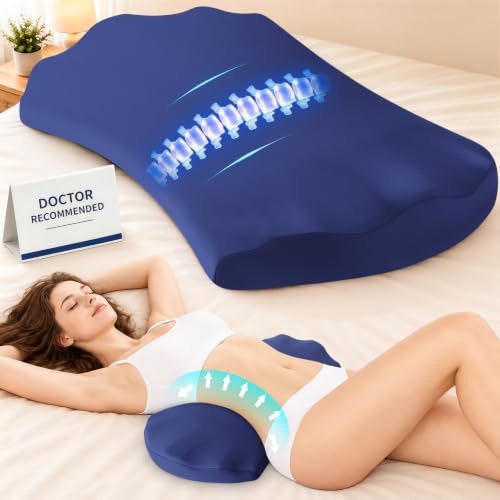
Fledano Lumbar Support Pillow for Bed — Best for Side & Back Sleepers
The Fledano completes the sleeping trio with the brief the other two do not cover: an ergonomic memory foam lumbar pillow designed for side and back sleepers both, with a washable cooling cover. Side sleeping changes the lumbar problem — the waist sags sideways into the mattress gap between ribs and hips — and a pillow shaped to support that lateral curve has to be lower and broader than a back sleeper’s ridge. The Fledano’s ergonomic shape is the side sleeper’s answer in this guide, and its cooling cover addresses the warmth that memory foam against the body all night can build.
Strengths
- Shaped for side and back sleepers — the only pick here designed for the sideways waist curve
- Washable cooling cover handles foam’s two known issues: hygiene and heat
- Memory foam molding suits the side position, where contact area is smaller and pressure concentrates
Trade-offs
- Full honesty about this listing: its title carries the heaviest medical-claim language in this guide, including condition names. We include the pillow for its verified shape, fill, and cover, and we repeat none of those claims — it is a comfort product, and anyone with a diagnosed condition should be guided by their clinician, not a pillow listing
- Side-sleeping lumbar support is the most individual fit in this guide; allow several nights and expect possible adjustment
- Combination sleepers who roll between positions may find any fixed waist pillow intermittently in the way
Choose the Fledano if you sleep on your side and have felt the waist-sag this category exists to address, or if you alternate between side and back and want one pillow designed for both. Together with the LUGRAOT (back, contoured) and the CRAURU (wedge, non-slip), it gives this guide a sleeping-pillow answer for every common sleeping style — which is what a lumbar bed pillow guide owes its readers.
Best for: side sleepers and side/back combination sleepers. Not suited for: anyone seeking treatment for a condition — see a clinician — or stomach sleepers.
Check on Amazon to check the current price on Amazon.
Comparison Table
| Pick | Badge | Key spec | Best for | Link |
|---|---|---|---|---|
| Chunful Long Lumbar Pillow / Bolster | Best True Lumbar Bolster (Verified) | 47″ x 7.87″ round roll, removable flannel cover | Lying-down lumbar and knee support | Check on Amazon |
| AMCATON Reading Pillow / Backrest | Best Backrest for Sitting Up (Verified) | 21″ back, arms, adjustable headrest, cup holder | Reading and bed rest, sitting up | Check on Amazon |
| Kayfia Reading Pillow, Gel Memory Foam | Best Memory Foam Backrest (Verified) | 19″ foam back rest, detachable arms, 3 pockets | Molding foam support, configurable | Check on Amazon |
| LUGRAOT Lumbar Support Pillow for Bed | Best Contoured for Back Sleepers | Ergonomic contour, high-density memory foam, washable cool-touch cover | Dedicated back-sleeper shaping | Check on Amazon |
| CRAURU Memory Foam Lumbar Support Pillow | Best Stay-in-Place Wedge | Ergonomic wedge, non-slip base, removable cover | Adjustable beds, restless sleepers | Check on Amazon |
| Fledano Lumbar Support Pillow for Bed | Best for Side & Back Sleepers | Ergonomic memory foam, washable cooling cover | Side sleepers, combination sleepers | Check on Amazon |
How to Choose a Lumbar Pillow for Your Bed
Decide which job you are hiring for. Lying-down support and sitting-up support are different products, and this guide’s picks divide cleanly: the Chunful bolster and the three memory foam sleeping pillows serve the lying-down job; the AMCATON and Kayfia backrests serve the sitting-up job. Many households honestly need both — a backrest for the evening’s reading and a bolster for the night’s sleep — and buying one product to fake the other job is how closets fill with pillows.
Respect the shallow curve. The lumbar curve is gentle, and support that matches it is modest in height. For lying-down pillows, be suspicious of anything tall and aggressive: a support you can feel working hard in the first five minutes is usually a support you will feel complaining by hour two. The Chunful’s 7.87-inch round diameter is about the upper end of gentle, and it works partly because a round roll meets the body tangentially — the effective lift is less than the diameter suggests. Contoured pillows should state their ridge height; natural-fill pillows let you set your own, which is their whole appeal.
Match the backrest to the torso. For sitting up, back height is the fit dimension: the 21-inch AMCATON and the 19-inch Kayfia differ meaningfully for tall readers, whose shoulders and head need the support to reach high enough, and for shorter readers, who can find a too-tall backrest pushing their head forward. Arms matter at book height — your elbows should rest without your shoulders shrugging — and an adjustable headrest, like the AMCATON’s, forgives a multitude of torso lengths.
Choose fill by temperament. Memory foam molds and holds, and sleeps warm. Fiberfill is soft, light, cooler, and gradually compresses over months of evenings. Buckwheat and latex tune and breathe, at the cost of weight and (for buckwheat) a faint rustle. There is no best fill; there is the fill whose trade-offs you will still be happy with in month six, and the reviews above are written to let you forecast exactly that.
Insist on a washable cover. Bed pillows live against skin, hair, and the occasional cup of tea. A removable, washable cover — like the Chunful’s flannel — is the difference between a pillow with a service life and a pillow with a smell by spring. Where a listing does not offer one, budget for a washable pillowcase that fits the shape, or choose a different pillow.
How to Position a Lumbar Pillow in Bed
For back sleeping with a bolster like the Chunful, two placements cover most needs. At the waist: slide the roll so its top meets the small of your back with your body settled — you should feel the gap at your waist fill, not feel your back arch. Under the knees: the same roll, moved down, lets the lower back settle flatter against the mattress, and many back sleepers prefer this placement for all-night use because nothing sits against the spine itself. Try each for several nights before judging; bodies adapt to support over days, not minutes, and the first night’s novelty is a poor oracle.
For sitting up, build from the wall outward. The backrest goes against the headboard or wall first, angled as upright as your reading wants; your own pillow can go behind your head or stay out of the stack entirely. Sit back so the backrest’s surface meets your whole back — if there is a hollow at your waist, that is the failure this category exists to fix, and the remedies are to sit deeper into the backrest, add the bolster at the waist as a lumbar roll (the Chunful and a backrest together are a genuinely good system), or adjust the headrest until the geometry closes. Arms should land on the backrest’s arms with shoulders down; if you are shrugging, the arms are too high or you are sitting too far forward.
For adjustable beds, raise the head section first and let the pillow settle into the angle, rather than positioning everything flat and then bending it — pillows placed flat and then folded by the bed migrate and bunch. This is also where the CRAURU’s non-slip wedge earns its existence: on a moving bed, anchored support is the only support that is still correctly placed at 2 a.m.
Common Buying Mistakes
Buying a desk-chair lumbar pillow for the bed. The largest category error in this search. Chair lumbar pillows are small, firm, and strap-shaped for a chair back; in a bed they are a lump. Buy bed-sized, bed-softened products.
Buying a cover or insert by mistake. Decorative lumbar pillow covers and bare inserts flood this category’s search results and are not pillows. Check that the listing is a complete, filled pillow — every pick in this guide is.
Expecting treatment. A lumbar pillow is a comfort product. It can support a relaxed posture and make bed time more comfortable; it is not a therapy device, and any listing that promises cures should lower your trust in everything else it says.
Going too tall. Aggressive lumbar height feels supportive in a five-minute test and punishing by morning. Modest, shallow support wins the night.
Ignoring the cover. A bed pillow without a washable cover has a short, sad service life. Verify the cover before the fill.
Judging on night one. Support is an adaptation. Give a new pillow several nights — and try its alternate placements — before concluding it does not suit you.
Final Recommendation
For lying-down lumbar support, start with the verified Chunful Long Lumbar Pillow — a true bed bolster that serves the waist, the knees, and the sitting-up stack alike. Back sleepers wanting dedicated shaping should take the LUGRAOT contour; adjustable-bed owners and restless sleepers, the CRAURU non-slip wedge; side sleepers, the Fledano. For sitting up in bed, choose between the structured, taller AMCATON backrest and the molding, configurable Kayfia memory foam backrest by your torso height and your feelings about foam.
Related guides: Best Leg Pillows For Back Sleepers, Best Luxury Bed Pillows, Best Pillows For Day Beds, and Best Back Side Pillows.
Materials and Covers: a Bed-First Comparison
Bed pillows live a harder life than their chair cousins: eight hours of contact, skin oils, hair products, and the occasional breakfast in bed. Material choices should be read with that life in mind. Memory foam, as in the Kayfia backrest, molds precisely and holds its shape for years, but it cannot be washed — only its cover can — and it sleeps warm, which the gel in its formulation tries to moderate. Fiberfill, the classic backrest fill, is light, cooler, and forgiving, and it compresses gradually; a fiberfill backrest in year two is a slightly slimmer version of itself, which most owners accept without noticing. Standard polyester fills in bolsters like the Chunful are chosen for resilience and washability of the whole system — the bolster keeps its roundness because the fill springs back.
Natural fills play a different game: buckwheat hulls flow like a beanbag and lock like a mold, latex shreds spring and breathe, and both let the owner adjust the fill volume after purchase. We note them here for completeness — and note honestly that no natural-fill lumbar bed pillow appeared in our API verification results for this guide, so none is recommended by name. If you shop that niche yourself, apply this guide’s checks: fill named honestly, an accessible fill chamber, a washable outer cover (the fill itself should never meet water), and a seller who states the fill weight rather than only photographing a plump pillow.
Covers are where bed-first design shows. Flannel, on the Chunful, is soft, warm, and quiet against a pillowcase-less pillow — a considered choice for a roll that touches skin all night. Corduroy, on the AMCATON, is a sitting-up fabric: durable, textured enough to grip the backrest’s angle rather than slide down it, and handsome enough to leave on the bed by day. Smooth microfiber covers slide — pleasant for repositioning a pillow, treacherous for a backrest that must hold its lean. Whatever the fabric, the non-negotiables are a zipper or closure that actually opens, seams that survive the wash, and a size that goes back on without a wrestling match. A cover that is miserable to refit is a cover that stops being washed, and an unwashed bed pillow is a short-lived one.
Lumbar Pillows for Bed Rest, Recovery, and Adjustable Beds
Three situations deserve their own word because they change what “best” means. The first is extended bed rest — recovery from illness or surgery, or a pregnancy period spent mostly in bed (this guide offers comfort framing only; anyone in medical recovery should follow their care team’s guidance on positioning). In bed rest, the sitting-up hours dominate, and the backrest picks stop being luxuries: a structured back like the AMCATON, with arms that help a person shift position and a headrest that adjusts as pillows are added or removed by caregivers, is the sustainable setup. The bolster earns its place in the same bed — under the knees during rest, at the waist during sitting — because a body that spends its days in one place needs its supports to change jobs as the day changes.
The second situation is the adjustable bed, now common enough that its pillow physics deserve respect. A moving bed defeats loose pillows twice: once when the head section rises and everything slides toward the hinge, and again when the sleeper’s own weight works against the angle. Firm, structured supports (foam backrests) resist better than soft ones; bolsters roll exactly when the bed moves; and the strap archetype in this guide exists because adjustable-bed owners wrote the reviews that demanded it. If your bed moves, shop this category by what stays placed, not by what feels best in a showroom minute.
The third is the shared bed. A 47-inch bolster has a foreign policy: it will spend part of every night on your partner’s side unless its territory is negotiated, and a full backrest transforms one half of a bed into a chair the other sleeper did not choose. None of this is a reason to abstain — it is a reason to size honestly (the Kayfia’s detachable arms slim it for shared beds), to store the backrest off the bed by day, and to treat the purchase as household furniture rather than a personal pillow. The couples who love their bed backrests are the ones who discussed the footprint before it arrived.
How Lumbar Bed Pillows Age, and When to Replace One
A lumbar pillow’s job is geometry, so its aging is geometric too: the question is never whether it still looks like a pillow but whether it still holds the shape that made it work. Memory foam ages by softening — a contour that once met your back with gentle resistance gradually meets it with less, and the LUGRAOT’s high-density foam is specified precisely to slow that curve. The honest test is positional: if you find yourself folding, stacking, or shimming a foam pillow to recover the support it gave in its first month, the foam has retired whether or not the cover still looks new. Expect a quality foam lumbar pillow to serve in the range of a few years of nightly use, less if it doubles as a sitting prop all evening, every evening.
Fiberfill ages by compression, visibly: the AMCATON’s back will be a slightly slimmer version of itself in year two, and the remedy owners actually use — a vigorous fluff and an hour of sun — restores loft temporarily but not permanently. Bolsters like the Chunful age at the cover first: flannel softens, thins at the roll’s contact line, and eventually asks to be replaced or re-covered, while the roll beneath is usually still sound. This is the quiet argument for the removable covers this guide insisted on — a pillow whose cover can be replaced or at least washed back to freshness outlives a sealed one by seasons.
Hygiene sets its own replacement clock. A bed pillow that has absorbed years of skin oil and cannot be adequately cleaned — because its cover does not open or its fill cannot be aired — should retire on hygiene grounds before it retires on shape grounds. Sun and air are the interim tools: a morning on a bright, breezy line does more for a bed pillow’s freshness than any spray, and none of the products in this guide should ever be sealed in plastic for storage, which traps the moisture that feeds mildew. Replace on shape, replace on smell that survives washing, and otherwise let a good pillow work — the best lumbar pillow is the one whose shape your back has already learned.
Frequently Asked Questions
What is the difference between a lumbar bed pillow and a reading pillow?
A lumbar bed pillow supports the lower back — typically while lying down, as a bolster or contoured pillow at the waist. A reading pillow (backrest) supports the whole back while you sit up in bed, which includes the lumbar region as part of a full angled surface. They are complementary, and many people use both: backrest for the evening, bolster for the night.
Where exactly should a lumbar pillow sit when I sleep on my back?
Either filling the small of your back at the waist, or under your knees — both placements support a relaxed lower-back posture, and different sleepers prefer different ones. The waist placement should feel like a gap being filled, not an arch being forced. Give each placement several nights before deciding.
How firm should a lumbar bed pillow be?
Firmer than your head pillow, softer than a chair cushion. The test is contact: lying on it, you should feel the support meet your back along its whole curve without a pressure point you keep noticing, and after ten minutes you should have stopped noticing it at all — a lumbar pillow doing its job disappears from attention. Foam density is the spec behind that feel, which is why the LUGRAOT’s high-density foam is a headline attribute rather than filler text. If a pillow feels impressive in the first minute — pronounced, architectural, impossible to ignore — it is usually too much pillow for the eighth hour.
Can a lumbar pillow help my back pain?
This guide does not make that claim, and you should be wary of any product page that promises it. A well-fitted pillow can make resting and reading in bed more comfortable, which is a worthwhile and honest benefit. Persistent or serious back pain deserves a clinician’s evaluation, not a shopping decision.
How tall should a bed backrest be?
Tall enough to support your back up to the shoulders without pushing your head forward — for most adults, somewhere in the 19-to-21-inch range covered by the verified picks here, with taller readers favoring the taller back or an adjustable headrest like the AMCATON’s.
Why does this guide keep declining to repeat the claims on the pillow listings?
Because a pillow is a comfort product, and this guide’s credibility is worth more than any listing’s marketing. Buy these pillows for shape, fit, and comfort; take medical questions to a clinician.
Can I use a lumbar bed pillow in a recliner or on the sofa?
Yes, and many owners do — the CRAURU wedge and the Chunful bolster in particular travel well between bed, recliner, and sofa, because lumbar geometry does not change with the furniture. Two cautions: a pillow softened for a bed will feel softer still on an upright chair, where dedicated chair cushions are firmer by design; and a pillow that lives on both bed and sofa should keep its washable cover washed, since it now serves two rooms’ worth of evenings. The backrests are bed furniture by size, but on a deep sofa an AMCATON-style backrest is a genuinely comfortable reading station.
Should I buy one lumbar pillow or a combination?
Let your evenings answer. If you only sleep, one lying-down pillow — bolster, contour, wedge, or side-sleeper design — is the whole purchase. If you read or work in bed and then sleep there, the combination this guide is quietly built around is the honest one: a backrest for the waking hours and a sleeping pillow for the night, because each is shaped for a posture the other cannot serve. The combined cost is real, but so is the alternative’s cost — a closet of single pillows that almost worked, bought one compromise at a time.
How do I keep a bolster from rolling away?
Back it against the headboard, a wall of pillows, or your own body; a round bolster stays where something holds it. Under the knees it is naturally trapped by your legs. If migration is your main frustration, the strap-positioned archetype in this guide exists for exactly that problem.

