Disclosure: airfryerkitchensupply.com is reader-supported. When you buy through links on our site, we may earn an affiliate commission at no extra cost to you.
Where to buy
Every pick below was verified against Amazon’s own catalog data before it earned a link, so the names, dimensions and construction details in this guide match the actual listings. Prices move constantly on pillows and bedding, so this page never prints a fixed price — use the links to check the current price on Amazon for the exact size and color you want. If a listing shows a different height or footprint than the one described here, you are looking at a different variant; back out and pick the configuration named in the review.
- MEGCXIT Leg Elevation Pillow (23.6 × 16.8 × 8 Inch) — Check the current price on Amazon
- KingPavonini Adjustable Leg Elevation Pillow — Check the current price on Amazon
- TranquilRelax Leg Elevation Pillow (Single-Leg Cradle) — Check the current price on Amazon
- Kolbs Leg Elevation Pillow (Flat Top, 7 Inch) — Check the current price on Amazon
- CRAURU Leg Elevation Pillow (Trapezoidal) — Check the current price on Amazon
- Kehangte Leg Elevation Pillow (4-Height Adjustable) — Check the current price on Amazon
Finding the best leg pillows for back sleepers starts with a simple observation: when you sleep on your back, a flat mattress leaves your legs fully extended and your lower back doing quiet work all night, and the right pillow changes that geometry. A leg pillow for a back sleeper is not the small hourglass cushion sold to side sleepers for between the knees. It is an elevation wedge or bolster that sits under your calves or knees, raising your legs a few inches so your knees rest with a soft bend and your legs feel supported instead of suspended. The six picks in this guide are all elevation-style designs verified through Amazon’s catalog data, and they cover the real range of shapes on the market: a classic incline wedge, an adjustable stacked design, a single-leg cradle, a flat-top bolster, a trapezoidal foot pillow and a multi-height adjustable model.
A note on honesty before the picks: most leg elevation pillows are marketed with recovery language, because elevation is also used after procedures. This guide evaluates them strictly as comfort products for back sleepers — how well they hold height through the night, how the foam feels under calves, how stable they stay on the bed and how easy the covers are to wash. Nothing here is a medical device, nothing here treats a condition, and if a clinician has given you specific elevation instructions, follow those instructions and your clinician’s product guidance rather than a shopping guide.
Height is the specification that matters most, and it is also the one shoppers most often get wrong. Too little elevation and the pillow is just a soft lump under your calves. Too much, and your knees hyperextend or the wedge slides toward the foot of the bed by 3 a.m. The picks below range from a low 7-inch flat top to taller adjustable stacks, and the buying guide further down explains how to match height to your body and your mattress instead of guessing.
In this guide
Quick Picks
Six elevation pillows, six different answers to the same question. If you want one safe recommendation, start with the MEGCXIT wedge; if you know you run hot, change heights often, or only ever elevate one leg, the specialist picks will suit you better.
| Pick | Badge | Why it stands out | Check |
|---|---|---|---|
| MEGCXIT Leg Elevation Pillow (23.6 × 16.8 × 8 Inch) | Best Overall | A full-width memory foam wedge sized for both legs, with dimensions stated right in the listing. | Check on Amazon |
| KingPavonini Adjustable Leg Elevation Pillow | Best Adjustable | Stackable, height-adjustable elevation with cooling gel memory foam and a non-slip base. | Check on Amazon |
| TranquilRelax Leg Elevation Pillow (Single-Leg Cradle) | Best for One Leg at a Time | A U-shaped cradle that holds one leg centered, with adjustable height and a washable cover. | Check on Amazon |
| Kolbs Leg Elevation Pillow (Flat Top, 7 Inch) | Best Flat-Top Bolster | A flat-top bolster at a stated 7-inch height — elevation without an incline to slide down. | Check on Amazon |
| CRAURU Leg Elevation Pillow (Trapezoidal) | Best Simple Foot-Up Design | A trapezoidal foot elevation pillow with a carry handle and removable cover. | Check on Amazon |
| Kehangte Leg Elevation Pillow (4-Height Adjustable) | Best Height Range | Four height settings in a single-leg format, with a washable cover. | Check on Amazon |
How These Picks Were Chosen
Each candidate was checked against Amazon’s catalog: the listing title, dimensions and construction had to confirm a genuine leg elevation pillow — a wedge, bolster or cradle designed to sit under the legs — rather than a between-the-knees side-sleeper cushion, a generic bed wedge meant for the torso, or a plain foam block with no shaped support. Products whose catalog data could not confirm the shape or dimensions were left out, and no pick in this guide carries a link unless its ASIN was confirmed in that check.
Within the confirmed set, picks were separated by the things back sleepers actually feel: stated height and whether it is adjustable, footprint (a pillow that fits one leg behaves very differently from one that fits both), foam type, whether the base grips the sheet, and whether the cover removes for washing. Badges were assigned by use case rather than by price, because with elevation pillows the most expensive model is frequently the wrong height for the person buying it.
Two limits of this category are worth stating plainly. First, foam softens: every memory foam wedge in this guide will feel slightly lower after months of nightly use than it did in week one, which is one reason adjustable designs score well here. Second, catalog dimensions are measured at the tallest point of the wedge, not at the average height under your calf, so the guide treats stated height as a ceiling and explains in each review where your leg actually rests.
The 6 Best Leg Pillows for Back Sleepers

MEGCXIT Leg Elevation Pillow (23.6 × 16.8 × 8 Inch) — Best Overall
The MEGCXIT is the most straightforward answer to this search: a single memory foam wedge, wide enough at 23.6 inches for both legs to rest side by side, rising to 8 inches at its tall end. For a back sleeper, that both-legs footprint is the whole point. Your calves settle onto the incline together, your knees keep a gentle bend, and there is no gap in the middle for a heel to drop into at 2 a.m. the way there is with two separate cushions.
The listing states its dimensions directly, which sounds like a small thing until you shop this category and find how many wedges hide their height behind lifestyle photos. Eight inches is a moderate, versatile elevation — enough to feel a clear difference from a flat bed, not so much that your knees feel pushed. The white and grey cover scheme is plain, functional and easy to match to bedding, and the wedge format needs no assembly, straps or adjustment out of the box.
Strengths
- Both legs supported on one continuous incline — no center gap
- Dimensions stated in the listing itself, so height is not a guess
- Memory foam surface softens pressure under calves and heels
Trade-offs
- Fixed 8-inch height — no adjustment if it feels too tall or short
- Wedge occupies real bed length; measure your mattress first
- Memory foam holds warmth more than plain foam alternatives
| Type | Incline leg elevation wedge |
| Dimensions (listing-verified) | 23.6 × 16.8 × 8 inches |
| Fill | Memory foam |
| Color in listing | White/Grey |
In practice this is the pick for the back sleeper who wants to solve the problem once and stop thinking about it. Place it once, and the routine is identical every night. The trade you accept is inflexibility: sleepers who alternate between reading in bed (legs higher) and sleeping (legs lower) will prefer an adjustable model, and very petite sleepers may find 8 inches at the tall end lands under the knee rather than the calf unless the wedge is pulled closer. For the broad middle of back sleepers, though, the combination of honest dimensions, full-width support and simple memory foam comfort is exactly what this category should offer.
Best for: Back sleepers who elevate both legs nightly and want a set-and-forget wedge / Not suited for: Sleepers who need adjustable height or who elevate only one leg

KingPavonini Adjustable Leg Elevation Pillow — Best Adjustable
The KingPavonini answers the biggest weakness of fixed wedges — the wrong height — by making height a choice. Its adjustable design lets you change how much lift your legs get, which matters more than it first appears: the elevation that feels perfect for an evening of reading is usually a touch high for eight hours of sleep, and the elevation that suits a taller sleeper will push a shorter sleeper’s knees too far. Being able to tune it in the first week, then leave it set, is the real feature here.
The supporting details are unusually complete for this category. The cooling gel memory foam addresses the warmth plain memory foam traps against calves. The non-slip base fights the slow migration every wedge suffers on smooth sheets. Four handles — more than the usual one or two — make repositioning a stacked pillow genuinely easier, and the breathable cover removes for washing, which matters for a product your legs rest on every single night.
Strengths
- Adjustable height adapts to different bodies and uses
- Cooling gel foam runs cooler than plain memory foam
- Non-slip base plus four handles keep the stack where you put it
Trade-offs
- Stacked pieces can shift relative to each other on restless nights
- More parts to store when you use the lowest configuration
- Costs more effort to set up than a one-piece wedge
| Type | Adjustable leg elevation wedge |
| Fill | Cooling gel memory foam |
| Base | Non-slip |
| Extras in listing | 4 handles; breathable washable cover |
Choose this pillow if you have ever bought a wedge, found it almost right, and had no way to fix the ‘almost’. Couples who share a bed but not a pillow sometimes buy one adjustable model each at different heights, which is cheaper than experimenting with two fixed wedges. The honest caveat is mechanical: any multi-piece design depends on friction and fit, so on very smooth sheets, check the stack’s position when you get into bed rather than assuming last night’s setup survived the day.
Best for: Back sleepers unsure of their ideal height, and anyone who reads in bed with legs raised / Not suited for: Sleepers who want a single solid piece with nothing to arrange

TranquilRelax Leg Elevation Pillow (Single-Leg Cradle) — Best for One Leg at a Time
Not every back sleeper elevates both legs. If one knee is stiff, one ankle is tender, or you simply prefer one leg up and one leg flat, a full-width wedge forces a compromise — and the TranquilRelax is built for exactly your case. Its U-shaped cradle channels a single leg down the center of the pillow, and the raised sides keep that leg from rolling off the edge while you sleep, which is the failure mode of resting one leg on an ordinary flat wedge.
The height adjusts, so the cradled leg can sit higher for evening elevation and lower overnight. The memory foam is described as supportive rather than plush, which suits a cradle: too-soft foam would let the leg sink until the channel walls do all the work. The cover washes, and the grey colorway is forgiving about the realities of nightly use. In a shared bed, the narrow footprint is a genuine courtesy — it takes roughly half the width of a both-legs wedge.
Strengths
- Cradle walls stop a single leg rolling off during sleep
- Adjustable height for evening versus overnight elevation
- Half the bed footprint of a full-width wedge
Trade-offs
- Only supports one leg — not a both-legs solution
- Channel width is fixed; very large calves may feel snug
- Less useful if your needs change to both-leg elevation later
| Type | Single-leg elevation cradle |
| Shape | U-shaped channel |
| Fill | Supportive memory foam |
| Cover | Washable |
This is a specialist pick and it knows it. Back sleepers who alternate legs night to night can still use it — the cradle does not care which leg — but sleepers who want symmetrical support should look at the MEGCXIT or the KingPavonini instead. Where the TranquilRelax wins is stability: the leg stays where you put it, and for light sleepers who wake whenever a pillow shifts, that containment is worth more than width.
Best for: Back sleepers who elevate one leg and hate it rolling off a flat wedge / Not suited for: Anyone who wants both legs raised symmetrically
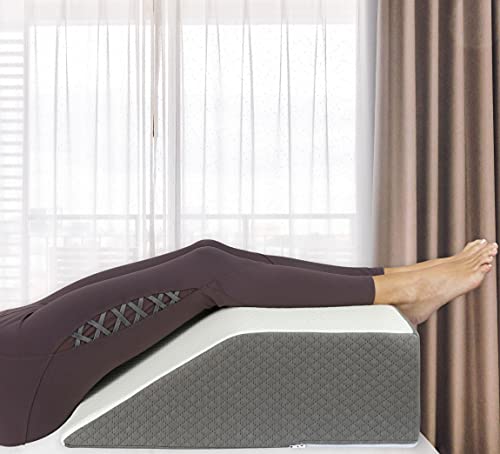
Kolbs Leg Elevation Pillow (Flat Top, 7 Inch) — Best Flat-Top Bolster
The Kolbs takes a different geometry from every incline wedge in this guide: its top is flat. Your legs rest on a level 7-inch platform rather than a slope, which changes the feel completely. There is no downhill for your heels to creep toward, no angle pressing into the back of the knee, and the position you fall asleep in is the position you wake in. For back sleepers who have tried wedges and disliked the slope itself, this is the design that usually converts them.
Seven inches is a moderate, honest height — stated plainly in the listing — and the bolster format spans foot, knee and ankle, so it works placed under the calves with feet resting on top, or further up so the whole lower leg is level. A flat top also doubles well outside sleep: it is a stable leg rest for reading or watching television in bed, where an incline can feel like it is pushing you somewhere.
Strengths
- Level surface — no sliding down an incline overnight
- Stated 7-inch height is easy to plan around
- Works equally as a bed-time leg rest for reading
Trade-offs
- Fixed height and fixed shape — nothing to adjust
- A level platform gives less knee bend than an incline wedge
- Takes the same bed length as a wedge despite the simpler shape
| Type | Flat-top leg elevation bolster |
| Height (listing-verified) | 7 inches, flat top |
| Shape | Level resting surface |
Pick the Kolbs if your complaint about leg pillows has always been movement: sliding, creeping, waking with the pillow half off the bed. The flat top removes the slope that causes most of it. The compromise is that sleepers who specifically want their knees bent by an incline — the classic wedge posture — will find a level platform less enveloping. Neither geometry is objectively better; they are different answers, and this is the strongest flat-top answer the catalog check produced.
Best for: Back sleepers who dislike incline wedges and want a stable, level leg rest / Not suited for: Sleepers who want a pronounced incline and knee bend

CRAURU Leg Elevation Pillow (Trapezoidal) — Best Simple Foot-Up Design
The CRAURU’s trapezoidal profile — wider at the base, narrower at the top — is the most stable shape in basic geometry, and it makes this pillow the one least likely to tip, rock or wander. It is marketed as a foot elevation pillow, and for a back sleeper that translates to a compact lift concentrated where many people want it: under the lower legs and feet, without a long wedge eating half the mattress.
The practical details are right for a pillow that will be moved constantly. A handle means it actually gets carried from bed to sofa instead of being abandoned in one room, and the removable cover means the inevitable spills and general nightly use do not become permanent. The grey finish hides wear better than white. If your pattern is ‘legs up on the sofa in the evening, legs up in bed at night’, this is the pick shaped around your actual life.
Strengths
- Trapezoid base is inherently stable and tip-resistant
- Handle makes it genuinely portable between rooms
- Removable cover keeps a nightly-use pillow fresh
Trade-offs
- Compact footprint concentrates support under lower legs and feet
- Simpler shape offers less calf-length support than a long wedge
- Fixed height, like most one-piece designs
| Type | Trapezoidal foot elevation pillow |
| Extras in listing | Handle; removable cover |
| Color in listing | Grey |
Think of the CRAURU as the minimalist’s elevation pillow: no stack, no channel, no adjustment, just a stable block of lift that is easy to live with. Back sleepers who want full calf support should choose a longer wedge; back sleepers who mainly want their feet and lower legs raised — and who know a complicated product would end up in a closet — will get more real use out of this one.
Best for: Back sleepers who want simple foot and lower-leg elevation they can move room to room / Not suited for: Sleepers who want support along the full calf

Kehangte Leg Elevation Pillow (4-Height Adjustable) — Best Height Range
The Kehangte offers the widest height range in this guide: four distinct settings in a single-leg design. That range is useful in a specific, common situation — your preferred elevation is not constant. Legs that feel fine at a low setting on Monday may want more lift after a long day on your feet on Friday, and a four-step pillow follows that rhythm instead of forcing one compromise height every night.
Like the TranquilRelax, it is a single-leg format, so the same logic applies: one leg gets proper, contained elevation while the other rests flat, and the bed keeps most of its width. The cover washes, which matters more at higher settings — the taller the stack, the more the top surface works. Four settings also make this the most forgiving pick for a first-time buyer who genuinely does not know their number yet: you can start low, step up over a week, and settle where your body votes yes.
Strengths
- Four heights — the most tuning range of any pick here
- Single-leg footprint leaves most of the bed free
- Washable cover suits a product adjusted and handled often
Trade-offs
- Single-leg only; no both-legs option
- Tallest settings are less stable than a one-piece wedge
- Finding your setting takes a few nights of experimenting
| Type | Adjustable single-leg elevation pillow |
| Heights (listing-verified) | 4 height settings |
| Cover | Washable |
Between the two adjustable picks, the split is simple: the KingPavonini adjusts a both-legs wedge, the Kehangte adjusts a single-leg pillow across more steps. Choose the Kehangte if your elevation needs swing noticeably from day to day, or if you are buying your first leg pillow and want the widest margin for error. Its ceiling is stability at full height — treat the top setting as an evening position and sleep one step down if you move a lot at night.
Best for: Back sleepers whose preferred elevation changes day to day / Not suited for: Sleepers who want both legs raised, or a one-piece pillow
Comparison Table
Read this table by height and footprint first, foam second. A back sleeper who elevates both legs every night needs a different pillow from someone who rests one leg up while reading, and the table makes that split obvious at a glance.
| Pick | Badge | Key spec | Best for | Check |
|---|---|---|---|---|
| MEGCXIT Leg Elevation Pillow (23.6 × 16.8 × 8 Inch) | Best Overall | 23.6 × 16.8 × 8 in memory foam wedge, both legs | Back sleepers who elevate both legs nightly and want a set-and-forget wedge | Check on Amazon |
| KingPavonini Adjustable Leg Elevation Pillow | Best Adjustable | Adjustable-height stack, cooling gel memory foam, non-slip base, 4 handles | Back sleepers unsure of their ideal height, and anyone who reads in bed with legs raised | Check on Amazon |
| TranquilRelax Leg Elevation Pillow (Single-Leg Cradle) | Best for One Leg at a Time | Single-leg U-shaped cradle, adjustable height, memory foam | Back sleepers who elevate one leg and hate it rolling off a flat wedge | Check on Amazon |
| Kolbs Leg Elevation Pillow (Flat Top, 7 Inch) | Best Flat-Top Bolster | Flat-top bolster, stated 7 in height | Back sleepers who dislike incline wedges and want a stable, level leg rest | Check on Amazon |
| CRAURU Leg Elevation Pillow (Trapezoidal) | Best Simple Foot-Up Design | Trapezoidal profile, handle, removable cover | Back sleepers who want simple foot and lower-leg elevation they can move room to room | Check on Amazon |
| Kehangte Leg Elevation Pillow (4-Height Adjustable) | Best Height Range | 4-height adjustable, single-leg design, washable cover | Back sleepers whose preferred elevation changes day to day | Check on Amazon |
How to Choose the Best Leg Pillows for Back Sleepers
Start with geometry, not brand. A back sleeper’s leg pillow does one job — hold the legs at a comfortable elevation all night — and the three geometries in this guide do it differently. An incline wedge (MEGCXIT, KingPavonini) supports the whole calf on a slope and bends the knee gently. A flat-top bolster (Kolbs) holds the legs level. A cradle or compact trapezoid (TranquilRelax, CRAURU, Kehangte) concentrates on one leg or the lower leg. Decide which posture you are actually seeking before comparing foams, because no foam upgrade fixes the wrong shape.
Height comes second, and it is a Goldilocks specification. As a starting frame, lower elevations around 7 inches suit most back sleepers for all-night use; taller stacks suit shorter periods — reading, relaxing, an hour with legs up after a long day. If you are between ideas, an adjustable pillow converts a guess into an experiment, which is why two of the six picks adjust. Whatever you choose, measure the pillow against your own leg: the tall end of a wedge should sit under your calves, not jammed behind your knees.
Foam: memory foam versus plain foam
Memory foam molds to the calf and spreads pressure evenly, which is why most picks here use it. Its costs are warmth and slow softening over months. Cooling gel infusions, like the KingPavonini’s, take the edge off the warmth. Firmer plain foams hold height more literally and feel cooler, but can feel plank-like under a bony heel. There is no universal winner — there is only the trade you mind least, which is why each review states the foam plainly instead of burying it.
Footprint and bed politics
A both-legs wedge is typically 20-plus inches wide. In a twin or a shared queen, that width is a negotiation. Single-leg designs halve it. Measure your mattress, subtract your partner’s non-negotiable territory, and check the number against the pick’s stated width before ordering — returns on bulky foam are a hassle nobody enjoys. Length matters too: a wedge placed for sleeping should not push your feet off the end of a shorter bed.
Covers, bases and the unglamorous details
The features that decide whether a leg pillow is still in use in six months are boring: a removable, washable cover; a base that grips the sheet instead of skating on it; a handle if the pillow will travel between rooms. Every pick in this guide was checked for these details in its catalog data, and the reviews note which ones each model has. Weight them heavily. A pillow that smells stale or migrates nightly gets abandoned regardless of its foam quality.
How to Position a Leg Pillow as a Back Sleeper
Correct placement matters as much as the pillow itself, and it takes under a minute to learn. Work through these steps the first few nights until the position is automatic.
- Lie on your back in your normal sleeping position first, without the pillow, and notice where your legs naturally rest.
- Slide the pillow under your legs so the support sits under your calves. For a wedge, the tall end goes toward your body with the slope running down toward your feet — your heels should rest on the pillow or just past its low end, never dangling in a way that pulls on the knee.
- Check the knee: it should hold a soft, slight bend. A locked-straight knee means the pillow is too far away or too low; a sharply bent knee means it is too close or too tall.
- For adjustable models, start one setting lower than you think you need for sleeping, and raise it on later nights if you want more.
- In the morning, note two things: whether the pillow moved, and how your legs feel in the first minute of standing. Adjust placement before you adjust the product — most ‘wrong pillow’ complaints are placement problems.
Care and Longevity: Keeping an Elevation Pillow Supporting You
Foam pillows fail quietly — they do not tear, they sag. Extend the useful life of any pick here by rotating it head-to-foot weekly so the same calf zone is not compressed every night, and by keeping it out of prolonged direct sun, which degrades foam. Wash the removable cover on the schedule you wash your pillowcases; the foam core itself should only be spot-cleaned and dried fully before the cover goes back on, because trapped moisture is what makes foam smell old.
Expect memory foam to feel firmest in a cold room and softest in a warm one; that is the material behaving normally, not a defect. If an adjustable stack starts to feel uneven, take it apart, let the pieces rest uncompressed for a day, and rebuild — foam recovers a surprising amount of height with a rest day. When a pillow no longer returns to roughly its stated height after a day uncompressed, it has given you its service and replacement, not another accessory, is the honest fix.
Leg Pillows and Your Mattress: Making the Combination Work
A leg pillow does not work in isolation — it works on your mattress, and the pairing changes the result. On a soft, deep mattress your body already sinks, so a wedge’s effective height is partly absorbed before your legs ever feel it; soft-bed sleepers often need one step more elevation than the same person on a firm bed. On a firm mattress the pillow’s stated height is close to the height you experience. This is the hidden reason two people can buy the same wedge and report opposite results, and it is another argument for adjustable designs when your mattress is very soft.
Bedding choices matter at the margins. A pillow placed under the fitted sheet stays put and feels integrated, but stretches the sheet and can pull its corners; placed on top of the sheet it is free to be repositioned nightly, which adjustable users prefer. Smooth satin-style sheets let any wedge creep; cotton and flannel grip better. If your pillow migrates, change the surface before you blame the pillow — a cotton pillowcase-style cover or a non-slip base solves most movement complaints in this category.
Finally, think about the rest of the bed’s ecosystem. Back sleepers often pair a leg pillow with a lower-profile head pillow, because raising the legs changes the angle your whole body rests at; a very tall head pillow plus elevated legs can leave the middle of your back unsupported. Treat the two pillows as one system, adjust one at a time, and give each change two nights before judging it.
Who Should Skip a Leg Pillow — and What to Do Instead
Honesty about fit matters more than another badge. Combination sleepers who roll from back to side through the night often find any fixed leg pillow becomes an obstacle at 3 a.m.; a smaller single-leg or trapezoidal design is the only version worth trying, and many combination sleepers are better served by a pillow they can push aside — which argues for light, handled designs like the CRAURU. Restless sleepers who travel across the bed will defeat any placement strategy.
Anyone whose clinician has prescribed a specific elevation, compression or positioning regime should treat that prescription as the specification and shop only within it — a general guide cannot substitute, and this article deliberately makes no medical claims for any pick. And if your reason for shopping is persistent pain rather than comfort, the pillow is the second appointment, not the first: get the cause assessed, then buy comfort equipment with a professional’s parameters in hand.
A Week with a Leg Pillow: What Changes, Night by Night
Night one is curiosity: the elevation feels deliberate, you notice your legs, and you may wake once aware of the pillow. This is normal and tells you almost nothing. Nights two and three are the honest data — your body stops treating the pillow as news, placement becomes automatic, and the morning report from your legs becomes consistent. If the pillow has migrated both nights, fix the surface or the height before night four rather than enduring a week of a solvable problem.
By nights five to seven, the question answers itself in one of two ways. Either you stop thinking about the pillow entirely — the signature of a correct fit, in bedding as in shoes — or a specific complaint has repeated enough to name: too tall, too warm, too narrow, too mobile. A named complaint is a shopping instruction for the adjustable pick, the cooler foam, the wider wedge. This is why this guide is organized by failure mode as much as by product: the right second decision is usually obvious once the first week has told you what your body objects to.
Keep the box until the week is out. Foam pillows compress for shipping and returns are straightforward in the trial window most sellers allow, but a pillow judged on night one and returned on day two teaches you nothing except that change feels strange at first — which you already knew.
Common Buying Mistakes
Mistake 1: Buying a side-sleeper knee pillow for back sleeping
The small hourglass cushions marketed for between the knees solve a side-sleeping problem. On your back they do almost nothing — too small to elevate, too narrow to support a calf. If the listing’s photos show it between knees of a side sleeper, it is not the product this search is about, no matter how the title is worded.
Mistake 2: Choosing height by enthusiasm
New buyers routinely order the tallest wedge available, reasoning that more elevation must be better. Overnight, excessive height bends or locks the knee uncomfortably and slides the pillow toward the foot of the bed. Moderate heights and adjustable designs exist precisely because the best height is personal and usually lower than first instinct.
Mistake 3: Placing the wedge backwards
A wedge reversed — tall end at the feet — creates a ramp that pushes your legs up at the ankles and leaves the knees unsupported, which feels wrong within minutes and gets blamed on the pillow. The tall end belongs under the calves near the body, sloping down toward the feet.
Mistake 4: Ignoring the cover
A non-removable cover on a product used nightly is a countdown to a pillow you no longer want in your bed. Every pick in this guide was checked for cover practicality; if you shop beyond this list, treat ‘cover not removable’ as a serious mark against the product.
Mistake 5: Expecting a comfort pillow to do a medical job
Leg elevation pillows are comfort products. Listings in this category often carry recovery language, but a shopping guide cannot tell you what elevation, duration or product a medical situation requires — that is a question for your clinician, and following general comfort advice instead of specific clinical instruction is the one genuinely harmful mistake on this list.
Final Recommendation
For most back sleepers, the decision resolves quickly. The MEGCXIT is the default recommendation: honest dimensions, both legs supported, nothing to adjust or assemble. If you know yourself well enough to name a specific need, the specialists beat it — the KingPavonini if you want to tune height on a both-legs wedge, the Kolbs if inclines themselves annoy you, the TranquilRelax or Kehangte if one leg is the whole story, and the CRAURU if simple, portable foot-up comfort is the actual goal.
Whichever you choose, give it five nights before judging. Legs that have slept flat for years notice any change at first, and the second and third nights are the honest test. Keep the placement steps from the how-to section beside the bed for the first week, start lower than your enthusiasm suggests, and let your morning legs cast the deciding vote.
- Best Overall: MEGCXIT Leg Elevation Pillow (23.6 × 16.8 × 8 Inch) — Check the current price on Amazon
- Best Adjustable: KingPavonini Adjustable Leg Elevation Pillow — Check the current price on Amazon
- Best for One Leg at a Time: TranquilRelax Leg Elevation Pillow (Single-Leg Cradle) — Check the current price on Amazon
- Best Flat-Top Bolster: Kolbs Leg Elevation Pillow (Flat Top, 7 Inch) — Check the current price on Amazon
- Best Simple Foot-Up Design: CRAURU Leg Elevation Pillow (Trapezoidal) — Check the current price on Amazon
- Best Height Range: Kehangte Leg Elevation Pillow (4-Height Adjustable) — Check the current price on Amazon
Best Knee Pillows For Sleeping Best Orthopedic Knee Pillows Best Knee Pillows For Side Sleepers Best Knee Pillows For Back Sleepers Best Cooling Pillows For Sleeping
Related guides
Frequently Asked Questions
What height leg pillow is best for back sleeping?
For all-night back sleeping, a moderate elevation — around 7 to 8 inches at the tallest point — suits most people, which is why the fixed picks in this guide cluster there. Taller settings are better treated as short-session positions for reading or relaxing. If you are unsure, an adjustable model removes the gamble: start low and step up over several nights.
Should a back sleeper’s leg pillow go under the knees or the calves?
Under the calves, with the support beginning below the knee. Support directly behind the knee can press into the joint and feel worse than no pillow. Placed under the calves, a wedge or bolster lets the knee keep a soft bend while the whole lower leg is carried — that is the position every pick in this guide is shaped for.
Can I use a regular bed pillow under my legs instead?
For one night, yes; as a routine, it disappoints. Bed pillows are soft fill in a rectangle — they compress to a fraction of their loft under leg weight, bunch up by midnight, and give a different height every night. A foam elevation pillow holds a consistent, stated height, which is the entire point of the category.
Is a leg pillow the same as a wedge pillow?
A leg wedge is one kind of wedge pillow. Large torso wedges — the kind used to prop up your back for reading — are wider, taller and angled for your upper body; they are too steep for comfortable all-night leg elevation. Leg-specific wedges and bolsters use gentler heights and leg-width footprints. Check the stated dimensions and the intended placement before assuming any wedge works under legs.
How do I stop my leg pillow sliding during the night?
Three fixes, in order: place the pillow on the sheet rather than on a slippery duvet; choose a model with a non-slip base, like the KingPavonini in this guide; and lower the height one step if you use an adjustable model, because excessive height is the most common cause of migration. A fitted sheet stretched over both mattress and pillow also works as a low-tech anchor for fixed wedges.
Are leg elevation pillows a medical treatment?
No. They are comfort products that hold your legs in a raised position while you rest. Listings in this category often use recovery language, but this guide makes no medical claims for any pick, and anyone with a medical reason to elevate their legs should follow their clinician’s specific instructions on product, height and duration.

