Disclosure: airfryerkitchensupply.com is reader-supported. When you buy through links on our site, we may earn an affiliate commission at no extra cost to you.
Where to buy
Every pillow below is genuinely low — the listings state heights between 2.25 and 2.75 inches, which is roughly half the loft of a standard hotel pillow. That number is the whole point of this guide, so it comes from the manufacturers’ own listings, and we do not print prices or scores here: use the link under each pick to check price on Amazon before you buy.
Bluewave Bedding Ultra Slim Gel Memory Foam Pillow — Best Overall: check price on Amazon.
BLISSBURY Stomach Sleeper Pillow — Best for Stomach Sleepers: check price on Amazon.
Ultra Thin Flat Pillow for Sleeping (Slim Memory Foam, 2.75 in) — Best Cooling Pick: check price on Amazon.
Flat Pillows for Sleeping — Thin Memory Foam 2-Pack (2.25 in) — Best Value 2-Pack: check price on Amazon.
Vipbear Ultra Thin Pillow 2.75″ — Best Certified Foam: check price on Amazon.
MINUPWELL Flat Pillow — Cooling Gel Memory Foam (2.5 in) — Best Compact Size: check price on Amazon.
Introduction
Most pillows are built too tall for the people shopping for the best low pillows. If you sleep on your stomach, sleep on your back with a naturally small frame, use a CPAP mask that a tall pillow shoves sideways, or simply wake up with a kinked neck from being propped at an angle all night, loft is not a luxury — it is the problem. A low pillow keeps the head close to the mattress so the neck stays near neutral instead of flexing up or dropping into a hole of soft fill.
The honest complication is that ‘low’ means different things on different listings, and some pillows marketed as low profile are five inches of foam — medium by any sane standard. So this guide applies a strict filter: every pick states a height of about 2.75 inches or less in its own listing. These are true flat pillows, mostly slim memory foam slabs, plus a two-pack for households converting both sides of the bed. If you are a committed side sleeper with broad shoulders, read the FAQ before ordering — most side sleepers genuinely need more loft than anything on this page, and we would rather tell you that than sell you a flat pillow.
One more expectation to set: a thin memory foam pillow feels strange for the first few nights if you are coming from a tall, fluffy pillow. The head sits lower, the pillow feels firmer because there is less material to sink into, and your shoulder takes a different angle. Give any pick here a week before you judge it — necks adapt slowly, and the second week is the honest test.
Key Takeaways
- Every pick states a height of 2.75 inches or less in its own listing — true low loft, not marketing ‘low profile.’
- Low pillows suit stomach sleepers, back sleepers with smaller frames, and CPAP users whose masks get pushed by tall pillows.
- Most broad-shouldered side sleepers need more loft than any pillow here; the guide says so plainly rather than overselling.
- The Bluewave Ultra Slim (2.75 in) is the best all-round pick; the 2-pack of 2.25-inch pillows is the thinnest option listed.
In this guide
Quick Picks
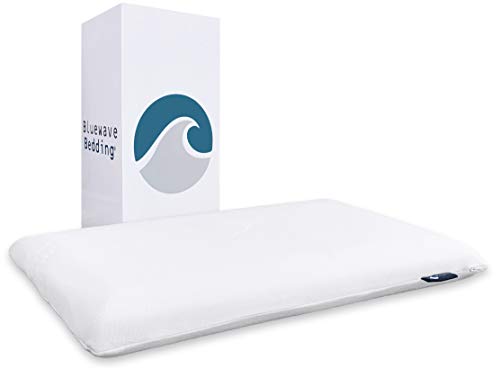
Bluewave Bedding Ultra Slim Gel Memory Foam Pillow — Best Overall
The reference point for this category: a 2.75-inch gel memory foam slab in standard size, made for stomach and back sleepers who want their head nearly level with the mattress. Thin, flat, and honest about what it is.
Check the current price on Amazon

BLISSBURY Stomach Sleeper Pillow — Best for Stomach Sleepers
A 2.6-inch flat memory foam pillow designed specifically for stomach sleepers, with a removable, washable cover. The listing’s own pitch — ‘made for people who find most pillows too high’ — is exactly the brief.
Check the current price on Amazon

Ultra Thin Flat Pillow for Sleeping (Slim Memory Foam, 2.75 in) — Best Cooling Pick
A cooling-focused slim pillow at the same 2.75-inch height as our top pick, aimed at hot sleepers: slim memory foam with a cooling design, for stomach sleepers who overheat on plain foam.
Check the current price on Amazon
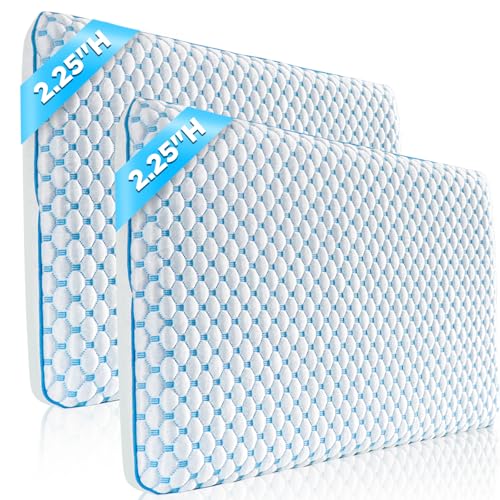
Flat Pillows for Sleeping — Thin Memory Foam 2-Pack (2.25 in) — Best Value 2-Pack
The thinnest option in this guide at a stated 2.25 inches, sold as a 2-pack of cooling gel memory foam pillows. For couples converting to flat pillows together, or a guest bed that needs a low option, the pair format is the value play.
Check the current price on Amazon

Vipbear Ultra Thin Pillow 2.75″ — Best Certified Foam
A 2.75-inch gel-infused memory foam pillow in standard size with a dual-sided cooling cover and CertiPUR-US certified foam — the pick for buyers who want the foam’s content standards documented, not just described.
Check the current price on Amazon

MINUPWELL Flat Pillow — Cooling Gel Memory Foam (2.5 in) — Best Compact Size
A 2.5-inch, 24×16-inch flat pillow in cooling gel memory foam — slightly smaller than standard, which suits smaller beds, smaller sleepers, and anyone who wants a low pillow that does not sprawl. (Medical wording in the full listing title is the seller’s; see the honesty notes.)
Check the current price on Amazon
How These Picks Were Chosen
Picks were chosen cache-first from pillows already verified on this site, with the ASIN and full listing title cross-checked before writing. The qualifying rule was mechanical: the listing itself had to state a low height (about 2.75 inches or under) or be an explicitly thin/flat design with a stated height. Pillows described only with vague words like ‘low profile’ and no stated height were left out, as were pillowcases, inserts, travel pillows and leg pillows that surfaced in the same searches.
Within the verified shortlist, the six slots cover the real variations inside ‘low’: gel-infused foam for hot sleepers, a dual-sided cooling cover, a CertiPUR-US certified foam (that certification covers the foam’s emissions and content standards — it is not a medical endorsement), a feather-flat alternative style in foam form, and a budget two-pack. One listing per model: color and size variants of the same pillow were deduplicated.
Heights are printed exactly as the listings state them. Foam compresses under a head, so the sleeping height is lower than the shelf height — that is normal and, for this category, desirable. We do not print prices, reader scores or review tallies; the link under each pick takes you to the current listing.
The 6 Best Low Pillows
Bluewave Bedding Ultra Slim Gel Memory Foam Pillow — Best Overall
The Bluewave Ultra Slim is the pillow most people picture when they go looking for a low pillow: a single flat slab of gel memory foam, 2.75 inches tall per the listing, in a standard size that takes ordinary pillowcases. There is no contour, no gusset, no adjustable fill — just a deliberately thin foam layer that keeps a back or stomach sleeper’s head close to the bed so the neck is not cranked upward all night.
The gel infusion is the practical upgrade over a plain foam slab. Thin pillows concentrate pressure, and plain memory foam holds heat exactly where your cheek sits; gel foam runs noticeably cooler to the touch, which matters when half your face is on the pillow in stomach position. The flat design also plays well with CPAP masks, because there is no tall pillow edge for the mask or hose to lever against when you turn.
Know what you are giving up. At 2.75 inches there is very little cushion travel, so the pillow feels firm compared with a plush hotel pillow, and committed side sleepers will feel their shoulder take the load their pillow used to carry. It is also a single standard-size pillow — no queen or king version in this listing — so measure your cases if your bedding is oversized. For its intended sleepers, though, this is the category’s benchmark for a reason.
Strengths
- True 2.75-inch height stated in the listing — genuinely low, not relabeled medium
- Gel memory foam sleeps cooler than a plain foam slab
- Flat profile is CPAP-mask friendly and keeps back sleepers near neutral
Trade-offs
- Feels firm if you are used to plush pillows — little foam travel at this thickness
- Standard size only in this listing
- Most side sleepers will find it too low, whatever the marketing says
| Specifications (from the manufacturer listing) | |
|---|---|
| Stated height | 2.75 in |
| Fill | Gel memory foam |
| Size | Standard |
| Shape | Flat slab |
| Intended positions | Stomach and back, per listing |
Best for: Stomach and back sleepers who want the classic thin-pillow benchmark / Not suited for: Side sleepers with medium or broad shoulders
Check the current price on Amazon
BLISSBURY Stomach Sleeper Pillow — Best for Stomach Sleepers
Stomach sleeping is hard on necks: the head turns to one side for hours, and every extra inch of pillow height adds twist and lift to that already-rotated position. The BLISSBURY answers with the thinnest mainstream design in this guide alongside the 2-pack — 2.6 inches of flat memory foam, per the listing — so the head stays low and the rotation stays as gentle as stomach sleeping allows.
Two details lift it above a bare foam slab. The feel is tuned soft rather than board-like, which matters when an ear and a cheek are the contact points, and the cover comes off for washing — a genuinely important feature for a pillow your face spends all night on, and one several rivals skip. The flat shape also slides partly under the chest comfortably, the way many stomach sleepers actually use a pillow, half-hugging it rather than lying fully on top.
The caveats are the category’s caveats, sharpened. At 2.6 inches this is a one-position pillow: roll onto your side and the gap between head and mattress is suddenly yours to fill with a folded arm. Combination sleepers who spend real time on their side should look at the taller end of this guide or elsewhere entirely. And no pillow makes stomach sleeping ergonomic — this one simply makes it less bad, which is the honest promise.
Strengths
- 2.6-inch height stated in the listing — among the thinnest here
- Soft-tuned foam suits face-down contact points
- Removable, washable cover — important for a face pillow
Trade-offs
- Effectively a single-position pillow; side sleeping on it feels empty
- Cannot fix the neck rotation inherent to stomach sleeping
- Memory foam this thin offers minimal pressure cushioning
| Specifications (from the manufacturer listing) | |
|---|---|
| Stated height | 2.6 in |
| Fill | Memory foam |
| Shape | Thin, flat |
| Cover | Removable and washable, per listing |
| Intended position | Stomach |
Best for: Dedicated stomach sleepers who find every normal pillow too high / Not suited for: Combination sleepers who spend half the night on their side
Check the current price on Amazon
Ultra Thin Flat Pillow for Sleeping (Slim Memory Foam, 2.75 in) — Best Cooling Pick
Thin pillows have a heat problem: with so little material between head and mattress, body heat has nowhere to dissipate, and plain memory foam is a known heat-holder. This ultra thin pillow is built around that complaint — slim memory foam at a stated 2.75 inches with a cooling design, pitched at stomach sleepers who wake up flipping the pillow hunting for the cool side.
In practice it competes directly with the Bluewave at the top of this guide: same stated height, same flat-slab idea, different emphasis. The Bluewave leans on gel infusion in the foam; this pick leans on its cooling surface approach. Which runs cooler depends on your sheets, your room and your own thermostat, and we will not pretend a listing can settle that — but if heat is your primary complaint and height is non-negotiable, this is the pick in the category designed around you.
Everything else follows the thin-pillow pattern: firm-feeling for its softness class because there is so little foam to compress, excellent for back and stomach positions, a poor idea for dedicated side sleepers. Cooling fabrics also tend to feel slick under a cotton case; a well-fitting pillowcase solves it. Treat it as the hot sleeper’s version of the benchmark pick and you have the right idea.
Strengths
- Stated 2.75-inch height with a cooling-focused design
- Flat slab keeps stomach and back sleepers low and near neutral
- Direct alternative to gel foam if gel slabs still sleep warm for you
Trade-offs
- Cooling effect varies with bedding and room temperature
- Firm effective feel, like all pillows this thin
- Not a side-sleeper pillow despite the category name games elsewhere
| Specifications (from the manufacturer listing) | |
|---|---|
| Stated height | 2.75 in |
| Fill | Slim memory foam |
| Design | Cooling, ultra thin flat |
| Intended positions | Stomach and back, per listing |
| Shape | Flat slab |
Best for: Hot sleepers who need a truly low pillow that does not trap heat / Not suited for: Cold sleepers who prefer a warm, plush, high-loft feel
Check the current price on Amazon
Flat Pillows for Sleeping — Thin Memory Foam 2-Pack (2.25 in) — Best Value 2-Pack
At a stated 2.25 inches, this 2-pack is the floor of the category — half an inch thinner than the Bluewave benchmark, which is a bigger difference than it sounds when the total height is under three inches. If you have tried a 2.75-inch pillow and still felt propped up, this is the next step down, and it arrives as a matched pair of cooling gel memory foam pillows rather than a single.
The pair format solves a real household problem. Low pillows are a preference that often runs in couples, and buying two singles of a niche product usually costs more than a purpose-made 2-pack. It also suits the common pattern of one pillow under the head and — for stomach sleepers — one thin pillow hugged or slid partly under the chest. The cooling gel foam keeps the thin-slab heat issue in check the same way the gel benchmark pick does.
Be honest with yourself about 2.25 inches before ordering: this is close to sleeping on a folded towel, by design. Back sleepers with any neck sensitivity may find it under-supportive rather than neutral, and there is no thinner ‘next step’ if it is too little — the only direction from here is a different pillow type. Order it because you already know flat is right for you, not as a first experiment; first experiments belong at 2.75 inches.
Strengths
- Thinnest stated height in this guide: 2.25 inches
- Matched 2-pack — better value for couples and guest beds
- Cooling gel memory foam addresses thin-pillow heat build-up
Trade-offs
- Very flat — too little support for some back sleepers
- No thinner fallback if it undershoots your preference
- Pair format means both pillows share the same firmness bet
| Specifications (from the manufacturer listing) | |
|---|---|
| Stated height | 2.25 in |
| Fill | Cooling gel memory foam |
| Pack | 2 pillows |
| Shape | Thin, flat |
| Intended positions | Stomach and back, per listing |
Best for: Confirmed flat-pillow fans, especially couples converting together / Not suited for: First-time low-pillow buyers — start at 2.75 inches instead
Check the current price on Amazon
Vipbear Ultra Thin Pillow 2.75″ — Best Certified Foam
The Vipbear matches the benchmark height — a stated 2.75 inches — and adds two things the plainer slabs do not: a dual-sided cooling cover, so one face of the pillow is the cool side by design, and CertiPUR-US certification for the foam. That certification has a specific meaning worth stating precisely: the foam is made without certain prohibited substances and is tested for emissions and durability standards. It says nothing medical, and we present it as what it is — a materials standard, independently administered.
The dual-sided cover is more practical than it sounds. Hot sleepers flip pillows; a cover designed with a cooling face gives that instinct somewhere to land, and in shoulder seasons the standard face is there when the cooling side feels too cool. Gel infusion in the foam works alongside it. For stomach, back and — the listing claims — side sleepers, the flat 2.75-inch profile keeps the head low; our own guidance remains that most side sleepers need more height, listing claim notwithstanding.
Standard size only, again — the thin-pillow market simply does not cater to king bedding, and this listing is no exception. The cooling face can feel cool enough to surprise under a thin case in an air-conditioned room. And as with every pick here, expect a firm effective feel: 2.75 inches of foam has very little give before you reach the mattress. Within those category rules, this is the most feature-complete thin pillow in the guide.
Strengths
- CertiPUR-US certified foam — documented materials and emissions standards
- Dual-sided cooling cover plus gel-infused foam for hot sleepers
- Benchmark 2.75-inch stated height in standard size
Trade-offs
- The listing markets it to side sleepers too; most will still find 2.75 in too low
- Standard size only — no king option in this listing
- Cooling face can feel cold under thin cases in air conditioning
| Specifications (from the manufacturer listing) | |
|---|---|
| Stated height | 2.75 in |
| Fill | Gel infused memory foam |
| Certification | CertiPUR-US (foam content/emissions standard) |
| Cover | Dual-sided cooling |
| Size | Standard |
Best for: Hot sleepers who want certified foam and a designed cool side / Not suited for: King-bed owners who need a matching king-size pillow
Check the current price on Amazon
MINUPWELL Flat Pillow — Cooling Gel Memory Foam (2.5 in) — Best Compact Size
The MINUPWELL sits between the 2.25-inch pair and the 2.75-inch benchmarks at a stated 2.5 inches, and pairs that height with a compact 24×16-inch footprint — a little smaller than a standard pillow. That combination has a real audience: petite sleepers whose shoulders are narrow, twin and dorm beds where a standard pillow crowds the mattress, and travelers who have learned that hotel pillows are always too tall and want a flat pillow that packs sensibly.
The fill is described in the listing as cooling gel memory foam, addressing the usual thin-pillow heat complaint, and the flat shape keeps back and stomach sleepers low. The seller’s title also aims the pillow at side sleepers; our standing advice in this guide is more conservative — a 2.5-inch pillow can work for a narrow-shouldered side sleeper, especially on a soft mattress that lets the shoulder sink, but broad shoulders need loft this category does not offer.
The smaller size is the main trade-off to check before buying: standard pillowcases will fit loosely, and on a king bed the pillow looks and feels modest. The 50D foam density figure in the listing suggests a firmer slab than average, which at 2.5 inches means a distinctly firm sleeping surface — good for those who want support without height, less good for anyone expecting plushness. As a compact, mid-thin option, it fills its slot cleanly.
Strengths
- Stated 2.5-inch height — the middle step between the pair and the benchmarks
- Compact 24×16 in size suits twin beds, petite sleepers and travel
- Cooling gel memory foam in a flat, low design
Trade-offs
- Smaller than standard — cases fit loosely, king beds dwarf it
- Firm foam density at this thickness feels distinctly firm
- Side-sleeper suitability depends heavily on shoulder width and mattress softness
| Specifications (from the manufacturer listing) | |
|---|---|
| Stated height | 2.5 in |
| Dimensions | 24 x 16 in |
| Fill | Cooling gel memory foam (100% memory foam, per listing) |
| Shape | Flat |
| Intended positions | Back, stomach and side, per listing |
Best for: Petite sleepers, twin beds and travelers who need a packable flat pillow / Not suited for: Anyone wanting a full standard or king footprint
Check the current price on Amazon
Comparison Table
| Pick | Badge | Key spec | Best for |
|---|---|---|---|
| Bluewave Bedding Ultra Slim Gel Memory Foam Pillow | Best Overall | 2.75 in gel memory foam, standard size | Stomach and back sleepers who want the classic thin-pillow benchmark |
| BLISSBURY Stomach Sleeper Pillow | Best for Stomach Sleepers | 2.6 in thin flat memory foam, washable cover | Dedicated stomach sleepers who find every normal pillow too high |
| Ultra Thin Flat Pillow for Sleeping (Slim Memory Foam, 2.75 in) | Best Cooling Pick | 2.75 in cooling slim memory foam | Hot sleepers who need a truly low pillow that does not trap heat |
| Flat Pillows for Sleeping — Thin Memory Foam 2-Pack (2.25 in) | Best Value 2-Pack | 2.25 in cooling gel memory foam, 2-pack | Confirmed flat-pillow fans, especially couples converting together |
| Vipbear Ultra Thin Pillow 2.75″ | Best Certified Foam | 2.75 in gel foam, CertiPUR-US certified, dual-sided cooling cover | Hot sleepers who want certified foam and a designed cool side |
| MINUPWELL Flat Pillow — Cooling Gel Memory Foam (2.5 in) | Best Compact Size | 2.5 in cooling gel memory foam, compact 24×16 in | Petite sleepers, twin beds and travelers who need a packable flat pillow |
How to Choose the Best Low Pillows: Height, Position and Fill
Height is the decision; everything else is refinement. Measure what you actually need rather than trusting labels: lie on your current pillow in your main sleeping position and have someone look at your neck from behind. If your head tilts up toward the ceiling relative to your spine, your pillow is too tall — the classic stomach and back sleeper problem. The picks in this guide cluster between 2.25 and 2.75 inches because that is the range where ‘low’ stops being a marketing word. If you are experimenting for the first time, start at 2.75; if a pillow at that height still feels like a ramp, step down to 2.5 or 2.25.
Position comes second. Stomach sleepers need the least height — their heads are already rotated, and lift only adds strain. Back sleepers need just enough fill to support the neck’s natural curve without pushing the chin toward the chest; for small-framed back sleepers that is often exactly this category. Side sleepers are the exception this guide keeps repeating: the pillow must fill the gap between ear and shoulder, and for most adults that gap is four inches or more. A soft mattress that lets the shoulder sink can shrink the gap enough for a 2.5–2.75 inch pillow to work for a narrow-shouldered side sleeper — that is the honest edge case, not the rule.
Fill is the third decision. Memory foam dominates this category for a structural reason: it can be cut into a thin, even slab that stays consistent, while down and down-alternative fills bunch and migrate, so a ‘thin’ filled pillow develops thick and thin spots. Foam’s weakness is heat, which is why most picks here use gel infusions or cooling covers. Foam density matters at these thicknesses — a denser slab (one listing states 50D) feels firmer and lasts longer; a softer slab feels gentler on ears and cheeks. There is no contouring in this guide’s picks: at under three inches, a flat slab is the honest design, and sculpted cervical shapes belong to the taller pillow categories.
Low Pillow, Thin Pillow, Flat Pillow: What the Words Actually Mean
Sellers use low, thin, flat, slim and low-profile interchangeably, and the inches are the only reliable translation. As a working scale: under 3 inches is genuinely low (this entire guide); 3 to 4.5 inches is low-to-medium, where many ‘low profile’ pillows actually live; 5 inches and up is medium or high regardless of the label. When a listing states a height, trust it over the adjectives. When it does not state one, treat the pillow as unmeasured and be cautious — in this category, the number is the product.
Also separate loft from firmness, because buyers constantly confuse them. A 2.5-inch pillow can feel firm — there is little material to compress before your head reaches the mattress — while a 6-inch down pillow can feel soft. ‘Low’ describes geometry, not softness. If you want low and soft, choose the softest-tuned foam here (the BLISSBURY) and accept that thin foam will never feel plush. If you want low and supportive, the denser slabs are your end of the list.
Low Pillows and the Rest of the Bed: Mattress, Position and Partner
A pillow does not work alone, and low pillows expose the rest of the bed’s geometry more honestly than tall ones do. Mattress firmness is the biggest variable: on a soft mattress your shoulder and hip sink, the sleeping surface effectively rises around you, and a 2.5-inch pillow can feel like a 3.5-inch one. On a firm mattress nothing sinks, and the same pillow feels every bit as flat as its stated height. This is why the same pick delights one back sleeper and disappoints another, and why the transition advice in this guide — judge at the second week, shim with a folded towel while you calibrate — is practical rather than decorative. If you change mattresses, expect to re-judge your pillow; the pair is a system.
Position within the category deserves a finer split than most guides make. Pure stomach sleepers are the clearest case: the flatter the better, down to the 2.25-inch pair, and many do best with the pillow partly under the chest rather than fully under the head. Pure back sleepers split by build — a smaller-framed sleeper’s neck curve needs very little fill to rest in a neutral line, while a larger-framed back sleeper may find even 2.75 inches too little and belong in the low-medium category this guide deliberately excludes. Combination sleepers who rotate between back and stomach are this category’s natural citizens. Combination sleepers who rotate between back and side are its border dispute: they typically end up choosing which position to serve, or keeping a second, taller pillow for side nights — an untidy solution that works better than one wrong pillow.
Then there is the partner problem, which is real: couples rarely share a loft preference, and a bed dressed with two visibly different pillows looks odd to exactly the people who care about how a bed looks. The honest resolutions are the ones in this guide — a matched thin 2-pack where both partners genuinely sleep low, or matched cases over different pillows where they do not. A standard pillowcase does quiet visual work here: the standard-size picks in this guide dress identically to ordinary pillows, so a low pillow and a medium pillow in the same cases read as a pair. Buy sleep first and symmetry second; your neck keeps the score either way.
Finally, a word about children and guests, because low pillows get borrowed into both roles. A thin pillow is not a default child’s pillow — children’s needs differ by age, and this guide’s picks are adult products with adult listings. For the guest bed, though, a low pillow is the considerate second option: hosts stock the fluffy pillows guests are too polite to complain about, and a flat alternative in the closet is the one guests actually thank you for. The 2-pack exists for exactly that closet.
Low Pillows for Travel, Guests and the Second Bed
A low pillow’s virtues compound away from home. Hotel and rental pillows are the tallest objects in the bedroom — stacked, gusseted and built for the photograph rather than the sleeper — and a stomach or back sleeper who has fixed their home setup meets them like a relapse. The compact MINUPWELL exists in this guide partly for this: at 24×16 inches and 2.5 inches of foam, it packs flatter than any clothing bundle in the case and restores your home geometry in a strange bed. Frequent travelers who sleep badly away from home usually blame the mattress; the pillow is the smaller, fixable half of the problem.
The guest-room version of the same logic runs in reverse. Hosts cannot know a guest’s loft, but they can know that the standard guest pillow — chosen plump for looks — is wrong for the substantial minority of guests who sleep low and say nothing. A low pillow in the guest closet, offered without ceremony (‘there’s a flatter one if you prefer’), is hospitality that costs one 2-pack. It is also the cheapest way to trial the category yourself: buy the pair for the guest bed, borrow one for your own seven-night test, and let the household’s necks vote before you commit the master bed.
And the second bed — the sofa bed, the cabin, the dorm — deserves a sentence of its own, because thin pillows store like books. A tall pillow consumes a shelf; a 2.5-inch slab slides beside one. Households short on linen storage can keep genuine low options for every occasional bed they own in the space one traditional spare pillow used to occupy. Small virtues, but this category is made of them: low pillows are a geometry preference, and geometry, once you know yours, is easy to provision everywhere you sleep.
A closing calibration note: pillow height interacts with your pillowcase and protector more than buyers expect. A thick, quilted protector can add a perceptible fraction of loft and warmth to a 2.5-inch pillow — proportionally far more than it adds to a tall one. If a new low pillow feels slightly higher or warmer than its listing led you to expect, try it for a night in a plain, thin case before you blame the foam. In a category measured in quarter-inches, the textiles around the pillow are part of the measurement.
How to Transition to a Low Pillow Without Wrecking Your Week
Switching pillow height changes your sleeping geometry, and necks complain about change itself before they complain about the new position. A staged transition gets you the benefit without the miserable first nights that make people abandon a pillow that would have suited them.
- Start with naps and the first half of the night. Use the low pillow for a weekend nap, then for the first hours of the night, swapping to your old pillow if you wake uncomfortable. Most people extend the low-pillow hours naturally within a week.
- Keep your old pillow in the room, not on the bed. Having it as a fallback prevents the 3 a.m. frustration that kills transitions — but keeping it on the bed invites you to stack them, which defeats the purpose.
- Adjust what is under your shoulders. On a very firm mattress, a low pillow feels lower. If the first nights feel too flat, a folded towel under the pillow is a temporary half-inch shim you can remove later — the reverse of weaning off a tall pillow.
- Stomach sleepers: try the pillow half under your chest. Many stomach sleepers settle best with the thin pillow partly under the upper chest and shoulder, head resting at its edge. Experiment before concluding the height is wrong.
- Give it seven nights before judging. Judge by the second week: waking position comfort and morning neck feel, not night one’s strangeness. If morning stiffness persists past two weeks, the height is genuinely wrong for you — step up half an inch rather than abandoning the category.
- Fit the case snugly. A loose case on a thin pillow bunches under the cheek. Standard cases on these standard-size picks are fine; use the compact pick’s size (24×16) with a case that does not swim on it.
One group should skip the experiment: anyone whose clinician has specified a pillow height or a cervical pillow for a diagnosed condition should follow that advice over a shopping guide. This article is about comfort geometry for healthy sleepers, not treatment.
Common Buying Mistakes
Buying ‘low profile’ without checking the inches
Plenty of pillows labeled low profile measure five inches — medium loft in disguise. In this category the stated height is the product. Every pick in this guide states 2.75 inches or less; hold any other candidate to the same standard.
Expecting a thin pillow to feel soft
Thin foam has almost no compression travel, so low pillows feel firmer than the same foam in a tall pillow. Buyers who want low and plush are usually happier with the softest-tuned thin slab and realistic expectations.
Forcing a low pillow on a broad-shouldered side sleeper
The ear-to-shoulder gap has to be filled by something — pillow, or your own arm folded under your head all night. If you sleep mostly on your side with medium or broad shoulders, a low pillow is the wrong tool, whatever the listing claims.
Judging on night one
A new height feels wrong before it feels right. Quitting after one night tells you nothing except that change is noticeable. The seven-night rule in the how-to section exists because most failed low-pillow purchases are failed transitions, not failed pillows.
Stacking a low pillow on another pillow ‘just in case’
Two stacked pillows behave like one unstable tall pillow with a sliding layer — the worst of both. If the low pillow alone is not enough, the honest fix is a slightly taller pillow, not a stack.
Final Recommendation
Start with the Bluewave Ultra Slim if you are new to low pillows: its stated 2.75-inch gel foam design is the category benchmark for stomach and back sleepers. If heat is your main complaint, the Ultra Thin cooling pick or the CertiPUR-US certified Vipbear — with its dual-sided cooling cover — aim at the same height with cooler surfaces. Dedicated stomach sleepers should look at the BLISSBURY’s 2.6 inches and washable cover, couples should take the 2.25-inch 2-pack, and petite sleepers or twin-bed owners should consider the compact MINUPWELL at 2.5 inches.
And the standing caveat, one last time: if you sleep mostly on your side with anything but narrow shoulders, the best low pillow for you may be no low pillow at all — the guides linked below cover the heights your position actually needs. Buy the geometry that fits your sleep, not the label.
The shortlist to start from: Bluewave Bedding Ultra Slim Gel Memory Foam Pillow, BLISSBURY Stomach Sleeper Pillow, Ultra Thin Flat Pillow for Sleeping (Slim Memory Foam, 2.75 in).
Related guides on this site: Best Type Of Pillows For Stomach Sleepers Best Low Pillows For Side Sleepers Best Sleeping Pillows For Neck Support Best Standard Bed Pillows Best Soft Organic Pillows
Frequently Asked Questions
How low is a low pillow, in inches?
In this guide, 2.75 inches or less — every pick states its height in its own listing, from 2.25 to 2.75 inches. The wider market calls many 4–5 inch pillows ‘low profile,’ which is why we filter by the stated number rather than the label.
Are low pillows good for side sleepers?
Usually not. Side sleeping needs the ear-to-shoulder gap filled, which for most adults takes four or more inches of loft. Narrow-shouldered side sleepers on soft mattresses are the exception and can sometimes use a 2.5–2.75 inch pillow. One listing here markets itself to side sleepers; our guidance stays conservative.
Do low pillows help with neck pain?
A pillow that keeps your neck near neutral can remove one common cause of morning stiffness — being propped at an angle all night. That is comfort geometry, not treatment. Persistent neck pain deserves a clinician, and this guide makes no medical claims for any pick.
Why does my thin pillow feel so firm?
Because there is so little foam to compress. At 2.5 inches, your head travels a short distance before it is effectively resting on the mattress through the foam. That firmness is normal for the category; the softest-tuned pick here is the BLISSBURY.
Are low pillows good for CPAP users?
Often, yes — a tall pillow edge can push against a mask or hose when you turn, while a flat pillow leaves the mask alone. Several picks here are flat slabs for exactly that geometry. Check that your mask’s headgear, not the pillow, is doing the sealing work.
How long does a thin memory foam pillow last?
Thin slabs work hard — they compress the same head weight through less material. Expect the foam to soften gradually over a few years of nightly use; a pillow that has developed a permanent thin spot in the middle has done its service. Covers that remove for washing, like the BLISSBURY’s, extend the hygienic life even when the foam is fine.

