Disclosure: airfryerkitchensupply.com is reader-supported. When you buy through links on our site, we may earn an affiliate commission at no extra cost to you.
Where to buy
Shopping for the best low pillows for side sleepers? Every linked pick in this guide is sold through Amazon, where you can check the current price, confirm the exact size and height in the listing, and use standard returns if the loft is wrong for your shoulders. Start with our top recommendation, the Bluewave Bedding Ultra Slim Gel Memory Foam Pillow (Check the current price on Amazon), then compare it against the other five picks below. We never print a fixed price in the article itself, because pillow prices move with stock, size and season — use the check-price links to see the live figure.
- Bluewave Bedding Ultra Slim Gel Memory Foam Pillow — Check price on Amazon
- MINUPWELL Flat Pillow, Cooling Gel Memory Foam, 2.5 Inch — Check price on Amazon
- Vipbear Ultra Thin Pillow 2.75 Inch — Check price on Amazon
- BLISSBURY Stomach Sleeper Pillow, 2.6 Inch — Check price on Amazon
- SofGlowly Thin Flat Pillow, 2.25 Inch — Check price on Amazon
- Acteb Ultra Thin Flat Soft Bed Pillows, Set of 2 — Check price on Amazon
A quick honesty note before the intro: the low-pillow market is mostly built for stomach and back sleepers, and most listings say so in their own titles. Genuinely low pillows for side sleepers are a narrower niche than the keyword suggests, and this guide treats it that way — as a fit question for specific bodies, mattresses and sleeping styles, not as a universal upgrade.
Introduction: Who a Low Pillow Actually Suits on Your Side
The best low pillows for side sleepers exist because the standard advice — side sleepers need a tall, firm pillow — is only half the story. That advice assumes a firm mattress, broad shoulders and a head that rests on top of the pillow with nothing underneath. Change any one of those variables and a tall pillow starts pushing the head upward, bending the neck toward the ceiling and loading the downhill shoulder. A low pillow, roughly 2.25 to 3 inches of loft, solves a specific set of problems: a soft mattress that lets your shoulder sink deep, a narrow frame, a habit of tucking an arm under the pillow, or a preference for a softer pillow surface that compresses to almost nothing by morning.
Here is the honest market reality. Nearly every ultra-thin pillow sold today is marketed first to stomach sleepers, and the six picks in this guide are no exception — several say “stomach and back sleepers” right in the catalog title. We are not going to pretend otherwise. What makes a thin pillow work for a side sleeper is not the marketing label but the geometry: your shoulder width, how far your shoulder sinks into your mattress, and whether you add height with your arm or a folded hand. For a petite side sleeper on a plush mattress, a 2.5-inch pillow can hold the head and neck in a straighter line than a standard 5-inch pillow that jacks the head up. For a broad-shouldered side sleeper on a firm mattress, every pillow in this guide will be too low, and we say so plainly in the verdicts.
All six picks below were verified against live Amazon catalog data. Five are solid or molded memory foam designs with a stated height between 2.25 and 2.75 inches. The sixth, the Acteb set, is a soft flat pillow pair whose catalog title does not state a loft height at all — we flag that openly rather than invent a number, because loft is the entire point of this category and a missing measurement matters. Where a listing makes a comfort claim we could not verify from catalog data, we describe the design instead of repeating the claim.
In this guide
Quick Picks
- Best Overall: Bluewave Bedding Ultra Slim Gel Memory Foam Pillow — a 2.75-inch gel memory foam pillow in standard size, the most balanced low profile here for smaller-framed side sleepers. Check price on Amazon
- Best for Side Sleepers by Design: MINUPWELL Flat Pillow — a 2.5-inch cooling gel memory foam pillow whose catalog listing explicitly names side sleepers, in a 24 x 16 inch format. Check price on Amazon
- Best Cooling: Vipbear Ultra Thin Pillow — 2.75 inches of gel-infused memory foam with a dual-sided cooling design and a CertiPUR-US certified foam core. Check price on Amazon
- Best Soft, Low and Simple: BLISSBURY Stomach Sleeper Pillow — a 2.6-inch thin flat memory foam pillow with a removable, washable cover, made for people who find most pillows too high. Check price on Amazon
- Best for the Lowest Profile: SofGlowly Thin Flat Pillow — the thinnest pick in this guide at 2.25 inches, with a cooling memory foam core and a soft washable cover. Check price on Amazon
- Best Washable Pair: Acteb Ultra Thin Flat Soft Bed Pillows, Set of 2 — a standard-size pair of soft flat pillows that are fully machine washable; the listing does not state a loft height, so treat these as the soft, compressible option rather than a measured one. Check price on Amazon
How These Picks Were Chosen
We started with the only measurement that defines this category: stated loft. Every foam pick in this guide has a height printed in its verified catalog title — 2.25, 2.5, 2.6 or 2.75 inches — because a low-pillow guide built on guessed heights would be worthless. Any pillow whose height we could not confirm was either excluded or, in the case of the Acteb pair, included only with the missing measurement flagged in plain sight.
Second, we filtered for complete bed pillows in standard sleeping sizes. Knee pillows, leg spacers, travel pillows and pillow inserts were excluded — they solve different problems. Third, we weighed cover practicality: at these thicknesses there is very little foam to protect, so a removable, washable cover materially extends the useful life of the pillow. Fourth, we looked at cooling construction, because thin foam pillows sleep warmer than their size suggests — your head sits closer to the mattress with less airy fill around it, so gel infusions and cooling cover sides are real differentiators, not decoration. Finally, we deliberately kept the set honest about audience: these are low pillows that can work for the right side sleepers, and each review states exactly which side sleeper that is.
The 6 Best Low Pillows for Side Sleepers
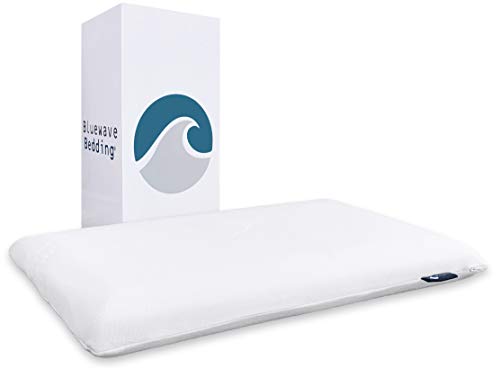
Bluewave Bedding Ultra Slim Gel Memory Foam Pillow — Best Overall
The Bluewave Ultra Slim is the pick we would hand to most people type this query, because it sits at the top of the low range rather than the bottom. At 2.75 inches in standard size, it has just enough substance to bridge the head-to-mattress gap for a smaller-framed side sleeper on a medium or soft mattress, while still reading as a genuinely low pillow. The gel memory foam construction is aimed at cervical alignment for stomach and back sleepers in the catalog copy, and that flat, even surface is exactly what transfers well to side sleeping when the shoulder is sinking into a plush bed: there is no sculpted contour forcing your head into a position your shoulders cannot support.
Strengths
- 2.75-inch loft is the most side-sleeper-plausible height in this guide — low, but not a pancake.
- Gel memory foam spreads pressure evenly instead of creating a hard ridge under the ear.
- Standard size fits ordinary pillowcases, so there is no specialty linen to buy.
Trade-offs
- Marketed primarily for stomach and back sleepers; broad-shouldered side sleepers will find it too low.
- Solid memory foam cannot be machine washed — spot care and a cover do the heavy lifting.
- Memory foam softens with body heat, so the effective loft by 3 a.m. is lower than the stated 2.75 inches.
Key specs (from the verified catalog listing): Height 2.75 inches; standard size; gel memory foam; thin, flat design.
The deeper story with the Bluewave is consistency. Contoured cervical pillows promise alignment through shape, but shape is a gamble when you change position through the night. A flat slab at a known height behaves the same at the edge as at the center, which matters for side sleepers who migrate across the pillow. If you are a side sleeper who has tried a standard pillow and woken with your head tilted up and your top shoulder aching, this is the measured step down to try first — one clear notch lower, not a leap to the thinnest foam on the market. Pair it with a thin pillowcase rather than a thick quilted protector, which can quietly add back half an inch of height.
Best for: petite to average-framed side sleepers on medium or soft mattresses. / Not suited for: broad shoulders, firm mattresses, or anyone who needs real elevation. Check price on Amazon

MINUPWELL Flat Pillow, Cooling Gel Memory Foam — Best for Side Sleepers by Design
The MINUPWELL entry earns its badge on a technicality that actually matters: it is the only pick in this guide whose verified catalog title explicitly names side sleepers. The title describes a 2.5-inch ultra-thin pillow in a 24 x 16 inch format, built from cooling gel memory foam at a stated 50D density, positioned as a cervical neck pillow and a side sleeper pillow. We do not repeat the title’s pain-relief language as a claim — comfort framing only — but the explicit side-sleeper positioning, the stated density and the mid-range 2.5-inch height make it the most purpose-aimed option here.
Strengths
- Explicitly positioned for side sleepers in the catalog listing, not just stomach and back sleepers.
- Stated 50D memory foam density suggests a firmer, more supportive thin foam that resists bottoming out.
- Cooling gel infusion addresses the warmth that thin foam pillows tend to trap.
Trade-offs
- 24 x 16 inches is a compact standard — restless sleepers may run off the edge.
- Firmer high-density foam at 2.5 inches will feel unyielding to anyone expecting a soft pillow.
- As with all solid foam, the core itself is not machine washable.
Key specs (from the verified catalog listing): Height 2.5 inches; size 24 x 16 inches; 100% memory foam with cooling gel; stated 50D density.
Density is the under-discussed variable in thin pillows. Two pillows can both measure 2.5 inches on a shelf and sleep completely differently: a low-density foam compresses to under an inch under a head, while a denser foam holds closer to its stated height. For a side sleeper, that difference is the whole ballgame, because your neck angle depends on the compressed height, not the shelf height. The MINUPWELL’s stated 50D density is the reason it can credibly court side sleepers at 2.5 inches — it is built to stay near 2.5 inches under load. If you have tried a soft thin pillow and felt your ear grind into the mattress by morning, this firmer interpretation of “low” is the corrective.
Best for: side sleepers who want low but genuinely supportive, and who sleep warm. / Not suited for: anyone who wants a soft, sink-in feel, or king-size pillow coverage. Check price on Amazon

Vipbear Ultra Thin Pillow 2.75 Inch — Best Cooling
The Vipbear matches the Bluewave’s 2.75-inch height and adds the strongest cooling story in this set: gel-infused memory foam with a dual-sided cooling design, so one face of the pillow is built to feel cooler against the skin. Its foam is CertiPUR-US certified — a certification about the foam’s content and emissions standards, which we note as a materials fact, not a health claim. For hot sleepers, thin pillows are a double-edged sword: less insulating fill, but your head rests closer to the warm mattress. A cooling cover side is a practical countermeasure.
Strengths
- Dual-sided cooling design plus gel infusion — the most deliberate temperature management here.
- CertiPUR-US certified foam gives a documented materials standard.
- 2.75-inch loft suits stomach, back and smaller-framed side sleepers alike.
Trade-offs
- Cooling surfaces feel coolest at first contact; the effect fades as the pillow warms through the night.
- Only the standard size is confirmed by the listing we verified.
- Gel foam still sleeps warmer than a breathable shredded or down fill would at the same height.
Key specs (from the verified catalog listing): Height 2.75 inches; standard size; gel-infused memory foam; dual-sided cooling; CertiPUR-US certified foam.
Think of the Vipbear as the Bluewave’s rival rather than its understudy. Both sit at 2.75 inches, both are gel memory foam slabs in standard size. The choice between them comes down to two questions: do you sleep hot enough that a cooling cover face matters, and do you value a named foam certification? If yes to either, the Vipbear is your pick. Side sleepers with a smaller frame who flip the pillow hunting for the cool side — a classic thin-pillow behavior, since there is less pillow to flip — will appreciate that the cooling side is a designed feature rather than an accident of the fabric.
Best for: hot-sleeping side and back sleepers with petite to average frames. / Not suited for: cold sleepers who dislike a cool first touch, or anyone needing queen/king width. Check price on Amazon

BLISSBURY Stomach Sleeper Pillow, 2.6 Inch — Best Soft, Low and Simple
The BLISSBURY states its design brief in its own catalog copy: it is made for people who find most pillows too high. At 2.6 inches of thin flat memory foam with a soft feel and a removable, washable cover, it is the comfort-first entry in this guide — the one for side sleepers who have discovered that what they actually dislike is not height in the abstract but the hard, propped-up feeling of a conventional pillow. If you are the side sleeper who punches a soft pillow down to a thin pad and sleeps happily, the BLISSBURY simply starts where your punching ends.
Strengths
- Soft feel distinguishes it from the firmer slabs in this guide — low without being board-like.
- Removable, washable cover is explicitly confirmed in the catalog title.
- 2.6-inch height is a gentle step down from standard pillows, easy to adapt to.
Trade-offs
- Soft foam compresses the most under load, so effective side-sleeping loft is the lowest of the foam picks.
- Designed and named for stomach sleepers; side use is the adaptation, not the headline.
- Less structured support for anyone whose neck wants a firm, held position.
Key specs (from the verified catalog listing): Height 2.6 inches; thin flat memory foam; soft feel; removable washable cover.
There is a real subculture of side sleepers who sleep nearly flat — often people who grew up on worn-out pillows, or who sleep on very soft mattresses where the shoulder sinks so deep that the head needs almost nothing. The BLISSBURY serves them without the hygiene penalty of an ancient pillow: the washable cover keeps the thin foam fresh, which matters more at this thickness because facial oils reach the core faster through 2.6 inches of foam than through a fat pillow. Rotate it weekly and flip it nightly; thin pillows show compression wear sooner than thick ones, and even wear is the cheapest life-extension there is.
Best for: soft-pillow loyalists, deep-sinking mattresses, and side sleepers who already flatten their pillows by hand. / Not suited for: anyone needing firm neck support or real elevation. Check price on Amazon

SofGlowly Thin Flat Pillow, 2.25 Inch — Best for the Lowest Profile
At 2.25 inches, the SofGlowly is the thinnest verified pick in this guide, and we include it because a segment of this search’s audience is searching for exactly that: the lowest pillow that is still a pillow. The catalog title describes an ultra-slim cooling memory foam design for stomach and back sleepers with a low-profile alignment intent and a soft washable cover. For side sleepers, this is a specialist tool — appropriate for very petite frames, for very soft mattresses, for side sleepers who sleep with a forearm under the pillow and need the pillow itself to contribute almost nothing, or as the top layer in a stack you are gradually reducing.
Strengths
- Thinnest stated loft here at 2.25 inches — the true floor of the category.
- Cooling memory foam and a soft washable cover keep it practical, not just minimal.
- Useful as a transition pillow when stepping down from a standard loft in stages.
Trade-offs
- Too low for most side sleepers used alone — be honest with yourself about your shoulder width.
- Thin foam shows compression set fastest; expect to replace sooner than a thick pillow.
- Stomach/back positioning in the listing means side sleepers are adapting it off-label.
Key specs (from the verified catalog listing): Height 2.25 inches; ultra-slim cooling memory foam; soft washable cover.
A practical technique if you are unsure whether 2.25 inches is your number: spend three nights sleeping on a folded bath towel adjusted to roughly that thickness before ordering. Towels compress differently from foam, but the geometry lesson transfers — you will learn quickly whether your neck is straight, tilted down or tilted up at that height, and whether your downhill shoulder feels relieved or crushed. If the towel test feels like relief, the SofGlowly gives you that height in a stable, covered, purpose-made form. If the towel test feels like a strain, step up to the 2.75-inch picks instead.
Best for: very petite side sleepers, arm-under-pillow sleepers, and staged loft reduction. / Not suited for: average or broad frames as a standalone side-sleeping pillow. Check price on Amazon

Acteb Ultra Thin Flat Soft Bed Pillows, Set of 2 — Best Washable Pair
The Acteb set is the non-foam option: two standard-size (20 x 26 inch) soft flat pillows, hypoallergenic in positioning and fully machine washable. We include it with a clear flag — the verified catalog title does not state a loft height. Based on the “ultra thin flat soft” description these are compressible soft pillows rather than measured slabs, and that is precisely their use case: side sleepers who want a low pillow they can fold, bunch or flatten to shape, and who prioritize being able to wash the whole pillow over holding an exact height. A pair also means a fresh one is ready while the other is in the laundry.
Strengths
- Fully machine washable — the only pick here you can launder whole, not just the cover.
- Sold as a set of two in standard 20 x 26 inch size.
- Soft fill can be redistributed — bunch it under the neck, flatten it under the head.
Trade-offs
- Loft height is not stated in the listing — you are buying “flat and soft,” not a measurement.
- Fill shifts and clumps over time; low height today may become uneven height later.
- Least structured option here for anyone who needs consistent, repeatable support.
Key specs (from the verified catalog listing): Set of 2; standard size 20 x 26 inches; flat soft fill; machine washable; loft height not stated in the listing.
The Acteb pair is the honest budget-tier way into this category — and we mean tier in the qualitative sense, since we do not print prices. If you are experimenting with low sleeping and do not yet know your number, a washable soft pair lets you test the concept, fold one pillow double for a medium night and single for a low night, and learn your geometry before committing to a foam slab at a fixed height. Guest rooms are the other natural home for these: a flat soft pillow offends almost no one, and it layers under a sleeper’s own pillow without a fight.
Best for: experimenters, washable-everything households, and guest beds. / Not suited for: anyone who needs a guaranteed, measured loft night after night. Check price on Amazon
Comparison Table
| Pick | Badge | Key spec | Best for |
|---|---|---|---|
| Bluewave Bedding Ultra Slim Gel Memory Foam Pillow (Check price on Amazon) | Best Overall | 2.75 in gel memory foam, standard size | Petite to average side sleepers on medium/soft mattresses |
| MINUPWELL Flat Pillow (Check price on Amazon) | Best for Side Sleepers by Design | 2.5 in cooling gel memory foam, stated 50D density, 24 x 16 in | Low-but-firm support, warm sleepers |
| Vipbear Ultra Thin Pillow (Check price on Amazon) | Best Cooling | 2.75 in gel-infused foam, dual-sided cooling, CertiPUR-US foam | Hot sleepers who flip the pillow |
| BLISSBURY Stomach Sleeper Pillow (Check price on Amazon) | Best Soft, Low and Simple | 2.6 in soft flat memory foam, washable cover | Soft-pillow loyalists on plush mattresses |
| SofGlowly Thin Flat Pillow (Check price on Amazon) | Best for the Lowest Profile | 2.25 in cooling memory foam, washable cover | Very petite frames, arm-under-pillow sleepers |
| Acteb Ultra Thin Flat Soft Pillows, Set of 2 (Check price on Amazon) | Best Washable Pair | Standard 20 x 26 in, machine washable, loft not stated | Experimenters and guest beds |
How to Choose a Low Pillow for Side Sleeping
Start with the gap, not the pillow. Lie on your side on your own mattress, without a pillow, in your normal sleeping position. Have someone look at the line of your spine, or prop a phone and use a timer photo. The distance between the side of your head and the mattress surface — after your shoulder has sunk in as far as it will go — is the compressed loft you actually need. On a soft mattress with a narrow frame that gap can genuinely be 2 to 3 inches, which is why this category exists. On a firm mattress with broad shoulders it can be 5 inches or more, and no pillow in this guide will serve you; a conventional side-sleeper pillow is the honest recommendation there.
Stated loft versus sleeping loft. The heights in this guide — 2.25 to 2.75 inches — are shelf measurements. Memory foam compresses under the weight of a head and softens with warmth, so sleeping loft is always lower. Denser foam (like the MINUPWELL’s stated 50D) holds closer to its number; softer foam (the BLISSBURY) gives up more. When you are between two heights, choose based on foam character: firm foam at 2.5 inches can sleep higher than soft foam at 2.75 inches.
Mattress softness is the hidden variable. The softer the mattress, the deeper the shoulder sinks, the lower the pillow should be. This is why the same person can need a tall pillow in a firm hotel bed and a thin pillow at home. If you are replacing a mattress soon, solve the pillow question after the mattress arrives, not before.
Your arm is part of the system. Many lifelong low-pillow side sleepers sleep with a forearm under the pillow or under the head itself. That arm adds an inch or more of effective height. If that is you, shop at the bottom of this guide’s range. If you sleep with both arms down, shop at the top.
Covers and cases change the number. A thick quilted protector or a tight, high-thread-count case can add noticeable height and firmness to a thin pillow. Use a simple, smooth case on a low pillow, and if the pillow comes with a washable cover, that cover is part of the measured design — keep it on.
How to Test and Adjust a Low Pillow at Home
Give any new low pillow a fair trial using this sequence. First, sleep on it for three consecutive nights before judging — neck muscles adapt gradually, and night one after years on a tall pillow feels strange regardless of what is correct. Second, on night two, check your alignment with the photo method from the buying guide: head neither tilted up toward the ceiling nor dropped toward the mattress. Third, if the pillow feels a fraction too low, add a folded hand towel under it — a quarter-inch adjustment — rather than abandoning it; small corrections are normal at these heights. Fourth, if it feels too high, remove any thick protector before concluding the pillow is wrong. Fifth, track your downhill shoulder: a low pillow that fixes your neck but crushes your shoulder is telling you the mattress, not the pillow, is the remaining problem. Finally, rotate the pillow end-for-end every few nights during the first month so early compression sets in evenly.
Low Pillow Materials Compared: Foam Slabs Versus Soft Fill
Five of the six picks here are solid memory foam, and that is not an accident of our selection — the thin-pillow market is dominated by foam slabs because foam is the only common pillow material that can be manufactured to an exact, repeatable height like 2.5 inches. A foam slab’s virtue is precision: you know what you bought, and it sleeps at roughly that height every night until the foam tires. Its vice is feel. Solid foam does not bunch, fold or cradle; it presents a flat, even platform, and sleepers who love to hug and reshape a pillow tend to bounce off it within a week.
Soft fill, represented here by the Acteb pair, trades precision for adaptability. A soft flat pillow can be folded in half for a medium-height night, spread thin for a low night, or gathered under the neck for targeted support. What it cannot do is promise a number. Fill migrates, clumps and gradually redistributes itself toward the edges, so the pillow you measured in month one is not the pillow you own in month nine. Down and feather fills behave similarly at low heights, with the added trait of compressing to nearly nothing under the head while staying lofty around it — a feel some side sleepers adore and others describe as sleeping in a nest with a hole in the middle.
Cooling construction deserves a separate word, because thin pillows concentrate heat differently from thick ones. With less material between your head and the mattress, the mattress itself becomes part of your pillow’s thermal behavior, and a heat-retaining foam mattress will warm a thin pillow from below all night. Gel infusions (Bluewave, MINUPWELL, Vipbear) moderate the foam’s own heat retention, and cooling cover fabrics (Vipbear’s dual-sided design, SofGlowly’s cooling build) change the first-contact feel. Neither turns a thin foam pillow into a cold pillow; both are worthwhile mitigations if you already know you sleep hot.
Combination Sleepers: When Your Side Is Only Part of the Night
Pure side sleepers are rarer than pillow marketing admits. Most people rotate — side to back, back to the other side, sometimes a brief stomach interval at dawn. Low pillows are unusually forgiving of that rotation, and it is one of their underappreciated strengths. A tall, gusseted side-sleeper pillow that is perfect at 11 p.m. becomes a neck-cramping wedge when you roll onto your back at 2 a.m., because the back of your head needs far less height than the side of your head. A 2.5 to 2.75 inch pillow splits the difference: low enough that back sleeping stays neutral, high enough that side sleeping works for the frames this guide describes.
If you are a combination sleeper, weight your choice toward the top of this guide’s height range — the Bluewave or Vipbear at 2.75 inches — because your side-sleeping intervals still need their geometry respected, while your back-sleeping intervals will tolerate an extra quarter inch far better than your neck tolerates a missing inch on your side. The exception is the combination sleeper whose rotation includes real stomach time: then the middle of the range, around the BLISSBURY’s 2.6 inches with its softer compression, is the compromise that offends no position too badly.
Who Should Skip Low Pillows Entirely
Honesty requires a section for the readers this search should not convert. Skip this category if you have broad shoulders relative to your head and sleep on a firm or extra-firm mattress — your measured gap will be 4 inches or more, and a thin pillow will pull your head downward all night. Skip it if you use an adjustable bed and sleep with the head elevated, because elevation changes the geometry in favor of more loft, not less. Skip it if you sleep with a large body pillow arrangement that already positions your head precisely; adding an unfamiliar thin pillow disrupts a working system. And skip it if your current pillow is genuinely worn out and you have simply adapted to its collapsed height — in that case, replace it with a fresh pillow at a proper side-sleeper loft and reassess, because what you may actually like is not “low” but “familiar.” A low pillow is a solution to a specific geometric problem. If the photo test shows your spine is already straight on your current setup, you do not have that problem, and the best purchase is no purchase.
Care, Rotation and Replacement: Keeping a Thin Pillow Honest
A thin pillow has nowhere to hide wear. A 6-inch pillow can lose an inch of loft and remain usable; a 2.5-inch pillow that loses half an inch has lost a fifth of its design. Care is therefore not housekeeping trivia in this category — it is how you preserve the measurement you paid for. Keep the manufacturer’s cover on the foam picks at all times; it is part of the stated height and the first barrier against the oils that break foam down. Wash covers on the schedule you would wash a pillowcase, and air foam cores in indirect light when you change bedding — never machine wash or soak a memory foam core, because waterlogged foam dries slowly, unevenly and sometimes not at all.
Rotate the pillow head-to-foot every few nights and flip it on the nights between. Side sleepers load one zone of the pillow — the area under the ear and jaw — far harder than the rest, and unrotated thin pillows develop a permanent valley exactly where your head lands, which quietly converts a 2.75-inch pillow into a 2-inch pillow with raised edges. The Acteb soft pair needs the opposite discipline: a vigorous fluff and shake each morning to redistribute fill back to the center, and a full machine wash whenever the fill starts clumping into lumps that no amount of shaking will separate.
Set a replacement test now, while the pillow is new, so future-you has an objective standard: once a month, fold the pillow’s job down to one question — lying on your side, is your head still level, or has it begun to drop? The month the answer changes is the month the pillow’s working life ended, whatever the calendar says. Most thin foam pillows in nightly use give one to two years of honest height; soft fill pairs washed regularly can last as long, but their height was never guaranteed in the first place, so judge them by comfort and evenness rather than by a number.
Common Buying Mistakes
- Buying “low” by name instead of by inches. “Low profile” is unregulated language. Only shop listings that state a height, or accept — as with the Acteb pair — that you are buying an unmeasured soft pillow.
- Ignoring the mattress. Ordering a 2.25-inch pillow for a firm mattress and broad shoulders is the most common failure in this category, and it is a geometry error, not a product defect.
- Assuming stomach-sleeper marketing disqualifies a pillow. Most thin pillows carry stomach-sleeper labels because that is the biggest thin-pillow market. Judge by height, density and your own gap measurement.
- Stacking two thin pillows. Two slabs slide, create a ridge and sleep higher than one correct pillow. If you need more height, buy the right height.
- Judging on night one. A single night measures novelty, not fit. Three nights minimum, with small towel adjustments, gives a real verdict.
- Forgetting the wash question. Thin foam cannot hide a season of sweat. If whole-pillow or cover washing matters to you, choose the BLISSBURY, SofGlowly or the fully washable Acteb pair accordingly.
Final Recommendation
For most people who genuinely fit this niche, start with the Bluewave Bedding Ultra Slim (Check price on Amazon): its 2.75-inch loft is the safest interpretation of “low” for a side sleeper. If you want low but firm, and you sleep warm, the MINUPWELL (Check price on Amazon) is the purpose-built alternative, while the Vipbear (Check price on Amazon) wins for hot sleepers who value its cooling cover and certified foam. Choose the BLISSBURY (Check price on Amazon) if soft is non-negotiable, the SofGlowly (Check price on Amazon) only if you are sure the lowest profile is your geometry, and the Acteb pair (Check price on Amazon) if washability and flexibility beat a measured loft. And if your gap measurement says 4 inches or more, believe it — this category is not for every side sleeper, and the right tall pillow beats the wrong thin one.
Exploring the wider pillow cluster on this site? These related guides are part of the same program: Best Flat And Fluffy Pillows, Best Affordable Pillows For Stomach Sleepers, Best Ethical Feather Down Pillows, Best Eco Friendly Hypoallergenic Pillows, and Best Duck Feather And Down Pillows.
Related guides
Frequently Asked Questions
Is a low pillow really okay for side sleepers?
It depends entirely on geometry. A low pillow is appropriate when the gap between your head and the mattress — after your shoulder sinks in — is small: petite frames, soft mattresses, or an arm tucked underneath. For broad shoulders on a firm bed, a low pillow drops the head and strains the neck. Measure your gap before buying.
What height counts as a low pillow?
In this guide, low means a stated loft of about 2 to 3 inches. The verified picks here run from 2.25 to 2.75 inches. Standard pillows are typically 4 to 6 inches, and dedicated side-sleeper pillows often go higher with gussets.
Why are most thin pillows marketed to stomach sleepers?
Stomach sleepers are the largest group who need minimal loft, so brands aim titles at them. The pillows themselves are simply thin slabs of foam or soft fill; a side sleeper whose measurements fit can use the same product. Judge by stated height and density, not by the sleeper type in the title.
Will a low pillow help my shoulder stop aching?
A correctly fitted low pillow can reduce the shoulder crunch that happens when a tall pillow forces you to shrug your downhill shoulder upward all night. But shoulder pain has many causes, and a pillow is a comfort adjustment, not a treatment. If pain persists, that is a question for a clinician, not a bedding guide.
How long does a thin memory foam pillow last?
Thin foam shows compression wear sooner than thick foam because there is less material to distribute the load. Rotating and flipping regularly evens the wear. Expect to reassess fit after a year or two of nightly use — if the pillow no longer holds its stated height under your head, it is done.
Should I use a pillow protector with a low pillow?
A thin, smooth protector is fine and will extend the pillow’s life, but a thick quilted protector works against the entire point of a low pillow: it adds height and changes the compressed loft you measured. If you use one, choose the thinnest available and re-run the photo alignment test with it fitted, because the combination — not the pillow alone — is what your neck experiences.
Can I wash these pillows?
The foam picks have washable covers (explicitly confirmed for the BLISSBURY and SofGlowly) but the foam cores themselves should not be machine washed. The Acteb pair is the exception in this guide: the whole pillows are machine washable, which is a major reason they earned their slot despite the unstated loft.

