Disclosure: airfryerkitchensupply.com is reader-supported. When you buy through links on our site, we may earn an affiliate commission at no extra cost to you.
Where to buy
Every pick in this guide to the best large cleaning towels was cross-checked against Amazon listing data cache of verified products before it earned a link, and only listing-confirmed listings carry one. Use the links below to check price on Amazon — we never print static prices here, because towel prices shift with pack counts and promotions. A word on what ‘large’ means in this guide: every pick states its dimensions in its own listing title, and every pick is at least 16 inches on its long side, with most at 24 inches or more — because a cleaning towel you have to fold four times to cover a counter has failed at its one job.
- COTTON CRAFT Waffle Terry Kitchen Towels, 12 Pack, 16×28 Inch — check price on Amazon
- Idea Home Premium Microfiber Cleaning Cloth, Large 16×24, 2 Pack — check price on Amazon
- SINLAND Microfiber Glass Polishing Cloths, 20×25 Inch, 2 Pack — check price on Amazon
- Groko Textiles Cotton Bar Mops, 24 Pack, 16×19 Inch — check price on Amazon
- Zeppoli Classic Dish Towels, 15 Pack, 14×25 Inch — check price on Amazon
- CODOHI Extra Large Microfiber Cleaning Cloths, 20×30 Inch, 6 Pcs — check price on Amazon
The best large cleaning towels solve a problem that standard dish towels and paper towels both handle badly: covering real surface area in one pass. A 12-inch cloth on a kitchen counter, a bathroom mirror, a car windscreen or a workshop bench means overlapping strokes, missed edges and streaks where the cloth ran dry halfway across. A genuinely large towel — 24, 25, 28 inches on the long side — folds into a thick pad with four or eight working faces, covers a counter run in two passes, and dries as much as it wipes. That is the entire case for the category, and it is a good one.
The verified market splits cleanly into two material camps. Cotton towels — waffle-terry kitchen towels, bar mops and terry weaves — absorb the most water, survive bleach and hot washes, and are the workhorses of kitchens and bars. Microfiber towels — flat-weave glass cloths and fish-scale polishing towels — absorb less total water but leave glass, mirrors, stainless steel and paint genuinely streak-free, which cotton rarely manages. This guide includes both camps deliberately, because ‘cleaning’ in a real house means spills on Monday and mirrors on Saturday.
Pack sizes are stated where the title states them. We excluded bath towels, travel towels and mop slippers that surfaced in the same cache files: a large cleaning towel is a cloth you hold in your hand, and the guide keeps that definition honest.
Who needs these? Anyone who cleans a kitchen daily, anyone maintaining glass and stainless steel, anyone running a small café, bar or rental property where cloths are consumed by the dozen, and anyone detailing a car at home. If your cleaning is one small sink and a single mirror, a standard cloth is honestly enough — the buying guide below says so, and then explains the fold-and-rotate method that makes a large towel worth its drawer space for everyone else.
In this guide
Quick Picks
Six verified picks across the cotton and microfiber camps. Badges match the reviews and the comparison table.
- Best Overall: COTTON CRAFT Waffle Terry Kitchen Towels, 12 Pack, 16×28 Inch — 100% cotton waffle-terry at a true 16×28 inches, in a 12 pack — the best all-round large cleaning towel in the verified set. — check price on Amazon
- Best for Glass and Drying: Idea Home Premium Microfiber Cleaning Cloth, Large 16×24, 2 Pack — an oversized 16×24 fish-scale microfiber for glass, mirrors and drying — the finishing cloth of the set. — check price on Amazon
- Largest Polishing Cloth: SINLAND Microfiber Glass Polishing Cloths, 20×25 Inch, 2 Pack — at 20×25 inches, the largest flat polishing cloth in the verified set — built for stemware, dishes and appliances. — check price on Amazon
- Best Bulk Workhorse: Groko Textiles Cotton Bar Mops, 24 Pack, 16×19 Inch — commercial-grade terry bar mops by the two-dozen — the cheapest cost-per-clean in the guide. — check price on Amazon
- Best Long Cotton Towel: Zeppoli Classic Dish Towels, 15 Pack, 14×25 Inch — a long 14×25 cotton format in a 15 pack — the over-the-shoulder, always-in-reach cleaning towel. — check price on Amazon
- Largest Microfiber Cloth: CODOHI Extra Large Microfiber Cleaning Cloths, 20×30 Inch, 6 Pcs — at 20×30 inches, the largest cloth in the guide — a floor-and-bathroom microfiber for housekeeping-scale jobs. — check price on Amazon
How These Picks Were Chosen
Picks were chosen from listings confirmed cache. The filter was strict: the listing title had to state dimensions, and the long side had to reach at least 16 inches, with preference given to 24 inches and above — the sizes that change how a cleaning session actually goes. Listings for bath towels, beach towels, travel towels and novelty mop footwear appeared in the same searches and were excluded as off-intent, however large they were.
Within that filter we balanced the two material camps and the two buying patterns. Three cotton picks cover absorbency-first work: a waffle-terry kitchen towel, a bulk terry bar mop pack, and a classic striped dish towel pack sized for cleaning as much as drying. Three microfiber picks cover finish and area work: an oversized 16×24 glass and drying towel, an extra-large 20×25 polishing cloth, and an extra-large 20×30 microfiber area cloth, verified fresh for this guide, included because it is the largest cloth in the entire verified set.
Pack economics were weighed honestly. Cleaning towels are consumables: they stain, they pick up grit, and a household that cleans daily needs depth in the drawer more than it needs one precious cloth. The bulk bar-mop pick exists for exactly that reason, and the guide’s care section explains how to keep a rotation of large towels working for years instead of months.
The 6 Best Large Cleaning Towels

COTTON CRAFT Waffle Terry Kitchen Towels, 12 Pack, 16×28 Inch — Best Overall
This is the towel we would stock a kitchen with and stop thinking about it. The listing states the three things that matter and states them plainly: 100% cotton, a waffle-terry weave, and a genuine 16×28-inch footprint — a full hand-towel-plus size that folds into a pad covering a forearm’s width of counter in one pass. Waffle weave is the right call for a cleaning towel: the recessed squares hold water in the structure of the cloth rather than on its surface, so the towel keeps absorbing after a flat weave would be pushing water around.
The ‘Euro café’ framing in the title is not just romance — this is the format cafés and bars use because it dries racks of glasses, wipes counters, handles hot pan bases briefly and goes through a hot wash without complaint, hundreds of times. Low lint, stated in the title, matters when the same towel dries glassware. Quick-drying, also stated, matters in a working kitchen where a towel that stays damp all day starts to smell by evening.
Its limit is the limit of all cotton: on mirrors and stainless steel it can leave a faint trail that a flat microfiber cloth would not. Pair it with one of the glass picks below and the kitchen is covered end to end. As a single purchase, though — absorbency, size, pack depth, honest materials — nothing else in the verified set is as complete.
Strengths
- True large format at 16×28 inches with a water-holding waffle structure
- 100% cotton survives hot washes and bleach that microfiber cannot
- 12-pack depth suits a real rotation — clean, in use, in the wash
Trade-offs
- Cotton can leave faint trails on mirrors and stainless steel
- Thicker and slower to wring out than microfiber cloths
- Blue is the verified listing’s colour; check other colours as separate listings
| Material (per listing) | 100% cotton, waffle terry weave |
| Size (per listing) | 16×28 inches |
| Pack (per listing) | 12 towels |
| Colour of verified listing | Blue |
Best for: kitchens that need one large towel for counters, spills, drying and bar work / Not suited for: final polishing of glass and mirrors, where flat microfiber wins

Idea Home Premium Microfiber Cleaning Cloth, Large 16×24, 2 Pack — Best for Glass and Drying
Fish-scale microfiber is the weave that changed glass cleaning: the overlapping scale pattern gives the cloth thousands of tiny edges that lift water and residue off glass instead of smearing it, which is why this style of cloth dominates the verified glass-cleaning listings. What makes this pick the large-towel choice is the format — 16×24 inches is roughly double the area of the standard 16×16 glass cloth, and on a bathroom mirror or a shower screen that difference is the difference between finishing in one direction and chasing your own streaks.
Use it as the second cloth, not the first. The honest workflow for glass is a wash cloth (any of the cotton picks, damp) to remove the dirt, then this cloth, dry or barely damp, to polish. Used that way, the fish-scale surface leaves the finish the title promises — streak and lint free — without sprays in most cases, which is also why these cloths are the detailer’s friend on windscreens and paint.
The two-pack is the honest size for a finishing cloth: one in use, one clean in reserve, because a polishing cloth that has absorbed a day of grime stops polishing. It will not replace the cotton workhorses for spills — microfiber’s total water capacity is lower — and it asks for the microfiber care rules in the how-to section: no fabric softener, no high heat, no washing with cotton lint.
Strengths
- Oversized 16×24 format finishes big glass in fewer passes
- Fish-scale weave is the proven streak-free glass finish
- Works with water alone on most glass — fewer sprays needed
Trade-offs
- Lower total absorption than cotton terry — not the spill towel
- Microfiber care rules apply: no softener, no high heat
- Two-pack means a smaller rotation than the bulk cotton picks
| Material (per listing) | Microfiber, fish-scale weave |
| Size (per listing) | 16 x 24 inches |
| Pack (per listing) | 2 towels |
Best for: large mirrors, shower glass, windscreens and stainless steel that must finish streak-free / Not suited for: heavy spill absorption, where cotton terry holds more water

SINLAND Microfiber Glass Polishing Cloths, 20×25 Inch, 2 Pack — Largest Polishing Cloth
Twenty by twenty-five inches is a serious piece of cloth — large enough to cup a wine glass inside it with both hands protected, large enough to dry a serving platter in two strokes, large enough to polish a refrigerator door without the cloth bunching into a ball. SINLAND’s listing aims it exactly where that size pays: stemware, dishes and stainless appliances, the finishing tasks where a small cloth forces you to touch the polished surface with your fingers and start again.
The black colour of the verified listing is a practical choice for bar and restaurant work, where a white polishing cloth shows every mark and looks tired within a service. At home it hides the inevitable staining that finishing cloths pick up from red wine drips and coffee splashes, extending the time before the cloth looks ready to retire.
Keep its role clear in your own drawer: this is the last cloth that touches a surface, not the first. It has no scrubbing texture and is not meant to; pair it with a cotton workhorse for the wash and keep this for the polish, and both cloths will do their jobs better and last longer.
Strengths
- Largest flat cloth in the guide at 20×25 inches
- Made for stemware and dishes — the two-hand polishing grip works
- Black hides working stains in bar and kitchen service
Trade-offs
- Finishing cloth only — no scrub or heavy absorption role
- Microfiber care rules: no softener, moderate wash temperatures
- Cache entry records no verification date — noted in sources
| Material (per listing) | Microfiber |
| Size (per listing) | 20×25 inches |
| Pack (per listing) | 2 cloths |
| Colour of verified listing | Black |
Best for: hosts and bars polishing stemware and serving dishes at volume, and big stainless appliances / Not suited for: grimy first-pass cleaning — this is a finishing cloth, not a scrubber
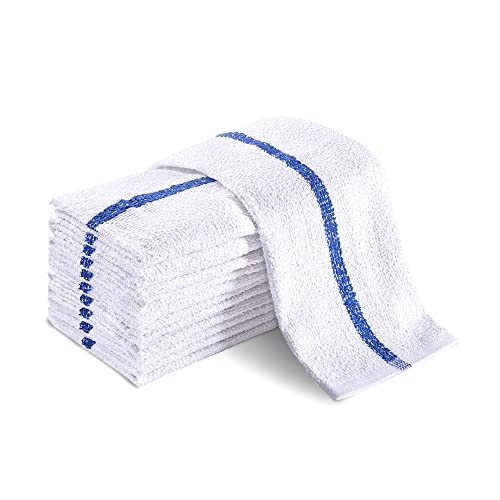
Groko Textiles Cotton Bar Mops, 24 Pack, 16×19 Inch — Best Bulk Workhorse
The bar mop is the towel the hospitality industry settled on after trying everything: a mid-large terry cotton cloth, cheap enough to use hard, absorbent enough for a spilled pint, and tough enough for bleach and industrial washing. Groko’s verified listing is the format in its classic form — 16×19 inches, blue stripe, twenty-four to a pack, described by its maker as commercial grade. It is the smallest ‘large’ towel in this guide, included because in bulk work the pack depth matters more than the last two inches.
The use case is volume. A household that cleans daily, a short-term rental turned over weekly, a workshop, a home bar — all consume towels at a rate that makes a precious two-pack absurd. With twenty-four in rotation, there is always a clean one, the wash becomes a weekly bulk load, and a cloth that picks up something genuinely horrible can be retired without a pang.
Do not ask bar mops to finish glass; terry sheds and streaks, and the guide’s microfiber picks exist for that job. Ask them to absorb, scrub, wipe, mop and endure, and they will out-perform every other pick here on cost per clean.
Strengths
- 24-pack depth makes a real rotation possible
- 100% cotton terry takes bleach, hot water and hard use
- The hospitality industry’s proven format for volume cleaning
Trade-offs
- Smallest large towel here at 16×19 inches
- Terry lint makes it wrong for glass and mirror finishing
- Utilitarian looks — a working cloth, not a display towel
| Material (per listing) | 100% cotton, terry weave |
| Size (per listing) | 16 x 19 inches |
| Pack (per listing) | 24 towels |
| Grade (per listing) | Commercial grade |
Best for: heavy daily cleaning, rentals, workshops and anyone who goes through cloths fast / Not suited for: glass finishing — terry cotton leaves lint and trails on mirrors

Zeppoli Classic Dish Towels, 15 Pack, 14×25 Inch — Best Long Cotton Towel
Length changes how a towel lives in a kitchen. At 14×25 inches the Zeppoli is long rather than wide: it drapes over a shoulder and stays there, hangs over an oven door without sliding off, wraps a hot handle with doubled cloth to spare, and still presents a full working face for wiping and drying. Its listing calls it a dish towel and a bulk cleaning cloth in the same breath, which is accurate — this is the format that blurs the two jobs in most working kitchens.
The 100% cotton construction and machine-washable note in the title put it in the easy-care camp: hot wash, no special handling, back in the drawer. Fifteen to a pack gives a household a genuine rotation without the commercial bulk of the bar mops, and the classic striped kitchen look means the towel on the oven door does not have to hide when guests arrive.
Its trade is width. For covering a big counter run or drying a roasting tray, the wider Cotton Craft pick above moves faster. For the hundred small touches of a cooking session — hands, rims, spills, handles — the long format is the one many cooks reach for instinctively. The two picks complement rather than compete, and a well-run kitchen drawer honestly holds both shapes.
Strengths
- Long format drapes, hangs and wraps better than square towels
- 100% cotton, machine washable — the easy-care option
- 15-pack depth at a household rather than commercial scale
Trade-offs
- 14-inch width covers less counter per pass than the 16-inch picks
- Cotton lint rules it out as a glass finisher
- Thinner kitchen-towel hand feel than the waffle-terry pick
| Material (per listing) | 100% cotton |
| Size (per listing) | 14 x 25 inches |
| Pack (per listing) | 15 towels |
Best for: cooks who keep a towel on the shoulder or oven door and use it fifty times a day / Not suited for: wide counter coverage in one pass — the 14-inch width is its trade

CODOHI Extra Large Microfiber Cleaning Cloths, 20×30 Inch, 6 Pcs — Largest Microfiber Cloth
Twenty by thirty inches is where a cleaning cloth stops being a cloth and becomes a tool. The CODOHI’s stated format — verified fresh for this guide — is the largest in this set, and its listing aims it at the jobs that size serves: floor cloth work, bathrooms, offices and housekeeping, including use with a mop or squeegee system. A cloth this size, folded, puts a thick absorbent pad under a flat mop head; spread flat, it covers a bath panel or a shower door in a handful of passes.
The six-pack matters at this scale. Floor and bathroom cloths pick up grit, and grit is what scratches surfaces and ends cloths; a rotation of six lets you retire a cloth to rougher duty the moment it feels loaded, instead of nursing one expensive cloth past its safe life. The orange and green colours of the verified listing are a quiet practical feature too — colour-coding bathroom cloths apart from kitchen cloths is the oldest hygiene trick in professional housekeeping.
Keep it in its lane: this is the volume cloth, for area work, not the finishing cloth for a mirror you are inspecting at an angle. Pair it with the Idea Home fish-scale pair for glass and the cotton picks for the kitchen, and the three size classes in this guide — finishing, working, and area — cover a whole house between them.
Strengths
- Largest format in the guide at 20×30 inches — real area coverage
- Six-pack rotation suits grit-heavy floor and bathroom work
- Colour-coded cloths keep bathroom and kitchen duty separate
Trade-offs
- Too large and absorbent for delicate one-hand glass finishing
- Microfiber care rules apply: no softener, no high heat
- Housekeeping styling — a working cloth, not a display towel
| Material (per listing) | Microfiber |
| Size (per listing) | 20 x 30 inches |
| Pack (per listing) | 6 cloths |
| Colours of verified listing | Orange, Green |
Best for: floors, bathrooms and housekeeping work where the job is measured in square metres, not square inches / Not suited for: delicate glass finishing — use the fish-scale picks for the final polish
Comparison Table
| Pick | Badge | Key spec | Best for |
|---|---|---|---|
| COTTON CRAFT Waffle Terry Kitchen Towels, 12 Pack, 16×28 Inch | Best Overall | 100% cotton waffle terry, 16×28 in, 12 pack (per Amazon title) | kitchens that need one large towel for counters, spills, drying and bar work |
| Idea Home Premium Microfiber Cleaning Cloth, Large 16×24, 2 Pack | Best for Glass and Drying | Microfiber fish-scale weave, 16×24 in, 2 pack (per Amazon title) | large mirrors, shower glass, windscreens and stainless steel that must finish streak-free |
| SINLAND Microfiber Glass Polishing Cloths, 20×25 Inch, 2 Pack | Largest Polishing Cloth | Microfiber polishing cloth, 20×25 in, 2 pack, black (per Amazon title) | hosts and bars polishing stemware and serving dishes at volume, and big stainless appliances |
| Groko Textiles Cotton Bar Mops, 24 Pack, 16×19 Inch | Best Bulk Workhorse | 100% cotton terry, 16×19 in, 24 pack, blue stripe (per Amazon title) | heavy daily cleaning, rentals, workshops and anyone who goes through cloths fast |
| Zeppoli Classic Dish Towels, 15 Pack, 14×25 Inch | Best Long Cotton Towel | 100% cotton, 14×25 in, 15 pack (per Amazon title) | cooks who keep a towel on the shoulder or oven door and use it fifty times a day |
| CODOHI Extra Large Microfiber Cleaning Cloths, 20×30 Inch, 6 Pcs | Largest Microfiber Cloth | Microfiber, 20×30 in, 6 pack (per Amazon title) | floors, bathrooms and housekeeping work where the job is measured in square metres, not square inches |
Two questions decide your pick. First, fibre: cotton (Cotton Craft, Groko, Zeppoli) for absorption, hot washing and hard use; microfiber (Idea Home, SINLAND, CODOHI) for streak-free finishing on glass and steel and for area work. Second, shape: wide towels (16 inches and up) cover counters and trays; long towels (25 inches and up) fold into more fresh faces and drape better. Most serious cleaning drawers end up with one of each camp — the table is a starting point, not a duel to the death.
How to Choose Large Cleaning Towels
Size first, because size is the keyword. A cleaning towel earns the word ‘large’ at about 16×24 inches — the point where it folds into a pad that covers a hand and forearm’s width and still has dry faces in reserve. Between 16 and 20 inches on the long side (the bar mops here) you get a working cloth that suits volume and rotation. Beyond 24 inches (the Cotton Craft, Zeppoli, SINLAND and CODOHI picks) you get the full large-towel behaviour: two-pass counters, whole mirrors, platters and trays in a few strokes. Below 16 inches, whatever the listing calls it, you are buying a standard cloth — fine for small jobs, not what this guide is for.
Fibre second. Cotton absorbs the most water per gram, tolerates bleach and boiling washes, and is the only sane choice where hygiene rules are strict or cloths meet food constantly. Its weakness is finishing: cotton trails and lints on glass. Microfiber absorbs less in total but its split fibres lift residue off smooth surfaces and leave them clear; its weaknesses are care rules (no softener, moderate heat) and a shorter peak-performance life. The mature answer for most homes is both: cotton to wash and absorb, microfiber to finish.
Weave third. Terry loops maximise absorption and scrubbing texture. Waffle weave holds water inside the cloth’s structure and dries faster — the working kitchen’s favourite. Flat and fish-scale weaves are finishing surfaces: no loops to leave marks, thousands of edges to lift the last film off glass. Match weave to the last thing the cloth touches: if it is a spill, loops; if it is a mirror, flat.
- Long side at least 16 inches — 24-plus for true large-towel behaviour
- Fibre matched to job: cotton for absorption and hot washing, microfiber for finishing
- Weave matched to surface: terry or waffle to wash, flat or fish-scale to polish
- Pack depth for a real rotation — a single towel is a hobby, six-plus is a system
- Care you will actually do: bleach-friendly cotton or softener-free microfiber, not both in one wash
How Many Towels Does a Household Actually Need?
Fewer than the bulk packs suggest, more than most drawers hold. A workable home system is: four to six large cotton towels in kitchen rotation (two in use, two clean, two in the wash), two microfiber finishing cloths for glass and steel, and one long polishing towel reserved for glassware and occasions. That is roughly the Cotton Craft or Zeppoli pack plus the Idea Home two-pack — which is why those picks lead this guide.
Volume users should think in weeks, not days. A rental property or café that launders weekly needs each day’s cloths plus wash-day spares: the Groko 24-pack exists at exactly that scale. The economics are simple — a towel’s cost is its price divided by hundreds of uses, so durability and wash tolerance matter more than the pack price, and a cloth that survives bleach will almost always out-earn a delicate one in a working setting.
Retirement matters too. A cleaning towel’s life should end in stages: kitchen duty, then general cleaning, then garage and paint duty, then the bin. Keeping stages separate — by colour or stripe, as the bar and glass picks here do with their blue and red stripes — is the unglamorous system that keeps a polishing cloth from ever meeting a greasy hob by accident.
Setting Up a Two-Cloth System for the Whole House
Individual towels are products; a cleaning system is what actually keeps a house clean, and the picks in this guide were chosen to assemble into one. The system most professional cleaners converge on has three layers, and it maps exactly onto this guide’s size classes. Layer one is the wash layer: a cotton towel — the Cotton Craft waffle or a Groko bar mop — used damp to lift dirt, absorb spills and do the scrubbing. Layer two is the finish layer: a flat microfiber — the Idea Home or SINLAND cloth — used dry or barely damp to polish glass, mirrors, steel and screens to a clear finish. Layer three is the area layer: the CODOHI 20×30 cloths, for floors, bath panels and the big flat surfaces where a hand towel is simply too small to be efficient.
The rule that makes the layers work is that they never swap jobs mid-task. A wash cloth that has absorbed a greasy hob does not then get to polish the mirror, however well it is rinsed; a finishing cloth never touches a spill. This sounds fussy until you have chased your own smears around a bathroom mirror with a contaminated cloth — the single most common reason home glass cleaning disappoints. Colour is the enforcement mechanism: the picks here conveniently arrive in distinguishable colours and stripes (blue waffle, blue-stripe bar mops, black polishing cloths, orange and green area cloths), so the system can be run by eye, by anyone in the household, without a training session.
Storage and laundry close the system. Keep the layers in separate piles or hooks, wash cotton hot and microfiber warm-and-separate as the how-to section describes, and run a simple stock check: when the clean pile of any layer drops below two, it is laundry day for that layer. Households that adopt even a loose version of this stop experiencing the two classic failures — the single disgusting all-purpose cloth, and the drawer of random towels none of which is right for glass. The products are ordinary; the system is the upgrade.
A note for smaller homes, in fairness: a studio or one-bedroom flat does not need three layers and twenty cloths. One Cotton Craft pack and one Idea Home pair — the two picks this guide leads with — is a complete, honest system at that scale. Buy the layers your square footage justifies, and let the bulk picks wait until you have the floors, the rental turnover or the café that earns them.
Towel Hygiene: Keeping the Cloths Themselves Clean
A cleaning towel has one job it can silently fail at: being cleaner than the surface it touches. Cloths that live damp, get washed cold with the general laundry, or are asked to work a week between washes become distribution systems for the grime and bacteria they were bought to remove — and the failure is invisible, because the counter still looks wiped. The rules that prevent it are few and unglamorous, and they are the difference between a towel drawer that is a hygiene asset and one that is a hygiene rumour.
First, dry storage between uses. A cloth hung fully open over a rail or hook dries within hours; a cloth left bunched on a worktop or in a sink stays damp for days, and damp cotton grows the mildew and sour smell that later survive into the wash. Second, honest washing: cotton towels hot, with a full detergent dose, and no fabric softener — softener coats absorbent fibres of both camps and is the quiet saboteur of more towel performance than any other laundry habit. Microfiber, as the how-to section sets out, washes separately and warm, for the same fibre-coating reason plus lint.
Third, zoning. The colour and stripe differences across this guide’s picks are not decoration — use them. Kitchen cloths, bathroom cloths and floor cloths should be visually distinct and never rotate across zones, because the whole point of a system is that the cloth that wiped a bathroom floor never meets a chopping board. Professional housekeeping enforces this with colour codes; a household can enforce it with the blue, black, orange and green palette the picks here happen to provide.
Finally, retirement without sentimentality. A towel that stays sour after a hot wash, that has gone thin and grey, or that has picked up grit that will not rinse out has finished its front-line life. Demote it — garage, paint, pet duty — and promote a fresh one. The bulk packs in this guide exist so that this decision costs almost nothing, which is precisely why it gets made in well-run homes and postponed forever in homes guarding a precious pair of cloths.
How to Use a Large Cleaning Towel: The Fold-and-Rotate Method
A large towel’s advantage is not its size spread flat — it is the eight clean faces a proper fold puts in your hand. Used this way, one large towel does the work of a handful of small cloths.
- Fold the towel in half, then in quarters, making a thick pad with four outer faces
- Work with one face until it is damp or dirty, then refold to a fresh face — the pad’s thickness keeps your hand dry and applies even pressure
- For glass, use two towels: a damp cotton one to wash, a dry flat microfiber one to polish in straight, overlapping passes
- For counters, work in long passes from the back edge toward you, folding debris into the cloth rather than pushing it to the floor
- Rinse and wring the pad when all faces are used; a large towel holds enough water that a mid-session rinse resets it completely
- Hang towels fully open after use — a bunched damp towel mildews, and mildew smell survives washing longer than the towel does
Washing closes the loop. Wash cotton towels hot with ordinary detergent; bleach is safe for the white and striped cotton picks. Wash microfiber separately, warm, with no fabric softener — softener coats the fibres and quietly destroys the streak-free finish that made you buy them — and dry both camps fully before they go back in the drawer.
Common Buying Mistakes
- Buying ‘large’ towels without checking stated dimensions — many listings shrink to standard size in the fine print
- Using one fibre for everything: cotton on mirrors (streaks) or microfiber on a big spill (saturated in seconds)
- Washing microfiber with fabric softener or cotton lint, and wondering why it stopped polishing
- Keeping too few towels, so a dirty cloth gets reused and spreads grime instead of removing it
- Leaving towels bunched and damp, growing the mildew smell that no detergent fully removes
- Judging towels by pack price instead of cost per use — wash tolerance is the real economy
Every mistake on that list is a system error, not a shopping error: the right towels used in the wrong rotation still clean badly. Buy for size and fibre, fold and rotate, wash the camps separately, and a drawer of large towels becomes one of the cheapest upgrades in the running of a house.
Final Recommendation
If you buy one product from this guide, buy the Cotton Craft waffle-terry 12-pack: true large size, honest 100% cotton, and the versatility to cover most of what a kitchen asks of a towel. Add the Idea Home 16×24 microfiber pair and glass, mirrors and steel are covered too — that two-product combination is the recommendation we would give a friend setting up a home. Volume users should start from the Groko bar mops and the CODOHI area cloths instead, and cooks who live with a towel on their shoulder will understand the Zeppoli’s long format immediately.
Whichever camp you start in, check the stated dimensions before you pay, keep the two fibres in separate washes, and retire cloths down the stages from kitchen to garage. Large cleaning towels are not glamorous, but they are used every single day — and that is exactly why getting them right pays back faster than almost anything else in the cleaning cupboard.
One last practical word on ordering: towels are sold in a thicket of near-identical listings, so before you pay, re-read the two numbers this guide has taught you to check — the stated dimensions and the pack count — on the actual listing in front of you, because sellers adjust both between variants. Match those two numbers to the pick you chose here, and what arrives will be what this guide reviewed. It is a thirty-second habit that prevents the one disappointment this category reliably produces: a box of ordinary small cloths wearing a large towel’s name.
- COTTON CRAFT Waffle Terry Kitchen Towels, 12 Pack, 16×28 Inch — check price on Amazon
- Idea Home Premium Microfiber Cleaning Cloth, Large 16×24, 2 Pack — check price on Amazon
- SINLAND Microfiber Glass Polishing Cloths, 20×25 Inch, 2 Pack — check price on Amazon
- Groko Textiles Cotton Bar Mops, 24 Pack, 16×19 Inch — check price on Amazon
- Zeppoli Classic Dish Towels, 15 Pack, 14×25 Inch — check price on Amazon
- CODOHI Extra Large Microfiber Cleaning Cloths, 20×30 Inch, 6 Pcs — check price on Amazon
Best Kitchen Towels For Cleaning
Frequently Asked Questions
What size counts as a large cleaning towel?
About 16×24 inches and up. That is the size at which a towel folds into a pad with multiple fresh faces and covers a counter or mirror in a couple of passes. Towels of 16×19 inches, like this guide’s bar mop pick, are the working minimum for volume use; below 16 inches on the long side you are buying a standard cloth, whatever the listing calls it.
Which is better for cleaning, cotton or microfiber?
They do different jobs. Cotton absorbs more water, tolerates bleach and hot washing, and is the right choice for spills, counters and food areas. Microfiber leaves glass, mirrors and stainless steel streak-free in a way cotton rarely matches, but needs gentler washing and no fabric softener. Most well-run homes keep both: cotton to wash and absorb, microfiber to finish.
Why does my microfiber cloth leave streaks now when it did not before?
Almost always the wash. Fabric softener and dryer sheets coat microfiber’s split fibres, and washing with cotton loads the cloth with lint — both destroy the finish the cloth was bought for. Wash microfiber separately in warm water with plain detergent, skip softener entirely, and a cloth that still streaks after that has simply reached the end of its working life.
How do I stop cleaning towels smelling musty?
Hang them fully open to dry after every use — a bunched damp towel grows mildew within a day. Wash cotton towels hot, dry them completely before storing, and do not leave finished laundry sitting in the machine. A towel whose smell survives a hot wash and full drying has mildew deep in the fibres and should be retired to garage duty.
How many cleaning towels should I buy?
For a home: one 12-to-15-pack of large cotton towels plus a two-pack of microfiber finishing cloths covers a kitchen and bathrooms with a sane wash rotation. For rentals, cafés or workshops, scale to your laundry cycle — enough cloths for every day between washes, plus spares — which is what the 24-pack bar mop format exists for.
Can large cleaning towels replace paper towels?
For most household cleaning, yes — that is their main economic and environmental argument. A cotton towel handles spills, counters and drying for hundreds of washes at a cost per use far below paper. Keep paper for the genuinely unpleasant one-way jobs if you prefer, but a proper rotation of large towels makes paper the exception rather than the system.


