Disclosure: airfryerkitchensupply.com is reader-supported. When you buy through links on our site, we may earn an affiliate commission at no extra cost to you.
Where to buy
The safest place to buy best kitchen towels machine embroider is Amazon, where the exact size, print, pack count and material wording can be checked on the live product page before you pay. Use the links below to check price on Amazon for each verified pick; prices are never printed in this guide because they change too often to stay honest.
- Aunti Em’s Kitchen Flour Sack Dish Towels for Embroidery (White, 13-Pack) (Best Overall Blank): Check on Amazon
- Aunti Em’s Kitchen Flour Sack Towels for Embroidery (Sage Green, 12-Pack) (Best Coloured Blank): Check on Amazon
- Flour Sack Towels for Embroidery, 12 Pack (18 x 28 in, White) (Best Large-Format Blank): Check on Amazon
- Simpli-Magic Flour Sack Kitchen Towels, 12 Pack (24 x 24 in) (Best Everyday Dual-Purpose): Check on Amazon
- Miss Adola Embroidered Flour Sack Kitchen Towels (Watercolor Flowers) (Best Finished Embroidered): Check on Amazon
- Aunt Martha’s Flour Sack Dish Towels (18 x 28 in, White, Set of 7) (Best Heritage Brand Blank): Check on Amazon
The keyword best kitchen towels machine embroider points at a craft as much as a product: kitchen towels that take machine embroidery well, whether you are buying blank towels to stitch yourself or finished towels already embroidered by their makers. This guide serves both shoppers honestly. Four picks are embroidery-ready blanks — flat-woven flour sack and cotton towels whose titles confirm they are made for embroidery, monograms and craft work — and two are finished embroidered towels for readers who want the stitched result without owning a machine.
Machine embroidery is unforgiving about fabric, which is why the towel aisle’s best sellers are not automatically this guide’s picks. Dense terry loops fight a needle and swallow fine stitching; loose weaves pucker under dense designs. What embroidery wants is a smooth, stable, flat surface — the flour sack weave that dominates the verified picks — with hemmed edges and enough body to sit in a hoop or on a stabiliser without stretching. Every pick below was confirmed, and the embroidery suitability quoted comes from the listing titles themselves.
A note on honesty about finished designs: the two embroidered picks are decorative towels whose embroidery is part of the product, while the blanks are working towels that also dry dishes daily. A towel can be both a craft canvas and a kitchen tool, and the best flour sack towels are exactly that — which is why generations of embroiderers have standardised on them.
In this guide
Quick Picks
Aunti Em’s Kitchen Flour Sack Dish Towels for Embroidery (White, 13-Pack) — Best Overall Blank. The category’s reference blank: ring-spun cotton flour sack towels sold explicitly for embroidery and monograms, hemmed and packed by the baker’s dozen. Check on Amazon
Aunti Em’s Kitchen Flour Sack Towels for Embroidery (Sage Green, 12-Pack) — Best Coloured Blank. The same embroidery-blank pedigree in sage green, sized at 27 by 27 inches, for stitchers whose designs live on colour. Check on Amazon
Flour Sack Towels for Embroidery, 12 Pack (18 x 28 in, White) — Best Large-Format Blank. A rectangular 18 by 28 inch blank format in a 12-pack, positioned by its title for embroidery crafts as well as baking duty. Check on Amazon
Simpli-Magic Flour Sack Kitchen Towels, 12 Pack (24 x 24 in) — Best Everyday Dual-Purpose. A 24-inch square flour sack workhorse whose title names crafting among its uses — the dual-purpose household and embroidery stock. Check on Amazon
Miss Adola Embroidered Flour Sack Kitchen Towels (Watercolor Flowers) — Best Finished Embroidered. For readers without a machine: a finished embroidered flour sack towel in a watercolor flowers design, pure cotton with a hanging loop. Check on Amazon
Aunt Martha’s Flour Sack Dish Towels (18 x 28 in, White, Set of 7) — Best Heritage Brand Blank. A heritage craft-brand flour sack in the classic 18 by 28 rectangle, with a stated 130 thread count — a name embroiderers have trusted for generations of stitching. Check on Amazon
How These Picks Were Chosen
Candidates were searched through the airfry site’s Amazon listing data for embroidered kitchen towels and for flour sack towels intended for machine embroidery. A blank pick had to state embroidery, monogram or craft suitability in its Amazon title; a finished pick had to state embroidery as its decoration. Pure terry kitchen towels with no embroidery connection were excluded, however absorbent.
The six picks divide into four blanks across sizes, colours and pack formats, and two finished embroidered designs. All are cotton or flour sack constructions per their titles, because synthetic microfibre — common in kitchen towels — is a poor embroidery ground and melts the craft’s premise entirely.
The 6 Best Kitchen Towels for Machine Embroidery
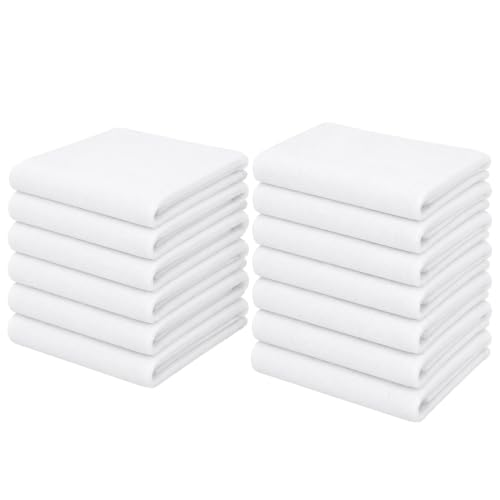
Aunti Em’s Kitchen Flour Sack Dish Towels for Embroidery (White, 13-Pack) — Best Overall Blank
Start here if you stitch. This listing does not merely tolerate embroidery — its title is built around it: flour sack towels for embroidery, 100% ring-spun cotton, hemmed edges, craft blanks and monograms all stated outright. A 13-pack gives a machine embroiderer a working stock for gifts, shop inventory and the inevitable practice pieces, in the classic white that shows thread colours at their truest.
Strengths
- Embroidery purpose stated directly in the Amazon title, not inferred
- Ring-spun cotton flour sack weave is the flat, stable ground machine stitching wants
- 13-pack quantity suits production stitching, gifts and craft fair stock
Trade-offs
- White only in this verified listing; colour work needs the sage variant below or dyes
- Flour sack is a working towel weight, not a plush hand towel feel
- Thirteen blanks is a commitment for a one-off single gift project
| Pack | 13 towels (per Amazon title) |
| Material | 100% ring-spun cotton flour sack (per Amazon title) |
| Edges | Hemmed (per Amazon title) |
| Purpose | Embroidery blanks, monograms (per Amazon title) |
Flour sack’s dominance in machine embroidery is earned, not traditional inertia. The weave is flat enough for fine detail, stable enough to resist the push-pull of dense stitch fields when properly stabilised, and absorbent enough to remain a real towel after decoration. Ring-spun cotton adds smoothness, so satin stitches sit cleanly instead of sinking between slubby yarns — the difference between a design that looks printed-sharp and one that looks tired.
The pack economics matter to anyone selling stitched towels. Thirteen matched blanks mean a dozen sellable pieces plus the practice towel every new design deserves, all from one consistent dye lot and weave batch. Consistency across a product line is a professional concern that single-towel buying never has to think about, and this pack is priced and packed for exactly that workflow.
Pre-wash one towel from the pack and stitch your test design on it before committing the batch; flour sack relaxes slightly in its first wash, and a design digitised for the washed dimensions stays honest for the whole run.
Best for: machine embroiderers producing gifts or shop stock in classic white / Not suited for: one-off buyers who need a single towel or a coloured blank
Check on Amazon — check the current price on Amazon before you buy, because sizes, prints and pack options change the total.

Aunti Em’s Kitchen Flour Sack Towels for Embroidery (Sage Green, 12-Pack) — Best Coloured Blank
White blanks show every thread colour, but some designs — whitework, tone-on-tone botanicals, metallic threads — are born for a coloured ground. This sage green variant keeps the verified formula: 100% ring-spun cotton, fully hemmed edges, embroidery blanks and monograms stated in the title, at a stated 27 by 27 inches in a 12-pack.
Strengths
- Coloured ground stated in the title, opening design palettes white cannot serve
- 27 x 27 inch size stated in the Amazon title, a generous square for hoop work
- Fully hemmed edges keep the blank’s shape through hooping and washing
Trade-offs
- Coloured blanks limit thread palette choices compared with white
- Sage is a specific aesthetic; it will not suit every kitchen the towels are gifted into
- A 12-pack of one colour is a production quantity, not a sampler
| Pack | 12 towels (per Amazon title) |
| Size | 27 x 27 inches (per Amazon title) |
| Material | 100% ring-spun cotton (per Amazon title) |
| Edges | Fully hemmed (per Amazon title) |
A coloured blank changes the embroidery maths in the stitcher’s favour more often than expected. Filling a background with thread is the slowest, densest, most pucker-prone part of machine embroidery; a sage ground provides the background for free, letting designs use open, lighter stitching that sits flatter and finishes faster. Botanical and herb designs — the kitchen towel classics — are practically designed for this towel.
The stated square size is a practical gift. A 27-inch square hoops comfortably for large centred designs, folds into the classic thirds for hanging display, and covers a proofing loaf or a lap with equal ease. When a listing bothers to state its dimensions in the title, as this one does, it saves the embroiderer the most common blank-buying disappointment in the craft.
Test your thread colours against the actual sage under your kitchen’s light before a production run; greens shift thread perception more than any neutral, and a sample stitch-out on one corner saves a dozen regrets.
Best for: embroiderers making coloured-ground designs, especially botanical and whitework pieces / Not suited for: stitchers who want maximum thread contrast or mixed-colour assortments
Check on Amazon — check the current price on Amazon before you buy, because sizes, prints and pack options change the total.

Flour Sack Towels for Embroidery, 12 Pack (18 x 28 in, White) — Best Large-Format Blank
Not every design wants a square. The 18 by 28 inch rectangle is the classic hanging kitchen towel proportion, and this 12-pack of cotton flour sack blanks states its embroidery purpose in its title — blank towel for embroidery, tea towel for crafts — alongside baking uses. Choose it when your designs are composed for the hanging rectangle: borders along the long edge, centred motifs that read when the towel hangs folded.
Strengths
- Rectangular format matches how kitchen towels actually hang and display
- Embroidery and craft purpose stated in the Amazon title
- Dual baking positioning reflects flour sack’s genuine versatility in a working kitchen
Trade-offs
- Unbranded listing; consistency between repeat orders is less predictable than a named brand
- Rectangles hoop differently from squares and may need repositioning for large designs
- Absorbency claims in the title are maker language, not measurements
| Pack | 12 towels (per Amazon title) |
| Size | 18 x 28 inches (per Amazon title) |
| Material | Cotton flour sack (per Amazon title) |
| Purpose | Embroidery blanks, crafts (per Amazon title) |
Composition is the rectangle’s argument. A design stitched for a square and hung on a rectangle looks lost; a design composed for the hanging rectangle — a border that runs where the fold falls, a motif placed for the visible third — looks tailored. Embroiderers selling finished towels think in these terms instinctively, and a blank manufactured in the display proportion removes a layer of compromise from every piece.
The baking crossover in the title is honest flour sack behaviour. The same lint-light, absorbent weave that takes embroidery also covers proofing dough and dries glassware without streaks, so the towels that do not get stitched are not wasted stock — they rotate into kitchen service, which is more than can be said for most craft blanks.
Stitch a hanging-direction marker into your workflow: pin the blank’s display orientation before hooping, because a rectangle embroidered upside-down relative to its hang is the classic beginner’s heartbreak.
Best for: embroiderers composing designs for hanging rectangular towels / Not suited for: square-format designers and brand-loyal production stitchers
Check on Amazon — check the current price on Amazon before you buy, because sizes, prints and pack options change the total.

Simpli-Magic Flour Sack Kitchen Towels, 12 Pack (24 x 24 in) — Best Everyday Dual-Purpose
The Simpli-Magic pack serves the household that stitches occasionally and cooks daily. Its title confirms 100% cotton flour sack at 24 by 24 inches in a 12-pack, described as lint-free and highly absorbent, with crafting named among its purposes. It is not sold as a dedicated embroidery blank like the Auntie Em’s picks, and this review keeps that distinction visible — but the fabric is the same flour sack family embroiderers use, making it a sensible dual-purpose stock.
Strengths
- 100% cotton flour sack construction confirmed in the Amazon title
- Crafting use named in the title alongside dish and baking work
- 24-inch square is a handy mid-size for both hooping and kitchen service
Trade-offs
- Not marketed specifically as embroidery blanks, so weave consistency for fine stitching is less assured than the dedicated picks
- Lint-free and absorbency wording is maker language
- One size and format only in this listing
| Pack | 12 towels (per Amazon title) |
| Size | 24 x 24 inches (per Amazon title) |
| Material | 100% cotton flour sack (per Amazon title) |
| Uses | Dish, baking, crafting (per Amazon title) |
There is a real buyer for whom the dedicated blank is overkill: the crafter who embroiders a few towels a year as gifts and wants the rest of the pack earning its keep at the sink. For that buyer, a general flour sack pack with crafting in its stated uses is the rational stock — the same weave family, bought without paying a speciality premium for production-grade consistency they will never test.
The honest limit is fine detail. Production embroiderers stitching dense, small lettering should default to the dedicated blanks above, whose entire listing is aimed at the craft. For bold motifs, monograms and appliqué-style designs, a good general flour sack towel like this one performs the job its title promises.
Sort a new pack before stitching: hold each towel to the light and reserve the most even-weave pieces for embroidery, sending any looser pieces straight to kitchen duty where they will serve perfectly well.
Best for: occasional stitchers who want one pack serving craft and kitchen / Not suited for: production embroiderers needing guaranteed blank consistency
Check on Amazon — check the current price on Amazon before you buy, because sizes, prints and pack options change the total.
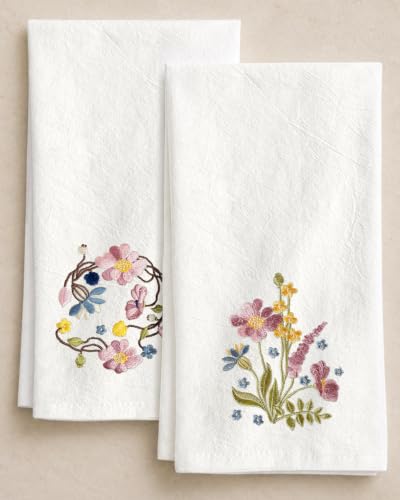
Miss Adola Embroidered Flour Sack Kitchen Towels (Watercolor Flowers) — Best Finished Embroidered
This pick serves the other half of the keyword — shoppers who want an embroidered kitchen towel, not the means of production. The Miss Adola listing states embroidered flour sack construction in pure cotton, a watercolor flowers design, a hanging loop and machine washability. It is a decorative, giftable towel whose embroidery arrives done.
Strengths
- Finished embroidery stated in the Amazon title; no machine or skill required
- Pure cotton flour sack keeps it a working towel, not only a display piece
- Hanging loop and machine washability stated in the title, the practical details decorative towels often omit
Trade-offs
- You are buying one maker’s design taste; the flowers will not suit every kitchen
- Finished embroidered towels sit at a decorative tier above blank pricing per towel
- Design variants from this maker are separate listings; the cat and bird designs are different products, not options confirmed here
| Material | Pure cotton flour sack (per Amazon title) |
| Design | Watercolor Flowers embroidery (per Amazon title) |
| Details | Hanging loop, machine washable (per Amazon title) |
A finished embroidered towel earns its premium in the hand-finishing details this title lists: a hanging loop so the design actually displays, and machine washability so it can live in a kitchen rather than a drawer. Decorative towels that cannot be washed become seasonal guilt objects; this one is built to be used, with the embroidery as the pleasure rather than the prohibition.
For gift buyers, the watercolor floral direction is the safest decorative bet in the kitchen category — it suits farmhouse, cottage and plain modern kitchens alike, and pairs naturally with the herb and garden themes that dominate kitchen gifting. If your recipient stitches, buy her the blanks above instead; if she does not, this is the embroidered towel to send.
Wash embroidered towels inside out on a gentle cycle to protect the stitch faces, a habit that keeps finished pieces like this one looking new through far more kitchen service.
Best for: gift buyers and non-stitchers who want a finished embroidered towel / Not suited for: embroiderers, who should buy the blanks and make their own
Check on Amazon — check the current price on Amazon before you buy, because sizes, prints and pack options change the total.

Aunt Martha’s Flour Sack Dish Towels (18 x 28 in, White, Set of 7) — Best Heritage Brand Blank
Aunt Martha’s is a name from the embroidery pattern world itself, and its flour sack towels carry that heritage into the blank itself. The verified title states the classic 18 by 28 inch rectangle, a premium 130 thread count and a set of seven in white. The title does not use the word embroidery — this review notes that honestly — but the brand’s entire identity is embroidery patterns and the towels are the traditional ground for them.
Strengths
- Heritage embroidery-world brand with a stated 130 thread count, a specification few blanks publish
- Classic 18 x 28 hanging rectangle suits traditional towel designs and patterns
- Set of seven matches a week of kitchen service or a small design series
Trade-offs
- Embroidery suitability is implied by brand and fabric rather than stated in the title, unlike the Auntie Em’s listings
- Seven is an awkward quantity for production runs compared with dozen packs
- White only in this verified set
| Pack | Set of 7 (per Amazon title) |
| Size | 18 x 28 inches (per Amazon title) |
| Weave | 130 thread count flour sack (per Amazon title) |
| Colour | White (per Amazon title) |
The stated thread count is this listing’s quiet flex. Thread count gives a stitcher a comparable number for weave density — the property that decides how fine a design the ground will hold — and almost no competing blank publishes one. A 130 count flour sack sits in the proven zone for machine embroidery: dense enough for detail, open enough for needle penetration without excessive stabiliser gymnastics.
Heritage cuts both ways and should be weighed fairly. Aunt Martha’s patterns and towels defined hand-embroidery generations, and machine stitchers inherit that ecosystem of towel-sized designs. If your design library leans traditional — days-of-the-week sets, vintage florals, retro kitchen motifs — this blank and those patterns were practically made for each other, in some cases literally.
A set of seven invites the classic project: one design for each day of the week, the heritage towel series that made this brand famous, updated on your machine instead of by hand.
Best for: traditional design libraries and stitchers who value a stated thread count / Not suited for: buyers who want embroidery purpose guaranteed in the listing title itself
Check on Amazon — check the current price on Amazon before you buy, because sizes, prints and pack options change the total.
Comparison Table
| Pick | Badge | Key spec | Best for |
|---|---|---|---|
| Aunti Em’s Kitchen Flour Sack Dish Towels for Embroidery (White, 13-Pack) | Best Overall Blank | 13-pack, 100% ring-spun cotton flour sack, hemmed, made for embroidery | machine embroiderers producing gifts or shop stock in classic white |
| Aunti Em’s Kitchen Flour Sack Towels for Embroidery (Sage Green, 12-Pack) | Best Coloured Blank | 12-pack sage green, 27 x 27 in, ring-spun cotton, fully hemmed | embroiderers making coloured-ground designs, especially botanical and whitework pieces |
| Flour Sack Towels for Embroidery, 12 Pack (18 x 28 in, White) | Best Large-Format Blank | 12-pack, 18 x 28 in rectangular flour sack blanks for embroidery | embroiderers composing designs for hanging rectangular towels |
| Simpli-Magic Flour Sack Kitchen Towels, 12 Pack (24 x 24 in) | Best Everyday Dual-Purpose | 12-pack, 24 x 24 in, 100% cotton flour sack, lint-free per title | occasional stitchers who want one pack serving craft and kitchen |
| Miss Adola Embroidered Flour Sack Kitchen Towels (Watercolor Flowers) | Best Finished Embroidered | Finished embroidered flour sack towel, pure cotton, hanging loop, machine washable | gift buyers and non-stitchers who want a finished embroidered towel |
| Aunt Martha’s Flour Sack Dish Towels (18 x 28 in, White, Set of 7) | Best Heritage Brand Blank | Set of 7, 18 x 28 in, 130 thread count flour sack | traditional design libraries and stitchers who value a stated thread count |
What Makes a Towel Take Machine Embroidery Well
Three fabric properties decide the result. First, a flat weave: loops and heavy texture fight the needle and swallow detail, which is why flour sack dominates this guide and terry is absent from it. Second, stability: the ground must not stretch under the hoop, or circles stitch as ovals and lettering leans; cotton flour sack’s plain weave is naturally stable, and proper stabiliser does the rest. Third, surface smoothness: ring-spun and higher-count yarns let satin stitches lie flat and shine, while slubby yarns break the light and the design’s crispness with it.
Preparation matters as much as purchase. Pre-wash blanks to remove sizing and let the weave relax, press them flat, and hoop with the stabiliser the design’s density demands — cut-away for dense fields, tear-away for light open work. The towels in this guide provide the right canvas; those unglamorous steps are what turn the right canvas into a finished piece worth gifting.
Building a Blank Library: Sizes and Colours That Cover Most Designs
Experienced stitchers stop buying towels per project and start keeping a blank library: a shelf of known, tested towels in the formats their designs recur to. The packs in this guide map neatly onto that library’s shelves — white squares for unrestricted design work, a coloured ground for botanical and tone-on-tone pieces, the hanging rectangle for composed borders and motifs, and a dual-purpose stock for experiments you would not risk a premium blank on. Two packs bought deliberately cover a year of ordinary gifting better than six packs bought impulsively.
The library’s real value is testability. A design digitised and proven on one towel from a pack will behave identically on its eleven siblings, which converts every new design from a gamble into a procedure. Keep one sacrificed towel from each pack as the permanent test piece, marked as such, and the library pays for its shelf space in saved failures.
Record what each pack taught you — shrinkage after pre-wash, the stabiliser that worked, the design density that puckered — on a card kept with the stock. Embroidery knowledge is perishable, and the stitcher who writes it down stops relearning the same lessons every craft fair season.
Selling and Gifting Embroidered Towels
An embroidered towel is the rare handmade gift that is also genuinely useful, which is why it survives every decluttering wave in recipients’ kitchens. For gifting, the design rules are simple: choose motifs for the recipient’s kitchen and humour rather than your own taste, keep stitch density moderate so the towel still dries dishes like a towel, and finish edges and jump threads as if the back will be inspected — on a hanging towel, it will be.
For sellers, the economics run through the blank. Your time and thread are roughly constant per piece; the blank is the variable, and the dozen packs in this guide exist to hold that variable low and consistent. Price for the finished object — a designed, stitched, pressed towel — not for the sum of its parts, and let the Auntie Em’s-style production packs quietly protect your margin while the work itself takes the compliments.
Presentation closes the sale or the gift: fold so the design shows its best third, the way the towel will hang, and if the design has a story — a grandmother’s motif, a wedding date, a house’s first Christmas — write it on a card. The embroidery carries the craft; the card carries the meaning, and recipients keep both.
Stabilisers, Hoops and Thread: The Supporting Cast
A blank towel is only a third of the embroidery equation. Stabiliser choice decides whether a dense design lies flat or puckers a plain weave into a relief map, and the working rule is density-driven: light, open designs can ride on tear-away, while filled fields and heavy satin need cut-away support that stays with the towel for its life. Hooping technique is the second third — taut without stretching, the towel’s grain straight, the design placed for how the towel hangs rather than how it lies.
Thread is the visible third. Polyester embroidery thread tolerates kitchen realities — hot washes, sunlight, the occasional bleach accident — better than rayon, which wins on sheen and loses on forgiveness; for towels that will work for a living, polyester is the pragmatic professional choice, and most production stitchers in this niche have already made it. Needle freshness is the cheapest quality upgrade in the craft: a tired needle shreds thread and chews plain weaves, and changing it costs pennies against a ruined blank.
None of this requires the most expensive version of anything. It requires the right version, matched to design density and the towel’s working life, which is why this guide spends its words on the canvas and the method together rather than pretending the towel alone determines the result.
Troubleshooting Common Embroidery Problems on Towels
Puckering around a design means the ground moved or the support failed: check that the blank was pre-washed, that the stabiliser matched the design’s density, and that the hoop held the weave neutral rather than stretched. The fix is almost never a different towel — the flour sack picks here are proven grounds — but a heavier stabiliser or a floated hoop on the next piece, which is what test stitch-outs exist to discover cheaply.
Designs that sink or look fuzzy usually trace to surface, not machinery: a towel with any texture will swallow fine detail, which is why this guide excludes terry entirely and favours smooth ring-spun and higher-count weaves. If lettering must be small, enlarge it or choose a bolder font before blaming the blank; plain weaves have a resolution, and respecting it is a design skill.
Thread breaks and bird’s nests are the machine’s complaints, not the towel’s: fresh needle, rethreaded path, correct tension for the design’s density. The discipline that separates finished towels from abandoned ones is changing one variable at a time and testing on the pack’s spare — the baker’s dozen in the Auntie Em’s pack is, among other things, a troubleshooting budget.
The Finished Towel’s Working Life
An embroidered towel returns to a kitchen, and its design must survive the return. Dense embroidery stiffens the patch it occupies, so place designs where stiffness does not matter — the hanging third, the border — and keep the drying heart of the towel free and flexible. A towel that cannot dry a dish because its centre is a stitched billboard has been decorated at the cost of its job, and recipients notice within a week.
Washing is the long negotiation between design and duty. Inside out, gentle cycle, moderate heat: the routine this guide repeats because it works, preserving stitch faces while the cotton does its absorbent work. Embroidered towels cared for this way age gracefully, the design softening into the towel’s own patina — the look that makes vintage embroidered linens collectible rather than merely old.
That ageing is the deepest argument for the whole craft. A printed towel fades toward blankness; an embroidered one matures toward heirloom. The blanks in this guide are inexpensive, the machine time is an afternoon, and the result is a kitchen textile that can plausibly be handed down — a return on a pack of flour sack towels that no other kitchen purchase quite matches.
From First Towel to Signature Style
Every embroiderer who sells or gifts seriously eventually develops a signature: a motif family, a thread palette, a placement habit that makes their towels recognisable across a market stall. The blank library this guide describes is what makes a signature possible, because style is consistency plus time — the same ground, the same stabiliser discipline, the same finishing, repeated until the work looks inevitable. Beginners should resist varying everything at once; change the design, keep the towel, and let one variable at a time teach its lesson.
The signature also lives in the finishing details recipients actually touch: the trimmed back, the pressed fold, the card that names the design. Two stitchers can buy the identical Auntie Em’s pack and produce towels a shelf apart in perceived quality, and the difference is never the blank. It is the patience after the machine stops, which is free, learnable, and — once learned — the hardest part of the craft for anyone else to copy.
Digital Designs and Sizing Them to the Towel
Machine embroidery designs are bought in fixed sizes, and the towel must be chosen to receive them: a design digitised at five inches wide needs a blank whose display third can hold it with breathing room, which is a sizing conversation between the design file and the pack dimensions stated in this guide. Resizing a design in software is not free — stitch density does not scale politely — so the professional habit is to buy designs at the size your blanks display best, rather than forcing favourites onto the wrong canvas. The stated dimensions in these listings exist to make that matching possible before money moves.
Keeping Records of What Worked
The final habit costs nothing and compounds forever: a notebook, physical or digital, where every finished towel leaves three lines — blank, stabiliser, design and any lesson the piece taught. Six months of those lines become a personal manual no blog can match, because it describes your machine, your towels and your hands. The stitchers who improve fastest are rarely the ones with the best equipment; they are the ones whose mistakes are written down where they cannot be repeated innocently.
How to Choose Kitchen Towels for Machine Embroidery
Decide first whether you are buying a canvas or a picture. Blanks — the flour sack packs that dominate this guide — are for stitchers, and among them the choice is format and colour: square whites for maximum design freedom, sage for coloured-ground work, rectangles for hanging compositions. Finished embroidered towels are for everyone else, and among them the choice is design taste plus the practical details, a hanging loop and machine washability, that decide whether the towel lives in the kitchen or the drawer.
Then match the blank to your machine habits. Production stitchers should buy dedicated embroidery blanks in dozen packs from listings that state the purpose, because consistency across a run is a professional requirement. Occasional stitchers can honestly save money with dual-purpose flour sack packs, reserving their most even towels for stitching. Everyone should confirm the pack’s stated size against their hoop and their design dimensions before ordering — a 24-inch design field does not care that the towel was a bargain.
Finally, remember the towel’s second life. An embroidered kitchen towel is still a kitchen towel: it will dry dishes, cover dough and hang by a working sink. Cotton flour sack succeeds because it performs both lives well. A blank that stitches beautifully but dries badly has failed the search’s first two words, whatever it does for the third and fourth.
How to Machine Embroider a Flour Sack Kitchen Towel
This walkthrough covers the standard workflow for stitching a design onto a flour sack blank like the picks above, from preparation to finishing.
- Pre-wash and press the blank towel to remove sizing and relax the weave, so the finished design is not distorted by the towel’s first wash after stitching.
- Mark the design placement with the towel folded as it will hang — centre of the visible third for a hanging motif, or centred for a flat display — rather than the towel’s geometric centre.
- Choose stabiliser by design density: tear-away for light, open designs; cut-away for dense stitch fields that would pull a plain weave out of shape.
- Hoop the towel and stabiliser together drum-taut without stretching the weave, or float the towel on hooped stabiliser with temporary adhesive for thick or awkward placements.
- Run a test stitch-out of the design on a spare blank or scrap from the same pack, checking tension, density and puckering before committing the good towel.
- Stitch the design, then remove stabiliser, trim jump threads, and give the finished towel a final press from the back over a soft surface to set the embroidery without flattening it.
Wash finished embroidered towels inside out on a gentle cycle and avoid high dryer heat on dense designs; the stitching will outlast the towel when it is treated as the textile it is, not as an indestructible print.
Common Buying Mistakes
Buying terry towels for machine embroidery. Loops swallow stitches and fight the needle. Embroidery belongs on flat weaves — flour sack above all — which is why every blank here is one.
Skipping the pre-wash. Sizing and first-wash relaxation distort finished designs. Wash the blank first and stitch the towel your customer or recipient will actually own.
Judging a blank by softness alone. Plush is a hand-towel virtue and an embroidery vice. For stitching, choose smooth, stable and flat, and let the finished design provide the luxury.
Hooping by stretching. A towel stretched in the hoop relaxes into puckers after stitching. Hoop taut and neutral, and let stabiliser — not tension — hold the ground.
Gifting blanks to a non-stitcher. Blanks are a hobbyist’s joy and everyone else’s plain towels. Match the gift to the person: blanks for the embroiderer, a finished Miss Adola for everyone else.
Final Recommendation
Stitchers should start with the Auntie Em’s white 13-pack for production work, the sage 12-pack for coloured-ground designs, and the Aunt Martha’s set for traditional pattern libraries, with the rectangular and dual-purpose packs serving their specific formats honestly. Non-stitchers should skip the blanks entirely and take the finished Miss Adola embroidered towel, which delivers the look with a hanging loop and machine washability included.
Whichever side of the machine you sit on, check price on Amazon on the live listing and confirm pack size and dimensions before ordering — in this category, the stated numbers are the difference between a canvas and a disappointment. Related kitchen textile topics from this programme follow below.
Best Kitchen Towels Absorbent Best Kitchen Towels Blue Best Kitchen Towels For Cleaning Best Kitchen Rugs For Standing Best Air Purifiers With Air Quality Sensors
Related guides
Frequently Asked Questions
What type of kitchen towel is best for machine embroidery?
Flat-woven cotton flour sack towels are the standard answer: their smooth, stable plain weave takes detail cleanly, hoops without stretching and still works as a real kitchen towel afterwards. Terry and microfibre towels are poor embroidery grounds and are deliberately absent from this guide’s picks.
Do I need to wash flour sack towels before embroidering them?
Yes. Pre-washing removes sizing and lets the weave relax, so the design is not distorted by the towel’s first wash after stitching. Press the blank flat after washing, and run a test stitch-out on a spare towel from the same pack before production work.
What stabiliser should I use on kitchen towels?
Match it to design density: tear-away stabiliser suits light, open designs, while dense stitch fields need cut-away stabiliser to stop the plain weave pulling out of shape. When in doubt, test on a spare blank — the packs in this guide include enough towels to make testing painless.
Can embroidered kitchen towels still be used for dishes?
Cotton flour sack embroidered towels remain working towels; that dual life is the fabric’s whole appeal. Wash them inside out on a gentle cycle to protect the stitching, and expect the embroidery to outlast everyday kitchen service when cared for that way.
Are coloured blanks better than white for embroidery?
Neither is better universally. White shows every thread colour at full contrast, while a coloured ground like the sage pick in this guide provides a free background for botanical and whitework designs and allows lighter, flatter stitching. Choose by design, not by habit.
I do not own an embroidery machine. What should I buy?
A finished embroidered towel, such as the Miss Adola pick in this guide, whose embroidery is part of the product. Look for the practical details that decide whether it gets used — pure cotton construction, a hanging loop and machine washability — all of which its listing states.


