Disclosure: airfryerkitchensupply.com is reader-supported. When you buy through links on our site, we may earn an affiliate commission at no extra cost to you.
Where to buy
For shoppers comparing the best kitchen faucets ceramic disk options in this guide, start here. Ceramic disk is a claim worth verifying, because listings use disc, disk and cartridge almost interchangeably. Every pick below was confirmed against a verified listing whose title or feature data supports its ceramic valve claim — Kohler’s ceramic disc valves, GROHE’s SilkMove ceramic valve, and ceramic cartridges from Kraus, FORIOUS and OWOFAN — and the Pfister pick’s verified title states Ceramic Disc Valve Technology outright. Where a pick uses a cartridge that packages the discs, the review says so. No fixed prices are printed; check price on Amazon through the links.
- Kohler Simplice K-596-BL Pull-Down Kitchen Faucet — Best Overall Ceramic Disk: Check on Amazon
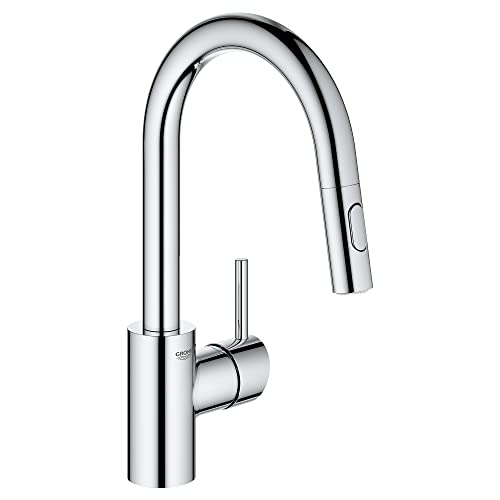
- GROHE Concetto 31479001 Pull-Down Bar Faucet — Best SilkMove Disk Engineering: Check on Amazon
- Kraus Oletto KPF-2820SFS Pull-Down Kitchen Faucet — Best Ceramic Cartridge for Cooks: Check on Amazon
- Pfister Pfirst G13310WW Pull-Out Kitchen Faucet — Most Explicit Ceramic Disc Claim: Check on Amazon
- FORIOUS Pull-Down Kitchen Faucet — Best Budget Ceramic Cartridge: Check on Amazon
- OWOFAN Spring Pull-Down Kitchen Faucet — Best Cycle-Tested Cartridge Value: Check on Amazon
The search for the best kitchen faucets ceramic disk is really a search for the longest-lived valve in the kitchen. A ceramic disk faucet seals with two ceramic discs polished so flat that their faces form the seal itself — no rubber washers to compress, no springs to tire, nothing in the water path that grit can quickly destroy. That is why disk and cartridge valves took over the industry, and why a buyer who specifies them is shopping for a decade of drip-free service rather than a season of novelty. This guide shortlists six verified models whose ceramic valve claims survive checking.
A quick vocabulary service, because this category’s listings will not give you one. Ceramic disc (or disk) describes the sealing pair itself. A ceramic cartridge packages that same pair inside a replaceable unit — the principle is identical, the service model differs: a cartridge swaps in minutes as one part. GROHE’s SilkMove is a proprietary refinement of the disc idea, with discs machined to extreme flatness gliding on a lubricant reservoir. All three appear in this guide, each labelled for what it is, because the honest differences are about service style and feel, not about which one seals — they all seal superbly.
The six picks span the useful market: Kohler’s Simplice for the best all-round disc performance, the GROHE Concetto for valve connoisseurs, the Kraus Oletto for cooks, the Pfister Pfirst for the most explicit disc-valve claim at a traditional format, and the FORIOUS and OWOFAN for ceramic reliability at accessible tiers — the OWOFAN with a cartridge whose verified features cite extended cycle testing. If your last faucet died by dripping, this is the list that ends the pattern.
In this guide
Quick Picks: The Shortlist for Best kitchen faucets ceramic disk
Start with the Kohler Simplice for all-round excellence, the Kraus Oletto if you cook seriously, and the FORIOUS for ceramic reliability on a budget.
- Kohler Simplice K-596-BL Pull-Down Kitchen Faucet — Best Overall Ceramic Disk. Kohler’s ceramic disc platform under the category’s most useful sprayhead — stream, the wide Sweep rinse, and Boost — with magnetic docking and temperature memory. — Check the current price on Amazon
- GROHE Concetto 31479001 Pull-Down Bar Faucet — Best SilkMove Disk Engineering. The valve connoisseur’s pick: GROHE’s SilkMove ceramic discs, machined to extreme flatness, in a compact pull-down bar faucet with dual spray. — Check the current price on Amazon
- Kraus Oletto KPF-2820SFS Pull-Down Kitchen Faucet — Best Ceramic Cartridge for Cooks. A brass-bodied cook’s faucet whose ceramic cartridge packages the disc seal in a swap-friendly unit — with the height and reach serious cooking demands. — Check the current price on Amazon
- Pfister Pfirst G13310WW Pull-Out Kitchen Faucet — Most Explicit Ceramic Disc Claim. The pick whose verified title says it outright — Ceramic Disc Valve Technology — in a traditional pull-out format and a white finish the rest of this guide does not offer. — Check the current price on Amazon
- FORIOUS Pull-Down Kitchen Faucet — Best Budget Ceramic Cartridge. Ceramic sealing at an accessible tier: a certified SUS304 faucet with a ceramic cartridge, three spray modes and an included deck plate. — Check the current price on Amazon
- OWOFAN Spring Pull-Down Kitchen Faucet — Best Cycle-Tested Cartridge Value. A spring-style pull-down whose verified features cite a ceramic cartridge tested through extended cycles — durability paperwork at a value tier, in a pro-style silhouette. — Check the current price on Amazon
How These Picks Were Chosen
Picks were admitted on valve evidence first: the verified listing had to support the ceramic claim — in the title, as with the Pfister’s Ceramic Disc Valve Technology and the GROHE’s SilkMove Ceramic Valve, or in verified features, as with Kohler’s ceramic disc valves and the Kraus, FORIOUS and OWOFAN ceramic cartridges. Faucets whose ceramic claims could not be traced to listing data were excluded, however attractive the rest of the specification. That discipline is the difference between a ceramic disk guide and a faucet guide with ceramic in the title.
Performance screening followed the programme’s usual order — spray quality, docking, reach, hose behaviour — and the final pass weighed service models: built-in disc valves from Kohler and GROHE for lifetime engineering, cartridges from Kraus, FORIOUS and OWOFAN for swap-in-minutes maintenance. Specifications in the mini boxes come only from verified records; the Kohler’s box is omitted because its verified dimension data was unreliable, and the guide prefers an absent box to an invented number. No prices or rating counts are printed anywhere.
The 6 Best Kitchen Faucets With Ceramic Disk Valves, Reviewed

Kohler Simplice K-596-BL Pull-Down Kitchen Faucet — Best Overall Ceramic Disk
The Simplice is for the buyer who wants the disc valve’s longevity wrapped in the most capable daily tool in this guide. Heavy rinsers, sheet-pan households and modern kitchens in matte black schemes are its natural home. Its temperature memory — returning to your last setting — suits households where the faucet is adjusted constantly and consistently.
Strengths
- Ceramic disc valves are Kohler’s long-life sealing standard across its range
- Sweep spray rinses a whole sink in a pass — genuinely different, not a gimmick mode
- Boost adds real flow for filling, then steps back for controlled work
Trade-offs
- Matte black needs regular wiping in hard-water homes to stay pristine
- No specification box is printed — verified dimension data for this listing was unreliable
- Premium tier, with matching-finish accessories adding project cost
The Simplice pairs the guide’s most proven disc platform with its most thoughtful sprayhead. The Sweep function lays a wide blade of water across the sink that pushes debris ahead of it — the closest thing to rinsing with a squeegee — while Boost answers the stockpot. Docking is magnetic and certain, and the lever’s disc-valve action has the light, exact feel that tells you the seal is made by surfaces, not springs.
Kohler builds its reputation on exactly this combination of valve engineering and hydraulic design, and supports it with a parts channel that keeps discs and cartridges orderable for years. No dimensions are printed for this pick because the verified data was unreliable — an omission this guide makes deliberately rather than guess. As the overall ceramic disk pick, the Simplice is the one most buyers should start from.
Best for: Most households wanting disc longevity plus elite rinsing / Not suited for: Hard-water homes wanting a wipe-free finish
Check the current price on Amazon
GROHE Concetto 31479001 Pull-Down Bar Faucet — Best SilkMove Disk Engineering
Choose the Concetto if the valve is the purchase. SilkMove’s glide — ceramic discs on a lubricant reservoir — is the benchmark lever feel in the industry, and this bar-format model brings it to prep sinks, bar sinks and compact kitchens where full-size faucets overwhelm. Design-led small kitchens get GROHE’s Starlight chrome discipline as a bonus.
Strengths
- SilkMove ceramic valve delivers the smoothest, most durable action here
- Compact pull-down format suits sinks the big picks would dominate
- Dual spray and full swivel cover daily work without excess modes
Trade-offs
- Bar/prep scale — not a main faucet for large family sinks
- Polished chrome shows water spots more than brushed finishes
- European parts channels are less familiar to US local suppliers
| Specification | Detail |
|---|---|
| Valve | SilkMove ceramic valve (per verified listing title) |
| Flow rate | 1.75 GPM (per verified listing title) |
| Spout | 360-degree swivel (per verified listing title) |
| Format | Bar/prep, single hole (per verified listing title) |
In a guide about ceramic disks, the Concetto is the connoisseur’s exhibit. GROHE’s manufacturing holds disc flatness to tolerances that make the seal essentially wear-proof in domestic service, and the lubricant reservoir keeps the action silken rather than merely smooth. Owners describe the lever feel in terms usually reserved for instruments — and in this category, feel is data: it is what a perfect seal feels like from outside.
The format caveat is stated plainly: this verified model is the bar-size Concetto. Within that role it is complete — pull-down convenience, two sprays, full swivel — and for a prep sink or a compact design kitchen it may be the finest faucet in this guide. Buy it for the right sink and the valve will outlast the kitchen around it.
Best for: Prep and bar sinks, compact kitchens, valve purists / Not suited for: Large main sinks needing maximum reach
Check the current price on Amazon

Kraus Oletto KPF-2820SFS Pull-Down Kitchen Faucet — Best Ceramic Cartridge for Cooks
The Oletto suits the cook who wants disc-principle longevity with cartridge practicality: when service eventually comes, the whole valve renews as one part in minutes. Its tall arc and long reach serve wide sinks and tall vessels, and its spot-free finish tolerates the steam and splash of a working kitchen better than any polished alternative.
Strengths
- Ceramic cartridge gives disc sealing with the simplest possible service model
- Brass body and exact handle action feel a tier above the price class
- Height, reach and even spray pattern are all tuned for volume cooking
Trade-offs
- Cartridge format means a whole-unit swap at service time rather than component renewal
- Tall profile requires confirmed overhead clearance
- Brand support is strongest online rather than at local counters
| Specification | Detail |
|---|---|
| Flow rate | 1.8 GPM (per verified listing) |
| Overall height | 16.63 in |
| Spout reach | 8.88 in |
| Valve | Ceramic cartridge (per verified listing features) |
| Body | Brass (per verified listing features) |
The cartridge-versus-built-in debate deserves a fair hearing, and the Oletto makes the cartridge case at its strongest. A cartridge concentrates the precision surfaces in one factory-sealed unit: no field assembly, no alignment, just a swap that returns the faucet to as-new sealing in one operation. For most households that is the better service model, and Kraus executes it in a brass body that feels properly engineered.
As a daily tool the Oletto remains this programme’s recurring cook’s recommendation for good reason — the proportions, spray and finish all serve work. In a ceramic disk guide it earns its badge by bringing the disc principle to the widest sinks and the busiest cooks, with the easiest long-term service story of the premium picks.
Best for: Serious cooks wanting disc sealing with simple service / Not suited for: Low-clearance kitchens or component-level tinkerers
Check the current price on Amazon

Pfister Pfirst G13310WW Pull-Out Kitchen Faucet — Most Explicit Ceramic Disc Claim
The Pfirst is for the traditional kitchen and the careful reader: a mid-arc pull-out whose disc valve is stated in its own listing title, in a white finish that suits country, cottage and classic white-appliance kitchens. Pull-out format suits shallower sinks where a high arc splashes, and Pfister’s mainstream support makes it a calm long-term ownership proposition.
Strengths
- Disc valve claim is explicit in the verified listing title — no inference needed
- Pull-out format and mid arc suit shallow sinks and traditional layouts
- White finish serves kitchens the stainless-heavy shortlist ignores
Trade-offs
- Pull-out hose travel replaces the high-arc pot clearance pull-downs offer
- White finish shows coloured stains more readily and needs gentler cleaning
- Traditional styling will not satisfy modern-design kitchens
| Specification | Detail |
|---|---|
| Valve | Ceramic Disc Valve Technology (per verified listing title) |
| Flow rate | 1.75 GPM (per verified listing title) |
| Spout | 360-degree swivel (per verified listing title) |
| Format | Pull-out sprayer, mid arc (per verified listing title) |
There is a particular trust in a listing that names its valve technology in the title, and the Pfirst earns its badge on exactly that transparency. Behind the claim sits a sensible faucet: a swivelling mid-arc spout, a pull-out sprayer for directed rinsing, and Pfister’s long-standing disc platform, supported by one of the most established retail parts networks in the category.
Format is the deliberate trade. A pull-out gives you hose length at a lower arc — excellent for filling on the counter and for shallow sinks — at the cost of under-arc clearance for the tallest pots. For the traditional and white-kitchen buyers this pick serves, that trade is usually welcome, and the disc valve at its heart matches anything in this guide for sealing principle.
Best for: Traditional and white kitchens, shallow sinks, claim-checkers / Not suited for: Tall-pot households wanting high-arc pull-down clearance
Check the current price on Amazon

FORIOUS Pull-Down Kitchen Faucet — Best Budget Ceramic Cartridge
The FORIOUS brings the disc principle to the budgets where drips are most common — rentals, first homes, utility sinks — because its ceramic cartridge deletes the washer-and-spring failures that plague cheap faucets. The included deck plate covers standard decks, and the pause spray mode is a thoughtful touch rarely seen at this tier.
Strengths
- Ceramic cartridge at an accessible tier, with certifications listed
- Pause mode prevents spray-back when filling on the counter
- Deck plate included for the common one and three-hole decks
Trade-offs
- Cartridge support depends on the brand’s online channel — record the model
- Refinement of finish and casting sits below the premium picks
- Spray performance is good rather than class-leading
| Specification | Detail |
|---|---|
| Flow rate | 1.8 GPM (per verified listing) |
| Overall height | 14.76 in |
| Valve | Ceramic cartridge (per verified listing features) |
| Construction | SUS304 stainless (per verified listing features) |
| Certification | cUPC and NSF/ANSI/CAN 61 (per verified listing features) |
The budget end of the faucet market is where valve quality goes to die — compression washers and mystery cartridges that drip within two years. The FORIOUS is notable precisely because it refuses that script: a named ceramic cartridge, stainless construction and listed certifications, at a tier where rivals offer none of the three in verifiable form. That is why it recurs across this programme’s value recommendations.
Judge it by its tier and it impresses; judge it against the Kohler and it will feel lighter, because it is. For the kitchens it targets — rentals, renovations to a budget, secondary sinks — the ceramic cartridge is the feature that matters most, and this pick delivers it honestly and verifiably.
Best for: Budget renovations, rentals and secondary sinks / Not suited for: Buyers wanting premium heft and counter-level parts support
Check the current price on Amazon

OWOFAN Spring Pull-Down Kitchen Faucet — Best Cycle-Tested Cartridge Value
The OWOFAN suits the buyer who likes the commercial spring look and wants its durability claim in writing: the verified features for this model cite ceramic cartridge cycle testing in the hundreds of thousands, the kind of figure premium brands publish and value brands usually omit. Farmhouse, RV, bar and laundry installations are all named in its listing, and its deck plate covers one or three-hole decks.
Strengths
- Cycle-tested ceramic cartridge claim documented in verified features
- Spring silhouette gives pro-style reach and a distinctive look
- Lead-free certified stainless construction at an accessible tier
Trade-offs
- Spring style divides opinion — it is a statement, not a neutral choice
- Value-tier brand with online-led support
- Dual-mode spray is simpler than the three-mode heads elsewhere here
| Specification | Detail |
|---|---|
| Overall height | 16 in |
| Dimensions | 1.85 x 1.85 x 16 in |
| Valve | Ceramic cartridge, extended cycle testing (per verified listing features) |
| Construction | SUS304 stainless, lead-free NSF certified (per verified listing title) |
| Installation | 1 or 3-hole with deck plate (per verified listing title) |
Cycle testing is the right way to talk about valve life, because it converts a promise into a number of operations — and at this tier, publishing the testing at all is a statement of intent. The OWOFAN’s cartridge claim, recorded in its verified features, anchors this pick’s badge: among value faucets, documented endurance testing is the exception, and it deserves the spotlight when it appears.
The spring format adds genuine function to the paperwork: the exposed coil gives the wand a long, flexible working arc that suits deep farmhouse sinks, and the whole faucet installs on common decks from one box. For style-led buyers on a budget who still read the valve specification first, the OWOFAN is the guide’s most interesting answer.
Best for: Farmhouse and pro-style kitchens wanting tested durability on a budget / Not suited for: Minimalist kitchens or buyers wanting legacy-brand support
Check the current price on Amazon
Comparison Table
Compare these six first on valve form — built-in disc, SilkMove disc, or cartridge — because that decides your service model in year ten. Then compare height and spray character against your sink and your cooking.
| Pick | Badge | Key spec | Best for |
|---|---|---|---|
| Kohler Simplice K-596-BL Pull-Down Kitchen Faucet (Check on Amazon) | Best Overall Ceramic Disk | Ceramic disc valves; 3-function sprayhead (stream / Sweep / Boost) | Most households wanting disc longevity plus elite rinsing |
| GROHE Concetto 31479001 Pull-Down Bar Faucet (Check on Amazon) | Best SilkMove Disk Engineering | SilkMove ceramic valve; 1.75 GPM; dual spray; bar format | Prep and bar sinks, compact kitchens, valve purists |
| Kraus Oletto KPF-2820SFS Pull-Down Kitchen Faucet (Check on Amazon) | Best Ceramic Cartridge for Cooks | 1.8 GPM; 16.63 in height; ceramic cartridge; brass body | Serious cooks wanting disc sealing with simple service |
| Pfister Pfirst G13310WW Pull-Out Kitchen Faucet (Check on Amazon) | Most Explicit Ceramic Disc Claim | Ceramic Disc Valve Technology (listing title); 1.75 GPM; pull-out format | Traditional and white kitchens, shallow sinks, claim-checkers |
| FORIOUS Pull-Down Kitchen Faucet (Check on Amazon) | Best Budget Ceramic Cartridge | 1.8 GPM; ceramic cartridge; SUS304; 3 modes including pause | Budget renovations, rentals and secondary sinks |
| OWOFAN Spring Pull-Down Kitchen Faucet (Check on Amazon) | Best Cycle-Tested Cartridge Value | 16 in height; ceramic cartridge with extended cycle testing in verified features | Farmhouse and pro-style kitchens wanting tested durability on a budget |
How to Choose the Best Kitchen Faucets With Ceramic Disk Valves
Start by confirming the claim. A genuine ceramic disk or cartridge faucet will say so in its listing title or features — as every pick in this guide does — while vague phrases like premium valve or advanced sealing usually describe something else. Decide next between the two service models. Built-in disc valves from makers like Kohler and GROHE are lifetime engineering: the discs themselves rarely need attention, and service, if it comes, is component-level. Cartridges package the discs into one swap-in-minutes unit, which most households will find the easier decade-later job. Neither is wrong; choose the model that matches how you maintain things.
Then judge the faucet around the valve with the usual rigour, because a great seal cannot rescue a poor spray head. Check docking security, hose length against your sink size, spray modes against your cooking, and height against your cabinets. Finally, check the cartridge or disc set’s part number exists as a purchasable item — the ten-minute check that separates a fifteen-year faucet from a five-year one. Do those things in that order and the ceramic disk premium buys exactly what it promises: the longest quiet interval between you and your faucet’s internals.
Why Ceramic Disks Outlast Washers, Balls and Springs
Traditional valves seal with soft materials under pressure: rubber washers compressed by a screw, or rubber seats pressed by springs against a ball. Soft materials in moving water have a fixed destiny — they harden, score, and take a set, and grit accelerates every step. The drip that results is not a defect so much as a schedule. Ceramic discs escape the schedule by sealing with hardness and flatness instead: two discs ground so precisely that water cannot pass their faces, rotating to align ports for flow. The sealing surfaces do not compress, fatigue or depend on spring force, so the schedule stretches from years to decades.
Hard water is the one honest caveat. Mineral scale can build on any valve’s surfaces over time, and extremely gritty water challenges every mechanism. Even there, discs hold the advantage — scale affects their action gradually and often reversibly with cleaning, where it destroys rubber seats outright. Pair a disc faucet with the simple habit of flushing lines at installation, and you have removed the two largest causes of early valve failure in one afternoon’s work.
Disk, Cartridge or SilkMove: Picking Your Service Model
The three valve forms in this guide are one principle at three addresses. A built-in ceramic disc valve, as in the Kohler Simplice, integrates the discs into the faucet body — the purest engineering, serviced rarely and at component level. A ceramic cartridge, as in the Kraus, FORIOUS and OWOFAN picks, seals the discs inside a replaceable unit: service becomes a ten-minute swap with basic tools, which is why cartridges dominate the modern market. GROHE’s SilkMove refines the built-in disc with extreme machining tolerances and a lubricant reservoir, prioritising lever feel and longevity together.
Choose by temperament and context. The owner who enjoys maintaining things properly will appreciate built-in discs; the owner who wants the fastest possible fix in year nine should choose a cartridge; the owner who cares about how the lever feels every single day should audition SilkMove. All three outclass the mechanisms they replaced. What matters is that the claim is verified — which is why this guide only prints valve claims it could trace to listing data, and why your own shortlist should apply the same rule.
Ceramic Disks and Water Quality: Grit, Scale and the Honest Limits
Ceramic disks are the most forgiving valve technology in dirty water, but forgiving is not invulnerable, and a disk guide should state the limits plainly. Grit is the first: construction debris and pipe scale can score any sealing surface if they are flushed through it under pressure, which is why every installation in this programme flushes lines before the valve is fitted. A disk that meets clean water at commissioning usually never meets grit again, because household water after that first flush is effectively filtered by the system’s own settling.
Scale is the slower adversary. In very hard water, mineral film can build on disk faces over years, showing up as a gradual stiffening of the lever rather than a drip — the seal holds while the glide suffers. The remedies are gentle and usually effective: exercising the full lever arc regularly, cleaning the cartridge if the model allows it, and softened water where the house already treats it. What scale almost never does to a disk is what it does to rubber seats — destroy the seal outright — which is why disk owners in hard-water regions still report the longest service intervals in the category.
Disk Valves and Temperature Control: Why the Lever Feels Different
Owners switching from compression or ball faucets notice the disk lever immediately: a short, precise arc, with flow and temperature responding in a smooth gradient rather than the older mechanisms’ hunting. That feel is the geometry of the disks themselves — small rotations align the ports progressively, so fine adjustment near the temperatures households actually use is unusually controllable. It is also why disk faucets scald-protect well in practice: the blend you set is the blend the valve holds, without the drift that spring-dependent seals introduce as they age.
Cartridge models package that control in a unit whose rotation stops and alignment are factory-set, which is why a cartridge swap restores not just the seal but the feel. Built-in disk models achieve the same precision with components the owner rarely touches. Either way, the lever’s authority in year five is the disk principle’s quietest advantage — the faucet keeps answering the hand exactly, long after spring-and-rubber designs have begun to approximate.
The 500,000-Cycle Idea: What Endurance Testing Really Promises
Cycle testing is the faucet industry’s most honest number when it is published, because it converts durability from an adjective into a count: one cycle is a full operation of the valve, and a household typically works a kitchen faucet through thousands of cycles a year. A cartridge tested through hundreds of thousands of cycles — the class of figure recorded in the verified features for this guide’s OWOFAN pick — is therefore making a claim measured in decades of ordinary use, tested under controlled conditions no marketing department can soften after the fact.
Read such figures with two qualifications and they become genuinely useful. First, laboratory cycles use clean water at specified pressures, so they rank valves against each other better than they predict any single household’s years — grit and scale remain the wild cards the installation flush exists to remove. Second, the valve is rarely the faucet’s whole life: hoses, finishes and spray heads age on their own schedules. Even with those caveats, a published cycle figure signals a manufacturer willing to be measured — and in a category full of unmeasured promises, that willingness is itself a specification worth paying for.
How to Replace a Ceramic Cartridge (and Check a Disk Valve)
The ceramic era’s great practical gift is that its standard service is a swap, not a rebuild. The steps below cover a cartridge replacement — the Kraus, FORIOUS and OWOFAN pattern — with notes for built-in disc models. Work depressurised, photograph the assembly before disturbing it, and keep the old cartridge until the new one is proven: its part number is your receipt.
- Shut off and relieve pressure. Close both angle stops, open the faucet to drain, and confirm the flow stops. Place a towel in the sink to catch screws and to protect the finish from dropped tools.
- Remove the handle. Pop the index cap if fitted, loosen the set screw, and lift the lever clear. Note any orientation marks — the handle’s alignment on reassembly is set by these, not by eye.
- Expose the cartridge. Unscrew the retaining bonnet or remove the retaining clip, depending on the model. Photograph the cartridge’s position before touching it: its alignment tabs and port orientation must be reproduced exactly by the replacement.
- Draw the old cartridge. Pull it straight out with a gentle rocking motion; if it resists, a cartridge puller is the correct tool — leverage against the faucet body risks the casting. Inspect the old unit’s seals: heavy scoring or grit confirms the diagnosis.
- Clean the valve chamber. Wipe the chamber and ports with a soft cloth and flush the lines briefly into a bucket with the cartridge still out. Grit left in the chamber is the leading cause of a new cartridge failing early — the ceramic-era version of the oldest mistake in plumbing.
- Seat the new cartridge. Align its tabs and ports with the body, press it home fully, and refit the bonnet or clip to the manufacturer’s guidance. On built-in disc models, this is the stage where individual discs and seals are renewed in their photographed order instead.
- Test through the full arc. Restore water slowly, run hot, cold and blends, and check for drips at rest for several minutes. A ceramic seal is either right immediately or something is mis-seated — there is no bedding-in period to wait out, which is the design’s honesty working in your favour.
Keep the new cartridge’s packaging and part number with your household records. If a drip returns within days, suspect grit or seating rather than the part — open, clean, reseat — before concluding anything about the faucet. Ceramic valves reward correct installation with silence, for years.
Aerators and Spray Heads: The Disk Faucet’s Supporting Cast
A disk valve’s longevity can be undermined by the two components owners forget are wear items: the aerator and the spray head. The aerator’s mesh catches the grit the installation flush missed and slowly strangles flow, mimicking valve failure in a faucet whose valve is perfect. Unscrewing, rinsing and reseating it is a five-minute, tool-light job that should precede any diagnosis of a disk faucet that feels weak — in this programme’s experience it is the correct diagnosis more often than the valve ever is.
Spray heads age by scale rather than wear, especially in hard water: nozzles narrow unevenly, patterns go ragged, and docking seals collect film. Rub-clean silicone nozzles answer with a fingertip; sealed heads answer with a soak in the manufacturer’s approved solution. Attend to both on the same annual rhythm and the faucet around the immortal valve stays as competent as the valve itself — which is the actual ownership goal in a ceramic disk purchase.
When a Disk Faucet Drips: A Calm Diagnostic Order
It happens rarely, and when it does, order matters more than urgency. First, confirm the source: a disk faucet that appears to drip is often shedding water held in the spout or wand after use, which stops within a minute and is not a fault. A true drip persists at rest with the handle closed. Second, check the aerator and wand seals, the two places residue imitates valve failure. Third, and only then, suspect the cartridge or disks — and if the faucet is within its early life, suspect installation grit before component failure, because a chamber clean and reseat cures the majority of early cases.
That order — observe, clean, then open — is the disk era’s maintenance philosophy in miniature. The valve is the last thing to blame because it is engineered to be the last thing that fails, and treating it that way saves owners the one cost disk faucets were invented to abolish: unnecessary surgery on a healthy faucet.
Common Buying Mistakes
Mistake 1: Trusting the word ceramic without evidence. Ceramic appears in listings for finishes, bodies and vague marketing as well as valves. The claim that matters is a ceramic disc or cartridge valve, stated in the title or features — the standard every pick in this guide was held to.
Mistake 2: Skipping the chamber clean at cartridge time. A new cartridge seated onto grit inherits the old faucet’s problem instantly. The sixty-second clean and flush during a swap is the difference between a ten-year fix and a ten-week one.
Mistake 3: Buying the valve and ignoring the spray head. A disc faucet with a weak, splashy wand is a daily disappointment with excellent internals. Judge docking, spray and reach as rigorously as the valve — the guide’s picks were screened on both.
Mistake 4: Forcing a stuck cartridge. Leverage against the body can crack a casting and convert a service into a replacement. Use a cartridge puller, or call the plumber — either is cheaper than a new faucet bought in anger.
Mistake 5: Assuming all cartridges are interchangeable. Cartridges are model-specific in size, porting and rotation. Order by the faucet’s exact model and keep the old unit until the new one is fitted and proven — the part number on the old cartridge settles every argument.
Final Recommendation
Start from the Kohler Simplice if you want the complete package: proven ceramic disc valves under the best sprayhead in this guide. Choose the GROHE Concetto when the valve itself is the point and the sink suits its bar format, the Kraus Oletto for cartridge practicality at a cook’s scale, and the Pfister Pfirst for an explicit disc claim in a traditional pull-out. The FORIOUS and OWOFAN prove the principle reaches accessible tiers — the OWOFAN with documented cycle testing behind its cartridge.
Whichever you choose, you are buying the sealing principle that ended the drip era: surfaces instead of springs, decades instead of seasons. Verify the claim, flush the lines, keep the part number — and then forget your faucet’s internals for a very long time, which is exactly what you paid for.
To recap the confirmed purchases in this guide: Kohler Simplice K-596-BL Pull-Down Kitchen Faucet (Best Overall Ceramic Disk) — check price on Amazon; GROHE Concetto 31479001 Pull-Down Bar Faucet (Best SilkMove Disk Engineering) — check price on Amazon; Kraus Oletto KPF-2820SFS Pull-Down Kitchen Faucet (Best Ceramic Cartridge for Cooks) — check price on Amazon; Pfister Pfirst G13310WW Pull-Out Kitchen Faucet (Most Explicit Ceramic Disc Claim) — check price on Amazon; FORIOUS Pull-Down Kitchen Faucet (Best Budget Ceramic Cartridge) — check price on Amazon; OWOFAN Spring Pull-Down Kitchen Faucet (Best Cycle-Tested Cartridge Value) — check price on Amazon.
Keep researching within this range with these companion guides: Best Kitchen Faucets Ceramic Ball; Best Kitchen Faucets Available; Best Kitchen Faucets Brushed Nickel; Best Ceramic Disk Kitchen Faucets; Best Ceramic Kitchen Faucets.
Frequently Asked Questions
What is a ceramic disk valve in a kitchen faucet?
It is a valve that seals with two ceramic discs ground and polished so flat that their faces form the seal. Rotating the handle aligns or closes ports in the discs to control flow and mix. Because the seal depends on surface flatness rather than compressed rubber or spring pressure, it resists the wear that makes older valve types drip — which is why disk and cartridge valves dominate modern faucets.
Are ceramic disk and ceramic cartridge faucets the same?
In sealing principle, yes; in service model, no. A disk valve is built into the faucet and serviced at component level. A cartridge packages the same disks into one replaceable unit that swaps in minutes. Both appear in this guide, each labelled — Kohler and GROHE for built-in disks, Kraus, FORIOUS and OWOFAN for cartridges — so you can choose the maintenance style you prefer.
How long does a ceramic disk faucet last?
The disks themselves are among the longest-lived components in any faucet, routinely outlasting the finishes and hoses around them in normal domestic water. Real-world life depends on water grit and installation care — flushing lines at install matters — and on the surrounding parts. Expect the valve to be the last thing you service, not the first, which reverses the older mechanisms’ pattern entirely.
What is GROHE SilkMove, and is it really ceramic?
SilkMove is GROHE’s ceramic disc system, named in the verified listing for the Concetto in this guide. Its distinction is manufacturing: discs machined to extreme flatness, gliding on a lubricant reservoir for an exceptionally smooth lever action. It is a refinement of the ceramic disc principle rather than a different principle — the refinement shows up as feel and longevity.
Can I replace a ceramic cartridge myself?
Yes — it is the standard owner-level service in the ceramic era, and this guide’s how-to section walks it step by step. You need the exact replacement cartridge for your model, basic tools, and the discipline to clean the chamber and flush before seating the new unit. If the old cartridge will not draw with reasonable force, use a puller or call a plumber rather than levering against the faucet body.
Does hard water damage ceramic disk valves?
Hard water challenges every valve, but disks cope best. Scale can gradually affect action and is often reversible with cleaning, whereas it destroys rubber seats outright. Rub-clean nozzles on the spray head, a wiped aerator, and — in severe areas — softened water all extend the interval. The OWOFAN’s documented cycle testing and the disc picks’ surface sealing give you the strongest starting position available.
Do ceramic disk faucets work with low water pressure?
Yes — the disk mechanism itself imposes no special pressure demand, and its precise port alignment actually gives good control at modest pressures. Perceived weakness in a new disk faucet usually traces to the aerator, the spray head’s flow design, or debris from installation rather than the valve, which is why this guide’s installation sequence flushes lines before fitting the wand and suggests checking the aerator before judging the faucet.


