Disclosure: airfryerkitchensupply.com is reader-supported. When you buy through links on our site, we may earn an affiliate commission at no extra cost to you.
Where to buy
For shoppers comparing the best kitchen faucets ceramic ball options in this guide, start here. This is the guide in this batch where the where-to-buy box matters most, because the honest headline is this: there is no mainstream ceramic ball kitchen faucet, new and warrantied, that this programme could confirm against a verified listing. Ball-valve faucets are a legacy single-handle mechanism, and what is sold today under ball terminology is almost always a repair kit or a ceramic cartridge faucet wearing loose language. Every link below therefore points to a verified modern successor — a ceramic disc or ceramic cartridge faucet that does the job the ball valve used to do, better. No fixed prices are printed; check price on Amazon through the links.
- Delta Boyd 19893Z-SPSD-DST Kitchen Faucet with Soap Dispenser — Closest Modern Successor: Check on Amazon
- Delta Essa 9113-AR-DST Pull-Down Kitchen Faucet — Best Single-Handle Feel: Check on Amazon
- Kraus Oletto KPF-2820SFS Pull-Down Kitchen Faucet — Best Ceramic Cartridge: Check on Amazon
- GROHE Concetto 31479001 Pull-Down Bar Faucet — Best Ceramic Valve Engineering: Check on Amazon
- FORIOUS Pull-Down Kitchen Faucet — Best Budget Ceramic Cartridge: Check on Amazon
- WEWE Pull-Down Kitchen Faucet with Ceramic Cartridge — Best Value With Easy-Clean Nozzles: Check on Amazon
Anyone searching for the best kitchen faucets ceramic ball deserves a straight answer before a shopping list, so here it is: the ball valve is a legacy mechanism, most associated with classic single-handle Delta designs, in which a rotating ball with ports and springs controls mix and flow. Ceramic ball, as a phrase, mostly appears in listings that conflate that ball mechanism with the ceramic cartridges that replaced it. When this programme checked the current market through its verified-listing process, no new, mainstream, warrantied kitchen faucet with a true ball valve — ceramic or otherwise — could be confirmed. Inventing a shortlist of them would be easy and dishonest, so this guide does something more useful instead.
What follows is the guide a ball-faucet owner actually needs. It explains what the ball mechanism was, why ceramic disc and ceramic cartridge valves replaced it — smoother action, far longer seal life, and no spring-and-seat maintenance — and it shortlists six verified faucets that carry those modern valves, including the Delta models built on the DIAMOND Seal disc platform that is the direct descendant of the ball era. The how-to section then covers the other half of the real search intent: servicing the ball faucet you may already own, whose repair kits remain widely available even though new ball faucets effectively do not.
Read this guide as a translation. If you loved a ball faucet’s single-lever sweep — one hand, one motion, temperature and flow together — every pick here preserves that experience with a better valve inside. If your ball faucet still serves you, the maintenance section will extend its life honestly. And if a listing somewhere promises you a brand-new ceramic ball faucet, you will finish this guide knowing exactly which questions expose what it really is.
In this guide
Quick Picks: The Shortlist for Best kitchen faucets ceramic ball
Start with the Delta Boyd for the closest modern successor feel, the Kraus Oletto for the best ceramic cartridge, and the GROHE Concetto if valve engineering is your whole reason for searching.
- Delta Boyd 19893Z-SPSD-DST Kitchen Faucet with Soap Dispenser — Closest Modern Successor. Delta’s DIAMOND Seal platform is the ball valve’s direct descendant — a disc valve with a diamond-embedded surface — here in a family-ready pull-down with dispenser and ShieldSpray. — Check the current price on Amazon
- Delta Essa 9113-AR-DST Pull-Down Kitchen Faucet — Best Single-Handle Feel. The single-lever experience, perfected: a light, precise lever on the DIAMOND Seal disc platform, in a clean modern body with magnetic docking. — Check the current price on Amazon
- Kraus Oletto KPF-2820SFS Pull-Down Kitchen Faucet — Best Ceramic Cartridge. The ceramic cartridge answer in its strongest form: brass body, generous proportions, and a cartridge platform proven across Kraus’s whole range. — Check the current price on Amazon
- GROHE Concetto 31479001 Pull-Down Bar Faucet — Best Ceramic Valve Engineering. GROHE’s SilkMove ceramic valve is the engineer’s answer to the ball: mirror-polished ceramic discs gliding on a lubricant reservoir, in a compact bar-format faucet. — Check the current price on Amazon
- FORIOUS Pull-Down Kitchen Faucet — Best Budget Ceramic Cartridge. The accessible-tier proof that the modern valve won: a certified stainless faucet with a ceramic cartridge and three spray modes for less fuss than a ball-faucet rebuild habit. — Check the current price on Amazon
- WEWE Pull-Down Kitchen Faucet with Ceramic Cartridge — Best Value With Easy-Clean Nozzles. A ceramic-cartridge value faucet with rub-clean nozzles and braided supplies — the low-maintenance successor for hard-water homes tired of servicing valves and spray heads alike. — Check the current price on Amazon
How These Picks Were Chosen
The selection method for this guide began with a verification pass for the mechanism itself: listings were checked for a genuine ball valve, and none in the mainstream market passed. That negative result shaped the shortlist. Picks were then chosen as successors on three criteria: a verified ceramic disc or ceramic cartridge valve in the listing data, a single-handle control experience faithful to what ball-faucet owners value, and the everyday pull-down performance — docking, spray, reach — that any modern replacement must also deliver. Delta’s DIAMOND Seal models lead because that platform is the ball valve’s own lineage, modernised.
Every specification printed here comes from verified listing records, and no pick is described as a ball faucet, because none is. Prices and ratings are not printed, as everywhere in this programme, because both change too quickly to state honestly. The result is a shortlist you can buy with confidence, plus the knowledge to service the classic you may be replacing.
The 6 Best Kitchen Faucets to Buy Instead of a Ceramic Ball Faucet, Reviewed

Delta Boyd 19893Z-SPSD-DST Kitchen Faucet with Soap Dispenser — Closest Modern Successor
The Boyd is the natural landing spot for a Delta ball-faucet loyalist: same brand, same single-lever philosophy, and a valve that keeps the ball’s smooth sweep while deleting its springs, seats and periodic rebuilds. The included dispenser suits the multi-hole decks that classic ball faucets usually leave behind, covering the deck neatly in one purchase.
Strengths
- DIAMOND Seal disc is engineered to eliminate the wear points that defined ball-valve maintenance
- Soap dispenser included, matching the deck layout most ball-faucet kitchens already have
- ShieldSpray contains splash while blasting stuck food — a spray the ball era never had
Trade-offs
- It is a successor, not a ball faucet — purists restoring a period kitchen should service the original instead
- SpotShield Stainless finish is cooler than the chrome most classic ball faucets wore
- Feature-rich head and dispenser add parts the simple classic never had
| Specification | Detail |
|---|---|
| Valve platform | DIAMOND Seal (DST platform, per verified listing features) |
| Included accessory | Soap dispenser (per verified listing title) |
| Spray system | ShieldSpray (per verified listing features) |
| Docking | MagnaTite magnetic docking (per verified listing features) |
The lineage matters. Delta built its single-handle reputation on the ball, then spent decades engineering its replacement: a disc valve whose sealing surface is embedded with diamond material to resist the wear that made ball seats perishable. In the hand, the Boyd’s lever sweeps with the same one-motion mix control ball owners love — the muscle memory transfers on day one — but the action stays tight and drip-free for years without a single spring change.
Around that valve, the Boyd is a thoroughly current faucet: magnetic docking, a containing power spray, and a matched dispenser. For the searcher who typed ceramic ball hoping for the classic experience without the classic upkeep, this is the most faithful modern answer the verified market offers.
Best for: Ball-faucet owners replacing like with better / Not suited for: Period restorations committed to the original mechanism
Check the current price on Amazon

Delta Essa 9113-AR-DST Pull-Down Kitchen Faucet — Best Single-Handle Feel
Choose the Essa if what you actually miss about ball faucets is the control feel — one lever, infinite blend, operable with a wrist or the back of a hand while cooking. The Essa’s lever is the most refined expression of that idea in this guide, and its modern single-hole body suits renovated kitchens where the classic ball faucet’s deck footprint is being designed away.
Strengths
- Lever action is light, precise and stays that way — no springs to tire
- MagnaTite docking and integrated lines simplify both use and installation
- Modern profile updates a classic kitchen’s function without visual clutter
Trade-offs
- Single-hole body needs a plate or filled holes on classic multi-hole decks
- Contemporary styling departs furthest from the classic ball-faucet look
- Premium tier within this successor shortlist
| Specification | Detail |
|---|---|
| Overall height | 15.25 in |
| Dimensions | 1.25 x 11 x 15.25 in |
| Valve platform | DIAMOND Seal (DST platform) |
| Installation | Single hole (per verified listing title) |
Ball valves earned loyalty through control: the lever’s arc blended temperature and volume in one gesture, and good examples felt hydraulic-smooth. Their weakness was time — springs fatigued, seats wore, and the smooth gesture became a dripping one. The Essa keeps the gesture and removes the timetable, because a disc valve’s sealing faces do not depend on spring pressure to stay closed.
For a kitchen being modernised around a beloved cooking workflow, the Essa is the successor that respects the workflow most. It is also the easiest recommendation here for anyone whose ball-faucet search was really a search for that lever feel in a faucet that will not need a rebuild kit every few years.
Best for: Cooks who prize one-lever blend control / Not suited for: Multi-hole decks without a plate plan or traditional styling
Check the current price on Amazon

Kraus Oletto KPF-2820SFS Pull-Down Kitchen Faucet — Best Ceramic Cartridge
The Oletto is for the searcher whose ceramic ball query really meant ceramic something — a hard, wear-proof valve material instead of rubber and springs. Its ceramic cartridge is the mainstream form of that idea, sealed in a brass body with the height and reach for serious cooking. Wide sinks and tall pots are its home ground.
Strengths
- Ceramic cartridge delivers the durability the searcher actually wants
- Brass body gives the handle a weighted, engineered feel
- Height and reach outperform the classic faucets it replaces by a wide margin
Trade-offs
- No lineage connection to ball designs — this is a clean break, not a descendant
- Tall body requires overhead clearance the classic low faucets never did
- Online-led parts channel compared with Delta’s counter presence
| Specification | Detail |
|---|---|
| Flow rate | 1.8 GPM (per verified listing) |
| Overall height | 16.63 in |
| Spout reach | 8.88 in |
| Valve | Ceramic cartridge (per verified listing features) |
| Body | Brass (per verified listing features) |
There is an honesty dividend in choosing the cartridge on its own merits rather than by ancestry. The Oletto’s ceramic cartridge is a mature, widely used platform: two polished ceramic discs whose flat faces seal by surface contact, shrugging off the grit and thermal cycling that destroyed ball seats. Handle feel is firm and exact, and it stays that way.
Around the valve, everything is a generation ahead of the ball era — pull-down rinsing, an even spray pattern, spot-free finish. If your search began with ceramic ball and ends with I just want the valve to last, the Oletto is the most complete verified answer in this guide.
Best for: Durability-first buyers with wide sinks and tall cookware / Not suited for: Small kitchens or low-clearance decks
Check the current price on Amazon
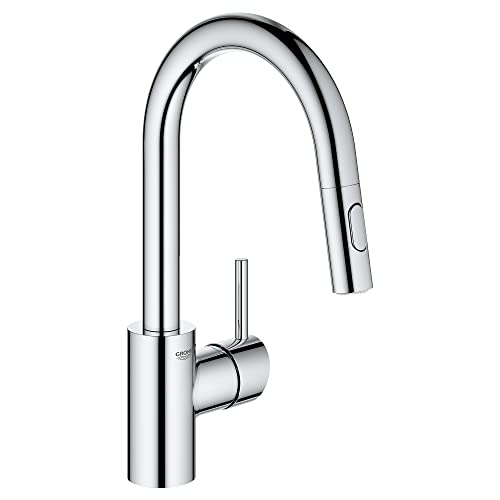
GROHE Concetto 31479001 Pull-Down Bar Faucet — Best Ceramic Valve Engineering
The Concetto suits the mechanically curious — the searcher who cares how the valve works, not just that it works — and smaller sinks where a full-size pull-down would overwhelm. As a bar and prep faucet it is also the right successor for the secondary sinks where classic single-handle faucets so often ended their service lives.
Strengths
- SilkMove ceramic valve is renowned for an exceptionally smooth, durable lever action
- Compact bar format fits prep sinks, bars and smaller kitchens the big picks cannot
- Dual spray and full swivel cover the daily jobs without excess
Trade-offs
- Bar/prep scale — too small as the main faucet for a large family sink
- Chrome Starlight finish shows spots more than brushed alternatives
- European sizing and parts channels differ from US mainstream norms
| Specification | Detail |
|---|---|
| Valve | SilkMove ceramic valve (per verified listing title) |
| Flow rate | 1.75 GPM (per verified listing title) |
| Spout | 360-degree swivel (per verified listing title) |
| Format | Bar/prep size, single hole (per verified listing title) |
SilkMove deserves its reputation in a valve-focused guide: GROHE machines its ceramic discs to extreme flatness and suspends the glide in a lubricant reservoir, producing a lever feel that stays silken for decades. Set beside a ball valve’s spring-loaded charm, it is the difference between a mechanism that manages wear and one that largely ignores it.
Size is the honest caveat. This verified Concetto is the bar-format model, and the review presents it as such — a superb prep-sink and small-kitchen successor rather than a main-sink giant. For the right sink, its valve is arguably the finest in this guide, and its compact pull-down format keeps every modern convenience in proportion.
Best for: Prep sinks, bars and valve connoisseurs / Not suited for: Large main sinks needing full-size reach
Check the current price on Amazon

FORIOUS Pull-Down Kitchen Faucet — Best Budget Ceramic Cartridge
The FORIOUS answers the budget form of the question: what replaces a tired ball faucet in a rental, a first home or a utility sink without spending premium money? Its ceramic cartridge deletes the rebuild cycle entirely, its deck plate covers the classic three-hole deck the old faucet leaves, and its certifications separate it from uncertified bargain listings.
Strengths
- Ceramic cartridge ends the springs-and-seats maintenance cycle outright
- Included deck plate covers the standard deck a classic faucet vacates
- Certified construction at an accessible tier, with a useful pause spray mode
Trade-offs
- Support tail is shorter than the legacy brands — keep model records
- Finish and casting refinement reflect the accessible tier
- No heritage connection — chosen purely as a functional successor
| Specification | Detail |
|---|---|
| Flow rate | 1.8 GPM (per verified listing) |
| Overall height | 14.76 in |
| Valve | Ceramic cartridge (per verified listing features) |
| Certification | cUPC and NSF/ANSI/CAN 61 (per verified listing features) |
There is a satisfying arithmetic to this pick: a ball faucet kept alive costs a rebuild kit and an hour every few years, forever, while this faucet’s cartridge asks for nothing for a very long time. The FORIOUS makes that trade at the lowest verified tier in this guide, without cutting the fundamentals — stainless construction, ceramic valve, real certifications.
For landlords, renovators and utility sinks, that is the whole argument, and it is a good one. Premium picks in this guide add feel, finish and support depth; the FORIOUS adds none of those, and charges accordingly. As a successor where the budget rules, it is the honest recommendation.
Best for: Rentals, first homes and utility sinks on a budget / Not suited for: Forever kitchens wanting maximum support depth
Check the current price on Amazon

WEWE Pull-Down Kitchen Faucet with Ceramic Cartridge — Best Value With Easy-Clean Nozzles
Choose the WEWE if your ball faucet lives in hard water, where its seats scaled and its spray head clogged in a yearly rhythm. This successor attacks both ends of that maintenance: a ceramic cartridge that ignores scale far better than spring-loaded seats, and silicone nozzles that clear with a fingertip rub instead of a vinegar soak and a pin.
Strengths
- Ceramic cartridge plus rub-clean nozzles minimise hard-water maintenance at both ends
- Braided stainless supply hoses included — a genuine step above basic lines
- Three spray modes and full swivel cover daily work without complexity
Trade-offs
- Single-hole fit only in this verified variant — multi-hole decks need another pick
- Value-tier brand support is online-led
- Spray quality is competent rather than premium
| Specification | Detail |
|---|---|
| Valve | Ceramic cartridge (per verified listing title) |
| Construction | SUS 304 stainless (per verified listing title) |
| Installation | 1-hole fit (per verified listing title) |
| Supply hoses | 304 braided (per verified listing title) |
Maintenance fatigue is the unspoken driver behind many ceramic ball searches: the owner is not in love with the ball, they are tired of servicing it. The WEWE is curated for exactly that owner. Its specification reads like a list of the classic faucet’s chores, each engineered away — seats, springs, clogged nozzles, perishable supply lines.
It remains a value-tier faucet, with the support caveats that implies, and its single-hole fit narrows its decks. But for a hard-water kitchen replacing a high-maintenance classic on a sensible budget, no pick in this guide removes more recurring chores per purchase.
Best for: Hard-water homes wanting minimum recurring maintenance / Not suited for: Multi-hole decks or buyers wanting legacy-brand support
Check the current price on Amazon
Comparison Table
None of these faucets contains a ball valve — the table instead compares the modern valves that replaced it, and the job each successor does best. If you are keeping a ball faucet instead, skip to the how-to section: its service procedure is the other half of this guide.
| Pick | Badge | Key spec | Best for |
|---|---|---|---|
| Delta Boyd 19893Z-SPSD-DST Kitchen Faucet with Soap Dispenser (Check on Amazon) | Closest Modern Successor | DIAMOND Seal disc platform; soap dispenser included; ShieldSpray | Ball-faucet owners replacing like with better |
| Delta Essa 9113-AR-DST Pull-Down Kitchen Faucet (Check on Amazon) | Best Single-Handle Feel | 15.25 in height; DIAMOND Seal platform; magnetic docking | Cooks who prize one-lever blend control |
| Kraus Oletto KPF-2820SFS Pull-Down Kitchen Faucet (Check on Amazon) | Best Ceramic Cartridge | 1.8 GPM; 16.63 in height; ceramic cartridge; brass body | Durability-first buyers with wide sinks and tall cookware |
| GROHE Concetto 31479001 Pull-Down Bar Faucet (Check on Amazon) | Best Ceramic Valve Engineering | SilkMove ceramic valve; 1.75 GPM; dual spray; 360° swivel | Prep sinks, bars and valve connoisseurs |
| FORIOUS Pull-Down Kitchen Faucet (Check on Amazon) | Best Budget Ceramic Cartridge | 1.8 GPM; ceramic cartridge; 3 modes; deck plate included | Rentals, first homes and utility sinks on a budget |
| WEWE Pull-Down Kitchen Faucet with Ceramic Cartridge (Check on Amazon) | Best Value With Easy-Clean Nozzles | Ceramic cartridge; 3 modes; easy-clean nozzles; tool-free install claim | Hard-water homes wanting minimum recurring maintenance |
How to Choose a Successor to a Ceramic Ball Kitchen Faucet
First, be certain what you are replacing. A classic ball faucet is a single-handle design whose lever sits on a domed cap; underneath, a slotted ball rotates over spring-loaded rubber seats. If that is your faucet, you have two honest paths. Path one is service: the mechanism is genuinely repairable, rebuild kits with balls, seats, springs and seals remain available, and the how-to section below walks the job. Path two is replacement with a ceramic disc or cartridge model from this guide, which trades the classic’s charm for a valve that needs nothing for years. Neither path involves buying a new ball faucet, because the mainstream market no longer makes one that this programme could verify.
Choosing within path two, match the successor to what you valued. If it was the brand and the blend gesture, Delta’s DIAMOND Seal models — Boyd and Essa here — are the direct lineage. If it was the promise of a hard valve surface, the Kraus Oletto’s ceramic cartridge and the GROHE Concetto’s SilkMove discs are the purest modern forms. If it was simply low cost of ownership, the FORIOUS and WEWE deliver the cartridge revolution at accessible tiers. Then apply the ordinary checks — deck holes, height clearance, sink size — exactly as you would for any faucet purchase.
Ball Valves vs Ceramic Discs and Cartridges: What Actually Changed
The ball valve sealed by pressure: springs pushed rubber seats against a rotating ball, and the lever’s cam set that pressure. It was ingenious and, when new, delightful — but every seal depended on spring force and rubber condition, so time, heat and grit guaranteed eventual drips, typically answered with a rebuild kit. The ceramic disc valve seals by surface: two discs polished so flat that their faces form the seal, rotating to align or close their ports. There is no spring to tire and no rubber seat in the water path to perish, which is why disc and cartridge faucets routinely outlast ball designs by years between services.
Ceramic cartridges package the same disc principle inside a replaceable unit, which is why the terms blur in listings — and why ceramic ball appears at all: sellers merge ball-era recognition with cartridge-era hardware. The practical differences among modern successors are smaller than the generational leap from ball to disc. Any verified pick in this guide will feel smoother at year five than a rebuilt ball faucet feels at month five, and that, more than any feature list, is what the upgrade buys.
Keeping a Classic Ball Faucet Alive: When Service Beats Replacement
Replacement is not always right. A ball faucet in a period kitchen, a rental you do not own, or a fixture with genuine sentimental or architectural value deserves service first — the mechanism was designed for it, and a full rebuild restores function for a modest parts cost. Service also wins when the faucet body and finish remain sound: it is the internals that wear, not the casting. The warning signs that service is losing the argument are a scored or corroded ball, a worn cam, or a body that drips from anywhere other than the spout — those point to replacement with a successor from this guide.
Budget the comparison honestly. A rebuild kit costs little and buys a few years; repeated rebuilds on a tired body buy less each time. A modern successor costs more once and removes the cycle. The crossover is usually the second rebuild: if you are opening the faucet again, price the successor before you order the kit. Many owners find the arithmetic — and the pull-down spray, docking and finishes that come with it — settles the question.
Reading Listings That Say Ceramic Ball: A Field Guide
When a listing uses the phrase ceramic ball, translate it before you evaluate it. In the great majority of current cases it means one of three things: a ceramic cartridge faucet described by a seller merging two eras of vocabulary; a ball-faucet repair component — an actual ball, seat set or rebuild kit — photographed like a product in its own right; or a faucet whose valve the seller cannot describe and has chosen not to. Each translation has a different correct response. The cartridge faucet can be judged on its merits, as this guide judges its picks. The repair component is a legitimate purchase if you are servicing a classic — bought by part number, not by photograph. The indescribable valve is a listing to leave.
The checks take a minute. Find the valve description in the title or specifications and see whether it names a mechanism you can verify — ceramic disc, ceramic cartridge, a named platform like DIAMOND Seal or SilkMove. Look for the brand’s own model number and confirm the same number carries the same description in the manufacturer’s documentation. If either check fails, the listing has told you what it is. This guide applied exactly those checks to build its successor shortlist, and they will protect any purchase you make beyond it.
What Happened to the Ball Faucet: A Short, Honest History
The ball valve was a mid-century breakthrough: one lever controlling temperature and flow together, through a slotted ball rotating over spring-loaded seats, at a time when the alternative was two compression taps and a washer schedule. Delta built an empire on it, and generations of plumbers built a service rhythm around its rebuild kits — seats and springs every few years, a ball when the old one scored. The design was not flawed; it was honest machinery for an era that expected to maintain its machinery.
What ended it was not a better idea about control but a better material for sealing. Ceramic discs, arriving in premium faucets and then everywhere, removed the perishable parts the ball design depended on, and the industry’s centre of gravity moved within a generation. The ball faucet’s legacy is visible everywhere in this guide: the single-lever gesture every pick preserves, the DST platform Delta built as its successor, and the repair kits that still keep sound classics alive. Understanding that history is the difference between shopping for a mechanism and shopping for a memory — both legitimate, but only one is sold in stores today.
The Rebuild Kit Economy: What Keeping a Classic Really Costs
Owners weighing service against replacement deserve the real arithmetic. A ball-faucet rebuild renews seats, springs and seals for a modest parts cost and an hour of careful work, and on a sound body it restores years of service — genuinely good value. The costs that hide are recurrence and condition: the second rebuild comes sooner than the first if the ball is wearing, a scored ball converts a kit into a kit plus a ball, and a body that has begun to drip from its casting is spending your money on a faucet that has already decided. Each service also carries the small-parts risk the how-to section guards against — a lost spring is a second purchase and a second day.
Set against that, a successor from this guide costs more once and then asks for nothing for a very long time, while adding pull-down rinsing and modern finishes the classic never had. The crossover most owners report is the second rebuild: the moment the faucet asks to be opened again, its lifetime cost of attention exceeds the successor’s. Service the classic proudly until that moment — it was designed for your hands — and then replace it without guilt when it arrives.
How to Service a Ball-Valve Kitchen Faucet (and Know When to Stop)
If you are keeping the classic, this is the service its design invites. Work on a depressurised faucet, lay parts out in removal order on a towel, and photograph each stage — a ball faucet has more small parts than any modern cartridge, and their order is the whole job. If you find corrosion or scoring at any stage, that is the honest signal to switch to a successor from this guide instead.
- Shut off and drain. Close both angle stops, open the faucet to relieve pressure, and plug the drain so no spring or seat can escape down it — the classic beginner’s loss in this job.
- Remove the handle and cap. Loosen the handle’s set screw, lift the lever off, then unscrew the domed cap assembly beneath it. Note the adjusting ring’s position if fitted; its setting controls handle feel and you will want it back where it was.
- Lift out the cam and ball. Remove the cam and its washer, then lift the ball itself. Inspect the ball’s surface under good light: smooth and bright means serviceable; pitted, scored or corroded means the faucet is telling you its age — price a successor before buying parts.
- Fish out the seats and springs. With tweezers, lift the two rubber seats and the springs beneath them from their ports. These are the wear parts that cause nearly all ball-faucet drips, and they are what the rebuild kit replaces.
- Clean the valve body. Wipe the chamber and ports free of grit and old grease with a soft cloth. Do not scour the sealing surfaces — like the ceramic discs that replaced this design, they seal by smoothness.
- Fit new seats and springs. Seat each new spring in its port, cap it with a new rubber seat, and press gently until both sit level. Refit the ball with its slot engaged on the body’s pin, then the cam and washer in their original orientation.
- Reassemble and test. Refit the cap and handle, restore water slowly, and test hot, cold and the full blend arc. A correct rebuild is drip-free immediately; a drip that persists after one careful re-check of seat seating means the ball or body is worn, and replacement — not another kit — is the honest next step.
A successful rebuild buys a sound ball faucet several more years, and there is real satisfaction in a mechanism designed to be serviced by its owner. Keep the kit’s part number with your records; if a second rebuild comes due sooner than the first did, the faucet is giving you its final verdict — answer it with a successor, not a third kit.
If You Own the Classic: Parts Numbers and Generation Traps
Ball faucets were produced across decades and generations, and their service parts are generation-specific in ways photographs conceal. Balls differ in port pattern, seats differ in size, and cams differ in profile between production eras of what looks like the same faucet. The reliable identifier is the faucet’s own model and date information, checked against the manufacturer’s parts documentation — never the shape of the old part alone, and never a kit chosen because its picture resembles yours.
Keep the old parts until the rebuilt faucet has run a week. If a drip returns, the comparison between old and new components is the fastest diagnosis available, and the kit’s packaging — with its part number — becomes the record that makes the next service, or the successor purchase, a one-step decision. Classic machinery rewards documented owners; be one, and the ball faucet’s famous serviceability stays famous in your kitchen too.
Common Buying Mistakes
Mistake 1: Believing a listing that says ceramic ball. In current listings the phrase almost always describes a ceramic cartridge faucet, a repair part, or nothing verifiable at all. Ask what the valve actually is; if the answer is not a clear mechanism description, you are looking at marketing, not engineering.
Mistake 2: Rebuilding a scored ball. New seats against a pitted ball will drip again within months. Inspect the ball honestly during service — its surface condition, not hope, decides whether the kit is money well spent.
Mistake 3: Losing the small parts. Springs and seats are tiny, springy and drawn to drains. Plug the sink, work over a towel, and lay parts out in order. Most failed rebuilds are missing-part stories, not skill stories.
Mistake 4: Replacing the faucet but not the deck plan. Classic ball faucets usually sit on three-hole decks with a sprayer or dispenser history. Choose a successor with an included deckplate or a dispenser plan — like the Boyd — so the new install finishes as neatly as it functions.
Mistake 5: Over-tightening the cap to stop a drip. On a ball faucet, crushing the adjusting ring distorts the seal geometry and accelerates wear. A drip after a correct rebuild means worn parts, not insufficient force — diagnose the surface, not the tightness.
Final Recommendation
If you came here for a ceramic ball faucet, leave with the truth and a better faucet. The Delta Boyd is the closest modern successor — the ball’s own lineage, minus its maintenance. The Delta Essa perfects the single-lever feel, the Kraus Oletto and GROHE Concetto carry the ceramic valve idea in its purest forms, and the FORIOUS and WEWE deliver it at accessible tiers. If your classic still deserves service, the how-to above will give it years more — with a clear-eyed rule for when to stop.
What this guide would not do is sell you a mechanism that the verified market does not offer. Every link here resolves to a real, checked successor — and that honesty, applied to a confusing search term, is worth more than a shortlist of faucets that do not exist.
To recap the confirmed purchases in this guide: Delta Boyd 19893Z-SPSD-DST Kitchen Faucet with Soap Dispenser (Closest Modern Successor) — check price on Amazon; Delta Essa 9113-AR-DST Pull-Down Kitchen Faucet (Best Single-Handle Feel) — check price on Amazon; Kraus Oletto KPF-2820SFS Pull-Down Kitchen Faucet (Best Ceramic Cartridge) — check price on Amazon; GROHE Concetto 31479001 Pull-Down Bar Faucet (Best Ceramic Valve Engineering) — check price on Amazon; FORIOUS Pull-Down Kitchen Faucet (Best Budget Ceramic Cartridge) — check price on Amazon; WEWE Pull-Down Kitchen Faucet with Ceramic Cartridge (Best Value With Easy-Clean Nozzles) — check price on Amazon.
Keep researching within this range with these companion guides: Best Kitchen Faucets Ceramic Disk; Best Kitchen Faucets Available; Best Kitchen Faucets Brushed Nickel; Best Ceramic Disk Kitchen Faucets; Best Ceramic Kitchen Faucets.
Frequently Asked Questions
Can I still buy a new ceramic ball kitchen faucet?
Not as a mainstream, warrantied product that this programme could verify. Ball-valve faucets are a legacy design; what current listings call ceramic ball is almost always a ceramic cartridge faucet or a repair kit described loosely. This guide therefore shortlists verified ceramic disc and cartridge successors — and shows you how to service a genuine ball faucet if you already own one.
What is the difference between a ball valve and a ceramic disc valve?
A ball valve seals with spring-loaded rubber seats pressed against a rotating slotted ball, so its seals wear with spring fatigue and grit. A ceramic disc valve seals with two discs polished flat enough to seal face-to-face, with no spring pressure involved. The disc design is why modern faucets run years longer between services — it manages the same job with far fewer perishable parts.
Is Delta’s DIAMOND Seal related to the old ball faucets?
Yes, in lineage. Delta built its single-handle reputation on ball designs, and the DIAMOND Seal platform in the DST models in this guide is its modern disc-based successor: same one-lever blend philosophy, with a diamond-embedded disc surface engineered to remove the ball era’s wear points. Owners switching across usually find the control feel familiar on the first day.
My ball faucet drips. Should I rebuild it or replace it?
Rebuild it if the ball’s surface is smooth and the body is sound — the job is detailed in this guide’s how-to section and the parts are inexpensive. Replace it if the ball is scored or corroded, if the body drips anywhere but the spout, or if this would be the second rebuild in a short span. Those are the faucet’s signals that service has stopped being economical.
Are ceramic cartridge and ceramic disc the same thing?
They are the same sealing principle in different packaging. A ceramic disc valve is built into the faucet; a ceramic cartridge packages the discs into a single replaceable unit that swaps as one part. Both outlast ball mechanisms by a wide margin. Listings use the terms loosely, which is one reason ceramic ball appears — the verified picks here state their valve basis plainly.
Will a modern successor fit the deck my ball faucet leaves behind?
Usually, with the right pick. Classic ball faucets typically occupied three-hole decks, so choose a successor with an included deckplate — the FORIOUS here — or a model that puts a hole to work, like the Boyd’s included soap dispenser. Single-hole models like the Essa need a separate plate. Measure your hole spread before ordering and the swap stays simple.
Are ball-faucet repair kits still available?
Yes — the service ecosystem outlived the faucet designs, which is exactly why this guide’s how-to section can walk a rebuild with confidence. Balls, seats, springs and full kits remain orderable for the classic single-handle designs, identified by the faucet’s model and generation. Buy by part number from the manufacturer’s documentation rather than by photograph, because visually similar kits differ in ball pattern and seat size between generations.


