Disclosure: airfryerkitchensupply.com is reader-supported. When you buy through links on our site, we may earn an affiliate commission at no extra cost to you.
Where to Buy
Every model in this guide to the best kinds of kitchen sink faucets was verified against Amazon’s catalog data for this site before it earned a link, and each listing is the exact model reviewed as its type’s representative. Types are best understood through real examples, so use these links to study the actual product behind each kind, then check price on Amazon.
- Moen Essie 87014SRS Pulldown Kitchen Faucet (The Pull-Down Kind) (Best Pull-Down Kind) — Check the current price on Amazon
- GROHE Essence 30271DC0 Dual Spray Pull-Out Kitchen Faucet (The Pull-Out Kind) (Best Pull-Out Kind) — Check the current price on Amazon
- Kingston Brass KS1273ALBS Heritage Bridge Kitchen Faucet (The Bridge Kind) (Best Bridge Kind) — Check the current price on Amazon
- Moen Belfield 7255SRS Two-Handle High Arc Faucet with Side Spray (The Two-Handle Side-Spray Kind) (Best Two-Handle Side-Spray Kind) — Check the current price on Amazon
- KOHLER Sensate K-72218-WB-BL Touchless Kitchen Faucet (The Touchless Kind) (Best Touchless Kind) — Check the current price on Amazon
- Kingston Brass KS3225AX Wall Mount Bridge Kitchen Faucet (The Wall-Mount Kind) (Best Wall-Mount Kind) — Check the current price on Amazon
The best kinds of kitchen sink faucets cannot be ranked on one list, because the kinds are not competitors so much as answers to different kitchens. A pull-down faucet, a bridge faucet, and a wall-mount faucet are not three attempts at the same job — they are three different ideas about where water should come from, how hands should control it, and what a sink is for. This guide treats the category the way it deserves: as a map. Six major kinds are profiled, each represented by the strongest verified example we could attach to it, with an honest account of who that kind serves and who it quietly fails.
The six kinds covered here span the full modern landscape. Pull-down and pull-out faucets dominate contemporary kitchens for good reasons of reach and rinsing. The bridge faucet carries two centuries of design into farmhouse and traditional kitchens. The two-handle faucet with a side sprayer remains the quiet workhorse of classic decks. Touchless faucets are the newest kind, solving the messy-hands problem with sensors. And the wall-mount faucet — the oldest kind of all — still owns situations no deck faucet can serve. Between them, they cover essentially every kitchen sink being plumbed today.
Read this guide as a decision tree rather than a countdown. Find the kind whose strengths match your cooking, your sink, and your deck’s realities; then use the representative pick as your benchmark example of that kind done well — and follow the internal links at the end into the deep-dive guide for whichever kind wins. The right kind, chosen first, makes every later decision in the purchase easier and better.
In this guide
Quick Picks
One benchmark product per kind. The badges name the kind itself — read the quick lines as the map’s legend, then the reviews as the territory. If you already know your kind, jump straight to its profile and its deep-dive link at the end; if you do not, the buying guide’s decision sequence will name it for you in about three questions.
- Best Pull-Down Kind: Moen Essie 87014SRS Pulldown Kitchen Faucet (The Pull-Down Kind) — The dominant modern kind: the spray head pulls down from a high-arc spout on a hose for aim and reach.
- Best Pull-Out Kind: GROHE Essence 30271DC0 Dual Spray Pull-Out Kitchen Faucet (The Pull-Out Kind) — The spray head pulls out from a lower, sleeker spout — lighter, more precise, kinder to small sinks.
- Best Bridge Kind: Kingston Brass KS1273ALBS Heritage Bridge Kitchen Faucet (The Bridge Kind) — Hot and cold supplies rise separately and join in an exposed bridge — the heritage kind, with a brass side sprayer.
- Best Two-Handle Side-Spray Kind: Moen Belfield 7255SRS Two-Handle High Arc Faucet with Side Spray (The Two-Handle Side-Spray Kind) — The classic layout: fixed high-arc spout, two handles, and a separate sprayer on its own hose.
- Best Touchless Kind: KOHLER Sensate K-72218-WB-BL Touchless Kitchen Faucet (The Touchless Kind) — The newest kind: sensor activation with the sensor in the spout itself — no handle interaction needed at all.
- Best Wall-Mount Kind: Kingston Brass KS3225AX Wall Mount Bridge Kitchen Faucet (The Wall-Mount Kind) — The faucet leaves the deck entirely — mounted on the wall, freeing the counter and serving deep farm sinks.
How These Picks Were Chosen
This guide’s method differs from a standard roundup, so it is stated plainly. Each kind was assigned the strongest representative we could verify through Amazon data for this site — searched by brand and model, title matched, link attached only on a confident match. The representative had to be a genuine exemplar: not merely a faucet of that kind, but one whose execution shows why the kind exists. A mediocre pull-down would teach the wrong lesson about pull-downs; the picks below were chosen to teach the right ones.
Kinds were selected for coverage of real buying decisions. We included the two sprayer architectures (pull-down and pull-out) because buyers conflate them and should not; the two heritage architectures (bridge and two-handle side-spray) because traditional kitchens are a third of the market and are served by no other kinds; touchless because it is the only genuinely new kind in a generation; and wall-mount because it solves installations the other five cannot. Specialty sub-kinds — pot fillers, bar and prep faucets, commercial pre-rinse — are addressed in the buying guide as branches from these six trunks, so the map is complete without pretending every branch is a tree.
A note on what this guide deliberately does not do: crown a single winner. Every other guide in this series ranks models within a lens; this one’s lens is the category itself, and its honest output is a match, not a champion. If the structure feels unusual, that is the point — the most common faucet-buying error we see is a reader carrying a ‘best faucet’ answer from one kind into a kitchen built for another. The benchmarks here are starting points inside each kind, and the deep-dive guides linked at the end take over the ranking work within whichever kind your kitchen chooses.
The 6 Best Kinds of Kitchen Sink Faucets, Each With Its Benchmark Example
Each entry profiles the kind first — its mechanics, its natural home, its characteristic failure — and then its benchmark product, so you can judge the kind and the example separately.
A reading tip that will sharpen every profile: when a kind’s trade-offs are listed, translate them into your own kitchen before judging. A shorter hose is trivia in a 24-inch sink and a deal-breaker in a 36-inch farm sink; a sensor’s learning curve is nothing to a household of two and a season of explanations to a household that hosts weekly. Kinds are not good or bad in the abstract — they are fitted or unfitted to specific sinks, cooks, and decades, and the profiles are written to let you perform that fitting honestly.
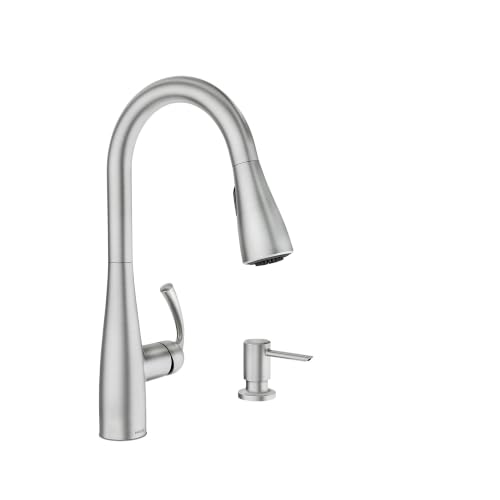
Moen Essie 87014SRS Pulldown Kitchen Faucet (The Pull-Down Kind) — Best Pull-Down Kind
The pull-down is the kind that won the modern kitchen, and the Essie shows why in its purest form. The concept: a high-arc spout whose tip is a spray head on a retractable hose. Docked, it is a handsome fixed faucet with full pot clearance. Undocked, the head comes to your hand and the water goes where the work is — the far corner of the sink, the sheet pan overhanging the edge, the pot sitting on the counter. That single move — bringing the outlet to the task instead of the task to the outlet — is the most consequential idea in modern faucet design, and it is why pull-downs outsell every other kind.
The Essie is the right benchmark because it executes the kind without excess. Power Clean spray gives the head a genuinely effective rinse; Reflex docking returns it smoothly and seats it securely, addressing the kind’s characteristic weakness — heads that droop or hang crooked as hoses and docks age; and the mounting flexibility (one to four holes, deck plate included, soap dispenser in this configuration) fits the real decks of real kitchens. At 15.75 inches tall, it clears standard pots under standard cabinets. It is the kind’s everyman, done properly.
Choose the pull-down kind if your cooking involves oversized items, deep sinks, and frequent rinsing — which is to say, most modern cooking. Pass on it if your deck is a period restoration (the bridge kind awaits), if you run a portable dishwasher (pull-downs cannot accept its adapter — a fixed-spout kind is required), or if you simply prefer a stream that never moves. The pull-down’s dominance is earned, but it is not universal, and the kinds below exist for the kitchens it does not fit.
Strengths
- The head comes to the work — unmatched rinsing aim and reach
- High arc gives pot clearance with the head docked
- The widest selection of any kind, at every tier and style
Trade-offs
- Hose and docking are wear components over a long life
- Cannot connect a portable dishwasher — no standard aerator threads
- Cheap examples droop; docking quality is the kind’s dividing line
| Kind | Pull-down |
| Benchmark dimensions | 8.78 x 2.31 x 15.75 in |
| Mounting | 1, 2, 3, or 4-hole (deck plate included) |
| Spray system | Power Clean |
| Docking | Reflex |
Best for: Most modern kitchens — the default kind for general cooking / Not suited for: Portable dishwasher connections or period-authentic restorations
Check on Amazon — check price on Amazon before you buy, since finish variants of this model are listed separately.

GROHE Essence 30271DC0 Dual Spray Pull-Out Kitchen Faucet (The Pull-Out Kind) — Best Pull-Out Kind
The pull-out is the pull-down’s older, subtler sibling, and the distinction matters. Where a pull-down’s head drops from a tall arc, a pull-out’s head extends forward from a lower, more compact spout. The result is a faucet that keeps a lower profile — the European preference, and the right answer for sinks under low cabinets or windows — while still putting a spray head in your hand. The aim is more horizontal than vertical: superb for rinsing at sink level, filling items beside the sink, and working in shallow basins where a tall arc would splash.
Grohe’s Essence is the kind’s exemplar because it pairs the format with the best handle feel in the business. The SilkMove ceramic cartridge moves with a damped precision that makes temperature adjustment a one-finger pleasure, the dual spray covers stream and shower patterns, and the SuperSteel finish delivers stainless character with Grohe’s surface quality. In a contemporary kitchen with a modest sink, the Essence delivers ninety percent of the pull-down experience in a calmer, sleeker object — which for many kitchens is the correct hundred percent.
Know the kind’s boundaries. The hose reach is shorter than a pull-down’s, and the lower spout gives less docked clearance for tall pots — measure your tallest vessel against it. Like pull-downs, pull-outs cannot host a portable dishwasher adapter. Choose the pull-out kind for smaller sinks, lower clearances, and cooks who work at sink level; choose its sibling when maximum reach and clearance rule. The kinds are close cousins, and the honest differences are profile, reach, and aim direction.
Strengths
- Lower profile suits low cabinets, windows, and smaller sinks
- Light, precise in-hand spray control at sink level
- Exemplary cartridge smoothness in the Grohe benchmark
Trade-offs
- Shorter hose reach than pull-down designs
- Less docked clearance for tall stockpots
- No portable dishwasher compatibility, like all wand kinds
| Kind | Pull-out |
| Spray | Dual spray |
| Cartridge | GROHE SilkMove ceramic |
| Finish | SuperSteel (stainless steel) |
Best for: Smaller sinks, low clearances, and European-style kitchens / Not suited for: Maximum reach needs or tall-pot households
Check on Amazon — check price on Amazon before you buy, since finish variants of this model are listed separately.
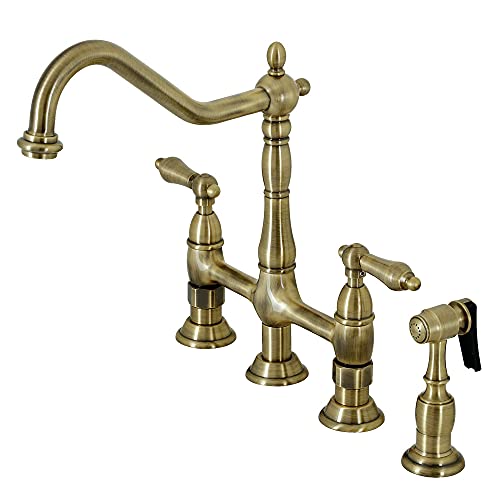
Kingston Brass KS1273ALBS Heritage Bridge Kitchen Faucet (The Bridge Kind) — Best Bridge Kind
The bridge faucet is plumbing as architecture. In every other kind, hot and cold mix inside a concealed body; in a bridge, the two supplies rise through separate deck holes and meet in an exposed horizontal bridge from which the spout descends — a layout inherited from the era when faucets were assembled from visible pipework. The result is the most characterful silhouette in the category: separate handles, exposed structure, and a presence that farmhouse, traditional, and restoration kitchens cannot obtain from any other kind.
Kingston Brass’s Heritage is the benchmark because the brand specializes in exactly this: traditionally styled bridge faucets in finishes the majors have abandoned, this one in antique brass with a matching brass side sprayer for rinsing utility. The format’s virtues are real beyond looks — individual handles give direct mechanical control, every joint is visible and serviceable, and the construction is honest metal throughout. In a kitchen built around a farmhouse sink and period detail, a bridge faucet is not a styling flourish; it is the historically correct fixture, and it works with a directness modern faucets rarely match.
The kind’s terms are equally real. Bridge faucets need their specific multi-hole deck layout (typically three holes with the sprayer), offer no pull-down convenience, and ask for traditional styling commitment from the whole room. Their sprayer is a side unit — good for rinsing, no substitute for a wand’s reach. Choose the bridge kind when the kitchen’s character is the brief and the cooking is conventional; it will serve beautifully for decades. Choose it for a minimalist modern kitchen and it will look like a museum loan — a fine object in the wrong home.
Strengths
- Unmatched period character — the historically correct farmhouse fixture
- Exposed, serviceable construction with direct mechanical control
- Heritage finishes unavailable from mainstream brands
Trade-offs
- Requires its specific multi-hole deck layout
- Side sprayer only — no wand reach or pull-down convenience
- Commits the room to traditional styling
| Kind | Bridge, 8-inch centers |
| Included | Brass side sprayer |
| Finish | Antique Brass |
Best for: Farmhouse, traditional, and period restoration kitchens / Not suited for: Modern minimalist kitchens or single-hole decks
Check on Amazon — check price on Amazon before you buy, since finish variants of this model are listed separately.

Moen Belfield 7255SRS Two-Handle High Arc Faucet with Side Spray (The Two-Handle Side-Spray Kind) — Best Two-Handle Side-Spray Kind
Before wands existed, this was the premium layout, and it remains the right answer for a large class of kitchens: a fixed spout — here a high arc with real pot clearance — flanked by two handles, plus a side sprayer on its own hose for rinsing. The architecture’s virtues are the inverse of the pull-down’s. The stream never moves, so it is always where you left it; the sprayer is light and independent; nothing docks, droops, or retracts. For cooks whose work is filling and rinsing at a fixed station, this kind’s calm permanence is a feature the wand kinds cannot replicate.
The Belfield is the benchmark because Moen executes the classics properly: Duralock quick-connect fittings underneath, ADA-compliant lever operation, and the Spot Resist Stainless finish that keeps a tall spout presentable under daily handling. The high arc deserves emphasis — this kind’s traditional weakness was low spouts, and the Belfield’s arc removes it, giving the layout modern clearance with classic manners. On a four-hole traditional deck, it installs as the faucet the sink was designed around.
Its boundaries are the layout’s own. The side sprayer’s hose is shorter than a wand’s, so countertop filling is out; two handles mean two-handed temperature changes; and the multi-hole footprint needs the deck to match. Uniquely among the sprayer kinds here, though, this one keeps a standard aerator on a fixed spout — which means it can accept a portable dishwasher adapter, a trick no wand kind can perform. For traditional kitchens, and especially traditional kitchens with portable dishwashers, this kind is not a compromise — it is the design center.
Strengths
- Fixed stream is always positioned — nothing to dock or droop
- Independent side sprayer is light and precise
- Standard aerator accepts a portable dishwasher adapter
Trade-offs
- Side sprayer reach is shorter than a pull-down wand
- Two-handed temperature control
- Multi-hole deck footprint required
| Kind | Two-handle with side spray |
| Style | Traditional high arc |
| Finish | Spot Resist Stainless |
| Features | Duralock quick connect, ADA compliant (per API features) |
Best for: Traditional kitchens, fixed-station cooks, portable dishwasher homes / Not suited for: Countertop pot filling or single-hole modern decks
Check on Amazon — check price on Amazon before you buy, since finish variants of this model are listed separately.

KOHLER Sensate K-72218-WB-BL Touchless Kitchen Faucet (The Touchless Kind) — Best Touchless Kind
The touchless faucet is the first genuinely new kind since the pull-down, and the Sensate is its purest expression: Kohler placed the sensor in the underside of the spout itself, so the faucet responds to the presence of hands or an object in the sink zone — no handle to touch, no wave gesture to learn, just water when something is under the spout and silence when nothing is. In matte black, with the Sensate’s sculptural single-post design, it is also the most visually distinctive kind on this page: a faucet with no visible controls at all.
The kind’s case is hygiene and flow discipline in one. Raw-food hands never touch the fixture; water runs only while the work is in the zone, which trims the waste of a faucet left running during prep; and the handle — present for temperature setting and manual override — stays clean indefinitely. Kohler’s execution runs the system on AC power with the design intent of a permanent installation, and the underlying faucet is a premium pull-down, so the kind’s novelty rides on flagship plumbing rather than gadgetry.
Judge the kind by its honest terms. Sensor systems add cost, a power requirement, and a behavior layer guests will need explained; the activation zone is a logic some households love in a day and others tolerate forever. And a touchless faucet is a commitment to a brand’s electronics support in a way a mechanical kind never asks. For high-mess, high-hygiene, design-forward kitchens, the touchless kind is the future arriving early. For households that prize mechanical permanence above all, the kinds above it on this page remain undefeated.
Strengths
- True hands-free activation — sensor in the spout, nothing to touch
- Water runs only while work is in the zone, trimming waste
- Sculptural control-free design unlike any other kind
Trade-offs
- Power requirement and electronics support commitment
- Guests need the system explained; a behavior layer to learn
- Premium pricing for the kind’s flagship execution
| Kind | Touchless (sensor-activated) |
| Style | Pull-down, single post |
| Finish | Matte Black |
| Activation | In-spout sensor (Sensate) |
Best for: High-hygiene, high-mess, design-forward kitchens / Not suited for: Electronics-free households or the tightest budgets
Check on Amazon — check price on Amazon before you buy, since finish variants of this model are listed separately.

Kingston Brass KS3225AX Wall Mount Bridge Kitchen Faucet (The Wall-Mount Kind) — Best Wall-Mount Kind
The wall-mount is the oldest kind in this guide — it predates deck mounting entirely — and it survives because it solves problems no deck faucet can. Mounting the faucet on the wall behind the sink frees the entire counter and sink ledge, serves deep farmhouse and commercial-style sinks whose ledges are too narrow or too precious to drill, and puts the spout at a height and reach deck geometry cannot always achieve. In restaurant kitchens, pot-filling stations, and period homes, it remains not a style choice but the correct engineering answer.
Kingston Brass’s KS3225AX presents the kind in its bridge form — wall-mounted supplies joining in an exposed bridge — in oil rubbed bronze, a finish that suits the farmhouse and traditional settings where wall-mounts most often live. The format’s daily character is distinctive: the deck stays completely clear for prep and cleaning, the spout swings over the sink from above, and the whole arrangement has the honest, plumbed-in permanence of a fixture that is part of the building rather than an appliance on it.
The kind’s price of admission is the highest in this guide, and it is paid in planning, not money. The water supplies must be in the wall, at the right height and spacing, before the wall is closed — making wall-mount a renovation decision, not a swap. Retrofitting one into a finished kitchen means opening the wall. Freeze climate and exterior walls add a plumbing caution a plumber should judge. But for a renovation already opening walls, or a farm sink with no deck to give, the wall-mount kind is not exotic — it is simply the right tool, and this benchmark shows it in its most characterful form.
Strengths
- Frees the entire deck and sink ledge — unmatched workspace
- Serves deep farm sinks and ledges that cannot be drilled
- Spout height and reach beyond deck-mount geometry
Trade-offs
- Requires in-wall supplies — a renovation-stage decision
- Retrofitting means opening the wall
- Exterior-wall installations need freeze-risk assessment
| Kind | Wall-mount bridge |
| Finish | Oil Rubbed Bronze |
Best for: Renovations, farmhouse sinks, and deck-less installations / Not suited for: Swap-in replacements on finished kitchens
Check on Amazon — check price on Amazon before you buy, since finish variants of this model are listed separately.
Comparison Table
Six kinds, six philosophies. This table compresses each kind’s defining mechanic and its natural home — the fastest way to find your kind before reading its full profile. Use it as a filter, not a verdict: strike the kinds your deck, sink, and special cases eliminate, then read the full profiles of the two or three survivors. That sequence — facts first, taste second — is the method this entire guide is built to teach.
| Pick | Badge | Key Spec | Best For |
|---|---|---|---|
| Moen Essie 87014SRS Pulldown Kitchen Faucet (The Pull-Down Kind) | Best Pull-Down Kind | Pull-down spray head on a retractable hose, high arc | Most modern kitchens — the default kind for general cooking |
| GROHE Essence 30271DC0 Dual Spray Pull-Out Kitchen Faucet (The Pull-Out Kind) | Best Pull-Out Kind | Pull-out spray head in a low-profile spout | Smaller sinks, low clearances, and European-style kitchens |
| Kingston Brass KS1273ALBS Heritage Bridge Kitchen Faucet (The Bridge Kind) | Best Bridge Kind | Exposed bridge mixing, two handles, brass sprayer | Farmhouse, traditional, and period restoration kitchens |
| Moen Belfield 7255SRS Two-Handle High Arc Faucet with Side Spray (The Two-Handle Side-Spray Kind) | Best Two-Handle Side-Spray Kind | Fixed high arc, two handles, independent side sprayer | Traditional kitchens, fixed-station cooks, portable dishwasher homes |
| KOHLER Sensate K-72218-WB-BL Touchless Kitchen Faucet (The Touchless Kind) | Best Touchless Kind | Sensor-activated, control-free design | High-hygiene, high-mess, design-forward kitchens |
| Kingston Brass KS3225AX Wall Mount Bridge Kitchen Faucet (The Wall-Mount Kind) | Best Wall-Mount Kind | Wall-mounted bridge, deck completely free | Renovations, farmhouse sinks, and deck-less installations |
How to Choose Among the Best Kinds of Kitchen Sink Faucets
Choose by constraints first, preference second — kinds are eliminated by facts before they are chosen by taste. Constraint one is the deck: count your sink or counter holes and their spacing. One hole admits pull-down, pull-out, and touchless kinds; three and four holes open the two-handle and bridge kinds (or require plates to close down); no usable deck at all points to wall-mount. Constraint two is the sink: deep basins want wand reach or high arcs; shallow basins punish tall fixed spouts with splash; farm sinks may force wall-mount. Constraint three is the household’s special cases: a portable dishwasher eliminates both wand kinds outright; accessibility needs elevate touchless and lever designs; a period restoration elevates bridge and wall-mount.
With constraints applied, usually two kinds remain, and preference decides honestly between them. Ask how you actually cook. If your sink work is pans, trays, and volume rinsing, wand kinds earn their dominance. If your work is filling, washing at a station, and calm repetition, fixed-spout kinds will please you longer. If your kitchen’s design is a serious project — farmhouse, period, architectural — let the room vote: bridge and wall-mount kinds exist because some kitchens are diminished by a pull-down’s modernity, and no amount of rinsing convenience compensates a room that feels wrong every day.
Finally, remember that kinds combine with tiers independently. Every kind in this guide exists from budget to luxury; the kind decision sets the architecture, the tier decision sets the materials and longevity. Make them in that order — kind first, then the best example of that kind your horizon justifies — and you will have replicated, in two steps, the process this entire guide series is built on.
The Branches: Sub-Kinds Worth Knowing
Three specialized branches extend the six trunks. The bar or prep faucet is a scaled-down pull-down or fixed faucet for a secondary sink — same kinds, smaller geometry, chosen for islands and prep zones where a full faucet would crowd the work. The pot filler is not a sink faucet at all but a wall- or deck-mounted articulated arm over the stove; it belongs in this map because buyers meet it while shopping kinds, and its lesson is that it fills pots only — you still carry them, full and heavy, to the sink to drain. The commercial pre-rinse is the pull-down’s industrial cousin — spring-mounted, built for dish pits — covered in depth in our industrial guide.
Two more distinctions prevent common confusion. Single-handle versus two-handle is a control layout that cuts across kinds — pull-downs are usually single-handle, bridges always two — and should be chosen by hand habit and accessibility, not treated as a kind itself. And ‘touch’ versus ‘touchless’ are different activation kinds: touch faucets respond to contact with the spout or handle, touchless to presence or gesture. Both live under the sensor umbrella in this guide’s touchless profile, and our integrated guide separates them properly for buyers choosing between them.
Matching Kind to Sink, Deck, and Decade
A few pairings recur so reliably they can be stated as defaults. Deep single-bowl sink, modern kitchen, family cooking: pull-down. Compact sink, low window, European styling: pull-out. Farmhouse sink, traditional renovation, design-led: bridge or wall-mount, decided by whether the walls are opening. Classic four-hole deck, mixed household, portable dishwasher in the picture: two-handle side-spray. High-mess cooking, hygiene priority, smart-home comfort: touchless. These defaults are starting points, not rules — but a buyer departing from one should know which fact about their kitchen justifies the departure.
Think in decades, too. Kinds differ in what ages: wand kinds age at their hoses and docks (replaceable, plannable), sensor kinds age at their electronics (brand support is the plan), heritage kinds age hardly at all because there is little to age. A household renovating for thirty years weights that ledger differently from a household bridging five. The kind is the longest-lived decision in the purchase — finishes date, tiers are outgrown, but the architecture you choose will shape every day at the sink for as long as the faucet lasts.
Second Sinks, Rentals, and Resale: Kind Strategy Beyond the Main Kitchen
The main kitchen gets the kind analysis; the rest of the property should get kind strategy. A prep or island sink wants a scaled version of the main kind or a simple fixed spout — its jobs are narrower, and matching the main faucet’s family keeps cartridges and finishes unified across the room. A laundry or utility sink wants the kinds at their most mechanical: two-handle or commercial fixed designs that tolerate dirty hands, buckets, and indifference. In each case the kind follows the work, and the savings from simplifying secondary sinks are real money that buys tier at the main sink, where it is felt daily.
Rentals invert the priorities: the kind that survives tenants and services cheaply wins, which is why the two-handle and simple pull-down kinds dominate sensible rental specifications, and why sensor kinds — batteries, behaviors, support calls — are usually wrong there however appealing. Resale sits between: buyers read a kitchen in seconds, and the kind contributes to that read — a pull-down signals a current kitchen, a bridge signals a designed one, a wall-mount signals an architectural one. None is universally ‘worth more’; each is worth most in the kitchen whose story it tells. The through-line of this whole guide applies at property scale exactly as at sink scale: kind is a match, not a ranking.
How to Identify Your Current Faucet Kind (and Measure for Its Replacement)
Before shopping kinds, know exactly what you have and what your sink permits. This ten-minute audit produces every fact the kind decision needs.
- Count the deck holes: look at the sink or counter behind the basin — one, two, three, or four holes, including any used by a sprayer, dispenser, or air gap. Note which are occupied and which are capped.
- Identify the current kind: a spray head that pulls from the spout (wand — down or out), a fixed spout with a separate sprayer, a bridge with exposed mixing, a wall-mounted unit, or a sensor model. The replacement kind must fit the same holes or bring a deck plate that covers them.
- Measure the essentials: spout height and reach of the current faucet, sink depth, and the clearance from counter to the lowest cabinet or window obstruction above the sink.
- Check under the sink: supply line condition, shut-off valves that actually shut, and the space a pull-down hose loop and weight would need if you are changing kinds.
- Note your special cases in writing: portable dishwasher (fixed spout required), water filter or dispenser plans (deck holes spoken for), accessibility needs (lever or sensor preference).
- If changing kinds, confirm the new kind’s mounting against your audit before ordering — most kind-change failures are hole-pattern and clearance surprises that this audit exists to prevent.
- On replacement day, the swap itself is standard faucet work: supplies off, old unit out, deck cleaned, new unit dry-fit and seated, lines flushed before the head is attached, every fitting checked dry.
With the audit in hand, the kind decision in the buying guide becomes mechanical — and mechanical, at the start of a purchase, is exactly what you want.
Repeat the audit mentally whenever your kitchen changes: a new deeper sink, a portable dishwasher arriving or retiring, a household member whose hands need a lever or a sensor. Kinds are chosen against a household’s facts, and facts change. The faucet that was right for the last decade of cooking may be the wrong kind for the next one, and recognizing that moment — rather than replacing like with like out of habit — is the most valuable habit this guide can leave you with.
Common Buying Mistakes
Kind-level mistakes are the most expensive in faucet buying, because the faucet can be excellent and the purchase still wrong. These six are the classics.
- Choosing a kind by photograph instead of by kitchen. A bridge faucet in a minimalist kitchen, a spring in a cottage — the kind must belong to the room and the cooking, not to a saved image.
- Forgetting the portable dishwasher rule. Wand kinds cannot accept the adapter. If a portable dishwasher lives in your kitchen, the kind decision is already made: fixed spout.
- Miscounting deck holes. Kinds have hole signatures. Order against a counted, photographed deck — never against memory — or budget for plates and caps.
- Treating pull-down and pull-out as the same kind. They differ in profile, reach, and aim direction. Small sinks and low clearances want the pull-out; big sinks and tall pots want the pull-down.
- Buying touchless without checking power. Sensor kinds need batteries or an outlet and a reachable control box. Audit under your sink before the kind seduces you.
- Renovating past the wall-mount moment. Wall-mount must be decided while walls are open. Fall in love with it after the tile is up and the price becomes a demolition.
Every one of these is a five-minute check made before ordering. The kind decision is the cheapest decision to get right and the most expensive to get wrong — spend the five minutes.
There is a reassuring flip side: because kinds are architectures rather than fashions, a kind chosen well stays chosen well. Finishes cycle, features accumulate, tiers shift — but the household that matched its kind to its sink, its cooking, and its constraints has made the one decision in the purchase that time does not erode. Everything else in faucet buying is refinement. This is foundation.
Final Recommendation
If you need one sentence: most modern kitchens should buy the pull-down kind, exemplified here by the Moen Essie; smaller and lower kitchens the pull-out, exemplified by the GROHE Essence; traditional kitchens the bridge or two-handle kinds, exemplified by the Kingston Heritage and the Moen Belfield; hygiene-led kitchens the touchless KOHLER Sensate; and renovations with open walls should at least consider the wall-mount Kingston. Choose the kind first — the model second — and the purchase will organize itself.
Now go deep on your kind: Best Bridge Kitchen Faucets for the heritage deep-dive, Best Automatic Kitchen Faucets for sensor kinds, Best High Pressure Kitchen Faucets For Portable Dishwasher for the fixed-spout requirement in full, and Best All Around Kitchen Faucets for the mainstream model comparison. If height is your deciding factor, Best High Kitchen Faucets compares the tall examples across kinds.
Frequently Asked Questions
What is the most popular kind of kitchen faucet?
The pull-down, by a wide margin in modern kitchens — its combination of high-arc clearance and a spray head that comes to the work suits the widest range of cooking. Popularity is a reasonable default, not a verdict: the other kinds in this guide each own kitchens the pull-down serves poorly, from period restorations to portable-dishwasher households to deck-less farm sinks.
What is the difference between pull-down and pull-out faucets?
Direction and profile. A pull-down’s head drops from a tall arc, giving maximum reach and docked pot clearance. A pull-out’s head extends from a lower spout, giving a sleeker profile, lighter in-hand feel, and better behavior in small sinks and low clearances — at the cost of reach and clearance. They are cousins, not synonyms, and the choice between them is one of the most consequential in this guide.
Are bridge faucets practical, or just decorative?
Practical in the way their era defined it: direct mechanical control, visible serviceable construction, and durability measured in decades. What they lack is wand convenience — rinsing reach comes from a side sprayer or not at all. In a traditional kitchen with conventional cooking, that trade is invisible in daily life. In a kitchen built around sheet pans and volume rinsing, it is not — kind follows cooking.
Can any kind of faucet work with a portable dishwasher?
No — and this is the kind decision’s hardest constraint. Portable dishwashers connect through the faucet’s aerator threads, which only fixed-spout kinds expose in standard form. Pull-down, pull-out, and touchless wand designs cannot accept the adapter. The two-handle side-spray kind and other fixed-spout designs are the compatible kinds, as our dishwasher guide details in full.
Is touchless a kind of faucet or a feature?
Functionally a kind, because it changes the faucet’s architecture — sensor, control box, power, and activation logic — and the household’s behavior around it. It also layers onto other kinds (most touchless models are pull-downs underneath), which is why this guide profiles it as a kind with its own benchmark while our integrated guide treats activation technologies in comparative depth.
When should I choose a wall-mount faucet?
When the deck cannot serve — a farm sink with no ledge to drill, a counter you refuse to pierce — or when a renovation already has the walls open and the design wants the deck completely free. It is a planning-stage decision: supplies must be roughed into the wall at the right height and spacing before closing. Chosen at the right moment, it is a superb kind; chosen late, it is an expensive one.
Whichever kind you choose, the deep-dive guides linked above carry the model-by-model comparisons — this map’s job was to make sure you are shopping in the right territory. Choose the territory well, and every subsequent decision gets easier; that is the quiet promise underneath all six profiles above.


