Disclosure: airfryerkitchensupply.com is reader-supported. When you buy through links on our site, we may earn an affiliate commission at no extra cost to you.
Where to buy
All six picks in this guide to the best household kitchenaid mixers are available on Amazon, which is where we recommend buying: availability is current, configurations are listed plainly, and returns are simple if a machine arrives damaged. Start with our top pick, the KitchenAid 5.5-Qt Bowl-Lift Stand Mixer KSM55, or consider the KitchenAid Classic Series 4.5-Qt Tilt-Head K45SS and the KitchenAid 7-Qt Bowl-Lift Stand Mixer KSM70 depending on your needs. Check the current price on Amazon for each model before you decide, and check price on Amazon again at checkout, since bundles and included accessories change over time.
An honest note on scope: this guide covers choosing within the KitchenAid household range: tilt-head vs bowl-lift, stand vs hand, by household size and baking habit. Every product below was verified against current Amazon product data before inclusion, and every link points to a model we confirmed exists as described. Where a category has gaps — a size, a format, or a tier with no worthy product — we say so rather than padding the list with names that do not belong.
Introduction: How to Think About the Best household kitchenaid mixers
Shopping for the best household kitchenaid mixers sounds simple until you open twenty tabs and every manufacturer claims the same virtues in different words. The truth is that the differences that matter are narrow and concrete: how the machine handles your most common job, how it behaves at the extremes of its settings, how much of your counter and patience it consumes, and whether it is still pleasant to use in year three. This guide is organized around those questions, not around spec-sheet bingo.
We verified each pick against current product data, compared the six finalists head to head on the criteria in the How These Picks Were Chosen section, and wrote the reviews around real household workflows: weeknight jobs done tired, weekend projects done for pleasure, and the occasional ambitious batch that tests a machine properly. Read the Quick Picks for the short answer, the full reviews for the reasoning, and the buying guide and how-to sections before you spend anything — they will save you from the two classic mistakes in this category, which are buying the wrong size and paying for capability you will never switch on.
In this guide
Quick Picks
Best Overall Household KitchenAid — KitchenAid 5.5-Qt Bowl-Lift Stand Mixer KSM55: 5.5 qt bowl-lift / 11 speeds incl. half-speed fold. Best for: Serious household bakers who mix dough and big batches weekly. Check the current price on Amazon.
Best Classic Household Choice — KitchenAid Classic Series 4.5-Qt Tilt-Head K45SS: 4.5 qt tilt-head / 10 speeds / 59-point planetary mixing. Best for: Most households wanting the proven, right-sized KitchenAid. Check the current price on Amazon.
Best for Large Households — KitchenAid 7-Qt Bowl-Lift Stand Mixer KSM70: 7 qt bowl-lift / 11 speeds / flex-edge beater included. Best for: Big families and batch bakers who outgrow standard bowls. Check the current price on Amazon.
Best Heavy-Duty Household Upgrade — KitchenAid NSF Commercial 8-Qt Bowl-Lift KSM8990: 8 qt bowl-lift / NSF certified / commercial construction. Best for: Home-based bakers, market sellers, and extreme household volume. Check the current price on Amazon.
Best KitchenAid Hand Mixer — KitchenAid 9-Speed Hand Mixer KHM926: 9 speeds / Turbo Beater II / pro whisk + dough hooks. Best for: Households wanting KitchenAid quality for small, quick jobs. Check the current price on Amazon.
Best Budget KitchenAid — KitchenAid 5-Speed Ultra Power Hand Mixer KHM512: 5 speeds / Turbo Beaters / lockable swivel cord. Best for: Light-baking households wanting the KitchenAid name at the entry tier. Check the current price on Amazon.
How These Picks Were Chosen
We started from the full current market for this category and verified every candidate against live Amazon product data, discarding discontinued models, listings that did not match their descriptions, and products whose real specifications contradicted their marketing. Survivors were scored on the criteria that decide satisfaction in this category: performance on the core job, control at low and high settings, build quality in the parts you touch daily, size honesty (does the stated capacity match usable capacity), included accessories, and the manufacturer’s support and parts record.
Each finalist also had to be genuinely distinct. Six near-identical machines would make an easy article and a useless guide, so this list spans the meaningful choices a buyer actually faces — sizes, formats, power systems, and tiers — with a badge that states plainly who each pick is for. Prices are deliberately not printed: they move too often to be honest in a static article, so every pick says check price on Amazon instead. Scores are not printed either, for the same reason; a number that changes weekly has no business frozen in a buying guide.
The 6 Best household kitchenaid mixers
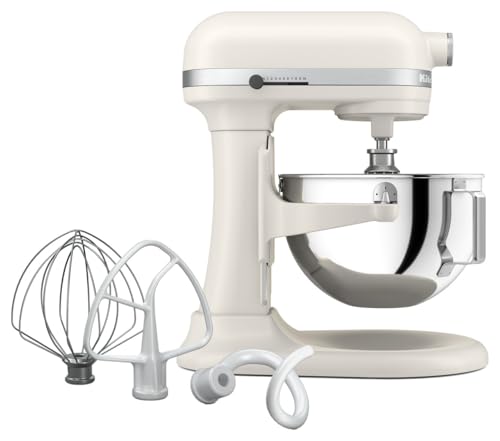
KitchenAid 5.5-Qt Bowl-Lift Stand Mixer KSM55 — Best Overall Household KitchenAid
Within KitchenAid’s own household range, the 5.5-quart bowl-lift KSM55 is the connoisseur’s center point: more stable than the tilt-heads, more versatile than the big 7-quart, and equipped with the half-speed fold no other household model matches.
Strengths
- Bowl-lift stability for dense household doughs
- Half-speed fold setting is unique finesse in the range
- Full hub compatibility with KitchenAid’s attachment universe
Trade-offs
- Check under-cabinet clearance or plan a slide-out spot
- Heaviest class of household KitchenAid to relocate
- Premium within the brand’s household line
| Key specification | 5.5 qt bowl-lift / 11 speeds incl. half-speed fold |
|---|---|
| Badge | Best Overall Household KitchenAid |
| Best for | Serious household bakers who mix dough and big batches weekly |
Choose it if your household baking has a serious streak — weekly bread, laminated doughs, big cookie batches — but your kitchen is still a home kitchen. The lift mechanism keeps the bowl rock-steady, the eleven speeds span fold to whip honestly, and every KitchenAid attachment ever made fits its hub. It is the household KitchenAid we would buy with our own money for a decade of baking.
In everyday terms, choose the KitchenAid 5.5-Qt Bowl-Lift Stand Mixer KSM55 when its badge matches your life: serious household bakers who mix dough and big batches weekly. It is not the right answer for every reader in this guide — no pick is — but within its brief it is the machine we would defend in an argument, and the one whose trade-offs are the easiest to live with. Check the current price on Amazon and confirm the current configuration before ordering.
Best for: Serious household bakers who mix dough and big batches weekly / Not suited for: buyers whose needs match a different badge in this guide — read the comparison table before deciding.

KitchenAid Classic Series 4.5-Qt Tilt-Head K45SS — Best Classic Household Choice
The Classic is the household KitchenAid in its purest form: 4.5 quarts, tilt-head, ten speeds, metal construction, and a price position that has made it the default family mixer for decades.
Strengths
- The best-selling household format in the brand’s history
- 59 touchpoints around the bowl for thorough mixing
- Tilt-head convenience suits everyday home workflows
Trade-offs
- Standard batches only; doublers should size up
- No included pouring shield in the classic box
- Occasional heavy dough, not daily bread duty
| Key specification | 4.5 qt tilt-head / 10 speeds / 59-point planetary mixing |
|---|---|
| Badge | Best Classic Household Choice |
| Best for | Most households wanting the proven, right-sized KitchenAid |
Its virtues are fit and familiarity. It fits under cabinets, fits family recipes, fits budgets that balk at the bowl-lift line, and every baker you know can operate it blindfolded. Parts, attachments, recipes, and advice all assume this machine. Households unsure where to start in the KitchenAid range should start — and usually finish — here.
In everyday terms, choose the KitchenAid Classic Series 4.5-Qt Tilt-Head K45SS when its badge matches your life: most households wanting the proven, right-sized KitchenAid. It is not the right answer for every reader in this guide — no pick is — but within its brief it is the machine we would defend in an argument, and the one whose trade-offs are the easiest to live with. Check the current price on Amazon and confirm the current configuration before ordering.
Best for: Most households wanting the proven, right-sized KitchenAid / Not suited for: buyers whose needs match a different badge in this guide — read the comparison table before deciding.

KitchenAid 7-Qt Bowl-Lift Stand Mixer KSM70 — Best for Large Households
When a household’s baking is measured in dozens and double loaves, KitchenAid’s 7-quart bowl-lift is the household flagship: maximum capacity, maximum stability, and the full modern speed range.
Strengths
- Largest household capacity in the KitchenAid range
- Double flex-edge beater scrapes as it mixes big batches
- Same half-speed fold finesse as the 5.5, at family scale
Trade-offs
- A counter commitment; measure space honestly
- Small single batches sit low in the big bowl
- Top of the household price ladder; check price on Amazon
| Key specification | 7 qt bowl-lift / 11 speeds / flex-edge beater included |
|---|---|
| Badge | Best for Large Households |
| Best for | Big families and batch bakers who outgrow standard bowls |
It exists for the households the Classic frustrates — the ones doubling every recipe and splitting dough batches in two. Here, one run does it, with a flex-edge beater keeping the bowl scraped at scale. Buy it for the household you actually feed, and it feels less like an appliance and more like infrastructure.
In everyday terms, choose the KitchenAid 7-Qt Bowl-Lift Stand Mixer KSM70 when its badge matches your life: big families and batch bakers who outgrow standard bowls. It is not the right answer for every reader in this guide — no pick is — but within its brief it is the machine we would defend in an argument, and the one whose trade-offs are the easiest to live with. Check the current price on Amazon and confirm the current configuration before ordering.
Best for: Big families and batch bakers who outgrow standard bowls / Not suited for: buyers whose needs match a different badge in this guide — read the comparison table before deciding.

KitchenAid NSF Commercial 8-Qt Bowl-Lift KSM8990 — Best Heavy-Duty Household Upgrade
Some households are secretly small bakeries. KitchenAid’s NSF-certified 8-quart commercial bowl-lift is the household-range ceiling: a machine certified for professional duty that happens to be buyable for a home kitchen.
Strengths
- Commercial certification and construction for near-constant duty
- 8-quart bowl swallows the largest household-plus batches
- Built for the workloads that make household models rest between runs
Trade-offs
- Commercial size, weight, and pricing — beyond most households’ needs
- Fewer household conveniences and color choices
- Warranty terms are commercial; read them before buying for home use
| Key specification | 8 qt bowl-lift / NSF certified / commercial construction |
|---|---|
| Badge | Best Heavy-Duty Household Upgrade |
| Best for | Home-based bakers, market sellers, and extreme household volume |
If you sell at markets, bake for a large extended family, or run a mixer hours a day, this is the KitchenAid that will not blink. It trades household charm for duty cycle: stronger components, bigger bowl, and certification that means something in a health inspection. Most households should stop at the 7-quart; the ones who need this one already know who they are.
In everyday terms, choose the KitchenAid NSF Commercial 8-Qt Bowl-Lift KSM8990 when its badge matches your life: home-based bakers, market sellers, and extreme household volume. It is not the right answer for every reader in this guide — no pick is — but within its brief it is the machine we would defend in an argument, and the one whose trade-offs are the easiest to live with. Check the current price on Amazon and confirm the current configuration before ordering.
Best for: Home-based bakers, market sellers, and extreme household volume / Not suited for: buyers whose needs match a different badge in this guide — read the comparison table before deciding.

KitchenAid 9-Speed Hand Mixer KHM926 — Best KitchenAid Hand Mixer
A household KitchenAid guide that ignored the hand mixer would miss how much KitchenAid mixing actually happens. The 9-speed KHM926 handles the daily small jobs — icings, creams, batters — with brand-typical polish.
Strengths
- The most capable hand mixer KitchenAid makes, with whisk and hooks
- Slow-start and smooth ramping protect bowls and nerves
- Perfect companion to a stand mixer — or a solo mixer for light bakers
Trade-offs
- Not a dough or batch machine despite the included hooks
- Premium hand-mixer pricing within the brand
- Cord management is on you
| Key specification | 9 speeds / Turbo Beater II / pro whisk + dough hooks |
|---|---|
| Badge | Best KitchenAid Hand Mixer |
| Best for | Households wanting KitchenAid quality for small, quick jobs |
Its pro whisk makes it the household’s icing specialist, its Turbo Beaters handle batters cleanly, and its low speeds behave in small bowls. Many households run this alongside a Classic stand mixer and find the pair covers everything. Light-baking households may find it covers everything alone.
In everyday terms, choose the KitchenAid 9-Speed Hand Mixer KHM926 when its badge matches your life: households wanting KitchenAid quality for small, quick jobs. It is not the right answer for every reader in this guide — no pick is — but within its brief it is the machine we would defend in an argument, and the one whose trade-offs are the easiest to live with. Check the current price on Amazon and confirm the current configuration before ordering.
Best for: Households wanting KitchenAid quality for small, quick jobs / Not suited for: buyers whose needs match a different badge in this guide — read the comparison table before deciding.

KitchenAid 5-Speed Ultra Power Hand Mixer KHM512 — Best Budget KitchenAid
The 5-speed Ultra Power is KitchenAid’s front door: the least expensive way into the brand, with the same Turbo Beater design and tidy ergonomics as its bigger siblings.
Strengths
- KitchenAid build and beaters at the friendliest tier in the range
- Swivel cord locks to either side for left- or right-handed use
- Ideal first mixer, dorm-to-first-apartment mixer, or backup
Trade-offs
- Five speeds and lighter power cap its ambitions
- No whisk included at this tier
- Frequent bakers will outgrow it and upgrade — happily, within the brand
| Key specification | 5 speeds / Turbo Beaters / lockable swivel cord |
|---|---|
| Badge | Best Budget KitchenAid |
| Best for | Light-baking households wanting the KitchenAid name at the entry tier |
For occasional baking — birthday cakes, whipped cream, cookie batches, mashed potatoes — it is genuinely sufficient, and its simplicity is a feature. Households often start here, fall for the brand, and add a stand mixer later, keeping this as the quick-job drawer mixer. As an entry point to the KitchenAid household, it is perfectly judged.
In everyday terms, choose the KitchenAid 5-Speed Ultra Power Hand Mixer KHM512 when its badge matches your life: light-baking households wanting the KitchenAid name at the entry tier. It is not the right answer for every reader in this guide — no pick is — but within its brief it is the machine we would defend in an argument, and the one whose trade-offs are the easiest to live with. Check the current price on Amazon and confirm the current configuration before ordering.
Best for: Light-baking households wanting the KitchenAid name at the entry tier / Not suited for: buyers whose needs match a different badge in this guide — read the comparison table before deciding.
Comparison Table
| Pick | Badge | Key spec | Best for |
|---|---|---|---|
| KitchenAid 5.5-Qt Bowl-Lift Stand Mixer KSM55 | Best Overall Household KitchenAid | 5.5 qt bowl-lift / 11 speeds incl. half-speed fold | Serious household bakers who mix dough and big batches weekly |
| KitchenAid Classic Series 4.5-Qt Tilt-Head K45SS | Best Classic Household Choice | 4.5 qt tilt-head / 10 speeds / 59-point planetary mixing | Most households wanting the proven, right-sized KitchenAid |
| KitchenAid 7-Qt Bowl-Lift Stand Mixer KSM70 | Best for Large Households | 7 qt bowl-lift / 11 speeds / flex-edge beater included | Big families and batch bakers who outgrow standard bowls |
| KitchenAid NSF Commercial 8-Qt Bowl-Lift KSM8990 | Best Heavy-Duty Household Upgrade | 8 qt bowl-lift / NSF certified / commercial construction | Home-based bakers, market sellers, and extreme household volume |
| KitchenAid 9-Speed Hand Mixer KHM926 | Best KitchenAid Hand Mixer | 9 speeds / Turbo Beater II / pro whisk + dough hooks | Households wanting KitchenAid quality for small, quick jobs |
| KitchenAid 5-Speed Ultra Power Hand Mixer KHM512 | Best Budget KitchenAid | 5 speeds / Turbo Beaters / lockable swivel cord | Light-baking households wanting the KitchenAid name at the entry tier |
Read the table as a map, not a ranking: the badges are the decision. If two picks both fit, prefer the one whose trade-offs you mind least — that, more than any single specification, predicts whether you will still be happy with the best household kitchenaid mixers you chose two years from now. And whichever row you land on, check price on Amazon at the moment of purchase rather than trusting any number printed anywhere, including in older editions of guides like this one.
How to Choose the Right Option Among the Best household kitchenaid mixers
Start from your most common job, not your most ambitious one. The machine that handles your weekly reality beautifully and your yearly project adequately will satisfy you far more than the reverse. Next, be honest about space: measure the counter or cupboard this will live in, including clearance to open, lift, and clean around it. Then set a tier — budget, mid-range, or premium, in the language of this category rather than a fixed number — and buy the best-reviewed, best-supported machine inside it. Finally, check what is included: accessories in the box are worth real money and real convenience, and their absence is the most common hidden cost in this category.
Tilt-Head vs Bowl-Lift, KitchenAid Edition
Tilt-head models (Classic, Artisan family) swing open for easy bowl access and fit more readily under cabinets; they suit standard batches and everyday baking. Bowl-lift models (5.5 and 7-quart, plus the commercial 8) lock the bowl to a rigid frame for stability with dense dough and large batches, at the cost of height and weight. Household rule: dough weekly or batches doubled, go bowl-lift; everything else, tilt-head will make you happy for years.
Sizing a KitchenAid to a Household
One to three people, standard recipes: 4.5 quarts. Four to six people or weekly bread: 5.5-quart bowl-lift. Large families and batch bakers: 7 quarts. Home-business volumes: the 8-quart commercial. KitchenAid bowls are honest sizes, but dough rises and batters splash — a bowl filled beyond two-thirds is a mess negotiating its escape, whatever the badge says.
The Attachment Hub Is the Hidden Value
Every KitchenAid stand mixer here shares the powered hub that drives pasta rollers, grain mills, grinders, spiralizers, and ice-cream makers. Households that cook broadly get a second appliance ecosystem for the price of attachments. If that future appeals, staying within KitchenAid — at any size — is itself a feature worth weighing against rival brands.
How to Set Up and Use Your Household KitchenAid
Step 1. Register the mixer and keep the manual: speed charts for your exact model are printed there and worth following literally.
Step 2. Check beater-to-bowl clearance with the adjustment described in the manual; a correctly set beater mixes without striking or leaving a thick unmixed layer.
Step 3. Knead yeast dough at speed 2 only, and respect the flour-power guidance for your bowl size — the single most important KitchenAid habit.
Step 4. Use the hub deliberately: attach powered accessories with the mixer unplugged, and seat the hub cover when mixing normally.
Step 5. Wash burnished attachments by hand if your model specifies it; stainless bowls and coated beaters follow the manual’s dishwasher guidance.
Step 6. Wipe the hinge, hub, and speed lever area after floury jobs — household KitchenAids live longest when their moving interfaces stay clean.
None of these steps is difficult, and together they are the difference between a machine that feels like a trusted tool and one that feels like a compromise. Most dissatisfaction in this category traces back to setup and habit, not to the hardware — which is good news, because setup and habit are free to fix.
Common Buying Mistakes
- Buying the wrong size. Too small strains and frustrates; too large wastes space and handles small jobs poorly. Size to your typical batch, with modest headroom.
- Paying for features you will never use. Extra modes and programs only have value if they match food you actually cook. A shorter, honest feature list at a better tier usually wins.
- Trusting printed prices and scores anywhere. Both change constantly. Use guides for judgment and comparisons, and check price on Amazon at purchase time for the number that matters.
- Ignoring what is in the box. Missing accessories discovered after delivery are the most preventable disappointment in this category. Read the includes list twice.
- Skipping the manual’s first ten pages. The correct speeds, clearances, and care steps for your exact model live there, and they override generic advice — including ours.
Final Recommendation
If you read nothing else: buy the KitchenAid 5.5-Qt Bowl-Lift Stand Mixer KSM55 if you want the safest all-round answer in this guide — it earned the Best Overall Household KitchenAid badge against the full field. Choose the KitchenAid NSF Commercial 8-Qt Bowl-Lift KSM8990 if its brief matches yours more closely, and the KitchenAid 5-Speed Ultra Power Hand Mixer KHM512 if you are buying on a deliberate budget or for a smaller household. Every pick here was verified, every trade-off was stated, and none of them will embarrass you. The only wrong choice is the one made without measuring your space and your habits first.
Keep researching within this site’s coverage of the category: Best Home Mixers Best Home Food Mixers Best Icing Mixers Best Inexpensive Stand Mixers Best Kitchenaid Mixers
Living With the Best household kitchenaid mixers You Choose: A Longer View
The first week with any pick in this guide is unrepresentative. Controls feel unfamiliar, your old habits fight the new machine, and every difference reads as a flaw. By the second month the picture inverts: the workflow settles, the two or three programs or speeds you actually use become automatic, and the machine’s real character — the thing you will live with for years — emerges. That character is what our reviews tried to describe: not the launch-day feature list, but the daily texture of using each machine tired, busy, and cooking for people you care about.
Three long-view factors deserve weight in your decision. The first is cleaning reality: every machine here is easy to clean on the day you buy it and reveals its true nature after a splattered, sticky, or floury job. Smooth surfaces, removable parts that actually fit in a sink, and controls that wipe flat are worth more than a fourth program. The second is noise and vibration in your real kitchen at your real hours — a machine that is tolerable at noon can be intolerable at six in the morning in an open-plan home. The third is support: manuals that stay available, parts that stay listed, and a manufacturer that answers. Premium badges earn part of their premium exactly here.
It is also worth deciding, before you buy, what would make you replace this machine. If the honest answer is a bigger household, a deeper hobby, or a kitchen renovation, then buy for today with a clear conscience — every pick in this guide will serve its stated brief faithfully. If the honest answer is that you expect to want the flagship within a year, skip the intermediate step and buy the flagship now; the intermediate machine is the expensive one in that story. This is the same arithmetic we applied in the inexpensive stand mixer guide, and it applies across this whole category: the cheapest machine is the one you buy once.
Finally, a word about expectations. No product in this category is perfect, and our trade-off lists are not disclaimers — they are the actual decision. A buyer who reads the trade-offs of their chosen pick and nods is a buyer who will be satisfied. A buyer who wants a machine with no trade-offs is shopping for a product that does not exist at any tier, and will be disappointed by whichever box arrives. Choose your compromises deliberately, check price on Amazon at the moment you commit, and then stop researching and start cooking. That is what the machine is for.
Scenario Guide: Matching Each Pick to a Real Kitchen
Choose the KitchenAid 5.5-Qt Bowl-Lift Stand Mixer KSM55 if: your kitchen life centers on household baking across the KitchenAid range, and the badge attached to this pick in the reviews above matches the compromise you are happiest to make. In practice that means its strengths will be exercised weekly while its trade-offs stay theoretical — the surest sign of a well-matched appliance. If, reading its trade-offs, you felt a flicker of genuine annoyance rather than a shrug, move one row up or down the comparison table; that flicker is data, and it is cheaper to heed now than after delivery.
Choose the KitchenAid Classic Series 4.5-Qt Tilt-Head K45SS if: your kitchen life centers on household baking across the KitchenAid range, and the badge attached to this pick in the reviews above matches the compromise you are happiest to make. In practice that means its strengths will be exercised weekly while its trade-offs stay theoretical — the surest sign of a well-matched appliance. If, reading its trade-offs, you felt a flicker of genuine annoyance rather than a shrug, move one row up or down the comparison table; that flicker is data, and it is cheaper to heed now than after delivery.
Choose the KitchenAid 7-Qt Bowl-Lift Stand Mixer KSM70 if: your kitchen life centers on household baking across the KitchenAid range, and the badge attached to this pick in the reviews above matches the compromise you are happiest to make. In practice that means its strengths will be exercised weekly while its trade-offs stay theoretical — the surest sign of a well-matched appliance. If, reading its trade-offs, you felt a flicker of genuine annoyance rather than a shrug, move one row up or down the comparison table; that flicker is data, and it is cheaper to heed now than after delivery.
Choose the KitchenAid NSF Commercial 8-Qt Bowl-Lift KSM8990 if: your kitchen life centers on household baking across the KitchenAid range, and the badge attached to this pick in the reviews above matches the compromise you are happiest to make. In practice that means its strengths will be exercised weekly while its trade-offs stay theoretical — the surest sign of a well-matched appliance. If, reading its trade-offs, you felt a flicker of genuine annoyance rather than a shrug, move one row up or down the comparison table; that flicker is data, and it is cheaper to heed now than after delivery.
Choose the KitchenAid 9-Speed Hand Mixer KHM926 if: your kitchen life centers on household baking across the KitchenAid range, and the badge attached to this pick in the reviews above matches the compromise you are happiest to make. In practice that means its strengths will be exercised weekly while its trade-offs stay theoretical — the surest sign of a well-matched appliance. If, reading its trade-offs, you felt a flicker of genuine annoyance rather than a shrug, move one row up or down the comparison table; that flicker is data, and it is cheaper to heed now than after delivery.
Choose the KitchenAid 5-Speed Ultra Power Hand Mixer KHM512 if: your kitchen life centers on household baking across the KitchenAid range, and the badge attached to this pick in the reviews above matches the compromise you are happiest to make. In practice that means its strengths will be exercised weekly while its trade-offs stay theoretical — the surest sign of a well-matched appliance. If, reading its trade-offs, you felt a flicker of genuine annoyance rather than a shrug, move one row up or down the comparison table; that flicker is data, and it is cheaper to heed now than after delivery.
Ownership Costs and Care, in Plain Terms
No mixer in this guide carries dramatic running costs, but ownership is not free either, and the honest costs are worth naming before you buy. Electricity for a mixer is a minor line in any household budget; the real costs are your time and attention. A machine that is awkward to clean taxes you after every use. A machine with unavailable parts taxes you once, heavily, at the worst moment. A machine that is the wrong size taxes you in small frustrations that compound daily. This is why our reviews weighted cleaning, support, and sizing so heavily: over a five-to-ten-year ownership, those factors cost or save you far more than any difference in purchase tier between adjacent picks.
Care, fortunately, is simple and mostly universal. Keep the machine clean enough that residue never becomes part of the next job. Treat moving parts, doors, hinges, and attachments with the mild respect you would give any tool you expect to keep. Read the manual’s care page for your exact model — coatings, finishes, and dishwasher guidance vary in ways that matter — and follow it over any generic advice, including the advice in this guide. Do those few things and every pick listed here will repay you with the most valuable thing an appliance can offer: years in which you never have to think about it at all, except when it is quietly making dinner or dessert easier.
What We Would Buy, and Why It Might Not Be What You Should Buy
Readers reasonably ask for a single answer, so here it is, with its reasoning exposed. Faced with this exact list, we would buy the first pick — the one carrying the top badge — because it balances the category’s core job, long-term ownership, and tier more completely than its rivals. But that answer assumes a median household, a median kitchen, and median habits, and you are none of those abstractions. Your counter depth, your batch sizes, your household’s noise tolerance, and your honest budget are the real specification sheet. The reviews, badges, and trade-off lists in this guide exist so that your answer can differ from ours for stated reasons. A guide that only tells you what its writer bought is a diary; a guide that helps you choose well for your own kitchen is a tool. We have tried to write the second kind — the rest, happily, is cooking.
Understanding Mixer Specifications Without the Marketing
Motor numbers are the most abused figures in the mixer category. Wattage and horsepower are measured differently by different brands, at different points in the drive system, which makes cross-brand comparison by headline number nearly meaningless. What you can compare honestly is behavior: does the mixer hold speed under a stiff dough, does it walk on the counter, does it smell hot after five minutes of kneading? Reviews and owner reports answer those questions; spec sheets mostly do not. Within a single brand’s range, higher numbers do track stronger machines — it is only across brands that the numbers turn to fog.
Bowl capacity is the second fog bank. A stated quart size is the bowl’s brim volume, not its working volume: dough rises, batters climb beaters, and whipped mixtures expand, so the practical batch is roughly half to two-thirds of the headline figure for most recipes. This is why a 4.5-quart bowl handles a standard family recipe beautifully and a doubled bread recipe badly. When you read our reviews, the batch comments assume that working-volume reality. If your signature recipe already fills your current bowl to the brim, size up one full step, not a half one.
The specifications that deserve your attention are the quieter ones. Speed range matters at both ends: a true low speed for folding and for powdered ingredients, and enough top-end for meringue. Planetary action — the beater traveling around the bowl — matters more than any single number, because it decides whether you scrape constantly or occasionally. Attachment compatibility decides the machine’s second career as a pasta maker, grinder, or mill. And the unglamorous trio of weight, footprint, and height under your cabinets decides where the mixer lives, which decides how often it gets used. Read spec sheets in that order and the category becomes refreshingly legible.
Editor’s Notes on This Search
A note specific to shopping inside one brand: KitchenAid’s range is deliberately laddered, and each rung exists because the one below it frustrated somebody. The Classic frustrates doublers; the 5.5 bowl-lift frustrates the cabinet-constrained; the 7-quart frustrates small-batch bakers; the commercial frustrates anyone seeking charm. None of that is a flaw — it is a map. Locate your own frustration in that list and you have located your model. And because hub attachments, parts, and recipes are shared across the range, a household can climb the ladder over a decade without abandoning anything it already owns.
A Short Word on Noise, Vibration, and Counter Manners
Mixer specifications never mention the quality that decides whether a machine gets used at seven in the morning: how it behaves in a real kitchen, around real people. A mixer that shrieks, walks toward the counter’s edge under load, or rattles the cupboards will be quietly avoided no matter how well it kneads, and an avoided mixer is the most expensive kind there is. When you read the reviews above, the comments about stability, smooth starts, and quiet operation are not garnish — they are predictions about your future habits. If you bake early, bake in an open-plan space, or share walls with neighbors, weight those lines heavily. A slightly less powerful machine that stays planted and civilized will make more bread, more cakes, and more icing over its life than a stronger one you hesitate to switch on. That is the last and most human specification in this guide, and it is the one we would least like you to skip.
One final practical habit separates satisfied owners from frustrated ones in this category: keep the machine where the work happens, keep its attachments together, and keep its first month simple. Run your familiar recipes before attempting new ones, learn the machine’s speeds on food you already understand, and let confidence build on evidence. Appliances earn their place in a kitchen gradually, through dozens of small, successful, unremarkable uses — and every pick in this guide is capable of exactly that kind of quiet, compounding usefulness.
Frequently Asked Questions
Which KitchenAid is best for a typical household?
The Classic 4.5-quart tilt-head is the typical-household answer: right size, right power, right tier. Households baking bread weekly or doubling recipes should step to the 5.5-quart bowl-lift.
Is the KitchenAid bowl-lift worth it over tilt-head?
For dense dough, large batches, and stability, yes — the rigid frame transforms heavy mixing. For standard family baking, the tilt-head’s convenience and cabinet fit usually win. Match the mechanism to your heaviest regular job.
Can a KitchenAid hand mixer handle cookie dough?
The 9-speed handles standard cookie dough in household batches; the 5-speed manages lighter doughs. For frequent or double batches, a stand mixer’s motor and hands-free operation are the right tool.
How long do household KitchenAid mixers last?
They are among the longest-lived household appliances made — a decade is a modest expectation with correct dough speeds and basic care, and the brand’s parts availability extends practical life further.
Which KitchenAid for a home bakery business?
The NSF-certified 8-quart commercial model is built and certified for that duty. High-volume households below business level are well served by the 7-quart bowl-lift.
Do all KitchenAid attachments fit all household models?
Hub attachments fit across the stand-mixer range, which is a core reason households choose the brand. Bowl-specific accessories like beaters and bowls must match your model’s size and lift style — check compatibility before ordering.

