Disclosure: airfryerkitchensupply.com is reader-supported. When you buy through links on our site, we may earn an affiliate commission at no extra cost to you.
Where to buy
All six picks in this guide to the best home food mixers are available on Amazon, which is where we recommend buying: availability is current, configurations are listed plainly, and returns are simple if a machine arrives damaged. Start with our top pick, the KitchenAid 5.5-Qt Bowl-Lift Stand Mixer KSM55, or consider the Cuisinart 5.5-Qt Stand Mixer (12 Speed) and the Bosch Universal Plus Stand Mixer depending on your needs. Check the current price on Amazon for each model before you decide, and check price on Amazon again at checkout, since bundles and included accessories change over time.
An honest note on scope: this guide covers everyday home food preparation: doughs, batters, whipped toppings, and family baking. Every product below was verified against current Amazon product data before inclusion, and every link points to a model we confirmed exists as described. Where a category has gaps — a size, a format, or a tier with no worthy product — we say so rather than padding the list with names that do not belong.
Introduction: How to Think About the Best home food mixers
Shopping for the best home food mixers sounds simple until you open twenty tabs and every manufacturer claims the same virtues in different words. The truth is that the differences that matter are narrow and concrete: how the machine handles your most common job, how it behaves at the extremes of its settings, how much of your counter and patience it consumes, and whether it is still pleasant to use in year three. This guide is organized around those questions, not around spec-sheet bingo.
We verified each pick against current product data, compared the six finalists head to head on the criteria in the How These Picks Were Chosen section, and wrote the reviews around real household workflows: weeknight jobs done tired, weekend projects done for pleasure, and the occasional ambitious batch that tests a machine properly. Read the Quick Picks for the short answer, the full reviews for the reasoning, and the buying guide and how-to sections before you spend anything — they will save you from the two classic mistakes in this category, which are buying the wrong size and paying for capability you will never switch on.
In this guide
Quick Picks
Best Overall — KitchenAid 5.5-Qt Bowl-Lift Stand Mixer KSM55: 5.5 qt bowl-lift / 11 speeds incl. half-speed fold. Best for: Serious home bakers mixing bread dough and big batches weekly. Check the current price on Amazon.
Best Value Performer — Cuisinart 5.5-Qt Stand Mixer (12 Speed): 5.5 qt tilt-head / 12 speeds / whisk, paddle, dough hook included. Best for: Home bakers wanting full kit included at a mid-range tier. Check the current price on Amazon.
Best for Bread Dough — Bosch Universal Plus Stand Mixer: 6.5 qt / 500W bottom-drive / dough hook extender bundle. Best for: Bread bakers producing multiple loaves and large whole-grain batches. Check the current price on Amazon.
Best Budget Stand — Hamilton Beach 4-Qt Electric Stand Mixer: 4 qt / 7 speeds / planetary mixing / carry handle. Best for: Occasional bakers and small households entering stand mixing. Check the current price on Amazon.
Best Hand Mixer — KitchenAid 9-Speed Hand Mixer KHM926: 9 speeds / Turbo Beater II / pro whisk included. Best for: Small batches, quick whipping, and kitchens without counter space. Check the current price on Amazon.
Best Hand Mixer Storage — Cuisinart Power Advantage Plus 9-Speed Hand Mixer: 9 speeds / SmoothStart / snap-on storage case. Best for: Tidy kitchens that want hand-mixer power with all parts in one case. Check the current price on Amazon.
How These Picks Were Chosen
We started from the full current market for this category and verified every candidate against live Amazon product data, discarding discontinued models, listings that did not match their descriptions, and products whose real specifications contradicted their marketing. Survivors were scored on the criteria that decide satisfaction in this category: performance on the core job, control at low and high settings, build quality in the parts you touch daily, size honesty (does the stated capacity match usable capacity), included accessories, and the manufacturer’s support and parts record.
Each finalist also had to be genuinely distinct. Six near-identical machines would make an easy article and a useless guide, so this list spans the meaningful choices a buyer actually faces — sizes, formats, power systems, and tiers — with a badge that states plainly who each pick is for. Prices are deliberately not printed: they move too often to be honest in a static article, so every pick says check price on Amazon instead. Scores are not printed either, for the same reason; a number that changes weekly has no business frozen in a buying guide.
The 6 Best home food mixers

KitchenAid 5.5-Qt Bowl-Lift Stand Mixer KSM55 — Best Overall
For home food mixing at the serious end, KitchenAid’s 5.5-quart bowl-lift is the current benchmark. It has the stability for bread dough, the finesse for folding, and the accessory ecosystem to grow from mixer into food-prep hub.
Strengths
- Bowl-lift stability handles dense dough without the head wobbling
- Half-speed fold setting treats delicate batters gently
- Huge attachment ecosystem turns it into a pasta, grinding, and spiralizing station
Trade-offs
- Bowl-lift needs clearance or a sliding mat under cabinets
- Premium tier; check price on Amazon
- Heavier than tilt-head models to move for storage
| Key specification | 5.5 qt bowl-lift / 11 speeds incl. half-speed fold |
|---|---|
| Badge | Best Overall |
| Best for | Serious home bakers mixing bread dough and big batches weekly |
The bowl-lift architecture is the story: the bowl locks to a rigid frame, so torque goes into the dough instead of into rocking the machine. Eleven speeds including a true half-speed fold mean meringue and brioche are both at home here. If your household bakes weekly and your recipes keep getting bigger, this is the home food mixer that ends the upgrade cycle.
In everyday terms, choose the KitchenAid 5.5-Qt Bowl-Lift Stand Mixer KSM55 when its badge matches your life: serious home bakers mixing bread dough and big batches weekly. It is not the right answer for every reader in this guide — no pick is — but within its brief it is the machine we would defend in an argument, and the one whose trade-offs are the easiest to live with. Check the current price on Amazon and confirm the current configuration before ordering.
Best for: Serious home bakers mixing bread dough and big batches weekly / Not suited for: buyers whose needs match a different badge in this guide — read the comparison table before deciding.

Cuisinart 5.5-Qt Stand Mixer (12 Speed) — Best Value Performer
Cuisinart’s 5.5-quart stand mixer is the value overachiever of home food mixing: a big bowl, twelve speeds, and every core attachment in the box, at a tier below the premium badges.
Strengths
- Complete attachment set in the box, including splash guard with pour spout
- 12 speeds give fine control from fold to whip
- Strong dough performance for its tier
Trade-offs
- Tilt-head is less rigid than bowl-lift under the heaviest doughs
- Lighter build walks slightly on counters at top speed with stiff mixes
- Accessory ecosystem is smaller than KitchenAid’s
| Key specification | 5.5 qt tilt-head / 12 speeds / whisk, paddle, dough hook included |
|---|---|
| Badge | Best Value Performer |
| Best for | Home bakers wanting full kit included at a mid-range tier |
In daily baking it covers the full home repertoire — cake batters, cookie doughs, pizza dough, whipped cream — without drama, and the splash guard with a pour spout is the small kindness you appreciate every time you add flour. Buyers cross-shopping KitchenAid should know the trade precisely: you give up some rigidity and ecosystem depth, and you keep a meaningful sum of money. For most homes, that trade is smart.
In everyday terms, choose the Cuisinart 5.5-Qt Stand Mixer (12 Speed) when its badge matches your life: home bakers wanting full kit included at a mid-range tier. It is not the right answer for every reader in this guide — no pick is — but within its brief it is the machine we would defend in an argument, and the one whose trade-offs are the easiest to live with. Check the current price on Amazon and confirm the current configuration before ordering.
Best for: Home bakers wanting full kit included at a mid-range tier / Not suited for: buyers whose needs match a different badge in this guide — read the comparison table before deciding.
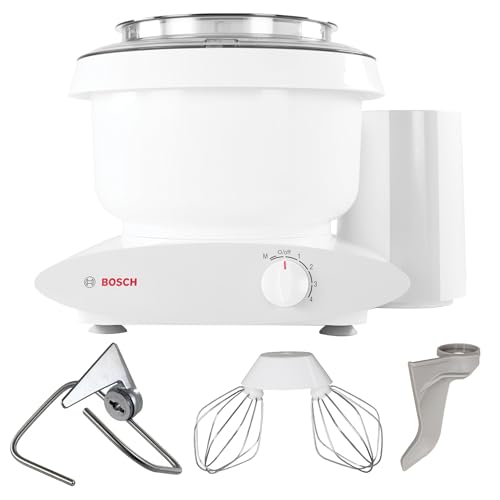
Bosch Universal Plus Stand Mixer — Best for Bread Dough
Ask bread bakers which home mixer they swear by and Bosch’s Universal Plus comes up with religious regularity. Its bottom-drive, open-bowl design was built around dough first, and it shows in every large batch.
Strengths
- Bottom-drive design kneads large, heavy dough batches without strain
- Open bowl top makes adding ingredients mid-mix effortless
- Legendary longevity in bread-baking communities
Trade-offs
- Whipped items need the wire whips technique; it is a dough-first machine
- Unconventional design has a learning curve
- Larger storage footprint than its bowl size suggests
| Key specification | 6.5 qt / 500W bottom-drive / dough hook extender bundle |
|---|---|
| Badge | Best for Bread Dough |
| Best for | Bread bakers producing multiple loaves and large whole-grain batches |
Where tilt-heads strain and walk, the Bosch just kneads — multiple loaves, whole-grain doughs, and big holiday batches included. The open top is a genuine workflow gift: flour goes in while it runs, without a guard gymnastics routine. It is less of a cake-and-meringue prima donna than the KitchenAid, which is exactly the point. Dough households, start here.
In everyday terms, choose the Bosch Universal Plus Stand Mixer when its badge matches your life: bread bakers producing multiple loaves and large whole-grain batches. It is not the right answer for every reader in this guide — no pick is — but within its brief it is the machine we would defend in an argument, and the one whose trade-offs are the easiest to live with. Check the current price on Amazon and confirm the current configuration before ordering.
Best for: Bread bakers producing multiple loaves and large whole-grain batches / Not suited for: buyers whose needs match a different badge in this guide — read the comparison table before deciding.

Hamilton Beach 4-Qt Electric Stand Mixer — Best Budget Stand
Hamilton Beach’s 4-quart stand mixer is how most households should enter stand mixing: real planetary action, a sensible bowl, and a price tier that does not require a family meeting.
Strengths
- Planetary mixing action reaches the whole bowl like pricier machines
- Carry handle and lighter weight suit stored-away, used-weekly routines
- Planetary action and splash guard at an entry tier
Trade-offs
- 4-quart bowl and motor are sized for standard, not double, batches
- Heavy bread dough is occasional work, not its specialty
- Plastic-forward build reflects the tier
| Key specification | 4 qt / 7 speeds / planetary mixing / carry handle |
|---|---|
| Badge | Best Budget Stand |
| Best for | Occasional bakers and small households entering stand mixing |
It handles the core home canon — cakes, cookies, muffins, mashed potatoes, whipped toppings — with competence and without counter dominance, and the handle matters more than spec sheets admit when the machine lives in a cupboard. Respect its batch limits, especially with stiff dough, and it will cover years of ordinary home baking faithfully.
In everyday terms, choose the Hamilton Beach 4-Qt Electric Stand Mixer when its badge matches your life: occasional bakers and small households entering stand mixing. It is not the right answer for every reader in this guide — no pick is — but within its brief it is the machine we would defend in an argument, and the one whose trade-offs are the easiest to live with. Check the current price on Amazon and confirm the current configuration before ordering.
Best for: Occasional bakers and small households entering stand mixing / Not suited for: buyers whose needs match a different badge in this guide — read the comparison table before deciding.

KitchenAid 9-Speed Hand Mixer KHM926 — Best Hand Mixer
Every home food-mixing guide needs its hand mixer, and KitchenAid’s 9-speed is the one to beat: controlled at low speeds, powerful at high ones, and equipped with a proper whisk for creams and icings.
Strengths
- Slow-start control avoids the flour-cloud first second
- Pro whisk makes it a genuine icing and cream specialist
- Stores in a drawer, ready in ten seconds
Trade-offs
- No match for a stand mixer on dough or big batches
- Your arm is the stand; long mixing tires
- Corded design only
| Key specification | 9 speeds / Turbo Beater II / pro whisk included |
|---|---|
| Badge | Best Hand Mixer |
| Best for | Small batches, quick whipping, and kitchens without counter space |
Its party trick is civility — the slow start that keeps flour in the bowl, the smooth speed ramp, and beaters that eject cleanly. For the daily reality of home cooking (a quick batter, whipped cream, mashed potatoes, a small icing), it is faster to deploy and clean than any stand mixer. Pair it with a stand mixer later, or let it be your only mixer if your baking is light.
In everyday terms, choose the KitchenAid 9-Speed Hand Mixer KHM926 when its badge matches your life: small batches, quick whipping, and kitchens without counter space. It is not the right answer for every reader in this guide — no pick is — but within its brief it is the machine we would defend in an argument, and the one whose trade-offs are the easiest to live with. Check the current price on Amazon and confirm the current configuration before ordering.
Best for: Small batches, quick whipping, and kitchens without counter space / Not suited for: buyers whose needs match a different badge in this guide — read the comparison table before deciding.

Cuisinart Power Advantage Plus 9-Speed Hand Mixer — Best Hand Mixer Storage
Cuisinart’s 9-speed hand mixer solves the hand mixer’s eternal annoyance — lost beaters in a junk drawer — with a snap-on storage case, and backs it with SmoothStart power that behaves in real bowls.
Strengths
- Snap-on case stores mixer and attachments as one grab-and-go unit
- SmoothStart with three low speeds prevents splatter
- LED speed display and one-step cord control are genuinely handy
Trade-offs
- Case adds bulk in very tight drawers
- Stand-mixer jobs remain stand-mixer jobs
- Beaters are capable but the whisk work is lighter than KitchenAid’s pro whisk
| Key specification | 9 speeds / SmoothStart / snap-on storage case |
|---|---|
| Badge | Best Hand Mixer Storage |
| Best for | Tidy kitchens that want hand-mixer power with all parts in one case |
Performance is squarely in the top hand-mixer class: batters mix evenly, cream whips promptly, and the low speeds are truly low. The case turns storage from archaeology into a single motion. Choose it over the KitchenAid hand mixer if tidiness is your religion; choose the KitchenAid if whisk work dominates. Either way, your home food mixing is covered.
In everyday terms, choose the Cuisinart Power Advantage Plus 9-Speed Hand Mixer when its badge matches your life: tidy kitchens that want hand-mixer power with all parts in one case. It is not the right answer for every reader in this guide — no pick is — but within its brief it is the machine we would defend in an argument, and the one whose trade-offs are the easiest to live with. Check the current price on Amazon and confirm the current configuration before ordering.
Best for: Tidy kitchens that want hand-mixer power with all parts in one case / Not suited for: buyers whose needs match a different badge in this guide — read the comparison table before deciding.
Comparison Table
| Pick | Badge | Key spec | Best for |
|---|---|---|---|
| KitchenAid 5.5-Qt Bowl-Lift Stand Mixer KSM55 | Best Overall | 5.5 qt bowl-lift / 11 speeds incl. half-speed fold | Serious home bakers mixing bread dough and big batches weekly |
| Cuisinart 5.5-Qt Stand Mixer (12 Speed) | Best Value Performer | 5.5 qt tilt-head / 12 speeds / whisk, paddle, dough hook included | Home bakers wanting full kit included at a mid-range tier |
| Bosch Universal Plus Stand Mixer | Best for Bread Dough | 6.5 qt / 500W bottom-drive / dough hook extender bundle | Bread bakers producing multiple loaves and large whole-grain batches |
| Hamilton Beach 4-Qt Electric Stand Mixer | Best Budget Stand | 4 qt / 7 speeds / planetary mixing / carry handle | Occasional bakers and small households entering stand mixing |
| KitchenAid 9-Speed Hand Mixer KHM926 | Best Hand Mixer | 9 speeds / Turbo Beater II / pro whisk included | Small batches, quick whipping, and kitchens without counter space |
| Cuisinart Power Advantage Plus 9-Speed Hand Mixer | Best Hand Mixer Storage | 9 speeds / SmoothStart / snap-on storage case | Tidy kitchens that want hand-mixer power with all parts in one case |
Read the table as a map, not a ranking: the badges are the decision. If two picks both fit, prefer the one whose trade-offs you mind least — that, more than any single specification, predicts whether you will still be happy with the best home food mixers you chose two years from now. And whichever row you land on, check price on Amazon at the moment of purchase rather than trusting any number printed anywhere, including in older editions of guides like this one.
How to Choose the Right Option Among the Best home food mixers
Start from your most common job, not your most ambitious one. The machine that handles your weekly reality beautifully and your yearly project adequately will satisfy you far more than the reverse. Next, be honest about space: measure the counter or cupboard this will live in, including clearance to open, lift, and clean around it. Then set a tier — budget, mid-range, or premium, in the language of this category rather than a fixed number — and buy the best-reviewed, best-supported machine inside it. Finally, check what is included: accessories in the box are worth real money and real convenience, and their absence is the most common hidden cost in this category.
Stand vs Hand: The Honest Home Answer
A stand mixer earns its counter space when you mix weekly, make dough, or double recipes. A hand mixer earns its drawer when you mix occasionally, whip small amounts, or cook in a small kitchen. Many serious home bakers own both and use the hand mixer more often — deployment speed matters on weeknights. Decide by your last month of actual cooking, not your aspirational sourdough era.
Bowl Size and Motor, Translated
For a family household, 4.5 to 5.5 quarts covers single and double batches of most recipes; bread specialists should look at 6 quarts and up or the Bosch’s dough-optimized design. Motor wattage numbers are marketing-friendly and inconsistent across brands; torque delivery, gearing, and stability under load are what you feel. A mixer that does not walk, strain, or smell hot on your stiffest regular dough is powerful enough, whatever the box claims.
Attachments That Matter at Home
The core trio — flat beater, dough hook, wire whisk — covers ninety percent of home food mixing. Beyond that, buy attachments for jobs you already do by hand: a pasta roller if you roll pasta monthly, a grinder if you grind meat regularly. Splash guards with pour spouts, flex-edge beaters that scrape the bowl, and a second bowl are the unglamorous upgrades home bakers end up valuing most.
How to Use a Home Mixer Well: Setup, Speeds, and Care
Step 1. Match the attachment to the job: flat beater for batters and cookies, dough hook for yeast doughs, whisk only for foams, creams, and egg whites.
Step 2. Start every mix at the lowest speed for ten seconds — flour and sugar stay in the bowl instead of on you.
Step 3. Add dry ingredients in two or three additions, scraping the bowl halfway; even planetary mixers leave a flour pocket at the base.
Step 4. Knead dough at low-to-medium speed only (typically speed 2 on KitchenAid-style dials) and stop when the dough clears the bowl and passes the windowpane test.
Step 5. Never force a straining motor: split oversized or extra-stiff batches in half rather than hero-mixing them.
Step 6. Wash beaters and bowls promptly, dry the hub and hinge areas, and store hand mixers with cords loosely coiled to protect the wiring.
None of these steps is difficult, and together they are the difference between a machine that feels like a trusted tool and one that feels like a compromise. Most dissatisfaction in this category traces back to setup and habit, not to the hardware — which is good news, because setup and habit are free to fix.
Common Buying Mistakes
- Buying the wrong size. Too small strains and frustrates; too large wastes space and handles small jobs poorly. Size to your typical batch, with modest headroom.
- Paying for features you will never use. Extra modes and programs only have value if they match food you actually cook. A shorter, honest feature list at a better tier usually wins.
- Trusting printed prices and scores anywhere. Both change constantly. Use guides for judgment and comparisons, and check price on Amazon at purchase time for the number that matters.
- Ignoring what is in the box. Missing accessories discovered after delivery are the most preventable disappointment in this category. Read the includes list twice.
- Skipping the manual’s first ten pages. The correct speeds, clearances, and care steps for your exact model live there, and they override generic advice — including ours.
Final Recommendation
If you read nothing else: buy the KitchenAid 5.5-Qt Bowl-Lift Stand Mixer KSM55 if you want the safest all-round answer in this guide — it earned the Best Overall badge against the full field. Choose the Hamilton Beach 4-Qt Electric Stand Mixer if its brief matches yours more closely, and the Cuisinart Power Advantage Plus 9-Speed Hand Mixer if you are buying on a deliberate budget or for a smaller household. Every pick here was verified, every trade-off was stated, and none of them will embarrass you. The only wrong choice is the one made without measuring your space and your habits first.
Keep researching within this site’s coverage of the category: Best Home Mixers Best Household Kitchenaid Mixers Best Icing Mixers Best Inexpensive Stand Mixers Best Stand Mixers
Living With the Best home food mixers You Choose: A Longer View
The first week with any pick in this guide is unrepresentative. Controls feel unfamiliar, your old habits fight the new machine, and every difference reads as a flaw. By the second month the picture inverts: the workflow settles, the two or three programs or speeds you actually use become automatic, and the machine’s real character — the thing you will live with for years — emerges. That character is what our reviews tried to describe: not the launch-day feature list, but the daily texture of using each machine tired, busy, and cooking for people you care about.
Three long-view factors deserve weight in your decision. The first is cleaning reality: every machine here is easy to clean on the day you buy it and reveals its true nature after a splattered, sticky, or floury job. Smooth surfaces, removable parts that actually fit in a sink, and controls that wipe flat are worth more than a fourth program. The second is noise and vibration in your real kitchen at your real hours — a machine that is tolerable at noon can be intolerable at six in the morning in an open-plan home. The third is support: manuals that stay available, parts that stay listed, and a manufacturer that answers. Premium badges earn part of their premium exactly here.
It is also worth deciding, before you buy, what would make you replace this machine. If the honest answer is a bigger household, a deeper hobby, or a kitchen renovation, then buy for today with a clear conscience — every pick in this guide will serve its stated brief faithfully. If the honest answer is that you expect to want the flagship within a year, skip the intermediate step and buy the flagship now; the intermediate machine is the expensive one in that story. This is the same arithmetic we applied in the inexpensive stand mixer guide, and it applies across this whole category: the cheapest machine is the one you buy once.
Finally, a word about expectations. No product in this category is perfect, and our trade-off lists are not disclaimers — they are the actual decision. A buyer who reads the trade-offs of their chosen pick and nods is a buyer who will be satisfied. A buyer who wants a machine with no trade-offs is shopping for a product that does not exist at any tier, and will be disappointed by whichever box arrives. Choose your compromises deliberately, check price on Amazon at the moment you commit, and then stop researching and start cooking. That is what the machine is for.
Scenario Guide: Matching Each Pick to a Real Kitchen
Choose the KitchenAid 5.5-Qt Bowl-Lift Stand Mixer KSM55 if: your kitchen life centers on weekly doughs, batters, and family baking, and the badge attached to this pick in the reviews above matches the compromise you are happiest to make. In practice that means its strengths will be exercised weekly while its trade-offs stay theoretical — the surest sign of a well-matched appliance. If, reading its trade-offs, you felt a flicker of genuine annoyance rather than a shrug, move one row up or down the comparison table; that flicker is data, and it is cheaper to heed now than after delivery.
Choose the Cuisinart 5.5-Qt Stand Mixer (12 Speed) if: your kitchen life centers on weekly doughs, batters, and family baking, and the badge attached to this pick in the reviews above matches the compromise you are happiest to make. In practice that means its strengths will be exercised weekly while its trade-offs stay theoretical — the surest sign of a well-matched appliance. If, reading its trade-offs, you felt a flicker of genuine annoyance rather than a shrug, move one row up or down the comparison table; that flicker is data, and it is cheaper to heed now than after delivery.
Choose the Bosch Universal Plus Stand Mixer if: your kitchen life centers on weekly doughs, batters, and family baking, and the badge attached to this pick in the reviews above matches the compromise you are happiest to make. In practice that means its strengths will be exercised weekly while its trade-offs stay theoretical — the surest sign of a well-matched appliance. If, reading its trade-offs, you felt a flicker of genuine annoyance rather than a shrug, move one row up or down the comparison table; that flicker is data, and it is cheaper to heed now than after delivery.
Choose the Hamilton Beach 4-Qt Electric Stand Mixer if: your kitchen life centers on weekly doughs, batters, and family baking, and the badge attached to this pick in the reviews above matches the compromise you are happiest to make. In practice that means its strengths will be exercised weekly while its trade-offs stay theoretical — the surest sign of a well-matched appliance. If, reading its trade-offs, you felt a flicker of genuine annoyance rather than a shrug, move one row up or down the comparison table; that flicker is data, and it is cheaper to heed now than after delivery.
Choose the KitchenAid 9-Speed Hand Mixer KHM926 if: your kitchen life centers on weekly doughs, batters, and family baking, and the badge attached to this pick in the reviews above matches the compromise you are happiest to make. In practice that means its strengths will be exercised weekly while its trade-offs stay theoretical — the surest sign of a well-matched appliance. If, reading its trade-offs, you felt a flicker of genuine annoyance rather than a shrug, move one row up or down the comparison table; that flicker is data, and it is cheaper to heed now than after delivery.
Choose the Cuisinart Power Advantage Plus 9-Speed Hand Mixer if: your kitchen life centers on weekly doughs, batters, and family baking, and the badge attached to this pick in the reviews above matches the compromise you are happiest to make. In practice that means its strengths will be exercised weekly while its trade-offs stay theoretical — the surest sign of a well-matched appliance. If, reading its trade-offs, you felt a flicker of genuine annoyance rather than a shrug, move one row up or down the comparison table; that flicker is data, and it is cheaper to heed now than after delivery.
Ownership Costs and Care, in Plain Terms
No mixer in this guide carries dramatic running costs, but ownership is not free either, and the honest costs are worth naming before you buy. Electricity for a mixer is a minor line in any household budget; the real costs are your time and attention. A machine that is awkward to clean taxes you after every use. A machine with unavailable parts taxes you once, heavily, at the worst moment. A machine that is the wrong size taxes you in small frustrations that compound daily. This is why our reviews weighted cleaning, support, and sizing so heavily: over a five-to-ten-year ownership, those factors cost or save you far more than any difference in purchase tier between adjacent picks.
Care, fortunately, is simple and mostly universal. Keep the machine clean enough that residue never becomes part of the next job. Treat moving parts, doors, hinges, and attachments with the mild respect you would give any tool you expect to keep. Read the manual’s care page for your exact model — coatings, finishes, and dishwasher guidance vary in ways that matter — and follow it over any generic advice, including the advice in this guide. Do those few things and every pick listed here will repay you with the most valuable thing an appliance can offer: years in which you never have to think about it at all, except when it is quietly making dinner or dessert easier.
What We Would Buy, and Why It Might Not Be What You Should Buy
Readers reasonably ask for a single answer, so here it is, with its reasoning exposed. Faced with this exact list, we would buy the first pick — the one carrying the top badge — because it balances the category’s core job, long-term ownership, and tier more completely than its rivals. But that answer assumes a median household, a median kitchen, and median habits, and you are none of those abstractions. Your counter depth, your batch sizes, your household’s noise tolerance, and your honest budget are the real specification sheet. The reviews, badges, and trade-off lists in this guide exist so that your answer can differ from ours for stated reasons. A guide that only tells you what its writer bought is a diary; a guide that helps you choose well for your own kitchen is a tool. We have tried to write the second kind — the rest, happily, is cooking.
Understanding Mixer Specifications Without the Marketing
Motor numbers are the most abused figures in the mixer category. Wattage and horsepower are measured differently by different brands, at different points in the drive system, which makes cross-brand comparison by headline number nearly meaningless. What you can compare honestly is behavior: does the mixer hold speed under a stiff dough, does it walk on the counter, does it smell hot after five minutes of kneading? Reviews and owner reports answer those questions; spec sheets mostly do not. Within a single brand’s range, higher numbers do track stronger machines — it is only across brands that the numbers turn to fog.
Bowl capacity is the second fog bank. A stated quart size is the bowl’s brim volume, not its working volume: dough rises, batters climb beaters, and whipped mixtures expand, so the practical batch is roughly half to two-thirds of the headline figure for most recipes. This is why a 4.5-quart bowl handles a standard family recipe beautifully and a doubled bread recipe badly. When you read our reviews, the batch comments assume that working-volume reality. If your signature recipe already fills your current bowl to the brim, size up one full step, not a half one.
The specifications that deserve your attention are the quieter ones. Speed range matters at both ends: a true low speed for folding and for powdered ingredients, and enough top-end for meringue. Planetary action — the beater traveling around the bowl — matters more than any single number, because it decides whether you scrape constantly or occasionally. Attachment compatibility decides the machine’s second career as a pasta maker, grinder, or mill. And the unglamorous trio of weight, footprint, and height under your cabinets decides where the mixer lives, which decides how often it gets used. Read spec sheets in that order and the category becomes refreshingly legible.
Editor’s Notes on This Search
A note specific to the phrase ‘food mixer’: it spans everything from a hand whisk with a motor to a bowl-lift that could run a bakery shift, and listings exploit that breadth shamelessly. This guide drew its line at machines that genuinely mix food at home scale — doughs, batters, creams, and mashes — and excluded audio mixers, commercial planetary giants, and novelty miniatures that share the keyword but not the job. If your cooking extends to grinding, pasta, or milling, note which picks carry a powered hub or accessory system, because that ecosystem is where a food mixer quietly becomes three appliances.
A Short Word on Noise, Vibration, and Counter Manners
Mixer specifications never mention the quality that decides whether a machine gets used at seven in the morning: how it behaves in a real kitchen, around real people. A mixer that shrieks, walks toward the counter’s edge under load, or rattles the cupboards will be quietly avoided no matter how well it kneads, and an avoided mixer is the most expensive kind there is. When you read the reviews above, the comments about stability, smooth starts, and quiet operation are not garnish — they are predictions about your future habits. If you bake early, bake in an open-plan space, or share walls with neighbors, weight those lines heavily. A slightly less powerful machine that stays planted and civilized will make more bread, more cakes, and more icing over its life than a stronger one you hesitate to switch on. That is the last and most human specification in this guide, and it is the one we would least like you to skip.
Frequently Asked Questions
What size mixer does a home kitchen need?
Most households are best served by 4.5 to 5.5 quarts for a stand mixer — enough for double cookie batches and standard bread doughs without dominating the counter. Bread-heavy homes should consider 6 quarts or a dough specialist like the Bosch.
Can a hand mixer replace a stand mixer?
For batters, whipped cream, icings, and small jobs, yes — and it is faster to use and clean. For yeast dough, large batches, and hands-free mixing while you do other prep, a stand mixer is decisively better.
What speed should I knead bread dough at?
Low to medium — speed 2 on most KitchenAid-style machines — regardless of temptation. Higher speeds overheat motors, tear gluten, and can walk the mixer off the counter. Time and correct speed build dough; violence does not.
Is bowl-lift or tilt-head better for home use?
Bowl-lift is more stable for heavy dough and larger bowls; tilt-head is easier to access, fits under cabinets more readily, and suits most home baking. Choose by your dough habits and your cabinet clearance.
How do I stop flour flying everywhere?
Start on the lowest speed, add flour in additions, use a splash guard or a tea towel over the bowl for the first seconds, and keep the beaters submerged before increasing speed.
Are expensive mixers worth it for home bakers?
If you bake weekly, the premium buys stability, longevity, and attachments you will use for a decade. If you bake monthly, a capable mid-range or budget stand mixer — or a top hand mixer — delivers most of the joy for far less.


