Disclosure: airfryerkitchensupply.com is reader-supported. When you buy through links on our site, we may earn an affiliate commission at no extra cost to you.
Where to buy
Every sealer in this roundup of the best home use vacuum sealers is sold on Amazon, and every model was verified against Amazon’s own catalog data before it earned a link. Prices in this category move with promotions and seasons, so check price on Amazon from the links instead of trusting any printed number. Two buying notes: confirm the bag width a machine takes before ordering rolls, and if a starter kit is included, plan your first roll purchase for the same order — a sealer without bags is a paperweight.
FoodSaver FM2100 · Nesco Deluxe VS-12 · FoodSaver V4400 2-in-1 · MEGAWISE 80kPa sealer · Bonsenkitchen vacuum sealer · Weston Professional Advantage
Introduction: what home use actually demands of a vacuum sealer
The best home use vacuum sealers are bought for one reason: to make home food storage behave. A home sealer lives at the intersection of bulk buying and the freezer — it turns a warehouse-club run into a month of flat, labeled, freezer-burn-resistant portions; it makes sous vide a weeknight technique instead of a project; and it stretches the life of cheese, coffee, grains and leftovers well past what wrapping and zip bags can do. That is the job. Everything in this roundup is judged against it.
Home use is a specific workload, and it is worth separating from its neighbors. It is heavier than the home-office pattern of occasional small jobs — which is why our sibling guide to office sealers favors handhelds and drawer-sized machines — and lighter than commercial processing, which is chamber-sealer territory. Home use means weekly sessions of a dozen bags, monthly bulk sessions of several dozen, and a machine that stores in a kitchen, not a back room.
Six verified machines follow, spanning the honest range of that workload: the reference all-rounder, the delicate-food specialist, the automatic convenience flagship, the budget suction leader, the compact for small kitchens, and the heavy-duty step-up for households that process at seasonal scale. Every ASIN was confirmed through this site’s Amazon catalog integration, and the specifications in the mini boxes come from the manufacturers’ own listings.
A note on prices, because this category invites number-chasing: we do not print static prices, here or anywhere on this site, because sealer pricing moves with promotions and a printed number is wrong within weeks. What we can tell you truthfully is the tier shape — the MEGAWISE and Bonsenkitchen anchor the budget end, the FM2100 and Nesco sit in the value middle, and the V4400 and Weston ask more for automation and duty cycle respectively. Check price on Amazon from any pick’s link to see where it sits today.
In this guide
Quick Picks
Short on time? Start with the FM2100 for the classic home kitchen, the MEGAWISE for budget suction, and the Weston if your autumn includes a harvest. The full reviews explain exactly who each machine suits — and who it does not.
- FoodSaver FM2100 Vacuum Sealer Machine — Best Overall for Home Use: one-touch sealing, built-in roll storage and cutter, dry and moist modes, an accessory port with hose, and starter bags and a roll in the box. — Check price on Amazon
- Nesco Deluxe VS-12 Vacuum Sealer (130 Watts) — Best for Delicate Foods and Control: a 130-watt deluxe sealer with kit bags and a viewing lid — the control-oriented pick for bakers, gardeners and delicate loads. — Check price on Amazon
- FoodSaver V4400 2-in-1 Vacuum Sealer Machine — Best Automatic, Hands-Off Sealing: automatic bag detection does the alignment for you, and the 2-in-1 design adds a built-in handheld for containers — the convenience flagship for home use. — Check price on Amazon
- MEGAWISE Vacuum Sealer Machine (80kPa) — Best Budget Suction Power: 80kPa suction, dry, moist and fresh modes, bags and a cutter included, and an external vacuum system — flagship numbers at a budget-tier position. — Check price on Amazon
- Bonsenkitchen Vacuum Sealer Machine (Silver) — Best Compact for Small Kitchens: multiple modes for meal prep in a compact silver body, an external vacuum system and five vacuum bags included — full sealing that fits a small kitchen. — Check price on Amazon
- Weston Professional Advantage Vacuum Sealer (65-0501-W) — Best Heavy-Duty Home Use: a professional-style 11-inch sealer from a brand built on game and harvest processing — the step-up pick for households that seal like it matters. — Check price on Amazon
How These Picks Were Chosen
Our first filter was the seal itself. A home-use machine must make a full heat seal on standard bags and rolls — the permanent, freezer-grade weld that defines the category. Handheld valve systems are genuinely useful elsewhere (our office guide covers them), but they were excluded here because home use means freezer storage measured in months. Every pick below heat-seals; most also add an accessory or external vacuum path for containers.
Second, we verified every model mechanically: brand and model matched against the title returned by Amazon listing data on this site’s own Amazon integration, ASIN taken from that response. Only listing-confirmed machines carry links. Specs quoted — suction, wattage, seal width, modes — are the ones the manufacturer publishes in its own listing, and where a brand is younger or a kit is small, the review says so in plain language.
Third, we spread the picks across the real axes of home use: batch pace, delicate-food control, automation, kitchen size and duty cycle. No single machine wins all five, and pretending otherwise would make this a worse guide. The verdict line under each review is the honest summary — read those first if you are deciding quickly.
The 6 Best Home Use Vacuum Sealers

1. FoodSaver FM2100 Vacuum Sealer Machine — Best Overall for Home Use
The FM2100 is the machine most home kitchens actually need, and its feature list reads like the definition of the category: one-touch vacuum sealing, roll storage with a built-in cutter so custom bags take seconds, dry and moist food settings, and an accessory port with a hose for containers and jar attachments. The box includes starter bags and a roll, so the first bulk run happens the day it arrives.
What makes it the overall pick is not any single specification — it is the absence of friction across hundreds of ordinary jobs. Portioning chicken, sealing cheese, freezing soup flat, prepping sous vide bags: the FM2100’s workflow never changes, the consumables are the most widely stocked in the category, and the machine’s footprint is reasonable for a counter or a deep drawer. It is the reference home-use sealer against which the rest of this list defines itself.
Strengths
- Built-in roll storage and cutter make custom-length bags a ten-second job
- Dry and moist modes cover everything from crackers to marinated meat
- Accessory port and hose extend it to containers, jars and marinating dishes
Trade-offs
- Like all external sealers, liquids must be managed — pre-freeze soupy items or use the moist setting carefully
- Seal bar needs short cooling pauses during very long batch sessions
- Proprietary-height profile: measure a low cabinet shelf before assigning it one
| Specification | Detail (from the manufacturer listing) |
|---|---|
| Sealing | One-touch vacuum seal |
| Bag making | Roll storage with built-in cutter |
| Modes | Dry and moist food settings |
| Accessories | Accessory port and hose; starter bags and roll included |
The freezer is where this machine pays for itself. Vacuum-sealed portions stack flat, resist freezer burn far longer than wrapped or zip-bagged food, and thaw evenly because the package is thin. Bulk buyers feel it first: a warehouse-club run of meat becomes a month of labeled, dated, single-meal packages in one session, and the roll cutter means each package is exactly as big as its contents — no wasted bag, no oversized pouch of air.
Sous vide is the second act. The FM2100’s seals hold through long water baths, the moist mode handles marinated proteins, and the accessory hose covers the container work — marinating, deli meats, cheese — that keeps a kitchen running between cooks. If a household can justify exactly one sealer, this is the one that covers the whole map of home use without a specialist’s price or footprint. Check price on Amazon for its current position in the tier.
Best for: most home kitchens: bulk buying, freezer storage, meal prep and sous vide in one machine / Not suited for: commercial-volume users who need a chamber sealer for liquids and all-day duty

2. Nesco Deluxe VS-12 Vacuum Sealer (130 Watts) — Best for Delicate Foods and Control
The Nesco VS-12 Deluxe is the sealer for people who have watched an automatic machine crush a loaf of bread or a tray of berries and sworn ‘never again.’ Nesco built its name in food preservation — the dehydrator brand — and the VS-12 carries that sensibility: a 130-watt sealing system, a viewing lid so you can watch the bag as it evacuates, and kit bags included to start with.
The viewing lid sounds minor until you seal delicate things regularly. Being able to see the moment the air is out — before the contents compress — is the practical difference between protecting soft foods and flattening them. Gardeners sealing herbs and blanched vegetables, bakers freezing rolls and pastries, and anyone portioning soft cheese will understand the appeal immediately.
Strengths
- Viewing lid lets you stop the cycle at the right moment for delicate foods
- Preservation-focused brand with a strong ecosystem of rolls and bags (VS-04R, VS-03R)
- Compact, tidy footprint for a full-feature home sealer
Trade-offs
- Less of a household name than FoodSaver, so accessories are sourced from Nesco’s own line
- Batch pace suits home volumes rather than marathon processing days
- Silver finish and lid design are functional rather than countertop jewelry
| Specification | Detail (from the manufacturer listing) |
|---|---|
| Power (listing) | 130 watts |
| Lid | Viewing lid |
| Included | Kit bags |
| Finish | Silver |
In the freezer workflow, the VS-12 behaves like the FM2100’s thoughtful sibling: same job list — bulk portions, flat-stacking freezer packages, sous vide prep — with a calmer hand on soft contents. Herbs keep their structure, berries keep their shape, and baked goods survive the trip to the freezer looking like themselves. The machine’s compact body also suits smaller kitchens where a sealer must earn its storage space weekly, not monthly.
Nesco’s consumables deserve a mention: its rolls and precut bags are long-standing products in their own right, so restocking is a solved problem. For households whose sealing skews toward the garden, the bakery and the delicate end of the grocery list, the VS-12 is the connoisseur’s home-use pick — less famous than the overall winner, better matched to its owner’s actual food.
Best for: gardeners, bakers and anyone sealing delicate foods that automatic machines crush / Not suited for: buyers who want the largest accessory ecosystem and one-touch everything
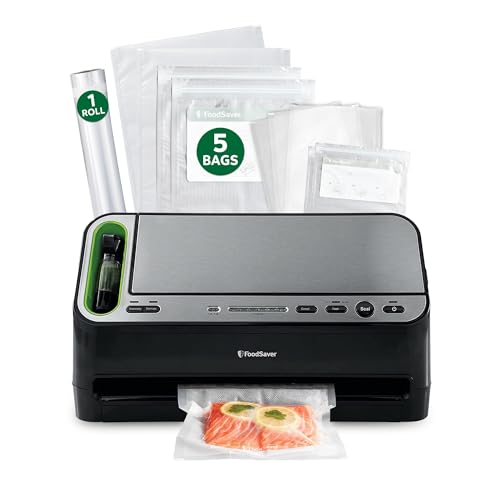
3. FoodSaver V4400 2-in-1 Vacuum Sealer Machine — Best Automatic, Hands-Off Sealing
The V4400 attacks the most annoying step in vacuum sealing: getting the bag positioned correctly. Its automatic bag detection senses the bag and starts the cycle, removing the alignment fuss that makes beginners produce failed seals. As a 2-in-1 machine it also carries a built-in handheld sealer for zip bags and containers, so one appliance covers both the freezer-bag workflow and the everyday container workflow.
This is the pick for the household that seals often enough to value automation but not enough to tolerate a learning curve. Family members who would never read a sealer manual can still seal leftovers correctly on the first try, because the machine handles the judgment calls — detection, vacuum, seal — in order.
Strengths
- Automatic bag detection removes the main cause of failed seals for casual users
- Built-in handheld covers containers and zip bags without a separate gadget
- Starter kit included, and full access to the FoodSaver bags and rolls ecosystem
Trade-offs
- Automation costs more than the manual machines here — it sits above the budget tier
- More features mean more to learn for owners who do use the advanced options
- The 2-in-1 body is larger than the compact picks; give it a real counter or cabinet home
| Specification | Detail (from the manufacturer listing) |
|---|---|
| Detection | Automatic vacuum sealer bag detection |
| Design | 2-in-1: countertop sealer plus built-in handheld |
| Included | Starter kit |
The value of automation compounds across a household. One enthusiast will master any machine; a family needs the machine to be masterable by everyone, including the teenager sealing leftovers at midnight. The V4400’s detection system is exactly that kind of feature — invisible when it works, and it works by removing the step humans get wrong. Seal quality consistency, week after week, is the real product here.
The integrated handheld is the second half of the argument. Kitchens actually run two sealing systems — bags for the freezer, containers and zip bags for the fridge and pantry — and most households buy them separately and store them in different drawers. The V4400 consolidates both into one footprint and one brand of consumables. For busy home kitchens, that consolidation is worth its premium over the FM2100 — check price on Amazon to see the current gap.
Best for: busy households that want automatic, mistake-proof sealing plus container duty in one machine / Not suited for: single users on a tight budget who seal a few bags a week
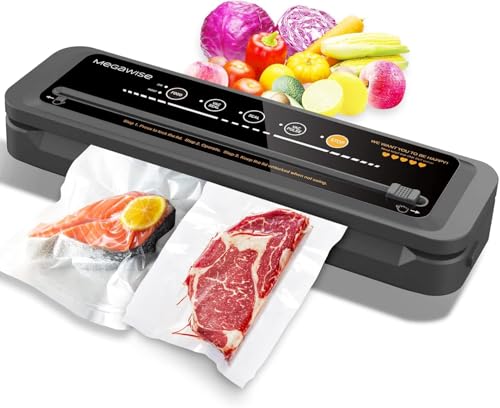
4. MEGAWISE Vacuum Sealer Machine (80kPa) — Best Budget Suction Power
MEGAWISE built this machine around a number — 80kPa of suction — and then, unusually for the budget tier, surrounded it with the right supporting features: dry, moist and fresh modes, a built-in cutter, bags included in the box, and an external vacuum system for containers. It is the value-engineered pick: the one that asks why the flagship costs what it does.
Suction strength matters for two home jobs in particular. Dense, irregular loads — bone-in cuts, whole chickens portioned, bulky roasts — need the pump to pull air out of every fold of the bag before sealing. And speed matters across a long batch: stronger vacuum finishes each cycle faster, which is the difference between a pleasant hour of processing and a slog.
Strengths
- 80kPa suction handles dense, irregular loads and keeps batch pace brisk
- Three modes (dry, moist, fresh) cover the realistic range of home foods
- Cutter and bags included — the box is a working kit, not a starter tease
Trade-offs
- A younger brand than FoodSaver or Nesco; long-term parts support is less proven
- Budget build means treating latches and the seal bar with reasonable care
- External vacuum containers are an ecosystem to check for compatibility before buying extras
| Specification | Detail (from the manufacturer listing) |
|---|---|
| Suction (listing) | 80kPa |
| Modes | Dry, moist and fresh |
| Included | Bags and cutter |
| Extra | External vacuum system for containers |
On the counter, the MEGAWISE behaves like a machine from the tier above: bags pull down tight and flat, the cutter makes custom lengths routine, and the moist mode extends the seal for the marinated and juicy loads that defeat cheap sealers. For the bulk-buying household — the one whose freezer discipline funds the machine — it delivers the core experience at a budget position, which is why it anchors the value end of this roundup.
The trade is brand depth. FoodSaver’s thirty-year accessory tail and Nesco’s preservation heritage are real assets over a decade of ownership; MEGAWISE is asking you to trade some of that certainty for a lower entry price and strong headline performance. For many home users that trade is rational — particularly as a first sealer, where the question is whether the habit sticks at all. Start here, seal everything for a year, and you will know exactly what your second machine should be.
Best for: budget-conscious bulk buyers who want strong suction and full modes / Not suited for: buyers who prioritize a decades-deep brand and accessory ecosystem
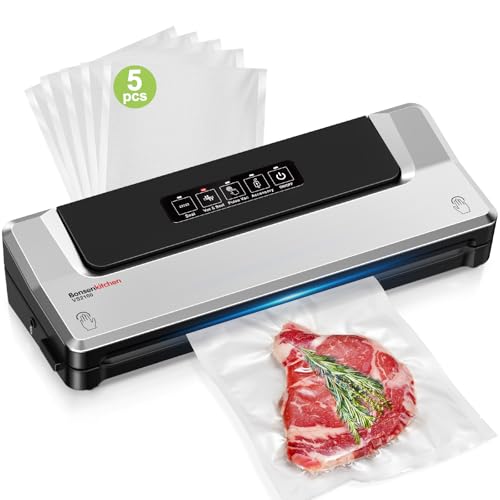
5. Bonsenkitchen Vacuum Sealer Machine (Silver) — Best Compact for Small Kitchens
Not every home kitchen has a counter that can host a full-size sealer, and the Bonsenkitchen is built for the ones that cannot. Its compact body carries multiple sealing modes for meal prep, an external vacuum system for containers, and a starter set of five vacuum bags — a complete home-use capability in a footprint that fits an apartment drawer.
Small-kitchen sealing has its own job profile: fewer warehouse-club marathons, more weekly rhythm — portioning for one or two, freezing a tray of dumplings, sealing cheese and deli meats, prepping two nights of sous vide. A compact machine that is quick to take out and quick to put away matches that rhythm better than a flagship that demands permanent counter residence.
Strengths
- Compact footprint stores in a drawer — no permanent counter commitment
- Multiple modes cover meal prep, dry goods and moist foods
- External vacuum system adds container sealing without a second device
Trade-offs
- Batch throughput is apartment-scale; marathon processing days will feel slow
- Five included bags are a starter set — budget for rolls at purchase time
- Compact seal width handles standard bags; oversized loads belong to bigger machines
| Specification | Detail (from the manufacturer listing) |
|---|---|
| Format | Compact countertop |
| Modes | Multiple modes for meal prep |
| Extra | External vacuum system |
| Included | 5 vacuum bags |
| Finish | Silver |
Meal prep is where this machine earns its drawer. Sunday’s session — grains portioned, proteins sealed with marinades, vegetables bagged for the week — runs smoothly through its modes, and the flat-sealed packages stack in a small freezer with the Tetris efficiency that small kitchens depend on. The external vacuum port quietly covers the container jobs, so leftovers and half-used ingredients get the same air-free treatment as the freezer stock.
Bonsenkitchen’s own rolls are the natural restock — the brand sells multi-roll packs in the standard widths, which keeps the consumables question simple. For the apartment, the small family and the first-time sealer owner, this is the proportionate choice: all of the home-use capability that matters, none of the bulk that does not fit the kitchen it will live in.
Best for: apartments and small kitchens that seal weekly in modest batches / Not suited for: bulk processors who measure sessions in dozens of bags
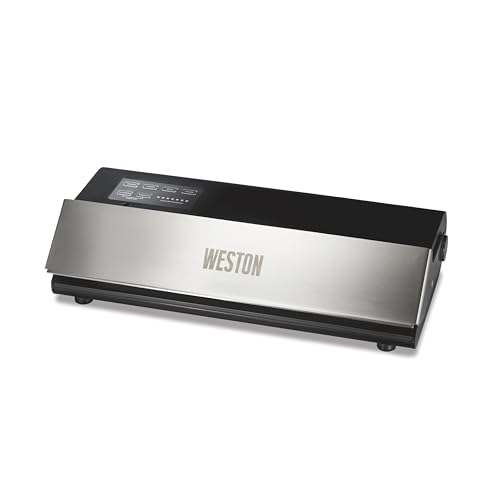
6. Weston Professional Advantage Vacuum Sealer (65-0501-W) — Best Heavy-Duty Home Use
Weston comes to home sealing from the other direction: it builds equipment for hunters, anglers, gardeners and homesteaders who process a season’s harvest in a weekend. The Professional Advantage brings that heritage down to an 11-inch home format — a professional-style machine for households whose ‘home use’ includes a deer season, a fishing trip, a garden glut or a side-of-beef purchase.
If your sealing sessions are measured in hours and your freezer is a chest model in the garage, the consumer machines above will do the work but feel like it. The Weston is built to be worked: a wide seal bar for standard 11-inch bags and rolls, and the kind of construction that expects heavy seasonal duty rather than occasional light use. It is the top of the home-use ladder before true commercial chamber machines.
Strengths
- Professional-style build intended for heavy, seasonal processing volumes
- 11-inch seal bar matches the standard wide bag and roll format
- Weston’s processing heritage means bags and support aimed at serious users
Trade-offs
- Bigger, heavier and priced above the consumer tier — overkill for weekly light sealing
- No chamber, so pure liquids still need pre-freezing or careful technique
- Its talents are wasted on a household that seals a few bags a month
| Specification | Detail (from the manufacturer listing) |
|---|---|
| Seal bar (listing) | 11 inch |
| Model | 65-0501-W (Professional Advantage) |
| Class | Professional-style home sealer |
The honest way to frame the Weston is cost per season. A household that processes a garden harvest, bulk meat orders and game or fish a few times a year puts more bags through a sealer in one weekend than a typical kitchen does in a year — and a consumer machine’s duty cycle, seal-bar cooling and latch wear all become the limiting factors. The Professional Advantage removes those limits at a price that amortizes across years of harvests.
For everyone else, it is a delightful over-specification. We include it because ‘home use’ genuinely includes the homestead end of the spectrum, and those readers are poorly served by roundups that stop at light-duty machines. If your freezer is a chest and your autumn has a processing weekend in it, this is your pick — check price on Amazon, and budget for wide rolls in the same order.
Best for: homesteaders, hunters, anglers and bulk processors working at seasonal volume / Not suited for: light weekly sealers, who are better served by every other pick here
Comparison Table
The six machines compared on the facts that separate them in a home kitchen: how bags get made, what modes they carry, and the workload each was built for in real weekly service.
| Pick | Badge | Key spec | Best for | Amazon |
|---|---|---|---|---|
| FoodSaver FM2100 Vacuum Sealer Machine | Best Overall for Home Use | Roll storage + cutter; dry/moist; accessory port and hose | most home kitchens: bulk buying, freezer storage, meal prep and sous vide in one machine | Check price on Amazon |
| Nesco Deluxe VS-12 Vacuum Sealer (130 Watts) | Best for Delicate Foods and Control | 130 watts; viewing lid; kit bags included | gardeners, bakers and anyone sealing delicate foods that automatic machines crush | Check price on Amazon |
| FoodSaver V4400 2-in-1 Vacuum Sealer Machine | Best Automatic, Hands-Off Sealing | Automatic bag detection; 2-in-1 handheld included; starter kit | busy households that want automatic, mistake-proof sealing plus container duty in one machine | Check price on Amazon |
| MEGAWISE Vacuum Sealer Machine (80kPa) | Best Budget Suction Power | 80kPa suction; dry/moist/fresh modes; cutter and bags included | budget-conscious bulk buyers who want strong suction and full modes | Check price on Amazon |
| Bonsenkitchen Vacuum Sealer Machine (Silver) | Best Compact for Small Kitchens | Compact body; multiple modes; external vacuum system; 5 bags included | apartments and small kitchens that seal weekly in modest batches | Check price on Amazon |
| Weston Professional Advantage Vacuum Sealer (65-0501-W) | Best Heavy-Duty Home Use | 11-inch seal bar; professional-style build; model 65-0501-W | homesteaders, hunters, anglers and bulk processors working at seasonal volume | Check price on Amazon |
How to Choose a Vacuum Sealer for Home Use
Begin with your dominant job, because it picks the machine class. Freezer-first households — bulk meat, batch cooking, garden produce — need roll storage and a cutter for custom bags, plus a moist mode for juicy loads: the FM2100 pattern. Delicate-first households — bakers, berry freezers, herb gardeners — need control over the vacuum’s end point: the Nesco pattern. Convenience-first households need automation the whole family can operate: the V4400 pattern. Volume-first households need duty cycle: the Weston pattern.
Then check the three specifications that actually differentiate home machines. Seal width decides your bag sizes — 11-inch compatibility covers the standard wide rolls. Modes decide your food range — dry and moist are the essential pair; pulse or manual control is the delicate-food upgrade. And the accessory path decides whether containers, jars and marinades join the system or need a second device. Suction figures are worth comparing within a class, but a well-sealed bag from a mid-strength pump outlasts a leaky seal from a strong one: technique and bag quality matter as much as the number.
- Buy rolls, not just precut bags: custom lengths waste less and cost less per seal.
- Pre-freeze liquids and very soft foods for an hour before sealing — the single biggest quality upgrade available for free.
- Leave headroom: a few inches of empty bag above the food is what lets the seal form cleanly.
- Double-seal heavy or long-storage loads if your machine allows a second pass — cheap insurance for a season in the freezer.
Finally, think in cost per year, not cost per machine. A sealer’s economics are bags plus the food it saves. Households that bulk-buy protein routinely recover a mid-range machine’s cost in avoided freezer burn and warehouse pricing within the first year; light users should buy down the range — the MEGAWISE or Bonsenkitchen — and let the habit prove itself before upgrading.
Freezer Storage, Done Properly: the System Around the Sealer
The sealer is one part of a freezer system, and the other parts are free. Label every package with contents, weight and date before it freezes — vacuum bags are anonymous, and a freezer full of mystery meat is a failed system no matter how good the seals are. Freeze packages flat on a tray first; flat packages stack like books, thaw in a fraction of the time, and let a home freezer hold noticeably more than the same food in bulky shapes.
Rotation is the second discipline: new packages go to the back or bottom, older stock comes forward, and a simple inventory note on the freezer door ends the archaeology. Vacuum sealing extends freezer life dramatically compared with wrapping, but ‘extended’ is not ‘eternal’ — the date on the label is what turns long storage into managed storage. Households that run this system waste strikingly little food, which is the quiet financial engine behind the whole category.
Sous Vide and Meal Prep: the Sealer’s Second Career
Sous vide is the use case that converts casual owners into daily ones. A vacuum bag is the cooking vessel: protein plus marinade, sealed, into the water bath, with no air pockets to float the bag or insulate the food. Home sealers handle the great majority of sous vide work — the cautions are liquids (use the moist mode, hang the bag over the counter edge so gravity helps, or freeze marinades into the bag first) and long cooks, where a confident double seal is cheap peace of mind.
Meal prep runs on the same rails. Grains, proteins and vegetables portioned and sealed on Sunday become a week of lunches that reheat — some of them directly in the bag in hot water — without drying out. The sealer also quietly upgrades the pantry: coffee, flour, rice and spices sealed in portions stay fresh in a way that clips and jars cannot match, because the enemy was never time; it was air. Remove the air, and the home kitchen’s whole relationship with storage changes.
Keeping the Seal Honest: Gaskets, Seal Bars and Bag Quality
A vacuum sealer has exactly three wear points, and all three are maintainable at home. The gaskets around the vacuum channel compress with every cycle and take a set if the lid rests latched for months — store the machine unlatched, and wipe the gaskets occasionally so crumbs and dried marinade do not create leak paths. The seal bar and its tape accumulate residue; a cool bar wiped with a damp cloth seals more evenly than a filmed one. And the drip tray, where your machine has one, should be emptied and washed after moist sessions before residue becomes odor.
Bag quality is the third variable owners underestimate. A pump can only evacuate through the bag’s embossed channels, and thin or poorly embossed film collapses those channels early, leaving air pockets that look like weak suction. When a trusted machine suddenly seems to underperform, the first test is a fresh bag from a known roll — not a parts order. Likewise, a seal that looks cloudy or wrinkled rather than clear and flat is telling you the seal zone was damp or contaminated; dry the bag mouth, refold, and run the cycle again before blaming the bar.
Diagnosed in that order — gasket, seal zone, bag — almost every home sealing failure resolves in minutes. True pump failure is rare and usually announces itself gradually across every bag type. The machines in this roundup are all simple enough that this maintenance contract amounts to a few minutes a month, which is part of what makes the category such good value: the appliance asks little, and returns a freezer that behaves.
How to Use a Home Vacuum Sealer: a Bulk Session, Step by Step
Set up the session like a small production line, because that is what it is: sealer on a clear counter, roll or bags to one side, food portioned and ready, a marker and labels within reach, and a tray lined for finished packages. Portion before you seal — decide the household’s real serving sizes now, because the bag you make is the meal you will thaw.
- Make the bag: pull roll stock to length with a few inches of headroom beyond the food, cut, and seal one end to form the pouch.
- Fill without touching the seal zone: fold the bag’s mouth outward like a cuff while loading, then unfold — a clean seal area is the difference between a weld and a leak.
- Pre-freeze anything liquid or very soft for about an hour, or use the moist setting and seal promptly; liquids climbing toward the seal bar are the main cause of failed seals.
- Vacuum and seal with the bag flat and the open end fully inside the channel; let the machine finish its full cycle before opening.
- Inspect every seal: it should be a clear, even band. Run a second seal pass on heavy or long-storage packages.
- Label with contents, weight and date, freeze flat on a tray, then file the frozen packages upright like books.
Between sessions, wipe the seal area and drip tray, store the machine with the lid unlatched if the manual advises it (compressed gaskets recover their shape), and keep rolls with the machine. A gasket stored squashed flat for months is the quiet cause of ‘my sealer lost suction’ — usually it is the seal around the vacuum channel, not the pump, and an unlatched rest is the prevention.
One pacing habit protects both the machine and the results on long sessions: give the seal bar a short rest every dozen or so consecutive seals, especially on moist loads. Seal bars are heaters, and back-to-back cycles without pause can overheat the tape and produce weaker welds precisely when the batch is biggest. Work in a rhythm — seal a tray’s worth, label and stack while the bar rests, then continue — and a home machine will run a bulk session that looks, from the freezer’s point of view, like professional work.
Common Buying Mistakes
- Sealing liquids without a plan. Soup sealed raw climbs into the machine. Pre-freeze it, or freeze it in the bag upright before sealing.
- Contaminating the seal zone. Grease or crumbs across the seal line make channels that leak. Cuff the bag while filling.
- Overfilling. Food jammed to the top leaves no headroom for a clean seal. Shorter bags, sealed well, beat stuffed bags that fail.
- Skipping labels. In the freezer, everything vacuum-sealed looks identical. Contents, weight, date — every time.
- Buying bags before checking width. Rolls come in widths; match them to your machine’s seal bar before ordering in bulk.
- Storing the machine latched tight for months. Gaskets take a set. Rest the lid unlatched unless your manual says otherwise.
Final Recommendation
For the majority of home kitchens, the FoodSaver FM2100 is the recommendation: it does every home job competently, its consumables are everywhere, and its workflow never gets in the way. The Nesco VS-12 is the better buy for delicate-food households, the V4400 for families who need automation, and the MEGAWISE for budget buyers who refuse to give up suction or modes. Small kitchens should take the Bonsenkitchen seriously, and high-volume households should skip straight to the Weston.
Whichever machine you choose, pair it with rolls in the right width and a labeling habit from day one — the system, not the appliance, is what transforms a freezer. Every pick here was verified against Amazon’s catalog before earning a link; check price on Amazon for the current position of the machine that matches your kitchen’s real workload.
And if you are choosing between this list and our home-office sealer guide, the deciding question is simply where the machine will live and what it will seal most. Kitchen-first households that freeze, prep and cook should buy from this page. Drawer-first households sealing small protective jobs should buy from the other. The households that do both heavily are not imagining it — they are the ones who end up owning one of each, and both earn their storage space.
Start here: FoodSaver FM2100 · MEGAWISE 80kPa sealer · Bonsenkitchen vacuum sealer
Best Vacuum Sealers Best Food Vacuum Sealers For Home Use Best Chamber Vacuum Sealers Best Commercial Vacuum Sealers Best Bags For Vacuum Sealers
Frequently Asked Questions
How long does vacuum-sealed food last in the freezer?
Substantially longer than wrapped or zip-bagged food, because freezer burn is driven by air contact and moisture loss, both of which a sound vacuum seal largely removes. Exact times depend on the food and your freezer’s temperature consistency, which is why the label date matters: vacuum sealing extends storage, and the date turns that extension into a rotation system rather than a guessing game.
As a practical frame: the foods households freeze most — portioned meats, batch-cooked meals, bread, hard cheeses, blanched vegetables — are precisely the foods that reward sealing most, because their failure mode in a freezer is surface drying rather than spoilage. Seal them well, keep the freezer cold and consistent, rotate by date, and the quality difference versus wrapped storage is obvious at the table months later.
Can I vacuum seal liquids and soups?
Yes, with technique. The reliable home method is to freeze the liquid first — in the bag held upright, or in a container — then seal the frozen block. Very moist solids are handled by the moist mode on machines like the FM2100 and MEGAWISE, which adjusts the seal for damp bag edges. What you should not do is run raw liquid through a standard cycle and hope; it will climb toward the seal and the pump.
Is a vacuum sealer worth it for a small household?
Usually, yes — small households waste proportionally more food from opened packages going stale, and sealing directly attacks that. The math improves further if you buy protein on promotion and freeze portions. Choose a compact or budget machine (the Bonsenkitchen or MEGAWISE here) so the appliance’s cost matches a small household’s volume, and the savings in discarded food do the rest.
What is the difference between an external sealer and a chamber sealer?
External sealers — everything in this roundup — suck air out of a textured bag and heat-seal it; they are affordable, compact and ideal for solids. Chamber sealers vacuum the whole chamber, which lets them seal liquids freely and run commercial volumes, at a much larger size and price. Home use overwhelmingly belongs to the external type; chamber machines are the step beyond the Weston for serious processors.
Do I need special bags, or will any bags work?
External sealers need textured (embossed) bags or rolls — the channels in the texture are what let the pump draw air out. Smooth bags will not evacuate properly. Within that requirement, most brands’ rolls are cross-compatible at standard widths, which keeps consumables affordable; just match the width to your machine’s seal bar.
Rolls beat precut bags on cost and waste for most households, because every bag is exactly the length its contents need. Precut bags win on speed for uniform jobs — a dozen identical portions, for instance. Many experienced owners keep both: rolls for the general run of work, and a box of precut quarts for the repetitive sessions.
Can vacuum sealers be used for sous vide?
Yes — it is one of their primary home uses, and the machines here all produce seals suitable for water-bath cooking. Use the moist mode for marinated items, consider a double seal for long cooks, and make sure bags are rated by their manufacturer for cooking use. The vacuum is not just packaging here: removing air is what lets the water heat the food evenly.

