Disclosure: airfryerkitchensupply.com is reader-supported. When you buy through links on our site, we may earn an affiliate commission at no extra cost to you.
Where to buy
The best high end toasters earn the label in one of two currencies: engineering you can taste — evenness, precision, repairability — or design you can see across the room. The six picks below were chosen because each is genuinely rich in at least one of those currencies and respectable in the other, and every linked model was verified against its own listing for this guide. Use the links to check price on Amazon, and read the trade-offs carefully: at this tier you are paying for the last ten percent, so you should know exactly which ten percent each machine delivers.
- Dualit Classic 4 Slice NewGen Toaster — Charcoal — Best Overall High-End: Check the current price on Amazon
- Breville BTA820XL Die-Cast Smart Toaster 2 Slice — Best Smart High-End: Check the current price on Amazon
- SMEG TSF02 4-Slice Long Slot Toaster, Cream — Best Design Statement: Check the current price on Amazon
- Dualit Design Series 4 Slice Toaster — Best Modern Dualit: Check the current price on Amazon
- Cuisinart 2-Slice Motorized Digital Toaster — Best Motorized Flagship: Check the current price on Amazon
- SMEG TSF01 2-Slice Toaster, Black — Best Compact Statement: Check the current price on Amazon
High end is the most abused phrase in small appliances, so this guide defines it before spending your money. A high end toaster must do at least one of three things exceptionally: toast with a precision and evenness that ordinary machines visibly cannot match; be built to a standard — materials, repairability, manufacturing origin — that removes it from the disposable economy; or function as a deliberate piece of design, an object whose presence on the counter is part of the purchase. A toaster that is merely expensive while doing none of these is not high end. It is merely expensive, and none are included here.
The six picks map the territory honestly. Dualit appears twice, for its two distinct answers: the hand-built Classic with replaceable elements, and the Design Series with its patented toast technology and peek function. Breville represents the engineering-led smart school, with motorized-era features like Lift & Look and A Bit More that exist to solve real toasting problems. SMEG represents the design school at its most credible — its retro machines are genuine appliances under the sculpture. And Cuisinart’s motorized digital model represents the modern flagship direction: quiet automation and digital precision from a mainstream premium maker.
What this guide will not do is pretend these currencies are interchangeable. If you want the best toast, the ranking logic points one way; if you want the most beautiful object, it points another; if you want the machine your grandchildren argue over, a third. The badges name each pick’s currency plainly, so you can spend yours on the one you actually value.
In this guide
Quick Picks
Two Dualits (heritage and modern), one Breville smart flagship, two SMEG design icons in two sizes, and one motorized Cuisinart. Every pick is a real appliance first — the beauty and the engineering vary, the competence does not.
- Dualit Classic 4 Slice NewGen Toaster — Charcoal — Best Overall High-End: The connoisseur’s default: hand built in the UK, replaceable ProHeat elements, mechanical timer — the toaster bought by people who have owned all the others. Check price on Amazon
- Breville BTA820XL Die-Cast Smart Toaster 2 Slice — Best Smart High-End: The engineering flagship: die-cast construction, wide slots, variable browning, and Breville’s Lift & Look and A Bit More functions per its listing — precision for people who check their toast. Check price on Amazon
- SMEG TSF02 4-Slice Long Slot Toaster, Cream — Best Design Statement: The icon at family size: SMEG’s 50s retro long-slot design in Cream, with wide slots, six browning levels, and defrost, reheat, and bagel functions at 1400W per its listing. Check price on Amazon
- Dualit Design Series 4 Slice Toaster — Best Modern Dualit: Dualit’s modern answer: extra-wide slots, a Peek and Pop function, and patented Perfect Toast Technology per its listing, in polished stainless with black trim. Check price on Amazon
- Cuisinart 2-Slice Motorized Digital Toaster — Best Motorized Flagship: The quiet flagship: motorized lift and digital control from Cuisinart’s premium tier — the toaster as a small, calm appliance of precision rather than a spring-loaded event. Check price on Amazon
- SMEG TSF01 2-Slice Toaster, Black — Best Compact Statement: The original icon, sized for two: SMEG’s TSF01 in Black, with two wide self-centering slots, six browning levels, and bagel, reheat, and defrost functions per its listing. Check price on Amazon
How These Picks Were Chosen
The first test was competence: every candidate had to be a genuinely good toaster — even browning, sensible controls, slots sized for modern bread — before its premium story was even heard. The second test was the premium claim itself, which had to be verifiable from the maker’s own listing: hand-built origin and replaceable elements for the Dualit Classic, patented technology claims for the Design Series, the named Lift & Look and A Bit More functions for the Breville, the retro design program and function set for the SMEGs, and motorized digital operation for the Cuisinart. Every linked pick was verified, and the feature claims in this guide are the listings’ own.
Balance mattered as much as excellence. A list of six engineering flagships would ignore why half of high end buyers buy; a list of six sculptures would ignore the toast. The final set therefore spans the schools deliberately, in two sizes where size is a real choice, so that whichever currency you spend in, there is a pick that respects it.
One category of product was excluded on principle: limited-edition and luxury-collaboration toasters whose premium is pure scarcity. Scarcity is a collecting value, not a toasting one, and this guide’s readers eat breakfast.
The 6 Best high end toasters
Each review names what the premium buys in that specific machine — and what it does not. At this tier, the trade-offs are not defects; they are the shape of each maker’s bet about what matters.
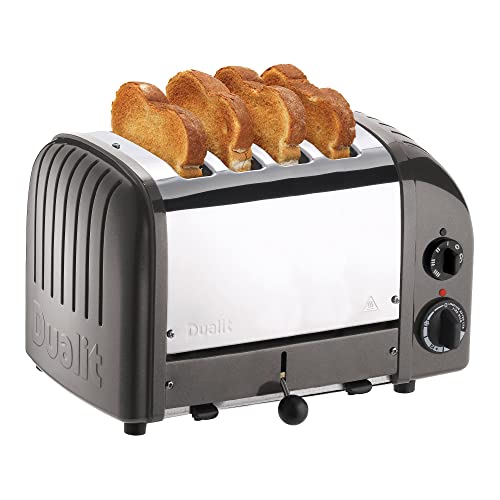
Dualit Classic 4 Slice NewGen Toaster — Charcoal — Best Overall High-End
Ask people who own several high end toasters which one would survive the fire, and the Dualit Classic is the answer that keeps coming back. Per its verified listing, it is hand built in the UK with replaceable ProHeat elements, a mechanical timer, and a defrost function, in a stainless body finished here in Charcoal. Its toasting philosophy is the opposite of the smart school’s: no sensors, no programs — just powerful elements, even heat, and a timer you learn the way you learn an instrument. In practiced hands it produces toast of a quality the automated machines chase, and it will do so, with element replacements, for decades.
Strengths
- Replaceable ProHeat elements per the listing — the only pick here designed to be repaired indefinitely
- Hand-built UK manufacture with a mechanical timer: an appliance from before the disposable era, still in production
- Four slots with the thermal authority to toast dense, thick, real bread properly
Trade-offs
- Manual operation is a skill: your first weeks involve learning its timer the way you would a hob
- No bagel programs, countdowns, or convenience automation whatsoever
- The premium buys longevity and toast quality, not features — feature shoppers should look at the Breville
| Specification | Detail |
|---|---|
| Slots | 4 |
| Elements | Replaceable ProHeat (per verified listing) |
| Build | Hand built in the UK, stainless steel |
| Controls | Mechanical timer, defrost |
| Finish | Charcoal |
The Classic’s case as best overall high-end rests on a definition of luxury the rest of the industry abandoned: an object made properly, by identifiable people, that can be maintained forever. Every component philosophy points the same way — elements that unbolt, a timer that can be serviced, a body that shrugs off decades of heat cycles. Owners do not describe buying it so much as acquiring it, and the secondhand market for old Classics, still toasting, is the strongest evidence in this entire guide.
And the toast? Element power plus even spacing plus a cook who knows the timer produces the thing high end buyers are actually chasing: a slice that is crisp at the surfaces and still tender inside, evenly colored to the edges. Automation approximates that result for beginners; the Classic delivers it to anyone willing to learn two weeks of breakfasts. That trade — your attention for its permanence — is the most honest bargain in the category.
Best for: Buyers who value permanence, repairability, and toast quality above automation / Not suited for: Anyone wanting programs, sensors, or a countdown display
Check the current price on Amazon

Breville BTA820XL Die-Cast Smart Toaster 2 Slice — Best Smart High-End
Breville’s Smart Toaster is the high end answer for the cook who toasts by inspection. Its verified listing specifies die-cast construction in brushed stainless steel, wide slots for bagels and thick artisan bread, variable browning control, and the two functions that define the design: Lift & Look, which raises the slice mid-cycle to check it without canceling the toasting, and A Bit More, which adds a short finishing burst when a slice is nearly — but not quite — there. These are not gimmicks; they are solutions to the two real failure modes of toasting, which are checking too late and re-toasting from zero.
Strengths
- Lift & Look per the listing — inspect mid-cycle without restarting, the single most useful smart-toaster idea
- A Bit More finishes underdone slices precisely instead of gambling on a second full cycle
- Die-cast body and wide slots give it flagship build and artisan-bread range
Trade-offs
- Two slots only; families will queue, and the four-slot need points elsewhere in this guide
- Electronic sophistication is the opposite philosophy from the Dualit’s repairable simplicity
- Brushed stainless shows fingerprints in a way the design-school picks’ finishes forgive
| Specification | Detail |
|---|---|
| Slots | 2, wide |
| Body | Die-cast, brushed stainless steel (per verified listing) |
| Functions | Lift & Look, A Bit More, defrost (per listing family) |
| Control | Variable browning control |
The Smart Toaster’s intelligence is refreshingly specific. It does not app-connect your breakfast or gamify the crumb tray; it watches the two moments where toast is actually lost — the mid-cycle check and the final thirty seconds — and engineers both. Lift & Look in particular changes behavior: once checking costs nothing, you check, and toast quality across a household quietly rises to the level of its most attentive member. That is what smart should mean in a kitchen appliance, and it is why this remains the engineering school’s benchmark years into its production run.
Choose it over the Dualit if your luxury is precision without apprenticeship — the Breville delivers its best toast to a first-time user, while the Classic reserves its best for the practiced. Choose it over the SMEGs if your counter values understatement and your palate outranks your interior scheme. It is the high end pick for people who read spec sheets at breakfast, and there is no shame in that sentence.
Best for: Precision lovers and artisan-bread households of one or two people / Not suited for: Families needing four slots, or repairability purists
Check the current price on Amazon

SMEG TSF02 4-Slice Long Slot Toaster, Cream — Best Design Statement
SMEG’s 50s-style line is the rare design phenomenon that survived its own hype, and the TSF02 is its most useful toaster form: a four-slice long-slot machine whose verified listing specifies wide slots for bagels and artisan bread, six browning levels, defrost, reheat, and bagel functions, at 1400W, in the Cream finish that launched a thousand kitchen renovations. Long slots are the connoisseur’s layout — they take full artisan slices lengthwise and four standard slices in a row — so the design pick is also, quietly, one of the most practical picks in this guide for real bread.
Strengths
- Long, wide slots per the listing — the best layout here for artisan loaves and full-size slices
- Complete function set: six browning levels plus defrost, reheat, and bagel modes
- The design itself, executed in enamelled retro form that has proven durable as taste, not just as trend
Trade-offs
- You are paying for design; the same money buys the Dualit’s repairability or the Breville’s intelligence
- Long-slot footprint is wide — measure the counter run, not just the depth
- Retro controls are deliberately simple; precision is by eye and experience
| Specification | Detail |
|---|---|
| Layout | 4-slice long slot, wide slots (per verified listing) |
| Power | 1400W (per verified listing) |
| Browning | 6 levels |
| Functions | Defrost, reheat, bagel |
| Finish | Cream, retro stainless steel |
The mature way to judge SMEG is to separate the two purchases bundled in its price. As an appliance, the TSF02 is complete and competent — real power, real functions, a slot layout many engineering-led rivals should envy. As an object, it is a considered piece of mid-century Italian design that anchors a kitchen’s whole visual scheme, which is why it appears in homes whose owners care about both breakfast and beauty and refuse to choose. Neither purchase is foolish; the guide simply insists you know you are making both.
Practical notes for the design-led buyer: the long slot wants a long counter run and rewards it by toasting the bakery loaf exactly as sliced; the enamel finishes are the durable choice over polished metal in hard-use kitchens; and the Cream finish in this listing is the line’s signature for a reason — it photographs the way it lives. If a toaster must sit out permanently, as all toasters do, there is a real argument that it should be this beautiful. This pick is that argument, with good toast included.
Best for: Design-led kitchens that also toast serious bread for a family / Not suited for: Buyers who want their premium spent on engineering alone
Check the current price on Amazon

Dualit Design Series 4 Slice Toaster — Best Modern Dualit
The Design Series is what happened when Dualit asked what its values look like in a contemporary machine. Per its verified listing: polished stainless steel with black trim, extra-wide slots, a Peek and Pop function that lets you check progress, and the company’s patented Perfect Toast Technology — an attempt to engineer the evenness the Classic achieves through mass and power into a modern, styled appliance. It is the Dualit for buyers who want the name’s substance without the Classic’s deliberately industrial aesthetic and manual apprenticeship.
Strengths
- Peek and Pop per the listing — the check-without-canceling idea, in Dualit’s own dialect
- Extra-wide slots suit the artisan bread the Classic’s reputation was built on
- Patented Perfect Toast Technology is the maker’s explicit evenness program
Trade-offs
- It does not carry the Classic’s replaceable-element, hand-built story — the two Dualits are different promises
- Polished stainless with black trim is a fingerprint-forward finish
- Sits between schools: traditionalists want the Classic, gadget lovers want the Breville
| Specification | Detail |
|---|---|
| Slots | 4, extra-wide (per verified listing) |
| Functions | Peek and Pop |
| Technology | Patented Perfect Toast Technology (per listing) |
| Finish | Polished stainless steel with black trim |
There is a real question this pick answers: can a heritage maker modernize without becoming generic? The Design Series’ answer is to keep the priorities — evenness, slot width, build substance — and change the interface and the styling. Peek and Pop concedes that the Breville school identified a genuine need; Perfect Toast Technology concedes that modern buyers want the machine, not the operator, to guarantee the result. What it does not concede is the disposable model: this is still a heavily built, premium Dualit, priced and finished accordingly.
Choose it if the Classic’s philosophy appeals but its 1950s workshop aesthetic and manual timer do not fit your kitchen or your patience. It is the high end pick for the buyer who wants one foot in each school — heritage substance, modern manners — and is untroubled that purists of both camps will call it a compromise. Compromises of this quality are usually called balance.
Best for: Buyers wanting Dualit substance in a modern, styled appliance / Not suited for: Repairability purists (Classic) or automation maximalists (Breville)
Check the current price on Amazon

Cuisinart 2-Slice Motorized Digital Toaster — Best Motorized Flagship
The motorized toaster is the flagship direction nobody expected to love until they used one: instead of a lever and a spring, the carriage lowers and raises the bread by motor, silently, at a controlled pace. Cuisinart’s entry — listed simply as its 2-Slice Motorized Digital Toaster — pairs that mechanism with digital control in the maker’s premium tier. The experience it sells is composure: no clunk, no launch, no slice ejected onto the counter’s edge — just bread descending into the heat and returning, evenly done, like a lift arriving at a floor.
Strengths
- Motorized carriage eliminates the spring-pop and treats thick, fragile slices gently
- Digital control suits repeatable, dialed-in browning preferences
- Composed, quiet operation suits open-plan and early-morning households
Trade-offs
- Two slices only, and motorized cycles are unhurried — this is not the family’s rush-hour machine
- A motor is another mechanism to age; the repairability story cannot match the Dualit Classic
- Its listing is sparing with detail, so buyers should confirm slot dimensions against their bread before ordering
| Specification | Detail |
|---|---|
| Slots | 2 |
| Mechanism | Motorized lift (per product name/listing) |
| Controls | Digital |
| Maker tier | Cuisinart premium line |
Motorization sounds like luxury for its own sake until you watch it handle the slices that defeat spring toasters: the thick, uneven artisan cut that a spring carriage tips; the delicate gluten-free slice that a violent pop cracks; the frozen waffle that needs a gentle, even cycle. Controlled descent and ascent are genuinely functional — they are just functional in the direction of care rather than speed, which is a legitimate definition of high end that the louder flagships overlook.
This pick is therefore the quiet household’s flagship: the apartment where a 6 a.m. spring-clunk wakes the baby, the cook who toasts two perfect slices rather than eight adequate ones, the counter that values calm. It will not win a features arms race and does not try to. Its premium buys refinement of motion — and for the right kitchen, that is the luxury that gets used twice a day.
Best for: Two-slice households valuing quiet, gentle, precise operation / Not suited for: Families, rush hours, or repairability-first buyers
Check the current price on Amazon

SMEG TSF01 2-Slice Toaster, Black — Best Compact Statement
The TSF01 is the toaster that made SMEG’s 50s line famous, and in Black it is the most architectural of the family — the same rounded retro body, read as sculpture rather than nostalgia. Its verified listing specifies two wide slots with self-centering racks, six browning levels, bagel, reheat, and defrost functions, and the line’s simple knob-and-lever controls. Self-centering deserves its sentence: it is the unglamorous mechanism that grips slices of varying thickness evenly, and it is a large part of why this design icon also toasts properly.
Strengths
- Self-centering wide slots per the listing — even toasting across bread thicknesses, designed in rather than hoped for
- Full function set in the compact body: bagel, reheat, defrost, six browning levels
- The Black finish makes the retro form read as modern minimalism
Trade-offs
- Two slots is a hard ceiling for households beyond two people
- The design premium is real; purely functional buyers get more toast per dollar elsewhere
- Retro knob-and-lever control is charming and imprecise in equal measure
| Specification | Detail |
|---|---|
| Slots | 2, wide, self-centering (per verified listing) |
| Browning | 6 levels |
| Functions | Bagel, reheat, defrost |
| Controls | Knob and lever |
| Finish | Black, 50s retro style |
Small kitchens and couples are this pick’s natural constituency, and for them the TSF01 resolves a genuine dilemma: the compact toaster market is a swamp of flimsy appliances, while the serious machines are all family-sized. The TSF01 is a serious machine at two-slice scale — weighted, finished, and mechanized like its larger sibling — that also happens to be the best-looking object on most counters it graces. In a small space, where every object is visible all the time, that double duty is not vanity; it is interior economics.
Buy it as you would buy the TSF02: knowingly, as appliance plus object. The toasting fundamentals — self-centering slots, adequate power, sensible functions — are honestly present, which is what separates SMEG from the novelty retro brands that borrow the silhouette without the substance. If your household is two and your kitchen is curated, this is the high end pick that respects both facts.
Best for: Couples and small, design-conscious kitchens / Not suited for: Families, or buyers indifferent to design
Check the current price on Amazon
Comparison Table
The high end splits three ways in this table: permanence (Dualit Classic), intelligence (Breville, Cuisinart, Design Series), and design (SMEG). Feature claims are from the verified listings.
| Pick | Badge | Key spec | Best for |
|---|---|---|---|
| Dualit Classic 4 Slice NewGen Toaster — Charcoal | Best Overall High-End | Hand-built UK, replaceable elements, 4 slots | Buyers who value permanence, repairability, and toast quality above automation |
| Breville BTA820XL Die-Cast Smart Toaster 2 Slice | Best Smart High-End | Die-cast, Lift & Look, A Bit More, 2 wide slots | Precision lovers and artisan-bread households of one or two people |
| SMEG TSF02 4-Slice Long Slot Toaster, Cream | Best Design Statement | Long slot x4, 1400W, retro Cream | Design-led kitchens that also toast serious bread for a family |
| Dualit Design Series 4 Slice Toaster | Best Modern Dualit | 4 extra-wide slots, Peek and Pop, Perfect Toast | Buyers wanting Dualit substance in a modern, styled appliance |
| Cuisinart 2-Slice Motorized Digital Toaster | Best Motorized Flagship | 2 slots, motorized carriage, digital | Two-slice households valuing quiet, gentle, precise operation |
| SMEG TSF01 2-Slice Toaster, Black | Best Compact Statement | 2 wide self-centering slots, retro Black | Couples and small, design-conscious kitchens |
How to Choose the Best High End Toasters
Decide which currency you are spending in, because the picks optimize for different ones. Permanence buyers should weight replaceable elements, mechanical simplicity, and manufacturing story — the Dualit Classic’s territory. Precision buyers should weight sensing, mid-cycle inspection, and finishing functions — the Breville’s Lift & Look and A Bit More, the Design Series’ Peek and Pop. Design buyers should weight form, finish, and how the object sits in the room — SMEG’s whole proposition. Every pick here toasts well; the premium buys the emphasis, so name your emphasis first.
Size by household, not by aspiration. Two-slice flagships — the Breville, the Cuisinart, the small SMEG — deliver their best experience to one- and two-person households and become a queue in a family kitchen. Four-slice and long-slot machines — both Dualits and the big SMEG — cost more counter and more money, and earn both back every school morning. High end buyers are especially prone to buying the beautiful two-slice sculpture for a five-person reality; the mismatch is daily and unforgiving.
Interrogate the repairability story if longevity is your claim. ‘Built to last’ is a phrase; replaceable elements, mechanical timers, and a maker that sells parts are facts. The Classic’s ProHeat elements can be replaced per its listing — that single verifiable fact is worth more than any amount of premium copy. Conversely, if your definition of high end is technological, accept the opposite trade knowingly: electronics age, apps change, and a smart flagship is a five-to-ten-year object, not a forever one. Both are legitimate definitions of luxury; confusing them is the only error.
Finally, match the finish to the kitchen’s real life. Polished stainless is beautiful and documents every fingerprint; enamelled retro colors forgive; brushed finishes split the difference. A high end toaster lives on the counter permanently — it is the one appliance nobody stores — so its finish will be looked at more than its specification sheet ever is. Buy the one you will enjoy seeing on an ordinary Tuesday, at your actual household size, in your actual currency of value.
What High End Toast Actually Tastes Like
Strip away the design and the heritage, and the high end claim reduces to one plate of toast. Superior machines brown evenly to the edges without pale borders or scorched corners, because their elements are powerful, well-spaced, and — in the smart school — monitored. They crisp the surfaces while keeping the interior tender, because their heat is intense enough to set the crust before the crumb dries. And they repeat that result slice after slice, because their thermal mass does not fade across a family’s breakfast the way a light machine’s does.
That plate is achievable by several picks here by different routes: the Classic by power and practice, the Breville by inspection and adjustment, the Design Series by its patented evenness program. The honest conclusion of this guide is that the destination is shared and the journeys differ — which is why the reviews spend their words on the journeys. Choose the one whose daily ritual you will enjoy, because at this level the ritual is the product.
The Second Decade: Living With a Premium Machine
High end purchases are usually reviewed at unboxing, which is the least informative moment of their lives. The more useful review happens in year two and year ten, and the picks in this guide were chosen with those years in mind. Year two is when a machine’s daily ritual has either become invisible — the setting memorized, the motion automatic — or become a low-grade irritation that no specification sheet predicted. It is also when finishes tell the truth: enamel that still wipes clean, stainless that has taken a graceful patina, or chrome that documents every breakfast since purchase.
Year ten separates the schools decisively. The mechanical and repairable machines are mid-life, with perhaps an element changed and a timer serviced, their owners’ cost per year now visibly lower than every ‘cheaper’ machine they outlived. The electronic flagships are at the far end of their designed lives — still toasting, ideally, but with the understanding that a board failure is a replacement decision. Neither outcome is a scandal; they are the two honest shapes of premium, and this guide’s reviews name which shape each pick has so the decade can be chosen rather than discovered.
The practical advice that follows is simple: buy the decade you actually want to live in. If your kitchen keeps objects — cast iron, mechanical watches, the knife you have had since your first apartment — the repairable school will feel like home. If your kitchen renews itself gladly and you value the best current experience over permanence, the smart school is your honest home. High end regret is almost never about toast; it is about buying one decade while wanting the other.
Finishes and Placement: The Counter Is a Gallery of One
A high end toaster is the rare appliance that is also furniture: it never goes in a cupboard, it sits at eye level in the room where guests gather, and it is looked at orders of magnitude more often than it is operated. That reality justifies more of the design school’s premium than critics admit — and it also imposes duties. Placement decides whether a beautiful machine stays beautiful: out of the steam path of the kettle, away from the splash zone of the sink, with clearance for its heat and for the crumb tray’s weekly journey.
Finish care is the other half of the gallery contract. Enamelled colors — the SMEG school — want a soft cloth and no abrasives, and repay it by looking new for years. Polished stainless wants the same cloth used more often, because it records fingerprints as faithfully as it reflects light. Brushed and matte finishes are the pragmatist’s premium: they hide the evidence of daily life and suit kitchens that cook more than they curate. None of this is frivolous. An object bought partly to be seen deserves to be kept seeable, and the five minutes a week it takes is the smallest line item in the whole high end budget.
Gifting and Registering: The High End Toaster as an Occasion Purchase
High end toasters are disproportionately bought as gifts — weddings, housewarmings, the serious upgrade for the parent whose thirty-year-old machine finally faded — and the occasion changes how to choose. A gift toaster must succeed without a consultation, which argues for the picks whose virtues are immediate: the SMEGs, whose pleasure begins at unboxing and whose competence needs no apprenticeship, and the Breville, whose best results arrive on the first morning. The Dualit Classic is the greater long-term gift and the riskier one: given to a kindred spirit, it becomes a family heirloom story; given to a convenience-first household, its manual timer reads as homework.
Size the gift by the recipient’s household, not by your admiration — the two-slice sculpture for a family of five is a beautiful burden. And consider the counter it will join: a high end toaster is a permanent visual commitment in someone else’s kitchen, so finishes that forgive and forms that sit quietly are safer generosities than statements that demand the room redecorate around them.
Handled well, though, few gifts perform like these: used twice a day, thought of kindly at both uses, and durable enough to still be working at anniversaries that embarrass most wedding presents. That daily, decades-long presence is the real luxury this category sells — the toast, in the end, is almost the excuse.
How to Get the Most From a High End Toaster
Premium machines reward small disciplines that cheap machines cannot respond to. These practices apply across the picks, with the school-specific notes folded in.
- Learn your machine on your bread. Toast the same loaf at successive settings and keep the winner’s setting as your household standard. High end controls are consistent enough for this calibration to hold for months — that consistency is what you paid for, so bank it.
- Use the inspection functions as designed. Lift & Look and Peek and Pop exist to be used mid-cycle without penalty. Check at the first sign of color, finish with A Bit More-style short bursts, and never run a blind second full cycle on an almost-done slice.
- Respect the manual machines’ apprenticeship. On the Dualit Classic, the timer is a skill: expect a week of breakfasts to learn your bread’s number, after which your results will match any sensor’s. Write the number on the bread bin if the household shares the machine.
- Center thin slices, use the racks. Self-centering and bagel functions are engineering, not decoration. Thin bread off-center is the leading cause of one-pale-side toast even in excellent machines.
- Keep the crumb tray on a rhythm. Premium elements and sensors alike suffer in a bed of old crumbs — flavor first, then smoke, then faults. Weekly emptying keeps a high end machine tasting high end.
- Register and record. For repairable machines especially, keep the model and serial details and the maker’s parts channel noted. The Classic’s decades-long story is written by owners who treated it as equipment from day one.
None of these habits is burdensome, and together they are the difference between owning a high end toaster and merely having bought one.
Common Buying Mistakes
Paying for the wrong currency. The design buyer who purchases engineering, and the engineer who purchases sculpture, both end up vaguely dissatisfied with an excellent machine. Name your value first; the badges in this guide do the rest.
Buying two slots for a five-person house. The most common high end regret. Beauty does not shorten a breakfast queue.
Assuming expensive means repairable. Only one pick here lists replaceable elements. If longevity is your argument, verify the parts story rather than trusting the price to imply it.
Ignoring the bread you actually eat. Artisan loaves need width and power; sandwich bread needs centering; frozen goods need a proper defrost cycle. The best high end toaster is the one matched to your loaf, not to a photograph.
Storing it away. These machines are heavy, beautiful, and meant to live out. If your kitchen routine involves a cupboard, the high end tier’s daily dividends — the look, the readiness — never arrive.
Final Recommendation
The Dualit Classic is this guide’s best overall high end toaster, because its definition of premium — hand-built, repairable, superb with practice — is the one that compounds over decades. The Breville Smart Toaster is the precision pick, delivering its best results to a beginner on day one. SMEG’s TSF02 and TSF01 are the design picks at family and couple scale respectively, and honest appliances beneath the iconography. The Design Series is Dualit’s modern dialect, and the Cuisinart motorized flagship is the quiet refinement play.
High end, done properly, is not an indulgence category; it is the decision to buy the last toaster rather than the next one — or to buy breakfast’s small daily ceremony properly. Any of these six honors that decision in its own currency.
- Dualit Classic 4 Slice NewGen Toaster — Charcoal (Best Overall High-End): Check price on Amazon
- Breville BTA820XL Die-Cast Smart Toaster 2 Slice (Best Smart High-End): Check price on Amazon
- SMEG TSF02 4-Slice Long Slot Toaster, Cream (Best Design Statement): Check price on Amazon
- Dualit Design Series 4 Slice Toaster (Best Modern Dualit): Check price on Amazon
- Cuisinart 2-Slice Motorized Digital Toaster (Best Motorized Flagship): Check price on Amazon
- SMEG TSF01 2-Slice Toaster, Black (Best Compact Statement): Check price on Amazon
More in the Toasters cluster: Best Heavy Duty Toasters · Best Home Toasters · Best Inexpensive 4 Slice Toasters · Best Dualit Toasters · Best 2 Slice Toasters
Frequently Asked Questions
Is a high end toaster actually better, or just prettier?
Both kinds exist, which is why this guide separates the schools. The engineering picks — Breville’s inspection functions, Dualit’s replaceable elements and hand-built construction — deliver measurable differences in evenness, consistency, and lifespan. The design picks deliver those fundamentals competently plus an object you live with happily. What this guide excludes is the third kind: expensive machines with neither engineering nor design substance.
How long should a high end toaster last?
The repairable school answers in decades: the Dualit Classic’s elements can be replaced, its timer serviced, its body is stainless. Electronic flagships should be judged on a five-to-ten-year horizon, as with any sophisticated appliance. The right question is not ‘how long’ in the abstract but ‘what fails first, and can it be replaced’ — ask it of any premium purchase.
Two slots or four at the high end?
Household arithmetic decides. One or two people: the two-slice flagships here are superb and cost less counter. Families: four slots or a long-slot layout, every time — the queue at a two-slice machine on a school morning will erode your love for the finest toaster ever made by Friday of the first week.
Does a motorized toaster toast better?
It toasts more gently and consistently in its handling — controlled descent and ascent protect thick and fragile slices and remove the spring mechanism’s violence — and its digital control is repeatable. It does not toast faster, and it serves two slices at a time. Judge it as refinement of experience rather than a browning breakthrough, which is exactly how this guide badges it.
What bread benefits most from a high end toaster?
Thick, uneven, real bread — artisan loaves, bakery slices, dense homemade cuts — because it demands slot width, element power, and evenness simultaneously, which is precisely the high end specification. Standard sandwich bread toasts acceptably in almost anything; the premium shows itself at the edges of the bread world, and at the edges of the slice.
Should I buy the Dualit Classic or the Breville Smart Toaster?
Buy the Classic if you will learn a timer happily and want a machine for decades; buy the Breville if you want inspection, adjustment, and best results from the first morning with no apprenticeship. They are the two poles of this guide — permanence versus precision — and the honest answer is that each buyer usually knows which one they are within ten seconds of reading the trade-offs.


