Commercial conveyor toasters are toasters with a moving belt that carries bread through a heated chamber, so the bread toasts itself while the cook does other jobs, and they are the toasters a cafe, a diner or a restaurant uses when toast is on the menu all morning. A home toaster makes two or four slices at a time, while a commercial conveyor toaster makes 150 to 450 slices an hour, so a breakfast rush that would swamp a home toaster is just another morning for a conveyor toaster. The five toasters in this guide cover the range, from the Waring heavy-duty machine at 450 slices per hour to the PYY machines at 150 and 450 slices per hour, the Dyna-Living machine at 450 pieces per hour with 1900W, and the HTTSICHI machine at 150 slices per hour with a wide slot for thick bread, and all five are real, currently listed products, made for commercial kitchens.
The five picks are all real, currently listed products, and each one is a genuine commercial conveyor toaster with its speed stated on its listing. All five are described with their strengths and their trade-offs, so a toaster that is wrong for your kitchen is easy to spot before you spend money on it. A toaster at 450 slices per hour suits a cafe with a big breakfast rush, while one at 150 slices per hour suits a small cafe or a breakfast counter, and the guide explains the difference honestly, so you can choose by speed rather than by guesswork. A conveyor toaster is a commercial machine, so it needs counter space, a power supply that can feed it, and a cleaning routine, and the guide covers all three.
Below we compare the five picks, explain what each toaster does well and where it compromises, and finish with a buying guide on speed, slot, power, size and care, so you can choose the toaster that fits your kitchen. A conveyor toaster is a working machine, not a showpiece, so the guide judges each one on the work it does in a real kitchen, not on how it looks on the counter.
In this guide
Quick picks: best commercial conveyor toasters
| # | Product | Where to buy |
|---|---|---|
| 1 | Waring Heavy-Duty Conveyor Toaster with 450 Slices per Hour | Check on Amazon |
| 2 | PYY Commercial Conveyor Toaster 150 Slices/h – Electric Conveyor Belt Toaster for Toast, Bun, Bagel, Bread | Check on Amazon |
| 3 | PYY Commercial Conveyor Toaster 450pcs/h – Commercial Toaster for Toast, Bun, Bagel, Bread, Heavy Duty Stainless Steel | Check on Amazon |
| 4 | Dyna-Living Commercial Toaster 450 PCS/H Conveyor Toaster for Restaurant | Check on Amazon |
| 5 | HTTSICHI Commercial Conveyor Toaster w/ 1 Slice Wide Slot, 150 Slice/hour Commercial Toaster w/ 7’’ Wide and 3‘’ Opening | Check on Amazon |
How the Picks Were Chosen
Before the detailed reviews, it is worth saying how this guide is put together. The 5 picks below were chosen from the products available for commercial conveyor toasters on Amazon, looking for models that cover the main sizes, styles and budgets rather than 5 versions of the same thing. Each one is a real, currently listed product with a clear identity: a brand, a model and a set of features you can check on its listing.
Quick Comparison
The table below gives the headline detail for each of the five commercial conveyor toasters, so you can shortlist by slices per hour before reading the full reviews.
| Product | Key Detail | Best For |
|---|---|---|
| Waring Heavy-Duty Conveyor Toaster with 450 Slices per Hour | 450 Slices per Hour, Stainless Steel Construction | 450 slices/hour, heavy-duty, stainless steel | cafe that serves toast all morning |
| PYY Commercial Conveyor Toaster 150 Slices/h – Electric Conveyor Belt Toaster for Toast, Bun, Bagel, Bread | 150 slices/hour, toast/bun/bagel/bread | small cafe or breakfast counter |
| PYY Commercial Conveyor Toaster 450pcs/h – Commercial Toaster for Toast, Bun, Bagel, Bread, Heavy Duty Stainless Steel | 450 pcs/hour, toast/bun/bagel/bread, steel | cafe that serves toast, buns and bagels all morning |
| Dyna-Living Commercial Toaster 450 PCS/H Conveyor Toaster for Restaurant | 1900W Commercial Conveyor Toaster, Heavy Duty | 450 pcs/hour, 1900W, for restaurants | restaurant that serves toast at breakfast service |
| HTTSICHI Commercial Conveyor Toaster w/ 1 Slice Wide Slot, 150 Slice/hour Commercial Toaster w/ 7’’ Wide and 3‘’ Opening | 150 slices/hour, wide slot, 7 in opening | small cafe that serves thick-cut toast |

1. Waring Heavy-Duty Conveyor Toaster with 450 Slices per Hour | 450 Slices per Hour, Stainless Steel Construction
If you want a dependable option without overthinking the choice, the Waring Heavy-Duty Conveyor Toaster with 450 Slices per Hour | 450 Slices per Hour, Stainless Steel Construction deserves a close look. The Waring Heavy-Duty Conveyor Toaster toasts 450 slices per hour, is made of stainless steel, and is built for cafes and restaurants.
What makes it easy to live with is the way the details fit together. Four hundred and fifty slices per hour is the number that matters: the toaster keeps up with a breakfast rush, so a cafe that serves toast all morning does not fall behind, and the conveyor belt moves the bread through by itself, so the cook does not stand at the toaster. Stainless steel is worth having: the steel body wipes clean and stands up to a commercial kitchen, and the Waring name is one a restaurant already knows.
What stands out:
- 450 slices/hour: keeps up with a breakfast rush.
- Conveyor belt: moves the bread through by itself.
- Stainless steel: wipes clean, stands up to a commercial kitchen.
Trade-offs to know:
- 450 slices/hour: a buyer who toasts for a small cafe will not need this much speed.
- Commercial: a buyer who wants a home toaster will find it too big.
- Waring: a buyer who wants a low-cost toaster will find it dearer.
Keeping it in good shape does not take much effort. Clean the crumb tray after every service, wipe the steel body, and brush crumbs off the belt before they burn.
Choose this one if your priority is 450 slices/hour, steel and you want a conveyor toaster that simply does its job well.
Best for: cafe that serves toast all morning. Not suited for: buyers who toast for a small cafe or want a home toaster.
Where does the Waring Heavy-Duty Conveyor Toaster with 450 Slices per Hour | 450 Slices per Hour, Stainless Steel Construction fit in this roundup? Its headline detail is 450 slices/hour, heavy-duty, stainless steel, and that shapes who should buy it. For a cafe that serves toast all morning, this is a natural match, because the features line up with the way that household actually uses the product.
A quick pre-purchase check is worth the minute it takes. First, make sure the Waring Heavy-Duty Conveyor Toaster with 450 Slices per Hour | 450 Slices per Hour, Stainless Steel Construction fits where you plan to keep it, both on the counter and in storage, and that you can reach its controls comfortably. Second, check the parts list against what you need, since the exact accessories included can change between listings. Third, look at the cleaning instructions: a model that is easy to wash will be used far more than one that is not.
Check price on Amazon: Waring Heavy-Duty Conveyor Toaster with 450 Slices per Hour

2. PYY Commercial Conveyor Toaster 150 Slices/h – Electric Conveyor Belt Toaster for Toast, Bun, Bagel, Bread
The PYY Commercial Conveyor Toaster 150 Slices/h – Electric Conveyor Belt Toaster for Toast, Bun, Bagel, Bread stands out for buyers who want solid everyday performance. The PYY Commercial Conveyor Toaster toasts 150 slices per hour, is an electric conveyor belt toaster for toast, bun, bagel and bread.
Day to day, this is a straightforward product to use. One hundred and fifty slices per hour is the speed that matters: the toaster suits a small cafe or a breakfast counter, so it keeps up without the size and power draw of a 450 slice machine, and the belt toasts toast, buns, bagels and bread, so one toaster covers the whole bread basket. Electric conveyor is worth having: the belt moves the bread through by itself, so the cook does not stand at the toaster, and the toast comes out even, slice after slice.
What stands out:
- 150 slices/hour: suits a small cafe or breakfast counter.
- Toast, bun, bagel, bread: one toaster covers the whole bread basket.
- Conveyor belt: toast comes out even, slice after slice.
Trade-offs to know:
- 150 slices/hour: a buyer with a big breakfast rush will need a faster machine.
- PYY: a buyer who wants a big-name brand may prefer Waring.
- Commercial: a buyer who wants a home toaster will find it too big.
Maintenance is one of the quieter strengths here. Clean the crumb tray after every service, wipe the body, and brush crumbs off the belt before they burn.
It is a natural fit for a small cafe or breakfast counter where 150 slices/hour, four breads matters more than having the longest feature list.
Best for: small cafe or breakfast counter. Not suited for: buyers with a big breakfast rush or who want a home toaster.
It helps to place the PYY Commercial Conveyor Toaster 150 Slices/h – Electric Conveyor Belt Toaster for Toast, Bun, Bagel, Bread against the rest of this guide before deciding. With 150 slices/hour, toast/bun/bagel/bread as its headline, it is aimed squarely at a small cafe or breakfast counter, and it does that job without asking you to pay for features you may never use.
There are a few things worth checking before ordering the PYY Commercial Conveyor Toaster 150 Slices/h – Electric Conveyor Belt Toaster for Toast, Bun, Bagel, Bread. Start with size: measure the spot it will occupy and the storage space for its parts, and remember that the listed dimensions do not include the room you need to open lids, lift baskets or slide out drawers. Next, confirm the included accessories and the cleaning method, since both vary between models.

3. PYY Commercial Conveyor Toaster 450pcs/h – Commercial Toaster for Toast, Bun, Bagel, Bread, Heavy Duty Stainless Steel
The PYY Commercial Conveyor Toaster 450pcs/h – Commercial Toaster for Toast, Bun, Bagel, Bread, Heavy Duty Stainless Steel is one of the most practical choices in this roundup, and it earns its place by getting the basics right. The PYY Commercial Conveyor Toaster toasts 450 pieces per hour, is a commercial toaster for toast, bun, bagel and bread, and is heavy duty stainless steel.
In daily use, the design choices behind this model show up in small ways. Four hundred and fifty pieces per hour is the number that matters: the toaster keeps up with a breakfast rush, so a cafe that serves toast all morning does not fall behind, and the belt toasts toast, buns, bagels and bread, so one toaster covers the whole bread basket. Heavy duty stainless steel is worth having: the steel body wipes clean and stands up to a commercial kitchen, and the heavy duty build means the toaster runs all day without a rest.
What stands out:
- 450 pcs/hour: keeps up with a breakfast rush.
- Toast, bun, bagel, bread: one toaster covers the whole bread basket.
- Heavy duty steel: runs all day without a rest.
Trade-offs to know:
- 450 pcs/hour: a buyer who toasts for a small cafe will not need this much speed.
- PYY: a buyer who wants a big-name brand may prefer Waring.
- Commercial: a buyer who wants a home toaster will find it too big.
Care and upkeep are simple enough for most households. Clean the crumb tray after every service, wipe the steel body, and brush crumbs off the belt before they burn.
This pick fits best in a cafe that serves toast, buns and bagels all morning, and it suits buyers who value 450 pcs/hour, steel over extra features they will rarely use.
Best for: cafe that serves toast, buns and bagels all morning. Not suited for: buyers who toast for a small cafe or want a home toaster.
Compared with the other picks in this guide, the PYY Commercial Conveyor Toaster 450pcs/h – Commercial Toaster for Toast, Bun, Bagel, Bread, Heavy Duty Stainless Steel sits in a useful middle ground. Its key detail, 450 pcs/hour, toast/bun/bagel/bread, steel, tells you most of what you need to know: this is a model built for cafe that serves toast, buns and bagels all morning, rather than a specialist that only suits one kind of household.
Before you buy, a few quick checks will save trouble later. Measure the space where the PYY Commercial Conveyor Toaster 450pcs/h – Commercial Toaster for Toast, Bun, Bagel, Bread, Heavy Duty Stainless Steel will live, including the height under your cabinets if it will sit on a countertop, and check the door or drawer where its parts will be stored. Confirm what is included in the box, since accessories and spare parts vary between listings, and read the care instructions so you know how to wash it before the first use.

4. Dyna-Living Commercial Toaster 450 PCS/H Conveyor Toaster for Restaurant | 1900W Commercial Conveyor Toaster, Heavy Duty
If you want a dependable option without overthinking the choice, the Dyna-Living Commercial Toaster 450 PCS/H Conveyor Toaster for Restaurant | 1900W Commercial Conveyor Toaster, Heavy Duty deserves a close look. The Dyna-Living Commercial Toaster is a 450 pieces per hour conveyor toaster for restaurants, with 1900W of power, and is heavy duty.
What makes it easy to live with is the way the details fit together. Four hundred and fifty pieces per hour is the number that matters: the toaster keeps up with a restaurant breakfast service, so the kitchen does not fall behind on toast, and the conveyor belt moves the bread through by itself, so the cook does not stand at the toaster. Nineteen hundred watts is worth having: the power means the toaster heats fast and recovers fast between slices, so the toast stays even even when the orders come in a rush, and the heavy duty build stands up to a commercial kitchen.
What stands out:
- 450 pcs/hour: keeps up with a restaurant breakfast service.
- 1900W: heats fast, recovers fast between slices.
- Heavy duty: stands up to a commercial kitchen.
Trade-offs to know:
- 1900W: a buyer with a weak circuit may need to check the power draw.
- 450 pcs/hour: a buyer who toasts for a small cafe will not need this much speed.
- Dyna-Living: a buyer who wants a big-name brand may prefer Waring.
Keeping it in good shape does not take much effort. Clean the crumb tray after every service, wipe the body, and brush crumbs off the belt before they burn.
Choose this one if your priority is 450 pcs/hour, 1900W and you want a conveyor toaster that simply does its job well.
Best for: restaurant that serves toast at breakfast service. Not suited for: buyers with a weak circuit or who toast for a small cafe.
Where does the Dyna-Living Commercial Toaster 450 PCS/H Conveyor Toaster for Restaurant | 1900W Commercial Conveyor Toaster, Heavy Duty fit in this roundup? Its headline detail is 450 pcs/hour, 1900w, for restaurants, and that shapes who should buy it. For a restaurant that serves toast at breakfast service, this is a natural match, because the features line up with the way that household actually uses the product.
A quick pre-purchase check is worth the minute it takes. First, make sure the Dyna-Living Commercial Toaster 450 PCS/H Conveyor Toaster for Restaurant | 1900W Commercial Conveyor Toaster, Heavy Duty fits where you plan to keep it, both on the counter and in storage, and that you can reach its controls comfortably. Second, check the parts list against what you need, since the exact accessories included can change between listings. Third, look at the cleaning instructions: a model that is easy to wash will be used far more than one that is not.
Check price on Amazon: Dyna-Living Commercial Toaster 450 PCS/H Conveyor Toaster for Restaurant
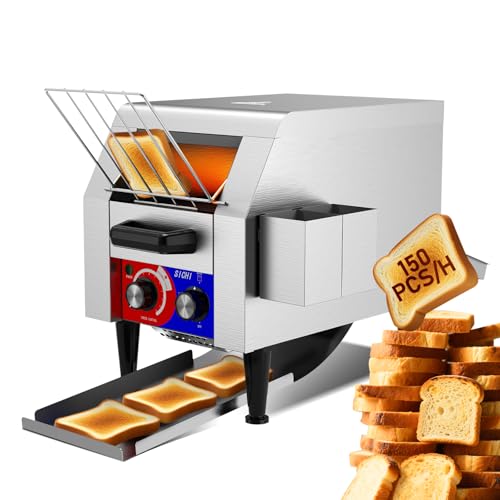
5. HTTSICHI Commercial Conveyor Toaster w/ 1 Slice Wide Slot, 150 Slice/hour Commercial Toaster w/ 7’’ Wide and 3‘’ Opening
The HTTSICHI Commercial Conveyor Toaster w/ 1 Slice Wide Slot, 150 Slice/hour Commercial Toaster w/ 7’’ Wide and 3‘’ Opening stands out for buyers who want solid everyday performance. The HTTSICHI Commercial Conveyor Toaster has a 1 slice wide slot, toasts 150 slices per hour, and has a 7 inch wide and 3 inch opening.
Day to day, this is a straightforward product to use. One slice wide slot is the feature that sets it apart: the wide slot takes thick bread, so a cafe that serves thick-cut toast or Texas toast will not find the bread stuck, and the 7 inch wide opening fits a full slice without folding it. One hundred and fifty slices per hour is worth having: the toaster suits a small cafe or a breakfast counter, so it keeps up without the size and power draw of a 450 slice machine.
What stands out:
- Wide slot: takes thick bread without sticking.
- 7 in opening: fits a full slice without folding it.
- 150 slices/hour: suits a small cafe or breakfast counter.
Trade-offs to know:
- 150 slices/hour: a buyer with a big breakfast rush will need a faster machine.
- 1 slice slot: a buyer who toasts two slices at once will find it slow.
- HTTSICHI: a buyer who wants a big-name brand may prefer Waring.
Maintenance is one of the quieter strengths here. Clean the crumb tray after every service, wipe the body, and brush crumbs off the belt before they burn.
It is a natural fit for a small cafe that serves thick-cut toast where wide slot, 150 slices/hour matters more than having the longest feature list.
Best for: small cafe that serves thick-cut toast. Not suited for: buyers with a big rush or who toast two slices at once.
It helps to place the HTTSICHI Commercial Conveyor Toaster w/ 1 Slice Wide Slot, 150 Slice/hour Commercial Toaster w/ 7’’ Wide and 3‘’ Opening against the rest of this guide before deciding. With 150 slices/hour, wide slot, 7 in opening as its headline, it is aimed squarely at a small cafe that serves thick-cut toast, and it does that job without asking you to pay for features you may never use.
There are a few things worth checking before ordering the HTTSICHI Commercial Conveyor Toaster w/ 1 Slice Wide Slot, 150 Slice/hour Commercial Toaster w/ 7’’ Wide and 3‘’ Opening. Start with size: measure the spot it will occupy and the storage space for its parts, and remember that the listed dimensions do not include the room you need to open lids, lift baskets or slide out drawers. Next, confirm the included accessories and the cleaning method, since both vary between models.
Buying Guide: How to Choose Commercial Conveyor Toasters
A commercial conveyor toaster is judged on speed, on slot, on power, on size, on build and on how it is cared for, so the points below help you choose by those six things.
Speed: slices per hour
A toaster at 450 slices per hour keeps up with a breakfast rush, so a cafe that serves toast all morning does not fall behind, while one at 150 slices per hour suits a small cafe or a breakfast counter. Choose the speed that matches how much toast your kitchen serves, since a toaster that is too slow will hold up the orders, and one that is too fast will cost more and draw more power than a small cafe needs. Count the slices your kitchen serves in its busiest hour, then choose a toaster that covers that number with room to spare.
Slot: wide or standard
A wide slot takes thick bread, so a cafe that serves thick-cut toast or Texas toast needs a wide slot, while a standard slot suits ordinary sliced bread. The HTTSICHI here has a 1 slice wide slot with a 7 inch wide opening, so it takes thick bread without sticking, while the others suit standard sliced bread, buns and bagels. Check the bread your kitchen serves before you buy, since a slot that is too narrow will jam on thick bread.
Bread: toast, bun, bagel
A conveyor toaster that handles toast, buns, bagels and bread covers the whole bread basket, so one toaster does the work of several, while one that handles toast only will need a second machine for bagels. The PYY machines here handle toast, buns, bagels and bread, so a cafe that serves all four will want one of them. Choose by the breads on your menu, not just by the toast.
Power: watts and circuits
A toaster at 1900W heats fast and recovers fast between slices, so the toast stays even when the orders come in a rush, while a lower power toaster will slow down when the belt is full. Check the circuit before you buy, since a 1900W toaster needs a circuit that can feed it, and a kitchen with a weak circuit will trip the breaker at the worst moment. Ask an electrician if you are not sure what your circuit can carry.
Size: counter space
A commercial conveyor toaster is bigger than a home toaster, so it needs counter space and room above it for the heat to escape. Measure the counter before you buy, including the height above the toaster, since the machine gives off heat and needs air around it. A toaster that is squeezed into a corner will overheat, and one that sits under a low shelf will scorch the shelf.
Build: stainless steel
A stainless steel body wipes clean and stands up to a commercial kitchen, while a painted body will chip and rust where it is wiped every day. The Waring and the PYY 450 here are stainless steel, so they suit a kitchen where the toaster is cleaned after every service. Choose steel if your kitchen cleans the toaster daily, since a toaster that is not steel will show the wear fast.
Care: crumbs and belt
A conveyor toaster must have its crumb tray emptied after every service, and the belt brushed clean before the crumbs burn, since burnt crumbs will smoke and make the toast taste burnt. A toaster that is not cleaned will lose speed, since the crumbs build up on the belt and slow it down, and that is the most common reason a commercial toaster stops toasting evenly. Choose a toaster whose cleaning routine your kitchen will actually follow.
How to Use and Care for Your conveyor toaster
Use the toaster on a clean counter, with the crumb tray in place, and let it heat up before the first slice goes on the belt. A toaster that is heated toasts evenly, so the bread comes out golden on both sides, and the belt should be clean, since crumbs on the belt will burn and make the toast taste burnt. Put the bread on the belt, let the belt carry it through, and take the toast off at the end, then put the next slice on.
Care is simple: empty the crumb tray after every service, wipe the steel body, and brush crumbs off the belt before they burn. Do not let crumbs build up on the belt, since they will slow the belt down and make the toast uneven, and do not put the toaster away wet, since it will rust. A toaster that is cleaned daily will toast evenly for years, and a kitchen that cleans the belt after every service will never taste burnt crumbs in the toast, since the belt stays clean and the heat stays even.
Common Mistakes to Avoid
Buying a toaster that is too slow
The most common mistake is buying a toaster that is too slow: a 150 slice machine will hold up a cafe that serves 400 slices in its busiest hour, so the orders will back up. Count the slices your kitchen serves in its busiest hour, then choose a toaster that covers that number with room to spare.
Buying a toaster that is too fast
A 450 slice machine costs more and draws more power than a small cafe needs, so a kitchen that serves a small breakfast counter will waste money on speed it never uses. Choose 150 slices per hour if your cafe is small, and 450 only if the rush needs it.
Not checking the circuit
A toaster at 1900W needs a circuit that can feed it, so a kitchen with a weak circuit will trip the breaker at the worst moment. Check the circuit before you buy, and ask an electrician if you are not sure what your circuit can carry.
Not cleaning the belt
A belt that is not brushed clean will slow down as the crumbs build up, so the toast will come out uneven, and burnt crumbs will smoke and make the toast taste burnt. Brush the belt clean after every service, even if it looks clean, since crumbs you cannot see will build up.
Related Guides
If this guide helped, these related guides on this site cover the same topic in more depth:
- Best Toasters for Restaurants
- Best Sandwich Toasters with Removable Plates
- Best Convention Toaster Ovens
Frequently Asked Questions
What is the best commercial conveyor toaster?
For the fastest toasting, the Waring heavy-duty machine at 450 slices per hour is the best pick, and for a small cafe the PYY machine at 150 slices per hour is the one. For 450 pieces per hour with 1900W, the Dyna-Living is the choice, and for a wide slot for thick bread the HTTSICHI is the pick. For 450 pieces per hour in stainless steel, the PYY 450 is the one.
How many slices per hour does a commercial conveyor toaster make?
A commercial conveyor toaster makes 150 to 450 slices per hour, so a small cafe will want 150 slices per hour and a busy cafe will want 450. Count the slices your kitchen serves in its busiest hour, then choose a toaster that covers that number with room to spare, since a toaster that is too slow will hold up the orders.
Can a commercial conveyor toaster toast bagels and buns?
Yes: the PYY machines here toast toast, buns, bagels and bread, so one toaster covers the whole bread basket. A toaster that handles only toast will need a second machine for bagels, so check the breads on your menu before you buy.
What is a wide slot on a conveyor toaster?
A wide slot takes thick bread, so a cafe that serves thick-cut toast or Texas toast needs a wide slot, while a standard slot suits ordinary sliced bread. The HTTSICHI here has a 1 slice wide slot with a 7 inch wide opening, so it takes thick bread without sticking.
How much power does a commercial conveyor toaster need?
A toaster at 1900W, like the Dyna-Living here, heats fast and recovers fast between slices, but it needs a circuit that can feed it. Check the circuit before you buy, since a kitchen with a weak circuit will trip the breaker at the worst moment, and ask an electrician if you are not sure what your circuit can carry.
How do I clean a commercial conveyor toaster?
Empty the crumb tray after every service, wipe the body, and brush crumbs off the belt before they burn. A toaster that is not cleaned will lose speed, since the crumbs build up on the belt and slow it down, and burnt crumbs will smoke and make the toast taste burnt.
Can I use a commercial conveyor toaster at home?
A commercial conveyor toaster is made for a cafe or a restaurant, so it is bigger than a home toaster, needs a circuit that can feed it, and gives off heat that a home kitchen must deal with. A household that toasts for a large family or a home business may still want one, but most homes will do better with a home toaster, since a commercial machine is too big, too hot and too powerful for a normal kitchen. Choose a commercial toaster only if your home truly serves toast at commercial speed.
A Final Tip Before You Buy
Whatever conveyor toaster you choose, give yourself a simple test before you order: picture the product in your home, in the place it will live, being used by the people who will use it most. If you can see it fitting there, being taken out without a struggle, and being cleaned without a sigh, it is the right choice. A conveyor toaster that fits your home and your habits is worth far more than a more impressive model that does not, and the 5 picks in this guide cover enough range that there is a good fit here for most households.
Conclusion
The best commercial conveyor toaster for your kitchen depends on how much toast you serve. For the fastest toasting, the Waring heavy-duty machine at 450 slices per hour is the pick, and for a small cafe the PYY machine at 150 slices per hour is the one. For 450 pieces per hour with 1900W, the Dyna-Living is the choice, and for a wide slot for thick bread the HTTSICHI is the pick. For 450 pieces per hour in stainless steel, the PYY 450 is the one. A kitchen that serves toast all morning will want the fastest machine, while one that serves a small breakfast counter will want the smaller one, so choose by the slices in your busiest hour.
Whichever you choose, check the slices per hour before buying and empty the crumb tray after every service: those two habits matter more than any single toaster. A toaster with the right speed keeps up with the rush from the first day, while one that is not cleaned will slow down and smoke, so the toast will taste burnt.
One last point: the best time to buy is when you have a clear use in mind, not when a deal appears. A conveyor toaster bought for a real job gets used from the first week, while one bought on impulse often waits for a job that never comes. Measure your space, check the listing for the exact model described here, and choose the pick that matches your household.


