A sandwich toaster makes the easiest meal in the kitchen and the worst cleanup. The cooking takes four minutes; the aftermath is cheese that escaped the bread, carbonised on a hot ribbed plate, in the one appliance that cannot be put under a tap. A fixed-plate press has to be cleaned where it sits, with a damp cloth, around a hinge, next to a power cord, while the surface is either too hot to touch or already cold enough for the cheese to have set like grout. Removable plates abolish that whole negotiation. Press the release buttons, lift the plates out, and the part of the machine that actually met the food goes to the sink or into the dishwasher like any other pan. This guide compares six presses built that way, and every one of them had to clear the same bar: plates that genuinely come off, and a sandwich or panini function the maker states outright rather than implies.
One disclosure before the picks. This site may earn an affiliate commission when readers buy through links on the page, at no extra cost to the reader. That commission is the business model, and it is stated plainly so the reasoning below can be judged on its merits. The selections come from research: manufacturer manuals, published plate and dimension figures, stated cleaning instructions, and the feature lists the makers themselves print. Nothing here rests on a popularity score, and no performance claim in this article goes beyond what the individual makers themselves publish.
Two neighbouring guides on this site are easy to confuse with this one, and the boundary is a difference of device class, not of topic. The stainless steel toasters covered elsewhere here are slot toasters judged on their housings; they take sliced bread vertically and brown it. The even-toasting guide is about browning quality in that same slot format. This page is about hinged presses: two heated plates that close on a filled sandwich and cook it from both sides at once. A word on vocabulary, because the category name travels badly. What British kitchens call a sandwich toaster — the machine with triangular moulded pockets that seals and cuts a sandwich — is sold in the United States mostly as a novelty with fixed plates, and fixed plates fail this guide’s first rule. The American expression of the same job is the panini press and the contact grill, and it is in that class that removable plates actually exist.
In this guide
Quick picks: best sandwich toasters with removable plates
| # | Product | Where to buy |
|---|---|---|
| 1 | Cuisinart Griddler Five | Check on Amazon |
| 2 | Cuisinart Griddler Elite | Check on Amazon |
| 3 | George Foreman Evolve Grill | Check on Amazon |
| 4 | T-fal OptiGrill+ | Check on Amazon |
| 5 | De’Longhi Livenza All-Day Grill | Check on Amazon |
| 6 | Cuisinart Griddler | Check on Amazon |
Why the plates decide everything
Start with the physics of the failure, because it explains why the plate question outranks every other specification in this category. A pressed sandwich leaks by design: the press squeezes, the filling migrates, and cheese, tomato juice, and butter reach the plate at exactly the moment the plate is hottest. Sugars and cheese proteins bake onto that surface within the cooking time itself. On a fixed plate the cook then faces a ribbed, non-submersible, electrically live surface that can only be wiped, and the ribs that make handsome grill marks also make a series of small valleys where residue collects and hardens across sessions. Each subsequent sandwich is cooked on a thin archaeological layer of the previous ones, and the flavour of that layer eventually announces itself.
Removable plates change the cleaning category rather than merely easing it. A plate that comes off can be soaked, which is the one treatment that reliably dissolves baked-on cheese without abrasion; it can go through a dishwasher, which is the treatment most households will actually perform on a weekday; and it can be replaced if the coating eventually fails, which converts the most failure-prone component of the appliance from a death sentence into a spare part. Three of the makers in this roundup sell additional or replacement plates for these very machines, which is only possible because the plates were designed to leave the appliance in the first place.
The makers’ language needs decoding, because two separate claims are routinely blurred into one. Removable describes the mechanism: the plate detaches from the body. Dishwasher safe describes the washing terms the maker will stand behind. A plate can be removable and hand-wash only, and a dishwasher claim can carry conditions — Cuisinart, for instance, states the Griddler Five’s drip tray as top-rack dishwasher safe while its plates carry the full claim. Every pick in this guide states both claims for its plates in its own documentation, and the most honest sentence in any of these manuals belongs to De’Longhi, which confirms its plates are dishwasher safe and then warns that frequent dishwasher washing could reduce the properties of the coating. That caution is not a contradiction; it is the correct mental model for the whole category, and the care section near the end of this guide returns to it.
What to look for in a sandwich toaster with removable plates
The release mechanism is the first axis, because it is the feature the whole purchase rests on and it will be operated with warm hands over a sink. The patterns in this group are push-buttons and spring clips: Cuisinart fits dedicated plate release buttons to its Griddlers, De’Longhi uses plate release buttons on the Livenza, T-fal clips each OptiGrill plate in behind a latch, and George Foreman builds the Evolve’s release to be cool-touch so plates can come off while still warm. What matters is that both plates release — a removable lower plate under a fixed upper plate is half a solution — and that the mechanism works without tools, prying, or a fingernail sacrificed to a hot seam. A mechanism that fights back will be used less and less, and a removable plate that is never removed is a fixed plate with extra seams.
Dishwasher terms are the second axis, and they reward literal reading. The useful question is not whether the word dishwasher appears on the box but which parts it covers and under what conditions. Across these six machines the plates themselves carry the claim in every case; the drip trays and scraping tools vary, with top-rack conditions appearing on some. The second useful question is what the maker concedes alongside the claim. De’Longhi’s coating caution, quoted above, is the documented position of the most candid manual here; the other makers print no such warning, which should be read as silence rather than as a promise that detergent chemistry treats their coatings more gently.
Plate architecture is the third axis, and it divides the roundup cleanly in two. The Cuisinart pattern is the reversible plate: a single pair of plates, each with a ribbed grill face on one side and a flat griddle face on the other, so the machine’s second personality is stored in the same metal it cooks on. The system pattern, used by George Foreman and De’Longhi, is the dedicated set: separate plates for separate jobs, including the waffle plates that a reversible plate cannot imitate, at the cost of a cupboard shelf for the sets not in use. Neither architecture is superior in the abstract. The reversible plate is the better answer for a kitchen that grills and griddles; the dedicated set is the only route to waffles and shaped plates, and the buyer should decide which of those sentences describes their cooking before comparing anything else.
The sandwich function itself is the fourth axis, because this roundup’s hard rule — a stated sandwich or panini role — is satisfied in three different ways. Cuisinart and De’Longhi list panini press among their cooking functions and press sandwiches on their grill plates. George Foreman includes dedicated panini plates in the Evolve’s box. T-fal goes furthest and gives the OptiGrill+ a Sandwich programme among its automatic cycles, so the machine treats the sandwich as a food category with its own timing rather than as a generic grilling task. What none of the six offers is the triangular sealed-pocket mould of the British-style sandwich toaster; that shape belongs overwhelmingly to fixed-plate machines, and a buyer whose definition of a toasted sandwich is a sealed triangle with a cut diagonal should understand that this entire guide is about the press style instead.
The hinge is the fifth axis, and it decides what happens to a thick sandwich in the first ten seconds. A floating or self-adjusting cover — fitted across the Cuisinart line, the Livenza, and in sensor form on the OptiGrill+ — rises and settles level on the food, so pressure spreads across the whole sandwich instead of pivoting on the back edge and squeezing the filling out of the front. The Griddler Elite adds the most deliberate version: an adjustable top cover with six height presets, which also enables its top melt mode, where the upper plate hovers above the food and melts without touching. T-fal replaces the mechanical answer with a measurement: the OptiGrill+ gauges the thickness of what is inside and adapts its programme to it. Lid locks, where fitted, deserve a clarification — on these machines the lock is principally for upright storage and for holding the cover at a set height, not a clamp for crushing sandwiches thinner, and buying a press for its lock is buying the wrong feature.
Heat control is the sixth axis, and the roundup spans the full range of philosophies. The original Griddler uses two analogue dials and indicator lights, with temperatures chosen by position rather than readout. The Griddler Five digitises the same job: a dial and an LCD, settings from 175 to 450 degrees Fahrenheit in 25-degree steps, and a sear mode that holds its highest setting for two minutes before stepping down. The Griddler Elite and the Livenza split control by plate, so upper and lower surfaces can run at different temperatures — the Elite reaching a 500-degree sear — which matters when a sandwich wants a hard sear below and a gentler melt above. The Evolve offers digital time and temperature across a 300-to-500-degree range with a one-minute sear burst. The OptiGrill+ declines to offer numbers at all in its main mode: its programmes and its cooking-level indicator judge doneness by colour stages, with a manual mode of four temperature levels for those who insist on a setting. For sandwiches specifically, the differences that matter are recovery — how fast the plate reheats after cold bread and cheese land on it — and evenness, which is where the Livenza’s heating elements embedded directly in its die-cast plates make their argument.
Size is the seventh axis, and it should be read as two numbers: the closed surface that presses one round of sandwiches, and the open surface available when a machine lays flat. The Livenza carries the largest plates here at roughly fourteen and a half by nine inches, doubling when opened. The three Cuisinarts cluster together at about 100 square inches closed and 200 open, with the Elite a step larger at 120 closed and 240 open. George Foreman sizes the Evolve by servings — five — rather than by area. The OptiGrill+ has the smallest plates of the six and makes no open-flat claim at all; it and the Evolve are closed-press-only designs, which is a genuine structural limit for households that also want a flat griddle. Counter footprint follows the same ordering in reverse: the machines with the most plate are the machines that ask for the most cupboard.
Drip management is the quiet axis that decides whether the counter survives lunch. Every machine here routes grease somewhere: the Cuisinarts and the Livenza collect it in integrated trays that slide out of the base, the OptiGrill+ fills a removable tray at its front, and the Evolve leans on the George Foreman slope, its plates angled so fat runs forward by design. The questions are capacity and honesty of access. A tray that is fiddly to reach gets emptied late, an undersized one overflows under exactly the fatty sandwich that produced the most runoff, and the tray is also the part most often abandoned in the sink — so a machine whose tray carries the dishwasher claim keeps the whole grease path machine-washable rather than most of it.
Coating is the last axis, and the honest summary is that every plate in this roundup is a coated plate whose coating is a consumable with a lifespan, differing in material and in how gracefully it ages. The Cuisinart, T-fal, and De’Longhi plates are nonstick-coated metal — die-cast aluminium on the T-fal and the De’Longhi, the latter with the heating elements embedded in the casting. George Foreman’s grill plates wear the brand’s premium ceramic coating, which the maker positions as its most durable finish, and ceramic’s known trade is a surface that starts exceptionally slick and asks for gentler treatment to stay that way. The practical consequence of any coating choice is the care routine, and the care routine is where this category is won or lost; it gets its own section below.
The six picks
Each machine below has removable plates its maker states as dishwasher safe, and an explicit sandwich or panini function in its maker’s own description. They are ordered by the shape of their argument rather than by rank: the balanced digital press, the two-zone flagship, the plate system, the automatic sensor press, the big multi-set machine, and the analogue original are different answers to the same leaked cheese.


Cuisinart Griddler Five: the balanced digital press
The Griddler Five is the centre of Cuisinart’s line and the natural reference point for this roundup: a five-function machine — contact grill, panini press, full grill, full griddle, and half grill with half griddle — built on one pair of reversible plates. Each plate is ribbed on one face and flat on the other, so the change from pressing sandwiches to cooking pancakes is a flip rather than a swap, and nothing needs storing. The plates come off with dedicated release buttons, one for the upper and one for the lower, and Cuisinart states them as nonstick and dishwasher safe; the integrated drip tray that slides out of the base is stated as top-rack dishwasher safe, and the included scraping tool is rated for the top rack as well.
The controls are the Five’s argument over the older Griddler below. A single dial works with a backlit LCD that shows the cooking function, the temperature, preheat progress bars, and a timer that counts up or down. Temperature runs from 175 to 450 degrees Fahrenheit in 25-degree steps, and the sear mode holds 450 degrees for two minutes before stepping down to 425, which is a considered way to treat a sandwich: hard heat for the crust, then a slightly kinder finish for the melt. The cover is self-adjusting, floating on its hinge to sit level on thick sandwiches, and a hinge release lever lets the machine open fully flat, doubling the roughly 100 square inches of closed surface for open grilling or griddling. Cuisinart also sells waffle plates sized for the Griddler family as a separate accessory, which is the one expansion this otherwise self-contained design accepts.
The limits are the limits of the reversible idea. One pair of plates means grill and griddle faces only in the box, so waffles are an accessory purchase rather than a feature. The single dial also means a single temperature across both plates at any moment; a cook who wants the bottom plate searing while the top plate merely melts is describing the Elite, not this machine. And the drip tray’s top-rack condition is a small but real asterisk on the dishwasher story, the kind of detail that only appears in the manual.
Strengths
- Reversible plates give grill and griddle faces with nothing extra to store, released by dedicated buttons.
- Digital control with an LCD: 175 to 450 degrees in 25-degree steps, a two-minute sear mode, and a count-up or countdown timer.
- Self-adjusting floating cover for thick sandwiches, and a hinge release that opens the machine fully flat.
- Plates stated dishwasher safe by the maker, with an integrated drip tray and scraping tool included.
Trade-offs
- One temperature governs both plates; there is no independent upper and lower control.
- Waffle plates are a separate accessory, not part of the box.
- The drip tray is top-rack dishwasher safe only, per the manual.
Who it suits: the household that presses sandwiches several times a week, griddles on weekends, and wants digital manners without flagship bulk or flagship segment pricing. If one dial, a clear display, and plates that flip from grill to griddle cover the whole brief, the Griddler Five is the natural place to check price on Amazon.
Check price on Amazon: Cuisinart Griddler Five


Cuisinart Griddler Elite: the two-zone flagship
The Griddler Elite is what the Griddler idea becomes with the constraints removed. It keeps the reversible removable plates — ribbed grill on one face, flat griddle on the other, stated dishwasher safe — and adds a sixth cooking function the Five does not have: top melt, in which the adjustable upper cover hovers above the food at a chosen height and melts cheese or warms toppings without contact. The cover offers six height presets and locks for storage, and the cooking surface is the largest Cuisinart offers in this line, about 120 square inches closed and 240 with the machine open flat.
The control story is the real separation. The Elite runs dual-zone temperature control, with the upper and lower plates set independently from its electronic display, and its sear function — the maker’s SearBlast — reaches 500 degrees for up to two minutes at a time. A 60-minute countdown timer, an integrated drip tray, a scraping tool, and a limited three-year warranty complete a specification that is plainly aimed at the cook who uses a press as a primary appliance rather than an occasional one. For sandwiches, the two zones are not a gimmick: a hard sear on the bottom plate and a gentler top plate is precisely the combination a thick, cheese-heavy sandwich asks for and a single-zone machine cannot express.
The costs are physical and financial rather than functional. This is the heaviest and largest of the three Cuisinarts, a brushed stainless presence that needs a permanent counter home rather than a cupboard rotation, and it sits in the premium segment of this roundup in prose terms — the machine a household buys when the press is a daily tool. It also shares the reversible plate’s boundary: grill and griddle faces in the box, and no dedicated waffle or sandwich-shaped plates in its standard kit, so its versatility is about heat and space rather than about plate shapes.
Strengths
- Dual-zone temperature control: upper and lower plates set independently, with a 500-degree sear for up to two minutes.
- Top melt mode with six cover height presets — the only hover-and-melt function in this roundup.
- The largest Cuisinart surface here, about 120 square inches closed and 240 open.
- Removable reversible plates and all accessories stated dishwasher safe; limited three-year warranty.
Trade-offs
- The biggest and heaviest machine in the Cuisinart trio; it wants a permanent counter slot.
- Premium segment positioning, priced in spirit well above the Five and the original.
- Plate shapes stop at grill and griddle; no waffle plates in the box.
Who it suits: the daily press cook with the counter space to house it — the household that melts as often as it presses, sears on the same plates it griddles with, and will genuinely use two temperature zones. If that description fits and the footprint is available, start with the Elite and check price on Amazon.
Check price on Amazon: Cuisinart Griddler Elite

George Foreman Evolve Grill: the plate system
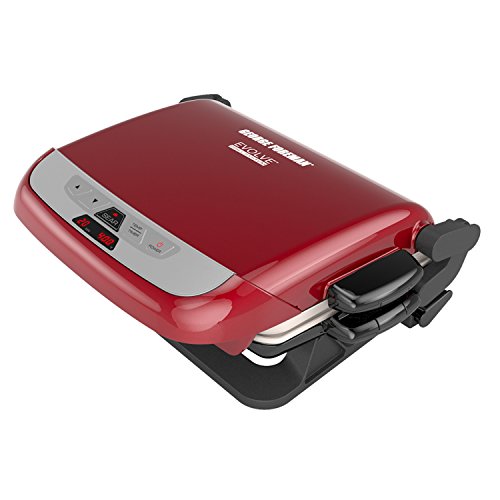
The Evolve is the only machine in this roundup designed as a plate system first and a grill second. The base unit accepts interchangeable plates that snap in and release with a cool-touch mechanism, so a plate can come off while it is still warm rather than after a wait. The configuration described here ships with two sets: premium ceramic grill plates, which double as the panini plates, and nonstick waffle plates — the only waffle plates included in any box in this roundup. Around those two sets the maker sells a small library of additional plates and inserts, including a griddle plate, a bake dish, a muffin pan, and omelette and snack plates, each of which turns the same base into a different appliance. All of the plates are removable and stated dishwasher safe.
The controls match the system’s ambition. Temperature and time are set digitally, across a range the maker states as 300 to 500 degrees, with a timer that runs up to 90 minutes and a sear button that drives the plates to 500 degrees for a 60-second burst before returning to the set temperature. The grill is sized at five servings, keeps the brand’s signature slope so fat runs forward into a drip tray, and the hinge adjusts to the thickness of what is being pressed. As a sandwich machine it presses panini on its ceramic grill plates, and its claim on a place here rests on breadth: no other pick changes its cooking surfaces this completely.
The boundaries are structural. The Evolve is a closed press only; it does not open flat, so there is no open-griddle mode and no doubling of surface, and the sloped geometry that drains fat so well with burgers is a fixed trait a sandwich cook simply lives with. The system’s strength is also its storage problem, because every additional plate set is another object in a cupboard, and the value of the library depends on plates remaining available for a line that has been in the catalogue for years. Ceramic coating, finally, rewards the gentler end of utensil and cleaning habits; the maker positions it as the brand’s most durable finish, and it should be treated as a surface to keep rather than a surface to abuse.
Strengths
- Two plate sets in the box — ceramic grill and panini plates plus waffle plates — with more sets sold separately.
- Cool-touch plate release: plates can come off while still warm, and all are stated dishwasher safe.
- Digital time and temperature control, 300 to 500 degrees, with a 60-second sear burst at full heat.
- Five-serving capacity on a sloped grill that drains fat forward into its drip tray.
Trade-offs
- Closed press only: no open-flat griddle mode and no doubled cooking surface.
- The plate library is a storage commitment, and extra sets are separate purchases.
- Ceramic plates ask for non-metal utensils and considerate handling to keep their finish.
Who it suits: the variety cook — the household that wants waffles on Saturday, panini on Tuesday, and a muffin or bake insert when the mood arrives, all from one base and one cupboard shelf of plates. If breadth of surfaces matters more than opening flat, the Evolve is the system to check price on Amazon.
Check price on Amazon: George Foreman Evolve Grill

T-fal OptiGrill+: the sensor that decides
The OptiGrill+ is the contrarian of this roundup: the machine that asks the cook to surrender judgement to a sensor. Its defining mechanism is an automatic thickness measurement — the press gauges how thick the food between its plates is, adapts its cooking to that measurement, and reports progress through a cooking-level indicator that moves through colour stages from rare to well done, with audible signals at each stage. Around that sensor sit six automatic programmes — burger, poultry, sandwich, sausage, red meat, and fish — plus a frozen-food mode and a manual mode with four temperature levels. The Sandwich programme deserves emphasis, because it makes this the only pick whose maker treats the sandwich as a category with its own dedicated automatic cycle rather than as one more thing a grill plate can do.
The plates honour this guide’s first rule in the plainest way. They are die-cast aluminium with a nonstick coating, each held by a latch and released at the press of a button, and T-fal states both plates and the drip tray as dishwasher safe. The plates are ribbed grill plates only — there is no second face and no set to swap — which keeps the cleaning story as simple as the cooking story: two plates, two buttons, one tray, all of it washable by machine. The plus in the name marks this generation’s addition of the manual mode over the original OptiGrill, a distinction that matters at purchase, because the original model and the larger XL are different machines wearing similar faces.
The trade-offs follow from the philosophy. The OptiGrill+ does not open flat, so there is no griddle mode, no doubled surface, and no eggs-and-bacon work; it is a press and only a press. Its plates are the smallest in this roundup, sized for a couple of sandwiches at a time rather than a family’s full round. And the automation that defines it cuts both ways: a cook who thinks in temperatures gets four manual levels and no numeric readout in the automatic programmes, because the machine’s position is that its sensor and its indicator know the stages better than a dial does. Buyers who find that position reassuring will love this machine; buyers who find it presumptuous have five other picks.
Strengths
- Automatic thickness sensing with a cooking-level indicator that tracks doneness through colour stages.
- A dedicated Sandwich programme among six automatic cycles, plus frozen mode and a four-level manual mode.
- Die-cast aluminium plates released by button and stated dishwasher safe, drip tray included in the claim.
- The simplest cleaning story here: one pair of plates, no sets to store, no faces to flip.
Trade-offs
- No open-flat position, so no griddle work and no doubled surface.
- The smallest cooking surface in the roundup; family-sized rounds need batches.
- Automation limits manual expression: four temperature levels and no numeric control in programme mode.
Who it suits: the cook who wants the decision made — sandwiches and weeknight proteins cooked by programme and indicator rather than by hovering with a timer and an opinion. If pressing a button marked Sandwich and being told when it is done sounds like the correct division of labour, let the sensor do the judging and check price on Amazon.
Check price on Amazon: T-fal OptiGrill+

De’Longhi Livenza Digital All-Day Grill: the big multi-set machine
The Livenza is the largest and most ambitious machine in this roundup, and the version described here is the Digital All-Day Grill bundled with waffle plates, a bundle detail that matters because the plate count varies across the line. In that configuration the box holds three sets of die-cast plates — grill, griddle, and waffle — each set released by plate buttons and stated dishwasher safe, with the grill and griddle plates fully interchangeable between the upper and lower positions. The plates measure about fourteen and a half by nine inches, the largest surface here, and the machine opens flat to double that area. Seven cooking functions run from contact grill and panini press through open grill and griddle combinations to an oven-style mode that uses the height-adjustable cover.
Two engineering choices separate the Livenza from the field. The first is inside the plates: the heating elements are embedded directly in the die-cast metal rather than sitting beneath it, which is the construction makers use when even heat across the whole plate is the priority, and it shows in the design’s intent — a plate this large has nowhere to hide a cold corner. The second is control: a digital display with two knobs sets the upper and lower plate temperatures independently, so the Livenza joins the Elite as the roundup’s dual-zone machines, and its hinge is self-adjusting to food thickness. The grease tray is integrated and removable, a cleaning tool is included, and the manual’s candour has already been quoted in this guide: the plates are dishwasher safe, and the maker itself notes that frequent dishwasher washing could reduce the coating’s properties. That sentence, printed by the manufacturer, is worth more than a page of marketing.
The costs are scale and complexity. This is a premium-segment machine with a footprint to match its plates, and a household with a small counter will feel its presence daily. Three plate sets mean two sets are always in storage, and the line’s bundle variations mean a buyer must confirm which plates a given listing actually contains before assuming the waffle set is in the box — the manual itself warns that the number and type of plates ranges by model. None of that diminishes the machine; it defines the buyer it is for.
Strengths
- Three plate sets in the described bundle — grill, griddle, and waffle — the most complete box in the roundup.
- Heating elements embedded in die-cast plates, aimed at even heat across the largest surface here.
- Independent upper and lower temperature control with a digital display; self-adjusting hinge.
- Plates released by button and stated dishwasher safe, with the maker’s own coating caution printed in the manual.
Trade-offs
- The largest footprint and a premium segment position; it is a commitment of counter space.
- Plate sets not in use need storage, and bundle contents vary across the line — verify the set list before buying.
- Frequent dishwasher washing can reduce the coating’s properties, by the maker’s own statement.
Who it suits: the high-volume household — big breakfasts, full rounds of sandwiches for a table, waffles from the same machine — with the counter to park the largest plates in the class and the appetite to use three plate sets. If capacity and even heat outrank compactness in your kitchen, the Livenza is the one to check price on Amazon.
Check price on Amazon: De’Longhi Livenza All-Day Grill

Cuisinart Griddler: the analogue original
The original Griddler, the GRID-8 that started the line, is the machine the other two Cuisinarts in this guide are developments of, and its design has survived because its fundamentals were right. Five cooking functions — contact grill, panini press, full grill, full griddle, and half grill with half griddle — run on the same reversible plate pattern the line still uses: ribbed on one face, flat on the other, released by buttons, nonstick, and stated dishwasher safe, with an integrated drip tray catching what the slope delivers. The cover floats on its hinge to accommodate thick sandwiches, the machine opens flat to turn about 100 square inches of closed surface into 200, and Cuisinart’s waffle plates for the Griddler family fit it as a separate accessory.
What dates the design is the interface, and for some kitchens that is the appeal. Two analogue dials divide the work — a selector that also carries the griddle temperatures, and a grill and panini dial spanning roughly 200 to 425 degrees — with indicator lights announcing readiness instead of a display. There is no timer, no sear mode, and no readout; temperature is a position on a dial, learned by habit the way an oven knob is learned. The result is a machine with almost nothing electronic to fail, nothing to programme, and a learning curve measured in one sandwich.
The honest limits are the mirror of the Five’s strengths. A cook who wants to know the plate temperature as a number, to be timed, or to sear at a held peak will find the dials vague company, and the temperature ceiling sits below the newer machines’ highest settings. The drip arrangement is of its generation as well. None of this makes the original a nostalgia purchase; it makes it the baseline against which the Five’s display and the Elite’s zones must justify themselves, and for a household that presses sandwiches and griddles breakfast without ceremony, the justification is not automatic.
Strengths
- The proven reversible plate system: grill and griddle faces, button release, stated dishwasher safe.
- Two-dial analogue control with indicator lights — nothing to programme and little to fail.
- Floating cover for thick sandwiches and a fully flat open position that doubles the surface.
- Accepts the Griddler family’s waffle plates as a separate accessory.
Trade-offs
- No display, no timer, and no sear mode; temperature is chosen by dial position, not readout.
- A lower temperature ceiling than the digital Cuisinarts in this guide.
- Single temperature behaviour shared across the plates, as with the Five.
Who it suits: the analogue household — cooks who trust a knob, distrust a menu screen, and want the original, simplest expression of the removable-plate press for daily sandwiches and weekend griddling. If two dials and a ready light are all the interface your kitchen asks for, the original Griddler remains the honest starting point to check price on Amazon.
Check price on Amazon: Cuisinart Griddler
The six compared, qualitatively
| Machine | Plate arrangement | Dishwasher terms, as stated | Heat control | Opens flat | Defining trait |
|---|---|---|---|---|---|
| Cuisinart Griddler Five | One reversible pair: grill and griddle | Plates yes; drip tray top-rack | Digital dial and LCD, 175–450 degrees, sear mode | Yes | The balanced default |
| Cuisinart Griddler Elite | One reversible pair: grill and griddle | Plates and accessories yes | Dual-zone digital, 500-degree sear | Yes | Top melt and two zones |
| George Foreman Evolve Grill | Two sets in the box: ceramic grill and panini, plus waffle; more sold separately | Plates yes | Digital time and temperature, 300–500 degrees | No | The plate system |
| T-fal OptiGrill+ | One ribbed pair, no second face | Plates and drip tray yes | Automatic programmes with a doneness indicator | No | The sensor decides |
| De’Longhi Livenza All-Day Grill | Three sets in the described bundle: grill, griddle, waffle | Yes, with the maker’s coating caution | Dual knobs with digital display, zones independent | Yes | The biggest plates |
| Cuisinart Griddler | One reversible pair: grill and griddle | Plates yes | Two analogue dials, roughly 200–425 degrees | Yes | The analogue baseline |
Read the table by columns rather than by rows. The plate arrangement column settles the versatility question — one reversible pair, a system of sets, or a single fixed personality. The dishwasher column settles the chore, including its asterisks. The heat control column settles how much judgement the machine wants from its cook, running from the original Griddler’s dials to the OptiGrill+’s refusal to ask. The opens-flat column is the quiet divider: four of these machines are also griddles, and two are presses only, and a household that knows which of those it is buying has already made most of the decision.
Matching a pick to the kitchen
For the sandwich-first household — the one where the press earns its place at lunch, daily, and breakfast is somebody else’s problem — the decision narrows to hinge behaviour and plate size. The Griddler Five is the default answer, because its floating cover, mid-sized plates, and digital control suit repetition without ceremony. The OptiGrill+ is the alternative for the same household when the cooking around the sandwich matters as much as the sandwich: its programmes handle the chicken and the sausages with the same indifference to supervision. The original Griddler serves this household too, at the analogue end, provided nobody in it reads temperatures as numbers.
For the weekend-versatility household, where the machine must justify its footprint across waffles, pancakes, and a full breakfast, the plate sets decide. The Livenza is the maximal answer — three sets, the largest plates, an open-flat griddle — and the Evolve is the expandable one, starting with two sets and a catalogue behind them. The Elite belongs in this conversation for a different reason: opened flat with two zones, it is the best breakfast station here, one plate griddling eggs at a gentle setting while the other sears bacon hard, a trick neither the Five nor the original can perform with their shared temperature.
For the small kitchen, the ordering inverts. The OptiGrill+ has the least plate and the least presence, and its refusal to open flat matters less where it would have nowhere to open to. The original Griddler and the Five store as single bodies with their plates inside them, asking for no shelf of accessories, while the Evolve and the Livenza should be bought with their plate storage already planned — a system without a home for its sets becomes a base unit with regrets. Measure the cupboard as honestly as the counter; in this category the second measurement is the one buyers skip.
Plate care: the routine that decides how long the coating lives
Every plate in this roundup will eventually lose its coating, and the routine decides whether eventually means two years or eight. The first rule is thermal patience: plates should cool before they meet water, because a hot plate under a cold tap is a warping and coating-shock lesson, and the makers’ manuals direct cleaning after the plates have cooled — the Evolve’s cool-touch release exists so its plates can be moved early, not so they can be washed hot. The second rule is the soak’s priority. Baked-on cheese surrenders to twenty minutes in hot soapy water without any abrasion at all, and a removable plate is the only kind that can be soaked properly; the dishwasher is the convenience option, not the gentlest one, which is exactly the trade De’Longhi’s manual names.
Utensils and tools are the third rule. The scraping tools included with the Cuisinarts and the Livenza are shaped for their plates’ ribs and made of materials the coatings tolerate; metal spatulas and scouring pads are the two fastest ways to shorten a plate’s life, and they are both unnecessary in a category where soaking exists. The fourth rule concerns the dishwasher itself: plates should go in without other metal items resting against the coated faces, and households that run the dishwasher nightly should consider whether the plates need to be in every load or whether a rinse-and-soak rotation halves their exposure to detergent for the same cleanliness.
The last point is the ownership advantage that only removable plates offer. When a coating does finally tire — food beginning to grip in the centre of the plate, the surface losing its easy release — the plate, not the appliance, is the part at the end of its life. Cuisinart, George Foreman, and De’Longhi all sell plates for these machines beyond the ones in the box, as expansions and as replacements, so the correct response to a worn plate is a parts order rather than a new machine. A fixed-plate press in the same condition is simply finished, which is the whole argument of this guide stated from the far end of the product’s life.
What this class leaves out
The most conspicuous absence is the sealed triangle. The pocket-style sandwich toaster — two moulded plates that crimp a sandwich into sealed triangles — is a real and loved format, but its plates are overwhelmingly fixed, and this guide’s first rule excludes the format rather than any individual machine. A buyer whose sandwich is defined by that sealed edge should shop that class knowingly, accepting the cloth-and-patience cleaning routine as the price of the shape. The second absence is plain toast itself. A press browns bread in contact with a plate and flattens as it goes; it is not a substitute for a slot toaster when toast is the meal, and this site’s browning guide covers the machines built for that job.
The third absence is subtle: none of the six is a sandwich specialist in the way a café press is. All six are contact grills that press sandwiches among other duties, because the removable-plate engineering in the current market lives in the grill category rather than in dedicated sandwich appliances. That is why every pick here can also grill a chicken breast, and why a buyer who wants nothing but sandwiches is still, correctly, buying a grill. The category’s centre of gravity is the plate, and the plate does not care whether the thing being pressed is a sandwich or a steak — which is precisely the versatility the removable design was built to deliver.
Frequently asked questions
Are removable plates really dishwasher safe, or is that marketing?
For these six machines it is a documented claim, not a slogan: each maker states its plates as dishwasher safe in its own manual or specification, and the drip trays carry the claim in most cases too, with the Griddler Five’s tray limited to the top rack. The honest asterisk is durability rather than safety. De’Longhi’s manual states outright that frequent dishwasher washing could reduce the properties of the coating, and that caution is sound chemistry for every coated plate in this roundup, whether or not the other makers print it. Dishwasher for routine weeks, a soak and a soft sponge when time allows, is the rhythm that respects both the claim and the coating.
What is the difference between reversible plates and a plate system?
A reversible plate is one plate with two working faces — ribbed grill on one side, flat griddle on the other — so the machine’s second function is stored in the same piece of metal, as on all three Cuisinarts here. A plate system uses separate dedicated plates for each job, as on the Evolve and the Livenza, which is the only architecture that can offer shapes a flat plate cannot flip into, waffle grids being the standing example. The reversible design wins on storage and simplicity; the system wins on range, and charges a cupboard shelf for the sets not in use.
Can these presses handle a thick sandwich without squeezing the filling out?
That is what the floating hinge is for. The Cuisinart covers, the Livenza’s self-adjusting hinge, and the Evolve’s adjustable hinge all let the top plate rise and settle level instead of pivoting from the back edge, which is the motion that pushes filling forward and out. The Griddler Elite goes further with six cover height presets, and the OptiGrill+ answers the same problem by measuring the thickness and adapting its programme. One clarification worth repeating: the lid locks on these machines are for storage and for holding a hover height, not clamps for compressing a sandwich thinner than its ingredients allow.
Do I need a dedicated sandwich plate to make a good panini?
No, and the roundup is the evidence. Four of the six picks press sandwiches on their standard ribbed grill plates, which is the classic panini arrangement: the ribs mark the bread, the plates’ weight and heat do the rest. The Evolve includes panini plates in its set, and the OptiGrill+ dedicates a whole automatic programme to sandwiches, but both are refinements of the same contact principle rather than different cooking. What a standard grill plate will not produce is the sealed triangular pocket of the moulded sandwich toaster, which is a different format with mostly fixed plates, excluded here by the removable-plate rule.
How long does a nonstick plate coating last, and what happens when it wears out?
The makers do not promise a number of years, and any figure would depend on utensils, cleaning chemistry, and how often the plates meet the dishwasher, which is why this guide treats the coating as a consumable from the start. The practical signs of a tiring coating are food beginning to grip at the centre of the plate and residue surviving a soak that once lifted it cleanly. The removable design is the answer to that day: Cuisinart, George Foreman, and De’Longhi all sell plates for these machines beyond the original sets, so a worn plate is a replaceable part. On a fixed-plate press, the same wear ends the appliance.
A sandwich press earns its counter space in the two minutes after the meal rather than during it, so choose the machine whose plates come off in the way your household actually cleans, and the midday sandwich stops being a negotiation with a cloth, a hinge, and a layer of yesterday’s cheese.


