Disclosure: airfryerkitchensupply.com is reader-supported. When you buy through links on our site, we may earn an affiliate commission at no extra cost to you.
Where to buy
The best heavy duty toasters are not prettier home toasters — they are throughput machines, rated by their makers in slices per hour, built to run through a breakfast rush without fading. Every pick below was verified against its own listing for this guide, and the output figures quoted are the makers’ own figures from those listings. Use the links to check price on Amazon, and check your circuit before you fall in love: two picks here are serious electrical citizens, and one is a 208-volt commercial unit that does not belong on a kitchen counter circuit.
- Waring WCT800RC 4-Slot Pop-Up Toaster — Best Overall Heavy Duty: Check the current price on Amazon
- Waring 4-Slot Toaster, 380 Slices per Hour — Best Throughput on 120V: Check the current price on Amazon
- Waring WCT805B 4-Slot Pop-Up Toaster 208V — Best for True Commercial Premises: Check the current price on Amazon
- Waring WCT708 4-Slot Pop-Up Toaster — Best Wide-Slot Commercial: Check the current price on Amazon
- PYY Professional 6-Slice Commercial Toaster — Best 6-Slice Value Volume: Check the current price on Amazon
- Dualit Classic 4 Slice NewGen Toaster — Best Buy-It-for-Life Heavy Duty: Check the current price on Amazon
Heavy duty, in toasters, has a precise meaning that marketing tries to blur. A heavy duty toaster is built for volume and repetition: a cafe turning out toast through a three-hour rush, a bed-and-breakfast feeding a full house, a large family or shared house where the toaster works like an appliance of the house rather than a gadget of the moment. The honest makers in this category — and this guide sticks to them — rate their machines in slices per hour, build them with replaceable or serviceable elements, and give each slot its own browning control because in real service, no two orders want the same shade.
The six picks below divide into two honest families. The first is true commercial equipment from Waring, the name that dominates diner and cafe counters, in four configurations spanning compact two-slot service to a 208-volt, high-output four-slot machine. The second family is the heavy-duty end of the broader market: a six-slice commercial-style unit for value volume, and the Dualit Classic — a domestic-looking toaster whose hand-built, replaceable-element construction has made it the default ‘buy it once’ answer for decades. What unites them is not a look but a duty cycle: these are toasters designed to be used hard, daily, for years.
One warning belongs at the top, because it decides purchases in this category more than any feature: power. High-throughput toasting is high-wattage toasting, and commercial units assume commercial circuits. One pick below is a 208V machine for genuine commercial premises. Home buyers should read the electrical trade-offs in each review as seriously as the toast quality, because the best heavy duty toaster for a cafe and the best one for a farmhouse kitchen are cousins, not twins.
In this guide
Quick Picks
Four Waring commercial machines for graded levels of service, a six-slice value volume play, and the repairable Dualit for heavy home duty. Throughput figures are the makers’ figures from the verified listings.
- Waring WCT800RC 4-Slot Pop-Up Toaster — Best Overall Heavy Duty: The commercial benchmark in a home-friendly voltage: 240 slices an hour, four slots taking bread up to 1⅛ inches thick, and separate electronic browning controls per its listing — on 120V. Check price on Amazon
- Waring 4-Slot Toaster, 380 Slices per Hour — Best Throughput on 120V: The output leader that still plugs into standard power: 380 slices an hour per its listing, with switchable bread and bagel operation across bread, bagels, Texas toast, and frozen waffles. Check price on Amazon
- Waring WCT805B 4-Slot Pop-Up Toaster 208V — Best for True Commercial Premises: The premises-grade machine: 360 slices an hour on 208V per its listing, with separate electronic browning controls — for commercial kitchens wired for it, and emphatically not for home counters. Check price on Amazon
- Waring WCT708 4-Slot Pop-Up Toaster — Best Wide-Slot Commercial: The thick-bread specialist: slots for bread up to 1⅜ inches per its listing — the widest in this guide — at 225 slices per hour on 120V with separate electronic controls. Check price on Amazon
- PYY Professional 6-Slice Commercial Toaster — Best 6-Slice Value Volume: The value volume play: six slots and 1800W per its listing, with six browning levels — the most simultaneous toast in this guide for small businesses counting every dollar of the fit-out. Check price on Amazon
- Dualit Classic 4 Slice NewGen Toaster — Best Buy-It-for-Life Heavy Duty: The repairable icon: hand built in the UK with replaceable ProHeat elements and a mechanical timer per its listing — the heavy duty answer for homes that measure duty in decades. Check price on Amazon
How These Picks Were Chosen
Selection began with the slices-per-hour test: a heavy duty claim had to be backed by a maker’s throughput rating in its verified listing, or by a construction story — replaceable elements, commercial build — that amounts to the same promise. Decorative ‘pro’ styling on ordinary home mechanisms was excluded. Every linked pick was verified against its own Amazon listing, and every throughput, slot-width, and voltage figure in this article comes from those listings.
The set was then graded by duty. Genuine commercial service splits by volume — a small cafe’s two-slot rhythm is not a diner’s four-slot rush — so the Waring line is represented at several output levels rather than once. The value six-slice and the Dualit were included because heavy duty home and small-business use is real use: a household toasting twenty slices every morning will kill a light-duty toaster in a year, and deserves machines built for that arithmetic.
Finally, electrical honesty was treated as a selection criterion, not a footnote. Picks are labeled with their voltage and circuit implications wherever the listing states them, and the buying guide returns to the subject at length — in this category, the install is part of the product.
The 6 Best heavy duty toasters
Throughput figures below are the makers’ published figures from the verified listings. Treat them as ceiling ratings for comparison between these machines, achieved with standard bread in continuous service.

Waring WCT800RC 4-Slot Pop-Up Toaster — Best Overall Heavy Duty
The WCT800RC is the machine most people actually mean when they say ‘commercial toaster’: four slots, a rated 240 slices per hour per its verified listing, separate electronic browning controls, and slots that accept bread up to 1⅛ inches thick — all on a standard 120V supply. That combination is why it anchors this guide. It delivers genuine cafe-grade service without demanding commercial wiring, which makes it the rare heavy duty pick that serves a small cafe, a serious B&B, and a very busy home kitchen with equal legitimacy.
Strengths
- 240 slices per hour per the verified listing — true rush-hour capacity
- 120V operation, so it fits standard premises wiring unlike the 208V pick below
- Separate electronic browning controls per slot pair, because service means different shades simultaneously
Trade-offs
- It is a working machine in size and voice; domestic counters will feel its footprint
- Commercial build means commercial replacement-part pricing when service eventually comes
- Slots top out at 1⅛-inch bread per the listing; the thickest artisan cuts belong to the wider-slot pick below
| Specification | Detail |
|---|---|
| Slots | 4, up to 1⅛ in thick bread (per verified listing) |
| Throughput | 240 slices/hour (per verified listing) |
| Power | 120V |
| Controls | Separate electronic browning controls |
| Model | WCT800RC |
What 240 slices an hour buys in practice is composure. A home toaster in a rush fades — elements cycle, later rounds toast lighter, and somebody is always re-toasting. A machine rated for continuous service holds its thermal state through the rush, so slice forty toasts like slice four. That consistency, more than the raw number, is the heavy duty experience, and it is why cafes buy this class of machine even when their average hour never approaches the rating: the rating is really a promise about thermal mass and element recovery.
As the overall pick it also makes the fewest demands. No special circuit, no six-slot counter commitment, no exotic parts story — just a commercial toaster from the category’s defining maker, in the configuration that fits the most premises. If your use case is ‘a lot of toast, every day, for years,’ and you are buying one machine from this guide, this is the one the rest are measured against.
Best for: Small cafes, B&Bs, offices, and very busy households wanting true commercial service on 120V / Not suited for: Occasional toast households — this is more machine than two slices on Sunday justifies
Check the current price on Amazon

Waring 4-Slot Toaster, 380 Slices per Hour — Best Throughput on 120V
If the WCT800RC is the benchmark, this Waring is the overachiever: its verified listing claims 380 slices per hour — the highest throughput in this guide — while remaining a 120V machine. It adds switchable bread and bagel toasting, with the listing naming bread, bagels, Texas toast, and frozen waffles as its uniform-toasting repertoire. For a diner-style operation or a big institutional kitchen — a school, a church hall, a workplace canteen — that combination of maximum output on standard power is exactly the specification that matters.
Strengths
- 380 slices per hour per the verified listing — the highest throughput here
- Switchable bread/bagel operation suits mixed breakfast service
- Still 120V, avoiding the electrical project of the 208V machine below
Trade-offs
- Maximum output assumes continuous feeding; a single operator becomes the bottleneck before the toaster does
- High-throughput 120V toasting is a serious circuit load — dedicate the circuit as the guide advises
- Pure service machine: no domestic styling concessions whatsoever
| Specification | Detail |
|---|---|
| Slots | 4 |
| Throughput | 380 slices/hour (per verified listing) |
| Power | 120V |
| Modes | Switchable bread and bagel |
| Named foods | Bread, bagels, Texas toast, frozen waffles (per listing) |
Throughput at this level changes how a kitchen organizes breakfast. At 380 slices an hour the toaster stops being a station someone tends and becomes a utility someone feeds — toast production decouples from individual orders, and the pass can hold a rhythm. The bagel switch matters in that world more than it does at home: bagels want one-sided intensity and longer cycles, and a machine that handles both bread and bagels in the same four slots removes a second appliance from a crowded line.
The electrical honesty applies with full force here. A 120V machine with this output is drawing near what a standard circuit offers; put it on a shared circuit with a coffee brewer and you will learn about breaker panels at the worst possible moment. Treat the dedicated-circuit advice in the buying guide as part of this pick’s price, and it will repay you every single service.
Best for: Diners, canteens, and high-volume breakfast service on standard power / Not suited for: Homes or premises where a dedicated circuit is not available
Check the current price on Amazon
Waring WCT805B 4-Slot Pop-Up Toaster 208V — Best for True Commercial Premises
The WCT805B is included to draw the category’s top line honestly. Per its verified listing it is a four-slot machine rated at 360 slices per hour on a 208V supply, with separate electronic browning controls and slots for bread up to 1⅛ inches thick. In a commercial kitchen wired for 208V — the standard in much professional food service — that supply means faster element recovery and sustained output through the longest rush. In a home, it means an electrician and a new circuit, which is why this pick’s badge says ‘true commercial premises’ and means it as a filter, not a flourish.
Strengths
- 360 slices per hour per the verified listing, sustained by a 208V supply’s recovery speed
- Separate electronic browning controls for simultaneous mixed service
- Built for the electrical environment professional kitchens already have
Trade-offs
- 208V excludes it from ordinary homes without electrical work — this is the pick’s defining condition
- Commercial service ecosystem: parts and service assume a business buyer
- No advantage over the 120V picks at low volume; its virtues only appear under sustained load
| Specification | Detail |
|---|---|
| Slots | 4, up to 1⅛ in thick bread (per verified listing) |
| Throughput | 360 slices/hour (per verified listing) |
| Power | 208V |
| Controls | Separate electronic browning controls |
| Model | WCT805B |
Why does voltage matter to toast? Because a toaster’s real enemy in service is recovery — the dip in element temperature after cold bread absorbs heat. Higher-voltage elements restore that heat faster, so the fiftieth cycle of a rush matches the first. That is the entire case for this machine, and it is a strong one in the premises it was built for: hotels, hospitals, high-volume cafes, anywhere toast is a line item produced by the hundreds daily.
For every other reader, this pick functions as the guide’s honesty marker. Heavy duty marketing tempts home buyers toward the most ‘professional’ specification available, but professionalism in equipment means fitness for an environment. The 120V Waring picks above deliver the same maker’s service quality inside a home or small business’s electrical reality. Buy the environment you actually have.
Best for: Hotels, hospitals, and high-volume commercial kitchens wired for 208V / Not suited for: Homes and small premises on standard circuits
Check the current price on Amazon

Waring WCT708 4-Slot Pop-Up Toaster — Best Wide-Slot Commercial
Slot width is the specification heavy duty buyers most often get wrong, and the WCT708 exists for the ones who got it right. Its verified listing rates it at 225 slices per hour with slots accepting bread up to 1⅜ inches thick — a quarter-inch more than its Waring siblings here — on 120V with separate electronic browning controls. That extra width is the difference between toasting a thick-cut artisan slice, a halved bagel, or a chunky Texas toast as it comes, and trimming, squeezing, or tearing it to fit a slot designed for sandwich bread.
Strengths
- 1⅜-inch slots per the verified listing — the widest here, made for artisan and thick-cut work
- 225 slices per hour is genuine service capacity for cafes built around good bread
- 120V with separate electronic controls, matching the overall pick’s practical formula
Trade-offs
- Slightly lower throughput than the WCT800RC; you are trading a little output for a lot of width
- Thin sandwich bread in wide slots can toast less evenly if not centered — the eternal wide-slot trade
- Commercial footprint and pricing tier, as with all the Waring picks
| Specification | Detail |
|---|---|
| Slots | 4, up to 1⅜ in thick bread (per verified listing) |
| Throughput | 225 slices/hour (per verified listing) |
| Power | 120V |
| Controls | Separate electronic browning controls |
| Model | WCT708 |
The artisan-bread cafe is this machine’s natural home. A bakery-cafe toasting its own thick-cut loaves cannot use a standard slot at all, and a home toaster’s wide slot — usually paired with light-duty elements — fades under service volume. The WCT708 pairs the width with commercial thermal recovery, which is the combination the category otherwise splits between two machines. If your toast starts life as a loaf you slice yourself, this specification is not a luxury; it is the entry requirement.
Home buyers with a serious sourdough habit should also read this pick closely. It is the one commercial machine here whose defining feature translates directly to domestic pleasure — thick slices, properly toasted, at family volume, for years. The throughput you will never use is simply the durability you will.
Best for: Bakery-cafes and homes built around thick-cut and artisan bread / Not suited for: Sandwich-bread-only service chasing maximum slices per hour
Check the current price on Amazon

PYY Professional 6-Slice Commercial Toaster — Best 6-Slice Value Volume
Not every heavy duty buyer can start with the category’s premium names, and the PYY Professional exists for the fit-out budget that cannot. Per its verified listing it is a six-slice commercial toaster at 1800W in stainless steel, with six browning levels. Six slots change the service math in a way four cannot: a full round of toast for a table of six lands at once, and a small cafe or food truck can run bread, bagels, and a spare slot simultaneously. For a new small business, that simultaneity at a value tier is a legitimate strategy — buy capacity now, upgrade the badge later if the business earns it.
Strengths
- Six slots — the most simultaneous capacity in this guide
- 1800W per the verified listing is proper heating power for the slot count
- Value tier positioning suits new businesses and budget fit-outs
Trade-offs
- Long-term parts and service depth cannot match Waring’s commercial ecosystem
- Six browning levels is coarser control than the electronic per-pair controls on the Waring picks
- Six slots of counter is a real estate commitment in a small kitchen
| Specification | Detail |
|---|---|
| Slots | 6 |
| Power | 1800W (per verified listing) |
| Body | Stainless steel |
| Controls | 6 browning levels |
| Positioning | Commercial value tier |
The honest frame for this pick is cost per slot over the first years of a business. New cafes fail on cash flow more often than on toast quality, and a machine that delivers six-slot capacity at the value tier keeps capital for the espresso machine and the lease. The risk being accepted is longevity uncertainty: commercial incumbents like Waring publish throughput ratings and maintain parts pipelines because their buyers demand them; value commercial brands compete on the specification you can see. Judge your own horizon — a two-year proof-of-concept and a twenty-year institution should buy differently, and this guide respects both decisions.
For heavy home use — a large household, a holiday rental, a community kitchen — the same logic applies in miniature. Six slots end the breakfast queue entirely, and at this tier the purchase does not need to be a decade-long commitment to be a good one.
Best for: New cafes, food trucks, large households, and budget fit-outs needing maximum slots / Not suited for: Established high-volume operations that need proven parts support
Check the current price on Amazon
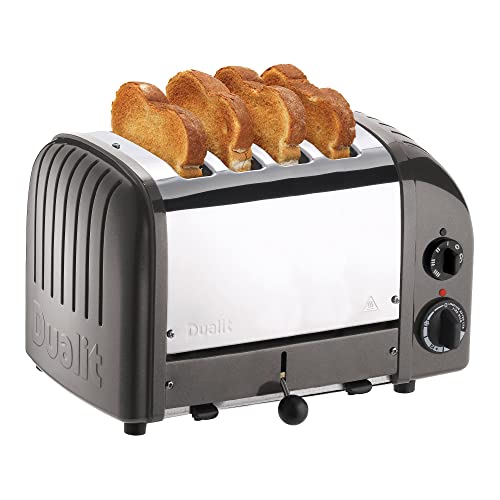
Dualit Classic 4 Slice NewGen Toaster — Best Buy-It-for-Life Heavy Duty
The Dualit Classic earns its heavy duty badge by a completely different route from the Waring machines: not throughput, but permanence. Per its verified listing it is hand built in the UK, uses replaceable ProHeat elements, and runs on a mechanical timer with a defrost function. Replaceable elements are the whole philosophy in two words — when a heating element eventually fails, as all elements do, you replace the element, not the toaster. That is why Classics are measured in decades of service in homes and small establishments that toast heavily but do not need slices-per-hour ratings.
Strengths
- Replaceable ProHeat elements per the verified listing — the repairability benchmark of the entire toaster category
- Hand-built stainless construction with a mechanical timer: minimal electronics to age out
- Four-slice capacity suits heavy home and small-establishment duty
Trade-offs
- No slices-per-hour service rating; it is heavy duty by construction, not by commercial throughput
- Manual, mechanical operation — no electronic controls or digital convenience
- Premium purchase tier justified only if you actually keep it for the decades it is built for
| Specification | Detail |
|---|---|
| Slots | 4 |
| Elements | Replaceable ProHeat (per verified listing) |
| Build | Hand built in the UK, stainless steel |
| Controls | Mechanical timer, defrost function |
| Finish | Charcoal (this listing) |
Every other pick in this guide will, at some year, meet the failure that ends it — and for the commercial machines that is an acceptable term of service, because their economics assume it. The Dualit’s economics assume the opposite: that a toaster is a durable good like a cast-iron pan, maintained rather than replaced. Owners who buy into that philosophy describe a different relationship with the object — elements swapped, timer serviced, the same machine at the center of twenty years of breakfasts. In a category drowning in disposable appliances, that is a genuinely heavy duty proposition.
Its limits are equally clear. It will not run a diner rush, it offers no electronic finesse, and its first cost only makes sense amortized over the long life it promises. For the heavy-use home, the farmhouse kitchen, the small quality-obsessed establishment — the buyers who toast a great deal and hate waste more than they love features — it closes this guide as the connoisseur’s heavy duty pick.
Best for: Heavy-use homes and small establishments that value repairability over throughput / Not suited for: High-volume commercial service
Check the current price on Amazon
Comparison Table
Throughput and slot figures are the makers’ figures from the verified listings. Note the two different meanings of heavy duty in the last column: service throughput for the commercial machines, construction permanence for the Dualit.
| Pick | Badge | Key spec | Best for |
|---|---|---|---|
| Waring WCT800RC 4-Slot Pop-Up Toaster | Best Overall Heavy Duty | 4 slots, 240 slices/hr, 120V | Small cafes, B&Bs, offices, and very busy households wanting true commercial service on 120V |
| Waring 4-Slot Toaster, 380 Slices per Hour | Best Throughput on 120V | 4 slots, 380 slices/hr, 120V, bagel switch | Diners, canteens, and high-volume breakfast service on standard power |
| Waring WCT805B 4-Slot Pop-Up Toaster 208V | Best for True Commercial Premises | 4 slots, 360 slices/hr, 208V | Hotels, hospitals, and high-volume commercial kitchens wired for 208V |
| Waring WCT708 4-Slot Pop-Up Toaster | Best Wide-Slot Commercial | 4 slots, 1⅜-inch width, 225 slices/hr | Bakery-cafes and homes built around thick-cut and artisan bread |
| PYY Professional 6-Slice Commercial Toaster | Best 6-Slice Value Volume | 6 slots, 1800W, stainless steel | New cafes, food trucks, large households, and budget fit-outs needing maximum slots |
| Dualit Classic 4 Slice NewGen Toaster | Best Buy-It-for-Life Heavy Duty | 4 slots, replaceable elements, mechanical timer | Heavy-use homes and small establishments that value repairability over throughput |
How to Choose the Best Heavy Duty Toasters
Start with your true hourly volume, honestly counted. Count the slices your busiest hour actually demands — a family of six at breakfast might peak at thirty slices in an hour; a cafe’s rush can pass two hundred. The makers’ ratings in this guide span 225 to 380 slices per hour, and the right buy is the machine whose rating clears your peak with room to spare, because a toaster run continuously at its ceiling fades exactly when you need it most. Buying double your peak is not waste in this category; it is how the machine loafs through your rush and lasts.
Match slot width to your bread before anything else. The listings here span 1⅛-inch to 1⅜-inch slots, and that quarter-inch is the difference between toasting your actual bread and fighting it. Artisan loaves, thick Texas cuts, and halved bagels need the wide slot; standard sandwich service does not, and narrower slots center thin bread better. Measure your thickest regular slice the way you measure a doorway — before the furniture arrives.
Then do the electrical audit that this category demands. High-throughput toasting means sustained high wattage: keep these machines on circuits that can carry them, dedicate the circuit where the guide’s picks advise it, and treat the 208V machine as what it is — professional infrastructure for professional premises. A heavy duty toaster on an undersized shared circuit does not toast badly; it trips breakers, which in service is worse.
Finally, decide your service philosophy. Commercial incumbents sell throughput plus a parts pipeline; the Dualit sells repairability itself; value commercial sells capacity per dollar. All three are coherent — for different owners. The incoherent purchase is the light-duty home toaster asked to do heavy duty work, which fails early and costs more per year than any pick in this guide. Heavy duty is ultimately an amortization argument: cost divided by years of hard service, and every machine here wins that argument against the disposable alternative.
Duty Cycles, Explained Without the Brochure
A duty cycle is simply how much of the time a machine can work at full output without degrading. Home toasters are designed for a few cycles, then rest — their elements, timers, and housings assume breakfast, not service. Heavy duty machines assume the opposite: back-to-back cycles through a rush, thermal stability across the fiftieth slice, and components rated for thousands of cycles a year. That assumption is built from heavier elements, better ventilation, and mechanical or electronic controls designed to be operated hundreds of times a day.
You can feel the difference without any instruments. Run a home toaster through six consecutive rounds and the later rounds drift — lighter, then uneven — as the machine’s modest thermal design saturates. Run any pick in this guide through the same test and the drift is minimal, because holding state under repetition is literally what you paid for. If your household or business lives beyond six consecutive rounds with any regularity, you are a heavy duty buyer whether you use the phrase or not.
Total Cost of Service: Reading Heavy Duty Economics
Heavy duty purchases confuse buyers who compare tickets instead of totals. The correct unit is cost per year of service at your volume, and it has three components: the purchase, the energy, and the service events. Purchase is the visible third. Energy at commercial throughput is real but modest per slice — the machines are heavily insulated by their own thermal mass in continuous use, and an idling home toaster reheated for single slices is often the less efficient pattern. Service events are where the categories separate: a machine with available elements, timers, and a maker’s parts pipeline converts failures into repairs, while a sealed machine converts the same failures into replacements.
Run the arithmetic for a small cafe toasting two hundred slices a day. A light-duty machine in that seat is a consumable, replaced on a rhythm measured in months, each replacement carrying downtime and a morning of improvisation. Any Waring in this guide amortizes its higher ticket across years of that same seat, with service events instead of funerals. The home version of the arithmetic is gentler but identical in shape: twenty slices every morning is over seven thousand cycles a year, a duty cycle that quietly retires domestic machines while the commercial and repairable picks here are still in early middle age.
This is why the guide’s badges are organized by situation rather than by a single winner. The cheapest correct machine for a two-year food-truck experiment is not the correct machine for a twenty-year diner, and pretending one ranking serves both would be a disservice. Heavy duty is an economics category disguised as an equipment category — buy the amortization curve that matches your horizon.
A Note on Bread Programs and Mixed Service
Commercial service is mixed service: the same four slots owe the kitchen sandwich slices, bagel halves, Texas toast, and frozen waffles across a single rush, often simultaneously. That is why the picks here emphasize separate controls per slot pair and, on the throughput leader, a switchable bread and bagel mode. The operational habit that makes mixed service work is zoning: dedicate slot pairs to product families during the rush — bread on the left, bagels on the right — so shades stay set and the operator’s hands learn one motion per product. Kitchens that re-dial every order lose more time to adjustment than to toasting.
Frozen product deserves its own sentence because it is where service quality quietly dies. A frozen waffle or slice dropped into a cycle timed for fresh bread emerges dark outside and cold within; the defrost-aware workflow — a dedicated setting or a dedicated slot pair during the rush — is a quality system, not a preference. The machines in this guide give you the controls to run that system; the station discipline in the setup section turns the controls into results.
Placement, Ventilation, and the Working Counter
Where a heavy duty toaster lives decides how well it works, and the rules are stricter than for domestic machines because the heat output in sustained service is in another class. Keep the manufacturer’s clearances in every direction — the air around the machine is part of its cooling system, and a toaster boxed beneath a low shelf will heat-soak its own controls and drift its calibration across a rush. The surface matters too: these machines belong on heat-tolerant, level, commercial-grade counters, not on wooden boards that insulate the base and scorch quietly over months.
Ventilation above the station deserves one deliberate thought. A toaster produces no grease plume, but it produces a steady column of hot air and, when crumbs are neglected, smoke. In a commercial kitchen the station belongs under the general exhaust umbrella; in a heavy-use home, it does not belong directly beneath a smoke alarm or a heat-sensitive cabinet finish. The number of heavy duty installations ‘mysteriously’ plagued by alarms is, on inspection, almost entirely a placement story.
Workflow completes the placement picture. Bread lands on one side, finished toast exits to the other, and the operator never crosses hands over a hot machine at speed. Butter, plates, and service tools live on the exit side; raw product and the crumb-tray’s path live on the entry side. Ten minutes spent arranging this once saves a small accident every week for the life of the machine — which, for the picks in this guide, is a very long time indeed.
One Machine or Two: The Redundancy Question
Serious operations eventually face a pleasant question: one large machine or two mid-size ones? Two WCT800-class machines give redundancy — a failure during service halves capacity instead of ending it — and let the station zone products permanently, bread on one unit and bagels on the other, with no re-dialing across the rush. One larger machine gives a simpler station, one cleaning routine, and one service relationship. For premises where toast is mission-critical — the diner whose menu is breakfast — this guide’s quiet advice is redundancy, bought as two of the overall pick rather than one flagship. Homes and small establishments should ignore the question entirely: one correct machine, kept well, is the whole answer there.
How to Set Up a Heavy Duty Toaster Station
Whether the station is a cafe pass or a farmhouse counter, the setup principles are the same: power, airflow, workflow, and a cleaning rhythm that keeps crumb load from becoming a fire and flavor problem.
- Dedicate the circuit. Put the toaster on a circuit that does not also carry the coffee brewer, microwave, or kettle. Label the breaker. Most ‘toaster problems’ in busy kitchens are circuit problems wearing a disguise.
- Give it air and clearance. Commercial toasters radiate serious heat in service. Follow the maker’s clearances from walls, shelving, and paper goods, and never box the machine into a cubby it can heat-soak.
- Season the elements. Run two or three empty cycles on a new machine to burn off manufacturing residues before the first food cycle — standard practice for commercial elements, and the reason the first slice from a new unit sometimes tastes of the factory.
- Calibrate your shades. Toast test slices of your actual bread at each control setting and note the results at the station. In service, ‘a 4 on the left pair’ should be a shared language, not a guess — and your bread, not the maker’s test loaf, is the reference.
- Empty crumbs on a schedule, not on a symptom. In volume service, crumb trays fill fast and old crumbs smoke, flavor new toast, and eventually become a genuine hazard. Daily for commercial use, weekly for heavy home use — and always with the machine cool and unplugged.
- Log the machine. A notebook line per service issue — element replaced, timer fault, breaker trip — turns anecdote into maintenance data. Heavy duty economics reward owners who treat the toaster as equipment with a history.
None of this is elaborate, and that is the point: heavy duty machines reward routine care with years of unremarkable, perfect service. The drama in a toaster station is always a sign that a routine was skipped.
Common Buying Mistakes
Buying a home toaster for service volume. It will not fail dramatically; it will fade, drift, and die young, costing more per year than the commercial machine you avoided buying.
Ignoring the circuit. A 380-slice-per-hour machine on a shared kitchen circuit is a breaker-trip generator. Electrical planning is part of the purchase in this category.
Chasing slot count over slot width. Six slots that cannot take your bread are worth less than four that can. Measure the loaf first.
Assuming 208V is a home upgrade. It is commercial infrastructure. The 120V picks in this guide exist precisely so homes and small premises can have real heavy duty performance without rewiring.
Neglecting crumbs at volume. At heavy duty throughput, crumb management is fire safety, not housekeeping. Put it on the schedule.
Final Recommendation
For most heavy duty buyers, the Waring WCT800RC is the answer: genuine 240-slice-per-hour commercial service on a standard 120V supply. Volume leaders should step to the 380-slice Waring; true commercial premises wired for it should take the 208V WCT805B; artisan-bread operations should choose the wide-slot WCT708. New businesses counting capital should buy the PYY’s six slots without embarrassment, and heavy-use homes that think in decades should buy the Dualit and keep it forever.
Heavy duty is the least glamorous and most honest category in small appliances: it is simply the decision to buy the machine whose working life matches your working load. Every pick here honors that decision.
- Waring WCT800RC 4-Slot Pop-Up Toaster (Best Overall Heavy Duty): Check price on Amazon
- Waring 4-Slot Toaster, 380 Slices per Hour (Best Throughput on 120V): Check price on Amazon
- Waring WCT805B 4-Slot Pop-Up Toaster 208V (Best for True Commercial Premises): Check price on Amazon
- Waring WCT708 4-Slot Pop-Up Toaster (Best Wide-Slot Commercial): Check price on Amazon
- PYY Professional 6-Slice Commercial Toaster (Best 6-Slice Value Volume): Check price on Amazon
- Dualit Classic 4 Slice NewGen Toaster (Best Buy-It-for-Life Heavy Duty): Check price on Amazon
Keep browsing the Toasters cluster: Best High End Toasters · Best Home Toasters · Best Inexpensive 4 Slice Toasters · Best 4 Slice Toasters · Best Commercial Toasters
Frequently Asked Questions
What makes a toaster ‘heavy duty’?
A duty cycle built for repetition: elements and controls rated for back-to-back cycles through a rush, thermal stability across dozens of consecutive rounds, and — in the commercial picks here — a maker’s throughput rating in slices per hour. Construction tells the same story, from Waring’s service machines to the Dualit’s replaceable elements. A heavy-styled home toaster without those internals is a costume, not a category.
How many slices per hour do I actually need?
Count your busiest hour’s real demand and buy a rating comfortably above it. A large household peaks in the tens of slices; a cafe rush runs into the hundreds. The guide’s commercial picks span 225 to 380 slices per hour per their listings. The rating’s real promise is not the peak number but thermal composure — slice forty toasting like slice four.
Can I use a commercial toaster at home?
Yes, with two conditions: choose a 120V model, as most picks here are, and give it a circuit that can carry sustained high wattage without sharing with other heavy appliances. The 208V pick is the exception — that one belongs in commercial premises. Counter space and heat clearance are the other honest considerations; these are working machines, not countertop jewelry.
Why does slot width matter so much?
Because bread does not negotiate. Slots in this guide span 1⅛ to 1⅜ inches per the listings, and a thick artisan slice forced into a narrow slot toasts unevenly, tears, or jams — while thin bread in a very wide slot can sit off-center. Match the slot to the thickest bread you toast regularly and the category’s other virtues can actually reach your plate.
Are replaceable elements worth paying for?
If you keep appliances for a long time, they are the single most valuable feature in this guide. Heating elements are the component that eventually fails in every toaster; a machine like the Dualit Classic, whose ProHeat elements are replaceable per its listing, turns that failure into a service event instead of a replacement purchase. Amortized over the decades the machine is built for, the premium is the cheapest option on this page.
How do I maintain a heavy duty toaster?
Crumbs on a schedule (daily in service, weekly in heavy home use, always cool and unplugged), exterior wipedown, periodic shade calibration with your actual bread, and attention to the circuit it lives on. Commercial machines additionally reward a service log. None of it is difficult; all of it is cheaper than the neglect it replaces.


