Disclosure: airfryerkitchensupply.com is reader-supported. When you buy through links on our site, we may earn an affiliate commission at no extra cost to you.
Where to buy
Every product named in this guide to the best high end meat grinders for high volume at home was checked against Amazon listing data before it earned a place here, and the links below go to the exact verified listings. Prices change constantly, so each pick is linked with a live price check instead of a printed number:
- LEM BigBite Dual Grind #22 Meat Grinder, 1.0 HP — Check the current price on Amazon
- MEAT! 1 HP Pro-Grade Dual Grinder #22 — Check the current price on Amazon
- MEAT! 1 HP Pro-Grade Meat Grinder #22 — Check the current price on Amazon
- Valley Sportsman Commercial Meat Grinder #22, 1.0 HP — Check the current price on Amazon
- Weston #12 Electric Meat Grinder and Sausage Stuffer, 750 Watt — Check the current price on Amazon
- VEVOR Meat Grinder #12, 750W / 1 HP — Check the current price on Amazon
The best high end meat grinders for high volume at home share a profile the budget shelves cannot fake: a #12 or #22 grinding head, a motor at or near a full horsepower that holds speed under load, stainless where meat and cleaning meet, and a maker whose plates and parts will still exist in five years. This guide compares six verified machines for the home processor whose sessions are measured in tens of pounds — game season, sausage days, freezer-filling burger production — where the difference between grinders is not whether they work, but whether the day ends at noon or at dark. Every machine was verified connection, and every motor, size and throughput figure quoted comes from its verified listing.
Two technologies organise the top of the list. Dual-grind flagships (LEM, MEAT!) cut in two stages inside one head, collapsing the classic two-pass grind into a single run — the single biggest time saving available to a home processor. Conventional flagships (the second MEAT!, the Valley Sportsman) keep the classic architecture at full #22 scale. Below them, two #12 machines (Weston, VEVOR) prove that high volume has a second, more storable form. Read by your session size, honestly estimated, and the class chooses itself.
A note on numbers before the picks: horsepower and watts in listings describe motors under differing conventions, and throughput figures describe ceilings under ideal feeding. This guide quotes each listing’s own figures, flags them as ratings rather than promises, and ranks on the things that survive contact with a real session — head size, motor class, included plates, maker support and the architecture of the grind itself.
In this guide
Quick Picks
- LEM BigBite Dual Grind #22 Meat Grinder, 1.0 HP — Best Overall High-End: LEM’s flagship home grinder: a 1.0 HP stainless #22 with dual-grind technology that cuts the second pass — the high-volume home benchmark — Check the current price on Amazon
- MEAT! 1 HP Pro-Grade Dual Grinder #22 — Best Dual-Grind Alternative: the other dual-grind #22: MEAT!’s 1 HP pro-grade stainless machine with coarse and fine plates for one-pass production — Check the current price on Amazon
- MEAT! 1 HP Pro-Grade Meat Grinder #22 — Best Single-Pass Pro #22: the conventional-cutting sibling: a 1 HP #22 stainless grinder with coarse and fine plates for processors who prefer classic two-pass control — Check the current price on Amazon
- Valley Sportsman Commercial Meat Grinder #22, 1.0 HP — Best Rated Throughput: a commercial-style #22 rated by its listing at 550 lbs/hr, with 750W stainless construction, sausage stuffer, two plates and ETL approval — Check the current price on Amazon
- Weston #12 Electric Meat Grinder and Sausage Stuffer, 750 Watt — Best #12 High-End: the #12-class flagship: 750W / 1 HP, a listing-stated 4 lbs per minute, stainless plates and die-cast aluminium build from a game-processing institution — Check the current price on Amazon
- VEVOR Meat Grinder #12, 750W / 1 HP — Best Value High-Volume: a #12 rated by its listing at 552 lbs/h, with two plates, three stuffing tubes and a kibbe kit — the volume-per-pound-sterling champion of the six — Check the current price on Amazon
How These Picks Were Chosen
Selection required the high-volume profile in full: #12 head or larger, motor in the 750W / 1 HP class or above as stated in the listing, and a build intended for continuous sessions rather than occasional mince. We weighted one-pass dual-grind architecture as the class’s defining technology, included-plate completeness as real money, and maker ecosystems — plates, knives, tubes, stuffing accessories — as the difference between a machine and an investment. Throughput figures were recorded exactly as listings state them and treated as class signals.
The six split into three pairs. The dual-grind flagships (LEM, MEAT!) serve maximum-volume fine grinding. The conventional #22 pair (MEAT! single-stage, Valley Sportsman) serve coarse-heavy and certification-led buyers. The #12 pair (Weston, VEVOR) serve serious volume in storable form, at flagship and value positions respectively. Machines below this motor and head class — however charming — live in our companion home grinders guide, where they belong.
The 6 Best High End Meat Grinders for High Volume at Home

LEM BigBite Dual Grind #22 Meat Grinder, 1.0 HP — Best Overall High-End
High volume at home means one thing in practice: a deer in the autumn, a half hog’s worth of sausage, a freezer-filling burger session — work measured in tens of pounds, where the grinder’s speed decides whether the day is pleasant or punishing. The LEM BigBite Dual Grind #22 is the machine this guide puts at the top of that work. Its verified listing describes a 1.0 HP stainless steel electric grinder in the #22 format with Dual Grind technology — a two-stage cutting arrangement that produces a finished grind in what is effectively a single pass through the head.
The dual-grind point deserves unpacking, because it is a throughput feature, not a badge. Conventional grinding of coarse-then-fine textures means passing meat twice: twice the handling, twice the warming, twice the time the batch spends out of the cold. A dual-stage head collapses that into one continuous run, so a high-volume session keeps meat cold, keeps the operator ahead of the machine instead of behind it, and finishes while the day still has light in it. Paired with the #22 head’s wide throat and large plates, and a full 1.0 HP motor that does not bog as the hopper loads, this is the home format’s ceiling — deliberately.
Buy it if your grinding calendar includes game season and sausage days and you intend to buy once. The machine is heavy, premium-priced within its class and entirely wasted on a pound of burger mince twice a month — the home guide companion to this one has your machine if that is your life. For genuine volume, nothing else here combines the maker, the motor and the one-pass system as completely.
Strengths
- Dual Grind processes in effectively one pass what rivals need two to achieve — the volume feature that matters most
- Full 1.0 HP behind a #22 head: the largest mainstream home format, fed by a wide throat
- LEM’s parts and plate ecosystem makes long-term ownership genuinely supportable
Trade-offs
- A serious, heavy machine that wants a permanent counter or storage home
- Premium tier in every sense; occasional small-batch grinders will never use its capacity
- Dual-grind internals reward proper cleaning discipline after big sessions
| Specification | Verified detail |
|---|---|
| Size class | #22 grinding head |
| Motor | 1.0 HP, per the verified listing |
| Build | Stainless steel electric grinder; Dual Grind technology per listing |
Check the current price on Amazon
Best for: game processors and sausage makers running tens of pounds per session at home / Not suited for: small-batch households, for whom this is magnificent overkill

MEAT! 1 HP Pro-Grade Dual Grinder #22 — Best Dual-Grind Alternative
Competition at the top is healthy, and the MEAT! Dual Grinder is the LEM flagship’s most direct rival: the verified listing describes a 1 HP pro-grade dual grinder in #22 format, stainless steel, with coarse and fine grinding plates included. The proposition mirrors the leader’s — one-pass dual-stage grinding for home production volumes — from a brand whose entire catalogue is meat processing, which shows in the kit and the positioning.
Choosing between the two dual-grind flagships comes down to ecosystem and allegiance rather than capability. LEM brings the longer parts-and-accessories tail and the BigBite feeding reputation; MEAT! brings a focused, processor-first range and aggressive completeness in the box. Either machine will run a deer season without complaint. Read both listings’ included-parts lines carefully, price the plates and tubes you will actually add over five years, and let that arithmetic — not a headline — separate them.
Take the MEAT! if its bundle matches your sausage programme out of the box, or if you are already invested in the brand’s other processing equipment. It is a flagship bought on fit, not on consolation.
Strengths
- Dual-grind one-pass production in the same #22, 1 HP class as the LEM flagship
- Coarse and fine plates included for the full texture range
- Pro-grade positioning from a brand built entirely around meat processing
Trade-offs
- A younger brand ecosystem than LEM’s decades-deep parts network
- Same weight and footprint commitment as any #22 production machine
- Dual-stage heads ask for methodical cleaning after fatty sessions
| Specification | Verified detail |
|---|---|
| Size class | #22 dual grinder |
| Motor | 1 HP, per the verified listing |
| Kit | Coarse and fine grinding plates; stainless steel build |
Check the current price on Amazon
Best for: high-volume home processors who want dual-grind one-pass production with a complete plate kit / Not suited for: buyers who value the longest-established parts network above bundle fit
MEAT! 1 HP Pro-Grade Meat Grinder #22 — Best Single-Pass Pro #22
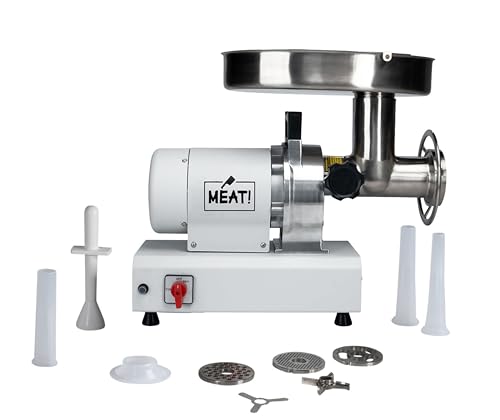
Not every serious processor wants a dual-stage head. The classic workflow — coarse pass, chill, fine pass — gives the operator a hand on texture at each stage, and some sausage makers simply trust it more. The MEAT! 1 HP Pro-Grade in standard #22 form serves that school: the verified listing describes a 1 HP stainless steel grinder with coarse and fine plates, built for grinding and sausage stuffing at production pace, without the dual-grind internals.
What you keep is the class’s substance: a #22 head that swallows large chunks and shortens feeding time, a full 1 HP motor that holds speed under load, and stainless construction that cleans down properly after fatty work. What you give back is time on fine grinds — the second pass is real work, with real warming to manage by re-chilling between passes. For coarse-dominant programmes (burger blends, chilli grind, pet-food batches where one pass suffices), that trade never even appears.
Choose it if your programme is coarse-heavy or your technique is two-pass by conviction. Choose a dual-grind flagship if fine sausage textures at volume are the weekly reality; the price of the second pass is paid in hours every season.
Strengths
- Full #22, 1 HP production capacity in the classic single-stage format many processors trust
- Coarse and fine plates cover the two-pass workflow completely
- Simpler head architecture than dual-grind rivals — fewer internals to clean and maintain
Trade-offs
- Fine textures need the traditional second pass, with its extra handling and warming
- Same #22 storage and weight commitment as the flagships
- Lacks the one-pass speed story that justifies the dual-grind premium
| Specification | Verified detail |
|---|---|
| Size class | #22 grinding head |
| Motor | 1 HP, per the verified listing |
| Kit | Coarse and fine grinding plates; stainless steel build |
Check the current price on Amazon
Best for: coarse-grind and two-pass traditionalists wanting full #22, 1 HP capacity / Not suited for: fine-texture sausage production at volume, where one-pass dual grinding earns its premium

Valley Sportsman Commercial Meat Grinder #22, 1.0 HP — Best Rated Throughput
Throughput claims are the fog of grinder marketing, which is why this Valley Sportsman earns its place by doing something unusual: its verified listing states a figure — 550 lbs/hr from a #22, 1.0 HP (750W) stainless machine, ETL approved, with a sausage stuffer and two grinding plates. Treat the number as a ceiling under perfect feeding rather than a promise, and it is still useful: it tells you the class the machine is built for, which is continuous production rather than domestic dabbling.
The ETL mark is the quieter credential and arguably the more valuable one: it indicates the machine’s electrical and safety design passed a recognised testing laboratory’s review, which matters in a device that combines a powerful motor, water-adjacent cleaning and hours of continuous running. For a home processor effectively running a small production line in the garage each autumn, that certification is worth real money and is rare at this end of the market.
Buy it if rated capacity and certification lead your decision and your volume is genuine. Keep the feeding discipline the figure assumes — well-chilled, properly cubed meat, steady feeding without forcing — and the machine will reward you with the shortest grinding days in this guide.
Strengths
- The only pick whose listing states a throughput figure outright — 550 lbs/hr for planning big days
- ETL approval signals commercial-grade electrical and safety review
- Stuffer and two plates included for an immediate sausage workflow
Trade-offs
- Listing throughput is a maximum under ideal feed; home sessions will run below it
- Commercial styling prioritises function over countertop beauty
- Brand support network is thinner than LEM or MEAT! for long-term parts
| Specification | Verified detail |
|---|---|
| Size class | #22 heavy-duty grinder |
| Motor | 1.0 HP, 750W, per the verified listing |
| Throughput | 550 lbs/hr as rated in the listing title |
| Kit | Sausage stuffer and 2 grinding plates; ETL approved per listing |
Check the current price on Amazon
Best for: production-minded home processors who plan sessions by the hundredweight / Not suited for: countertop-aesthetic kitchens or buyers who need a deep brand parts network

Weston #12 Electric Meat Grinder and Sausage Stuffer, 750 Watt — Best #12 High-End
Not every high-volume home needs a #22, and the Weston #12 is the proof. Its verified listing describes a 750-watt, 1 HP grinder and sausage stuffer that grinds 4 lbs per minute, with stainless steel grinding plates in a die-cast aluminium body. Do the arithmetic the listing invites: 4 lbs a minute is a deer quarter in minutes and a full burger session inside the hour — high volume by any honest home definition — in a machine one person can lift onto the counter without a plan.
Weston is one of the names game processors actually use, and the #12 format is its home turf: big enough for season work, small enough for a kitchen. The stainless plates matter — plates and knives are where grind quality lives — while the aluminium body keeps the machine movable between counter and cupboard. Stuffing is native to the design rather than an afterthought, which sausage makers will feel in the workflow.
Choose the Weston if your volume is real but your storage is domestic. It is the high-end answer for the majority of serious home processors; the #22 flagships above serve the minority whose sessions are measured in hundredweights.
Strengths
- A stated, realistic rate — 4 lbs per minute — that translates to serious home volume without #22 bulk
- Weston’s game-processing pedigree and accessory ecosystem
- Stainless plates where they matter, in a lighter die-cast body that is easier to move and store
Trade-offs
- #12 throat and plates are a step down from #22 for the very largest sessions
- Aluminium body trades the all-stainless flagship feel for portability
- Sustained maximum-rate running still needs chilled meat and sensible pacing
| Specification | Verified detail |
|---|---|
| Size class | #12 grinding head |
| Motor | 750 watt, 1 HP, per the verified listing |
| Throughput | Grinds 4 lbs per minute, per the listing title |
| Build | Die-cast aluminium body; stainless steel grinding plates |
Check the current price on Amazon
Best for: serious home and game processors wanting flagship pace in a movable #12 machine / Not suited for: hundredweight session producers who need #22 throat capacity

VEVOR Meat Grinder #12, 750W / 1 HP — Best Value High-Volume
VEVOR’s formula is specification density, and this #12 wears it proudly: the verified listing describes a 750W / 1 HP electric mincer rated at 552 lbs/h, with two grinding plates, three stuffing tubes and a kibbe kit included, and an ETL listing. As with the Valley Sportsman, read the throughput as a class signal rather than a session plan — but note how much working kit arrives in the box for a machine positioned as this class’s value pick. A new sausage maker could run a full first season on the included tubes alone.
The honest trade is finish and tail. The Weston and LEM machines feel machined to tighter tolerances and sit inside deeper parts ecosystems; the VEVOR asks you to accept value-brand realities — verify the kit on arrival, keep the paperwork, and confirm plate availability while the model is current. In exchange, the per-session capability is genuinely flagship-adjacent: same motor class, same #12 format, a broader starter kit than machines costing far more provide.
Buy it if the budget has a hard ceiling and the volume does not. For a first high-volume season — a hunter equipping from scratch, a sausage hobby becoming a habit — it is the rational entry to this entire guide, with an upgrade path that runs through the five machines above it.
Strengths
- The broadest included kit in this guide: plates, three tube sizes and kibbe in the box
- A stated throughput rating and ETL listing at the value end of the class
- #12 format keeps the machine storable while the motor keeps it serious
Trade-offs
- Rated throughput is a ceiling figure; plan real sessions well below it
- Value-brand ownership means checking parts availability for the long term
- Fit and finish trail the Weston and LEM flagships it undercuts
| Specification | Verified detail |
|---|---|
| Size class | #12 electric meat mincer |
| Motor | 750W / 1 HP, per the verified listing |
| Throughput | 552 lbs/h as rated in the listing title |
| Kit | Two plates, three stuffing tubes, kibbe kit; ETL listing per title |
Check the current price on Amazon
Best for: value-led buyers equipping for a first serious high-volume season / Not suited for: buy-once-for-decades shoppers who prioritise parts networks and finish
Comparison Table
| Pick | Badge | Key spec | Best for |
|---|---|---|---|
| LEM BigBite Dual Grind #22 Meat Grinder, 1.0 HP | Best Overall High-End | #22 grinder, 1.0 HP motor, stainless steel, Dual Grind system | game processors and sausage makers running tens of pounds per session at home |
| MEAT! 1 HP Pro-Grade Dual Grinder #22 | Best Dual-Grind Alternative | #22 dual grinder, 1 HP motor, stainless steel, coarse and fine plates included | high-volume home processors who want dual-grind one-pass production with a complete plate kit |
| MEAT! 1 HP Pro-Grade Meat Grinder #22 | Best Single-Pass Pro #22 | #22 grinder, 1 HP motor, stainless steel, coarse and fine plates included | coarse-grind and two-pass traditionalists wanting full #22, 1 HP capacity |
| Valley Sportsman Commercial Meat Grinder #22, 1.0 HP | Best Rated Throughput | #22 head, 1.0 HP / 750W, listing-rated 550 lbs/hr, ETL approved | production-minded home processors who plan sessions by the hundredweight |
| Weston #12 Electric Meat Grinder and Sausage Stuffer, 750 Watt | Best #12 High-End | #12 grinder, 750W / 1 HP motor, 4 lbs/min per listing, stainless grinding plates | serious home and game processors wanting flagship pace in a movable #12 machine |
| VEVOR Meat Grinder #12, 750W / 1 HP | Best Value High-Volume | #12 grinder, 750W / 1 HP motor, listing-rated 552 lbs/h, ETL listing | value-led buyers equipping for a first serious high-volume season |
How to Choose the Best High End Meat Grinders for High Volume at Home
Head size: why #22 and #12 run the high end
Grinder numbers are head sizes, and head size is destiny. A #22 head takes larger chunks through a wider throat, carries bigger plates with more cutting area, and clears ground meat faster — which is why production home grinding starts there. A #12 head is the serious domestic format: meaningfully quicker than the #8 home class, still liftable and storable, and — in the Weston and VEVOR’s 1 HP implementations — fast enough for all but hundredweight sessions. Below #12, you are in the home guide’s territory, whatever the marketing says.
Feeding is where head size is felt. Wide throats accept rough cubes without constant plunging, and every plunge you do not make is time and warmth saved across a long session. When you compare listings, throat and tray capacity deserve the same attention as motor figures; a strong motor behind a narrow throat spends its day waiting for the operator.
Motors, watts and the truth about throughput
Listings quote horsepower and watts with more enthusiasm than consistency — the same class of machine appears as 1 HP here and 750W there, because the figures describe the motor differently. Use them as class markers (the 750W–1 HP band is the high-volume home class) and judge sustained performance by architecture and maker: a conservatively rated flagship motor that holds speed under a full hopper beats a heroically rated budget motor that fades by the tenth pound.
Throughput ratings — 550 lbs/hr, 552 lbs/h, 4 lbs per minute — are ceilings measured with ideal meat, ideal feeding and no stuffing, chilling or cleaning pauses. Real home sessions run at a fraction of them, and that fraction is still enormous: even a quarter of the Weston’s stated rate clears a family burger session in minutes. Plan your day by the conservative figure, keep meat at near-freezing firmness, and never force-feed to chase a number; the machine’s pace is set by the coldest link in your process, which is usually the meat, not the motor.
Dual grind versus two passes: the session-time decision
Fine grinds traditionally take two passes — coarse, then fine — with the meat warming and the clock running between them. Dual-grind heads (LEM’s Dual Grind, MEAT!’s dual grinder) run both stages in one continuous pass: meat enters once, finished grind leaves once, and the batch spends half the time out of refrigeration. Across a 40-pound session that is not a convenience; it is the difference between grinding in the cold window and grinding against it.
The classic architecture keeps its defenders honestly: two passes let the operator inspect and adjust between stages, the heads are simpler to clean, and coarse-only programmes never needed the second stage anyway. Our list honours both schools at full #22 scale. Decide by your dominant texture: fine sausage at volume argues dual; coarse burger and chilli at volume argues classic — and either way, the head and motor classes in this guide are the price of admission.
Plates, knives and the ecosystem you are really buying
A grinder is a motor married to a wear-parts ecosystem. Plates and knives dull, tubes multiply, and the fifth-year cost of a machine is the availability of its consumables. LEM and Weston bring the deepest tails in this guide; MEAT! brings a focused processor catalogue; the value picks ask you to stock a spare plate and knife set while the model is current. Before buying any flagship, price its replacement knife and your two most-used plates — that basket, available or not, is the ownership truth behind the badge.
Stuffing deserves the same forward look. All six picks address sausage work, but tube ranges, stuffer ergonomics and the option of a dedicated stuffer later differ by ecosystem. High-volume sausage makers often graduate to a standalone stuffer for control; buying a grinder whose plates and tubes remain useful after that graduation is the quiet mark of a well-chosen flagship.
How to Run a High-Volume Grinding Session Without Losing the Cold
Flagship machines reward flagship process. This is the session routine that lets the grinders above deliver their class:
- Chill everything, twice. Cube meat and fat, spread on trays and chill until firm at the edges — near freezing without being frozen solid. Chill the grinder head, plates and knife too; a cold head is worth more than a bigger motor.
- Stage by batch, not by mountain. Keep the bulk refrigerated and bring out one tray at a time. High volume is a flow, not a pile: grind, return to cold, next tray. The machine waits happily; warm meat does not.
- Feed steadily, never force. Let the auger take meat at its pace and use the pusher for guidance, not pressure. Forcing warms the grind, smears fat and turns texture to paste — the classic high-volume failure, and always an operator error, never a machine specification.
- Match the pass to the texture. Dual-grind owners run once and check texture at the tray. Classic-head owners grind coarse, re-chill thoroughly, then grind fine — and treat the re-chill as part of the recipe, not a delay.
- Grind fat and lean by plan. Alternate fatty and lean cubes through the head for an even mix, or grind components separately and blend by hand for precision blends. Decide before the first tray; mid-session improvisation shows in the sausage.
- Clean hot, dry fully, store oiled where the maker advises. Wash parts promptly, dry them completely — plates and knives rust from neglect, not use — and store the head assembled loosely or as the manual directs, ready for the next session.
The Rest of the Production Line: What High-Volume Days Actually Require
A flagship grinder is the centre of a high-volume day, not the whole of it, and the processors who run the smoothest seasons build the supporting cast deliberately. Trays that fit the fridge and the grinder’s hopper in the same footprint. A scale that weighs blends as they are built, because a 60/40 ratio guessed across forty pounds is a rumour, not a recipe. Knives and plates stored as matched, labelled sets — a knife wears against its plate, and keeping pairs together preserves the cut quality both were bought for. A tub system for ground meat that stacks, chills fast and labels clearly, because the session’s second half is logistics, and more high-volume days are lost to tub chaos than to any motor ever built.
Power and placement deserve the same forethought. These machines draw serious current for hours; a circuit shared with a freezer and a slow cooker is a tripped breaker waiting for its moment, ideally not mid-deer. Ventilation and a washable work zone matter at hundredweight scale — a garage or utility setup with water access turns cleanup from the day’s punishment into its final ten minutes. And the operator is part of the line: grinding at this volume is standing, feeding, tray-swapping work, best shared in shifts with the music on. The flagship earns its price by never being the reason the line stops; everything else on this page exists to make sure nothing else is either.
Season planning: buying the flagship against the calendar
The smartest time to buy a high-end grinder is the season before you need it. Prices and availability in this class tighten exactly when every hunter in the country remembers the calendar, and a machine bought in spring gets its shakedown sessions — a burger batch, a small sausage run — at leisure, with support lines unhurried and spare plates in stock. Buy the spare knife and your working plates with the machine, log the model’s plate standard in the house file, and run one full session before the season that matters. A flagship’s first hundredweight should be a rehearsal, not an opening night.
Finally, plan the exit of each session before its entrance: freezer space cleared, bags or tubes counted, labels written, the next day’s cooking decided. High volume is a promise you make to your future self in bulk; the grinders in this guide keep the grinding half of that promise magnificently. The rest of the line — trays, tubs, power, people — is how you keep yours.
Accessories That Earn Their Storage at Volume
Flagship ownership accumulates accessories, and at volume the discipline is to buy the ones that change sessions rather than the ones that fill a catalogue page. A fitted patty maker earns its place when burger production passes the hand-formed stage; a foot pedal switch — where the ecosystem offers one — earns its place the first time both hands are occupied with casing and the motor needs stopping now. Additional trays that match the hopper’s footprint, a second set of stuffing tubes in the sizes your recipes actually use, and a dedicated scale for blend ratios all pass the same test: they remove a pause, an error or a workaround from the production line.
The accessories that fail the test are the universal ones — attachments designed for every grinder and therefore fitted to none, novelty dies for textures no recipe in your repertoire requests, and storage systems bought before the parts collection exists to be stored. Buy the flagship, run a season, and let the season’s friction write the accessory list. Volume is the best shopping adviser in this entire category, because at a hundredweight a year, every genuine bottleneck introduces itself personally.
Buying used, buying once: the flagship’s second-hand logic
High-end grinders hold their value and their function unusually well, which makes the used market for LEM- and Weston-class machines genuinely rational — with an inspector’s conditions. A used flagship should be judged by its cutting set and its drive, not its cosmetics: run it, listen for bearing protest, inspect the plate faces for flatness and the knife for honest edges, and confirm that plates and parts for the model remain in the maker’s current ecosystem. A machine that passes those tests at a fair price is the buy-once philosophy arriving by the side door. A machine that fails them is a project wearing a bargain’s clothes, and high-volume season is no time to restore equipment. New or used, the rule from the rest of this guide stands unchanged: the ecosystem is the investment, and the motor is merely its vehicle.
Common Buying Mistakes
- Buying head size for the biggest day of the decade. A #22 bought for one legendary session is a storage problem for the other 364 days. Size for your real season; the #12 flagships exist precisely for serious-but-storable volume.
- Grinding warm meat to save prep time. Warm meat smears, stalls and ruins texture regardless of motor size. The chill is the recipe. Every shortcut here is paid for in sausage quality.
- Believing the throughput ceiling is a session plan. Ratings assume perfect feeding and no pauses. Plan by a fraction of the figure, and let a fast day be a pleasant surprise rather than a broken promise to a freezer schedule.
- Neglecting the spare-parts basket at purchase. A dull knife discovered mid-season, with plates on back-order, ends more grinding days than motor failure ever has. Buy the spare knife and plates with the machine.
- Force-feeding to keep up with the motor. The pusher is a guide, not a ram. Forcing packs the head, warms the meat and strains the drive — the trifecta of texture and machine abuse.
- Skipping the standalone-stuffer conversation forever. Grinder stuffing works; dedicated stuffers control better at volume. If sausage is the main programme, plan the two-machine future and choose a grinder ecosystem that supports it.
Knives, Plates and Cold Metal: The Maintenance Regime of a Flagship
A flagship grinder’s performance in its fifth season is decided by habits formed in its first. The knife and plate are a matched cutting pair: they wear together, they should be stored together, and mixing a new knife against a worn plate — or the reverse — produces the smeared grind that owners misdiagnose as motor failure. Keep each pair in its own labelled wrap or box, note which pair ran which session if you run several, and treat a noticeable rise in feeding effort as the pair asking for professional sharpening or honourable retirement. Plates can be lapped flat and knives ground true by services that cater to processors; the flagships in this guide use standard sizes precisely so that such services — and replacements — remain available for decades.
Corrosion is the second regime, and it is a storage story rather than a use story. Plates and knives are commonly carbon-bearing steels chosen for edge life; they leave the sink dry or they rust. The ritual is short and non-negotiable: wash hot, dry immediately and completely, store dry, and where the maker advises a food-safe oil film for long storage, apply it thinly. Stainless heads and bodies forgive more, but the cutting set forgives nothing — it is the part of the machine that touches every pound you grind, and its condition is the truest specification your flagship will ever have.
Finally, the motor’s regime is rest and honesty. Continuous grinding generates heat in any drive; flagship machines are built for long sessions, not infinite ones, and the natural pauses of tray work are the cooling the design assumes. Feed at the pace the machine sets, let the session breathe, and never defeat a thermal cut-out to finish a batch — the breaker that stops a Valley Sportsman or any protected machine mid-run is delivering information, not inconvenience. Processors who respect the regime find their fifth season indistinguishable from their first. That, ultimately, is what the premium bought.
Final Recommendation
For maximum home volume, the LEM BigBite Dual Grind #22 is the complete flagship: 1.0 HP, #22 capacity and one-pass dual grinding inside the deepest support ecosystem in the class. The MEAT! Dual Grinder matches its architecture with a bundle many sausage makers will prefer, while the conventional MEAT! #22 serves two-pass traditionalists at full scale. The Valley Sportsman is the certification-and-rating pick for production planners. And the #12 pair — Weston’s polished flagship and VEVOR’s value stormer — bring genuine high-volume pace to kitchens that must store what they own.
If your sessions are smaller than this guide assumes, our companion Best Home Meat Grinders covers the domestic class with the same rigour. For the wider processing bench, explore this site’s meat preparation guides — and whatever flagship you choose, buy the spare knife and plates the same day. Future you, mid-season, sends thanks.
Producers narrowing the field further should also read Best Electric Meat Grinders for the wider electric landscape, Best Game Meat Grinders for the hunting-season specialisation of this class, and Best Hunting Meat Grinders for the field-to-freezer workflow in full.
Shortlist for convenience — LEM BigBite Dual Grind #22 Meat Grinder, 1.0 HP, MEAT! 1 HP Pro-Grade Dual Grinder #22, MEAT! 1 HP Pro-Grade Meat Grinder #22: check price on Amazon, check price on Amazon, check price on Amazon.
Frequently Asked Questions
What size grinder do I need for grinding a whole deer at home?
A #12 flagship like the Weston handles deer work comfortably across a day; a #22 — LEM, MEAT! or Valley Sportsman — shortens the day and swallows larger chunks with less cubing. Frequency decides: one deer a year argues #12; a household processing several animals plus sausage argues #22.
Is dual grind worth the premium?
For fine textures at volume, yes: it halves handling, keeps meat colder and shortens sessions materially. For coarse-dominant work — burger, chilli grind — the second stage adds little, and a conventional #22 at a lower tier serves better. Match the architecture to your dominant texture.
How fast is 4 lbs per minute in real terms?
It is the Weston’s listing-stated rate and, even discounted for real-world pauses, it clears family-scale sessions in minutes rather than hours. Plan days by a conservative fraction of any stated rate, keep meat properly chilled, and the machine will never be the bottleneck — the chilling will.
Can a high-end home grinder replace a commercial unit?
For home volumes, these flagships deliver commercial-class work in domestic form. What they do not claim is all-day, every-day duty cycle of a true commercial line. A home processor running seasonal hundredweights is exactly their design brief; a business should buy business equipment.
What plates should I own first?
A coarse and a fine plate cover the classic range — both included with most picks here — plus a sharp spare knife, the true consumable of the system. Add stuffing tubes in your sausage sizes and a kidney plate if your recipes call for one, in that order.
How do I keep ground meat texture from turning pasty?
Cold meat, cold head, sharp knife, correct plate, steady unforced feeding. Pasty grind is a temperature and sharpness failure, not a motor failure — the session routine in this guide exists because flagship power cannot rescue warm meat.