Disclosure: airfryerkitchensupply.com is reader-supported. When you buy through links on our site, we may earn an affiliate commission at no extra cost to you.
Where to buy
If you are shopping for the best heavy duty stand mixers, start with the shortlist below. Heavy duty here means a specific thing: bowl-lift or fixed-bowl frames, drives built for continuous load, and bowls sized for real batches — not a tilt-head with a confident badge. Every model was checked against its current listing data before inclusion. Start with the KitchenAid 7 Quart for the best all-round heavy machine, the Bosch for maximum dough capacity, or the Cuisinart digital if your heavy work is varied rather than dough-led. Check the current price on Amazon for the exact bundle, since included accessories differ between listings of the same machine.
- KitchenAid 7 Quart Bowl-Lift Stand Mixer KSM70 — Best Overall. Check the current price on Amazon.
- KitchenAid NSF Certified Commercial Series 8-Qt Bowl Lift Stand Mixer KSM8990 — Best Commercial Duty. Check the current price on Amazon.
- Bosch Universal Plus Stand Mixer 500 Watt, 6.5 Quarts Bundle — Best for Dough Volume. Check the current price on Amazon.
- Ankarsrum Original Stand Mixer AKM6230 — Best Kneading Action. Check the current price on Amazon.
- KitchenAid 5.5-Qt Bowl-Lift Stand Mixer KSM55 — Best Mid-Size Heavy Duty. Check the current price on Amazon.
- Cuisinart Precision Pro Digital Stand Mixer SMD-50BC — Best Digital Control. Check the current price on Amazon.
The best heavy duty stand mixers earn the label in the drive train, not the brochure. Heavy duty work — double batches of cookie dough, stiff bread dough, dense fruit-cake batter, big meringue loads whipped at speed — loads a mixer continuously and punishes three things: a hinged head that flexes, gears that were specified for occasional use, and motors that fade as they heat. The six machines in this guide are the ones built against those failure modes: bowl-lift frames, a rotating-bowl kneader, a bottom-drive universal, a certified commercial unit and two flagships with the bowl capacity and speed control to work hard all day.
This guide deliberately overlaps the bread-making guide on this site only at the top of the range, and the angle is different. Here the question is total workload: the household that bakes bread on Saturday also creams butter by the kilo at Christmas, whips egg whites for a crowd and mixes meatball batches that would stall a light machine. Each review therefore weighs the whole workload — dough, batter, whipping, batch rhythm and accessories — rather than crowning a single-task specialist.
All picks were verified against current listing data, including bowl sizes, speed counts and included accessories as printed by the manufacturers. Prices in this class move with bundles and colour, so no fixed prices appear anywhere in this guide — check price on Amazon for each pick, and let the tier guidance in the buying sections translate the market whenever you read it.
In this guide
Quick Picks
Six stand mixers built for sustained load — thick doughs, double batches, dense batters — with badges that stay consistent from this list into the full reviews.
- KitchenAid 7 Quart Bowl-Lift Stand Mixer KSM70 — Best Overall: Seven quarts, bowl-lift rigidity and 11 speeds with a half-speed fold — the heavy duty benchmark for a whole household’s workload. See it: check price on Amazon.
- KitchenAid NSF Certified Commercial Series 8-Qt Bowl Lift Stand Mixer KSM8990 — Best Commercial Duty: NSF-certified, 8-quart, built for working days — the duty cycle pick for sellers, caterers and relentless home producers. See it: check price on Amazon.
- Bosch Universal Plus Stand Mixer 500 Watt, 6.5 Quarts Bundle — Best for Dough Volume: Bottom-drive torque and a 6.5-quart bowl: the volume dough champion that also whips and mixes through a family workload. See it: check price on Amazon.
- Ankarsrum Original Stand Mixer AKM6230 — Best Kneading Action: The rotating-bowl Swedish kneader: the gentlest, most thorough heavy duty action, with an open bowl that changes how you bake. See it: check price on Amazon.
- KitchenAid 5.5-Qt Bowl-Lift Stand Mixer KSM55 — Best Mid-Size Heavy Duty: The bowl-lift architecture and 11 speeds of the flagships, scaled to a 5.5-quart machine for realistic household heavy work. See it: check price on Amazon.
- Cuisinart Precision Pro Digital Stand Mixer SMD-50BC — Best Digital Control: A 5.5-quart digital machine with 12 speeds and preprogrammed prep settings — heavy duty for varied, precision-led workloads. See it: check price on Amazon.
How These Picks Were Chosen
The first filter was frame architecture. For sustained heavy work, bowl-lift and fixed-bowl designs beat tilt-heads because rigidity under load is what keeps gears meshing and heads planted; every pick here passes that test or replaces the planetary frame with a fundamentally stronger drive layout, as the Ankarsrum and Bosch do. The second filter was honest capacity: bowl size matched against the batch loads the drive can actually turn, not the liquid volume the bowl can hold.
The third filter was speed architecture — a genuine low gear for incorporating heavy dry loads without shock, and stable middle speeds where most heavy mixing actually happens. Machines were cut when their heavy duty claim rested on peak-watt marketing, when their bowls were large but their drives were carry-overs from light models, or when replacement parts and accessories were effectively unobtainable. What remains is a short list where every machine can be worked hard, weekly, for years.
The 6 Best Heavy Duty Stand Mixers, Reviewed

KitchenAid 7 Quart Bowl-Lift Stand Mixer KSM70 — Best Overall
Check the current price on Amazon for the current listing, configuration and included attachments before you buy.
The KSM70 is the machine most households should mean when they say heavy duty. Its bowl-lift frame removes the hinge that limits lesser mixers, so double batches of cookie dough and stiff bread dough meet a structure that simply does not flex, and its 7-quart bowl gives those batches room to be worked instead of merely contained. Eleven speeds with a half-speed fold gear means the same machine that kneads firmly also folds delicate batters without violence.
What separates it from the commercial unit below is balance. The included accessory set — headed by the Double Flex Edge Beater — covers creaming, mixing and whipping at flagship level out of the box, and the attachment hub opens the deepest ecosystem in the category for later expansion. Through a heavy week — bread, pizza night, a celebration cake, a double cookie batch — it never asks you to think about which machine a job needs. It is the job’s machine.
The honest costs are size, weight and tier. It will live on your counter, because moving it is a decision, and it sits at the top of the domestic price range. Households whose heavy work is real and varied will find both costs proportionate; occasional bakers should look at the KSM55-class machines in this site’s other guides instead.
Strengths
- Bowl-lift rigidity across dough, batter and whipping loads
- 11 speeds including a true half-speed fold
- Full flagship accessory set included in the box
Trade-offs
- Large and heavy — a permanent counter resident
- Top domestic price tier
- More capacity than small households will use
| Specification | Detail |
|---|---|
| Bowl | 7 quart, bowl-lift |
| Speeds | 11, including 1/2 speed for folding |
| Included | Double Flex Edge Beater and 4 other accessories |
Best for: households with heavy, varied weekly workloads across baking and cooking / Not suited for: small kitchens or light, occasional mixing only

KitchenAid NSF Certified Commercial Series 8-Qt Bowl Lift Stand Mixer KSM8990 — Best Commercial Duty
Check the current price on Amazon for the current listing, configuration and included attachments before you buy.
Where the KSM70 is a domestic flagship, the KSM8990 is equipment. NSF certification signals construction and cleanability audited to commercial food standards, and the machine’s brief is a working rhythm: batch after batch, day after day, in cottage bakeries, cafes, test kitchens and homes that produce like them. Eight quarts ends batch-splitting conversations for big doughs, dense batters and bulk mixing of every kind.
Under sustained load is where it justifies itself. Domestic mixers manage heat and wear by expecting pauses; this machine expects continuity. If your Saturdays involve a dozen loaves, layered production for a market stall or catering prep that runs the mixer for hours in aggregate, the commercial build is not indulgence — it is the difference between a tool and a bottleneck.
Everything else about it is workmanlike by design: the heaviest footprint here, the highest tier here, and an accessory world aimed at function rather than variety. Buy it when your production volume signs the cheque; households baking heavily but domestically will be better served — and better accessorised — by the KSM70.
Strengths
- Commercial duty cycle for continuous batch work
- 8-quart capacity for production-scale batches
- Certified construction and cleanability
Trade-offs
- Highest price tier and heaviest footprint in this guide
- Accessory ecosystem is narrow and utilitarian
- Over-specified for purely domestic rhythms
| Specification | Detail |
|---|---|
| Model | KSM8990 |
| Bowl | 8 quart, bowl-lift |
| Certification | NSF certified, Commercial Series |
Best for: cottage businesses, caterers and high-volume home producers / Not suited for: typical family kitchens, however enthusiastic
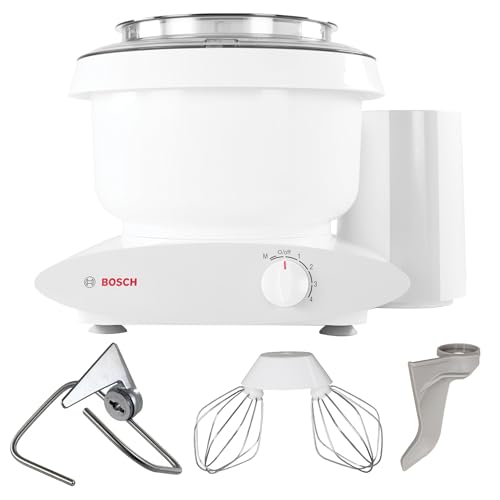
Bosch Universal Plus Stand Mixer 500 Watt, 6.5 Quarts Bundle — Best for Dough Volume
Check the current price on Amazon for the current listing, configuration and included attachments before you buy.
The Bosch approaches heavy duty from underneath. Its drive turns the bowl’s centre column directly, so torque reaches the dough hook without travelling through a head casting, and the result is a machine whose heavy-load composure has been proven over decades of whole-grain, multi-loaf baking. In this guide’s terms it is the dough-volume champion: the biggest flour loads, taken in stride, batch after batch.
This bundle’s dough hook extender quietly fixes the design’s one classic weakness — small batches escaping the hook up the centre column — which makes the Bosch a complete heavy duty answer rather than a big-batch-only one. The 6.5-quart bowl and included wire whips extend its range to serious batter and whipping work, and the machine’s lighter overall build surprises people used to cast-metal planetary mixers: heavy duty here is engineered through the drive, not through sheer mass.
Judge it on function. The styling is appliance-practical, some bowl components are polymer rather than metal, and its technique — steady flour addition, the centre-column workflow — takes one bake to learn. For households whose heavy work is dough-led and voluminous, it is arguably the smartest money in this guide.
Strengths
- Bottom-drive torque for the largest dough loads
- Extender bundle makes small batches work properly
- Lighter to move and store than cast planetary rivals
Trade-offs
- Functional styling, some polymer bowl parts
- Centre-column technique takes a bake to learn
- Whipping setup differs from planetary conventions
| Specification | Detail |
|---|---|
| Motor | 500 watt |
| Bowl | 6.5 quarts |
| Included | Wire whips, dough hook, NutriMill dough hook extender (bundle) |
Best for: dough-led households baking large and frequent batches / Not suited for: buyers who want classic cast-metal stand mixer form
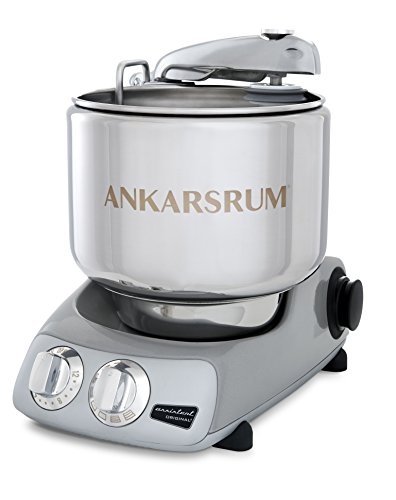
Ankarsrum Original Stand Mixer AKM6230 — Best Kneading Action
Check the current price on Amazon for the current listing, configuration and included attachments before you buy.
Every other machine in this guide kneads by moving a tool through a stationary mass. The Ankarsrum rotates the bowl past a roller and scraper, folding and pressing the dough the way hands do — and for heavy duty purposes the consequence is load distribution. Sustained kneading force is spread through the bowl drive rather than concentrated in one hook shaft and head casting, which is part of why these machines develop their reputation for lasting decades under weekly bread duty.
The open bowl is the second heavy duty virtue nobody expects. Adding flour to a running batch, checking dough development by touch mid-knead, scraping down without stopping a head mechanism — the workflow of serious batch baking is simply easier when the top of the bowl is open and turning. Wet doughs that defeat planetary hooks are gathered and worked properly, and stiff doughs knead without drama.
It asks commitment in return: premium pricing, a technique to learn, and a separate whisking arrangement for light work. As a pure heavy duty kneading instrument it is the finest machine in this guide; as an all-round household mixer it is a connoisseur’s choice rather than the default. Both statements are compliments, aimed at different buyers.
Strengths
- Roller kneading distributes load and develops dough superbly
- Open rotating bowl simplifies additions and checks
- Legendary longevity under weekly heavy use
Trade-offs
- Premium tier pricing
- Learning curve versus every other design here
- Separate setup for whisking and light work
| Specification | Detail |
|---|---|
| Model | AKM6230 |
| Design | Rotating bowl with roller and scraper kneading |
| Finish | Jubilee Silver |
Best for: bread-led bakers who knead heavily every week / Not suited for: buyers wanting one familiar machine for mostly light work

KitchenAid 5.5-Qt Bowl-Lift Stand Mixer KSM55 — Best Mid-Size Heavy Duty
Check the current price on Amazon for the current listing, configuration and included attachments before you buy.
Heavy duty is a property of architecture before it is a property of size, and the KSM55 proves it. The same bowl-lift rigidity and 11-speed control as the 7-quart flagship, in a 5.5-quart machine sized for the batches households actually make: single and family dough batches, double cookie batches, dense cake batters and full whipping loads, all worked against a frame that does not hinge or flex.
Proportion is its virtue. The flagship’s capacity is wasted on a two-person household and its footprint is a real cost in a small kitchen; the KSM55 keeps every structural advantage and gives back counter space and a friendlier tier. The included tool set — flat beater, dough hook, wire whip — covers the whole workload without an accessory shopping trip, and the stainless bowl handles dough release and batter work equally well.
Its boundary is batch scale, and it is an honest one: production bakers and habitual double-batchers of stiff dough should step up to the 7-quart or across to the Bosch. For the large middle of serious home bakers, this is the correctly-sized heavy duty purchase — the one that gets worked hard for years instead of admired for its capacity.
Strengths
- True bowl-lift rigidity at a mid-size footprint
- 11 speeds with the flagship’s control range
- Complete included tool set for the whole workload
Trade-offs
- Batch ceiling below the 7-quart and Bosch
- Still heavy to lift into a cupboard
- Accessory bundle slimmer than the flagship’s
| Specification | Detail |
|---|---|
| Bowl | 5.5 quart, bowl-lift, stainless steel |
| Speeds | 11 |
| Included | Flat Beater, Dough Hook, Wire Whip |
Best for: serious small-to-medium households with varied heavy work / Not suited for: production volumes or routine double stiff batches
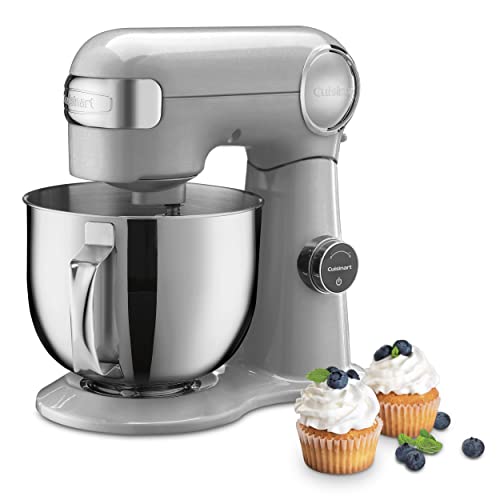
Cuisinart Precision Pro Digital Stand Mixer SMD-50BC — Best Digital Control
Check the current price on Amazon for the current listing, configuration and included attachments before you buy.
The Cuisinart Precision Pro makes its heavy duty case through control rather than mass. Twelve digitally managed speeds and three preprogrammed prep settings let you hand the machine a repeatable programme — a timed knead, a staged whip — and get the same result on Friday as on Monday. For bakers who scale recipes, test formulas or run a small but exacting production rhythm from a home kitchen, that repeatability is a working feature, not a gadget.
The 5.5-quart bowl places it in the same realistic household class as the KSM55, and its heavy work credentials are honest within that class: double cookie batches, firm doughs in single batches, dense batters and full whipping loads are its territory, handled with a smoothness that digital ramping gives at start-up, where heavy mixtures usually splash or shock the drive.
Against the bowl-lifts it concedes ultimate frame rigidity and dough specialisation; against everything else it offers the most modern control set in this guide. If your heavy duty work is varied and precision-led rather than dough-dominated, the Cuisinart is the thoughtful pick — and its digital display makes speed discipline, the quiet skill behind all good mixing, effortless to keep.
Strengths
- 12 digital speeds with preprogrammed prep settings
- Smooth ramping protects heavy mixtures at start-up
- Repeatable programmes suit formula-driven bakers
Trade-offs
- Not a dough specialist at the Bosch or Ankarsrum level
- Digital controls are a different ownership style from dial machines
- Accessory ecosystem smaller than KitchenAid’s
| Specification | Detail |
|---|---|
| Bowl | 5.5 quart |
| Speeds | 12, digital control |
| Programs | 3 preprogrammed food prep settings |
Best for: precision-led bakers with varied, repeatable workloads / Not suited for: maximum-volume dough production
Comparison Table
| Pick | Badge | Key spec | Best for |
|---|---|---|---|
| KitchenAid 7 Quart Bowl-Lift Stand Mixer KSM70 | Best Overall | 7-qt bowl-lift, 11 speeds, full accessory set | households with heavy, varied weekly workloads across baking and cooking |
| KitchenAid NSF Certified Commercial Series 8-Qt Bowl Lift Stand Mixer KSM8990 | Best Commercial Duty | 8-qt bowl-lift, NSF commercial certification | cottage businesses, caterers and high-volume home producers |
| Bosch Universal Plus Stand Mixer 500 Watt, 6.5 Quarts Bundle | Best for Dough Volume | 500W bottom drive, 6.5-qt bowl, extender bundle | dough-led households baking large and frequent batches |
| Ankarsrum Original Stand Mixer AKM6230 | Best Kneading Action | Rotating-bowl roller kneading, AKM6230 | bread-led bakers who knead heavily every week |
| KitchenAid 5.5-Qt Bowl-Lift Stand Mixer KSM55 | Best Mid-Size Heavy Duty | 5.5-qt bowl-lift, 11 speeds, complete tool set | serious small-to-medium households with varied heavy work |
| Cuisinart Precision Pro Digital Stand Mixer SMD-50BC | Best Digital Control | 5.5-qt, 12 digital speeds, 3 prep programs | precision-led bakers with varied, repeatable workloads |
Read across by workload: dough volume points to the Bosch, kneading quality to the Ankarsrum, continuous duty to the commercial KitchenAid, balanced households to the KSM70 or KSM55, and precision variety to the Cuisinart.
How to Choose a Heavy Duty Stand Mixer
Define your heaviest regular job and buy one class above it. A mixer run routinely at its limit ages fast; a mixer run at two-thirds of its capacity for the same jobs lasts for many years. Then choose architecture: bowl-lift planetary for the best all-round balance, bottom-drive for dough volume, rotating-bowl for kneading quality, commercial frames for continuous duty, and digital mid-size machines for precision across varied work. Every pick in this guide represents one of those answers, which is why the comparison table leads with method and frame rather than colour or speed count.
- Frame: bowl-lift or fixed — hinges flex under load, and flex is wear.
- Drive honesty: judge by sustained behaviour and brand duty class, not peak-watt stickers.
- Speed architecture: a true low gear for heavy incorporation, stable mids for working, and enough top end for whipping — the KSM70’s half-speed fold is the benchmark feature.
- Bowl realism: match bowl size to your batches; oversized bowls mix small loads badly, undersized bowls force batch-splitting.
- Ecosystem and parts: heavy duty machines are long-term purchases — attachments, replacement bowls and service support decide year-five happiness.
Budget tiers in words: the mid tier buys genuine bowl-lift rigidity at household size (the KSM55 class). The upper tier buys flagship capacity and accessories, or dough-specialist engineering from Bosch and Ankarsrum. The commercial tier buys duty cycle — hours of weekly running — and is only money well spent when your production rhythm actually runs those hours.
Heavy Duty Myths That Cost Buyers Money
Myth one: wattage is power. Peak wattage figures describe a momentary electrical draw, not sustained torque at the hook. Drive design, gearing and duty class — the unglamorous specifications — decide what happens in minute eight of a stiff knead. Myth two: bigger bowl, heavier duty. Bowl volume is a container measurement; plenty of large-bowl machines carry light drives, and the mismatch shows the first time a full bowl of dough meets a small motor. Myth three: all-metal outside means all-metal inside. Cast housings can hide polymer gears; conversely the Bosch’s engineered build delivers heavy duty through its drive layout rather than its shell. Judge the mechanism, using the filters in this guide, and the badge takes care of itself.
Running a Heavy Duty Mixer So It Stays One
Heavy duty machines tolerate hard work, not careless work. Start heavy loads at the lowest gear and let the mixture gather before stepping up. Keep batches inside the flour and mass limits the manual states — they are engineering limits, not legal caution. Give the machine air: do not run it backed against a wall on a long knead, and wipe flour from vents and seams after bake days. Between back-to-back stiff batches, a short rest protects more than pride costs. Finally, use the right tool per job — dough hooks for dough, the flex-edge beater for creaming, the whip only for foams — because half of all ‘weak mixer’ stories are actually wrong-attachment stories.
How to Set Up and Run a Heavy Duty Stand Mixer for Big Batches
Big batches succeed or fail in the first two minutes. This setup sequence — written for bowl-lift machines and adaptable to the Bosch and Ankarsrum — keeps heavy loads controlled from the first addition to the last scrape.
- Place the mixer on a clear, dry counter with working room on both sides and nothing stored on top of it. Heavy machines under load should start stable, not be made stable mid-batch.
- Lock the bowl fully onto the lift arm or base and raise it into working position before adding anything. A bowl seated after loading is a spill and a strain risk.
- Fit the tool for the job first — dough hook for dough, flat or flex-edge beater for batters and creaming, whip only for foams — and check the tool clears the bowl bottom closely without striking it.
- Add ingredients in load order: liquids and fats low, dry ingredients in stages. Start every heavy batch at the lowest speed and let each flour addition gather before adding the next.
- Step up only to the working speed the job needs — the designated low kneading speed for dough, mid speeds for batters — and stay there. Heavy mixing is a pace discipline, not a race.
- Stop once mid-batch to scrape the bowl walls and bottom with the machine off. One scrape-down replaces minutes of extra mixing and prevents the unmixed pocket that makes bakers overwork a batch.
- Finish, lower the bowl, and remove the tool before the bowl if the load is heavy — control the weight in stages rather than lifting a full bowl and tool together.
- Wash tools and bowl promptly, dry the hub and shaft area, and leave the machine uncovered until fully dry if your kitchen is humid. Flour paste left in seams is tomorrow’s mechanical grit.
Run this way, a heavy duty mixer settles into a rhythm where big batches feel routine — which is the entire point of buying one. The machine’s strength is a resource; technique is how you spend it slowly.
Planetary vs Bottom-Drive vs Rotating Bowl
Three mechanical philosophies share this guide, and understanding them is worth more than any single specification. Planetary action — KitchenAid and Cuisinart — moves the tool in an orbit while it spins, covering the bowl thoroughly from above. It is the most versatile geometry ever fitted to a mixer: beaters, whips and hooks all work naturally in it, which is why planetary machines anchor general kitchens. Its costs are structural: the drive arrives through a head, so rigidity must be engineered in (the bowl-lift’s whole purpose), and dough is worked by a single hook against bowl friction.
Bottom drive — the Bosch — inverts the layout: power enters from below, through the bowl’s centre, and the tool works the mass outward. Torque delivery is direct and the head-flex question disappears, because there is no head. The trade is convention: the centre column shapes how ingredients are added and how small batches behave, which the dough hook extender exists to manage. Rotating bowl — the Ankarsrum — removes the tool’s orbit entirely and moves the work instead, pressing dough between roller and bowl wall. It is the least versatile geometry for light work and the most accomplished for kneading, a specialist’s bargain struck deliberately.
None of the three is ‘best’ in the abstract; each is best at the workload it was designed around. The buying mistake is purchasing a philosophy accidentally — a planetary cake machine for a dough life, a kneading specialist for a patisserie life. The reviews in this guide name each machine’s philosophy in its first paragraph so the match can be made on purpose.
Motors, Gears and the Meaning of Duty Cycle
Heavy duty advertising loves the moment of maximum effort; engineering cares about the twentieth minute. A mixer’s duty cycle is the pattern of work it can sustain — how long under load, how often, with what cooling between — and it is set by motor design, gear materials, ventilation and the honesty of the thermal protection. Commercial machines like the KSM8990 are built for a duty cycle of near-continuous production. Domestic flagships assume a keen household’s rhythm: hard batches separated by the natural pauses of cooking. Both are legitimate; confusing them is how a domestic machine ends up exhausted by a cottage business, or a home buyer overpays for capacity their Sundays never touch.
Gear materials tell the same story quietly. Metal gear trains tolerate sustained torque and heat; engineered polymer gears run quieter and can serve as a sacrificial element that protects the motor in a stall — a legitimate design choice with a different service implication. What matters to the buyer is not memorising materials but matching class to workload and knowing that parts support exists. Every brand in this guide supports its machines with parts and service infrastructure, which is itself a heavy duty specification.
Your side of the duty contract is simple: batches inside rated loads, correct tools, ventilation unobstructed, and rests between back-to-back stiff batches on domestic machines. Kept, that contract is why the machines in this class are measured in decades. Broken, it voids the engineering of any badge at any price.
The Attachment Hub: When a Mixer Becomes a System
The front hub on planetary stand mixers is easy to dismiss as an accessory gimmick until a household’s cooking grows into it: pasta rollers that turn a dough habit into fresh pasta nights, grain mills for the bread baker who wants to control flour itself, grinders and slicers that move prep work from knife to machine. For heavy duty buyers the hub matters strategically — it converts a single-purpose purchase into a platform whose value compounds with each attachment, and it is the deepest structural reason the KitchenAid flagships anchor so many serious kitchens.
Judge the hub by your real trajectory, not your aspirational one. A baker certain to mill grain should weigh the Bosch and Ankarsrum ecosystems, where milling and baking accessories are part of the design heritage. A varied cook should weigh KitchenAid’s breadth. A dough purist should ignore hubs entirely and buy kneading quality. The mistake is paying for an ecosystem you will never enter — or, worse, discovering in year three that the machine you love has no door into the work you have grown into.
Noise, Heat and the Working Kitchen
Two ownership realities rarely appear in buying guides and dominate daily satisfaction: noise and heat. A heavy duty mixer under load is a working machine, and its sound is information — a steady note means a settled batch, a rising whine means resistance climbing, a sudden change means stop and look. Designs differ honestly here: the Cuisinart’s digital ramping starts quietly, the Ankarsrum’s bowl drive runs with a low mechanical murmur, and planetary machines under dough load announce their effort in proportion to the batch. None of this is a defect; it is the acoustics of torque. What matters is matching machine to household — the baker who mixes at dawn in a sleeping house will weight this paragraph more heavily than the Saturday-afternoon baker, and both are right.
Heat is the silent partner of every long knead and double batch. Motors warm under sustained load by design, and casings are built to shed that warmth into the room — which is why the care sections insist on ventilation space and rests between stiff batches on domestic machines. A machine that is merely warm after a hard batch is healthy; a machine that smells hot or fades in speed is sending the overload message in its clearest language. Respecting that message is the entire difference between a mixer that serves a decade and one that serves a warranty claim.
The practical synthesis: place the machine with air around it, learn its normal sound in your first week, and treat deviations as data. Heavy duty ownership is a relationship with a working tool, and like all such relationships it runs on attention more than on money.
What Heavy Duty Owners Actually Do Differently
Talk to owners of ten-year-old heavy duty mixers and a pattern emerges that has little to do with brands. They batch with intention: ingredients measured before the machine starts, additions staged, the scrape-down treated as part of the recipe rather than an interruption. They use the low gears without embarrassment, understanding that the first speed is a working gear and not a warm-up act. They keep the machine clean at the seams — hub, shaft, bowl pins — because they have learned that flour paste is a mechanical substance, not a cosmetic one. And they chose their machine by workload in the first place, so the machine has never spent its life apologising for being the wrong size.
They also tend to own the unglamorous accessories: the second bowl that doubles a bake day’s flow, the spare tool that turns a breakage into a pause, the cover that keeps a counter resident clean between sessions. None of these purchases photograph well, and all of them compound. Heavy duty, in the end, is less a property printed on a box than a system — a correctly chosen machine, run with pace discipline, maintained in minutes rather than weekends. The six machines in this guide are the ones that reward that system most; the system itself is free, and it is available to whichever of them you bring home.
That is the note to end the analysis on: buy the architecture that matches your heaviest honest work, then become the kind of owner these machines were designed for. The combination is what the words heavy duty were always supposed to mean.
A Note on Refurbished and Open-Box Flagships
Heavy duty flagships hold their value, which creates a legitimate second route into this class: manufacturer-refurbished and open-box machines sold through authorised channels. A refurbished bowl-lift with its warranty paperwork intact can deliver a decade of heavy work at a friendlier tier, because the architecture — the thing you are actually buying — does not wear out on a retail shelf. Inspect what matters: bowl and tools present and correct, lift mechanism smooth through its travel, hub cover and attachments seating properly, and a return route if the drive sounds wrong under its first real load. What you are listening for is a steady note without grinding or surging through a stiff batch.
Private second-hand purchases demand one extra test: run the machine. A heavy duty mixer reveals itself under load in ninety seconds — a dough batch will expose a tired drive, a slipping belt or a worn gear more honestly than any visual inspection. Sellers of sound machines expect the test; sellers who refuse it have answered your question. Bought this way, with the architecture verified rather than assumed, the used flagship is not a compromise of this guide’s standards. It is those standards, applied with a tape measure and a test batch, at a price the first owner subsidised.
Common Buying Mistakes
Confusing peak wattage with working torque. A big wattage sticker on a light drive fools buyers every season. Judge frame, drive layout and duty class — the specifications that describe minute eight, not second one.
Buying a tilt-head for heavy dough work. The hinge flexes, the head nods, the gears wear. If dough and double batches are your normal, bowl-lift rigidity is not an upgrade; it is the entry ticket.
Oversizing the bowl for your batches. Small loads in a huge bowl smear up the walls and mix unevenly, tempting you to overwork them. Match the machine to your real batch sizes — the 5.5-quart class exists for a reason.
Running every job at high speed. High speed is for whipping. Dough tears, batters toughen and motors heat when pace discipline collapses. The low and mid gears are where heavy work is done.
Skipping the scrape-down. An unscraped bowl hides an unmixed pocket, and bakers respond by mixing longer — overworking the batch and the machine to fix a ten-second job.
Ignoring the ecosystem at purchase. Bowls, tools and attachments are how a mixer grows with your cooking. A cheaper machine with no available second bowl can cost more by year three than the flagship did.
Final Recommendation
For most households the KitchenAid KSM70 is the heavy duty stand mixer to buy: rigid, capacious, fully accessorised and calm under every load a home produces. Dough-led bakers should split by priority — Bosch for volume, Ankarsrum for kneading quality — while genuine producers should step straight to the commercial KSM8990 and stop negotiating with domestic duty cycles. The KSM55 scales the same virtues to realistic household size, and the Cuisinart digital serves precision-led, varied workloads beautifully.
Buy the architecture first, the capacity second and the colour last, and the machine will still be working hard when the colour is long forgotten. The companion guides below dig into the bread-specific and countertop-specific corners of this decision.
Start with the three safest first looks: KitchenAid 7 Quart Bowl-Lift Stand Mixer KSM70, KitchenAid NSF Certified Commercial Series 8-Qt Bowl Lift Stand Mixer KSM8990, Bosch Universal Plus Stand Mixer 500 Watt, 6.5 Quarts Bundle.
Keep reading in this series: Best Heavy Duty Mixers For Bread Making Best Heavy Duty Hand Mixers Best Heavy Duty Table Top Mixers Best Stand Mixers Best Stand Mixers For Bread Making
Frequently Asked Questions
What makes a stand mixer heavy duty?
Architecture and duty class: a bowl-lift or fixed frame that does not flex under load, a drive specified for sustained torque rather than peak figures, honest batch capacity, and speed gearing with a true low for heavy incorporation. Every pick in this guide meets those tests; a wattage sticker alone does not.
Is bowl-lift really better than tilt-head?
For heavy work, yes. The lift frame locks the bowl to a rigid structure, so dough and double batches cannot flex the head or walk the machine. Tilt-heads remain convenient for light, small-batch baking — the distinction is workload, not quality.
How big a stand mixer do I need?
Match the bowl to your largest regular batch with headroom: 5.5 quarts covers most households including family dough batches, 7 quarts covers double batches and entertaining scale, and 8-quart commercial machines serve production rhythms. Oversized bowls mix small loads poorly, so bigger is not automatically better.
Can one mixer handle bread, cakes and whipping equally well?
The flagship bowl-lifts come closest — the KSM70’s 11 speeds including a half-speed fold exist precisely for that range. Specialists still win their own events: the Ankarsrum kneads best, the Bosch swallows the most dough. Most households are best served by the balanced flagship.
How long should a heavy duty stand mixer last?
With batches kept inside rated loads, correct tools per job and basic cleaning discipline, a machine in this class should serve for many years of weekly heavy use. Commercial-duty models extend that horizon further for producers. Early failures usually trace to chronic overloading, not to the badge.
Do I need the commercial model for a home bakery business?
If you sell what you bake, strongly consider it. The KSM8990’s NSF-certified construction and continuous duty cycle match how cottage production actually runs, and inspectors and insurers both understand commercial equipment. For purely domestic baking, it is capability you will rarely use.


