Disclosure: airfryerkitchensupply.com is reader-supported. When you buy through links on our site, we may earn an affiliate commission at no extra cost to you.
Where to buy
If you are shopping for the best heavy duty hand mixers, start with the shortlist below. Every model here is a current corded (or, in one case, cordless) hand mixer sold through Amazon, and each one was checked against the manufacturer’s listing data before it earned a place. A hand mixer will never replace a stand mixer for big bread batches, and this guide says so plainly where it matters — but the strongest hand mixers genuinely can cream cold butter, whip stiff meringue and work through moderately stiff cookie and pizza dough in small batches without stalling or overheating. Start with the Breville if you want the most control, or the Hamilton Beach 62682G if you want proven power on a budget, and check the current price on Amazon for the exact configuration.
- Breville Handy Mix Scraper Pro BHM800SIL — Best Overall. Check the current price on Amazon.
- KitchenAid 9 Speed Hand Mixer KHM926 — Best for Versatility. Check the current price on Amazon.
- Cuisinart Power Advantage Plus 9-Speed Hand Mixer HM-90S — Best Storage Design. Check the current price on Amazon.
- Hamilton Beach 6-Speed Electric Hand Mixer 62636J with Easy Clean Beaters — Best for Thick Batters. Check the current price on Amazon.
- Hamilton Beach 6-Speed Electric Hand Mixer 62682G — Best Budget. Check the current price on Amazon.
- KitchenAid Go Cordless Hand Mixer KHMR762 — Best Cordless Convenience. Check the current price on Amazon.
The best heavy duty hand mixers are the ones that keep turning when the bowl gets difficult: cold butter going into shortbread, a double batch of chocolate-chip cookie dough, pizza dough that climbs the beaters. Most hand mixers are built for cake batter and whipped cream, and their motors fade, whine or cut out the moment a dough hook meets resistance. The six models in this guide were chosen because they hold speed under load, ship with dough hooks as standard, and give you low gears that are actually low — the difference between folding flour in gently and wearing it.
Set expectations honestly before you buy. Even the strongest hand mixer is a moderate-duty dough tool. A single batch of pizza or enriched dough, worked in stages with rests, is realistic. A double batch of stiff bagel dough is not, and no badge in this guide pretends otherwise — where a model hits its ceiling, the review says so. If your baking is mostly bread, a bowl-lift stand mixer is the right tool and this guide points you there in the final recommendation. If your baking is cookies, cakes, enriched doughs and occasional small pizza batches, a heavy duty hand mixer earns its drawer space and costs a fraction of a stand mixer.
Every pick below was verified against current listing data, including speed counts, included attachments and motor figures where the manufacturer publishes them. Prices move constantly on these models, so this guide never prints a fixed price — each pick says check price on Amazon instead, and the buying-guide sections explain the budget tiers in words so you can judge value whenever you shop.
In this guide
Quick Picks
Six hand mixers that hold their speed under load better than the featherweight models most roundups lead with. Badges are consistent between this list and the full reviews below.
- Breville Handy Mix Scraper Pro BHM800SIL — Best Overall: Nine speeds plus boost, with a Beater IQ system that adjusts power to the load and scraper beaters that work right to the bowl edge. See it: check price on Amazon.
- KitchenAid 9 Speed Hand Mixer KHM926 — Best for Versatility: Nine speeds with Soft Start, a Pro Whisk, Turbo Beater II accessories and dough hooks — the widest attachment set in this guide. See it: check price on Amazon.
- Cuisinart Power Advantage Plus 9-Speed Hand Mixer HM-90S — Best Storage Design: Nine speeds with SmoothStart, an LED speed display and a snap-on case that stores the beaters, dough hooks, whisk and spatula together. See it: check price on Amazon.
- Hamilton Beach 6-Speed Electric Hand Mixer 62636J with Easy Clean Beaters — Best for Thick Batters: Six speeds with QuickBurst, easy-clean beaters, dough hooks and a whisk in a snap-on case — built for sticky, thick mixtures. See it: check price on Amazon.
- Hamilton Beach 6-Speed Electric Hand Mixer 62682G — Best Budget: A 250-watt motor, six speeds with QuickBurst and a bowl-rest heel — the proven budget route to real dough-hook work. See it: check price on Amazon.
- KitchenAid Go Cordless Hand Mixer KHMR762 — Best Cordless Convenience: Seven cordless speeds with Soft Start and the battery included — total freedom of movement, with an honest power ceiling. See it: check price on Amazon.
How These Picks Were Chosen
Picks were chosen on four tests that matter for heavy work. First, torque behaviour: does the mixer hold its set speed when the beaters meet thick dough, or does it slow to a crawl? Models with electronic speed sensing or high published wattage scored best. Second, the low end of the speed range: heavy duty work starts with folding, and a first gear that launches flour out of the bowl fails the brief no matter how strong the top gear is. Third, attachments: dough hooks and a whisk in the box, made of stainless steel stout enough not to flex. Fourth, endurance details — vents that do not clog with flour, a swivel or heel rest that keeps the mixer stable between additions, and a case or clip that keeps the attachments with the machine.
Models were cut when their dough hooks were an optional extra, when the lowest speed was widely reported as too fast for folding, or when the motor class was clearly aimed at occasional cake batter only. One cordless model is included deliberately and labelled honestly: it is the convenience pick, not the dough pick, and its review explains exactly where the line sits.
The 6 Best Heavy Duty Hand Mixers, Reviewed

Breville Handy Mix Scraper Pro BHM800SIL — Best Overall
Check the current price on Amazon for the current listing, configuration and included attachments before you buy.
The Breville is the hand mixer to buy if heavy work in your kitchen means thick cookie dough, dense brownie batter and butter that came straight from the fridge. Its party trick is control under load: the Beater IQ system senses resistance and adjusts power so the beaters keep their set pace instead of bogging down, which is exactly the failure mode that makes cheaper hand mixers feel weak. Nine speeds plus a boost button give you a genuinely slow first gear for folding and a top end that whips cream and egg whites fast.
The scraper beaters deserve their own mention. Their flexible edges ride the bowl wall, so stiff dough and thick batter get pulled in rather than pushed around, and they are noticeably quieter than bare wire beaters clattering on stainless steel. For heavy duty use that matters twice: the mixer wastes less effort, and you can hear the motor change tone — your best early warning that a batch is getting too stiff — instead of hearing only beater noise.
Honest limits: this is still a hand mixer, and a full batch of stiff bread dough will make it work hard and warm. Work bread-style doughs in two halves or finish by hand. What the Breville does better than anything else here is everything up to that line — and for most home bakers, that line is exactly where their baking lives.
Strengths
- Beater IQ holds speed under load instead of bogging down
- Scraper beaters mix to the bowl edge and run quietly
- True slow first speed plus a boost for stubborn spots
Trade-offs
- Premium tier pricing for a hand mixer
- Bread dough still needs batch-splitting and rest stages
- Scraper edges are one more surface to wash clean of dough
| Specification | Detail |
|---|---|
| Speeds | 9, plus boost |
| Beater type | Scraper beaters (quiet, bowl-edge contact) |
| Control | Beater IQ automatic power adjustment |
Best for: bakers who push cookie and enriched doughs hard and want stand-mixer-like control in a drawer-sized tool / Not suited for: anyone kneading large or stiff bread batches weekly — buy a bowl-lift stand mixer instead

KitchenAid 9 Speed Hand Mixer KHM926 — Best for Versatility
Check the current price on Amazon for the current listing, configuration and included attachments before you buy.
KitchenAid’s 9-speed is the mixer for the baker whose heavy work changes shape every week: dough hooks for a small pizza batch on Friday, the Pro Whisk for a big bowl of meringue on Saturday, standard beaters for everything between. The Soft Start feature is not a gimmick on stiff mixtures — it ramps the beaters up gradually, so the first seconds of a thick batter do not splash, and the motor arrives at full torque progressively instead of jolting.
Under load it behaves like a mixer designed by people who bake. The low speeds are genuinely low, which makes folding flour into a heavy batter a controlled job, and the middle range — where cookie dough actually gets mixed — holds its pace well. The lockable swivel cord sounds minor until you have dragged a cord through batter for the tenth time; parked to the side, it stays out of the bowl and off the dough.
Its ceiling is the same as every hand mixer’s: sustained kneading of a large stiff batch will heat it and slow it. In single batches with sensible rests it is a durable, complete package, and the accessory set means you are not shopping for hooks later. For households that want one hand mixer to cover everything from whipped cream to a modest dough, this is the balanced choice.
Strengths
- Widest attachment set here: whisk, hooks, beaters, blending rod
- Soft Start protects thick batters from splashing at startup
- Low gears are slow enough for controlled folding
Trade-offs
- Costs more than the 5-speed sibling without more raw power
- Still a single-batch tool for dough work
- Accessory bag storage is less tidy than a snap-on case
| Specification | Detail |
|---|---|
| Speeds | 9 |
| Attachments | Turbo Beater II, Pro Whisk, dough hooks, blending rod |
| Start | Soft Start feature |
| Cord | Lockable swivel cord |
Best for: mixed baking — cookies, meringue, cakes and small dough batches with one machine / Not suited for: high-volume bread bakers who need sustained kneading torque

Cuisinart Power Advantage Plus 9-Speed Hand Mixer HM-90S — Best Storage Design
Check the current price on Amazon for the current listing, configuration and included attachments before you buy.
The Cuisinart HM-90S earns its place on heavy duty merit first: nine speeds, a SmoothStart ramp that keeps thick mixtures in the bowl, and enough motor to work dough hooks through a single batch of cookie or pizza dough without the gear-hunting whine of weaker models. The LED display is genuinely useful at the stiff end of mixing, because you always know which gear you are actually in when your hands are busy steadying the bowl.
Then there is the case, which sounds like a lifestyle feature and is actually a durability feature. Dough hooks and beaters that live loose in a drawer get bent, and a bent hook wobbles, and a wobbling hook makes the mixer walk and strain. The snap-on case keeps the full set — beaters, hooks, whisk, spatula — clipped under the mixer, protected and findable. For a tool whose whole job is torque through small steel attachments, keeping those attachments true is heavy duty thinking.
In use it sits between the Breville and the KitchenAid: slightly less finesse at the very lowest speed than the Breville, a tidier package than the KitchenAid. It handles enriched doughs and dense batters confidently in home-sized batches, and like every model here it should be rested and batch-split on stiff bread dough rather than forced.
Strengths
- Snap-on case keeps torque attachments straight and together
- SmoothStart plus clear LED speed readout
- Confident single-batch dough and dense batter performance
Trade-offs
- Lowest gear is a touch quicker than the Breville’s
- Case adds bulk in a shallow drawer
- No load-sensing power adjustment
| Specification | Detail |
|---|---|
| Speeds | 9, with LED display |
| Start | SmoothStart feature |
| Storage | Snap-on storage case |
| Attachments | Beaters, dough hooks, chef’s whisk, spatula |
Best for: organised bakers who want strong 9-speed performance and attachments that stay in one place / Not suited for: anyone expecting stand-mixer kneading from a hand-held tool
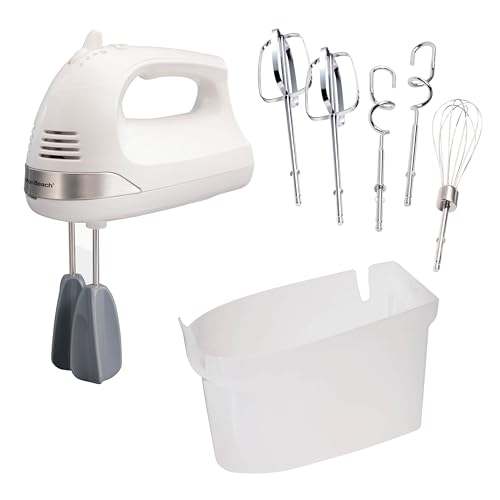
Hamilton Beach 6-Speed Electric Hand Mixer 62636J with Easy Clean Beaters — Best for Thick Batters
Check the current price on Amazon for the current listing, configuration and included attachments before you buy.
Thick batter is where hand mixers go to be humbled, and the 62636J is specified for exactly that fight. The easy-clean beaters have a smooth coated design that sticky mixtures — think peanut-butter cookie dough, thick blondie batter, cream-cheese frostings — release from instead of climbing and clinging. Less climbing means less motor strain wasted on dragging dough up the shafts, and far less scraping-down mid-mix.
Six speeds plus QuickBurst is a simpler range than the 9-speed flagships, and for heavy work that is mostly fine: the bottom gears fold, the middle gears do the real mixing, and QuickBurst gives a short hit of extra power to pull through a stiff patch. Dough hooks are in the box, and in single batches of moderately stiff dough they perform honestly — this mixer does not pretend to be a kneading machine, but it does not collapse at the first sign of resistance either.
The snap-on case keeps the unusually generous attachment set together. If your heavy duty work is batters and cookie doughs rather than bread, and you are tired of mixtures that climb the beaters and stall lesser mixers, this is the pragmatic pick — check price on Amazon, because it frequently sits in a friendlier tier than the 9-speed models.
Strengths
- Easy-clean beaters shed sticky dough instead of clogging
- QuickBurst handles short stiff patches well
- Generous attachment set with storage case included
Trade-offs
- Six speeds give coarser control than 9-speed rivals
- Not the choice for repeated bread-dough batches
- Beater coating needs non-abrasive washing to last
| Specification | Detail |
|---|---|
| Speeds | 6, with QuickBurst |
| Attachments | Easy Clean beaters, traditional beaters, dough hooks, whisk |
| Storage | Snap-on storage case |
Best for: thick batters, sticky cookie doughs and frosting work / Not suited for: precision folding or large stiff dough batches

Hamilton Beach 6-Speed Electric Hand Mixer 62682G — Best Budget
Check the current price on Amazon for the current listing, configuration and included attachments before you buy.
The 62682G is the budget pick that has outsold fancier mixers for years, and the reason is simple: a 250-watt motor and honest gearing at a price tier where most rivals are underpowered toys. For heavy duty work on a budget, published wattage you can compare beats vague promises, and this model’s motor class is the strongest in its tier. Cookie dough, thick cake batter and whipped work are all comfortably inside its ability.
Two design details punch above the price. The bowl rest lets you perch the mixer on the bowl rim between additions, so it is not lying in flour or trailing its cord through batter while you scrape. QuickBurst gives you a momentary top-power hit, which is the right tool for the last stiff corner of a batch. The snap-on case keeps beaters and whisk with the machine, the same attachment-protection logic as the pricier Cuisinart.
Be clear about what the budget buys and what it does not. Dough hooks are not the headline here — verify the current listing’s included set before relying on them — and sustained stiff-dough work is beyond its brief. As a powerful everyday mixer that can take on heavier batters than its price suggests, it remains the value benchmark of this guide.
Strengths
- 250-watt motor is the strongest in its price tier
- Bowl rest and QuickBurst are genuinely useful under load
- Snap-on case included at a budget price
Trade-offs
- Attachment set is slimmer than the 62636J
- Coarser speed control than 9-speed models
- Stiff dough work is occasional, not routine
| Specification | Detail |
|---|---|
| Motor | 250 watts (peak power) |
| Speeds | 6, with QuickBurst |
| Design | Bowl rest heel, snap-on storage case |
| Attachments | Traditional beaters, whisk |
Best for: budget buyers who still mix thick batters and cookie dough regularly / Not suited for: frequent dough-hook users — step up to the 62636J or a 9-speed model

KitchenAid Go Cordless Hand Mixer KHMR762 — Best Cordless Convenience
Check the current price on Amazon for the current listing, configuration and included attachments before you buy.
This pick comes with the clearest label in the guide: it is here for convenience, not for kneading. The KitchenAid Go cordless removes the two annoyances that make people avoid hand mixers — the cord in the batter and the socket hunt — and for the majority of hand-mixer jobs (cakes, whipped cream, frostings, light batters, mashed potatoes at the table) seven speeds with Soft Start is a complete tool. The battery is included in this configuration, which matters: some versions of this mixer are sold battery-out.
For heavy duty work, be realistic. A cordless motor trades sustained torque for freedom, and stiff dough will drain the battery and strain the drive faster than any corded model here. Treat it as the mixer you grab for everything up to moderately thick batter, and reach for a corded pick — or the stand mixer — when the recipe turns stiff. Judged on that honest brief, it is excellent: the Soft Start keeps first contact gentle, and the build quality is a clear step above novelty cordless gadgets.
Buy it as a second mixer or as your only mixer if your baking is light-to-medium. The review is deliberately placed last so the hierarchy is unmistakable: for heavy duty dough work, every corded pick above outranks it; for daily convenience, nothing else here touches it.
Strengths
- No cord in the bowl, no socket needed — use it anywhere
- Soft Start and seven speeds cover light-to-medium work fully
- Battery included in this configuration
Trade-offs
- Lowest sustained torque in this guide
- Battery drains fast under stiff loads
- Not a dough mixer despite the brand name
| Specification | Detail |
|---|---|
| Speeds | 7 |
| Power | Cordless, rechargeable battery included |
| Start | Soft Start feature |
| Beaters | Stainless steel Turbo Beaters |
Best for: light-to-medium baking with maximum convenience, or as a second mixer / Not suited for: heavy dough, thick double batches, or anyone’s only mixer for bread
Comparison Table
| Pick | Badge | Key spec | Best for |
|---|---|---|---|
| Breville Handy Mix Scraper Pro BHM800SIL | Best Overall | 9 speeds + boost, Beater IQ load sensing | bakers who push cookie and enriched doughs hard and want stand-mixer-like control in a drawer-sized tool |
| KitchenAid 9 Speed Hand Mixer KHM926 | Best for Versatility | 9 speeds, Soft Start, Pro Whisk + dough hooks | mixed baking — cookies, meringue, cakes and small dough batches with one machine |
| Cuisinart Power Advantage Plus 9-Speed Hand Mixer HM-90S | Best Storage Design | 9 speeds, SmoothStart, snap-on attachment case | organised bakers who want strong 9-speed performance and attachments that stay in one place |
| Hamilton Beach 6-Speed Electric Hand Mixer 62636J with Easy Clean Beaters | Best for Thick Batters | 6 speeds + QuickBurst, easy-clean beaters, dough hooks included | thick batters, sticky cookie doughs and frosting work |
| Hamilton Beach 6-Speed Electric Hand Mixer 62682G | Best Budget | 250W motor, 6 speeds + QuickBurst, bowl rest | budget buyers who still mix thick batters and cookie dough regularly |
| KitchenAid Go Cordless Hand Mixer KHMR762 | Best Cordless Convenience | 7 cordless speeds, Soft Start, battery included | light-to-medium baking with maximum convenience, or as a second mixer |
Read the table by load, not by badge order: the top rows hold speed best in thick mixtures, the middle rows trade a little finesse for value or storage, and the cordless row trades outright torque for freedom of movement.
How to Choose a Heavy Duty Hand Mixer
Start with the load, not the logo. Write down the stiffest thing you actually make — for most households that is chocolate-chip cookie dough or a thick brownie batter, not bread — and buy for that load plus one step of headroom. A mixer that cruises through your stiffest regular job will last for years; a mixer that strains through it will be replaced within two. The models in this guide divide cleanly: 9-speed load-sensing flagships at the top, honest 6-speed workers in the middle, and cordless convenience at the edge.
- Motor and torque delivery: published wattage (the Hamilton Beach’s 250 watts) or load-sensing electronics (Breville’s Beater IQ) are the two honest signals; a bare speed count is not a power claim.
- Lowest speed behaviour: heavy work begins with folding flour into a stiff base. A first gear that is too fast will splash, overwork and toughen — Soft Start and SmoothStart features exist precisely to fix this.
- Dough hooks in the box: hooks should be included, stainless and stout. If hooks are an accessory purchase, the mixer was not designed around dough.
- Heat and vents: feel where the vents are. Vents that sit where your palm covers them, or that clog with flour dust, shorten a hard-working mixer’s life.
- Rest and storage design: a bowl rest or heel stand plus a case or clip keeps the machine stable mid-recipe and its attachments unbent between recipes.
Budget tiers in words, since prices move: the budget tier buys you a strong simple motor and basic attachments — enough for batters and cookie dough. The mid tier adds dough hooks as standard, better low-speed control and storage cases. The premium tier buys load-sensing power, scraper beaters and the finest speed control. None of the tiers buys you a bread machine; that step-change only comes from moving to a stand mixer, which is a different purchase this guide’s final section points you toward.
Hand Mixer vs Stand Mixer for Dough: The Honest Line
A hand mixer kneads with two small hooks while you supply the counter-force with your wrist and steer the bowl with your other hand. That arrangement works — genuinely — for single batches of pizza dough, enriched doughs like brioche and challah in modest quantities, and soft sandwich doughs, provided you work in stages: mix to a shaggy mass, rest ten minutes, mix again, and finish the last kneading by hand on the counter. The rests are not a weakness of the method; they let the flour hydrate and the gluten relax, so the mixer does less work per pass and runs cooler.
The line is crossed by volume and stiffness together. Double batches, low-hydration bagel or pretzel dough, and wholemeal doughs with bran that cuts gluten will overheat any hand mixer and can strip gears over time. If those recipes are your weekly routine, the correct heavy duty purchase is a bowl-lift stand mixer with a spiral or C-hook — see the internal links in the final recommendation for this site’s stand mixer guides. Buying the strongest hand mixer for a stand mixer’s job is the most expensive mistake in this category, because you pay twice.
Getting More From the Mixer You Own
Technique extends any hand mixer’s heavy duty range. Bring butter to cool room temperature rather than fridge-hard for creaming — the motor load drops dramatically and the result is better. Add flour in three additions and let each one mostly incorporate at the lowest speed before the next. For doughs, switch from beaters to hooks the moment the mixture forms a mass, because beaters pack dough into their cages and waste torque. Keep the vents clear, listen for the motor note dropping — that is your signal to rest the machine for five minutes — and never hold the mixer at a stall. A stalled motor is being damaged in real time; stop, split the batch, and continue with half.
How to Use a Hand Mixer for Thick Dough Without Burning It Out
Used correctly, a heavy duty hand mixer handles a single batch of pizza or enriched dough well. Used carelessly, the same mixer can be overheated in ten minutes. This sequence protects the machine and produces better dough than forcing it.
- Combine the flour, water and yeast in a large, deep bowl and mix with the beaters on the lowest speed only until a shaggy mass forms — about a minute. Depth matters: a deep bowl keeps dough on the hooks instead of climbing out.
- Swap the beaters for the dough hooks. Beat in the salt and any butter or oil in small additions, letting each addition pull in before adding more.
- Mix on the lowest two speeds for two to three minutes, moving the mixer slowly around the bowl so the hooks pick up the whole mass. Keep the hooks submerged; lifting them whips air and throws dough.
- Stop and rest both dough and mixer for ten minutes. The dough hydrates and relaxes, the motor cools, and the next pass will need noticeably less effort.
- Mix for another two to three minutes. If the motor note drops sharply or the casing grows hot to the touch, stop — turn the dough onto a floured counter and finish kneading by hand for the remaining minutes.
- For cookie and thick batter work, use the same discipline: beaters only, lowest speed for flour additions, and scrape the bowl walls down twice so the mixer is not straining against an unmixed pocket.
- Wash beaters and hooks promptly — dried dough is hard enough to bend thin attachments during scrubbing — dry them fully, and store them in the case or clipped to the mixer.
Followed honestly, this method keeps a good hand mixer inside its design limits for years. The moment your recipes routinely need two batches back to back, read that as the equipment telling you the truth: your baking has outgrown the format, and the stand mixer guides linked below are your next step.
Attachments, Decoded: Beaters, Hooks, Whisks and Rods
The attachment drawer is where a hand mixer’s heavy duty character is written. Standard beaters are the generalists — flat-bottomed or wire — and their quality shows in the welds and the wire gauge: thin, springy beaters flex in thick dough and return less energy to the mixture, while stout beaters hold their shape and cut cleanly. The Breville’s scraper beaters add a flexible edge that keeps the bowl wall in the mixing circuit, which is why stiff mixtures come together faster with less scraping. When a mixture climbs the beaters instead of folding, that is geometry talking: the mass is too stiff for beaters at all, and the correct response is to change the tool, not the speed.
Dough hooks on a hand mixer are short, curved hooks that pull a formed mass from the top. They work because dough, once formed, is a single elastic object; the hooks’ job is to stretch and re-fold it against the bowl. Hooks earn their keep on pizza, focaccia and enriched doughs in single batches, and they are the attachment to inspect before buying — stainless, unbendable by hand pressure, and shaped to shed dough rather than trap it. The whisk, by contrast, is a light-work tool with a heavy-work warning: use it for egg whites, cream and thin batters, never for anything that resists, because its fine wires are the easiest attachment in the box to bend. The blending rod on the KitchenAid 9 Speed turns the mixer into a drink and soup tool — irrelevant to dough, delightful for everything else.
Storage closes the loop. Attachments that live loose get bent, and bent attachments make every later job harder on the motor — the wobble multiplies friction and the strain compounds. That is why this guide keeps praising snap-on cases: they are not tidiness theatre, they are how the working edges of the machine survive the drawer.
Speed Control, Explained Like It Matters
Heavy duty mixing lives or dies at three points of the speed range, and only one of them is the top. The first point is the start: a heavy mixture met at full speed splashes, shocks the drive and can stall the motor in the first second. Soft Start, SmoothStart and Breville’s controlled ramp all exist to make the first two seconds gentle — the beaters arrive at working speed progressively, the mixture begins moving as a mass, and the motor’s torque is spent on mixing rather than on a standing start against a wall of dough.
The second point is the working middle, where cookie dough, thick batters and hook work actually happen. What matters here is not the number of speeds but their stability under load — the difference between a mixer that holds its note and one that sags and surges as the beaters pass through thick and thin patches. Load-sensing electronics hold the line automatically; honest motors on simpler models hold it well enough that an attentive cook can compensate with a gear change. The third point, the top end, matters least for heavy work and most for whipping — and even there, control beats raw speed, because a stable high gear builds a finer, stronger foam than a frantic one.
A practical test when you first use any model in this guide: mix a standard batch of chocolate-chip cookie dough and listen. Note the gear where the motor sounds unhurried, the gear where it begins to labour, and how the casing temperature feels after five minutes. Those three observations are your machine’s personal heavy duty map, and they will serve you longer than any specification printed on the box.
Warranty, Parts and the Five-Year View
A hand mixer is a small appliance with a hard life, and the five-year view separates this guide’s picks from the disposable tier. The failure modes of hard-worked hand mixers are consistent: gear wear from repeated stalls, motor brushes and bearings tired by heat, and attachments bent or lost. The brands in this guide — Breville, KitchenAid, Cuisinart, Hamilton Beach — all support their machines with replacement attachments through normal retail channels, which sounds mundane until the day a dough hook bends in year three and the alternative to a spare part is a new mixer. Before buying, it is worth one minute on the listing checking that beaters and hooks for your exact model are separately listed; that single check predicts your ownership experience better than any feature comparison.
Heat discipline, covered in the how-to section, is the other half of longevity, and it is worth restating as an ownership rule rather than a technique: a hand mixer should never be held at a stall, never run continuously on stiff dough beyond a few minutes without a rest, and never stored with its vents packed in flour dust. Wipe the casing and vents after heavy sessions — thirty seconds with a dry cloth — and the machine’s cooling stays as designed. Coatings and finishes last when attachments are washed promptly and dried fully; dried dough scrubbed off with abrasives is how good beaters become rough beaters.
Judge the purchase, finally, as cost per year of your actual baking. A flagship that serves six years of weekly cookie and dough work is cheaper per bake than a bargain replaced twice, and it mixes better in every one of those years. That arithmetic — not the badge, not the launch price — is what heavy duty means once the box is recycled.
Common Buying Mistakes
Buying on speed count alone. Nine speeds on a weak motor lose to six speeds on a strong one every time the bowl gets thick. Judge by wattage, load-sensing features and included dough hooks — the specifications that describe work, not marketing.
Kneading a double batch because the bowl fits it. Bowl capacity is not motor capacity. A double batch of stiff dough doubles the torque load while halving the mixer’s cooling airflow per unit of work. Split the batch; two easy passes beat one motor-killing one.
Using beaters for dough. Once a mixture forms a mass, beaters cage the dough and waste power while stressing the drive. Switch to hooks early — that is what they are for.
Starting thick mixtures at full speed. Full-speed starts splash batter, shock the gears and can stall the motor instantly in stiff dough. Use Soft Start models or ramp up manually from the lowest gear.
Ignoring the heat warning signs. A dropping motor note, a hot casing or a faint electrical smell are stop signals, not challenges. Rest the mixer; a five-minute pause costs nothing and a burned motor costs the machine.
Storing attachments loose in a drawer. Bent hooks and beaters wobble, and wobble multiplies strain on every subsequent job. The snap-on cases on several picks in this guide exist because attachment condition is a performance feature.
Final Recommendation
For most bakers, the Breville Handy Mix Scraper Pro is the heavy duty hand mixer to buy: it holds speed under load, controls the low end beautifully, and its scraper beaters genuinely mix better. The KitchenAid 9 Speed is the versatility champion if your week runs from meringue to pizza dough, and the Cuisinart HM-90S matches it closely with the tidiest storage in the class. On a budget, the Hamilton Beach 62682G’s 250-watt motor embarrasses mixers twice its tier, while the 62636J is the thick-batter specialist. Choose the KitchenAid Go Cordless only with its limits understood — convenience first, dough never.
And keep the honest line in view: if bread is the centre of your baking, put your money into a bowl-lift stand mixer instead and let a simple hand mixer handle the light work. The guides below cover that side of the decision in full.
Start with the three safest first looks: Breville Handy Mix Scraper Pro BHM800SIL, KitchenAid 9 Speed Hand Mixer KHM926, Cuisinart Power Advantage Plus 9-Speed Hand Mixer HM-90S.
Keep reading in this series: Best Heavy Duty Stand Mixers Best Heavy Duty Mixers For Bread Making Best Heavy Duty Table Top Mixers Best Stand Mixers Best Hand Mixers
Frequently Asked Questions
Can a hand mixer really knead bread dough?
Yes, within limits. A heavy duty hand mixer with dough hooks handles a single batch of pizza, enriched or soft sandwich dough when you work in stages with rests. Stiff, low-hydration or double batches exceed any hand mixer’s design — that work belongs to a bowl-lift stand mixer.
What wattage counts as heavy duty in a hand mixer?
Around 250 watts peak is the practical floor for confident thick-batter work, as on the Hamilton Beach 62682G. Load-sensing models like the Breville achieve similar real-world results by adjusting power delivery, so judge wattage alongside speed control and included hooks.
Are dough hooks worth it on a hand mixer?
Yes — they are the difference between mixing dough and fighting it. Hooks pull and fold a formed mass efficiently where beaters cage it. Any mixer you plan to use on dough should include stainless hooks in the box, as most picks in this guide do.
Why does my hand mixer slow down in thick dough?
The motor is meeting more resistance than its torque can overcome at that speed. Drop a gear, rest the batch, split it if needed, and switch from beaters to hooks. Persistent slowing with a hot casing means the batch is beyond the machine — finish by hand rather than forcing a stall.
Is a cordless hand mixer strong enough for cookie dough?
For standard single batches of cookie dough, a good cordless model copes, though it will drain its battery quickly. For thick, chilled or double batches, a corded heavy duty model is the right tool — the cordless pick in this guide is recommended for convenience across light-to-medium work, not as a dough specialist.
How long should a heavy duty hand mixer last?
With batch discipline — no stalls, rests on stiff work, attachments stored unbent — a quality model should give many years of regular service. Most early failures trace back to repeated overheating on oversized dough batches, which is a usage pattern, not a brand defect.


