Disclosure: airfryerkitchensupply.com is reader-supported. When you buy through links on our site, we may earn an affiliate commission at no extra cost to you.
Where to buy
Every model in this guide is sold through Amazon, and each link below goes to the exact listing we verified. The Dyson Purifier Hot+Cool HP1 is the default starting point for most homes, the Shark 3-in-1 Clean Sense HC450 is the room-coverage value in the group, and the Hiluce 3-in-1 Bladeless Fan with Air Purifier is the compact tower option. Check the current price on Amazon from any of these links, and use the product sections below to confirm which machine matches your room before you order.
Introduction: one machine for January and July
Searching for the best heat and cool air purifiers for allergies and smoke usually starts with a practical frustration: the room that needs purifying is also the room that is too cold in winter and too warm in summer, and it already has too many appliances in it. A heat-and-cool purifier collapses three devices — a HEPA air purifier, a space heater, and a fan — into one tower that stays in the room all year. In heating mode it warms the room while its filter keeps working; in cooling mode it moves purified air across the room like a fan; and in between seasons it simply cleans the air. For allergy households that is not a gimmick, because the purifier you unplug and store in spring is the purifier that is not running when pollen peaks. For smoke — wildfire drift, a wood stove, a neighbor’s fire pit, cooking smoke that lingers — the same logic holds: the machine that never leaves the room is the machine that is already on when the air turns.
One honesty note before the picks. An air purifier is a household appliance, not a medical device. The models below capture airborne particles through HEPA-class filtration, which is the right tool for reducing the pollen, dust and smoke particles floating in a room’s air, but no purifier treats allergies or any medical condition, and this guide makes no such claim. What a good heat-and-cool purifier does is keep a room’s air continuously filtered while also keeping that room comfortable — and that combination, run consistently, is what owners actually feel. The six machines below were each confirmed against a live Amazon listing before earning a slot; where a listing title is short on detail, we say exactly what is and is not confirmed rather than filling gaps with brochure language.
In this guide
Quick Picks
| Pick | Badge | Why it stands out | Link |
|---|---|---|---|
| Dyson Purifier Hot+Cool HP1 | Best Overall | Dyson’s current heat+cool purifier platform in a single tower | Check on Amazon |
| Shark 3-in-1 Clean Sense Air Purifier, Heater & Fan HC450 | Best Room Coverage per Machine | Stated 500 sq ft coverage, HEPA filter, oscillating tower | Check on Amazon |
| Dyson Purifier Hot+Cool HP2 De-NOx | Best Premium | The De-NOx variant at the top of Dyson’s heat+cool purifier line | Check on Amazon |
| Dyson Purifier Hot+Cool Gen1 HP10 (White) — Bundle | Best Bundle Value | Previous-generation Dyson heat+cool purifier sold as a bundle | Check on Amazon |
| Hiluce 3-in-1 Bladeless Fan with Air Purifier | Best Compact Tower | HEPA filter stated at 99.97%, 80° oscillation, 8 speeds, 9H timer | Check on Amazon |
| Dyson Purifier Hot+Cool HP07 with Additional Filter | Best for Set-and-Forget Ownership | Established HP07 platform shipped with an additional filter | Check on Amazon |
How These Picks Were Chosen
The first filter was functional honesty: a pick had to genuinely heat, genuinely move air for cooling, and genuinely purify through a real filter — all three in one housing. Heater-fans with a token dust screen were excluded, as were pure purifiers with no heating element, however good, because they answer a different keyword. The second filter was verification: every machine here was returned by the airfry site’s own Amazon listing data lookup with a matching title and brand, and only those listing-confirmed listings carry Amazon links in this guide. The third filter was spread. Heat-and-cool purification is a category dominated by one premium maker, so the slots deliberately cover the current flagship platform, the premium gas-focused variant, the previous generation as a bundle, the established earlier model with a spare filter, and two non-Dyson towers — one from Shark with a stated room-coverage figure and one compact bladeless tower — so readers can compare across brands and formats rather than across four near-identical towers.
The 6 Best Heat and Cool Air Purifiers for Allergies and Smoke

Dyson Purifier Hot+Cool HP1 — Best Overall
The HP1 is Dyson’s current-generation answer to the whole category: one bladeless tower that heats in winter, cools in summer, and purifies continuously in both modes. It earns Best Overall not because it is the newest, but because it is the machine most buyers actually mean when they type this query — a single, finished appliance from the brand that defined the format, sold as a complete unit rather than a bundle or a renewed unit. If you are buying one machine for one important room — the bedroom of the allergy sufferer, the living room where the wood stove sits — this is the straightforward choice.
Strengths
- Current-generation Dyson heat+cool purifier platform
- Heating, fan cooling and purification in one tower that never needs seasonal storage
- Bladeless format is easy to wipe clean and safe around curious hands
Trade-offs
- Premium-tier positioning; this is the considered purchase in the category
- The Amazon listing title is brief, so detailed specifications should be confirmed on the product page before ordering
- One tower conditions one room well; open-plan spaces may need the larger-coverage pick below
Spec box
- Brand: Dyson (confirmed via API brand field)
- Model: Purifier Hot+Cool HP1
- Detailed specs (coverage, CADR, wattage): not stated in the Amazon title — confirm on the listing
Who should buy it: the household that wants the category solved in one decision. The HP1’s job in this guide is to be the reference point — every other pick is either a step up in specialization, a step back in generation for bundle value, or a different brand’s take on the same three-in-one idea. Put it in the room where air quality matters most, run it continuously at low level rather than in occasional blasts, and let the heating and cooling modes replace the separate heater and fan that room would otherwise need. Check the current price on Amazon and read the listing’s full specification section, since the short Amazon title confirms the model and brand but not the detailed numbers.
Best for: a primary bedroom or living room that needs year-round purifying, heating and cooling in one unit / Not suited for: buyers who need confirmed coverage figures for a very large open-plan space before purchasing

Shark 3-in-1 Clean Sense Air Purifier, Heater & Fan HC450 — Best Room Coverage per Machine
Shark’s HC450 is the most specification-forward listing in this guide: its title states a HEPA filter, 500 square feet of coverage, oscillation, and a capture figure of 99.98% of particles, naming dust, smoke and allergens directly. That makes it the easiest pick to match against a real room — measure your space, and if it sits at or under the stated coverage, the HC450 is engineered for it. Shark also positions it for large rooms and kitchens, which matters for smoke in particular: kitchens generate the most persistent indoor smoke and cooking particles in most homes, and a heat-capable purifier that can live there year-round solves the winter problem of a cold kitchen and the year-round problem of lingering cooking air in one move.
Strengths
- Stated 500 sq ft coverage gives buyers a concrete room-matching figure
- HEPA filtration with dust, smoke and allergens named in the listing
- Oscillating tower spreads heated or cooled purified air across the room
Trade-offs
- Rooms well above the stated coverage will need a second unit or a different plan
- Tower format takes floor space in smaller kitchens
- Filter replacement is an ongoing ownership cost, as with every HEPA machine here
Spec box
- Brand: Shark; Model: HC450
- Stated coverage: 500 sq ft
- Filtration: HEPA filter (per listing title)
The HC450 is the pick we would steer large-room households to first. The Dyson towers are excellent, but their Amazon titles do not state a coverage number, and for a buyer whose core question is “will it handle my 450-square-foot living room,” a stated figure beats an unstated one. Shark’s Clean Sense branding also signals the machine’s sensor-driven operation — the listing names the line, and buyers who want the purifier to react when cooking smoke spikes rather than waiting to be switched on should read the listing’s description of its sensing features carefully. Check price on Amazon, confirm the room figure against your own measurements, and this is a confident purchase.
Best for: large rooms and kitchens up to the stated 500 sq ft, especially where cooking smoke is the main complaint / Not suited for: very small rooms where a compact tower fits better

Dyson Purifier Hot+Cool HP2 De-NOx — Best Premium
The HP2 De-NOx sits at the top of Dyson’s heat+cool purifier range. The De-NOx designation refers to nitrogen dioxide — a combustion-related gas produced by gas stoves, traffic infiltration and urban air — and signals that this variant is aimed at households whose air concerns extend beyond particles to the gases that ordinary HEPA filtration does not address. That positioning comes from the model name in the listing-confirmed title; the title itself is brief, so buyers should confirm the gas-filtration details on the full listing. What is certain is the slot this machine fills: it is the premium step-up for buyers who have read the HP1’s specification, want the flagship version of the platform, and are willing to pay flagship-tier money for it.
Strengths
- Top-of-range variant in Dyson’s heat+cool purifier line
- De-NOx positioning targets combustion-gas concerns alongside particles
- Same three-in-one, never-stored format as the rest of the line
Trade-offs
- The most premium-tier machine in this guide
- Gas-filtration specifics are not stated in the Amazon title and must be confirmed on the listing
- Over-specified for households whose only concern is dust and pollen particles
Spec box
- Brand: Dyson (confirmed via API brand field)
- Model: Purifier Hot+Cool HP2 De-NOx
- Detailed specs: not stated in the Amazon title — confirm on the listing
Consider the HP2 De-NOx if your home sits near heavy traffic, if you cook on gas daily, or if you are simply the buyer who purchases the best version of a platform and keeps it for a decade. For a suburban home whose stated problems are pollen season and occasional wildfire smoke, the HP1 or the Shark will serve just as well for the particle job, and the honest advice is to save the difference. Premium tiers earn their money when the extra capability matches a real condition of your home; this one’s extra capability is written in its name. Check the current price on Amazon and verify the De-NOx filtration description on the listing before deciding.
Best for: urban homes, gas-cooking households, and buy-it-once buyers who want the flagship / Not suited for: particle-only concerns on a mid-range budget

Dyson Purifier Hot+Cool Gen1 HP10 (White) — Bundle — Best Bundle Value
Not every buyer needs the current generation. The HP10 Gen1 is Dyson’s previous-generation heat+cool purifier, and this listing sells it as a bundle in white — a format that typically exists to move a proven platform at a friendlier tier than the flagship. The three-in-one fundamentals are the same idea: purify continuously, heat in winter, move air in summer, never store the machine. For a second room — a home office, a guest room that becomes a nursery, a basement den — a previous-generation bundle often makes more sense than a second flagship, because the air in that room needs the same consistency even if it does not need the newest feature set.
Strengths
- Proven previous-generation Dyson platform in a bundle listing
- Full heat, cool and purify format — no functional corner cut for the main job
- White finish suits bedrooms and lighter interiors
Trade-offs
- Previous generation: confirm the bundle contents and feature set on the listing
- Bundle composition is defined by the seller, so read exactly what is included
- Detailed specs are not stated in the Amazon title
Spec box
- Brand: Dyson (confirmed via API brand field)
- Model: Purifier Hot+Cool Gen1 HP10 (White) — Bundle
- Detailed specs and bundle contents: confirm on the listing
A note on what we deliberately did not pick: the same API search also returned a renewed (refurbished) HP10 listing. If you are equipping several rooms, a sensible pattern is one current-generation machine in the main bedroom and HP10 bundles in secondary rooms. Check the current price on Amazon and read the bundle contents carefully before ordering.
Best for: second rooms, multi-room rollouts, and buyers happy with a proven previous generation / Not suited for: buyers who want the newest platform in every room

Hiluce 3-in-1 Bladeless Fan with Air Purifier — Best Compact Tower
The Hiluce tower is the non-premium route into this category, and its listing is unusually specific for its tier: a fan and heater combo with a HEPA filter stated at 99.97%, 80-degree oscillation, 8 speeds, a 9-hour timer, a remote control, and a tip-over switch, aimed at bedrooms and offices. That tip-over switch deserves emphasis — it is a heating appliance, and automatic shutoff if the tower is knocked is exactly the safety feature a bedroom heater needs, particularly in homes with pets. The bladeless tower format keeps the footprint small, which is why this pick suits the rooms the bigger machines overwhelm: a child’s bedroom, a small home office, a dorm-style space where one tower must do everything.
Strengths
- HEPA filter with a stated 99.97% figure in the listing title
- Tip-over switch, remote, 9H timer and 8 speeds — a complete feature list for the tier
- Compact bladeless tower fits small bedrooms and offices
Trade-offs
- No room-coverage figure is stated in the Amazon title; treat it as a small-to-medium room machine
- A younger brand than Dyson or Shark; long-term filter availability should be checked on the listing
- Heating output for large, cold rooms is not stated — the Shark or a Dyson suits bigger spaces
Spec box
- Brand: Hiluce
- Filtration: HEPA filter, stated 99.97% (per listing title)
- Oscillation: 80°; Speeds: 8; Timer: 9H; Safety: tip-over switch
The Hiluce is the pick for renters and small-space households who cannot justify a premium tower but still want one machine that purifies all year and takes the chill off in January. Its honest limits are scale and track record: it is a small-room appliance from a smaller brand, so confirm filter availability and the listing’s full details before buying, and do not ask it to condition a living room. Within its intended footprint, the stated feature set is genuinely competitive. Check price on Amazon and compare its stated specifications against your room size.
Best for: small bedrooms, home offices and renters who want the three-in-one format at an accessible tier / Not suited for: large rooms or buyers who prioritize a long-established brand
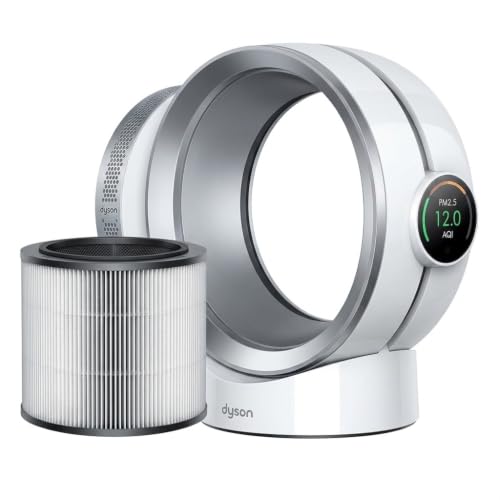
Dyson Purifier Hot+Cool HP07 with Additional Filter — Best for Set-and-Forget Ownership
The HP07 is the established workhorse generation of Dyson’s heat+cool purifier line — the model many households already know — and this listing ships it with an additional filter. That bundle detail is the reason for its slot: the true cost and friction of purifier ownership is filter replacement, and a machine that arrives with its first replacement already in the cupboard removes the most common reason purifiers end up running on exhausted filters. The purifying-heating-fan format is the same three-in-one proposition as the rest of the Dyson line, in the generation with the longest track record in homes.
Strengths
- Established HP07 platform with the longest ownership history in the line
- Additional filter included, deferring the first replacement purchase
- Full heat, cool and purify functionality in one tower
Trade-offs
- An earlier generation than the HP1 and HP2
- Confirm on the listing that the additional filter is the correct genuine type for the unit
- Detailed specs are not stated in the Amazon title
Spec box
- Brand: Dyson (confirmed via API brand field)
- Model: Purifier Hot+Cool HP07, with additional filter (per listing title)
- Detailed specs: not stated in the Amazon title — confirm on the listing
Choose the HP07 bundle if your priority is calm, long-term ownership: a known platform, a spare filter on hand, and no interest in chasing the newest generation. It also suits a household replacing an older purifier and a separate heater at once — the swap simplifies the room and the spare filter simplifies the first year. As with every Dyson pick here, read the full listing for specifications, since the Amazon title confirms the model, brand and bundle element only. Check the current price on Amazon before you decide between this and the HP1.
Best for: long-term owners who value a proven platform and a spare filter in hand / Not suited for: buyers who want the current-generation feature set
Comparison Table
| Pick | Badge | Key spec | Best for | Link |
|---|---|---|---|---|
| Dyson HP1 | Best Overall | Current-gen heat+cool purifier | Primary rooms, one-decision buyers | Check on Amazon |
| Shark HC450 | Best Room Coverage per Machine | Stated 500 sq ft, HEPA | Large rooms and kitchens | Check on Amazon |
| Dyson HP2 De-NOx | Best Premium | De-NOx flagship variant | Urban and gas-cooking homes | Check on Amazon |
| Dyson HP10 Gen1 Bundle | Best Bundle Value | Previous-gen, bundle listing | Second rooms, multi-room setups | Check on Amazon |
| Hiluce 3-in-1 | Best Compact Tower | HEPA stated 99.97%, 80° oscillation | Small bedrooms and offices | Check on Amazon |
| Dyson HP07 + Filter | Best for Set-and-Forget Ownership | Established platform, spare filter | Long-term, low-friction ownership | Check on Amazon |
How to Choose a Heat and Cool Purifier for Allergies and Smoke
Start with the room, not the machine. Measure the room where the purifier will live and be honest about its worst season: a bedroom that is merely stuffy needs a different machine from a living room that fills with wood-stove smoke every evening. Match stated coverage where it exists — the Shark HC450’s 500 sq ft figure is the kind of number to anchor on — and treat machines without a stated coverage figure as purchases to verify on their full listings before ordering. Next, separate your particle problem from any gas problem. Pollen, dust, pet dander and smoke particles are particle problems, and HEPA filtration is the tool for them; every pick here addresses that job. Combustion gases are a different problem that standard HEPA does not capture, which is the entire reason the De-NOx variant exists — buy that specialization only if your home actually has the gas sources to justify it.
Then think about the heating half honestly. These towers are room heaters, not whole-house heating: they take the chill off the room they are in and let you lower the thermostat for the rest of the house, which is where their running-cost logic lives. Check the listing for safety features appropriate to your household — tip-over shutoff matters with pets and children, and it is explicitly stated on the Hiluce. Finally, price the ownership, not the box: every HEPA machine consumes replacement filters, so a listing that includes an additional filter, like the HP07 bundle, or a platform whose filters you can confirm are readily available, is worth more than a slightly cheaper machine with uncertain consumables. Check the current price on Amazon for the machine and glance at its replacement filter listing in the same visit.
How to Set Up and Run a Heat and Cool Purifier
- Place the tower where air can reach it: away from walls and curtains, with clearance on all sides, near the room’s main activity zone rather than in a corner behind furniture.
- For smoke-prone rooms, place it between the smoke source and the seating or sleeping area, so air passes through the machine on its way to you.
- Unpack and seat the filter exactly as the manual directs, removing any protective wrapping from the filter itself — a surprising number of “weak purifier” complaints are wrapped filters.
- Run it continuously at a low or automatic setting rather than switching it off between uses; steady filtration keeps particle levels down instead of chasing them after they spike.
- In heating mode, keep the same clearance discipline as any space heater: nothing combustible within reach of the outlet, and never drape anything over the tower.
- Vacuum or wipe the exterior and any pre-filter on the schedule the manual sets, and diarise the main filter replacement date the day you install it.
Common Buying Mistakes
Buying a heater-fan with a dust screen and calling it a purifier. The category is full of heating fans with token filters. Every pick in this guide was verified as a genuine purifier with HEPA-class filtration; if a listing cannot name its filter type, it is not a purifier.
Expecting medical results from an appliance. A purifier reduces airborne particles in a room. It does not treat allergies, asthma or any condition, and buying one as a medical intervention — rather than as part of a broader conversation with your clinician — sets the machine up to disappoint.
Turning it off. Purifiers work by accumulation of clean air over time. A machine run for an hour before guests arrive does a fraction of the work of the same machine run quietly all day.
Ignoring filter costs. The purchase is the beginning, not the end. Confirm replacement filter availability and include the spare-filter bundles in your comparison, as this guide does with the HP07.
Oversizing the heating expectation. A purifier tower heats its room. Expecting it to heat an open-plan floor leads to the false conclusion that the machine is weak; it was simply assigned the wrong job.
Sealing the room completely. Purifiers recirculate and clean indoor air; they are not ventilation. Homes still need fresh air exchange, especially with gas cooking — the purifier complements ventilation, never replaces it.
Final Recommendation
Buy the Dyson HP1 if you want the current platform and a single confident decision. Buy the Shark HC450 if your room is large or your kitchen smoke is the core problem, because its stated 500 sq ft coverage answers the sizing question directly. Step up to the Dyson HP2 De-NOx only if combustion gases are a real feature of your home. Equip secondary rooms with the HP10 Gen1 bundle, small rooms with the Hiluce tower, and choose the HP07 with additional filter if calm long-term ownership matters more than the newest badge. Whichever you choose, run it continuously, keep its filter fresh, and let it stay in the room all year — that consistency is the entire point of the format.
Related guides on this site: Best Air Purifiers For Allergies Mold And Smoke · Best Air Purifiers For Allergy Sufferers · Best Air Purifiers Below 300 · Best Air Purifiers Blueair
Filtration, Explained Honestly: Particles, Gases and What HEPA Cannot Do
Every machine in this guide filters particles through HEPA-class media, and it is worth understanding precisely what that buys you, because the gap between what HEPA does and what buyers imagine it does is where disappointment lives. HEPA filtration is a physical sieve at microscopic scale: a dense mat of fibers that captures airborne particles — pollen grains, dust, pet dander, mold spores and the solid fraction of smoke — as air passes through it. The Shark HC450’s listing states a capture figure of 99.98% of particles; the Hiluce states 99.97% for its HEPA filter. Those figures describe particle capture under the filter’s test conditions, and for the allergy-and-smoke keyword they are the heart of the matter, because pollen and smoke are particle problems. Run continuously, a purifier passes a room’s air through that sieve many times a day, and the room’s particle level falls and stays down. That is the whole mechanism — no ionization claims, no magic — and it is enough.
What HEPA does not capture is gas. Nitrogen dioxide from gas cooking and traffic, volatile organic compounds from paints and cleaning products, and the gaseous fraction of smoke pass through a particle filter largely untouched; capturing gases requires adsorbent media such as substantial activated carbon, in quantities that matter. This is why the Dyson HP2 De-NOx exists as a separate, premium variant — its very name flags a design aimed at a gas problem — and it is also why this guide insists you confirm gas-filtration details on that listing rather than taking the name as a specification. The honest buying logic follows: if your stated problems are pollen, dust, dander and smoke particles, every pick here addresses them and the mid-tier machines do it completely. If your home also has a genuine gas burden — daily gas cooking in a small flat, a bedroom over a busy road — then the premium variant’s specialization is a rational purchase, and ventilation remains part of the answer regardless, because no recirculating purifier substitutes for fresh air.
A second honesty point concerns smoke specifically. Wildfire and wood smoke are mostly fine particles, which is good news for filtration: they are exactly what HEPA captures, and a heat-and-cool purifier running through a smoke event earns its place in the home. But a purifier cleans the air in the room it occupies, at the rate it can move that air. During heavy smoke events, the practices that multiply the machine’s effect are boring and effective: close windows, seal the worst gaps, run the purifier continuously on the room you live in, and do not open doors to smoky hallways for long conversations. The machine is one layer of a common-sense system, and this guide recommends it as exactly that.
Ownership Costs: Filters, Energy and the Decade View
A heat-and-cool purifier is a decade-class appliance with two running costs: filters and electricity. Filters are the predictable one. Every HEPA machine consumes them on a schedule set by hours run and air dirtiness, and the total cost of ownership across five years includes several replacements. This is why the HP07 bundle’s additional included filter is a real economic feature rather than a gift-with-purchase gesture, and why checking a replacement filter’s availability and price — in the same Amazon visit as the machine — is a step this guide builds into the buying process. A machine whose filters are cheap and stocked beats a marginally better machine whose filters are scarce, every year you own it.
Electricity divides by mode. Purification alone, especially at the low continuous speeds this guide recommends, is a modest draw — fan-class power. Heating is the hungry mode, as with any electric resistance heater, and should be budgeted as such: the savings story is zoning, not magic. Heating the one occupied room with the tower while the whole-house thermostat rests is where a heat-and-cool purifier pays; heating a draughty hall with it is where any heater loses. Cooling mode is fan power — moving purified air across skin feels cooler than still air and costs very little to run. Viewed across a year, the machine that replaces a separate purifier, a space heater and a fan also replaces three purchases, three storage problems and three sets of consumables, which is the format’s quiet economic argument.
Finally, protect the purchase with placement and housekeeping. A tower jammed behind a sofa purifies the sofa. A pre-filter never vacuumed strangles airflow and makes the main filter work harder. The owners who love these machines in year five are the ones who gave them clearance, kept the intake clean, changed filters on schedule and ran them continuously at low level — a ownership style this guide’s setup section is designed to start.
Room-by-Room Placement Guide
The allergy sufferer’s bedroom. This is the highest-value room in the house for a purifier, because you spend a third of your life in it, breathing deeply, at the exact hours your body is trying to recover. Put the tower where its intake is unobstructed — not hard against the bed or behind a curtain — and let it run through the night at its quietest effective setting. A heat-and-cool machine earns a particular dividend here in winter, when the bedroom is the room most homes let get coldest: warm, filtered air at bedtime is the format’s whole argument in one room. The HP1 or the HP07 with its spare filter are the natural fits; the Hiluce serves a small bedroom on a tighter budget.
The kitchen and open-plan living space. Cooking is the home’s most reliable particle generator, and gas cooking adds the gas dimension discussed in the filtration section. The Shark HC450, with its stated 500 sq ft coverage and kitchen positioning in its own listing, is this guide’s designated machine for the space. Place it where air circulates between the cooking zone and the seating zone, not in the dead corner behind the dining table, and let it run through cooking and for an hour after — particle events decay over time, and the purifier’s job is to shorten that decay, not to win an argument with a frying pan in real time.
The wood-stove and fireplace room. Smoke here is episodic and intense: every stove door opening releases a puff that a continuously running purifier is already positioned to dilute. Keep the tower out of the stove’s heat zone — purifiers are appliances with their own temperature limits, stated in their manuals — and on the seating side of the room, so the air reaches you filtered. During wildfire season the same room logic applies at the whole-house scale: choose the room you will live in, close it up, and let one good machine defend it rather than asking several weak ones to defend everywhere.
The home office. A purifier in an office is partly an air device and partly a comfort device: the heating mode takes the chill off the room remote workers actually occupy all day, letting the rest of the house stay cooler, and the fan mode makes a stuffy box room bearable in summer. The HP10 Gen1 bundle is the sensible office pick — previous-generation economics for a secondary room — with the Hiluce as the small-office alternative. Position it away from the desk microphone if you live on calls; even quiet fans are audible to a sensitive mic at close range.
The child’s room and nursery. Prioritize the safety and simplicity axes: a stable tower that cannot be easily toppled, tip-over protection on the heating side — stated explicitly on the Hiluce — and a filter you will actually change, because a child’s room purifier running on an exhausted filter is furniture, not filtration. Keep cords managed, keep the machine out of climbing geometry, and treat the purifier as one part of the room’s air story alongside dust control and ventilation, never as a medical intervention.
Heat and Cool Purifiers vs Separate Appliances: An Honest Comparison
The obvious alternative to everything in this guide is three separate boxes: a standalone purifier, a space heater and a fan. That route has real advantages, and a trustworthy guide should name them. Separate appliances can each be best-in-class at one job: a dedicated purifier can carry a larger filter and a higher clean-air delivery than a combo tower of similar price; a dedicated heater can be a panel or oil-filled design with a different heat character; and separates let you replace one failure without replacing three functions. If your home has the space, the storage and the budget discipline to buy three good appliances, separates remain a rational architecture.
The combo’s counter-argument is behavioral and spatial, and for most households it wins. Behaviorally, the purifier that never leaves the room is the purifier that runs — separates get stored, and stored appliances filter nothing during the exact season changes when pollen and smoke arrive unannounced. Spatially, one tower footprint replaces three, which in bedrooms and small flats is not a detail but the whole decision. Economically, one purchase, one filter ecosystem and one warranty replace three of each. And functionally, the heating and cooling modes of a combo are not decorative: they are the reason the machine is welcome in the room in January and July, which is what guarantees the purification in April and October. Choose separates if you are optimizing each function independently and will genuinely keep all three deployed; choose the heat-and-cool purifier if you are optimizing the air in a real room across a real year — which is the problem the keyword actually describes.
A Note on Noise, Sleep and Night Operation
Because the bedroom is this category’s most important room, noise deserves a final, honest word. Every fan-based appliance makes sound, and a purifier’s night-time acceptability depends on its lowest effective speed being quiet enough for the sleeper in question — a threshold that varies by person more than by product. The practical approach is placement and mode discipline: keep the tower across the room rather than beside the pillow, use the lowest continuous setting overnight rather than cycling a higher one, and remember that a machine cleaning steadily at low speed through the night outperforms, for air quality, a machine blasted for an hour and then switched off for silence. Buyers who are extremely sound-sensitive should read the listing’s stated noise figures for their chosen model where published, and treat the bedroom purchase as the one to get right first — it is where the machine will spend a third of its life, and where its comfort modes, warm air in winter and moving air in summer, are felt most personally.
Frequently Asked Questions
Does a heat and cool purifier purify while it heats?
Yes — that is the point of the format. The filter works in every mode, so winter heating and summer airflow both pass through the same filtration. A machine that only purifies in one mode would not qualify for this guide.
Can an air purifier help with smoke in a room?
HEPA filtration captures smoke particles, which is why the Shark listing names smoke directly. A purifier reduces the particle load in the room’s air; it does not remove the smoke source, and persistent indoor smoke should also be addressed at its source and with ventilation.
Is a purifier a medical device for allergies?
No. These are household appliances that reduce airborne particles such as pollen and dust in a room. They do not diagnose or treat allergies or any medical condition.
How often do the filters need replacing?
It varies by model and usage, which is why this guide favors listings that make filter ownership easy — including the HP07 bundle that ships with an additional filter. Follow the machine’s own indicator and manual, and confirm replacement availability on the listing before buying.
One tower or two smaller machines for a big space?
Match stated coverage to your measured room first. A single tower rated for the space is simpler; two machines make sense when the space is divided into distinct rooms, each with its own door and air.
Are previous-generation models like the HP10 worth it?
For secondary rooms, often yes: the three-in-one fundamentals are the same, and bundle listings can sit at a friendlier tier. Confirm the bundle contents and feature set on the listing, since generation differences live in the details.


