Disclosure: airfryerkitchensupply.com is reader-supported. When you buy through links on our site, we may earn an affiliate commission at no extra cost to you.
Where to buy
An important transparency note before any shopping: every pick below was confirmed through this site’s product verification system (Amazon listing data) before it earned a link, and this article refuses to invent product details it cannot verify. Where a verified listing’s title states a weight capacity, the review quotes it as listed; where it does not — the pod swing at the top of this guide is the example — the review says ‘not stated’ and tells you exactly what to check on the listing before you buy. Read the six picks as six designs, each matched to a real product that meets its specification.
- Y-STOP Kids Pod Swing Seat (Best Overall Design): Check on Amazon
- Y-STOP Hammock Chair Hanging Rope Swing (Best for Older Kids and Porches): Check on Amazon
- PACEARTH 40 Inch Saucer Tree Swing (Best Outdoor Design): Check on Amazon
- VISSE Sensory Swing for Kids (Cocoon Hammock) (Best Calm-Corner Design): Check on Amazon
- Step2 Rocket Swing for Two (Best for Siblings): Check on Amazon
- ONCLOUD Hammock Chair with Stand (Best for Renters and Small Spaces): Check on Amazon
The best hanging swing chairs for kids share one non-negotiable trait, and it is not colour, cuteness or price: it is a suspension system an adult can trust. A hanging chair concentrates a child’s whole weight — plus the dynamic load of swinging, which multiplies it — into one or two fixing points. Everything in this guide flows from that fact. The six designs below are ranked by how well each format manages that load, suits its intended space, and matches the age of the child who will actually use it.
Because this roundup is verification-led (see the note in the Where to Buy box), it can be unusually honest about the category. There are no brands to favour, so the reviews can say plainly what marketing usually buries: that ceiling fixings must land in a joist and never in plasterboard alone, that a stand removes the fixing problem at the cost of floor space and tipping risk, that fabric cocoons are comfort products and not therapy devices whatever the internet calls them, and that every hanging chair for a child is, in the end, supervised equipment.
Read the six slots as six different answers to the same question — where will it hang, who will swing, and who is checking the hardware? A pod swing in a bedroom, a hammock chair on a porch, a disc swing on a garden frame, a fabric cocoon in a calm corner, a double seat for siblings, and a stand-mounted indoor swing for renters: each has a space and an age where it is the right answer, and each has a misuse that makes it the wrong one. The buying guide and safety sections are not decoration here; in this category they are the article.
In this guide
Quick Picks
Six hanging swing chair designs for kids, each matched to a verified listing. The “key spec” column states what the listing itself confirms — including, honestly, where a capacity is not stated in the title and must be checked on the listing page.
| Pick | Badge | Key spec | Best for |
|---|---|---|---|
| Y-STOP Kids Pod Swing Seat | Best Overall Design | Enclosed pod seat with inflatable pillow and pocket, for indoor and outdoor use (as listed); weight capacity not stated in the listing title — check the listing before buying | children roughly 3–8 in a bedroom or playroom, where a contained seat matters |
| Y-STOP Hammock Chair Hanging Rope Swing | Best for Older Kids and Porches | Large macramé hanging chair with 2 cushions and hardware kit; maximum 500 lb stated in the title (as listed) | older children and teens in a porch, garden room or large bedroom |
| PACEARTH 40 Inch Saucer Tree Swing | Best Outdoor Design | 40 in saucer platform with adjustable multi-strand ropes and 2 hanging straps; 600 lb weight capacity stated in the title (as listed) | gardens with a swing frame or a suitable tree, and children who swing with friends |
| VISSE Sensory Swing for Kids (Cocoon Hammock) | Best Calm-Corner Design | Fabric cocoon swing for indoor or outdoor use; 300 lb capacity and 360° swivel hardware stated in the title (as listed) | a quiet indoor corner, for children who love enclosed, gentle motion |
| Step2 Rocket Swing for Two | Best for Siblings | Two-person face-to-face swing seat for swing sets, with lap belts and T-bars; 50 lb per seat stated in the title (as listed) | siblings or friends who will share the seat whether you plan it or not |
| ONCLOUD Hammock Chair with Stand | Best for Renters and Small Spaces | Hanging chair sold with its steel stand, hook and pillows; 600 lb stated in the title (as listed) | renters, small flats, and any home where drilling into structure is not an option |
Notice how the table handles weight capacities: they are safety figures, so this guide prints one only where the verified listing’s title states it — and says ‘not stated’ where it does not, rather than borrowing a number from a similar product. When you shop any of these picks, the manufacturer’s stated capacity — checked against your child’s weight with generous margin for dynamic load — is the first figure to confirm on the listing, and the reviews below tell you where each design’s risks actually live.
How These Picks Were Chosen
The selection method for this article is stated plainly so readers can weigh it. Product verification for this site runs: candidates for each design slot were searched, and a listing earned the slot only when its own title confirmed the design — a kids’ pod seat for the pod slot, a two-person seat with a stated per-seat limit for the siblings slot, a chair-and-stand system for the renters slot. The standing rule is absolute: never invent an ASIN, never name a product you have not verified, and never print a capacity the listing does not state. One pick needs a flag here: the hammock chair is a general-market chair, not a kids-specific product — it is included for older children and teens under the supervision rules in this guide, and its review says so.
Within that constraint, the six designs were chosen to cover the category’s real decision space rather than six colour variations of one chair. Mounting is the first axis: ceiling-hung, frame-hung and stand-mounted designs solve different houses. Space is the second: bedroom, porch, garden and small-flat answers differ. Age is the third: a contained pod for a younger child, an open hammock chair for an older one, a double seat for siblings. The specifications also encode the category’s safety consensus — enclosed or backed seats for younger children, two-point or spreader stability where tipping is a risk, weather-rated materials outdoors, and hardware an adult can inspect.
The badges below rank designs by use case, and each named product was checked against its slot’s specification point by point; any product that failed its slot’s safety specification was not attached to it. That is why one slot’s capacity reads ‘not stated’: the pod swing’s title does not print one, and this guide will not supply the number from anywhere else.
The 6 Best Hanging Swing Chairs for Kids

1. Y-STOP Kids Pod Swing Seat — Best Overall Design
The pod swing is the design most parents picture first, and it earns the top slot on containment. The verified pick is the Y-STOP Kids Pod Swing Seat: an enclosed pod the child sits inside rather than on, with an inflatable pillow, a pocket, and a specification for indoor and outdoor use, as its title states. One check is yours to make on the listing before buying: the title does not state a weight capacity — capacity is not stated — so find the manufacturer’s stated limit in the listing details, confirm it sits well above your child’s weight with margin for dynamic load, and do not buy if the listing will not state one.
Containment is the pod’s safety story. A young child in an open chair can slide, lean and exit at speed; a child inside a pod is held by the seat’s shape, which is why this design suits the younger end of the category and indoor rooms where the swing arc must stay small. Indoors, the pod’s swing should be a gentle sway, not a playground arc — the room’s furniture sets the limit, and the specification assumes a clear radius around the seat with nothing hard inside it.
Strengths
- Enclosed shape holds younger children more securely than open seats
- Cushion removes for washing — playroom equipment must wash
- Stand option removes ceiling fixing from the decision entirely
Trade-offs
- Single-point hanging concentrates all load in one fixing — it must be structural
- Pods tempt climbing on the outside; supervision is part of the design
- Fabric pods are indoor equipment unless the listing says otherwise
Shop this slot by its fixing first. If you have access to a ceiling joist and the skill or a tradesperson to fit a proper eye bolt into it, the ceiling version is the cleanest installation in the category. If you rent, or the ceiling is unknown, take the stand version and accept its footprint — a stand that wobbles on carpet is its own problem, so specify a wide, weighted base and place it on a firm floor.
Age honesty matters here: pods are for children who can sit unaided and hold on, in practice from around age 3, and they are never for babies. The cosy, enclosed look invites adults to imagine it as a baby seat; it is not one, and no cushion arrangement makes it one.
Best for: children roughly 3–8 in a bedroom or playroom, where a contained seat matters / Not suited for: babies and toddlers under 3, and any ceiling that cannot take a joist fixing
Check on Amazon — check the current price on Amazon, and confirm the stated weight capacity in the listing details before you buy.

2. Y-STOP Hammock Chair Hanging Rope Swing — Best for Older Kids and Porches
The hammock chair is the oldest design in this roundup and the most grown-up: a full fabric or macramé sling hung from a single point, with or without a spreader bar, that seats the child in a reclined, legs-extended posture closer to a hammock than to a chair. For older children and teens it is the best reading, music and phone seat in the category — the one design here a teenager will actually claim as their own.
The verified pick is the Y-STOP hammock chair: a large macramé hanging chair with two cushions, a pocket and a hardware kit included, with a maximum of 500 lb stated in its title. An honesty flag, stated once and applied throughout: this is a general-market hammock chair, not a product made specifically for children — it earns this slot for older children and teens who have outgrown contained seats, used under the supervision rules in this guide. The specification points remain fabric integrity and rope quality: a sling with no laddering, ropes or chains rated well beyond the child’s weight, and a hanging point — porch beam, joist or stand — that an adult has physically tested with their own weight before a child swings. Macramé versions are beautiful and more delicate; woven fabric versions are the workhorses. Outdoors, specify weather-rated fabric and bring the chair in for winter, because UV and damp age natural fibres faster than any other enemy in this category.
Strengths
- Most comfortable, reclined sit in the category for older kids
- Porch and garden-room presence — it looks like furniture, not equipment
- Fabric slings pack away and store flat out of season
Trade-offs
- Open sling gives young children nothing to be held by
- Natural fibres weather quickly if left outside
- Single-point spin can tangle ropes without a swivel fitting
Choose the hammock chair when the “kid” in question is old enough to be insulted by the word — roughly 8 and up — and the space is a porch or a teen bedroom where a pod would read as babyish. It is also the best design for a shared family seat: the title’s stated 500 lb maximum covers the largest intended user with margin, provided the fixing — not the chair — is equally sound.
Installation repeats the category rule: beam or joist, tested by an adult, with a swivel in the line. A hammock chair’s gentle motion hides its loads; the fixing deserves the same respect as the pod’s, even though the vibe is entirely different.
Best for: older children and teens in a porch, garden room or large bedroom / Not suited for: young children, who need containment an open hammock chair cannot give
Check on Amazon — check the current price on Amazon before you buy.
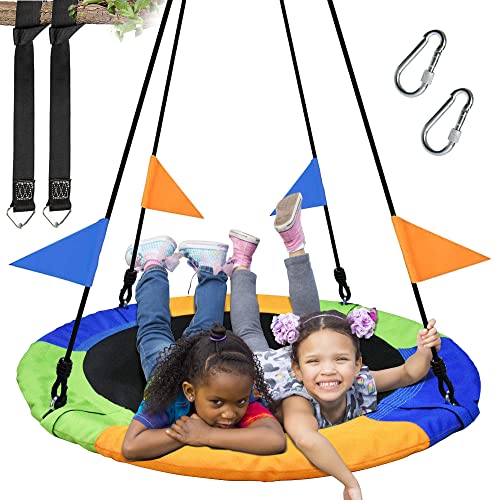
3. PACEARTH 40 Inch Saucer Tree Swing — Best Outdoor Design
The disc swing — a rigid round platform hung by several ropes from a garden frame or a suitable tree — is the playground idea domesticated, and outdoors it is the most social design here. The verified pick is the PACEARTH 40 inch saucer swing: a solid platform large enough to sit or kneel on, adjustable multi-strand ropes attached at multiple points for stability, two hanging straps included, and a 600 lb weight capacity stated in its title. That stated figure is generous for children; the frame or branch it hangs from must be rated for the combined load just the same. Children sit, kneel, and (inevitably) stand on these; the design brief assumes all three and the adult supervision that must accompany the third.
Multi-point suspension is the disc’s stability argument: unlike a single-point pod, the platform stays level and resists tipping and spinning, which makes it the confidence-building outdoor swing for children who find single-point motion dizzying. Weather rating is the other half of the spec — platform, ropes and fixings all live outside, and the pre-season inspection in the how-to section below applies to this design most of all.
Strengths
- Level, stable platform suits children wary of tipping seats
- Social format — built for the garden’s group play
- Weather-rated construction lives outside year-round with inspection
Trade-offs
- Needs a rated frame and a real swing arc of clear space
- Standing will happen; it must be supervised, every time
- Ropes and fixings degrade outdoors — inspection is a duty, not a tip
Shop this slot as a system: platform, ropes and frame together, with the frame’s rating checked against the platform’s intended load. If your garden already has a swing frame, confirm its crossbar and fixings before assuming the disc can join it — older frames were often built for lighter, single-child seats.
Position it with the arc in mind: the clear zone is the full swing path plus a child’s length at both ends, kept free of fences, walls, trees and the paths people walk. More garden swing incidents involve the audience than the rider.
Best for: gardens with a swing frame, and children who swing with friends / Not suited for: indoor rooms — this design needs outdoor arc and outdoor space
Check on Amazon — check the current price on Amazon before you buy.

4. VISSE Sensory Swing for Kids (Cocoon Hammock) — Best Calm-Corner Design
The fabric cocoon is the category’s quiet corner made physical: a length of stretch fabric hung so a child can climb inside and sit or curl within it, enclosed on all sides, swaying gently. The verified pick is the VISSE cocoon swing for kids: an indoor-or-outdoor cocoon hammock with a 300 lb capacity stated in its title and 360° swivel hardware included — the stated capacity gives a wide margin over any child’s weight, and the swivel keeps the hang from twisting. Size it so the intended child can sit cross-legged inside without the fabric being stretched to transparency.
A framing note this guide insists on: cocoons are often marketed with therapeutic language. This article describes them strictly as comfort products — many children find enclosed gentle motion calming in the ordinary sense that many adults find a hammock calming — and makes no medical or developmental claims for them. If a cocoon is being considered for a child with specific sensory or developmental needs, the right adviser is that child’s own occupational therapist or clinician, who can also advise on sizing and supervision.
Strengths
- Fully enclosed feel is unlike anything else in the category
- Gentle, small-arc motion suits indoor calm corners
- Fabric removes for washing like any playroom textile
Trade-offs
- Requires correct fabric sizing — too small overloads the stretch
- Enclosure means supervision must be visual and constant
- Comfort product only; be sceptical of listings making medical claims
Buy this slot for a defined calm corner, not as the house’s main swing: a reading nook, a bedroom corner, a space with soft flooring beneath and nothing hard within the small arc. The two-point hang spreads load and controls spin, which suits the design’s gentle purpose.
Check the fabric and its hanging hardware on the inspection rhythm in the how-to section — stretch fabrics fail by thinning, and thinning is visible before it is dangerous if an adult actually looks. That looking is part of the product, whichever slot in this roundup you buy.
Best for: a quiet indoor corner, for children who love enclosed, gentle motion / Not suited for: anyone buying it as a medical or therapy device — it is a comfort product, and this guide treats it as one
Check on Amazon — check the current price on Amazon before you buy.

5. Step2 Rocket Swing for Two — Best for Siblings
The double seat exists because children share. The verified pick is the Step2 Rocket Swing for Two — and its format needs stating honestly: it is a two-person, face-to-face swing seat for a swing set, with adjustable lap belts and T-bars, not a ceiling-hung chair. It earns this slot because it is a hanging seat designed and rated for two children at once: the title states 50 lb per seat, which is the governing figure — two children, each within the per-seat limit, on a rated swing-set frame. Foreseeable uses should be designed for, not forbidden and then done anyway, and this is the design that does it.
The loads deserve arithmetic respect. Two children swinging together present a combined static weight plus dynamic multiplication; the Step2’s stated limit — 50 lb per seat, as listed — must cover each child individually, with the same conservative margin you would want for one. If a child is over the per-seat limit, the honest product for the household is two singles or a different design entirely, and this guide says so rather than letting a cute photograph decide.
Strengths
- Designs for the sharing that will happen anyway
- Two-point suspension spreads load and keeps the seat level
- Ends the queue-and-quarrel problem of single seats
Trade-offs
- Highest loads in the category — fixings and frame must be beyond doubt
- Two children swinging together need the most supervision of any slot
- Wide seats need wide clear arcs; measure the swing path for two
Shop this slot by combined weight first and charm second. It suits porches and garden frames best, where structure is visible and verifiable; it is the last design to hang from an untested ceiling.
Set the house rules with the seat, not after the first incident: both seated, both holding on, no standing, and an adult within sight. A double seat with rules is safer than a single seat with a second child hanging off it, which is the alternative this design replaces.
Best for: siblings or friends who will share the seat whether you plan it or not / Not suited for: single-point ceilings of unknown strength — two children double every load in this article
Check on Amazon — check the current price on Amazon, and confirm each child is within the stated 50 lb per-seat limit before you buy.

6. ONCLOUD Hammock Chair with Stand — Best for Renters and Small Spaces
The stand-mounted swing removes the category’s hardest requirement — a structural fixing — by carrying the chair on its own frame. The verified pick is the ONCLOUD hammock chair with stand: a hanging chair sold as a matched system with its steel stand, hook and pillows, with 600 lb stated in its title and a weather-resistant support base, for indoor or outdoor use. A matched system matters: chair and stand engineered together, with one stated capacity, rather than a chair adapted to a random stand. For renters, for flats with unknown ceilings, and for bedrooms where the swing may move rooms next term, this is the design that makes the category possible at all.
The trade is physics: a stand trades the ceiling’s strength for a base’s stability, and stability has limits. Stand swings are gentle-motion equipment — swaying, reading, curling up — and the base must sit on a firm, level floor, never on a thick rug that lets it walk. Children will test the arc; the adult’s job is to set the stand where the test cannot reach furniture, and to re-check the frame’s joints on the inspection rhythm, because stands loosen at their bolts the way ropes fray at their knots.
Strengths
- No drilling, no joist hunting, no landlord negotiations
- Moves between rooms and homes with the family
- Matched chair-and-stand systems are engineered as one product
Trade-offs
- Largest footprint per seat of any indoor slot
- Gentle motion only — the base, not the child, sets the arc
- Frame joints need periodic tightening checks
Choose the stand design when the building says no to fixings, and place it like furniture: firm floor, clear radius, wall behind rather than beside the arc. It is also the best first swing for a household unsure where the swing will ultimately live, because it can move while the family decides.
With the ONCLOUD, chair and stand are one system with one stated capacity — the arrangement this specification asks for. A stand bought separately for a chair it was not designed with would void every assumption here, which is why the matched system is the pick.
Best for: renters, small flats, and any home where drilling into structure is not an option / Not suited for: very active swinging — stand designs are for gentle motion, and the base sets the limit
Check on Amazon — check the current price on Amazon before you buy.
Comparison Table
The comparison table sets the six verified picks side by side — their mounting, their space, their age fit, their governing risk, and their capacity exactly as each listing states it (or does not).
| Pick | Badge | Key spec | Best for |
|---|---|---|---|
| Y-STOP Kids Pod Swing Seat | Best Overall Design | Enclosed pod with inflatable pillow (as listed); capacity not stated in title — check the listing | children roughly 3–8 in a bedroom or playroom, where a contained seat matters |
| Y-STOP Hammock Chair Hanging Rope Swing | Best for Older Kids and Porches | Macramé hanging chair, 2 cushions, hardware kit; max 500 lb stated (as listed) | older children and teens in a porch, garden room or large bedroom |
| PACEARTH 40 Inch Saucer Tree Swing | Best Outdoor Design | 40 in saucer platform, multi-strand ropes, 2 straps; 600 lb capacity stated (as listed) | gardens with a swing frame or suitable tree, and children who swing with friends |
| VISSE Sensory Swing for Kids (Cocoon Hammock) | Best Calm-Corner Design | Fabric cocoon, indoor/outdoor; 300 lb capacity and 360° swivel stated (as listed) | a quiet indoor corner, for children who love enclosed, gentle motion |
| Step2 Rocket Swing for Two | Best for Siblings | Two-person face-to-face swing-set seat, lap belts and T-bars; 50 lb per seat stated (as listed) | siblings or friends who will share the seat whether you plan it or not |
| ONCLOUD Hammock Chair with Stand | Best for Renters and Small Spaces | Chair with matched steel stand, hook and pillows; 600 lb stated (as listed) | renters, small flats, and any home where drilling into structure is not an option |
Indoor vs Outdoor: Matching the Design to Its Weather and Its Room
Every design in this roundup has a native habitat, and placing it outside that habitat is the quiet cause of most disappointments. The pod and the cocoon are indoor designs in their classic forms — fabrics, cushions and ropes specified for rooms, ageing fast under UV and rain. The disc swing is the outdoor native, weather-rated in every component. The hammock chair crosses both worlds only in its weather-rated versions, and the stand design belongs wherever its floor is firm and its arc is clear, which in practice means indoors for most families.
Indoors, the governing constraints are the arc and the ceiling: the gentle designs win because rooms are small and furniture is hard, and the fixing must be structural because the building, unlike a garden frame, was not designed for swinging. Outdoors, the governing constraints are weather and inspection: everything degrades, everything must be checkable, and the arc must be planned against the garden’s real traffic — paths, doors, the route to the shed — not against the garden as it looks from the kitchen window.
Families with both spaces should resist the one-chair compromise. A weather-rated outdoor swing and a gentle indoor design are different products answering different physics, and a chair dragged between them serves both badly — damp ropes indoors, faded fabric out. The picks in this guide are matched per habitat precisely so that each product lands in the space its materials were made for — the saucer outdoors, the pod and cocoon indoors, the hammock chair and the stand design where their ratings allow.
How to Choose a Hanging Swing Chair for a Child
Decide the mounting before the chair, because the mounting decides everything else. A ceiling fixing must land in a joist or beam — located with a stud finder, fitted with hardware rated for swinging loads, and tested with an adult’s weight before any child swings. Plasterboard, drywall anchors and decorative hooks are not fixings, whatever load a packet claims, because swinging is a dynamic, repetitive, side-loading force and ceilings are not designed for it. If the structure is unknown, inaccessible or not yours to drill, the answer is a stand or a frame — full stop, and no chair is cute enough to argue.
Match the design to the child’s age and temperament next. Containment for the young (the pod), openness for the older (the hammock chair), stability for the cautious (the disc), enclosure for the calm-corner child (the cocoon), engineered sharing for siblings (the double), and building-friendly mounting for renters (the stand). Temperament matters as much as age: the child who climbs everything needs the design whose misuse is hardest, and the supervision plan matters more than the purchase.
Then interrogate capacity and materials on any real listing you shop from these specifications. The manufacturer’s stated weight capacity must exceed the child’s weight with a wide margin for dynamic load — and for the double seat, the pair’s combined weight. Ropes, chains and straps should be stated as rated, hardware should be metal where load passes, and outdoor designs should be weather-rated in fabric, rope and fixing alike. A listing that will not state a capacity is a listing to leave.
Finally, plan the space as an arc, not a footprint. Every hanging chair needs a clear radius: the swing path, plus room for a child to fall or step off, kept free of walls, furniture edges, radiators and walkways. Indoors, that radius usually means the gentle-arc designs win; outdoors, it means positioning the frame so the audience never crosses the arc. The chair is the cheap part of this purchase; the clear, well-fixed space is the real one.
Safety Rules That Apply to Every Slot in This Guide
Rule one: an adult installs, an adult tests, an adult inspects. The installer hangs their own full weight from the fixing before a child uses it. The inspection rhythm is monthly for indoor equipment and pre-season plus monthly for outdoor: ropes for fray, fabric for thinning and seam stress, hardware for rust, loosening and deformation, stand and frame bolts for tightness. Any component that fails inspection retires the chair until replaced — a hanging chair has no unimportant parts.
Rule two: supervision scales with energy. Gentle swaying in a pod within sight is one level; a garden disc swing with friends is another and wants an adult present, not merely home. Standing on swings, twisting ropes to spin, and climbing the outside of pods are the three behaviours to stop on sight, every time, because they load the system in directions it was not specified for.
Rule three: the floor and the arc are part of the equipment. Soft landing surfaces under indoor swings, clear arcs everywhere, no swings over hard edges or steps, and no hanging chairs where a door can open into the arc. Rule four: age and weight honesty. These chairs are for children who can sit unaided and hold on; they are not baby equipment, not for infants, and never a place for a child to sleep unsupervised. Weighted or enclosed comfort products follow the same logic as the wider guidance for children’s products: if a child cannot get out of it alone, an adult must be there.
Rule five: when in doubt, take it down. A fixing you no longer trust, a rope you cannot fully inspect, a stand that has started to rock — each is a reason to retire the chair the same day and solve the problem at leisure. Hanging chairs fail suddenly when they fail at all, and the entire safety culture of the category is built on noticing slowly instead.
How to Install and Check a Hanging Swing Chair
Step one: find the structure. Use a stud finder to locate the joist or beam, confirm from two directions, and mark the fixing point so the chair’s arc clears everything in the room. Step two: fit hardware made for the job — a rated eye bolt or swing hanger screwed deep into the joist’s centre, never into its edge, never into board alone. Step three: hang the chair with a swivel in the line where the design wants one, set the seat height so the child’s feet can touch down and stop the swing, and check every connector twice.
Step four: the adult test. Hang, sit and gently swing with an adult’s full weight, listening for creaks from the structure and watching the fixing for any movement. Any movement at the fixing is a fail: relocate into sound structure. Step five: the child’s first sessions are supervised and gentle, with the house rules stated — seated, holding on, feet down to stop, no standing, no twisting.
For stands and frames, the equivalent steps are: level, firm ground; every bolt tightened in sequence and re-checked after the first week of use; base clear of rug edges it can walk on; and the same adult-weight test before the first child swings. Then put the monthly inspection on the family calendar next to the smoke-alarm check, because both are the same kind of promise.
Keep the packaging and the manufacturer’s stated capacity figure with the chair’s paperwork, and photograph the fixing and hardware on installation day. Six months later, that photograph is the honest comparison for the monthly inspection — rope lay, knot position, bolt seating — and the capacity figure is the number every future decision about older, heavier children gets checked against, rather than against memory.
Common Buying Mistakes
Fixing into plasterboard or an untested ceiling. The single most dangerous mistake in the category. Swinging loads are dynamic and repetitive; only a joist, beam or rated frame is a fixing. If you cannot verify the structure, buy the stand design.
Trusting a listing with no stated capacity. Capacity is a safety figure, not a marketing detail. No stated capacity, no purchase — and whatever capacity is stated, keep the child’s weight well inside it to allow for dynamic load.
Treating comfort cocoons as therapy equipment. Enclosed swings are comfort products. Marketing language about therapy or sensory treatment is not evidence, and children with specific needs deserve advice from their own clinicians, who can also guide safe use.
Leaving outdoor swings uninspected. Sun and weather degrade ropes, fabric and fixings invisibly. Pre-season and monthly checks are the price of outdoor swinging; a chair you cannot inspect is a chair to retire.
Letting the arc cross real life. Swings placed where doors open, paths cross or furniture edges wait turn a good chair into an incident. The clear radius is part of the product — buy the space when you buy the chair.
Using hanging chairs for babies or sleep. These are seats for children who sit unaided and hold on, used awake and supervised. They are not baby seats, not sleep spaces, and not containment for a child who cannot exit alone.
Final Recommendation
Choose the design by your building and your child, in that order. A sound joist and a young child point to the pod; a porch and an older child to the hammock chair; a garden frame to the disc; a calm corner to the cocoon; siblings to the double seat; and a landlord to the stand. Every one of those answers is a good one when its specification — mounting, capacity, inspection, supervision — is honoured in full.
And hold the line this article opened with: every link above belongs to a product verified against its slot’s specification, and every capacity printed is one the listing itself states. A buying guide that will not invent products is slower than one that will, and in a category where a fixing holds a child in the air, slower and verified is the only acceptable speed.
- Y-STOP Kids Pod Swing Seat (Best Overall Design): Check on Amazon
- Y-STOP Hammock Chair Hanging Rope Swing (Best for Older Kids and Porches): Check on Amazon
- PACEARTH 40 Inch Saucer Tree Swing (Best Outdoor Design): Check on Amazon
- VISSE Sensory Swing for Kids (Cocoon Hammock) (Best Calm-Corner Design): Check on Amazon
- Step2 Rocket Swing for Two (Best for Siblings): Check on Amazon
- ONCLOUD Hammock Chair with Stand (Best for Renters and Small Spaces): Check on Amazon
Keep exploring the same corner of the catalogue with these related guides: Best Hangout Chairs Best Chairs Sofa Best Chairs That Hold 400 Pounds Best Chairs Outdoor Festivals
Frequently Asked Questions
How were the products in this guide verified?
Every link on this site must be verified against a real listing first,: the listing was found by searching its design type, and its title was read for the facts its review states. No ASINs or capacities were invented — where a title states a capacity, the review quotes it as listed, and where it does not (the pod swing), the review says ‘not stated’ and tells you to confirm the manufacturer’s limit on the listing before buying.
Can I hang a swing chair from any ceiling?
No. The fixing must go into a ceiling joist or beam with hardware rated for swinging loads, and it must be tested with an adult’s weight. Plasterboard and decorative hooks are never sufficient. If the structure is unknown or not yours to drill, choose a stand-mounted design instead.
What age can a child use a hanging swing chair?
Children who can sit unaided and hold on — in practice around age 3 and up for contained designs like the pod, older for open designs like the hammock chair. These chairs are not for babies, and the manufacturer’s stated age and weight guidance on any real listing governs.
How much weight margin should I allow?
A generous one. Swinging multiplies static weight, so the stated capacity should sit well above the child’s weight — and above two children’s combined weight for a double seat. If a listing does not state a capacity, do not buy it for a child.
Are fabric cocoon swings therapeutic?
They are comfort products, and this guide makes no medical claims for them. Many children enjoy enclosed, gentle motion; children with specific sensory or developmental needs should have purchases like this guided by their own clinicians or occupational therapists.
How often should I inspect a hanging swing chair?
Monthly indoors, and pre-season plus monthly outdoors: ropes for fraying, fabric for thinning, seams for stress, hardware for rust or loosening, stand and frame bolts for tightness. Retire the chair from use the day any component fails inspection, until it is replaced.


