Disclosure: airfryerkitchensupply.com is reader-supported. When you buy through links on our site, we may earn an affiliate commission at no extra cost to you.
Where to buy
Every chair below is sold through Amazon, where you can check the current price on Amazon and — in this category above all — read the full listing specifications: the stated weight capacity, the seat width between the arms, and the base construction. A chair that “holds 400 pounds” on a headline but offers a seat too narrow to sit in comfortably has answered the wrong question, so verify both numbers before ordering.
- Big and Tall Office Chair 400lbs, Wide Seat Mesh — Check on Amazon
- 400lbs Executive Office Chair with Flip-Up Armrests — Check on Amazon
- GTPLAYER Big and Tall Gaming Chair 400lbs — Check on Amazon
- NAFORT Walnut Wood Dining Chairs, Set of 4, Max Load 400 Lbs — Check on Amazon
- PHI VILLA Oversized Zero Gravity Chair, 400 LBS — Check on Amazon
- Folding Chairs 4 Pack, 400 lbs Weight Capacity — Check on Amazon
Introduction
The best chairs that hold 400 pounds are not regular chairs with a bolder number printed on them. A chair honestly built for a 400-pound user differs in ways you can verify: a wider seat that accommodates the body it is rated for, a base and cylinder rated as components rather than hopes, frame materials and joinery chosen for load, and geometry that does not concentrate stress at one heroic bolt. The number matters — a user near 400 pounds should never be asked to trust a chair rated at 250 and a prayer — but the number is the beginning of the evaluation, not the end. This guide treats capacity as a system: rating, seat dimensions, base construction, and the margin a wise buyer keeps between their weight and the chair’s limit.
That margin deserves emphasis before any product names. Weight ratings describe a static, centered load under test conditions; real sitting is dynamic — we drop into chairs, lean, shift, perch on edges. A prudent rule is to choose a chair rated comfortably above the user’s actual weight, so that 400-pound-rated chairs are the sensible choice for users in roughly the 300-400 range, and users at or beyond 400 should look at the 500-pound class.
The list spans the rooms where heavy-duty seating is actually needed: two office chairs for the working day, a gaming chair for long sessions, a dining set that lets every guest sit without a calculation, an outdoor recliner built oversized, and folding event chairs that end the quiet anxiety of plastic chairs at gatherings. Below the reviews, the buying guide explains how capacity ratings work, how to measure seat fit, which components fail first on underbuilt chairs, and how to set up and maintain a heavy-duty chair so it delivers its full rated life.
In this guide
Quick Picks
- Best Overall: Big and Tall Office Chair 400lbs — wide mesh seat, lumbar support, adjustable arms, swivel task design for the full working day. Check the current price on Amazon
- Best Executive: 400lbs Executive Office Chair — PU leather, flip-up armrests, heavy-duty ergonomic build for desk and meeting duty. Check the current price on Amazon
- Best Gaming: GTPLAYER Big and Tall Gaming Chair 400lbs — high back, pocket-spring lumbar support, footrest for long sessions. Check the current price on Amazon
- Best Dining: NAFORT Dining Chairs Set of 4 — solid rubberwood legs, max load 400 lbs per chair, farmhouse ladder-back style. Check the current price on Amazon
- Best Outdoor: PHI VILLA Zero Gravity Chair — 30-inch-wide oversized padded recliner rated 400 lbs, with cup holder and pillow. Check the current price on Amazon
- Best Folding: Folding Chairs 4 Pack — plastic event chairs rated 400 lbs each, for parties, schools, weddings and gatherings. Check the current price on Amazon
How These Picks Were Chosen
Verification came first, through Amazon listing data for this site: each pick’s 400-pound capacity had to appear in the listing’s own title or specifications — not in a review, not in a Q&A answer, not in our imagination. Chairs whose capacity claims lived only in marketing images, or whose ratings shifted between the title and the spec table, were excluded; in a safety-relevant category, consistency is a feature.
Beyond the rating, we weighed fit and construction. Seat width and depth were checked against the plausible needs of the user the rating implies — a 400-pound chair with a standard-width seat is a contradiction we refused to list. Base and frame construction mattered in proportion to the room: five-star bases and rated cylinders in office chairs, solid wood legs in the dining pick, oversized steel framing in the outdoor recliner, and honest commercial-style construction in the folding set. Finally, we required range: this category fails buyers when it offers only desk chairs, so dining, outdoor and event seating — the places where underbuilt chairs most often embarrass and endanger — are represented with verified picks of their own.
The 6 Best Chairs That Hold 400 Pounds

Big and Tall Office Chair 400lbs, Wide Seat Mesh — Best Overall
This chair leads the guide because it answers the most common version of the need: a full working day, at a desk, in a chair that fits and endures. The listing specifies a 400-pound capacity with a wide seat, lumbar support, adjustable arms, and a mesh executive high-back design in a swivel task format. Mesh is a considered choice for big-and-tall office duty: it breathes through long sessions where PU leather grows warm, it does not crack or peel across years of heavy use, and a quality mesh seat distributes load without the foam-bottoming that ends cheaper chairs’ comfort by month six.
The adjustable arms matter more at this size than in standard chairs, because shoulder width scales with the user and fixed arms at standard spacing are a common hidden failure of “big” chairs that are merely strong. Lumbar support that adjusts — or at least sits at a sensible height against a high back — decides whether hour seven feels like hour one. The honest limits: mesh chairs feel firmer than padded executive chairs, and users who prefer a cushioned, enveloping sit should look at the executive pick below. As a daily-work instrument for a large user, though, this is the balanced, verifiable choice.
Strengths
- Verified 400-lb capacity with a genuinely wide seat and high back
- Breathable mesh survives heavy daily use without peeling or bottoming out
- Adjustable arms and lumbar support fit the chair to the user, not vice versa
Trade-offs
- Mesh firmness will not please cushion-first sitters
- Assembly is a real task at this size — budget time and a second pair of hands
- Task-chair styling reads office, not lounge
Best for: large users working full days at a desk who value breathability and adjustability. Not suited for: anyone wanting a plush executive sit, or users at the very top of the rating who should keep a larger margin. Check the current price on Amazon

400lbs Executive Office Chair with Flip-Up Armrests — Best Executive
The executive alternative trades mesh for presence: a 400-pound-rated big and tall chair in breathable PU leather with flip-up armrests and a heavy-duty ergonomic build. The flip-up arms are the feature to notice — they let the chair roll fully under a desk, let the user sit sideways or cross-legged without an armrest dictating posture, and remove the arm-width problem entirely for the broadest users, because an arm that folds away cannot pinch. For home offices that double as meeting space on camera, the leather-look finish presents as executive in a way mesh does not.
PU leather’s known trade applies: it is handsome and easy to wipe clean, and across years of heavy daily use it can wear at the seat’s front edge sooner than mesh or fabric. The ergonomic shaping and padding suit users who sit in longer, more stationary blocks — reading, calls, focused work — rather than the constant shifting of task work. Judge it as what it is: the boardroom answer in a category that too often offers only gaming aesthetics, with a capacity verified in its own listing title.
Strengths
- 400-lb rating in a presentable executive format
- Flip-up armrests solve arm-width fit and desk clearance at once
- Padded ergonomic sit for long stationary work blocks
Trade-offs
- PU leather wears faster than mesh under heavy daily use
- Warmer sit than mesh in hot offices
- Padded seats eventually compress; expect a finite cushion life
Best for: executives and home-office users wanting a formal look with real capacity. Not suited for: hot rooms, constant-motion task work, or buyers prioritizing decade-long upholstery life. Check the current price on Amazon

GTPLAYER Big and Tall Gaming Chair 400lbs — Best Gaming
Gaming chairs earn a dedicated pick because their use pattern — very long, reclined, session-based sitting — is distinct, and GTPLAYER’s big and tall model is the verified 400-pound entry: heavy-duty construction, a high back with pocket-spring lumbar support, a wide comfy seat cushion and a footrest, in carbon black. Pocket-spring lumbar is worth the mention: springs hold their support profile far longer than a foam pillow strapped to a chair, and lumbar support that survives the year is the difference between a gaming chair that helps your back across a session and one that merely photographs well.
The footrest and recline serve the session rhythm — play upright, lean back for cutscenes and streams, extend for a break without leaving the chair — and the high back supports taller users’ shoulders properly, a common failure of standard gaming chairs scaled only in width. The category’s usual cautions apply with force at this size: racing styling is a taste commitment, PU surfaces run warm, and a footrest is a convenience, not a structural member — never stand on it, and never let it substitute for getting up and moving during marathon sessions, which no chair can do for you.
Strengths
- Verified 400-lb heavy-duty build with a wide seat and high back
- Pocket-spring lumbar support that outlasts foam pillows
- Footrest and recline suit long session-based sitting
Trade-offs
- Racing style and PU warmth are not for every room or user
- Footrest is for resting legs, not for standing or load-bearing
- Large footprint — measure the gaming corner before ordering
Best for: large gamers and streamers in long sessions who want support that lasts. Not suited for: formal offices, or users wanting a cool mesh sit. Check the current price on Amazon
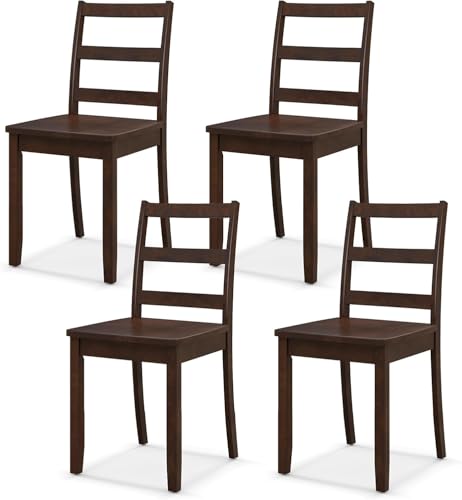
NAFORT Walnut Wood Dining Chairs, Set of 4 — Best Dining
Dining is where underbuilt chairs do their quiet damage — a guest, a holiday meal, a chair chosen for looks — and this NAFORT set is the verified answer: a set of four armless kitchen and dining chairs with solid rubberwood legs, non-slip foot pads, and a stated max load of 400 pounds per chair, in a farmhouse ladder-back style with a walnut finish. Solid wood legs are the right engineering for dining duty: the load path is straight, the material is honest, and there are no casters, cylinders or tilt mechanisms to fail. A dining chair’s job is to be sat in, gotten up from, and leaned back in after dinner — the two-front-legs moment that tests rear legs and joinery — and solid construction is what survives it for years.
The armless design is a fit feature, not a missing one: arms are where dining chairs exclude wide users, and an armless chair with a properly wide seat welcomes everyone at the table equally. The ladder back gives tall backs support and hands a natural grip for moving the chairs. The trade-offs are dining’s own: no cushioning beyond what you add, wood’s firmness across a three-hour dinner party, and a set-of-four commitment. For a household that hosts without anxiety, it is the most socially valuable pick in this guide.
Strengths
- 400-lb max load per chair on solid rubberwood legs — dining-duty engineering
- Armless wide seat welcomes every guest without a calculation
- Set of four solves the whole table at once, in a warm farmhouse style
Trade-offs
- Firm wooden sit for very long dinners; add cushions if your table lingers
- Sold as a set — single-chair replacement matching is on the brand
- No arms means no arm-assisted rising for users who need it
Best for: dining rooms and kitchens that host everyone, heavily and often. Not suited for: users who need arms to rise, or cushion-first comfort seekers. Check the current price on Amazon

PHI VILLA Oversized Zero Gravity Chair — Best Outdoor
The PHI VILLA takes the capacity brief outdoors: a 30-inch-wide oversized padded zero-gravity recliner rated at 400 pounds, folding, with cup holder and pillow, for patio, poolside, backyard and camping. Zero-gravity recliners distribute load along the whole body rather than concentrating it at the seat, which makes them both comfortable and structurally forgiving — and the oversized width is the honest version of the concept, because a recliner that pinches the hips fails the user it claims to serve. The padding distinguishes it from sling-style recliners: a cushioned sit that suits longer lounging and cooler evenings.
Folding portability at this capacity is genuinely useful — the chair that goes to the campsite and the beach house as well as the patio — with the owner’s disciplines that folding steel asks: dry it before storage, mind the locking mechanisms, and respect that outdoor steel and weather are in a long negotiation that paint only delays. As the outdoor representative of a 400-pound guide, it is exactly right: oversized, rated, and built for the horizontal hours.
Strengths
- 400-lb rating with a true 30-inch oversized width
- Zero-gravity recline spreads load along the body for real relaxation
- Folds for camping, beach houses and winter storage
Trade-offs
- Outdoor steel needs drying and covered storage to beat rust
- Padded fabric dries slower than sling mesh after rain
- Reclined-only comfort — it is not a dining or task chair
Best for: patios, poolsides and campsites where a large user wants to recline without worry. Not suited for: uncovered year-round outdoor storage, or upright seating tasks. Check the current price on Amazon

Folding Chairs 4 Pack, 400 lbs Capacity — Best Folding and Event
The folding chair is where capacity anxiety lives in public: the school hall, the wedding, the church basement, the backyard party, where a large guest is handed a chair and asked to trust it. This four-pack answers with a stated 400-pound weight capacity per chair in a portable plastic folding format for indoor and outdoor events. Plastic folding chairs at verified high capacity are a genuine category advance — the traditional event chair’s rating was a rumor — and a host who stocks these removes a small, real dread from every gathering they hold.
Plastic’s virtues here are practical: weather-tolerant, wipe-clean, light to carry in stacks, and cheap enough per chair to own in real quantity. The honest limits are the format’s: a folding chair is event seating, not ergonomic seating — hours in it will remind anyone of that — and plastic flexes in a way that reads as give even within rating, which sensitive users notice. Store them dry, check the locking and leg condition before events, and retire any chair that cracks or wobbles: at event scale, inspection is cheap and the alternative is not. For hosts, churches, schools and party-rental realism, this is the pick that makes inclusivity a stocking decision rather than a hope.
Strengths
- Stated 400-lb capacity per chair — verified event seating, not a rumor
- Light, stackable, weather-tolerant and wipe-clean
- Four-pack pricing makes inclusive hosting a practical decision
Trade-offs
- Event comfort only — not for hours of daily sitting
- Plastic flex is noticeable even within its rating
- Requires pre-event inspection discipline; retire cracked chairs promptly
Best for: hosts, schools, churches and event spaces seating everyone safely. Not suited for: daily desk or dining duty. Check the current price on Amazon
Comparison Table
| Pick | Badge | Key spec | Best for |
|---|---|---|---|
| Big and Tall Office Chair | Best Overall | 400 lbs, wide mesh seat, adjustable arms | Full workdays |
| Executive Office Chair | Best Executive | 400 lbs, PU leather, flip-up arms | Formal home offices |
| GTPLAYER Gaming Chair | Best Gaming | 400 lbs, pocket-spring lumbar, footrest | Long gaming sessions |
| NAFORT Dining Set of 4 | Best Dining | 400 lbs per chair, solid rubberwood legs | Hosting everyone |
| PHI VILLA Zero Gravity | Best Outdoor | 400 lbs, 30-in wide, padded, folding | Patio and camping recline |
| Folding Chairs 4 Pack | Best Folding | 400 lbs per chair, plastic event format | Parties and gatherings |
How to Choose a Chair That Holds 400 Pounds
Keep a margin between the user and the rating. Ratings are test numbers for static, centered loads. Real life adds drops, leans and shifts. If the user weighs close to 400 pounds, the genuinely safe purchase is the next class up — a 500-pound-rated chair — and the 400-pound picks here serve users up to that neighborhood with the margin intact. Any seller or guide that treats the rating as a target to hit exactly is misunderstanding what the number is for.
Measure the seat, not just the spec sheet’s first line. The user needs seat width that accommodates their hips with a small clearance — sitting ON a chair’s bolsters or armrests is both uncomfortable and a load path the chair was not tested for. Check width between the arms (or the full width on armless designs), seat depth against thigh length (the seat front should not press the back of the knees), and seat height against lower-leg length so feet rest flat. The picks here were screened on these dimensions’ plausibility for their rated users; verify them against your own measurements on the listing before ordering.
Inspect the load path by chair type. Office chairs: a five-star base in metal or reinforced construction, a rated gas cylinder, and a tilt mechanism whose housing is metal where it counts — the cylinder and base are the classic failure points, and both are replaceable on better chairs, which is a longevity argument for the category leaders. Dining chairs: leg material and joinery — solid wood or welded steel over hollow tube and screws into particleboard. Recliners and folding chairs: frame gauge, locking hardware, and the condition of both after a season — which is why inspection and dry storage recur in our reviews.
Match the chair to the sitting it will actually do. Eight-hour desk work wants adjustability and breathability. Dining wants armless width and upright support. Events want honest capacity in a stackable format and a host who inspects. Outdoor reclining wants width, distribution and weather discipline. A household often needs two picks from this list rather than one chair asked to be everything — and buying the pair is cheaper than replacing the compromise.
How to Set Up and Maintain a Heavy-Duty Chair
Assembly is where heavy-duty chairs are won or lost, because their fasteners carry more load than standard furniture’s. Follow the manual’s torque guidance honestly — snug every bolt in the staged pattern described, then re-check every bolt after the first week of use, when new joints settle, and again at a month. That re-torque habit, which takes five minutes, is the single most effective longevity practice in this category: most “the chair got wobbly” stories are un-re-torqued assemblies, not failed chairs. Set seat height so feet rest flat and knees sit at roughly hip height or a touch lower; set lumbar support against the small of the back, not the shoulder blades; and set armrests — where adjustable — to support forearms without lifting the shoulders.
In service: keep casters and glides clean, because grit in a caster concentrates load and scars floors; vacuum mesh and wipe PU leather with a damp cloth rather than solvents; and listen to the chair. New creaks, a cylinder that sinks slowly overnight, a recliner lock that slips a notch — each is an early, cheap symptom of a problem that becomes expensive or unsafe if ignored. Replace a sinking cylinder promptly (it is a standard part on office chairs), retire folding chairs at the first crack, and never exceed the rating as a party trick. A heavy-duty chair maintained this way delivers its rated life; neglected, even the best rating is just a number a chair used to have.
Common Buying Mistakes
- Treating the rating as a target. Buy margin. A 400-lb chair serves a 320-lb user with confidence; a user at 400 deserves the 500-lb class.
- Checking capacity but not seat width. A strong chair you cannot fit between the arms has failed before it begins. Measure both.
- Assuming “big and tall” means heavy-duty. Tall is a height, not a load rating. The verified capacity in the listing is the only version that counts.
- Skipping the re-torque. New chairs settle. Five minutes with the wrench at week one prevents the wobble blamed on quality at month six.
- Using event chairs as daily chairs. Folding chairs are rated for events and built for storage. Daily duty belongs to daily chairs.
- Ignoring early symptoms. Sinking cylinders, new creaks, slipping locks — fix them when they whisper, not when they shout.
Final Recommendation
For desk work, start with the Big and Tall mesh chair for breathability and adjustment — check the current price on Amazon — or the executive PU leather model when the room demands formality. Gamers should take the GTPLAYER and its spring-supported lumbar. Then solve the rest of the house: the NAFORT set for a table everyone can sit at, the PHI VILLA for the patio, and the folding four-pack so no guest ever has to wonder. Verify the rating, measure the seat, keep your margin — and sit down without thinking about it, which is the entire point.
More seating reading: Best Chairs With 350 Lb Limit, Best Chairs To Use For Long Hours Of Sitting, Best Chairs With Adjustable Lumbar Support, Best Compact Folding Camp Chairs.
Why Chairs Fail: A Short Engineering Tour
Understanding the three classic failure modes helps you shop and maintain with better instincts. First, the office-chair cylinder and base: the cylinder carries the entire seated load on a piston seal, and its slow failure mode is the overnight sink; the base fails at the caster sockets when side loads — a user dropping in at an angle, repeatedly — fatigue the arms of the star. Metal bases and rated cylinders postpone both, and replacement parts cure the first. Second, joint fatigue in wooden chairs: dining chairs loosen at the leg joints because sitting down is a small impact, thousands of times, and getting up pushes off-axis through the arms or back. Solid wood with real joinery tolerates this for years; the maintenance answer is the same re-tightening discipline as office chairs, applied to leg bolts where the design uses them. Third, frame and lock fatigue in folding and reclining chairs: every fold cycles the hinges, every recline loads the lock, and corrosion from damp storage accelerates both — hence dry storage and pre-event inspection as non-negotiable habits. None of these modes is mysterious, and none is instant: chairs announce their decline, and the owners who listen get a decade from the picks in this guide.
Seating the Whole Household: A Room-by-Room Plan
Heavy-duty seating works best as a household plan rather than a single heroic chair, because large users live in every room and guests arrive without regard to which chairs you have upgraded. Start where the hours are: the desk. A large user working from home spends more seated time in the office chair than in every other seat combined, which is why the office picks lead this guide and why adjustability — arms that fit, lumbar that lands correctly, a seat height that lets feet rest flat — outranks every other feature at the desk. The second priority is the table. Dining is the social room, and it is where an underbuilt chair does its damage in front of an audience; a verified dining set quietly removes the host’s and the guest’s shared anxiety, and it does so for every meal, not just holidays.
Third comes the gathering layer: folding chairs for the overflow, the party, the holiday table extended into the living room. Hosts consistently underestimate this layer because it is used monthly rather than daily — but it is the layer a large guest meets first, and a stated 400-pound event chair communicates welcome more eloquently than any apology for the furniture. Fourth, the restorative layer: the recliner, indoors or out, where the body is meant to fully unload. Zero-gravity designs earn their place here because distribution is their principle — the load that a dining chair concentrates at the seat is spread along the entire frame, which is why a well-built recliner can feel more secure than a stronger-rated upright chair.
The plan’s economics are friendlier than they look. You do not need every layer at once, and the sequence above buys them in order of hours served. What you should not do is buy one chair and ask it to serve two layers badly — the office chair dragged to the table, the folding chair promoted to daily desk duty. Each format in this guide is engineered for its layer’s load pattern: cycles per day, duration per sit, and the way users enter and exit. Respect the layers and every seat in the house becomes an unremarkable, dependable object — which is the highest compliment furniture can earn.
For Buyers on Behalf of Others: Offices, Churches and Families
A large share of 400-pound-capacity chairs are bought by someone other than the sitter — an office manager, a church committee, a spouse, an adult child furnishing a parent’s home. That buyer’s duties differ in one respect: dignity. The right chair, bought matter-of-factly and without commentary, simply appears in the room and works; the wrong conversation about it lingers longer than the furniture. Practically, this means choosing designs that read as mainstream — the executive and mesh office picks, the farmhouse dining set — rather than industrial-looking “bariatric” equipment, unless the setting is clinical and function properly leads. It also means buying for the largest plausible user of the room, not the person you happen to know: a waiting area, fellowship hall or family dining room serves bodies you have not met, and a 400-pound rating across the seating is the quiet standard that includes them all.
Institutional buyers should add two habits households can skip. Keep the assembly and rating documentation on file — if a chair is ever questioned after an incident, the paperwork is the answer. And inspect on a schedule rather than on suspicion: quarterly for event chairs in regular use, with a simple log. The folding four-pack in this guide makes that program affordable; the inspection habit makes it real. Families buying for a parent should weigh the exit as heavily as the entrance — arms that assist rising, a seat height that does not strand the sitter, a recliner chosen with the getting-up in mind — because independence lives in those transitions, and the right chair protects it daily.
Materials and Construction: What Actually Carries the Load
It is worth naming the materials that earn trust in this category, because “heavy duty” is printed on chairs that contain none of them. In office chairs, look for a base in cast aluminum, steel or glass-reinforced nylon of visible substance; a cylinder from a recognized maker, replaceable as a standard part; and a mechanism housing in steel rather than thin stamped metal. Upholstery carries no load but decides service life: mesh woven for contract use, or PU leather over resilient foam, will outlast the bargain versions of both by years under a heavy user, and foam density — not thickness — is what resists bottoming out. In wooden dining chairs, solid hardwood legs with corner blocks or proper mortise joinery are the standard; the NAFORT’s solid rubberwood is exactly this class of construction, rubberwood being a dense, plantation-grown hardwood with a long furniture record. In folding and outdoor chairs, powder-coated steel tube of honest gauge, with welds that are continuous rather than decorative, is the tell — pick up a folding chair and the weight in your hand is information: at equal design, the heavier chair is usually the stronger one, and in this category that trade is worth making every time. None of this requires engineering knowledge to assess. It requires only the habit of asking “what is this part made of, and can it be replaced?” — two questions whose answers separate the chairs in this guide from the chairs that merely cite a number.
A Final Word on Confidence
There is a human detail underneath this entire category that specifications do not capture: a large person sitting down in an unfamiliar chair performs a small, silent risk assessment that smaller people never have to think about. They glance at the chair, gauge its build, lower themselves carefully, and keep a fraction of their attention on the furniture for the first minute. A chair that holds 400 pounds — verified, well-built, correctly assembled — returns that attention. The sitter relaxes fully, the conversation gets their whole mind, the work gets their whole focus, the meal gets their whole appetite. That is what the number on the listing is actually buying, and it is why this guide has been strict about verification, margins and maintenance rather than cheerful about claims. Buy the chair that ends the calculation, in every room where you and your guests sit — and then enjoy never thinking about chairs again, which is the precise luxury this category exists to sell.
Frequently Asked Questions
Is a 400-pound rating enough for a 400-pound person?
It is the minimum, not the ideal. Ratings describe static test loads; daily sitting is dynamic. A user who weighs near 400 pounds will be better served — in comfort, longevity and safety margin — by a chair from the 500-pound class. The 400-pound picks here are the right choice for users comfortably below the rating.
What seat width should a larger user look for?
Measure your seated hip width in your usual clothing, then look for a seat — measured between the arms, or full width if armless — that exceeds it by at least an inch or two. Sitting on bolsters or armrests defeats both comfort and the chair’s tested load path. Every listing here publishes dimensions; compare them to your tape measure, not to adjectives.
Are gaming chairs actually stronger than office chairs?
Not inherently — strength lives in the specific model’s rated components, which is why this guide verifies each chair’s own listing rather than trusting its category. The GTPLAYER earns its place on its stated 400-pound heavy-duty build and spring lumbar, not on being a gaming chair. Judge every chair by its rating, base and cylinder, in that order.
How long should a heavy-duty chair last?
With assembly re-torqued and symptoms addressed early, the office picks should serve for years of daily use; cylinders are wear parts and may need one replacement in that span. Dining chairs in solid wood are the longest-lived format here. Folding event chairs last as long as their inspections say they do — retire them at the first crack or wobble, without sentiment.
Can I use a zero-gravity recliner if I have trouble getting up?
Recliners sit low and deep, which makes rising harder for some users; the PHI VILLA’s arms give some purchase, but anyone with significant difficulty rising should test the geometry carefully or choose upright seating with arms, like the dining format, for daily use. Comfort in the chair is only half the question — the exit matters as much as the entrance.
What if the user is tall as well as heavy?
Then two dimensions govern: seat height and back height, in addition to width and rating. A tall user’s knees rise uncomfortably on a standard-height seat, shifting load and posture; look for seat heights at the upper end of the standard range and high backs that reach the shoulder blades — the office picks here are high-back designs for this reason, and the GTPLAYER’s tall back suits the tall gamer specifically. Dining chairs are the hardest fit for tall users, since table aprons limit thigh room regardless of the chair; measure the table’s under-apron clearance alongside the chair. When in doubt, prioritize in this order: rating margin, seat width, seat height, back height — safety, then fit, then comfort refinements.
Do heavy-duty chairs need special floors or protection?
They concentrate more load at their contact points, so a little protection goes far: quality caster cups or a chair mat under office chairs on hardwood, glide pads checked and replaced on dining chairs, and recliners placed so their frames rest evenly rather than rocking on one corner of an uneven patio. None of this is structural — the floor of any sound house carries these chairs easily — it is surface care, protecting finishes from the honest weight the chairs were bought to carry.
Are there heavy-duty options for rocking chairs and recliners indoors?
The indoor recliner and rocker market does offer higher-capacity models, but ratings there are less consistently published than in the office category, which is why this guide’s reclining pick is the verified outdoor zero-gravity chair rather than an indoor model whose capacity we could not confirm in its own listing. If you shop indoor recliners in this class, apply the same discipline used throughout this guide: the rating in the manufacturer’s specifications, a steel lift or rocker mechanism where applicable, and a seat width measured between the arms. A model that will not state its number has answered your question.
How do I transport a heavy-duty office chair when moving?
Remove the cylinder-and-base assembly if the design allows it, wrap the seat and back separately, and keep the hardware bag taped to the frame — heavy-duty chairs are heavier than movers expect, and a lost bolt bag turns a strong chair into furniture sculpture. On arrival, reassemble with the same staged tightening as the first build and re-check the bolts after the first week, exactly as you did when it was new; a moved chair is a new assembly for settling purposes.
Can a heavy-duty chair help with back comfort?
A chair that fits properly is the precondition for back comfort: a seat deep enough to support the thighs without pressing the knees, a back tall enough to meet the shoulder blades, and lumbar support positioned at the small of the back rather than floating at mid-spine. The office picks here offer that adjustability; dining and event chairs offer upright posture for meal-length sitting, which is a different and legitimate brief. No chair treats back conditions — but a chair that is too small forces the exact slumped, perched posture that makes long sitting miserable, and in that narrow, honest sense, capacity and fit are comfort features before they are anything else.
What should I check on a folding chair before an event?
Open each chair fully and confirm the lock engages; press down firmly at the seat’s center and corners listening for cracks; check legs for bends and feet for damage; and sit-test any chair that has been stored since last season. Two minutes per chair is the whole protocol, and it is the difference between hosting and hoping.


