Disclosure: airfryerkitchensupply.com is reader-supported. When you buy through links on our site, we may earn an affiliate commission at no extra cost to you.
Where to buy
If you are shopping for best handheld food mixers, Amazon is the most practical place to compare the current versions of the models in this guide, because hand and stand mixers are sold in several colors, bundle configurations, and model-year revisions that look nearly identical in photos. Every linked pick below was matched to a verified listing before this guide was written, and each one is presented with a live price check instead of a fixed number, because mixer pricing shifts with color, season, and seller.
Handheld food mixer is the broadest phrase in the mixer aisle — it covers every corded hand mixer doing general food work, from mashed potatoes to meringue. That breadth is why verification matters here: every pick below was matched to a current listing with its model number and attachments confirmed, so the whisk, hooks, or case a review mentions are the ones in the box you would receive. Check color and configuration on the listing, since several models sell in multiple finishes at once.
- KitchenAid 9 Speed Hand Mixer (KHM926) (Best Overall Handheld Food Mixer) — check price on Amazon
- Cuisinart Power Advantage Plus 9-Speed Hand Mixer (HM-90S) (Best for Tidy Kitchens and Gentle Starts) — check price on Amazon
- Hamilton Beach 6-Speed Electric Hand Mixer with Easy Clean Beaters (62636J) (Best Value All-Rounder) — check price on Amazon
- KitchenAid 5 Ultra Power Speed Hand Mixer (KHM512) (Best Compact Everyday Food Mixer) — check price on Amazon
- Breville Handy Mixer (BHM800SIL) (Best Premium for Control Across Foods) — check price on Amazon
- Cuisinart Power Advantage 5-Speed Hand Mixer (HM-50) (Best Simple Second-Kitchen Mixer) — check price on Amazon
The best handheld food mixers are the generalists of the kitchen: the tool that mashes the potatoes, whips the cream, mixes the meatloaf gently, creams the cookie base, and folds the pancake batter, all in the same week, and then goes back in a drawer. Unlike the baking-specialist guides in this series, this one judges hand mixers as food tools in the widest sense — savory as much as sweet — because that is how most households actually use them.
That wider brief changes what matters. Attachment range counts for more, because food work beyond baking asks for a whisk for dressings and egg whites and beaters that can move through mashed potatoes without straining. Low-speed manners count for more, because savory mixing — meatloaf, meatballs, dips — punishes overworking even faster than cake batter does. And cleanup counts most of all, because a mixer that touches raw-egg dressings and cooked-potato starch in the same week must wash completely and easily, every time.
Six verified generalists follow. They overlap in brand with this series’ specialist guides — the mixer market is not that large — but the judgments here are re-made from the food-first angle: different badges, different winners for different kitchens, and trade-offs stated for savory work that a baking guide would never think to mention.
In this guide
Quick Picks
The KitchenAid 9 Speed is the complete food mixer: beaters, whisk, and hooks with dishwasher-safe cleanup. The Cuisinart HM-90S is the tidy-kitchen pick with its case and gentle starts, the Hamilton Beach Easy Clean the value all-rounder, the KHM512 the compact everyday tool, the Breville the premium control option, and the Cuisinart HM-50 the simple second-kitchen mixer.
- KitchenAid 9 Speed Hand Mixer (KHM926) — Best Overall Handheld Food Mixer: beaters, a pro whisk, and dough hooks across nine speeds — the one mixer that covers sweet and savory without a second purchase. Check on Amazon
- Cuisinart Power Advantage Plus 9-Speed Hand Mixer (HM-90S) — Best for Tidy Kitchens and Gentle Starts: nine speeds with a named SmoothStart for flour and cocoa, and a snap-on case that keeps a multi-use mixer stored as one clean unit. Check on Amazon
- Hamilton Beach 6-Speed Electric Hand Mixer with Easy Clean Beaters (62636J) — Best Value All-Rounder: a 275-watt motor, beaters, dough hooks, and a whisk in one budget box — the generalist kit with nothing left to buy. Check on Amazon
- KitchenAid 5 Ultra Power Speed Hand Mixer (KHM512) — Best Compact Everyday Food Mixer: five speeds and Turbo Beaters in a compact body for the everyday jobs — potatoes, batters, creams — with dishwasher cleanup. Check on Amazon
- Breville Handy Mixer (BHM800SIL) — Best Premium for Control Across Foods: nine settings plus boost for cooks who move between delicate dressings and firm whipping in one session. Check on Amazon
- Cuisinart Power Advantage 5-Speed Hand Mixer (HM-50) — Best Simple Second-Kitchen Mixer: five speeds, a 220-watt motor, and extra-long beaters that reach deep pots and bowls — the dependable simple generalist. Check on Amazon
How These Picks Were Chosen
Picks were verified against current listings, with attachments and features taken strictly from the listing titles. Generalist judging then applied three food-first tests beyond the usual baking criteria: savory range (can it handle mashed potatoes, dips, and gentle meat mixing without straining or overworking?), attachment completeness (is a whisk present for dressings and egg whites, or must one be improvised?), and cleanup integrity (do the parts that touch varied foods wash fully, ideally in a dishwasher?).
Models that were excellent but narrow — whisk-only gadgets, novelty minis — were excluded, as were any whose listings could not confirm what was in the box. A food mixer is bought for the jobs you cannot predict in March that arrive in November; the picks below were chosen to still be the right tool when those jobs show up.
The 6 Best Handheld Food Mixers
Badges here describe food roles, not baking roles, so the same model may wear a different badge than in this series’ baking guide — deliberately. Read for the jobs your kitchen actually assigns.

KitchenAid 9 Speed Hand Mixer (KHM926) — Best Overall Handheld Food Mixer
The KHM926 wins the generalist crown on completeness. Beaters for batters, potatoes, and dips; a pro whisk that makes dressings, whipped cream, and egg whites proper jobs instead of improvisations; dough hooks for soft doughs; and nine speeds whose low end is gentle enough for meatloaf — the mixture that most punishes aggressive mixing — and whose top end firms a meringue without complaint. Every accessory goes in the dishwasher, which closes the food-hygiene loop that generalist use opens.
Strengths
- Only pick here whose box covers the full sweet-and-savory attachment range
- Nine speeds span gentle folding for meats to firm whipping for whites
- Dishwasher-safe everything makes multi-food use hygienically effortless
Trade-offs
- Premium tier; households that only bake boxed cakes will underuse it
- Dough hooks tempt bread ambitions the motor class cannot sustain weekly
- Corded, like all picks here; counter layout still matters
Key specs (from the verified listing)
- Speeds: 9
- Attachments (verified listing): Pro whisk, Turbo Beater II beaters, dough hook
- Care: dishwasher-safe accessories
The savory case deserves detail, because it is where generalists separate. Mashed potatoes want thorough work at moderate speed without turning gluey — a whisk-beater balance this mixer’s low-mid range handles well in short passes. Meat mixtures want the opposite discipline: the lowest speed, brief contact, just until combined. A nine-speed ladder gives you both tempos in one tool, which is why this mixer, alone here, can be a household’s only mixer without an asterisk.
Ownership stays simple across that range because cleanup is uniform: everything that touched food goes in the dishwasher, the body wipes down, the cord wraps away. Generalist tools fail when one of their jobs is annoying enough to avoid; this one’s jobs are all equally low-friction, so none of them get avoided.
Best for: Households wanting one hand mixer for all food work, sweet and savory / Not suited for: Single-purpose bakers who will never touch the whisk or the low savory speeds
Check on Amazon — check price on Amazon for the current configuration and color.

Cuisinart Power Advantage Plus 9-Speed Hand Mixer (HM-90S) — Best for Tidy Kitchens and Gentle Starts
Food mixing is messier than baking alone — flour, cocoa, powdered sugar, and the occasional dip splash — and the HM-90S is built for the tidy-minded cook who does all of it. Its verified listing names SmoothStart, an anti-splatter ramp that makes dry-ingredient starts calm, and the snap-on case stores the mixer and its attachments as a single clean unit, which matters extra when the attachments serve both frosting and French onion dip in the same month.
Strengths
- Named SmoothStart system tames the messiest starts in general food work
- Case storage keeps multi-use attachments together, clean, and findable
- Nine speeds cover the same wide range as the overall winner
Trade-offs
- White finish shows savory stains — turmeric is forever — more than darker models
- Case needs drawer or cupboard depth
- Premium-mid tier
Key specs (from the verified listing)
- Speeds: 9
- Feature (verified listing): SmoothStart anti-splatter
- Storage: snap-on storage case included
The case-as-hygiene argument is underrated for generalists. Attachments that live loose in a drawer contact everything else in that drawer; attachments that live in their case stay as clean as you left them, which for a tool that moves between raw-egg dressings and cooked foods is a genuine, if quiet, food-safety benefit. Wash, dry, case, done — a routine this pick makes natural.
In the bowl, expect the same composed behavior the slow-start guide in this series describes: calm starts, fine steps, confident whipping. Savory cooks should note the low end particularly; dips and meat mixtures incorporate at the bottom gears without the overworking that toughens them, which is the savory skill most hand mixers are never judged on.
Best for: Tidy, varied cooks who mix sweet and savory weekly and store carefully / Not suited for: Buyers short on storage depth or indifferent to startup splatter
Check on Amazon — check price on Amazon for the current configuration and color.
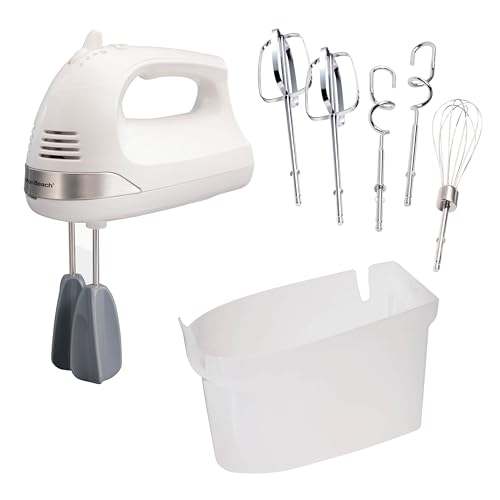
Hamilton Beach 6-Speed Electric Hand Mixer with Easy Clean Beaters (62636J) — Best Value All-Rounder
Value in a generalist means completeness per dollar, and this Hamilton Beach is the completeness champion: a stated 275-watt motor, six speeds, traditional beaters in an easy-clean profile, dough hooks, a whisk, and a snap-on case. That is the entire handheld food brief — batters, potatoes, dressings, creams, light doughs — in a single budget purchase, which is why it anchors the value end of every mixer guide in this series and earns it again here on food-first grounds.
Strengths
- Full attachment range at the budget tier; the whisk’s presence is the headline
- Easy-clean beaters rinse fast after starch and dip duty
- 275-watt stated motor handles mashed potatoes and thick dips without drama
Trade-offs
- Six speeds space the low end more coarsely; gentle meat mixing needs a light hand
- Budget-tier finish and feel
- Case adds storage bulk
Key specs (from the verified listing)
- Speeds: 6
- Motor (verified listing): 275 watts
- Attachments (verified listing): easy-clean beaters, dough hooks, whisk; snap-on case
Potato duty is this pick’s proving ground. A family-sized pot of mashed potatoes is the heaviest routine job in general food mixing, and the combination of motor headroom and smooth beaters handles it in passes without the straining whine that announces an underpowered tool. Work in the pot the potatoes boiled in, add butter and warm milk gradually at low-mid speed, and stop while texture remains — the same discipline as every pick here, executed at a budget tier without apology.
For a first mixer, a wedding-registry mixer, or a rental-house mixer, this is the recommendation that survives contact with reality: nothing to add, nothing exotic to break, every ordinary job covered. Upgrade paths exist for specialists; generalists on a budget should start and quite possibly end here.
Best for: Budget generalists, first kitchens, and anyone wanting the whole kit in one box / Not suited for: Precision bakers who need nine-speed finesse at the low end
Check on Amazon — check price on Amazon for the current configuration and color.

KitchenAid 5 Ultra Power Speed Hand Mixer (KHM512) — Best Compact Everyday Food Mixer
Most food mixing is not elaborate; it is Tuesday. The KHM512 is the compact tool for Tuesday: five speeds, efficient Turbo Beaters, an easy-release button, dishwasher-safe cleanup, and a swivel cord that locks out of the way. It mashes, mixes, and whips the everyday repertoire without ceremony and stores in the drawer space a generalist in a small kitchen can actually spare.
Strengths
- Right-sized for the everyday jobs that make up most food mixing
- Dishwasher-safe beaters keep savory cleanup effortless
- Compact storage suits small kitchens where a case-based kit will not fit
Trade-offs
- Beaters only; dressings and egg whites miss the whisk the bigger KitchenAid includes
- Five speeds and a compact motor class cap the heavy end — big potato pots want batches
- Not a specialist’s tool for meringue volume or thick doughs
Key specs (from the verified listing)
- Speeds: 5
- Attachments (verified listing): Turbo Beaters
- Care: dishwasher-safe beaters; lockable swivel cord
The honest way to frame this pick is frequency-weighted: if eighty percent of your mixing is batters, potatoes for two to four, whipped cream, and pancake mornings, this mixer performs that eighty percent indistinguishably from the flagship above, at a friendlier tier and a smaller footprint. The remaining twenty percent — the holiday meringue, the double batch — can be borrowed, batched, or simply done a little more slowly.
Small households in particular should resist overbuying here. A mixer matched to your real portions gets used constantly and washed cheerfully; an oversized kit migrates to the back of a cupboard and takes its attachments with it. This is the generalist for cooks who know their portions are modest and their drawers are too.
Best for: Small households and everyday cooks with modest batches / Not suited for: Large families and whisk-dependent cooks
Check on Amazon — check price on Amazon for the current configuration and color.

Breville Handy Mixer (BHM800SIL) — Best Premium for Control Across Foods
The Breville’s food-first case is control across categories. Nine settings plus boost means the same session can hold a dressing at a gentle incorporation speed, whip cream to exact peaks, and finish a stiff dip without changing tools. Its listing promises precise control, and for the cook who works by texture — the one who knows what properly mixed meatloaf feels like through the beaters — that granularity is the feature that matters in savory work as much as in baking.
Strengths
- Widest control range here, serving delicate and forceful food jobs alike
- Boost handles momentary resistance — cold butter chunks, thick dips — without a permanent speed change
- Premium feel rewards frequent, varied cooking
Trade-offs
- Top tier pricing for control that occasional cooks will not perceive
- Verified listing is brief on attachments; confirm the box contents on the listing
- Power is control-oriented, not a substitute for a food processor’s chopping
Key specs (from the verified listing)
- Speeds: 9 settings plus boost (verified listing)
- Positioning: premium tier, precision control
Consider the dinner-party sequence this mixer smooths: a vinaigrette whisked to emulsion at low speed, potatoes mashed at mid, cream whipped at high, each at its correct tempo without a tool change or a wash in between beyond a rinse. Generalist cooking is sequences like that, and a wide, fine ladder is what makes one tool credible across all of them.
As elsewhere in this series, the premium warning applies with love: if your food mixing is monthly and simple, the value pick above serves you identically and the savings buy ingredients for a year of Tuesdays. The Breville is for the cook who will feel the ladder — and that cook already knows it from the description.
Best for: Frequent, varied cooks who mix by texture across sweet and savory / Not suited for: Occasional mixers and strict budgets
Check on Amazon — check price on Amazon for the current configuration and color.
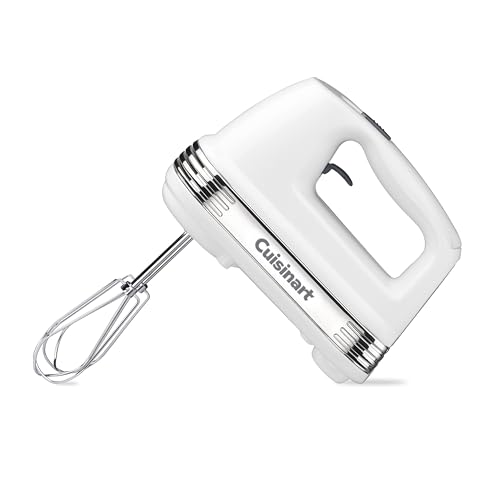
Cuisinart Power Advantage 5-Speed Hand Mixer (HM-50) — Best Simple Second-Kitchen Mixer
The HM-50 closes the guide as the simple, durable generalist: five speeds, a 220-watt motor stated in its listing, extra-long beaters, and a swivel cord. The extra-long beaters are its food-first distinction — they reach the bottom of deep pots for mashed potatoes and large bowls for family batters where standard beaters ride shallow — making it a quietly excellent choice for bigger everyday batches on a simple platform.
Strengths
- Extra-long beaters suit deep pots and family-size bowls better than standard lengths
- Stated 220-watt motor and five honest speeds; nothing to learn
- Dishwasher-safe beaters and swivel cord keep ownership simple
Trade-offs
- Beaters only in the box; whisk jobs need another tool
- Five speeds are the coarse end of control
- White finish, with the usual savory-stain visibility
Key specs (from the verified listing)
- Speeds: 5
- Motor (verified listing): 220 watts
- Beaters: extra-long, dishwasher-safe; 60-inch swivel cord
Second kitchens — cabins, rentals, parents’ houses, the starter apartment — are where this pick shines brightest, because those kitchens need a mixer that works for whoever grabs it, on whatever the weekend produces, with no manual and no attachments to lose. Five speeds, long beaters, dishwasher cleanup: the specification of reliability over brilliance, chosen on purpose.
In a primary kitchen it plays the same role for cooks who value simplicity as a feature. Not every buyer wants nine speeds and a case system; some want the mixer their hands already understand. If that is you, this verified, long-running design is the respectful choice, and the guide is glad to make it.
Best for: Second kitchens, simplicity seekers, and deep-pot potato makers / Not suited for: Whisk-dependent cooks and fine-control bakers
Check on Amazon — check price on Amazon for the current configuration and color.
Comparison Table
| Pick | Badge | Key spec | Best for |
|---|---|---|---|
| KitchenAid 9 Speed Hand Mixer (KHM926) | Best Overall Handheld Food Mixer | 9 speeds; Pro whisk, Turbo Beater II beaters, dough hook; dishwasher-safe accessories | Households wanting one hand mixer for all food work, sweet and savory |
| Cuisinart Power Advantage Plus 9-Speed Hand Mixer (HM-90S) | Best for Tidy Kitchens and Gentle Starts | 9 speeds; SmoothStart anti-splatter; snap-on storage case | Tidy, varied cooks who mix sweet and savory weekly and store carefully |
| Hamilton Beach 6-Speed Electric Hand Mixer with Easy Clean Beaters (62636J) | Best Value All-Rounder | 275-watt motor; 6 speeds; beaters, dough hooks, whisk, case included | Budget generalists, first kitchens, and anyone wanting the whole kit in one box |
| KitchenAid 5 Ultra Power Speed Hand Mixer (KHM512) | Best Compact Everyday Food Mixer | 5 speeds; Turbo Beaters; dishwasher-safe beaters | Small households and everyday cooks with modest batches |
| Breville Handy Mixer (BHM800SIL) | Best Premium for Control Across Foods | 9 speed settings plus boost; precision control positioning | Frequent, varied cooks who mix by texture across sweet and savory |
| Cuisinart Power Advantage 5-Speed Hand Mixer (HM-50) | Best Simple Second-Kitchen Mixer | 5 speeds; 220-watt motor; extra-long dishwasher-safe beaters | Second kitchens, simplicity seekers, and deep-pot potato makers |
How to Choose the Best Handheld Food Mixer
Inventory your real jobs across a whole year, not a baking weekend. Most households find a mix: batters and cakes, yes, but also mashed potatoes, whipped cream, dips, dressings, egg whites, the occasional meatloaf, and holiday surges of everything. A generalist purchase should be scored against that full list — which is why attachment completeness (is there a whisk?) and low-speed gentleness (can it touch meat mixture without toughening it?) outrank top speed and headline power in this category.
Then choose your cleanup religion. Multi-food tools touch raw egg, cooked starch, dairy, and dips; the parts must wash completely without archaeology. Dishwasher-safe beaters and smooth, easy-clean profiles are therefore not conveniences here but the core specification, and storage that keeps clean attachments clean — a case, a dedicated drawer spot — belongs in the same line of the budget.
Size the motor and speeds to your largest routine job, not your largest imaginable one. Family potato pots and double batters justify stepping up; a household of two buying flagship headroom for a yearly pavlova is funding a specification it will not meet. The picks above are ordered so that each tier’s honest ceiling is stated in its trade-offs — believe them, and the purchase will fit.
Handheld Food Mixer vs Immersion Blender vs Food Processor
Three tools share the phrase food in their marketing and divide the work cleanly in practice. The handheld mixer aerates and combines in bowls — batters, creams, potatoes, gentle meat mixing. The immersion blender purees liquids in their vessel — soups, sauces, smoothies — and is covered in this series’ wand mixer guide. The food processor chops, slices, and kneads with blades in a work bowl, at a scale and violence neither handheld tool attempts.
Overlap exists at the edges — a whisk attachment whips, a wand’s chopper dices an onion — but buying one tool to do another’s core job is how kitchens accumulate disappointment. Most scratch-cooking households end up with the handheld mixer first, because its job list is the longest, and add the wand when soup season proves the need. This guide’s picks were chosen to remain the right first purchase under that sequence.
How to Use a Handheld Food Mixer for Savory Jobs
Savory mixing has its own technique, distinct from baking: gentleness where meat is concerned, passes where potatoes are concerned, and hygiene throughout. This sequence covers the three classic savory jobs.
- Mashed potatoes: work warm, in passes. Keep potatoes in their hot pot, add butter first at low speed, then warm milk gradually at low-mid speed. Stop while texture remains — overworked potatoes turn gluey, and no mixer can reverse it.
- Meat mixtures: lowest speed, briefest contact. For meatloaf and meatballs, mix at the lowest speed only until ingredients are evenly distributed. Every extra second develops texture you do not want; finish distribution by hand if in doubt.
- Dips and spreads: start low, scrape once. Begin at the lowest speed to combine without flinging, scrape the bowl once midway, and finish at mid speed for smoothness. Cold cream-cheese bases soften faster at room temperature than under any beater.
- Dressings and egg whites: reach for the whisk if you have one. Beaters whip adequately; a whisk attachment whips efficiently. Either way, start slow in a deep bowl and raise speed only once volume builds.
- Wash for the job you just did. After raw-egg or meat-adjacent work, beaters get a full hot soapy wash or the dishwasher before any other use — no exceptions, no quick rinses.
Gentle with meat, patient with potatoes, prompt with washing: savory technique in one line. The mixers above were picked to reward exactly those habits.
The Generalist’s Year: Mapping a Hand Mixer Across Four Seasons of Food
A handheld food mixer earns its drawer across a calendar, and mapping that calendar is the surest way to choose the right one. Spring brings dressings, whipped creams for early fruit, and egg-white work for lighter desserts — whisk territory, low speeds, finesse. Summer adds dips, marinades’ emulsions, potato salads’ dressings, and the occasional shredded-chicken assist — cleanup and gentleness territory. Autumn is mashed-potato and casserole season, the year’s heaviest routine loads, where motor headroom and beater reach decide whether the tool feels willing. Winter concentrates everything: holiday baking surges, frostings, double batches, and the simultaneous second-mixer moments that make households grateful for simple, borrowable tools.
Score the picks against your own calendar rather than this generic one. A household whose year peaks at autumn potatoes should weight the stated-motor picks; a household living in spring’s whisk work should refuse any box without a whisk; a household whose winter involves two cooks at once should value the simple second mixer as a first-class citizen rather than an afterthought. The guide’s badges already encode these judgments — the exercise is matching your calendar to them honestly, including the months you would rather not admit are mostly takeout.
One seasonal trap deserves naming: buying in December for December. Holiday surges are real but brief, and a mixer bought for the surge alone spends eleven months oversized for its life. Buy for the year’s center of gravity and borrow, batch, or split for the surge; the picks here were chosen so that the center-of-gravity purchase at every tier is a good one.
Accessories, Spares, and the Second-Drawer Strategy
Generalist mixers accumulate an entourage — spare beaters, a second whisk, the dough hooks that live somewhere specific — and managing it is the difference between a tool system and a drawer of metal. The case-based picks in this guide solve the problem structurally, which is part of their value. For caseless models, the working solution is a single designated container or drawer section for everything that attaches to the mixer, established on day one; attachments that migrate become attachments that vanish, and a whisk is always missed at the exact moment egg whites are separating.
Spares deserve one deliberate purchase: a second pair of beaters. They are inexpensive, they are the part most likely to be in the dishwasher when needed, and they convert the mixer from a single-threaded tool into one that can move between a batter and a frosting in one session. Confirm the shaft pattern against your exact model when ordering — beater fit is model-specific even within a brand — and store the spare pair with the mixer, not near it.
The second-drawer strategy completes the system for busy households: a simple, durable spare mixer — the Cuisinart HM-50’s role in this guide — kept where a second cook or a holiday surge can reach it. It sounds like abundance until the first December evening when two recipes need mixing at once and the household discovers it has been a two-mixer kitchen all along, merely an underequipped one.
Three Households, Three Correct Answers
The generalist category resolves fastest when matched to concrete households, so consider three. The first is a couple in a small apartment cooking varied dinners nightly and baking monthly: their mixer year is potatoes, dressings, dips, and the occasional cake, in modest portions, from a kitchen with one shallow drawer. Their correct answer is the compact KitchenAid five-speed or the simple Cuisinart — tools sized to their portions and their drawer — and the flagship’s whisk would be their only unused feature, which is an argument for it only if dressings are a nightly ritual rather than a weekly one.
The second household feeds five, meal-preps on Sundays, and regards mashed potatoes as a food group. Their loads are the year’s heaviest routine work, their batches are double, and their cleanup volume is industrial by home standards. They belong in the stated-motor, easy-clean, case-stored tier — the Hamilton Beach kit as the value answer, the nine-speed KitchenAid as the longevity answer — and they should buy the spare beaters this guide recommends in the same order, because their December will otherwise be interrupted by a dishwasher’s schedule.
The third household is one serious cook equipping a first real kitchen for a decade: scratch cooking across cuisines, baking ambitions forming, guests often. Completeness is their criterion because their future jobs are genuinely unknown, and the guide’s overall winner — or the Breville, if they cook by feel — is the purchase that will still be correct when the unknown jobs arrive. Three households, three different best mixers, one category: that spread is what honest badging is for.
Reading a Hand Mixer Listing Like an Inspector
Generalist listings reward a particular reading order, because the information that predicts satisfaction is rarely in the headline. Read attachments first — the exact list, in the text, not the photograph — because the whisk’s presence or absence is the single largest capability fork in this category. Read the motor statement second, noting whether wattage is given at all and treating its absence as a signal to judge the model on control and brand support instead. Read beater description third: length, profile, and whether dishwasher safety is stated, since those three words predict your cleanup life for years.
Read storage fourth — case, wrap, or nothing — and price the nothing honestly against your drawer. Read the seller last and always: the same model is a different purchase from a traceable seller with readable returns than from an unknown storefront, and in a category where listings persist for years across model revisions, confirming that the revision described is the revision shipped is the buyer’s final job. The picks in this guide passed that reading before they were written up; applying the same reading to anything you buy outside this list is the guide’s parting gift.
One more inspector’s habit: after purchase, run the three tests in the first week — mashed potatoes at family scale, a whisk job if a whisk exists, and a low-speed gentle job — while returns are still simple. A generalist reveals itself quickly under its three characteristic loads, and a week of honest testing is worth a year of hopeful ownership.
One More Test Before You Decide: The Three-Bowl Morning
If two finalists remain, settle it with a single Saturday-morning session during the return window: one bowl of pancake batter mixed at the lowest comfortable speed, one pot of mashed potatoes at family scale, and one small bowl of whipped cream taken to soft peaks. Three bowls, three characteristic loads — combining, dragging, aerating — and roughly twenty minutes. The mixer that feels calm in all three, washes without archaeology, and stores where you planned is your generalist. The one that strains, splashes, or sheds its attachments across the counter has graded itself, whatever its listing promised.
Key Takeaways for Generalist Buyers
Buy for the whole year, not the baking weekend. A handheld food mixer is a savory tool as much as a sweet one, so the winning specification is a triangle: attachment completeness (a whisk, if your cooking ever emulsifies or aerates), low-speed gentleness (for the meat mixtures and dips that punish aggression), and cleanup integrity (dishwasher-safe, smooth-profile parts that wash completely between unlike jobs). The KitchenAid nine-speed satisfies all three corners at the premium tier; the Hamilton Beach kit satisfies them at the budget tier to a degree that still surprises this guide; and the simpler picks satisfy the corners their owners actually visit.
Then run the ownership habits that make generalists last: wash completely between raw-adjacent and ready-to-eat work, store attachments as a set, keep a spare pair of beaters, and size every batch to the tool rather than the ego. A generalist is the hardest-working small appliance in the house. Chosen by the triangle and kept by those habits, it will behave like it for years.
One last calibration: if your year’s honest inventory is ninety percent baking, buy from this series’ baking guide instead, where the same market is judged by creaming, folding, and peaks. The generalist brief is for kitchens that truly cook everything — and for those kitchens, this page’s picks are the ones that will still be right in November.
Common Buying Mistakes
- Buying for baking alone, then improvising the savory year. The whisk you skipped becomes the dressing you cannot emulsify. Buy the generalist brief, not the weekend brief.
- Overmixing meat mixtures at high speed. The fastest route to tough meatloaf ever documented. Lowest speed, brief contact, always.
- Turning potatoes to glue. Long, fast mixing ruptures starch. Warm ingredients, mid speed, short passes, early stop.
- Treating cleanup as optional between food types. A generalist touches everything; wash completely between raw-adjacent and ready-to-eat jobs.
- Expecting chopping from a mixer. No beater dices an onion. That is the processor’s or the wand kit’s job, and pretending otherwise ends in uneven food and bent beaters.
Final Recommendation
Buy the KitchenAid 9 Speed (B00CPSRE4U) if one mixer must do everything — it is the only complete, dishwasher-clean, nine-speed generalist here. Buy the Cuisinart HM-90S for tidy storage and calm starts, the Hamilton Beach Easy Clean kit for value completeness, and the KHM512 or HM-50 for compact and second-kitchen simplicity. The Breville rewards the frequent cook who mixes by feel across the whole menu.
A handheld food mixer is the hardest-working small tool most kitchens own. Choose it by the whole year’s jobs, wash it like it touches everything — because it does — and it will repay you weekly for years.
Start your comparison with the top picks from this guide: KitchenAid 9 Speed Hand Mixer (KHM926), Cuisinart Power Advantage Plus 9-Speed Hand Mixer (HM-90S), Hamilton Beach 6-Speed Electric Hand Mixer with Easy Clean Beaters (62636J) — check price on Amazon for each before deciding.
Related guides in this series: Best Hand Wand Mixers; Best Handheld Mixers For Baking; Best Hand Mixers To Shred Chicken; Best Hand Mixers Oster; Best Hand Stand Mixers.
Frequently Asked Questions
What counts as a handheld food mixer?
The general category of corded hand mixers used across all food work: twin-beater machines that mix batters, mash potatoes, whip cream, blend dips, and gently combine meat mixtures, then store in a drawer. It is the broadest mixer category, distinct from immersion blenders (which puree liquids in the pot) and from stand mixers (which stay on the counter). This guide judges handheld food mixers on that full generalist brief — savory as well as sweet — which is why attachments, low-speed gentleness, and cleanup weigh more here than in a baking-only comparison.
Do I need a whisk attachment on a hand mixer?
If your cooking includes dressings, vinaigrettes, egg whites, or whipped cream more than occasionally, yes — a whisk is meaningfully faster and more effective at aeration and emulsification than beaters, which were designed for combining. Two picks in this guide include a whisk at very different tiers: the KitchenAid 9 Speed at the premium end and the Hamilton Beach Easy Clean kit at the budget end. If your mixing is batters and potatoes only, beaters alone serve perfectly well and the simpler, cheaper models here are the right buy.
Can a hand mixer mix meatloaf and meatballs without toughening them?
Yes, with the discipline savory mixing demands: the lowest speed, brief contact, and mixing only until the ingredients are evenly distributed. Overworking is what toughens meat mixtures, and a mixer makes overworking easy because it is fast — so use it in short passes and finish by hand if you are unsure. Mixers with fine low-speed ladders, like the nine-speed picks here, make that gentleness easier to achieve than coarse five-speed models, which is one reason they headline a food-first guide.
Why do mashed potatoes turn gluey, and how do I prevent it?
Potato starch, once ruptured by prolonged or violent mixing, turns the mash gummy and glue-like. Prevention is technique: keep the potatoes hot, add butter first and warm milk gradually, mix at low-to-mid speed in short passes, and stop while the texture still has body. Every mixer in this guide can make excellent mashed potatoes under that discipline, and every one of them can ruin the same pot if run long and fast. The tool matters less than the stopping, which is why the how-to section leads with it.
How should I clean a mixer that handles many kinds of food?
Completely, between unlike jobs — a generalist touches raw egg, cooked starch, dairy, and dips, sometimes in one day. Beaters should get a full hot soapy wash or a dishwasher cycle after any raw-adjacent work, never just a rinse, and should be fully dry before storage. Dishwasher-safe beaters and smooth easy-clean profiles, both highlighted in the picks, turn that standard from a chore into a default. Wipe the mixer body down as well; splashes at beater height are a normal part of food mixing.
Handheld mixer or immersion blender — which should I buy first?
For most households, the handheld mixer first: its job list — batters, potatoes, creams, dips, gentle meat mixing — is the longest in everyday cooking, and it stores in a drawer. Add the immersion blender when soup, sauce, and smoothie work becomes frequent enough that transferring hot liquids to a countertop blender feels like the chore it is; this series’ wand mixer guide covers that purchase. A food processor, when it eventually arrives, takes over chopping and heavy dough. Bought in that order, each tool arrives when its jobs do.


